Archive for November, 2006

Reductio Ad Hitlerum

ahmad.jpgIn rhetorical circles, there is a concept known as “Reductio Ad Hitlerum” – a whimsical term that refers to the reduction of any threat or potential threat to the most extreme example posed by Hitler and Nazism. I’m sure we can all conjure up instances of this phenomenon at work (Seinfeld’s “Soup Nazi,” anyone?) In one particularly odious example, CNN reporter Glenn Beck recently compared Hilary Clinton to Hitler because of her stand on national health care.

On a geopolitical level, the “Hitler meme” has been used consistently to justify the use of military force since the end of World War II. The ultimate goal of this rhetoric is clear. Once we cry Hitler, all attempts at detente or diplomacy are dismissed as mere appeasement. There is little left to do but storm the beaches at Normandy.

Reductio Ad Hitlerum was evident in full force during a speech by former Israeli Prime Minister Benyamin Nentanyahu at the General Assembly of the United Jewish Communities this month. As the Jewish Telegraphic Agency recently reported:

Netanyahu warned that Iran is aiming to develop 25 nuclear weapons a year, ultimately with a range that can reach the East Coast of the United States.

“It’s 1938 — and Iran is Germany. And Iran is racing to get atomic weapons,” Netanyahu repeated again and again. “When someone tells you he is going to exterminate you, believe him and stop him.”

The former prime minister said he had been trying for a decade to warn world leaders that Iran represented the greatest threat — not just to Israel but also to Europe and America — “but nobody seems to care very strongly.”

While Hitler started a war and then tried to develop an atomic bomb, Iranian President Mahmoud Ahmadinejad is building nuclear weapons first and then will start a war, Netanyahu warned. Unlike 1938 and its aftermath, however, this time the Jewish people will not be the sacrificial lamb, Netanyahu declared to prolonged applause.

Alas, I have been trying in vain to find any discussion of the Iran crisis in the “official” Jewish community that does not somehow invoke “1938 and its aftermath.” Clearly Ahmadinejad’s murderous rhetoric toward Israel cannot and should not be taken lightly, and we should never minimize the threat posed by Iran’s nuclear ambitions. But we must also be very clear about what we are suggesting when we compare Ahmadinejad to Hitler and present day Iran to Nazi Germany. For what it’s worth, consider me to be one member of the organized Jewish community that finds this comparison unhelpful – and the prospect of an American or Israeli attack on Iran truly horrifying to contemplate.

Here’s an alternative viewpoint, suggested by Mideast analyst Ray Takeyh in a recent Los Angeles Times editorial:

Ahmadinejad Is no Hitler

By Ray Takeyh

Los Angeles Times, November 19, 2006

If you think Iranian President Mahmoud Ahmadinejad makes outlandish comments, consider what Mao Tse-tung said to a visiting head of state in 1954: “If someone else can drop an atomic bomb, then I can too. The death of 10 or 20 million people is nothing to be afraid of.”

Nonetheless, 15 years later, a nuclear-armed China was not only contained by the world, it opted for normalization of relations with its archenemy, the United States. Today, it is fashionable to equate Ahmadinejad with Hitler, yet the lesson of the 20th century is that rash leaders can, in fact, be deterred. And Iran’s president will prove no exception.

Remember that Ahmadinejad’s comments are not even unique in the context of Iranian discourse. In 2001, the former Iranian president and putative moderate, Hashemi Rafsanjani, declared that although Israel would be destroyed by an atomic bomb, the Islamic world would only be damaged by one and therefore “such a scenario is not inconceivable.” Nevertheless, four years later, when Rafsanjani was running for president, Washington and its European allies were eagerly hoping that he would win.

Ahmadinejad is considered nutty in the United States because of his denial of the Holocaust — but that’s nothing new in the Islamic Republic either. The foremost ruler of the country, Ayatollah Ali Khamenei, has declared: “There are documents showing close collaboration of Zionists with Nazi Germany, and exaggerated numbers relating to the Jewish Holocaust were fabricated to lay the groundwork for the occupation of Palestine and to justify the atrocities of the Zionists.” Yet today, it is quietly hoped in Washington that Khamenei will be the one to restrain the intemperate Ahmadinejad.

All this suggests that in dealing with Iran, American officials have historically discounted its bluster and paid attention to its actual conduct. And they were right to do so. Khamenei and Rafsanjani, despite their irresponsible assertions and pernicious support for a variety of terrorist organizations, have pursued a relatively pragmatic foreign policy that has sought to eschew direct confrontation with the U.S. and Israel.

Ahmadinejad’s behavior suggests continuity with his predecessors: incendiary rhetoric and restrained conduct.

The fact is that today, unlike the 1980s, Iran is not challenging the legitimacy of the region’s political order or calling for the overthrow of regimes in places such as Saudi Arabia and Egypt. Tehran’s support for groups such as Hezbollah and Hamas is not an Ahmadinejad innovation but a long-standing Iranian policy.

To be sure, Iran is intervening in Iraq and arming various Shiite militias — but such conduct is designed not to export Iran’s model of governance but to prevent the rise of a state dominated by Sunni elites whose pan-Arab aspirations have in the past led to tense relations, and even war, with Iran. Tehran has no delusions that the Shiites of Iraq will subordinate their communal interest to Iran’s national ambitions, but it does hope that a Shiite-dominated regime will provide it with a suitable interlocutor.

Even the nuclear issue has to be viewed in the context of continuity rather than change. The decision to resume the nuclear program after a long period of suspension was taken not by Ahmadinejad but by the reformist government of Mohammad Khatami before leaving office in 2005. What’s more, Iran’s pursuit of the bomb has less to do with the destruction of Israel than with deterring a United States that has invaded two states that border Iran in the last five years. This is a moment of heightened tension between the U.S. and Iran, with the Bush administration routinely calling for a change of regime in Tehran, so perhaps it’s not so surprising that the Islamic Republic feels it requires a deterrent capability to ensure both regime survival and territorial integrity.

So then, why has Ahmadinejad persisted in his contemptible denials of the Holocaust and his repeated calls for the eradication of Israel if, in fact, they are more bluster than anything else? As a cagey politician, Ahmadinejad appreciates that his incendiary denunciations actually enhance his popularity in the Middle East. The carnage in Iraq, the failure to broker a peace between Israel and the Palestinians and the Arab rulers’ inability to stand up to Washington have generated a popular clamor for a politician willing to defy the U.S. and Israel.

Ahmadinejad has taken on that role, successfully capturing the imagination of a region prone to rely on conspiracies to explain its predicament. In this context, his persistent religious exhortations are designed not to prepare the path for the return of the Hidden Imam — the Messiah-like figure of Shiite Islam who some believe will reappear in a period of global war, chaos and bloodshed — but to advance himself and the cause of Iranian influence.

It is a peculiar American fascination to continually look for the next Hitler. Josef Stalin, Mao, Ho Chi Minh and even Saddam Hussein were all touted at one time or another as Hitler incarnate. Ahmadinejad is simply the latest figure to be contemplated for that role. Evidently, many in Washington simply cannot grasp the fact that Hitler was a uniquely evil politician and that he is in fact dead. The United States — the country that won the Cold War and contained its adversaries — should be able to deter a second-rate power with an intemperate leader.

RAY TAKEYH is a senior fellow at the Council on Foreign Relations and the author of “Hidden Iran: Paradox and Power in the Islamic Republic.”

JRC Construction Diary #2

caissondrilling.jpg

Here’s something you don’t see too often on a construction project…

We discovered last year that the soil on our property was soft and sandy – definitely not suitable for supporting a large three story building. This necessitated the drilling of caissons: concrete pillars driven deep into the ground that will serve to stabilize the structure. Last week, we drilled the long shafts for our caissons, which needed to go down 55 feet into the earth in order to reach hard clay. The foundation surface will eventually be supported by these massive underground pillars – eighteen in all.

Just before the caisson drilling commenced, our congregation’s president, Alan Saposnik, came up with an inspired idea. Since we are constructing pillars to support our congregation, why not create eighteen symbolic “pillars” of our community – spiritual values that we could somehow connect to the physical caissons? And the fact that we would be drilling eighteen underground pillars was just perfect. Eighteen, after all, is a celebrated Jewish number: equalling “life” according to Hebrew numerology.

I took Alan’s idea to our 4th and 7th grade religious school students. I did my best to explain the concept of caissons to them, then we read a classic Jewish text from Pirke Avot (“The Chapters of the Fathers”): Rabbi Shimon the Righteous said, “the world stands on three things: study, worship and acts of lovingkindness.’ What, I asked our students, would you consider to be the eighteen “pillars” upon which our congregational community stands?

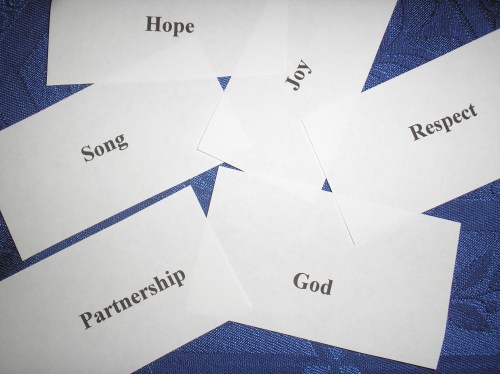
Then together we brainstormed eighteen spiritual values of our JRC community: God, Judaism, Joy, Prayer, Hope, Respect, Partnership, Song, Tikkun Olam, Community, Study, Freedom, Friendship, Spirit, Learning, Peace, Growth, and Love.

Afterwards, I wrote out the values on a separate pieces of paper and each one was placed by the construction crew into a separate caisson shaft to be mixed together with the concrete, becoming a permanent part of JRC’s support structure.

Marc Bonnivier, our construction supervisor, just LOVED the idea. He later mentioned to me his workers were so enthusiastic about it, they each jockeyed for a turn to place a paper slip into the shafts after they were drilled. Needless to say, working with JRC is turning out to be a unexpectedly unique experience for him and his entire crew.

I love the notion that these unseen but powerful pillars for our building will be a permanent support structure to our community in more ways than one.

pillars.jpg

Parashat Toldot 5767

lentils1.jpgJacob then gave Esau bread and lentil stew; he ate and drank, and he rose and went away. Thus did Esau spurn the birthright.” (Genesis 25:34)

Could there be brothers more different than Jacob and Esau? As we learn in this week’s portion Toldot, Jacob is the mild mannered lad who prefers to stay in the tent while his twin Esau is the macho, hairy hunter who loves the outdoors (25:27). As if to accentuate their differences even further, we learn that their parents play favorites with their sons: Isaac prefers Esau (for no other reason, apparently, than he simply likes his sons’s cooking) while Rebecca favors Jacob (no reason is given, though it may be because she has been given some critical inside information – see 25:23).

The episode in which Jacob buys his birthright from Esau demonstrates deeper aspects to their personalities. There is no doubt that Jacob is deviously taking advantage of Esau’s weaknesses when he tells his tired, hungry older brother that he won’t give him some lentil stew until he hands over his birthright. On the other hand, what are we to make of someone who will give up his birthright for a measly bowl of lentils?

A statement by Esau is extremely telling in this regard: “I’m at the point of death, so of what use is my birthright to me?” (25:32) It’s one of those wonderful Biblical double entendres. In the immediate sense, he seems to be saying, “I’m dying of hunger – why are we talking about birthrights here?” But we might also understand this line as “I’m going to die someday anyhow, so what good is my birthright?”

With this offhand remark, Esau betrays his most fatal flaw: his desire to live only for his immediate needs and his inability to appreciate the larger significance of his place in the world. In this way, we might say he demonstrates a kind of “proto-hedonism.” Esau represents the individual who lives first and foremost for the pleasures of the moment with little regard for transcendent meaning or purpose.

While we might take Jacob to task for his underhanded tactics (not the last time we will witness this) he ultimately understands the deeper value of his birthright: the promise made to his family, his people and to the world in which he lives. In his heart, Jacob somehow knows this promise is worth fighting for. Indeed, it is a struggle he waged even before he was born (see 25:22) – and one that will continue for the rest of his/our days.

Thanksgiving in the American Land

Here’s my recommendation for a Thankgiving anthem for 2006: “American Land,” by Bruce Springsteen.

It’s a contemporary American folk song Bruce recently composed for the new edition of “We Shall Overcome: The Seeger Sessions.” Upon first hearing, it sounds like a garden-variety Irish-inflected immigrant song, extolling the joys of the American dream (“There’s treasures for the taking, for any hard working man/Who makes his home in the American land.”) But true to form, Bruce folds a deeper and more complex message into his vision of America, proving once again why he is among the most powerful – if misunderstood – songwriters of our time. Listen carefully and you’ll catch his inclusion of illegal immigrants and even (gasp!) Arabs among those who reach our shores, hoping for a better life and future.

Every Thanksgiving, I’m mindful that like most Americans, my ancestors didn’t come over on the Mayflower. My paternal grandfather, Yitzhak (later Irving) Rosen up and left his home town of Kamen-Kashirsk in the northwest Ukraine when he was a teenager, certain that a better life must certainly await him somewhere else. After wending his way through Europe (among other things, serving as a soldier in WW I) he ended up in the American Land supporting a wife and two sons by driving a candy truck in City Terrace, Los Angeles. His two sons grew up to be a doctor and a lawyer – every Jewish parent’s dream come true.

As we debate immigration policy in our country today, I can’t help but think of the myriad of immense challeges my own grandparents faced when they immigrated here not so long ago – and how this hard fought dream continues even now. In the words of the song: “They died to get here a hundred years ago, they’re dyin’ now.”

Anyhow, Happy Thanksgiving. And sing this one around the table this year:

“American Land” by Bruce Springsteen

What is this land of America, so many travel there
I’m going now while I’m still young, my darling meet me there
Wish me luck my lovely, I’ll send for you when I can
And we’ll make our home in the American land

Over there all the woman wear silk and satin to their knees
And children dear, the sweets, I hear, are growing on the trees
Gold comes rushing out the river straight into your hands
If you make your home in the American land

There’s diamonds in the sidewalks, there’s gutters lined in song
Dear I hear that beer flows through the faucets all night long
There’s treasure for the taking, for any hard working man
Who will make his home in the American land

I docked at Ellis Island in a city of light and spire
I wandered to the valley of red-hot steel and fire
We made the steel that built the cities with the sweat of our two hands
And I made my home in the American land

The McNicholas, the Posalski’s, the Smiths, Zerillis too
The Blacks, the Irish, the Italians, the Germans and the Jews
The Puerto Ricans, illegals, the Asians, Arabs miles from home
Come across the water with a fire down below

They died building the railroads, worked to bones and skin
They died in the fields and factories, names scattered in the wind
They died to get here a hundred years ago, they’re dyin’ now
The hands that built the country were all trying to keep down

JRC Construction Diary #1

As I wrote in an earlier post, my congregation, JRC, is currently building a brand new synagogue facility on the site of our old building. Construction officially began last month is slated to be finished Nov./Dec. 2007. In the meantime, I’ll be posting perodic reports of our progess over the course of the coming year.

We’re particularly proud that we are attempting to create the first certified “Green Synagogue” in the world. Specifically, this means we hope to be certified at a LEED Gold Level by the US Green Building Council. The pic below is an artist’s rendering of what the final product, designed by the architectural firm, Ross, Barney, Jankowsky, will look like.

mishkan-day-view.jpg

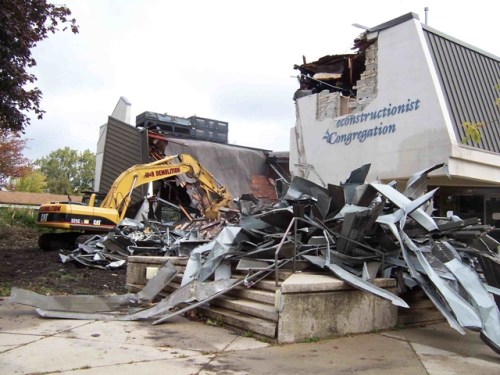
JRC moved into temporary quarters this past summer and the demolition of our old synagogue building commenced in September. It was an exciting moment for us all – the first tangible evidence of so many years of devoted work and preparation. Still, we were unprepared for how it would feel to see our synagogue being demolished (see below). While it was clear to us all that our old facility was too small, too decrepit, and not terribly functional to our needs, it had still been our spiritual home for over twenty years. Many members told me it was unexpectedly traumatic to see our synagogue, the place of so many sacred memories, torn down in this way. It felt much better when the site was eventually cleared out of debris and was unrecognizable as its “former self.”

jrc-demo-2-101706.JPG

We had our official groundbreaking ceremony toward the end of the demo process. On a very cold Sunday afternoon, we gathered together, sang songs, recited blessings, then we busted out the hard hats and gold shovels for the obligatory PR pix. Carol Ross Barney, our architect, and Ann Rainey, the Alderman of our ward, were among the digniaries who spoke movingly at the ceremony. Now we were officially on our way!

goldenshovels1-1.jpg

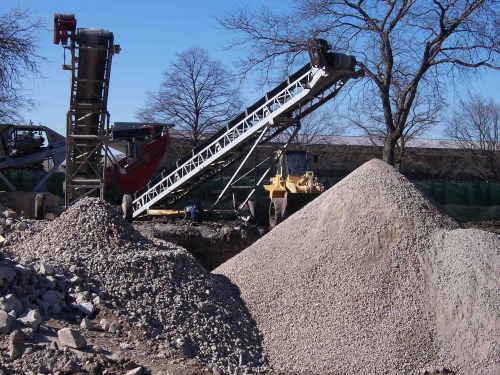
One very cool aspect of our green building project is the recycling of the concrete from the front steps and facade of our old facility. Two huge grinders were brought onto the construction site for this purpose so the old concrete could be ground up and reused in our new foundation. If any JRC members ever feel homesick for the old building, I’ll just remind them that they they’re still standing on it…

crushing3.jpg

(Thanks to David Parisi of dPict Visualization and Howard Ellegant for the great pix.)

Intelligent Giving

tzedakah.jpgIf you are starting to think about year-end tzedakah giving, here’s a plug for Charity Navigator – a incredibly helpful on-line “charity evaluator” that does a comprehensive financial evaluation of thousands of American charities. It’s a particularly helpful guide to intelligent giving.

Charity Navigator rates charities by evaluating two broad areas of financial health: organizational efficiency and capacity. They use a set of financial ratios or performance categories to rate each of these two areas, and issue an overall rating that combines the charity’s performance in both areas. So if you are ever unsure about how efficiently one of your favorite causes is using your donations, Charity Navigator is a very trustworthy place to turn.

FYI, among prominent Jewish institutions, the following received their coveted four-star rating:

American Jewish Committee, American Jewish World Service, Americans for Peace Now, Chai Lifeline, Friends of the Israel Defense Forces, Jewish Community Centers Association, North American Conference on Ethiopian Jewry, and the Ziv Tzedakah Fund.

The venerable American Jewish Joint Distribution Commitee actually ranked second in their list of “10 Best Charities Everyone’s Heard Of.” (On the opposite end of the spectrum, I was recently dismayed to learn that one of my favorite organizations, the Israel Policy Forum, came in sixth on a list entitled, “10 Charities in Deep Financial Trouble.”)

I’ve especially appreciated the website’s tips and resources for giving, including “questions to ask before donating,” “tips for giving in times of crisis,” and “a guide to volunteering.” I also recommend Charity Navigator’s President Trent Stamp’s great blog, billed as “an insider’s perspective to the inspiring, intruiging, and sometimes idiotic inner workings of the world of non-profits and charities.”

Parashat Chayei Sarah 5767

machpelah.jpg“And then Abraham buried his wife Sarah in the cave of the field of Machpelah, facing Mamre – now Hevron – in the land of Canaan.” — Genesis 23:19

Our portion begins with a complex description of Abraham’s purchase of the cave of Machpelah as a burial place for his wife Sarah – a site will eventually become the familial burial plot for the Patriarchs and Matriarchs.

The name “Machpelah” literally means “the doubled one” for reasons that are not entirely clear. According the Midrashic legend, Adam and Eve were the first to be buried there. In Talmudic commentary, Rav suggests the cave had two levels, while Rabbi Shmuel says it contained tombs in pairs. Abahu comments that anyone buried in the cave had a double portion in the world to come (Eruvin 53a).

But there is a more compelling reason why Machpelah might be called “the doubled one:” it is the only site in the world that doubles as both a synagogue and a mosque.

Amazingly, the cave continues to function as a holy site for Jews and Muslims even today. Its sanctuary has been divided (doubled?) into two individual sites, with two completely separate entrances for Muslims and Jews. It has been a tragic “doubling” to be sure. Hebron, where the cave is located, has historically been a flashpoint for bloodshed between Jews and Muslims. In 1929, sixty seven Jews were massacred during Arab rioting. More recently, in 1994, a Jewish settler murdered twenty nine Muslims in Machpelah itself. It is powerfully ironic that this double house of worship is “ground zero” for the conflict between these two peoples, the children of Abraham who are bound together by their common history as well as their common grief.

In its way, Chayei Sarah predicts this tragic bond. At the end of the portion we learn that after the death of Abraham, “his sons Isaac and Ishmael buried him in the cave of Machpelah (25:9).” Though these two brothers are separated by vast and painful differences, they ultimately come together in Machpelah, in order to bury their mutual dead.

For all their differences, the children of Isaac and the children of Ishmael are still united, even today, by their shared bereavement.

Objectifying Africa

ga_dish_madge200×1511.jpgDuring the summer of 2005, I spent a month in Nigeria, traveling and working with the Igbo tribe. (I plan to write much more about my trip in future posts, but you can click here to read an article about my visit).

As it turned out, my sojourn in Africa happened to coincide with the G8 – the high profile summit of international leaders who met to discuss world economic policy. As you may recall, international aid – and in particular African debt relief – was foremost on the agenda of the G8. You may also recall this was the time of the Live 8 concerts that took place simultaneously in the US, Britain, and South Africa.

It was a remarkable and edifying experience for me to watch the G8 unfold from Africa. I recall one evening in particular: I was watching CNN International’s coverage of the G8 with a group of Nigerians – at the time the network was running one of it’s ongoing special reports, entitled something like”Africa in Crisis!” Every fifteen minutes or so, they’d plug the report, along with the obligatory images of emaciated children and ominous music. The commercials were interspersed among the network’s coverage of the G8 rallies and concerts, with crowds of thousands urging Western governments to do right by Sub-Saharan Africa.

As we watched, the woman next to me made no effort to hide her disgust. She was particularly mortified by the portrayal of Africans largely as pathetic victims desperately in need of the largess of the “developed world.” She was profoundly cynical about the noblesse oblige of the West, as well as the objectification that invariably went along with it.

I think of my Nigerian friend a great deal when I read about the increasingly high profile efforts to aid Africa. As I have written in earlier posts, as a Jew I do believe that my spiritual tradition commands us to do our part to alleviate poverty in the world. And to be sure, most would agree that affluent nations cannot turn a blind eye to the scourge of extreme poverty anywhere in the developing world. But beyond the academics of this important debate, there is a deeper and even more complicated issue to contemplate. To what extent do our efforts, with all good intentions, serve to objectify Africa and, in a sense, dehumanize Africans?

As I have also written earlier, Judaism urges us to engage in charitable acts in such a way that does not deprive the recipients of their essential humanity. Indeed, I would venture to guess that for most Westerners, when we think of Africans, we think of them largely as helpless objects of our pity – and not as living breathing human beings. But we must not forget that what we routinely call “Africa” is in reality a vast continent that contains 53 countries, with hundreds of distinct tribes, languages and cultures.

So while we find our place in the worthy efforts to support efforts in Sub-Saharan Africa, here’s a suggestion: let’s also make efforts to learn more about real Africa and real Africans – and not merely the pre-digested images served to us through Western cultural sensibilities. Here are some great Internet resources that can provide you with a helpful starting point. (Thanks to my friend, congregant and reference librarian extraordinaire Lesley Williams for helping with the research!)

News From Africa

http://www.newsfromafrica.org/

A great source of news about Africa, this website publishes regular news, features, press reviews and editorials. It is the initiative of Koinonia Community, a not-for-profit development organisation based in Nairobi, Kenya. All the articles published in News From Africa are written from the perspective of the African grassroots people, their struggle for freedom, dignity and justice.

Science in Africa

http://www.scienceinafrica.co.za/

A monthly magazine containing popular articles, research findings, events, scientific developments, and resources about science in Africa. Intended to promote local and international awareness of science conducted in Africa, the site also lists job, funding, and educational opportunities for scientists, educators, and students.

African Studies Quarterly

http://web.africa.ufl.edu/asq/

ASQ is an interdisciplinary, refereed, on-line journal dedicated to publishing the finest scholarship relating to the African continent.

Africa Focus

http://digicoll.library.wisc.edu/AfricaFocus/

This database of over 3,500 digitized visual images and 50 hours of sound files from 45 African countries is search-able by keyword, subject, or country.

The Story of Africa

http://www.bbc.co.uk/worldservice/africa/features/storyofafrica/

The Story of Africa tells the history of the continent from an African perspective. Africa’s top historians take a fresh look at the events and characters that have shaped the continent from the origins of humankind to the end of South African apartheid. There are many pictures and over 40 sound recordings.

African Voices

http://www.mnh.si.edu/africanvoices/

An examination of the diversity, dynamism, and global influence of Africa’s peoples and cultures over time in the realms of family, work, community, and the natural environment. It covers prehistory through the 20th century . Themes include various forms of wealth, working and living in Africa, the Kongo people of Central Africa, and the African Diaspora.

Rhythmweb

http://www.rhythmweb.com/africa/

The Africa page of a wonderful music community website devoted to fans and practitioners of rhythm music.

Afropop Worldwide

http://www.afropop.org/

Afropop Worldwide is PRI Public Radio International’s weekly series showcasing the contemporary musical cultures of Africa and the African Diaspora in the Caribbean, the Americas and Europe. It is a great source of general information about the music of Africa and the African diaspora.

Parashat Vayera 5767

ab-angels.jpg“As soon as (Abraham) saw them, he ran from the entrance of the tent to greet them and, bowing to the ground, he said, ‘My lords, if it please you, do not go on past your servant. Let a little water be brought; bathe your feet and recline under the tree.’” (Genesis 18:2-4)

According to commentators, Abraham’s and Sarah’s eagerness to receive the three strangers demonstrates the sacred value of hospitality (in Hebrew: “hachnasat orchim” – literally, “receiving of guests.”) Since we are told from the outset that this visit represents a divine revelation (18:1), the implication could not be clearer: receiving guests in our home is tantamount to bringing God’s presence into our midst.

Even more powerfully, this story suggests we must, like Abraham and Sarah, be particularly open and welcoming to the stranger. (According to the Midrash, Sarah’s tent was open on all four sides for precisely this reason: all were welcome.) In Jewish tradition, hospitality represents much more than mere etiquette: it is a profound moral challenge. This is all the more critical in our day – in the age of security fences, border guards and gated communities, true hachnasat orchim is fast becoming difficult, if not impossible to contemplate.

To drive this point home, Vayera contrasts the hospitality of Abraham and Sarah with the inhospitality of the citizens of Sodom. The Midrash, in fact, is replete with references to their brutal and inhumane treatment of the strangers in their midst. Indeed, this “radical inhospitality” is the true sin of Sodom. Though the Sodomites are more popularly associated with homosexuality, it is their attempt to rape and brutalize Lot’s guests – not their sexuality – that defines their crime.

Recent events in Jerusalem give our Torah portion a sadly ironic relevance. A Gay Pride march in Jerusalem, planned for today, was cancelled due to widespread threats of violence by ultra-orthodox demonstrators. (At last year’s parade, three parade participants were stabbed by an individual who was later arrested). Jerusalem police were preparing to mobilize 12,000 officers, which would have made it the most heavily secured event in the history of the State of Israel. Yesterday, it was announced that the organizers of the parade, Jerusalem Open House, had decided to hold the event in a stadium, rather than risk the possibility of more violence.

In the end, this radical inhospitality to a peaceful display of pride and tolerance in Jerusalem begs the question: who are the real Sodomites?

People You Should Know About: David Grossman

david-grossman.jpgDavid Grossman, the great Israeli novelist and journalist gave a devastating, astonishing, profoundly moving and immensely important speech at the annual memorial ceremony for Yitzchak Rabin in Tel Aviv last Saturday night.

You may recall that Grossman’s 20 year old son, Uri was killed during the final offensive of the war in Lebanon this past summer, just two days after Grossman and other prominent Israeli writers pleaded with the Israeli government to reach a cease-fire agreement with Hezbollah.

Here is the complete text of Grossman’s remarks at the Rabin memorial, as reported by the Israeli newspaper Ha’aretz:

The annual memorial ceremony for Yitzhak Rabin is the moment when we pause for a while to remember Rabin the man, the leader. And we also take a look at ourselves, at Israeli society, its leadership, the national mood, the state of the peace process, at ourselves as individuals in the face of national events.

It is not easy to take a look at ourselves this year. There was a war, and Israel flexed its massive military muscle, but also exposed Israel’s fragility. We discovered that our military might ultimately cannot be the only guarantee of our existence. Primarily, we have found that the crisis Israel is experiencing is far deeper than we had feared, in almost every way.

I am speaking here tonight as a person whose love for the land is overwhelming and complex, and yet it is unequivocal, and as one whose continuous covenant with the land has turned his personal calamity into a covenant of blood.

I am totally secular, and yet in my eyes the establishment and the very existence of the State of Israel is a miracle of sorts that happened to us as a nation – a political, national, human miracle.

I do not forget this for a single moment. Even when many things in the reality of our lives enrage and depress me, even when the miracle is broken down to routine and wretchedness, to corruption and cynicism, even when reality seems like nothing but a poor parody of this miracle, I always remember. And with these feelings, I address you tonight.

“Behold land, for we hath squandered,” wrote the poet Saul Tchernikovsky in Tel Aviv in 1938. He lamented the burial of our young again and again in the soil of the Land of Israel. The death of young people is a horrible, ghastly waste.

But no less dreadful is the sense that for many years, the State of Israel has been squandering, not only the lives of its sons, but also its miracle; that grand and rare opportunity that history bestowed upon it, the opportunity to establish here a state that is efficient, democratic, which abides by Jewish and universal values; a state that would be a national home and haven, but not only a haven, also a place that would offer a new meaning to Jewish existence; a state that holds as an integral and essential part of its Jewish identity and its Jewish ethos, the observance of full equality and respect for its non-Jewish citizens.

Look at what befell us. Look what befell the young, bold, passionate country we had here, and how, as if it had undergone a quickened ageing process, Israel lurched from infancy and youth to a perpetual state of gripe, weakness and sourness.

How did this happen? When did we lose even the hope that we would eventually be able to live a different, better life? Moreover, how do we continue to watch from the side as though hypnotized by the insanity, rudeness, violence and racism that has overtaken our home?

And I ask you: How could it be that a people with such powers of creativity, renewal and vivacity as ours, a people that knew how to rise from the ashes time and again, finds itself today, despite its great military might, at such a state of laxity and inanity, a state where it is the victim once more, but this time its own victim, of its anxieties, its short-sightedness.

One of the most difficult outcomes of the recent war is the heightened realization that at this time there is no king in Israel, that our leadership is hollow. Our military and political leadership is hollow. I am not even talking about the obvious blunders in running the war, of the collapse of the home front, nor of the large-scale and small-time corruption.

I am talking about the fact that the people leading Israel today are unable to connect Israelis to their identity. Certainly not with the healthy, vitalizing and productive areas of this identity, with those areas of identity and memory and fundamental values that would give us hope and strength, that would be the antidote to the waning of mutual trust, of the bonds to the land, that would give some meaning to the exhausting and despairing struggle for existence.

The fundamental characteristics of the current Israeli leadership are primarily anxiety and intimidation, of the charade of power, the wink of the dirty deal, of selling out our most prized possessions. In this sense they are not true leaders, certainly they are not the leaders of a people in such a complicated position that has lost the way it so desperately needs. Sometimes it seems that the sound box of their self-importance, of their memories of history, of their vision, of what they really care for, exist only in the miniscule space between two headlines of a newspaper or between two investigations by the attorney general.

Look at those who lead us. Not all of them, of course, but many among them. Behold their petrified, suspicious, sweaty conduct. The conduct of advocates and scoundrels. It is preposterous to expect to hear wisdom emerge from them, that some vision or even just an original, truly creative, bold and ingenuous idea would emanate from them.

When was the last time a prime minister formulated or took a step that could open up a new horizon for Israelis, for a better future? When did he initiate a social or cultural or ideological move, instead of merely reacting feverishly to moves forced upon him by others?

Mister Prime Minister, I am not saying these words out of feelings of rage or revenge. I have waited long enough to avoid responding on impulse. You will not be able to dismiss my words tonight by saying a grieving man cannot be judged. Certainly I am grieving, but I am more pained than angry. This country and what you and your friends are doing to it pains me.

Trust me, your success is important to me, because the future of all of us depends on our ability to act. Yitzhak Rabin took the road of peace with the Palestinians, not because he possessed great affection for them or their leaders. Even then, as you recall, common belief was that we had no partner and we had nothing to discuss with them.

Rabin decided to act, because he discerned very wisely that Israeli society would not be able to sustain itself endlessly in a state of an unresolved conflict. He realized long before many others that life in a climate of violence, occupation, terror, anxiety and hopelessness, extracts a price Israel cannot afford. This is all relevant today, even more so. We will soon talk about the partner that we do or do not have, but before that, let us take a look at ourselves.

We have been living in this struggle for more than 100 years. We, the citizens of this conflict, have been born into war and raised in it, and in a certain sense indoctrinated by it. Maybe this is why we sometimes think that this madness in which we live for over 100 years is the only real thing, the only life for us, and that we do not have the option or even the right to aspire for a different life.

By our sword we shall live and by our sword we shall die and the sword shall devour forever. Maybe this would explain the indifference with which we accept the utter failure of the peace process, a failure that has lasted for years and claims more and more victims.

This could explain also the lack of reaction by most of us to the harsh blow to democracy caused by the appointment of Avigdor Lieberman as a senior minister with the support of the Labor Party – the appointment of a habitual pyromaniac as director of the nation’s firefighters.

And these are partly the cause of Israel’s quick descent into the heartless, essentially brutal treatment of its poor and suffering. This indifference to the fate of the hungry, the elderly, the sick and the disabled, all those who are weak, this equanimity of the State of Israel in the face of human trafficking or the appalling employment conditions of our foreign workers, which border on slavery, to the deeply ingrained institutionalized racism against the Arab minority.

When this takes place here so naturally, without shock, without protest, as though it were obvious, that we would never be able to get the wheel back on track, when all of this takes place, I begin to fear that even if peace were to arrive tomorrow, and even if we ever regained some normalcy, we may have lost our chance for full recovery.

The calamity that struck my family and myself with the falling of our son, Uri, does not grant me any additional rights in the public discourse, but I believe that the experience of facing death and the loss brings with it a sobriety and lucidity, at least regarding the distinction between the important and the unimportant, between the attainable and the unattainable.

Any reasonable person in Israel, and I will say in Palestine too, knows exactly the outline of a possible solution to the conflict between the two peoples. Any reasonable person here and over there knows deep in their heart the difference between dreams and the heart’s desire, between what is possible and what is not possible by the conclusion of negotiations. Anyone who does not know, who refuses to acknowledge this, is already not a partner, be he Jew or Arab, is entrapped in his hermetic fanaticism, and is therefore not a partner.

Let us take a look at those who are meant to be our partners. The Palestinians have elected Hamas to lead them, Hamas who refuses to negotiate with us, refuses even to recognize us. What can be done in such a position? Keep strangling them more and more, keep mowing down hundreds of Palestinians in Gaza, most of whom are innocent civilians like us? Kill them and get killed for all eternity?

Turn to the Palestinians, Mr. Olmert, address them over the heads of Hamas, appeal to their moderates, those who like you and I oppose Hamas and its ways, turn to the Palestinian people, speak to their deep grief and wounds, acknowledge their ongoing suffering.

Nothing would be taken away from you or Israel’s standing in future negotiations. Our hearts will only open up to one another slightly, and this has a tremendous power, the power of a force majeur. The power of simple human compassion, particularly in this a state of deadlock and dread. Just once, look at them not through the sights of a gun, and not behind a closed roadblock. You will see there a people that is tortured no less than us. An oppressed, occupied people bereft of hope.

Certainly, the Palestinians are also to blame for the impasse, certainly they played their role in the failure of the peace process. But take a look at them from a different perspective, not only at the radicals in their midst, not only at those who share interests with our own radicals. Take a look at the overwhelming majority of this miserable people, whose fate is entangled with our own, whether we like it or not.

Go to the Palestinians, Mr. Olmert, do not search all the time for reasons for not to talk to them. You backed down on the unilateral convergence, and that’s a good thing, but do not leave a vacuum. It will be occupied instantly with violence, destruction. Talk to them, make them an offer their moderates can accept. They argue among themselves far more than we are shown in the media. Make them an offer that will force them to choose between accepting it or prefering to remain hostage to fanatical Islam.

Approach them with the bravest and most serious plan Israel can offer. With the offer than any reasonable Palestinian and Israeli knows is the boundary of their refusal and our concession. There is no time. Should you delay, in a short while we will look back with longing at the amateur Palestinian terror. We will hit our heads and yell at our failure to exercise all of our mental flexibility, all of the Israeli ingenuity to uproot our enemies from their self-entrapment. We have no choice and they have no choice. And a peace of no choice should be approached with the same determination and creativity as one approaches a war of no choice. And those who believe we do have a choice, or that time is on our side do not comprehend the deeply dangerous processes already in motion.

Maybe, Mr. Prime Minister, you need to be reminded, that if an Arab leader is sending a peace signal, be it the slightest and most hesitant, you must accept it, you must test immediately its sincerity and seriousness. You do not have the moral right not to respond.

You owe it to those whom you would ask to sacrifice their lives should another war break out. Therefore, if President Assad says that Syria wants peace, even if you don’t believe him, and we are all suspicious of him, you must offer to meet him that same day.

Don’t wait a single day. When you launched the last war you did not even wait one hour. You charged with full force, with the complete arsenal, with the full power of destruction. Why, when a glimmer of peace surfaces, must you reject it immediately, dissolve it? What have you got to lose? Are you suspicious of it? Go and offer him such terms that would expose his schemes. Offer him a peace process that would last over several years, and only at its conclusion, and provided he meets all the conditions and restrictions, will he get back the Golan. Commit him to a prolonged process, act so that his people also become aware of this possibility. Help the moderates, who must exist there as well. Try to shape reality. Not only serve as its collaborator. This is what you were elected to do.

Certainly, not all depends on our actions. There are major powers active in our region and in the world. Some, like Iran, like radical Islam, seek our doom and despite that, so much depends on what we do, on what we become.

Disagreements today between right and left are not that significant. The vast majority of Israel’s citizens understand this already, and know what the outline for the resolution of the conflict would look like. Most of us understand, therefore, that the land would be divided, that a Palestinian state would be established.

Why, then, do we keep exhausting ourselves with the internal bickering that has gone on for 40 years? Why does our political leadership continue to reflect the position of the radicals and not that held by the majority of the public? It is better to reach national consensus before circumstances or God forbid another war force us to reach it. If we do it, we would save ourselves years of decline and error, years when we will cry time and again: “Behold land, for we hath squandered.”

From where I stand right now, I beseech, I call on all those who listen, the young who came back from the war, who know they are the ones to be called upon to pay the price of the next war, on citizens, Jew and Arab, people on the right and the left, the secular, the religious, stop for a moment, take a look into the abyss. Think of how close we are to losing all that we have created here. Ask yourselves if this is not the time to get a grip, to break free of this paralysis, to finally claim the lives we deserve to live.

(Translated by Orr Scharf)

Next Page »


Welcome

Welcome to "Shalom Rav," a collection of posts that have nothing much in common other than my desire to share them with you.

While some of my posts are related to my day job (I serve as Rabbi of Jewish Reconstructionist Congregation in Evanston, IL), the opinions I express here are mine alone and do not reflect official stands of my congregation or any organization with which I'm affiliated.

Enter your email address to subscribe to Shalom Rav and receive notifications of new posts by email.

Categories