Monthly Archives: June 2007

JRC Construction Diary #18

img_3173-1.jpg

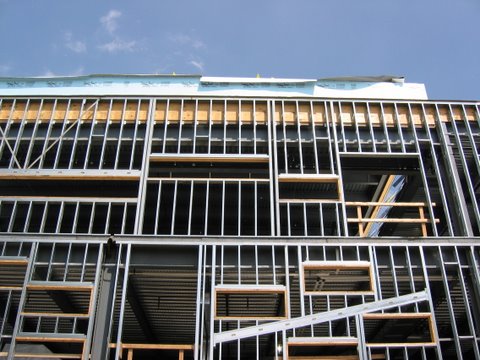
Our first shipment of cypress wood has arrived at the construction site – about half of the material that will serve as our exterior siding. The cypress is 100% reclaimed wood from barns in upstate New York (actually “mushroom houses,” to be completely specific.) After treating the wood with a clear sealer, they will start installing the siding hopefully by the end of the week.

The crew also expects to install the glass in the third floor clerestory on Monday, then proceed to the windows on the rest of the building. During the next few weeks, we should make significant progress on the building’s exterior and have a good sense of what it will eventually look like on the outside.

Bilaam’s Folly and the Evangelical Right

weblog341.jpgIn this week’s Torah portion, Balak, King of the Moabites sends for Bilaam, a sorcerer-type who is reputed to have remarkable powers: whomever he blesses becomes blessed and whomever he curses becomes cursed. Impressed by his reputation, Balak recruits Bilaam to curse the Israelites and seal their doom.

What ensues is brilliant Biblical satire. Bilaam sets out on his mission and is toyed with by God at every turn. Bilaam, the great seer cannot even see what his own ass (pardon the expression) sees:

(Bilaam) was riding on his she-ass, with his two servants alongside, when the ass caught sight of the angel of the Lord standing in the way, with his drawn sword in his hand. The ass swerved from the road and went into the fields; and Bilaam beat the ass to turn her back on to the road. (Numbers 22:22)

When Bilaam finally arrives at the Israelite camp, his humiliation deepens: try as he might to curse the Israelites, God makes sure that he can only bless them. Ironically, his blessings over Israel are among the most powerful Biblical poems of praise (including the famous verses “Mah tovu ohalecha ya’akov” – “How beautiful are your tents, O Jacob!” which have since become a permanent part of the Jewish morning liturgy.)

Though some commentators view Bilaam in positive terms, the conventional understanding of this story is as a monotheistic polemic against pseudo-prophets. Indeed, although Bilaam blesses Israel in the end, his blessings are the product of divine manipulation, not authentic piety. It is difficult to read this story and not, on some level, view Bilaam as something of a fraud.

The story of Bilaam raises many issues, not least of which is the role of flatterers and sycophants in society. Are blessings truly blessings if they come to us through circumstance or with ulterior motive? Who are the Bilaams in our midst today, whose words of support only serve to mask a deeper and possibly darker motive?

For the Bilaam of the 21st century, I cast my vote for Christian evangelical pastor John Hagee, founder of the Christians United For Israel – a religious leader who has been embraced by many quarters of the Jewish community for his staunchly pro-Zionist views. Though Hagee and his followers are amassing impressive political clout and raising increasing amounts of dollars that fill the coffers of Jewish Federations around the country, there is certainly ample reason to question whether his “blessing” to the Jewish community is one we should be so eager to accept.

Hagee’s preaches a Biblically-based version of Zionism that views Israel as God’s gift to the Jewish People and is an avowed opponent of the peace process. Even more troubling, however, is his apocalyptic prescription for Mideast “peace.” In his bestselling book, “Jerusalem Countdown,” he advocates a preemptive strike against Iran and posits that the West will soon become engaged in nuclear war with “Islamo-fascists” which will eventually initiate Armageddon, the final earthly battle described in the Book of Revelation. Hagee further claims that this battle will conclude with the death of countless Israeli citizens and the Second Coming of Jesus Christ.

Some Jews argue that we have cannot afford be choosy, that in desperate times we must find our friends where we can – even if they are among the Bilaams of the world. But are such alliances truly in our best interest? Indeed, as we learn in this week’s Torah portion: motives matter. We would do well to avoid “crisis mode thinking” that could lead us to ill-advised relationships with pseudo-prophets such as Hagee – and unwittingly help create circumstances that will eventually make Armageddon a self-fulfilling prophecy.

(For more about Hagee and the growing Jewish relationship with the Evangelical Right, check out this article from The Jewish Week.)

Israel and the UN, Again…

200px-united_nations_human_rights_council_logo.pngIn a move that is sure to further endear the UN to the State of Israel, the recently created UN Human Rights Council voted last Monday to establish one permanent agenda item: the “human rights situation in Palestine and other occupied Arab territories.”

Needless to say, the abject hypocrisy of this move did not escape the notice of the Jewish press. From the Jerusalem Post:

In other words, Israel (or “Palestine,” in the council’s terminology), alone among the nations of the world, will be subjected to continual and open-ended examination. That’s in keeping with the record of the council’s first year: Eleven resolutions were directed at the Jewish state. None criticized any other government. Genocide in Sudan, child slavery and religious persecution in China, mass repression in Zimbabwe and Burma, state-sponsored murder in Syria and Russia – and, for that matter, suicide bombings by Arab terrorist movements – will not receive systematic attention from the world body charged with monitoring human rights. That is reserved only for Israel, a democratic country that has been guilty of human rights violations but also has been under sustained assault from terrorists and governments openly committed to its extinction.

Even Mitchell Plitnick, in his decidedly left-learning Jewish peace blog, The Third Way, noted the double standard:

Of course, Israel’s list of human rights violations is long; this is inevitable when conducting a military occupation and is, among the many reasons for that occupation to end, by far the most important. But criticizing Israel’s human rights violations can only be just in the context of establishing and trying to enforce global human rights norms. Pretending that Israel’s human rights violations are somehow different and worse than many other countries’ is simply absurd and wrong.

Read the annual global reports from Amnesty International. No country gets a clean bill of health, and most countries have a pretty sad list of human rights violations. Many can certainly say pretty clearly that their record is better than Israel, although most of those are not engaged in an ongoing conflict. Many others can make no such claim. And many such violations by other countries are, like Israel’s, a major cause of regional de-stabilization. There is simply no justification for Israel receiving such singular treatment.

Re the response of the human rights community: I was disappointed to read this tepid reaction from Peggy Hicks of Human Rights Watch:

Critics have denounced the inclusion of a separate agenda item on Israel. The council should not single out one country in this way. However, the item refers to the “human rights situation in Palestine and other occupied Arab territories,” meaning that in principle, at least, the council can scrutinize both Israeli and Palestinian behavior.

For its part, Amnesty International weighed in on the issue earlier this month:

The Council must consider situations of human rights violations in an impartial and non-selective manner. Specific situations, including the situation of human rights in the Occupied Palestinian Territories and other occupied Arab territories, should be addressed consistently with the principles of impartiality, objectivity and non-selectivity.

It’s also worth noting that UN Secretary General Ban Ki Moon has also publicly criticized the council’s recent action:

The Secretary-General is disappointed at the council’s decision to single out only one specific regional item given the range and scope of allegations of human rights violations throughout the world.

What to make of all this? The UN Human Rights Council’s obsessive Israel-focus is only the latest in a long and ongoing saga. While I personally understand the Jewish community’s widespread cynicism about the United Nations, I’m often frustrated that most of this criticism tends to descend into wholesale dismissal of the UN itself.

At the end of the day, for all its shortcomings, the UN remains the only institution that exists to bring together the diverse nations of the world to “save succeeding generations from the scourge of war” and to work together for a more just world. While it is certainly unrealistic to ignore its weaknesses, those of us who are committed to international human rights must help the UN to build on its strengths and utilize its limited resources as effectively as possible.

Specifically, this latest development only further points up the need for fundamental UN human rights reform. For an intelligent and balanced discussion of this issue, I recommend this report from UN Watch.

JRC’s Greening Spotlighted!

06-22-07_cover.gifThe latest issue of the Chicago Jewish News featured a comprehensive article about environmentalism in the Chicago Jewish community.  JRC’s efforts to build a LEED certified synagogue figured prominently. Read on:

One Chicago synagogue has made environmental issues its top priority-and is making history in the process.

The impressive-looking building quickly going up at 303 Dodge Ave. in Evanston is the new home of the Jewish Reconstructionist Congregation. When it’s finished, it will become what may be the first LEED-certified synagogue in the United States.

This state of affairs came about when it became clear that the congregation had outgrown its old building, which was on the same site as the new one, according to Julie Dorfman, head of the synagogue’s environmental committee. The congregation discussed renovating the old building, then decided to tear it down and build a new one, she says.

Around the same time, Dorfman became head of the committee and, along with other members, “decided to move away from a they-should-do-it model to a we-should-do-it model,” she says. Members of the committee along with members of another local group, the Evanston Interreligious Sustainability Circle, got together to brainstorm various ways of making the building more sustainable.

After the synagogue held a Tu B’Shevat seder with an environmental focus, “a lot of people got interested in the whole topic,” Dorfman says. “We decided if we were going to build a new building, it needed to be designed green from the beginning. One member introduced us to the concept of LEED certification, and other people joined and taught us about green buildings, and the decision was made” to seek certification. Rabbi Brant Rosen, the synagogue’s spiritual leader, got behind the project and board members supported it unanimously.

It was a momentous decision and a mammoth effort. In the case of the new JRC building, items that had to be taken into account included not causing erosion during construction; building a roof that would not function as a “heat island”; offering bicycle racks and a shower bike riders could use; energy and water use efficiency; use of recycled or reclaimed construction materials (the exterior siding, for instance, was previously used in barns in upstate New York, and some of the interior materials are made from sunflower kernels); and a heating and cooling system that works by zone, “so we don’t heat or air condition areas when they aren’t in use,” Dorfman explains.

For instance, religious school rooms, which are used only a few hours each week, don’t need to be heated or cooled the rest of the time; consequently each room must have individual temperature controls.

In addition, 50 percent of all new wood used comes from sustainable forests; no paint or carpeting will use volatile organic chemicals; and the landscaping will include drought-resistant native plants that provide a habitat for birds and butterflies.

The Ner Tamid or eternal light will be solar powered and the sanctuary is designed to use “displacement ventilation.” That means that “the air conditioning comes in low and gently wafts up to about seven feet” so energy is not wasted cooling all the way up to the 18-foot ceiling, Dorfman explains. In the rest of the building, cold air will blow in from the top down.

The building will use 42 percent less energy and more than 40 percent less water than a conventional building, she says.

The cost for the entire project, Dorfman says, will come in at about $10 million (which includes the cost to the congregation of having to rent a new site while construction is going on). The figure, she says, is “a little more costly than a conventional building, but not much.” A grant from the Illinois Clean Energy Community Foundation will help with the costs of the design and engineering. Dorfman estimates that the congregation will make back the approximately $250,000 extra in cost savings in about 10 years. The congregation is targeting January 2008 as the estimated completion date. Congregants are very happy about the project, Dorfman says. “So many people say to us that they’ve become part of the community in a way they weren’t before because of this,” she says. “We wanted a process to reflect our values-doing something in a way that would inspire us and inspire other congregations.”

Rabbi Rosen agrees. “From the beginning, I felt very strongly about educating the congregation that this effort is grounded in our spiritual values as Jews,” he says. “Environmentalism is not just a political issue, not just a bandwagon to jump on. It goes back to the Torah, a value we’ve inherited in our own spiritual tradition – energy efficiency, not destroying natural resources. The world does not belong to us – we’re reminded repeatedly of that in the Torah.”

His role in the effort, he says, is “helping the congregation understand that how we build the building is as important, if not more so, than the building itself. The spiritual values reflect on who we are. It’s not easy to build a green building. There is a learning curve that is very daunting and a financial commitment on top of the financial commitment of building a new building.”

Rosen has been gratified by the response of congregants, he says. “By helping people understand the values behind the building process, it has created more of an investment in the process,” he says. “Their spiritual investment in it is much deeper. We’re proud of doing it and our biggest hope is to be a role model for other communities to follow suit. That would be the greatest honor.”

Where are the Peacemakers?

_38856823_suukyi_bbc_203.jpgIn this week’s Torah portion, Hukkkat, we read of the death of Aaron:

Moses stripped Aaron of his vestments and put them on this son, Eleazar. When Moses and Eleazar came down from the mountain, the whole community knew that Aaron has breathed his last. All the house of Israel bewailed Aaron thirty days. (Numbers 20:28-29)

It is noteworthy that Aaron was mourned by the entire people of Israel – and that their period of mourning lasted for thirty days rather than the traditional seven. According to the Midrash, this reflects Aaron’s status as an unusually and universally beloved leader – even more than Moses:

Only the men showed lovingkindness to Moses, as it is said, “And the sons of Israel wept for Moses.” (Deuteronomy 34:8) (But) the men and women and children showed lovingkindness to Aaron.

Why? Because he loved peace and pursued peace, and passed daily through the entire camp of Israel and promoted peace between a man and his wife and between a man and his neighbor. Therefore all Israel showed lovingkindness to him, as it is said, “And when all the congregation saw that Aaron was dead, they wept for Aaron thirty days, even all the house of Israel.” (Pirke De’Rabbi Eliezer 17)

The Midrash thus presents us with a decidedly ”revisionist Aaron.” While the Aaron of the Torah is the venerable High Priest of Israel, the archetypal Aaron of Rabbinic tradition is portrayed as the quintessential “Ohev V’Rodef Shalom” – “Lover and Pursuer of Peace.” Witness also this well-known verse from Pirke Avot:

Rabbi Hillel said, be a disciple of Aaron: “loving peace and pursuing peace, loving all people and bringing them closer to Torah.” (Pirke Avot 1:12)

Who are today’s disciples of Aaron? Invariably they are the one’s whose love and pursuit of peace comes at great personal cost. In honor of this week’s Torah portion, I’d like to spotlight the work of one courageous peacemaker:

Aung San Suu Kyi is a Burmese peace activist and Nobel Peace Prize recipient who has spent more than ten of the past seventeen years in some form of imprisonment or detention under Burma’s military regime. Like many important peacemakers (she has cited MLK and Mahatma Ghandi as personal influences) Aung San Suu Kyi’s struggle for justice and human rights is grounded in a profoundly spiritual vision. Here is an excerpt from one of her writings, which was quoted in her Nobel Prize Presentation Speech:

Where there is no justice there can be no secure peace. That just laws which uphold human rights are the necessary foundations of peace and security would be denied only by closed minds which interpret peace as the silence of all opposition and security as the assurance of their own power.

The Burmese associate peace and security with coolness and shade:

The shade of a tree is cool indeed.
The shade of parents is cooler.
The shade of teachers is cooler still.
The shade of the ruler is yet more cool.
But coolest of all is the shade of the Buddha’s teachings.

Thus to provide the people with the protective coolness of peace and security, rulers must observe the teachings of the Buddha. Central to these teachings are the concepts of truth, righteousness and loving kindness. It is government based on these very qualities that the people of Burma are seeking in their struggle for democracy.

Do you know of other Disciples of Aaron? I encourage you to write and share the stories of those whose efforts are contributing to a more just and peaceful world.

Visionary Quote of the Week

“We’re laying the foundations for someone else to succeed in the future, and I think that’s fine.”

- Condoleeza Rice on the Bush administration’s Mideast policy (quoted in Newsweek)

Inherent Dignity

image002.jpgAnother anniversary I can’t let slip by unnoticed: on this day fifty-nine years ago, the United Nations Commission on Human Rights adopted its Universal Declaration of Human Rights.

I know, I know: it’s a controversial document, it’s non-binding, the UN has left unfulfilled its promise on human rights, blah, blah, blah…

I don’t want to hear it. I don’t care what they say: I believe the Universal Declaration still remains the central moral conscience of the world community and one of the truly sacred documents of our day. In particular, its reference to the “inherent dignity…of all members of the the human family” is a powerful reminder that human rights ultimately begin at home. In the words of one of its drafters, the great Eleanor Roosevelt:

Where, after all, do universal human rights begin? In small places, close to home — so close and so small that they cannot be seen on any maps of the world. Yet they are the world of the individual person; the neighborhood he lives in; the school or college he attends; the factory, farm or office where he works. Such are the places where every man, woman and child seeks equal justice, equal opportunity, equal dignity without discrimination. Unless these rights have meaning there, they have little meaning anywhere. Without concerned citizen action to uphold them close to home, we shall look in vain for progress in the larger world.

In honor of the day, I encourage you to click above, read the Declaration, then send on the link to your friends.

May we realize its vision speedily and in our day.

Making Democracy Safe for the World

revolution_home.jpgAs this week’s Torah portion opens, a prominent Israelite named Korach ben Yizhar, together with two hundred and fifty chieftains, publicly revolts against the leadership of Moses and Aaron. Korach’s grievance is articulated as a populist call to arms:

They combined against Moses and Aaron and said to them, “You have gone too far! For all the community are holy, all of them, and the LORD is in their midst. Why then do you raise yourself about the LORD’s congregation?” (Numbers 16:3)

The rebellion ends ignobly: at the climax of this episode, the earth opens up to swallow Korach, his followers, their families and all of their possessions.

Korach’s is not the first rebellion experienced by the Israelite community, but in some ways it is the most complex and disturbing. For one thing, we cannot help but be struck by the fact that Korach’s grievance seems to be quite valid: he voices a kind of proto-democratic sentiment that speaks to the intrinsic value of every Israelite citizen (contrasted with the more “hierarchical and “elitist” leadership embodied by Moses and Aaron). Many commentators have pointed out, however, that Korach’s populism might not be all it’s cracked up to be. While he speaks the language of the masses, the traditional take on Korach is that his “democratic commitment” is somewhat less than pure.

Though this story was written centuries before the political concept of liberal democracy was ever dreamed of, Korach’s rebellion has a special resonance for the 21st century world. Indeed, what do we mean when we speak of our commitment to the “global spread of democracy?” What do we make of world leaders, like Korach, who speak the language of the masses, but clearly harbor their own anti-democratic agendas? How do we feel when, in our own country, our leaders talk passionately about spreading our democratic values abroad yet show little regard for the Constitution here at home?

Fareed Zakaria, in his important book “The Future of Freedom” articulates the current challenge well:

Modern democracies will face difficult new challenges – fighting terrorism, adjusting to globalization, adapting to an aging society – and they will have to make their system work much better than it currently does. That means making democratic decision-making effective, reintegrating constitutional liberalism into the practice of democracy, rebuilding broken political institutions and civic associations. Perhaps most difficult of all, it will require that those with immense power in our societies embrace their responsibilities, lead, and set standards that are not only legal, but moral. Without this inner stuffing, democracy will become an empty shell, not simply inadequate but potentially dangerous, bringing with it it the erosion of liberty, the manipulation of freedom, and the decay of common life.

…As we enter the twenty-first century, our task is to make democracy safe for the world.

(“The Future of Freedom,” p. 256)

JRC Construction Diary #17

jrc-exterior-low-resolution.jpg

img_2937.jpg

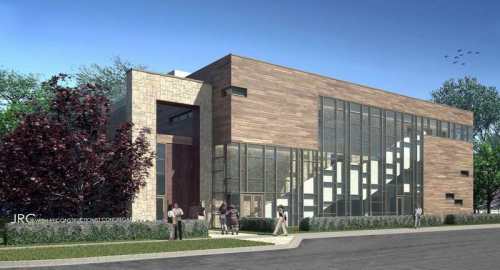
The exterior of the building continues to take shape. I’ve juxtaposed the computerized rendering (top) with an actual exterior taken yesterday (next down) to give you a comparison of the virtual with the actual. Below, is a pic of the duct work and electric conduit, now installed in the first floor offices. The second pic from the bottom shows the rear stairs (termed the “Stairway to Heaven” by one contruction worker) that leads from the ground floor to the third floor sanctuary. The bottom pic offers a southward view on the third floor. The black pipe is the “rough-in” plumbing for the bathrooms. You can also see the main air duct and the yellow board enclosure that wraps around the elevator shaft.

We’re about five weeks behind schedule, but with good weather, we are still hoping for an early-Jan occupancy date. On the LEED front, we are currently safely in range for a Gold rating with the US Green Building Council and still have a fighting chance for Platinum (the highest rating!) The final determinant will ultimately come down to cost, but whatever happens, we are so very proud to be building synagogue so thoroughly infused with Green values…

img_2935.jpg

img_2903.jpg

img_2920.jpg

Everybody Jump!

Woo hoo!!! I had the very good fortune to catch the Balkan Beat Box concert last night at the Empty Bottle in Chicago. I don’t get out to the clubs an awful lot, but boy am I glad I caught this particular gig – they did not disappoint!

For the uninitiated, here is a description of BBB, cribbed from their MySpace site:

Balkan Beat Box is steeped with an intense lifetime of research into their own non-Western roots as well as other cultures. A quasi-circus event, BBB performs with a core of 6 musicians, collaborating with artists from Bulgaria, Morocco, Spain, Israel, and Turkey who draw on a variety of styles from around the world. Every event keeps the audience guessing what the next surprise will be.

BBB makes connections that politics often keep separate. Jewish, Gypsy, Arabic, and American are united by hip hop beats and dancehall toasts. BBB’s musical hitch-hiking continues as they mix things up with dub and electronics, juxtaposed with ancient Moroccan and Mediterranean melodies. The band’s uncategorizable sound gives equal weight to soulful acoustic timbres and digital rhythms creating a uniquely organic sound with electronic elements.

Yep, that pretty much sums ‘em up. And it’s true: BBB is one of those acts that you must absolutely see live to get the full effect of their artistry. This band is clearly at the height of its musical power – this was one of the best concerts I’ve seen in a long time in any genre (make that multi-genre…)

Last night was the final stop on their current tour, but don’t pass up the chance to see them on their next go around. In the meantime, check out their great new album, “Nu-Med” or click below for a clip of them performing in Europe. (That’s the chronically shirtless, indefatigable lead singer Tomer Yosef singing “Ramallah Tel Aviv,” the song that closed last night’s show.)

(Eternal thanks to Adam Davis and the good folks at Kfar Jewish Arts Center for bringing BBB to town!)