Monthly Archives: January 2008

Stuff You Should Read

newsboy2-745827.jpgThe Jerusalem Post predicts that Israeli Prime Minister Olmert will survive the release of the Winograd Report and that Defense Minister Ehud Barak will remain in the government:

Sources close to Barak said it was unlikely that he would honor the promise he made when running for Labor leader last year that as soon as the report came out, Labor would “end its partnership with Olmert and work to establish a new government in the current Knesset, or alternatively, to set a date for elections.”

“He will find it extremely difficult to demand Olmert’s resignation based on this report,” a source close to Barak said. “This is not a report that justifies bringing down the government. I can’t see him leaving the government or demanding Olmert’s resignation.”

A Kenyan journalist, Edwin Okong’o offers an extremely helpful, in-depth analysis of the current Kenyan crisis for Frontline/World:

Odinga and Kibaki are now locked in a political struggle that could tear the country apart. Odinga is under pressure to deliver on behalf of his associates who may not be willing to wait another five-year term before they come to power.

…Regrettably, as a popular Kiswahili saying goes, when two elephants fight, it’s the grass that suffers. Whatever showdown emerges will involve tribal sentiments. My fear is that if both sides fail to agree to share power, they will summon their tribal armies of poor people to do their dirty work for them.

Ha’aretz reports on this deeply troubling Jewish new construction project in East Jerusalem:

The Yemin Yehuda non-profit association has begun building 200 housing units in the Shimon Hatzaddik compound, in the heart of East Jerusalem’s Sheikh Jarra neighborhood. In the process, the organization intends to demolish the homes of dozens of Palestinian families who live there.

This neighborhood is in a strategic location: If Yemin Yehuda completes its plan, it will cut the Old City off from the Palestinian neighborhoods in northern Jerusalem.

MK Benny Elon (National Union-National Religious Party), who supports building the new neighborhood, says it is designed to create a Jewish continuum surrounding the Old City, where there currently is a massive Palestinian majority.

Meir Margalit of the Israeli Committee Against House Demolitions says the new plan is very dangerous because it aims to thwart any chance of a future agreement based on the division of Jerusalem.

Veteran writer/journalist Kevin Kelly offers this exquisite piece for NPR’s “This I Believe:”

When the miracle flows, it flows both ways. With each gift the threads of benevolence are knotted, snaring both giver and recipient. I’ve only slowly come to realize that good givers are those who learn to receive with grace as well. They radiate a sense of being indebted and a state of being thankful. As a matter of fact, we are all at the receiving end of a huge gift simply by being alive. Yet, most of us are no good at being helpless, humble or indebted.

As with my hitchhiking rides, the gift is an extravagant gesture you can count on. No matter how bad the weather, soiled the past, broken the heart, hellish the war, I believe all that is behind the universe is conspiring to help us — if we will humble ourselves enough to let it.

Wangari Maathai on the Kenyan Crisis

maathai.jpgIf you are following the tragic and heartbreaking news from Kenya and are not sure of what to make of it all, I recommend this excellent article by one of my heroes, Kenyan environmental/political activist and Nobel Prize receipient Wangari Maathai. (at right)

I’m especially taken by her analysis of tribal loyalties (what she calls “micro-identities”) against the broader context of Kenyan society (the “Nation State”). Indeed, the challenge of respecting diversity within a greater sense of national unity should be familiar to us all – and is an important rejoinder to those who tend to dismiss tribal conflicts as just an “African issue.”

Here’s an excerpt from Maathai’s article below. If you’d like to contribute to ongoing relief for the victims of the crisis in Kenya, click here.

Kenyans should not lose site of the fact that it has been an ongoing struggle, that goes back to the colonial period. Kenyans, and indeed all African need to embrace their micro-nationalities because they need culture, language, values and purpose. They do not have to melt into the Nation State: it is impossible anyway. Rather, they ought to consciously and deliberately work to strengthen the Nation State by bringing on board the best from their micro-nationality and enrich the heritage at the level of Nation State.

…We can make a deliberate choice to move forward together towards a more cohesive Nation State, where we can all feel free, secure, and at peace with ourselves and our neighbours. In such a Nation State there would be no need for any Kenyan to organize tribal clashes against their neighbours. The micro-nationalities would begin to see the benefits of unity in diversity.

…The rest of the leadership is all of us, playing our part wherever we are, and maintaining peace and goodwill. The international community will help us but we are the ones who must rise up and walk towards, truth, justice, healing and reconciliation. That is the path to a lasting peace.

We Can Work It Out

beatles_narrowweb__300x3710.jpgDid you know that The Beatles were scheduled to perform in Tel Aviv in 1965, but Israeli government leaders nixed the tour for fear the Fab Four would “corrupt” Zionist youth?

Well, me neither. But get this: Israel is now trying to atone for their, shall we say, “ill-advised” decision. According to news reports, Israeli Ambassador to Britain Ron Prosor was expected to meet with John Lennon’s sister at The Beatles museum in Liverpool and to present her with an official letter of apology from the State of Israel.

Click here for the lowdown…

The Real “Pro-Israel” Vote

obama_aipac248_ap.jpgYes, it’s an election year, and once again it’s “through the looking glass time” for the American Jewish community. Bucking the views of the majority of American Jews, candidates are once again doing their best to court the Jewish vote with the hawkish AIPAC line articulated by the self-appointed “American Jewish establishment.” I was particularly disappointed to read Obama’s recent letter to UN Ambassador Khalilzad, in which he wrote that Israel was “forced” to respond to the Kassam attacks with an economic blockade. (Forced? In point of fact, the Israel’s blockade was not initially a response to the Kassams, but rather to Hamas’ electoral victory in June 2006.)

As President Bush attempts to revive the peace process in the final year of his Presidency, those of us in the American Jewish majority would do well to express to the current candidates know what it truly means to be Pro-Israel. To this end, I commend to you this excellent article by Gershom Gorenberg from “The American Prospect.” An excerpt:

I suggest that it’s time to talk about what “pro-Israel” should mean. Not because the discussion will change campaign rhetoric: The candidates will stick to cliches. But after the election, one will have to govern. Members of Congress will need to decide how to vote on the usual strident resolutions backed by AIPAC. Debate now on what it means to support Israel might mean that a year from now, elected leaders will be able to refer to publicly recognized ideas to justify acting more sensibly.

Start here: Being pro-Israel does not require backing the most bellicose possible Israeli position, anymore than being “pro-American” requires backing the war in Iraq. To be “pro” means to support, to want a country to survive and flourish. Supporting an ill-considered war (Iraq, Lebanon) is like encouraging a friend to leap into a barroom brawl: a poor form of friendship.

To be pro-Israel certainly doesn’t mean basing foreign policy on the alleged conflict of civilizations; the whole West locked in combat with the Islamic world. The perception that the United States is at war with Islam leaves Israel dangerously exposed on the front lines. It is in Israel’s interest to get along at least tolerably with as many of its Muslim neighbors as possible.

A pro-Israel policy does not mean refusal to talk to Iran. An Iranian bomb is certainly a serious danger to Israel. Refusing to negotiate with Teheran means giving up in advance on possible ways to reduce the threat. There are hard-nosed strategic analysts in Israel who advocate a diplomatic quid pro quo: U.S. acceptance of the Iranian regime in return for an end to uranium enrichment and support for terror groups. If America resorts to military means, it will further destabilize the Middle East, doubling the damage caused by the war in Iraq.

Being pro-Israel certainly doesn’t mean standing in the way of peace negotiations with Syria, as the Bush administration has consistently done. Negotiations might not succeed. If they do, they will probably produce a cold peace– which is much better than the current reality of cold war, in which Damascus uses Hamas and Hezbollah as proxies to bleed Israel. (If one reads Obama’s statement to AIPAC very closely, he said that, “No Israel prime minister should ever feel dragged to or blocked from the negotiating table by the United States.” I’d like to believe the “or blocked from” is a hint at ending the veto on peace talks with Syria.)

Most critically, support for Israel does not mean support for West Bank settlement, for the Whole Land of Israel, for endless occupation. The sane, mainstream Zionist vision was and is of a democratic state with a Jewish majority, with full rights for all citizens, a country living at peace with its neighbors. (That’s what the country’s declaration of independence says.) Rule over the disenfranchised Palestinians of the West Bank undermines democracy. Every additional settler makes withdrawal more difficult.

Brooks on the Mountain

Since my posts have been fairly heavy of late, here’s a little lightness in honor of this week’s Torah portion, Parashat Yitro…

Gaza Crisis Letter

pm_gaza3_wideweb__470x3360.jpg

Here’s a letter I recently sent off to the editor of the Chicago Sun-Times: 

To the editor,

I recently traveled with a Brit Tzedek v’Shalom (Jewish Alliance for Justice and Peace) delegation to Israel and the Palestinian territories. We met with academics, peace activists, and politicians, including Israeli Prime Minister Olmert and Palestinian Prime Minister Fayad. Among other things, we learned much about the humanitarian crisis in the Gaza Strip, circumstances reflected in the 1/22/08 article, “Tens of thousands of Palestinians flood into Egypt through breached Gaza wall.”

Critics of Gaza’s Hamas-led government blame the destitution on the firing of Qassam rockets into southern Israel and clearly, such attacks are intolerable. No country should be expected to remain passive under attack.

But are Israel’s economic blockade and military incursions providing the answer? Currently 860,000 Gazans – more than half the population – now rely on the UN for food. In recent military operations, some twenty Palestinians were killed, including a three-year-old girl. Israel may hope its tactics will turn Gazans against Hamas, but given the choice to hate Hamas or hate Israel, Palestinians will most certainly choose the latter.

Economic deprivation is clearly not working, and we know that there’s no military solution. As always, the only answer is negotiation, as President Bush indicated at the Annapolis peace conference. In the short term this means a negotiated ceasefire between Israel and Hamas; long term, it means a two-state solution.

This won’t be easy. It won’t happen in one step, and more blood may be shed. Bush’s path is far from clear, but those who support Israel must support his efforts towards peace and encourage him to follow up his words with strong actions.

Clearly, war and collective punishment aren’t the answer. If Israel and the Palestinians want true peace and security, the only solution will occur across a table.

Sincerely,

Rabbi Brant Rosen
Jewish Reconstructionist Congregation, Evanston
Brit Tzedek v’Shalom Rabbinic Cabinet

JRC Construction Diary #30

img_0410.jpg

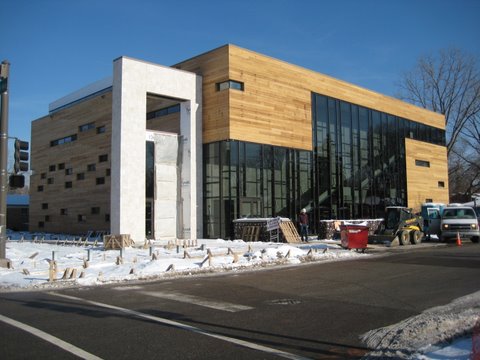
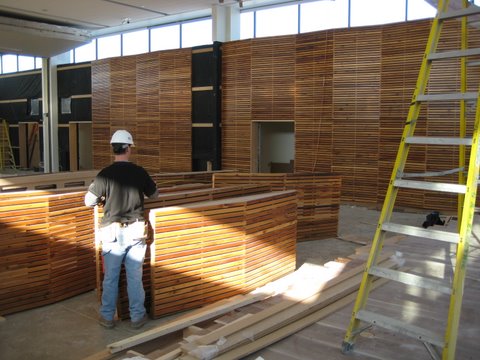
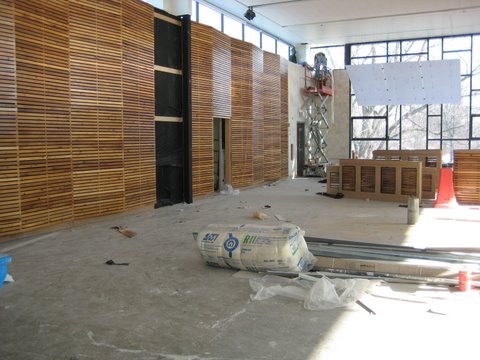
Things are getting exciting as the contractor puts the final touches on JRC’s new home. They are looking to finish the bulk of the work this week so that we can get ready for an upcoming indoor air quality test, a requirement of LEED certification by the US Green Building Council.

The picture above shows the cypress that wraps along the ceiling of our first floor chapel. The shot below shows the cypress slats that have installed along the sanctuary wall. Just to make things official, our name went up on one of the gabion walls in front of the building (second pic down) and beneath this you can see our front entryway. It features a ceremonial door made of reclaimed maple trees from our former site. The last two pix offer views of the kitchen and of a men’s room respectively.

The big move will take place during the first week in February. On 2/8-9 we will hold our final Shabbat services in our temporary site (Shaarei Tikvah in Chicago) then on Sunday, February 10, we will joyfully process with JRC Torah scrolls as we bring them to our new home!

Stay tuned for more…

img_0444.jpg

img_0457.jpg

img_0458.jpg

img_0446.jpg

img_0463.jpg

Wading Through the Waters

parting-of-the-red-sea-web.jpg

From this week’s Torah portion, Parashat Beshallach:

And the children of Israel went into the midst of the sea upon dry ground, and the waters formed a wall to them on their right hand and on their left. (Exodus 14:22)

I’ve always been struck by the dramatic, almost fearful description of the parting of the waters. It’s often seemed to me that the Israelites’ song is as much a song of terror as much as it is a song of joy and liberation. It’s an apt image, I think: the Israelites head toward their liberation with two fragile walls of water on their left and their right, threatening to obliterate them at any moment as they pass between.

Finding your way to liberation and peace is indeed a terrifying business. It means wading into powerful waters that rise before you while simultaneously threatening to submerge you on either side. I’m sure there are many who would simply prefer to stay turn back at various points along the way – or not to wade in at all. In so many ways, this story is about facing the terror of the narrow path through the waters, but finding the wherewithal to move forward nevertheless because the alternative (i.e., remaining in place or turning back) is even more terrifying to contemplate.

This past week, as my Meretz-Brit Tzedek V’Shalom Symposium visited with Israeli and Palestinian activists, leaders, politicians, and ordinary citizens, so devoted the cause of peace, I have been mindful of how fragile and discouraging this work so often feels. Indeed, I know how tempting it can be to surrender to this discouragement, to give in to the the fatigue: “We’ve tried and failed” “It’s too late.” “Peace between Jews and Palestinians can never truly happen.”

It is clear to me that for most Israelis and Palestinians, this fearful voice comes from a collective sense of ongoing trauma. During the week of our visit, hundreds of Kassam rockets rained down daily on and around the Israeli town Sderot -and Israel responded with deadly military incursions in Gaza. I spoke with Israeli friends who told me with great emotion that life in Sderot and the surrounding area is absolutely unbearable. As I traveled through Ramallah, I saw Palestinian flags flying at half mast for the Gaza dead.

As the cycle of violence continued however, we met and spoke with inspired individuals who worked tirelessly for peace for their respective peoples. Yes. we were told repeatedly by many experts that moderates on both sides are simply growing tired and less sure that peace will ever be possible. But we know first-hand that there are also many who defy the fear and press on for peace in Israel/Palestine, knowing that discouragement is simply a luxury they cannot afford.

Of course I realize that walking the path of peace will require complex and often painful decisions, but after my experiences of this week, I am even more convinced of this: two states for two peoples is simply the only way out, and we must support the efforts of those working toward this end with everything we have. Accepting an untenable status quo, or going back the way we came are simply not options. The way through the waters is not easy or comfortable, but as ever, there is still only one way forward.

Shalom/Salaam from Jerusalem…

Adding the Goat

israel-symposium-1-19-001.jpg

Some highlights of our final day of the Meretz/Brit Tzedek V’Shalom Israel Symposium

In the morning we visited and spoke with some members of Alon Shvut, a West Bank settlement in Gush Etzion, south of Jerusalem. Afterwards we were given a tour of the Arab villages and new Jewish settlements/outposts in the region by Hagit Ofran (above) who works for the settlement-watch division of Peace Now. We paid special attention to the new bypass roads and tunnels that connect the settlements to each other and to other areas inside the Green Line.

Needless to say, bypass roads have aided considerably in the growth of the settlements. Since they are designed to help the Jewish population avoid travel near or through Arab centers on the West Bank, Palestinian access to them is virtually impossible. There are also three “sterile” roads (meaning Jewish-only): Rte. 443, that connects Modi’in, to the settlement of Elon Moreh, a highway near Nablus, and the Dead Sea road to Ein Gedi

We also saw several so-called illegal Israeli outposts along the way – new settlements that have built on private Palestinian land (see pic below). Since 1996, more than 100 outposts have been built with the assistance of the Ministry of Housing. Because they are easily built and easily taken down, the Israeli government can take dismantle them when necessary to create the impression of compliance with the first phase of the Road Map, which directs Israel to actively remove all illegal settlements on the West Bank. (Of course, the term “illegal outpost” is a bit of a misnomer as all West Bank settlements are technically illegal according to international law.)

A great aside: Hagit says the construction of illegal outposts is known in Peace Now circles as “adding the goat” – a reference to the well-known Jewish folktale about the man who has so many children that he goes to the Rabbi to ask him how to get some peace and quiet from all of the noise. The Rabbi tells him to bring a goat into his house. He does so and in a few days there is so much noise that the man tells the Rabbi the situation is even worse than before. So the Rabbi tells him, “Now take the goat out of your house” and the noise finally settles down…

After returning to Jerusalem our group participated in a demonstration in Paris Square by Women in Black – a well-known Israeli peace group that has been gathering to protest the occupation every Friday afternoon on this site for the past twenty years. The pic at the bottom shows Brit Tzedek President Steve Masters talking with Dafna Kaminer, one of the founders of Women in Black who has been standing on this street corner fighting the good fight for two decades. (Afterwards, we heard an inspiring presentation from another Israeli peace activist veteran: Gila Svirskey of the Coalition of Women for Peace.)

It’s been a long, exhausting, educational, heartbreaking, inspiring week. Some final thoughts follow in my next post…

israel-symposium-1-19-002.jpg

israel-symposium-1-19-005.jpg

An Afternoon in Ramallah

israel-symposium-1-17-002.jpg

Today was devoted to meetings with various leaders of the Palestinian Authority in Ramallah. Our group met first with Hanan Ashrawi, the well-known Palestinian leader, negotiator and academic – and currently a member of the Palestinian Legislative Council. (That’s her above, on the right, together with me and fellow trip member Susie Coliver).

Ashrawi greeted us warmly but told us we were visiting during a very difficult time for the community. As we had been told by many Israelis and Palestinians previously, we heard grave disappointment from her that the promises made post-Annapolis are not matched by the reality on the ground, and most troubling, that there is an increasing skepticism among Palestinians over the viability of a two-state solution.

Ashrawi explained that this was an inevitable response to the despair of their daily reality: the clamping down at the checkpoints, the growth of settlements and outposts, and the increasing violence of the settlers. Ashrawi said to us sadly that she believed Palestinians who believe in the two-state solution (like herself) are now a distinct minority. Interestingly, she also told us she believes that while Palestinian intellectuals and solidarity groups abroad tend to advocate a one-state solution from an ideological point of view, Palestinians in the territories are essentially coming this position due to the dismal reality of their situation

She also had a great deal to say about the lack of trust that Palestinians have in Bush and Blair, and the increasingly stagnant economic straits in the West Bank. I was most struck, however, by her analysis of the situation in Gaza. Ashrawi believes Hamas is quickly losing support of Gazans – largely because of the brutal way they took power and the harsh nature of their Islamic fundamentalist rule. Ironically, she says the economic blockade imposed by the US and Europe really only serves to strengthen their popularity. (This was not the first time we have heard such an analysis.)

We also visited with Palestinian Prime Minister Salaam Fayed at his office (below). By contrast, Fayed told us that compared to where life was in 2006 (i.e, the Hamas coup in Gaza, Israel’s war in Lebanon), he felt there had been important progress. In particular, he pointed to the PA’s implementation of their security plan in Nablus, where the police were recently able to disarm gunmen and curb local violence. These measures were an important part of their commitments to the first phase of the Road Map – and Fayed he felt that this had improved life for Palestinians to an important extent. (From his point of view, there was still critical work to be done in the area of services and social welfare.)

israel-symposium-1-17-003.jpg

It was interesting that while Ashrawi chose to focus on the overall political reality, Fayed chose to speak about local Palestinian politics – and though the PA admittedly has limited power to institute change, he saw their efforts beginning to bear meaningful fruit. It seems to me that the difference in the presentations stemmed largely from their respective points of view: Ashrawi is a political veteran who has been in the trenches for many years. She has seen the rise and fall of the Palestinians’ political fortunes – and while some of our group heard her words as largely pessimistic, it seemed to me that she was simply relating to us the hard reality of the situation as she saw it. Fayed, on the other hand, is a political technocrat. As a prominent international economist, it seems that he understands the way systems operate – particularly the slow and gradual nature of progress in the life of a community. In end, despite what we might think about the nature of their leadership. both Ashrawi and Fayed represent the forces of moderation in the Palestinian community – and do I believe they need our support now more than ever.

Back in Jerusalem, we had dinner with Tsvia Greenfield, a remarkable woman from the ultra-orthodox community who is also a member of the Meretz party slate. (If Meretz had received one more seat in the last election, she would now be a member of Knesset.) Here is a woman who single handedly dispels many of our preconceptions of a Haredi woman: she received her MA in philosophy from Hebrew University, helped found the Israeli human rights group B’tselem, supports religious pluralism, a two-state solution, and gay/lesbian rights. (Yes, you heard me correctly!)

Tomorrow it’s back to West Bank for the last full day of our trip. Among other things, we’ll be visiting with a settler family in Gush Etzion. There’s still more to come…