Monthly Archives: September 2008

Shanah Tovah/Eid Mubarak

This year there’s a wonderful Jewish-Muslim harmonic convergence: Rosh Hashanah and Eid (the final fast of Ramadan) fall on the same day. Though I read this morning in the NY Times that it’s causing a “monotheistic traffic jam” on the streets of the Old City, I still choose take this dual observance as a sign of additional holiness in our world. May we all be worthy of this double-blessing and do what we can to live up to it…

In honor of this day, I suggest giving to any number of worthy grassroots interfaith initiatives. Here are just a few of my favorites that you might want to consider supporting:

Interfaith Youth Core, Interfaith Encounter, Mirembe Kawomera Interfaith Coffee Coop, Muslim-Jewish Peace Walk, Daughters of Abraham, Hands of Peace

Please feel free to post links to any others you would recommend…

Shanah Tovah/Eid Mubarak!

JRC Goes Platinum!

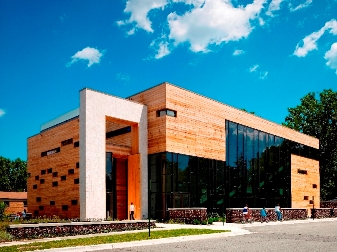
I am thrilled to announce JRC has officially achieved a LEED level Platinum rating from the US Green Building Council (USGBC), making it the highest rated green house of worship in the world!

I’ve written about this extensively before, but just to recap:  LEED (Leadership in Energy and Environmental Design) is the point-based review process created by USGBC to certify green buildings.  It is an extremely rigorous system requiring creative integrated design, detailed record keeping and a demanding submission process. Platinum is the highest of four levels of LEED certification, requiring fifty-two points. In the end, JRC earned all fifty-three of the points for which we applied!

Visit the JRC website for the official announcement.  For much, much more on the entire project, check out the JRC Construction Diaries in this blog.

Stay Tuned for McCain’s Courageous Mideast Peace Plan…

Hoping against hope that a McCain administration would take the lead in the Mideast peace process?  Don’t even bother. At a weekend retreat hosted by the Washington Institute for Near East Policy, two McCain advisers indicated that a McCain presidency would have more pressing foreign policy matters to attend to.  According to a recent JTA report:

(McCain adviser Max) Boot said pursuing an Israeli-Palestinian deal would not be a top priority in a McCain administration, adding that as many as 30 crises across the globe require more urgent attention.

I’m pretty curious to know the list of 30 crises that somehow rate “more urgent” than the longest-running conflict in the Mideast that continues to contribute to insecurity for Israelis, misery for Palestinians, and ongoing instability for the region…

(Russia’s alarming proximity to Alaska, perhaps?)

From Bhutan to Chicago

Just enjoyed a wonderful potluck dinner at JRC with the Khatiwodas – a refugee family from Bhutan who recently resettled in Chicago. (There they are in the pic above with congregation members Edie Canter and Elaine Waxman). JRC is sponsoring the Khatiwodas through the Interfaith Refugee and Immigration Ministries, an NGO that partners with congregations and organizations and in Illinois to provide direct services to refugees and immigrants and encourages active involvement in refugee and immigration issues.

Needless to say, the refugee crisis in Bhutan/Nepal has not received a lion’s share of media attention. The basics: in the early 1990s, the Bhutanese government began expelling ethnic Nepalese, regarding them as a demographic and cultural threat. As of early this year, roughly 108,000 stateless Bhutanese were living in seven refugee camps in Nepal and the Bhutanese government still has not allowed any to return. As far back as 2006 the US government offered to resettle 60,000 Bhutanese refugees, but they have only recently begun to arrive in the US.

By year’s end, over 10,000 refugees are expected to leave Nepal in what is being described as one of the world’s largest resettlement operations.  Meanwhile, the situation in the Nepal refugee camps remain dire. This past spring a fire raged through the Goldhap camp in eastern Nepal, leaving nearly 8,000 Bhutanese refugees homeless – including the Khatiwoda family. (As if all of these ordeals weren’t enough, the Khatiwodas were dealt even more heartache when the family’s grandmother took seriously ill after they arrived at their stopover in NYC. She has now remained behind for treatment, accompanied by her son).

In anticipation of the Khatiwoda’s arrival, JRC donated furnishings and household items for their new apartment in Rogers Park and members of our Refugee Task Force spent the better part of two weeks cleaning the place up and getting it ready. The family finally arrived in Chicago last week – and fortunately, their readjustment has been aided by the presence here of extended family who arrived in town ahead of them. Many JRC members have also begun to help them negotiate through the challenges of the initial settlement into their new home.

We had a lovely time at our dinner tonight as members of our Task Force had the opportunity to formally meet the Khatiwodas. They are beginning a new and hopeful chapter in a long journey and we’re truly honored to be sharing it with them…

The Iran Circus Comes to Town

Get ready for an unbelievable din when Mahmoud Ahmadinejad comes to town next week.

For its part, the Jewish community is contributing its share to the political noise making with all the brouhaha over Sarah Palin’s invitation (and subsequent disinvitation) from a Jewish community protest against Iran on Monday.  Tellingly, through all of the Jewish coverage of that incident, there has been precious little focus on the stance of the rally itself. For my part at least, I’m more than a little troubled that the extent of the Jewish community’s response to the Iran crisis continues to be “Ahmadinejad is a Nazi.”

We seem chronically unable to treat this issue with even a modicum of sanity. Somehow lost in the clamor are the disturbing signs that our nation’s current policy toward that country (i.e. zero tolerance of uranium enrichment, regime change and increased diplomatic isolation) has been a total non-starter. Not to mention that our overt saber rattling (the US now wants to sell 1,000 bunker buster bombs to Israel) is deepening an already unbearably poisonous diplomatic atmosphere.

While I have no illusions about Iran’s nuclear ambitions and the odious nature of Ahmadinejad’s rhetoric, count me as one American Jew that believes that simply spewing rhetoric right back is getting us nowhere -  and that the prospect of a military attack on Iran is a disaster we must not even begin to contemplate. Would that Ahmadinejad’s visit to the US would give us that opportunity to engage his regime in a more meaningful conversation and not simply amplify an ever-escalating war of words.

For those of you looking for an preemptive antidote to what is surely to be a week of painful political posturing and diplomatic regression, I urge you to read this important piece by the Iranian-American political scientist Trita Parsi. Though it was written a year ago, I’m sorry to say it’s more relevant now than ever.

Go Rabbis for Obama!

Big, big kudos to Chicago-area rabbis Steve Bob and Sam Gordon for organizing Rabbis for Obama! As of this writing over 400 rabbis (and counting) have signed up to show their support. And this just in: yesterday 900 rabbis joined Obama for a conference call in which he answered questions and spoke eloquently about a number of critical issues facing American Jews (and all Americans for that matter). He also offered this trenchant Rosh Hashanah message:

And I know that the Shofar is going to be blown in your synagogues over Rosh Hashanah and there are many interpretations of its significance. One that I have heard that resonates with me is rousing us from our slumber so that we recognize our responsibilities and repent for our misdeeds and set out on a better path. The people in every community across this land join our campaign and I like to think that they are sounding that Shofar and to rouse this nation out of its slumber and to compel us to confront our challenges and ensure a better path. It’s a call to action. So as this New Year dawns, I am optimistic about our ability to overcome the challenges we face and the opportunity that we can bring the change we need not only to our nation but also to the world

I’m proud to be on record as a Rabbi for Obama. Here’s hoping that Americans heed the call of the Shofar and awaken from their eight-year slumber this New Year…

Arab-Israeli Cultural Correspondence

The first exhibit of Arab-Israeli art to appear in Israel has just opened at the L.A. Mayer Museum for Islamic Art in Jerusalem. Entitled “Correspondence,” it features the art of 13 Arab-Israeli artists who explore the cultural tensions inherent experienced by Palestinian citizens of Israel.

According to the Mayer’s description of the exhibit:

“Correspondence” attempts to reveal the dialogue between its own culture and the culture of the other, whether in politics, social affairs, fear and doubt or curiosity and the desire for knowledge. Some of these elements can provoke controversy while others may give rise to civilized, humane dialogue and correspondence. The exhibition expropriates some of the artists’ cultural assets, since he or she is here observed as being preoccupied with, angry at and influenced by the culture of an other in an age of Modernism, globalization and Zionism.

In a recent Forward article, the museum’s artistic director explained it in less academic terms:

“I thought the Israeli public should be aware of the problems and the subjects and try to understand what is bothering them and what they are dealing with,” said the artistic director of the Mayer Museum, Rachel Hasson. “Israeli Arabs are part of us, they are living among us, and not to exhibit their work is a way to ignore it. Some can write songs and poems, and a painter can put on a painting what he feels, and we should all know and acknowledge it.”

“Correspondence” certainly appears to be a powerful and provocative exhibit – kudos to the Mayer for taking it on. It runs through January 2009 – anyone who visits is encouraged to weigh in with reviews and reactions…

My First Iftaar

Last night I was honored to participate in my first Iftaar. (Am somewhat ashamed it has taken me this long…)

It took place at the home of Dr. Shakeela Hassan, one of my fellow board members on Hands of Peace (a wonderful local coexistence organization about which I’ve written before). After our meeting we were invited by Shakeela and her husband Zia to stay for the traditional Ramadan break-fast. Many of us on the HOP board (which is made of Jews, Christians and Muslims) fasted during the course of the day in anticipation of the evening meal. At sundown we shared some dates and fruit juice, participated in evening prayers (led by Shaykh Abdool Rahman of the Islamic Foundation of Villa Park) and enjoyed a delicious Iftaar meal.

A memorable and moving experience for us all. I’m hoping for another Iftaar invitation soon…

“And You Will Incur Guilt…”

From this week’s Torah portion, Ki Tetzei:

You shall not abuse a needy and destitute laborer, whether a fellow countryman or a stranger in one of the communities of your land. You must pay him his wages on the same day, before the sun sets, for he is needy and urgently depends on it, else he will cry to the Lord against you and you will incur guilt.  (Deuteromony 24:14-15)

In what can only described as irony of Biblical proportions, we read these verses on the same week that the Iowa attorney general brought a myriad of criminal charges against the owners and managers of the Agriprocessors kosher meat packing plant (where almost 400 undocumented workers were arrested in an ICE raid last May):

The complaint charges that the plant employed workers under the legal age of 18, including seven who were under 16, from Sept. 9, 2007, to May 12. Some workers, including some younger than 16, worked on machinery prohibited for employees under 18, including “conveyor belts, meat grinders, circular saws, power washers and power shears,” said an affidavit filed with the complaint.

…The complaint also charges that under-age workers were not paid for all the overtime they worked and were forced to work before 7 a.m. and after 7 p.m., a violation of child labor laws. Agriprocessors managers “participated in efforts to conceal children when federal and state labor department officials inspected the plant,” the complaint says.

The silver lining? There is growing evidence that the Jewish world – across denominational lines – is ready to respond to the shandeh that is Agriprocessors. On Wednesday, the Orthodox Union threatened to withdraw kosher certification from the company unless Agriprocessors replaced its management and CEO. For their part, the good folks at Hekhsher Tzedek added their “Amen”:

The pressure from the Orthodox Union added to criticism of Agriprocessors from a movement led by Conservative Jews that is seeking to create an additional seal for kosher food to show it was produced according to ethical standards for wages and worker safety. The movement, Hekhsher Tzedek, praised the Orthodox Union’s “no-nonsense action,” saying it showed that the concept of ethical standards in kosher food “transcends denominational boundaries.”

A few weeks ago, I was asked by a congregant how traditional Jews could justify being so scrupulous about their production of kosher meat while being so unscrupulous in their flauting of the Torah’s clear laws against worker abuse. I’m not sure I had such a good answer, but it is gratifying that Jewish leaders are now publicly asking the same questions and demanding a response.

A Tale of Love and Hope

A hopeful gesture in response to tragedy: the family of an Arab man killed in a terror attack has made a contribution toward the Arabic translation of Amos Oz’s memoir, “A Tale of Love and Darkness” to further the cause of coexistence.

In 2004 George Khoury (right), an Israeli Arab student, was shot while running in the French Hill neighborhood of Jerusalem by a gunman from the Fatah Al-Aqsa Martyrs Brigade who mistook him for a Jew. Khoury’s family decided to make the donation in an effort to help create greater cultural understanding between Arabs and Jews. The translation is expected to be distributed in the Israeli Arab sector and eventually in other Arab countries.

Khoury came from a prominent Jerusalem family known for their efforts at promoting Jewish-Arab coexistence.  Khoury’s father, Elias, is a famous East Jerusalem lawyer who has represented Palestinian political figures and Israeli Arabs in court. George, the middle son in the Khoury family, had participated in interfaith dialogues in Germany and England. He had been studying economics and international relations at the Hebrew University and planned to follow in his father’s footsteps and become a lawyer before he was killed.

The translator of “Tale,” an Israeli Arab scholar named Jamal Gnaim, said he loved the book and spoke of his “sacred” efforts to stay true to Oz’s vision:

(The book represents) Oz from the point of view of his language and associations, and Hebrew literature and Zionist thought, and it’s important that others get to know this milieu.

A recent Ha’aretz article has the full story…