
Monthly Archives: August 2011

The Tar Sands Sit-In: Something is Happening!

photo credit: Milan Ilnyckyj

Have you been following the Tar Sands XL Pipeline Sit-In at the White House? This still-ongoing protest is being described as the biggest environmental civil disobedience action in a generation. It began on Saturday, Aug 21 and will continue until September 3. This action has already led to the arrest of almost 600 protesters to date, with crowds increasing every day.

Some background, courtesy of Friends of the Earth:

The Canadian oil and gas company TransCanada hopes to begin building a new oil pipeline that would trek close to 2,000 miles from Alberta, Canada to Texas. If constructed, the pipeline, known as the Keystone XL, will carry one of the world’s dirtiest fuels: tar sands oil. Along its route from Alberta to Texas, this pipeline could devastate ecosystems and pollute water sources, and would jeopardize public health.

Giant oil corporations invested in Canada’s tar sands are counting on the Keystone XL pipeline to make the expansion of oil extraction operations profitable: The pipeline would double imports of dirty tar sands oil into the United States.

Pollution from tar sands oil greatly eclipses that of conventional oil. During tar sands oil production alone, levels of carbon dioxide emissions are three times higher than those of conventional oil, due to more energy-intensive extraction and refining processes. The Keystone XL pipeline would carry 900,000 barrels of dirty tar sands oil into the United States daily, doubling our country’s reliance on it and resulting in climate-damaging emissions equal to adding more than six million new cars to U.S. roads.

Before TransCanada can begin construction, the company needs a presidential permit from the Obama administration (no Congressional approval is needed.) Alas, Secretary of State Clinton is already on record as being “inclined” to approve the project and Obama has been ominously silent on the issue. Hence, this incredible, inspiring mobilization in DC.
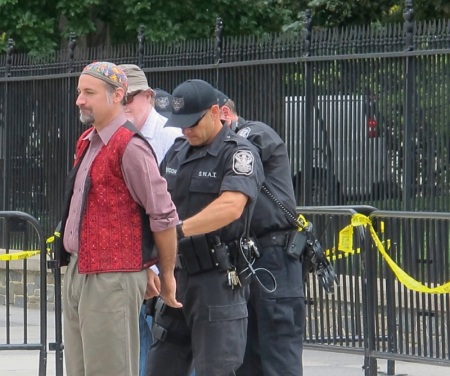
All honor to my friend and colleague, Rabbi Fred Scherlinder Dobb of Adat Shalom Reconstructionist Congregation in Bethesda – one of the leading rabbinical heroes of the environmental movement – who was among those arrested today (see above.) In a subsequent press release, he was quoted thus:

We must turn up the heat in a sustained effort against the scourge of climate change, which harms not just our land and water but people here and now, our human future and all earthly creation.

Please: if you aren’t able to join the action, please consider signing this petition or just contact the White House directly.
Coming Soon: Martin Luther King Jr. in Palestine

Last March, Academy Award nominated documentary director Connie Field went to Palestine with Clayborne Carson, director of the Martin Luther King, Jr. Institute, to film Carson’s play about King performed by the Palestinian National Theater and an African-American gospel choir.  Along the way, Field documented the accompanying cultural exchange between the two peoples – and the growing consciousness of the African-American choir members as they bore witness to the harsh realities of Palestinian life in the occupied West Bank.

I’ve long believed that the growing nonviolent movement in Palestine is reminiscent of the American civil rights movement in so many ways – and I’ll wager this film certainly has the potential to drive this point home in a powerful way. (Click above to see the trailer and you’ll see what I mean.)

Field and her production company, Clarity Films, are seeking donations via Kickstarter in order to complete the film. Click here if you’d like to contribute. You can also learn more about this worthy project through their Facebook page.

Eilat Attack Aftermath: Gazans Pay the Price Again

Since I wrote about last week’s Eilat/Gaza violence, I’ve read several news articles that report on increasing evidence that the Eilat attackers actually came from Egypt/Sinai and not Gaza.

From a +972 post by Yossi Gurvitz last week:

Yesterday evening the Egyptian newspaper Al Masry Al Youm reported that Egyptian security forces have identified three of the dead attackers. Egypt has a strong interest to claim the attackers were Gazans, since this would lessen its responsibility for the attacks; nevertheless, they say at least two of the attackers were known terrorists in the Sinai Peninsula. As far as I could find out, the rest of the bodies are in the hands of the IDF – which, again, does not reveal their identity.

This story has also been covered extensively by blogger Richard Silverstein at Tikun Olam, and more recently, by Amira Hass, writing for Ha’aretz. (Most of the mainstream media has, not surprisingly, long since moved on from this one.)

For an astute analysis of this whole tragic mess, I highly recommend Paul Woodward’s piece in War in Context:

As for those who have an interest in evidence, rather than taking comfort in deeply ingrained prejudice, the evidence suggests that the men who attacked Israelis yesterday and Egyptians today are in conflict with both states. More than likely, this has much less to do with Gaza or the Palestinian national cause than it has with the aspirations of radical groups based in the Sinai.

Those responsible for maintaining Israel’s security quickly claimed they knew exactly who was behind yesterday’s attacks in Eilat and duly dispatched the Israeli air force to rain down missiles on Gaza. No one explained why, if Israeli intelligence was so good, they had not prevented the attacks. Even so, the domestically perceived legitimacy of a security state depends less on its ability to thwart terrorism than its willingness to make a timely show of force. Indeed, the occasional tragedy has obvious political utility. The attacks in Eilat serve to remind Israelis that the state created as a safe haven for Jews can only remain safe so long as everyone remains afraid.

In the meantime, Israel’s assault against Gaza still continues. According to the Palestinian Center for Human Rights:

In the early morning of Thursday, 25 August 2011, two Palestinian civilians were killed and 25 others, including 11 children and 7 women, were wounded as Israeli warplanes bombarded a sports club in a densely-populated area in the northern Gaza Strip town of Beit Lahia. The attack resulted extensive damages to dozens of neighboring houses and facilities. On Wednesday, 24 August 2011, an elderly farmer and a worker were killed and four civilians were wounded, while three other persons are missing inside a tunnel at the Egyptian border due to an Israeli air strike against the tunnels.

It is looking increasingly likely that this latest violence has more to do with Israel-Egypt relations than Gaza. Is anyone asking why, then, is it largely Gazans who are paying the price?

Time to Leave Iraq as Promised!

At every JRC Shabbat evening service since December 2006, we’ve introduced our Prayer for Peace by reading the names of three American soldiers, three Iraqi civilians and three Afghan civilians who have been killed since these wars began in 2001.

It’s our way of very simply reminding ourselves that we are citizens of nation at war, that war comes with a real human cost, and that war is a terrible and daily reality for real life individuals. And we do it to acknowledge that as American citizens, we are complicit in all actions made by our country.

Exactly one year ago, when Obama announced a reduction of American combat forces in Iraq from 144,000 to 50,000 troops, I was tempted to stop reading the names of the Iraqi war dead during our services – but I was prevailed upon to continue by many JRC members. After all, Obama himself said that our active combat presence would be maintained until the end of 2011. And as long as this is the case, we’d be hard pressed to deny that we were still a nation at war.

And now – surprise of surprises – we’re hearing indications that Secretary of Defense Panetta and others in the Obama administration believe that “some American forces should stay beyond 2011.”

Oh yes, make no mistake: we are still very much at war in Iraq….

Obama campaigned on the promise to end this war. Americans oppose the war in Iraq by an overwhelming margin. Our economy is in crisis and Congress has committed to find $1.2 trillion in savings for the coming year.  It’s time to wake up from our slumber and let our leaders know its time to end this misbegotten adventure as promised.

Rep. Barbara Lee of California is currently sponsoring a bill known as the “Iraq Withdrawal Accountability Act” – legislation that would prohibit funding of troops and military contractors in Iraq past 2011. Please click here and join me in urging your Congressperson to co-sponsor Rep. Lee’s bill.

PS: At the risk of ending this post on an abjectly depressing note, I recently read that regardless of when the American military pulls out of Iraq, our presence there would still not be over by a long shot. Read, if you dare, this piece by ex-foreign service staffer Peter Van Buren, in which he explains what will actually happen when the American presence in Iraq is transferred from the military to the Dept. of State:

(The) State Department hasn’t exactly been thinking small when it comes to its future “footprint” on Iraqi soil. The U.S. mission in Baghdad remains the world’s largest embassy, built on a tract of land about the size of the Vatican and visible from space. It cost just $736 million to build — or was it $1 billion, depending on how you count the post-construction upgrades and fixes?

In its post-“withdrawal” plans, the State Department expects to have 17,000 personnel in Iraq at some 15 sites. If those plans go as expected, 5,500 of them will be mercenaries, hired to shoot-to-kill Iraqis as needed, to maintain security. Of the remaining 11,500, most will be in support roles of one sort or another, with only a couple of hundred in traditional diplomatic jobs. This is not unusual in wartime situations. The military, for example, typically fields about seven support soldiers for every “shooter.” In other words, the occupation run by a heavily militarized State Department will simply continue in a new, truncated form — unless Congress refuses to pay for it.

Tragedy in Eilat and Gaza: How Should We Respond?

In the wake of yesterday’s tragic violence in Eilat and Gaza, I commend to you this wise and rational-minded statement from Jewish Voice for Peace.

I would only add that I frankly think it’s remarkable, given Israel’s oppressive policies toward the people of Gaza, that we haven’t seen even more attacks such as this.  To be sure, these kinds of incidents do not exist in a vacuum. History has shown us again and again that when people are oppressed, they tend to resist – often violently.

And when it comes to the history of Gaza, this resistance – followed by overwhelming Israeli military retaliation – has been ongoing since 1948.

As Moshe Dayan said during a funeral of an Israeli killed by a Gazan in 1956:

Do not today besmirch the murderers with accusations. Who are we that we should bewail their mighty hatred of us?  For eight years they sit in refugee camps in Gaza, and opposite their gaze we appropriate for ourselves as our own portion the land and the villages in which they and their fathers dwelled.

This we know: that in order that the hope to destroy us should die we have to be armed and ready, morning and night. We are a generation of settlement, and without a steel helmet and the barrel of a cannon we cannot plant a tree and build a house.

Dayan, to his credit, understood the true source of Palestinians’ frustration and rage. But I think he was tragically wrong in his belief that Israeli machine guns and bomb shelters would be able to keep their rage at bay – or that their military power would ultimately keep Israelis safe. Yesterday’s incident in Eilat is but the latest proof of this sad reality. It didn’t work then, and it’s still not working now.

While I do not in any way condone Palestinian violence against Israelis, I do understand its source.  And until these root causes are fundamentally addressed, I fear we’ll only continue to hear more tragic news such as this.

With our Economy Tanking… 81 House Members Head to Israel

From the Washington Post (8/9):

A record 81 House members, about a fifth of the chamber, are spending a week in Israel this month, courtesy of a foundation set up by the American Israel Public Affairs Committee, a pro-Israel lobby.It’s apparently the largest number of lawmakers in the 20 years or so that these trips have been undertaken. They are run every other August in nonelection years. A group of 26 Democrats — the senior member is House Minority Whip Steny Hoyer (Md.) — is already there … (and) 55 Republican members , traveling in two groups, will take week-long jaunts to the Holy Land.

Yes, you heard that right: we’ve narrowly avoided a default on our national debt, our credit rating has been downgraded by the S&P, US markets are in a downfall, unemployment is at 9%, 10 million families are facing foreclosure on their homes by next year, and 20% of the House of Representatives is going to Israel on an all expense paid junket.

It’s not an understatement to say there is something horribly wrong with the priorities of our national leaders. The US Campaign to End the Israeli Occupation nails this point right on the head:

We are in an economic crisis. We’ve got to send a stringent warning to our elected officials that we will no longer accept business as usual. Take action today to demand that Members of Congress do their job to respond to this crisis by working in their districts and listening to us, not by taking lobbyist-paid junkets to guarantee their support for even more money and weapons to Israel.

If you share my sentiments, you might want to find out if your Rep is participating in this mega-junket. Click here for some helpful action suggestions provided by the US Campaign.

Israel Economic Protests: What Game is Being Changed?

This past April, the Forward reported:

(The Organization for Economic Cooperation and Development) has reported that poverty is almost twice as widespread in Israel, 19.9% of the population, compared to the OECD average, 10.9%. The gap between the overall standard of living in Israel and that of the lowest tenth of the population was three times higher than the OECD average. In its latest release of data, made public April 12, the OECD reported that 39% of Israelis find it “difficult” or “very difficult” to live on their current incomes, well above the OECD average of 24%.

Those stats might explain this more recent news out of Israel:

More than 150,000 protesters took to the streets in 12 Israeli cities, calling for a change in the division of wealth and the resignation of Prime Minister Benjamin Netanyahu.

In Tel Aviv, an estimated 100,000 protesters marched from Habima Square to the Tel Aviv Museum. “We are happy to see the people of Israel taking to the streets, each in their own city, each with their own troubles, but many troubles that are common to all of us,” said one of the organizers, Yonatan Levy.

This one is a game changer, no question, but the jury is still out on how much it might eventually change, or what the game even is. Indeed, as Dahlia Scheindlin and Joseph Dana have just reported in +972:

Every grievance is coming out: there are slogans against the huge concentration of the country’s wealth into the hands of a very few, slogans raging against enormous economic gaps between rich and poor in Israel, lists of demands for just resource distribution and for various elements of a welfare state, salary hikes and lower costs, better education conditions and health care; against the national housing committees law, against the government, for Tahrir. At 10pm on Friday night, when a song group spontaneously burst into chants of “The people! Want! Social Justice!” one young woman sang out beatifically, “The people! Want! All Sorts of Things!”

It’s also notable that one critical cause of this economic disparity is glaringly absent from the protesters’ concern, as Aziz Abu Sarah noted last week:

What amazes me is many Israelis’ inability to make the connection between the continuation of the occupation and the domestic problems Israel faces today; Israel is building constantly in the West Bank but it is failing to provide housing to its citizens within Israel proper. The current Israeli government’s focus on improving living standards in settlements while failing to do the same for the rest of the country is a moral failure.

According to a Peace Now report published on July 20, settlers in the West Bank receive 69 percent discount on the value of the land (so that buyers have to pay only 31 percent of the price of the land) and 50 percent funding of the development costs of the building project. In 2009 Israel investment of settlements public building (excluding East Jerusalem) was 431 million shekels, which was 15.36 percent of all public investment in construction for housing that year, despite the fact that they compose only 4 percent of the residents of Israel.

Scheindlin/Dana drive this critical point home in their article as well:

On Friday, some protesters hassled other Palestinian protesters, citizens suffering from housing crises. It came to scuffles. The diminutive Palestinian flags they hung were removed. Joseph recalls the struggles against apartheid in South Africa and Jim Crow south. Can we imagine the ruling classes there demanding “social justice” without addressing their gravest internal injustices? What does the term “social justice” mean if so many who don’t have it are left out? Sure, let’s protest exorbitant housing costs – but why call it “social justice” if the very crux of social justice, namely equality, is not addressed? Can Israelis have a social justice revolution without speaking about the rights of people they control and occupy?

The remarkable power of these grassroots protests is undeniable – but just how far it goes in shifting power still remains to be seen.

(While we wait, however, at least we can enjoy this great mix by Israeli viral video satirist Noy Alooshe – see above…)