Monthly Archives: August 2012

On the Rachel Corrie Verdict and Doing the “Reasonable” Thing

I’m sure many people find it perfectly reasonable that an Israeli court recently ruled Palestinian solidarity protester Rachel Corrie caused her own death in 2003 by standing in front of a moving bulldozer. After all, as Judge Oded Gershon pointed out, she knew the risks. She “chose to endanger herself” by going into a “closed military zone” to try and stop the destruction of a Palestinian home in southern Gaza.  Then she refused to step aside, as “any reasonable person would have done.”

If this verdict all sounds perfectly “reasonable” to some, I believe it is only because it was presented devoid of any real context. It utterly ignores the fact that it is the Israeli military – and by extension, Israel itself – that creates the rules that govern the “reality” of this situation. The court could rule any way it pleased – even despite all evidence to the contrary – because at the end of the day it answers to no one but itself.

Why was this civilian area deemed a “closed combat zone?” Because the Israeli military deemed it as such. This, despite the fact that no combat was taking place in the area on that day and no closed military zone order was ever presented in court. This despite the compelling claims that these home demolitions have nothing to do with Israeli’s security and everything to do with collective punishment.

If you have any doubt about the length and breadth of Israel’s military impunity, I urge you to read this article by the Guardian’s Chris McGreal – to my mind the most important article about the Corrie verdict thus far:

The case laid bare the state of the collective Israeli military mind, which cast the definition of enemies so widely that children walking down the street were legitimate targets if they crossed a red line that was invisible to everyone but the soldiers looking at it on their maps. The military gave itself a blanket protection by declaring southern Gaza a war zone, even though it was heavily populated by ordinary Palestinians, and set rules of engagement so broad that just about anyone was a target.

Yes, Rachel Corrie knew the risks. As an activist with the International Solidarity Movement (ISM), she went through extensive training to prepare herself to engage in this form of nonviolent protest.  Eyewitnesses testified that she wore a high visibility orange vest and stood in full view of the soldier driving the bulldozer. But tragically, I doubt all the precautions in the world could ever have protected her from what McGreal refers to as “the collective Israeli military mind.”

Or, for that matter, Israeli military justice. As is now well known – and has even been admitted by US Ambassador to Israel Dan Shapiro – the IDF’s investigation into Rachel’s death was a sham, carried out by a team of 19-year-old inexperienced boys who never interrogated a single Palestinian or non-military witness. This is a critical point: Israel has to date not carried out a full, credible investigation of its military’s actions on that day – actions that resulted in the death of an American citizen. As Rachel’s mother Cindy has correctly pointed out: “a lawsuit is not a substitute for a legal investigation, which we never had.”

I have met Rachel’s parents Cindy and Craig on several occasions now and I know them to be among the most compassionate and principled social justice activists I have ever met.  Yes, they are pursuing this case because of what happened to their daughter, but anyone who knows them knows they are driven by a deeply held belief in justice.  Notably, they only sought one dollar in damages from the Israeli government – an award which Judge Gershon refused to grant them in his ruling.  I have no doubt that Cindy Corrie meant it from the bottom of her heart when she said after the verdict:

This is a sad day, not only to us, as a family. This is a sad day for Israel, a sad day for human right activists, a sad day for international law, a sad day for justice.

I do agree with Judge Gershon when he ruled that Rachel did not step aside “as any reasonable person would have done.”  As too many nonviolent protesters know all too well, when you find yourself in the midst of an unjust context, doing the just thing is rarely the most reasonable option. (I’m sure many didn’t consider it “reasonable,” for instance, when marchers in Selma walked straight into a line of armed state troopers on the Edmund Pettus Bridge in 1965.)

Look at the clip above. It comes from a Korean news story about the Palestinian nonviolent protest movement in the West Bank. In this clip, you can see ISM founder Huwaida Arraf protecting protesters from armed soldiers with her own body. Nothing reasonable there. How many of us have one iota of her – or Rachel’s – courage to stand firm in the face of such overwhelming injustice?

At the press conference following the verdict, the Corries were asked how they felt that the judge said that Rachel should have moved out of the bulldozer’s way. Cindy Corrie’s response:

I don’t think that Rachel should have moved. I think we should all have been standing there with her.

On the Smear Campaign Against Some “Rabbis for Obama”

Here is a post I co-wrote with Rabbi Alissa Wise for the Forward Thinking Blog of the Jewish Daily Forward:

The Republican Jewish Coalition and the Emergency Committee for Israel this week urged a group of rabbis supporting President Barack Obama’s reelection to purge members of the Jewish Voice for Peace Rabbinical Council from its ranks. The conservative groups claimed they were shocked by the inclusion in the “Rabbis for Obama” list of those whose “values are representative of a small and extreme group of anti-Israel activists.”

We are deeply dismayed by this cynical attempt at political gain through smears, half-truths and innuendos that only serve to create division in the Jewish community.

It is certainly true that many of on the JVP Rabbinical Council are deeply critical of Israeli policy (and the U.S. policy that too often enables it). It is not at all true, however, that such criticisms are “extreme” or marginal. Indeed, increasing numbers of Jews and Jewish leaders are finding the courage to speak out publicly against Israel’s practice of home demolition, forced eviction, settlement expansion and administrative detention, as well as its widespread restriction on Palestinians’ freedom of movement in the West Bank and Gaza.

Jewish Voice for Peace rabbis were not the only ones singled out by RJC and ECI’s smear. William Kristol included members of the J Street Rabbinical Cabinet and Rabbis for Human Rights as well. There are many perspectives within the American rabbinical community about how to create a just and lasting peace between Israelis and Palestinians. At the same time, we share a commitment to open and honest conversation about how a negotiated solution can ensure security and human rights for all.

By a margin of more than 2 to 1, according to the Public Religion Research Institute American Jews say that good diplomacy rather than military strength is the best way to ensure peace (63% vs. 24% respectively).

This reality stands in sharp contrast to the Jewish donors to the Republican party, such as Sheldon Adelson, who has reportedly asked Romney to state publicly that Israeli-Palestinian peace talks are a “waste of time.” Adelson is also pressing Romney for a firmer commitment to move the U.S. Embassy in Israel from Tel Aviv to Jerusalem, in what would be a de facto recognition of Israel’s annexation of East Jerusalem. These views lie far outside what most Americans would tolerate or expect from an American president.

We are saddened, but not surprised, by these smear tactics. They have long been the stock in trade of a Jewish establishment that demands lock-step agreement from Jewish rabbis and leaders – and Jewish neo-conservatives who do not hesitate to use divisive rhetoric and slanderous allegations against their own community members to achieve their political goals.

We are proud of the diversity of the American Jewish community and voice our hope that it will make room for all those who are dedicated to a future of peace, justice and dignity in Israel and Palestine. We are heartened that that by resisting calls to purge individual rabbis from their ranks, the leadership of “Rabbis for Obama” is remaining true to this inclusive vision.

In Israel, Every Sperm is Sacred

This just in:

(The) quality of Israeli sperm is falling at an alarming rate, and no one’s sure exactly why.

Fertility is a major issue in Israel, where memories of the Holocaust genocide are fresh, and having children is an entrenched part of Judaism. There’s also a political aspect, because birthrates among Arabs in Israel have at times been as much as double those of Jews, triggering a population race that some believe could one day affect who controls the land.

…The white-coated director of the Hadassah Sperm Bank, Ruth Har-Nir, hunches over a microscope to view a freshly donated specimen and begins to methodically count each squiggly swimmer magnified on the slide.

… After a quick scan, she sits up straight and shakes her head. The number of spermatozoa darting around each tiny grid on the slide is two to four, well below the minimum six required, and nowhere near the 10 to 20 per grid that indicates the kind of healthy concentration the bank likes to see.

Also, rather than surging forward, some of the little guys flit left and right or just stall out, suggesting a weak motility.

“Under no circumstances can we accept sperm of this quality,” she says.

No, it’s not Monty Python.  Just the kind of black comedy gold that ensues when a nation fights a “demographic time bomb”

“Wrestling in the Daylight” Launch Party!

Please join me in celebrating the publication of my new book, “Wrestling in the Daylight: A Rabbi’s Path to Palestinian Solidarity” on Thursday, September 6, 7:00 pm at The Book Cellar, 4736-38 N. Lincoln Ave, Chicago.

From a recent review by Rabbi Rachel “Velveteen Rabbi” Barenblat:

Gwen Macsai

“Wrestling in the Daylight”… is Rabbi Brant’s self-curated compilation of his blog posts from Shalom Rav, so if you’ve been reading Shalom Rav, this material won’t be new to you. But I’m finding, as I read, that reading the posts in this new setting and context — curated by their author into a narrative which clearly shows the progression of his thinking over time — is a different experience from reading the blog. And Rabbi Brant has chosen to reprint some of the comments from readers as well as responses he’s offered to those comments, which gives the book a bit of the internet’s Talmudic multivocality (and offers an example of how one can host difficult conversations in a thoughtful and generous way — which can be hard to come by on the internet, especially on questions of Israel/Palestine.)

Andrew White

The choice to include commentary makes the book particularly interesting, I think. Some of Rabbi Brant’s most frequent commentors disagree with him deeply. Over the course of the book, one can see conversations unfolding. Sometimes they are quite heated. And his responses are always thoughtful and respectful, even as he resists attempts at derailing the conversation. Having hosted some conversations about Israel at this blog over the years, I have a sense for how difficult that can be.

Kevin Coval

… Rabbi Brant Rosen is one of my role models in the difficult but important work of coming to terms with the clash between the classic Zionist narrative (a story which many of us want to continue believing — I know I still yearn for it to be true) and some of the realities on the ground in Israel and the Palestinian territories. He models for me not how one would do this internal work despite his ardent Jewishness, but precisely of it; not despite being a rabbi, but precisely because his rabbinate calls him to take seriously the Jewish call to stand with those who are oppressed. And he has also taught me a great deal about how to disagree without falling into the trap of looking down on (or dehumanizing) those with whom one disagrees.

If you’re interested in progressive Jewish takes on Israel and Palestine, this book is worth reading, and worth having on your bookshelf to return to again.

I’m thrilled to be joined at our September launch party by local Chicago celebs Kevin Coval, (Poet, Co-Founder, “Louder Than a Bomb“), Gwen Macsai, (Host, WBEZ’s Re:Sound) and Andrew White (Artistic Director, Lookingglass Theatre Company), who will join me in reading excerpts from the book. We’ll also make plenty of time for Q&A, book signing and quality bookstore shmoozing.

It promises to be a wonderful evening – RSVP at our Facebook event page here.

Standing Down Rep. Joe Walsh’s Islamophobic Bigotry

Shortly after a gunman killed six worshipers in a Wisconsin Sikh temple and a Joplin Missouri mosque was burned to the ground, Illinois Congressman Joe Walsh felt perfectly comfortable uttering incendiary anti-Muslim comments at a town hall meeting last Wednesday, warning that “there is a radical strain of Islam in this country…trying to kill Americans every week.”  Offering no evidence or backup for his allegations, he continued: “It’s here. It’s in Elk Grove, it’s in Addison, it’s in Elgin. It’s here.”

Then he poured it on:

I’m looking for some godly men and women in the Senate, in the Congress, who will stand in the face of the danger of Islam in America without political correctness.  Islam is not the peaceful, loving religion we hear about.

Shortly after Walsh’s town meeting remarks, pellet rifle shots were fired at a mosque in Morton Grove, IL.

I don’t know about a domestic “radical Islamic plot” but by now it should be abundantly clear that there is a deadly strain of Islamophobia in our country. In such a climate, I’d say it is the height of irresponsibility for public servants to issue remarks such as these.

It was my honor to stand, together with interfaith colleagues, with my good friends at CAIR – Chicago to express our outrage at Walsh’s sick bigotry (clip above). If you stand with us, please, please let Rep. Walsh know how you feel.

Talking Tikkun Olam on Poco a Poco Radio

I recently had the pleasure, along with my good friend, community organizer extraordinaire Michael Deheeger (left), to be interviewed by Gonzalo and Maya Escobar for the Poco a Poco Radio program on WLUW 88.7 Chicago. During our wonderfully wide-ranging bilingual conversation, we had the opportunity to explore the Jewish roots of social justice and how it informs our work as activists.

Chicago locals can hear the interview on Sunday, August 12 1:30 pm at 88.7 FM, but anyone anywhere can tune in to the live stream from the WLUW website. And if you can’t catch it live, never fear – the full version of the interview will soon be archived at the site.

Parsing the (Odious) New Term, “Jew-Washing”

photo: Jewish Voice for Peace

Cross-posted in the “Forward Thinking” blog of the Jewish Daily Forward:

In his latest column, Philologos correctly parses the linguistic problems with Yitzhak Santis and Gerald M. Steinberg’s invented term, “Jew-washing.” His political analysis, alas, fails miserably.

Philologos has it completely wrong when he speaks of the “anti-Semitism in boycotts of Israel.” To begin with, Santis and Steinberg did not use the term “Jew-washing” in reference to a boycott of Israel as a whole, but rather to a resolution recently brought to the Pittsburgh General Assembly of the Presbyterian Church (USA) that called for divestment of their pension funds from three specific companies that profit from Israel’s brutal and illegal occupation of the West Bank.

Regardless, it is highly disingenuous for Philologos to accuse the Presbyterian Church of anti-Semitism. Our Christian friends’ response to the Palestinian civil society call for Boycott, Divestment and Sanctions (BDS), reflects their deeply held commitment to justice in a land their tradition also considers holy.

Philologos asks, “Have the Presbyterians considered boycotting China because of Tibet? India because of Kashmir? Russia because of Chechnya?” This, of course, is classic misdirection. The issue at hand is not global human rights, but a very specific call from Palestinian civil society for international support in ending their oppression.

The real question before them (and us) is not “what about Tibet, Kashmir and Chechnya?”  The question, rather, is: “will we or won’t we respond to the Palestinian call?” To this question, many members of the Presbyterian Church are courageously responding “we will.” So too are increasing numbers of Jews who believe that our legacy of anti-Jewish oppression leads us to stand with Palestinians being denied basic human rights in our name.

No, we are not being used as pawns by Christian partners to further some nefarious “anti-Semitic plot”. Rather, we are standing in solidarity with the oppressed, as the most basic of our Jewish teachings demand that we do.  What irony that other Jews should stand in the way of the Jewish imperative to end injustice. How heartbreaking that some in the Jewish community pervert this imperative by labeling the best intentions of our Christian friends as “anti-Semitism.”

We do, however, fully share Philogos’ distaste for the term “Jew-washing,” the coining of which is a sign of abject desperation that itself crosses the line of anti-Semitism, as blogger Jeremiah Haber pointed out last week. We predict that odious terms such as this will soon be relegated to the history books as part of a last, flailing effort by a fearful generation of Jewish leaders unwilling to recognize the moral urgency of the moment. It also reflects the short-sightedness of an establishment that continues to support war and occupation while deliberately alienating itself from the next generation of courageous Jewish leaders.

Syrians Pay the Price in a Sick Proxy War

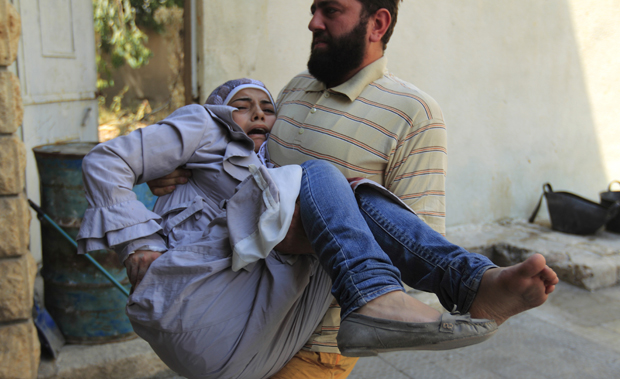
An injured civilian is evacuated after shelling by government forces in Aleppo. (Zohra Bensemra/Reuters)

Now that UN Secretary General Kofi Annan has resigned and is no longer leading the effort to find a diplomatic solution to the horrors unfolding in Syria, the prospect for a peaceful conclusion to this conflict look bleaker than ever – if it’s even possible to suggest such a thing:

(Kofi Annan) cited the Syrian government’s “intransigence” and the opposition’s “escalating military campaign” as major impediments to his peace efforts, along with a lack of unity in the international community on how to deal with the crisis.

I’m thinking “lack of unity in the international community” was just Annan’s polite way of saying this tragic mess in Syria has devolved into a sickening proxy war in which no one’s hands are clean and the only losers are the Syrian people themselves.

If you dare, I recommend you read this blisteringly bitter analysis by journalist Robert Fisk, who excoriates the cynical interests – from the US, to Russia and China, to Qatar and Saudi Arabia, to Hezbollah, to the media, to “our dear liberal selves – who are allowing Syria to be used as a bloody chess board, even as they speak out against the daily atrocities that are occurring there:

Has there ever been a Middle Eastern war of such hypocrisy? A war of such cowardice and such mean morality, of such false rhetoric and such public humiliation? I’m not talking about the physical victims of the Syrian tragedy. I’m referring to the utter lies and mendacity of our masters and our own public opinion – eastern as well as western – in response to the slaughter, a vicious pantomime more worthy of Swiftian satire than Tolstoy or Shakespeare.

What could possibly be the outcome of a cowardly proxy war in a sectarian Middle Eastern country? Samia Nakhoul, in a lengthy piece for Reuters, offered this dismal – if most likely – answer:

With no Western appetite for military intervention and no prospect of an internationally mediated political resolution, many see the civil war spreading and tearing the country apart.

“Disintegration of Syria is a possibility and the problem is it won’t work. It would create a power vacuum in which others get dragged in just like Iraq. It is a very frightening scenario,” (Cambridge University analyst George) Joffe said.

Lebanese columnist Rajeh Khoury predicted: “Syria could plunge into a long protracted civil war that could last years. The civil war in Lebanon, with its much smaller population of five million, lasted 15 years due to foreign interference so Syria would be much more complicated.

“The Syrian crisis is so inflammatory that its flames will affect the region in one way or another.”

A prayer for the people of Syria – and a pox on all our houses…