Monthly Archives: October 2015

The “Religious Roots” of Palestinian Violence: A Self-Fulfilling Prophecy?

al

Benjamin Netanyahu’s recent comment at the World Zionist Congress attributing the Final Solution to the Grand Mufti of Jerusalem was stupid and ignorant – and he has been justifiably ridiculed around the world for making it. But those who think these kinds of crazy comments will somehow prove his downfall should think twice. Netanyahu has long been willing to take his lumps for his silly behavior as long as it ultimately serves his political purpose. In this case, his purpose is clear: he is attempting frame Palestinian violence as the result of religious (read “Muslim”) intolerance of Jews.

And those of us who delight in ridiculing Bibi the Clown should take heed: there is every indication that his attempts to shift this particular narrative are starting to gain traction.

Just a few days before Netanyahu’s comments, for instance, Jeffrey Goldberg, a well-known mainstream media journalist, published an article in The Atlantic entitled “The Paranoid, Supremacist Roots of the Stabbing Intifada.” His conclusion?

One of the tragedies of the settlement movement is that it obscures what might be the actual root cause of the Middle East conflict: the unwillingness of many Muslim Palestinians to accept the notion that Jews are a people who are indigenous to the land Palestinians believe to be exclusively their own…

In his piece, Goldberg traces this “root cause” as far back as the 1920s. Like Netanyahu, he casually portrays the wretched Mufti of Jerusalem, Haj Amin al-Husseini as a surrogate for the Palestinian people writ large, conveniently neglecting to point out that al-Husseini was not in fact chosen by Muslim Palestinians, but was actually appointed by the British High Commissioner Herbert Samuel in 1921 – and that he was dismissed as Mufti in 1936, five years before he famously met with Hitler. Even more crucially, treating a colonially-appointed Muslim leader as representative of the entire Palestinian people conveniently ignores the presence of Palestinian Christians, who in the 1920s made up one tenth of the population of Palestine.

In its way, his post was even more dangerous than Netanyahu’s silly remark, as it put a legitimate face on the claim that the Israel-Palestine conflict can essentially be reduced to Muslim intolerance of Jews. In contrast to Netanyahu’s remarks, Goldberg’s article was widely respected and went viral across the social media. Much to my dismay, many of my liberal rabbinic colleagues approvingly posted it on their Facebook pages.

In his article, Goldberg also pointed to recent “harsh” statements by Palestinian Authority President Mahmoud Abbas, suggesting that “these sorts of comments…suggest a tragic continuity between the 1920s and today.” Abbas’ comments were odious to be sure, but it is ludicrous in the extreme to somehow characterize him as a wide-eyed Muslim extremist. And it is even more ludicrous to suggest that the majority of young Palestinians engaging in the current violence have been “incited” by his words.

As Israeli journalist Mya Guarnieri has rightly observed:

Those who call this a religious war, and who point to Abbas’ words as incitement, have got it backwards. Abbas — whose term expired in 2009 and has little legitimacy on the Palestinian street — is trying to insert himself into recent events in a bid to regain popularity.

But the Palestinian youth who are protesting and carrying out attacks on Israelis care little what he or other politicians say. Indeed, their actions can also be understood as moves against the current state of politics, including the Palestinian Authority itself. The young people are calling for something new, for something more than endless negotiations that go nowhere or that buy Israel the time to build more settlements and deepen the occupation. After all, this is the generation that was born and raised after the Oslo Accords were signed in 1993 — their difficult lives are a testimony to what negotiations will get the Palestinian people. That is to say, little.

That’s right: the true “roots” of this tragedy are not religious but political. If we are to draw a direct from the violence of the 1920s until today, it should more accurately be traced from a collision between a Jewish ethno-nationalist enterprise and an indigenous population resisting displacement and occupation.

I find it notable that Goldberg does not track his “religious intolerance” narrative further back than the 1920s. In fact, while there has always been a Jewish presence in this land, there was relatively little tension between the religious communities of Palestine before the 19th century – when the Zionist movement began colonizing it with the express purpose of creating an exclusively Jewish state in a historically multi-religious and multi-ethnic land.

Having said this, however, I do fear that the longer this political injustice is allowed to continue – the longer Israel’s oppression of Palestinians is allowed to continue with impunity – the more likely we will witness the rise of religious extremists on both sides. This is clearly Netanyahu’s strategy of course: to “manage the conflict” until the religious extremist meme invariably becomes a reality.

Just yesterday, for example, the Israeli Prime Minister was quoted as saying that although he does not want a bi-national state, “at this time we need to control all of the territory for the foreseeable future…I’m asked if we will forever live by the sword – yes.” Then most tellingly, he added this all-too-familiar analysis: “half of the Palestinians are ruled by an extreme Islam that wants to destroy us.”

Yes, on the one hand it’s just more Bibi-bombast. But don’t dismiss his words too easily. As long as Israel seeks to “control all of the territory,” the more likely the chances that his cynical narrative will tragically become a self-fulfilling prophecy.
Stop the Killing, End the Occupation: A Statement from the Global Jewish Network for Justice

f04da2db14840f3a1d9033

Please read and share this statement, which was initiated by an international Jewish network of groups and individuals working for justice in Palestine. We reclaim Jewish identity not as a nationalist identity but as one that celebrates our diverse roots, traditions & communities wherever we are around the world. We believe that it is essential for there to be a global Jewish voice to challenge Israel’s destructive policies, in solidarity with the Palestinian struggle. This international Jewish network aims to become that voice.

If you would like to sign on to this statement as an individual or a group, click here.

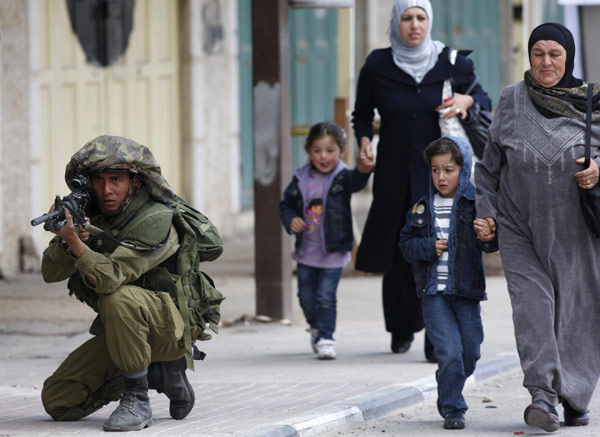
As members of Jewish communities around the world, we are horrified by the violence that is sweeping the streets of Palestine/Israel, costing the lives of over 30 people, both Palestinians and Israelis in the past two weeks alone. A 2 year old girl in Gaza was the youngest of 4 Palestinian children who were killed in the past two weeks. A 13 year-old Israeli boy is in critical condition after being stabbed nearly a dozen times. Over a thousand people were injured in the same period. Fear has completely taken over the streets of Jerusalem, the center of this violence. Israelis shooting Palestinian protesters in and around East Jerusalem. Palestinians stabbing and shooting Israeli civilians and policemen in the middle of the streets. Israeli forces killing Palestinian suspects when they are clearly not a threat and without trial. Palestinians throwing stones at passing cars. Israeli mobs beating up Palestinians or calling on police to shoot them. Humiliating strip searches of Palestinians in the streets – all of these have become a daily occurrence in the city in which we are raised to pray for peace, as well as other places in Israel, Gaza and the West Bank.

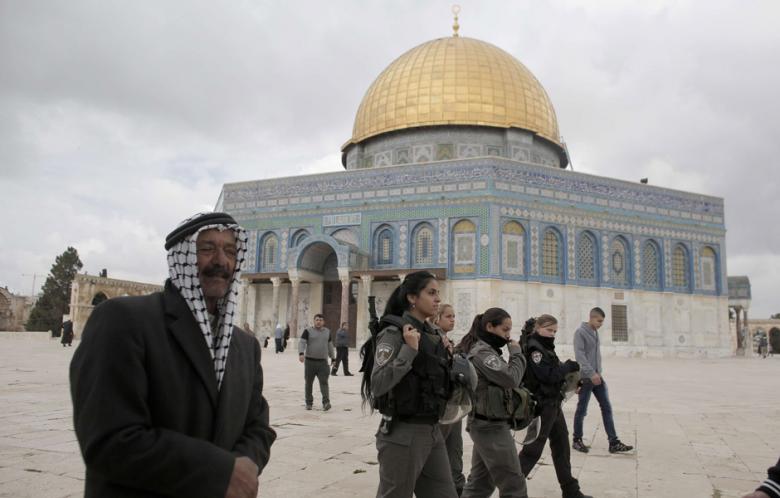
While violence is visible on the streets, it is also occupying people’s minds and hearts. Fear is bringing out the worst of people, and the demand for more blood to be shed, as if this will repair the damage done. Fear and racist rhetoric are escalating the situation. The Israeli government is once again responding in a militarised way: there have been hundreds of arrests; Palestinian access to the Al-Aqsa mosque compound has been limited; parts of the Muslim quarter of the Old City of Jerusalem have been closed to Palestinians; open-fire regulations have been changed to allow the use of sniper fire against children; a minimum sentence for stone throwing has been introduced, including for over 150 children arrested in East Jerusalem alone in the past few weeks; and now there are talks of enforcing a curfew, or even a closure, of East Jerusalem.

All these constitute collective punishment on the entire population of East Jerusalem with over 300,000 people. In the past, these measures have proven themselves ineffective at ending violence. Decades of dispossession, occupation and discrimination are the main reasons for Palestinian resistance. Further Israeli military repression and ongoing occupation and siege will never end the Palestinian desire for freedom nor will it address the root causes of violence. Indeed, the current actions by the Israeli government and army are likely to create further violence, destruction, and the entrenchment of division. Only justice and equality for all will bring peace and quiet to the residents of Israel and Palestine.

As a group of Jews from around the world we believe that immediate change needs to come from the Israeli government and Israeli people. It is incumbent on all Jews around the world to pressure the Israeli government – and those who follow and support its words and deeds – to change its approach. The military crackdown must cease immediately, Palestinians must be allowed complete freedom of movement. It is also a responsibility of Jewish people worldwide to obligate the countries in which we live to immediately cease the economic and military support of the ongoing Israeli occupation in Palestine and siege of Gaza.

We call on our Jewish communities, and our broader communities, to publicly insist on an end to the violence, occupation, siege and military response and instead demand equality and freedom for the Palestinian people and justice for all.

“Who will be Next?” Max Blumenthal’s Yom Kippur Presentation at Tzedek Chicago

Max and BrantOn Yom Kippur, journalist Max Blumenthal delivered this powerful presentation during the afternoon program at Tzedek Chicago, where he discussed what he witnessed in Gaza during Israel’s military onslaught last summer. He wrote about his experiences at length in his recent book, “The 51 Day War: Ruin and Resistance in Gaza.”
Max attended our services for the duration of Yom Kippur and remarked to me on more than one occasion how important it was for him to be invited to speak in a Jewish congregation for the first time.

For my part, I could not think of a more appropriate presentation for the Jewish Day of Atonement.

Please watch and share…


On the Uprisings in Jerusalem: Let Israel Renounce Violence

Photo: ynet.com

Photo: ynet.com

During the course of the tragic violence coming out of Jerusalem in the past week, I’ve been reading with familiar frustration the American Jewish establishment’s predictable accusations of “Palestinian incitement.” But I must confess I’m finding the reactions of some liberal Jewish leaders to be even more infuriating.

One prominent rabbi, for instance, who I know personally and would surely describe herself as on the progressive side of the Israeli peace camp, recently wrote this on her Facebook page:

Punching back with violence as a response to violence is the easy reaction. Each side has much to point to on the other side — each claims the mantel of victim, each claims the justice of their violent response. It takes courage to commit to non violence and lasting justice for all.

This is, indeed, the liberal Jewish meme when it comes to these outbreaks of violence in Israel/Palestine: “the level playing field.” According to this narrative, there is violence on both sides and peace will only come when courageous leaders on both sides commit to nonviolence.

The only problem with this narrative of course, is that it utterly ignores the all-pervasive and overwhelming nature of Israeli state violence. And given this structural imbalance of power, it is disingenuous in the extreme to somehow claim that “each side has much to point to on the other side.”

Yes, all violence is ugly and it is tragic – but this violence also exists within a context. Logically and ethically speaking, we simply cannot equate the brutal reality of state violence with the violence of those who resist it.

Yes, it does take “courage to commit to nonviolence and justice for all.” But when a state regularly employs violence to control and dominate another people, it is so very wrong to blithely call for “nonviolence” on all sides when that people inevitably fights back.

Nelson Mandela (once a “terrorist” now a “statesman”) certainly understood this when then South African Prime Minister P.W. Botha offered him the chance to be let out of prison (for the sixth time) if he publicly renounced violence – and Mandela famously responded, “Let him renounce violence.”

And even the most revered nonviolent leader of our day – Dr. Martin Luther King Jr. – had this to say in 1967 after speaking to the “the desperate, rejected and angry young men” who resorted to violence in America’s black ghettos:

I knew that I could never again raise my voice against the violence of the oppressed in the ghettos without having first spoken clearly to the greatest purveyor of violence in the world today, my own government.

Yes, those in the Jewish community who purport to support the cause of peace must first reckon with the reality of the context of violence that exists every single day by a people who live under military occupation.

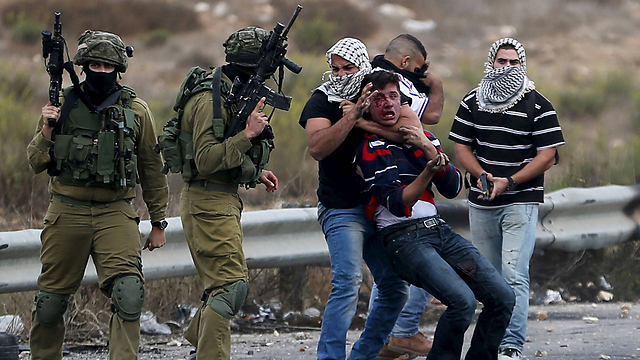
How many liberal Jewish leaders have called for “nonviolence” when last year, one Palestinian was killed by the Israeli military every 4.26 days? How many called for Israeli “nonviolence” last month after the killing of  Hadeel al-Hashlamoun, an 18 year old Palestinian woman who was shot and killed by an Israeli soldier in Hebron in what Amnesty International has described as an “extrajudicial execution?” For that matter, how many called for “lasting justice” this last July, when a Palestinian family was burned alive by settlers and the Israeli government stated it “had chosen to prevent legal recourse” even though it knew the identity of the murderers?

Frankly, given this constant and all pervasive context of Israeli state violence, it’s remarkable that these kinds of Palestinian uprisings don’t break out more often than they do. But when they invariably occur, we do the cause of peace no favors when we proclaim that “each side has much to point to on the other side” and call for a renewed commitment to “nonviolence.”

How will we achieve lasting justice for all? To paraphrase the oft-quoted Nelson Mandela: “Let Israel renounce violence.”

On Sukkot and the Struggles Over Chicago’s Dyett High School and the South Side Trauma Center

TCNOW

We’re currently in the midst of the Jewish festival of Sukkot – the harvest festival that commemorates the wanderings of the Israelites in the wilderness. I’ve always been fascinated tension by an inherent tension in this holiday: on the one hand Sukkot is referred to as “Zman Simchateinu,” the “time of our rejoicing,” but it is also a time tinged with seriousness and an innate sense of existential fragility.

Yes, this is the season in which we rejoice over our bountiful harvest – but this is also the time in which we plant a new set of crops and begin our prayers for rain, keenly aware that they/we are ultimately dependent upon forces outside our control. Yes, we rejoice as we arrive at this latest point in our journey – but we build and dwell in impermanent sukkot, as if to acknowledge the challenges and trials that most certainly await us on the road ahead.

I can’t help but think of this Sukkot-tension in relation to two local struggles going on here in Chicago. The first is the movement to save Dyett High School in the South side neighborhood of Bronzeville. Dyett was one of the many Chicago public schools that was closed by the city in predominantly black and brown communities. In response, a local coalition formed that developed an extensive plan to reopen Dyett as open enrollment neighborhood school focused on Global Leadership and Green Technology.

After first refusing, CPS eventually agreed to consider the community’s plan – but when it became clear that CPS had no intention in engaging in an honest, engaged process with the community, twelve members of the coalition went on a hunger strike in protest. (It was my honor, along with members of my congregation Tzedek Chicago, to draft a Jewish community letter to Mayor Rahm Emanuel demanding that he respond to the Dyett hunger strikers request. We delivered it to the mayor’s office on the second day of Rosh Hashanah)

After three weeks, CPS announced a “compromise.” It would reopen Dyett as a neighborhood public school, but not according to the Global Leadership Plan or any of the two other plans that had since been put forth. At the time the hunger strikers rejected this decision, stating that it was made over the heads of community members and without any due consideration of the desires of those who actually live in Bronzeville. The hunger strike continued on for a total of 34 days before they ended their action due to the health concerns of some of the strikers.

In announcing the end of the strike, hunger striker Monique Redeaux-Smith commented:

While we cannot yet claim complete victory, we do understand that our efforts so far have been victorious in a number of ways … Last year, Dyett was closed. But through community resistance, it was slated to be reopened in 2016 and ’17. And even though there was a request for proposals, we know that the plan was for that space to become another privatized school within Bronzeville. But again, through community resistance and this hunger strike, we pushed CPS and the mayor to commit to reopening Dyett as a public, open-enrollment neighborhood school. So that is an accomplishment.

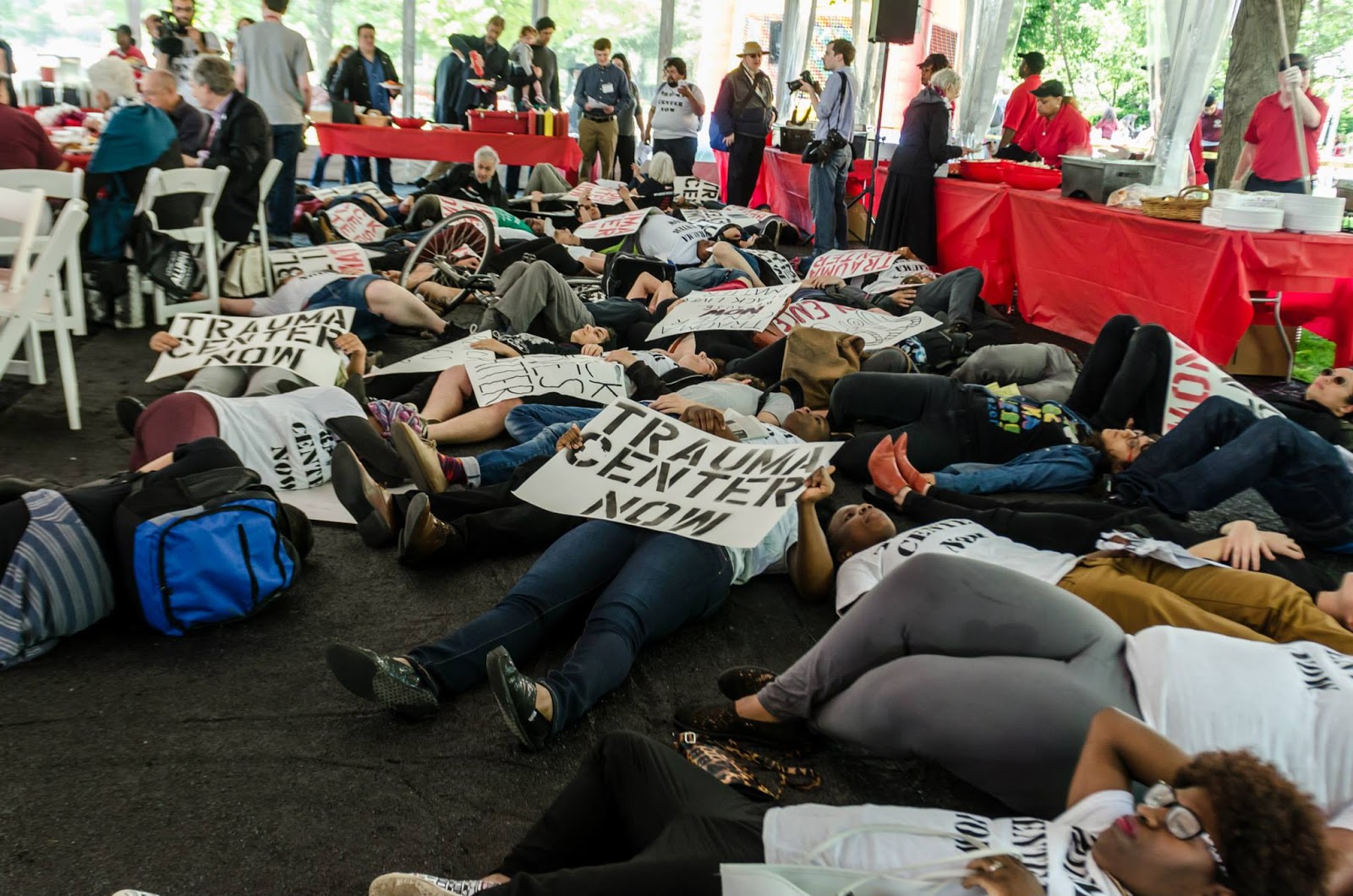
The other local struggle I’m thinking of this Sukkot is the movement to establish a Level 1 trauma center on Chicago’s south side.  There are eight adult trauma centers serving Chicago, but none are in this area that includes some of the city’s most gun violence-prone neighborhoods. Victims of gun violence are much more likely to die when more than five miles from a trauma center. As a result, large sections of the south side comprise Chicago’s only “trauma center desert.”

The campaign for a south side Level 1 adult trauma center was formally launched after 18-year-old student and youth activist Damian Turner was shot near the corner of 51st Street and Cottage Grove Avenue, just a few blocks away from the University of Chicago hospital. Turner was transported to a hospital farther away due to the absence of a nearby Level 1 trauma center, but he died an hour-and-a-half later.

The trauma center coalition was led by the remarkable youth-based grassroots organization, Fearless Leading by the Youth. Here’s an excerpt from an interview with FLY organizer Veronica Morris Moore:

As a young Black queer organizer, I feel affirmed by the trauma center campaign. The principles of the BLM movement helped us frame our tactic around the Obama library and I believe that framing our message with BLM principles put the [University of Chicago] in a big spotlight locally and nationally in terms of race issues. Having this national conversation about police shootings created opportunities to address gun violence in the Black community and the reality and root of the problem. Gun violence is the leading killer of young Black people in poor neighborhoods across this nation, and growing up on the South Side of Chicago, FLY members understand that gun violence stems from the economic violence that bankrupts our communities and bankrolls big business hospitals like the University of Chicago.

Like the Dyett HS struggle, this grassroots effort leveraged people power to shift political power. On September 10, the University of Chicago and Sinai Health System announced that they would partner to open a Level-I Adult Trauma Center at Holy Cross Hospital. But like the Dyett struggle, it was clear to organizers that the victory was not complete – having been made with no accountability or transparency to the community impacted by this decision. Moreover, in making their decision, the University of Chicago reneging on its previous commitment to raise the age of its pediatric trauma center.

If you are a member of the Chicago Jewish community you should should know that on Sunday, November 1, the Jewish Council on Urban Affairs – one of the members of the trauma center coalition – will host “L’Chaim: JCUA Community Meeting for Trauma Care” at KAM Isaiah, 1100 E. Hyde Park Ave. This meeting will provide an important opportunity to:

► Celebrate the growing momentum of this campaign, and be a part of the next victory.
► Take part in one of the most important racial justice issues facing Chicago today.
► Hear from the youth leaders that started the campaign for trauma care.
► Take action so the University of Chicago keeps all of its commitments for trauma care.

This Sukkot, let us rejoice in our victories – and let us give each other strength for the struggle that inevitably lays ahead…