Monthly Archives: July 2023

Naming Israeli Apartheid on Capitol Hill

While the US Congress is undoubtedly a horrid dysfunctional mess of an institution, there have been occasional examples of genuine hope and even inspiration. This past week provided us with one of those examples.

Many of you, I’m sure, have been following the upheaval that occurred when Washington Rep. Pramila Jaypal called Israel “a racist state” at the Netroots Nation conference. After the wrath of the Israel lobby and her Israel-supporting congressional colleagues inevitably rained down upon her, Jaypal walked back her statement. Shortly after, a Republican congressperson cynically introduced a non-binding House resolution that expressed unconditional support for Israel and condemned antisemitism. Of course, it passed overwhelmingly.

While all this was boilerplate Israel politics on Capitol Hill, nine Democratic representatives had the courage to vote no on the resolution: Alexandria Ocasio-Coretz and Jamaal Bowman of New York, Cori Bush of Missouri, Andre Carson of Indiana, Summer Lee of Pennsylvania, Ilhan Omar of Minnesota, Ayanna Pressley of Massachusetts, Delia Ramirez of Illinois and Rashida Tlaib of Michigan.

And speaking of courage, Tlaib went on to say this on the House floor: 

Israel is an apartheid state. To assert otherwise, Mr. Speaker, in the face of this body of evidence, is an attempt to deny the reality and an attempt to normalize violence of apartheid. Don’t forget: This body, this Congress, supported the South African apartheid regime, and it was bipartisan as well.

And if this wasn’t enough, all of this occurred before a US visit from Israeli Prime Minister Isaac Herzog. When Herzog address a joint session of Congress, his speech was openly boycotted by Ocasio-Cortez, Bowman, Omar, Bush and Tlaib. 

While some will undoubtedly say that we are only talking about a small number of congresspeople here, it is still utterly unprecedented. Some might well recall that back in 2015, 58 members of Congress similarly skipped a speech by Prime Minister Netanyahu. That protest, however, was largely an issue of political protocol – it was a Democratic response to the refusal of Congressional Republicans to alert the Obama White House of their invitation to Netanyahu to address Congress. By contrast, this boycott was an unabashed protest against Israeli racism and apartheid.

Of course, Jaypal was absolutely correct in referring to Israel as a racist state – a fact that was pointed out in several mainstream media op-eds following her comment. It was also noted that many Israelis and Israeli organizations have regularly referred to Israel in this manner as well. Apropos of Tlaib’s comment, I can’t help but recall when it was considered politically beyond the pale to criticize South African apartheid on the Hill. To be sure, naming this term out loud was an important part of what eventually resulted in the passage of the Anti-Apartheid Act of 1986 (vetoed by President Reagan, but overridden largely due to the leadership of the Black Congressional Caucus).

Fast forward to 2023: did any of us ever expect we would live to see the day that a Palestinian American congressperson would call Israel an apartheid state on the House floor? Or that another congressperson (Ilhan Omar) would publicly state:

There is no way in hell I am attending the joint session address from a President…during the deadliest year for Palestinians in the West Bank in history, immediately following Israel’s largest incursion into the occupied West Bank in two decades, one that flattened city blocks, and killed at least a dozen people.

Yes, we did indeed witness genuine political courage in Washington DC this week. Please join me in thanking these congresspeople for their fearless stand against Israeli apartheid. 

On the Battle of Jenin and “The Battle of Algiers”

For many, Gillo Pontecorvo’s “The Battle of Algiers” (1966) remains one of the truly great movies of modern times – and arguably the greatest anti-colonial film ever made. So much has been written about its audacious pseudo-documentary style and its radical ideological pedagogy – and well as the ways it has provided a kind of real life template for colonial powers and liberation movements throughout history. For me, this latter point has particular resonance and relevance in the wake of Israel’s latest military “counter-terrorism” operation in Jenin.

I use the word “latest,” because this recent assault was precisely that – the latest of a continuum of Israeli military incursions into the Jenin refugee camp on the pretense of rooting out Palestinian “terrorists” and “militants.” Jenin – a camp composed of refugees who were ethnically cleansed from their homes in 1948 – has long been a center of Palestinian resistance by groups such as the PLO, the Al Aqsa Martyrs Brigades, Hamas and Palestinian Islamic Jihad (PIJ), among others. Despite a long litany of Israeli operations to crush them, however, Palestinian resistance groups have inevitably continued to regroup and thrive throughout the years.

This dynamic was incisively described in a recent New York Times op-ed by Tareq Baconi, “The Tale of Two Invasions,” in which he compared Israel’s recent assault on Jenin to its 2002 Jenin assault led by then Prime Minister Ariel Sharon. Baconi powerfully concludes:

Residents of the Jenin camp, some of whom had fled from their homes in what is now Israel in 1948, are refugees once again. And some of the toddlers who were in the camp in 2002 are now the young men of the Palestinian resistance. As the history of other struggles against apartheid and colonial violence have taught us, today’s children will no doubt take up arms to resist such domination in the future, until these structures of control are dismantled.

After reading Baconi’s article, I immediately flashed on a memory from Israel’s 2002 invasion of Jenin (in which, according to Human Rights Watch, 52 Palestinians were killed, at least 22 of whom were civilians, including children, physically disabled, and elderly people). I well recall reading at the time that Israeli commander, Col. Moshe “Chico” Tamir, believed that “The Battle of Algiers” was “a valuable source of information” for his soldiers who were fighting against PIJ in the Jenin casbah. It was also noted that PIJ leader Iyad Sawalhe was hunted down and killed much in the same manner as in the conclusion of the film, when the Algerian rebel leader Ali La Pointe is killed by the French military.

Much of the power of “The Battle of Algiers” derives from its complex portrayal of the military mentality and tactics of the French in Algeria. In one of its most famous scenes, the French commander Col.  Mathieu offers a long monologue at at press conference in which he calmly and rationally presents the colonial case for what amounts to the torture and oppression of the Algerian people. When he concludes, he offers this final rhetorical argument: “Do you think France should stay in Algeria? If you do, you have to accept the necessary consequences.”

This colonial rationale, of course, is often made in a myriad of ways by the state of Israel and its defenders – and it goes a long way in explaining why Israel continues to stage brutal assaults upon Jenin, Gaza and other sites of Palestinian resistance. In essence: “Do you believe a Jewish state must continue to exist? If so, you have to accept the necessary consequences.”

Every time I watch “The Battle of Algiers,” I’m always moved by the dramatic finale, which portrays the killing of Ali La Pointe then abruptly jump cuts five years later to the liberation of the resistance and end of French colonial rule in Algeria. The message is all too clear: colonial powers may win the battles, but they will inevitably be defeated in the end.

So too in Jenin: Israel’s regular assaults may succeed in quashing the latest leaders of the Palestinian resistance, but it will never destroy the Palestinian people’s will to resist. As Baconi so aptly put it: “today’s children will no doubt take up arms to resist such domination in the future, until these structures of control are dismantled.”

The Nakba Continues in Jenin

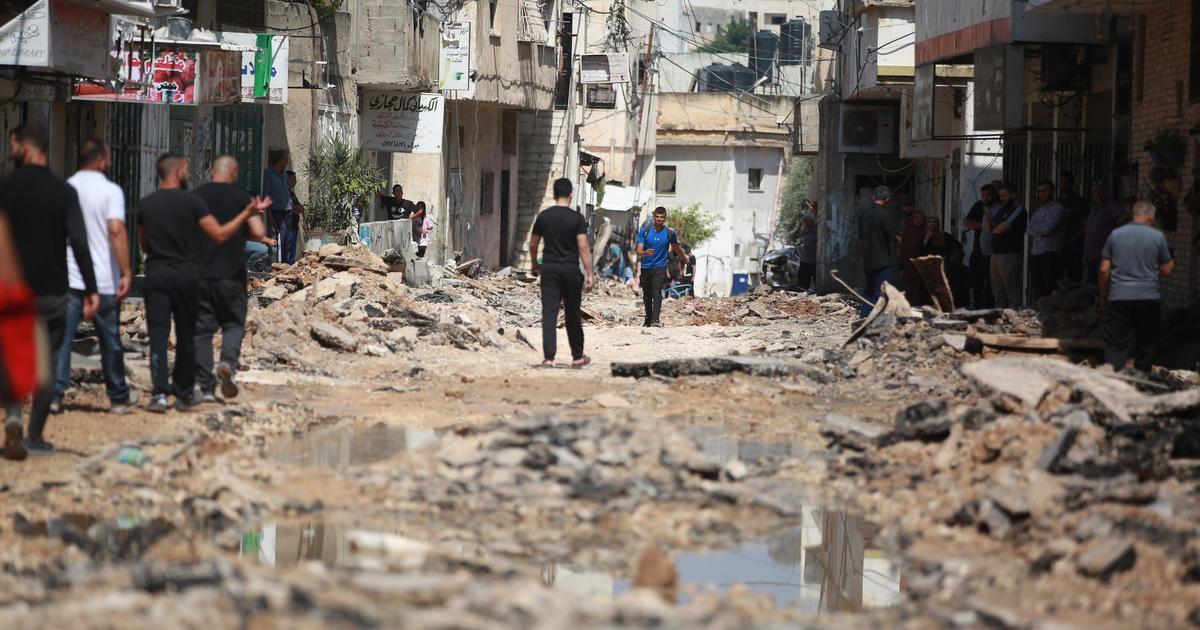
People carry their belongings on the street after the Israeli army’s withdrawal from the Jenin camp in the Israeli-occupied West Bank on July 5, 2023 [Ammar Awad/Reuters]

Israel’s military assault on Jenin may have receded from the headlines for most of the world, but it remains all too tragically present for the people of Jenin. The count this time: twelve Palestinians killed – including five children – and more than 100 injured. The Israeli government has said the raid is now officially “over.” But of course, Israel’s immiseration of the Palestinian people is so far from being over.

In the wake of this most recent operation, most of the mainstream media has, as ever, analyzed events using tired “war on terror” tropes. The New York Times, offered this all-too-familiar analysis:

As Israeli forces hunted for wanted men, weapons and explosives in the Palestinian refugee camp in Jenin this week, after using aerial drones to blow up what they described as terrorist hubs there, the city was living up to its reputation as a center of militant defiance in the occupied West Bank.

The US State Department did its part to promote this age-old narrative as well, issuing boiler plate talking points: “We recognize the very real security challenges facing Israel and the Palestinian Authority, and condemn terrorist groups planning and carrying out attacks against civilians.”  

If you want to know the actual truth behind Israel’s actions in Jenin, however, it’s not too difficult to discern – just listen to the Israeli government itself. Israel’s National Security Minister Itamar Ben-Gvir, for instance, had this to say last month during a press conference at a West Bank settlement:

The Land of Israel must be settled and at the same time as the settlement of the Land a military operation must be launched. [We must] demolish buildings, eliminate terrorists, not one or two, but tens and hundreds, and if necessary even thousands, because at the end of the day, this is the only way we will hold on here, strengthen control and restore security to the residents, and above all we will fulfill our great mission. The Land of Israel is for the people of Israel, we are backing you, run to the hills, settle down. We love you.

Make no mistake: Israel’s assault on Jenin is about the ethnic cleansing of Palestinians in service of widespread Jewish settlement. We are witnessing nothing short of an ongoing Nakba – the continuation of a story that began seventy-five years ago and shows no sign of stopping.

In fact, news reports of events in Jenin evoked chillingly familiar parallels to 1948. The operation led to the mass displacements of residents – as many as 3,000 of the camp’s roughly 17,000 residents sought shelter in schools and other public buildings, or with families elsewhere. Numerous Palestinian officials reported that Israel had threatened and forced camp residents to evacuate their homes. Jenin’s mayor, Nidal al-Obaidi commented, “What’s happening is like an earthquake. It reminds us of the days of Nakba.”

There is, of course, one way Israel can be stopped. Peter Beinart spelled it out plainly in an MSNBC op-ed yesterday:

Ultimately, preventing another Nakba requires telling Israeli leaders that another effort at mass expulsion would bring a dramatic U.S. response: a halt to arms sales, condemnation at the United Nations, support for prosecutions at the International Criminal Court. It requires telling Israel that America’s support is not, as President Joe Biden continues to insist, “unbreakable.” Mass ethnic cleansing would break it.

To this, I would add: liberal Zionists in the American Jewish community needs to give up their illusions that the latest events in Jenin are a product of aberrant Israeli ministers who are “threatening the democracy” of an otherwise noble national project. We are not witnessing the death of a dream – we are witnessing the logical consequences of a colonial movement that seeks to establish a state on the backs of another people.

If there is anything new now, it is that Israel has government leaders who are willing to say as much out loud. When will we take them as their word? And when will we hold them accountable?

To that end, I’ll close with the words from a recently released statement by the Jewish Voice for Peace Rabbinical Council:

There is no hiding from the horror of what Jenin has endured. We must act. We must hold Jewish communities and government officials accountable for allowing the attacks to continue. Each day a Jewish person takes action to resist Israeli occupation, we affirm what the Torah requires: To protest within our households, our cities and our world until the occupation is ended, the right of return is restored and Palestinians can live peacefully in their land.

 Click here to write to your member of Congress and demand they “condemn the Israeli government’s invasion of Jenin and take steps to end US complicity in Israeli apartheid.” 

A Report from Jenin – and a Call to Action

photo: Isaam Rimawi/Anadolu Agency/Getty

As I write, I write we are receiving the horrifying news that Israel has launched its largest military operation in the occupied West Bank city of Jenin in more than 20 years, killing at least ten people – including children – and injuring at least 80 others. The Israeli military has cut off all exits from the refugee camp and is preventing ambulances from reaching critically injured Palestinians. They have damaged the infrastructure and interrupted Jenin’s water and electricity supplies, bulldozed homes, ripped up roads, and attacked journalists reporting on the invasion as well as the Jenin Freedom Theater, where families were seeking refuge.

For an overview and analysis of Israel’s military onslaught on Jenin, I encourage you to read this piece by Amjad Iraqi, senior editor of +972mag:

Like Gaza, Jenin has long been a center of Palestinian social life and political resistance — and as such, a target of vicious repression. For over a year, the Israeli army has carried out a deadly and protracted operation in the city, repeatedly closing off the region while ground troops break into civilian homes and destroy public infrastructure on a near-weekly basis. The Palestinian armed groups, led by young men who have only known a life of despair and death, have put up a relentless fight, and have recently shown that they can make it even more difficult for Israeli troops to invade — a fact that forced the army to desperately turn to air power last week. The bombardment of a populated urban area, together with the city’s collective punishment, is further justified by the demonization of Jenin as a “cesspool of terrorism” requiring constant intervention — in essence, the same doctrine of “mowing the lawn” that is applied in the blockaded strip a few kilometers away.

I also strongly encourage you to read and share this letter written by Mustafa Sheta, General Manager of the Jenin Freedom Theater:

Today, Monday, July 3, 2023, I stand before you to share my personal account of the events that unfolded in Jenin refugee camp early this morning. The Israeli military operation commenced with an aggressive assault on sites believed to be affiliated with the Palestinian resistance. They claimed these locations as their targets, launching three missiles that resulted in the loss of innocent lives and left many wounded.

Soon after, a full-scale invasion ensued, with an overwhelming presence of military forces. Jeeps, armored vehicles and military bulldozers stormed into Jenin, asserting their dominance over the ground. The skies above were not spared either, as a multitude of drones hovered ominously.

During this tumultuous time it was impossible for the inhabitants of Jenin to sleep, young and old alike. My daughter, Salma, was terrified by the blaring warning sirens that announced the army’s incursion, her tears flowing uncontrollably. Meanwhile, my son, Adam, displayed a mix of fear and curiosity, trying to comprehend the gravity of the situation.

Isra Awartani, The Freedom Theatre’s accountant, hastily created a safe space within her home to shield her three daughters from harm. Ahmed Tobasi, artistic director of The Freedom Theatre, found himself face-to-face with an armoured vehicle stationed right outside his house, its barrel aimed at his window. Rania Wasfi, TFT former colleague, frantically tried to reach her mother and sister after news that their house was bombed.

The morning brought news of a devastating attack on The Freedom Theatre, where a group of families sought refuge amidst the turmoil. The occupying forces callously targeted them with missiles, shattering their hopes for safety. Adnan, who lives next door to The Freedom Theatre, huddled together with his family in one room, struggling to find comfort in the midst of chaos. Adnan’s niece Sadeel, 14 was murdered by an Israeli sniper less than two weeks ago. Her family lives in the same neighborhood.

The gravity of the situation cannot be understated. The occupation relentlessly tightens its grip on the refugee camp, decimating its infrastructure and obliterating the main roads in the camp. The message is crystal clear – punish the stronghold of popular resistance in Jenin, and project an image of invincibility to Israeli society regarding their military prowess.

What lies ahead? For me, the answer is nothing. The occupation’s attempts to eradicate the resistance in Jenin will not succeed, just as their predecessors failed in 2002. Buildings may crumble, cars may be reduced to wreckage, and countless individuals may be detained, wounded and even martyred. However, these actions will only serve to breed a new generation that will carry the torch of resistance passed down by those who came before them, as we do today, and as our children will do in the future. It is a relentless pursuit, driven by the aspiration to reclaim our land and restore the dignity of every human being.

And finally: click here to demand that the US Congress stop arming Israel’s massacres against the Palestinian people by ending U.S. military funding to Israel.