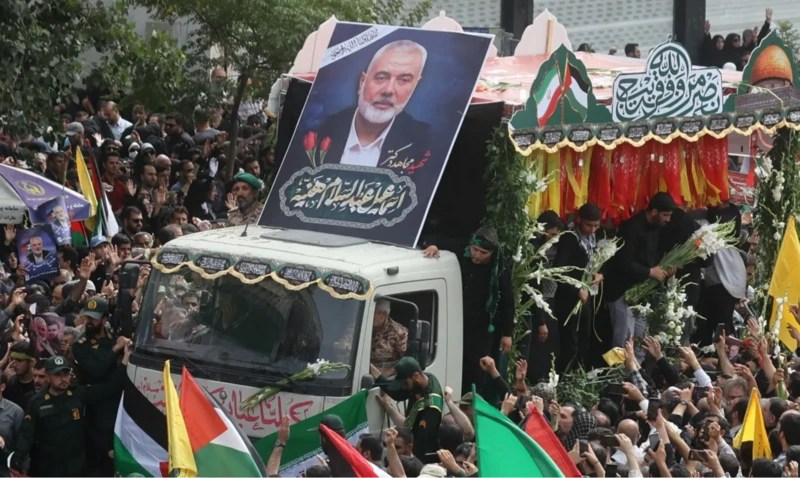
Among the myriad of news items jostling for our attention this past week was the assassination of Ismail Haniyeh, a top political leader of Hamas, who was killed by a bomb in Tehran on Wednesday. Israel is almost surely behind this act, even if it hasn’t publicly acknowledged it. While I realize that there are many in the Jewish community and around the world who are not mourning Haniyeh’s death, it’s difficult to overstate the damaging impact of Israel’s actions on the prospects for a ceasefire in Gaza.
Ismail Haniyeh may have been a leader of Israel’s sworn enemy, but he was also one of the primary figures in ongoing ceasefire negotiations. By killing its own negotiating partner, Israel has made it substantively more difficult to realistically imagine an end to its genocidal violence, a return of Israeli hostages and a Palestinian prisoner exchange any time soon. The Prime Minister of Qatar, who has been a central figure in brokering ceasefire talks put it bluntly: “How can mediation succeed when one party assassinates the negotiator on the other side?”
Why would Israel assassinate Haniyeh, knowing that it might fatally damage ceasefire talks? Many are suggesting that it is in Netanyahu’s personal/political interest to prolong this violence as long as possible – even as it endangers the lives of his own nation’s citizens. While this is no doubt true, I think there is a deeper reason: these latest targeted killings were rooted in Israel’s historic – and fatal – belief that the use of its relentless, overwhelming military force will inevitably force their enemies to submit. It’s worth noting that Haniyeh’s assassination follows the targeted killing of his three sons last April, as well as his sister and nine other members of his family in June. These actions certainly track with Netanyahu’s vow to exact a “mighty vengeance” following Hamas’ October 7 attack.
In fact, Israel has had a long history of assassinating Palestinian leaders, knowing full well that these actions ultimately serve no strategic purpose other than a satisfying show of force. The Israeli military has been assassinating Hamas’ leaders for decades – and Hamas has consistently replaced them. For all its efforts, Israel has succeeded only in increasing the number of Palestinian martyrs and strengthening Hamas’ resolve to resist all the more. In this most recent instance, many observers have pointed out that the killing of Haniyeh will now leave a vacuum to be filled by more radical leaders such as Yahya Sinwar, among others.
Meanwhile, Israel’s genocidal onslaught in Gaza continues with impunity – and nary a protest from the international community. Yesterday, Israel killed at least 15 people – including two children – and injured 40 others in an airstrike that targeted a school-turned-shelter in Gaza’s Shejaiya neighborhood. On Wednesday, the Israeli military killed two journalists from Al-Jazeera, Ismail Al-Ghoul and cameraman, Rami Al-Rifi, with an airstrike on their car. Their colleague Hind Khouri broke down as she reported on their killings, which brings the current number of journalists killed in Gaza to 113.
Israel’s most recent actions have also brought the region, terrifyingly, that much closer to all-out war. On the same day as Ismail Haniyeh’s killing, the Israeli government confirmed that it had assassinated a top Hezbollah leader, Fuad Shukr, in Beirut. The leadership of both Iran and Lebanon, and their proxies in the region are now vowing to retaliate – and the Israeli military is reportedly on “high alert.” Even more ominously, the US intelligence community reports it has received “clear indications” that Iran is planning an attack. One official said the Pentagon and US Central Command are making preparations to help defend Israel militarily, “(involving) US military assets in the Gulf, the Eastern Mediterranean and the Red Sea.”
In times such as these, we are reminded how unbearably high the stakes of a just peace in the region truly are. I understand the palpable sense of powerlessness in the current moment: it sometimes feels as if there is nothing left to do but to pray that leaders on all sides ultimately take a breath and a step back from the brink. In the end, however, we cannot be content to passively hope that the leaders who have brought us to this unthinkable moment will do the right thing.
As has often been said, hope is a discipline. We must find the wherewithal to continue the struggle: to demand a US arms embargo to Israel, an immediate ceasefire in Gaza – and a redoubling of our commitment to a just and equitable peace for all. We must advocate in no uncertain terms that the alternative is utterly unacceptable.
 Shalom Rav
Thank you for your sane response in a world full of insanity.