The course of Jewish history has never been a straight line. Throughout the centuries, the evolution of Jewish life has been shaped by a series of crises, tension points – and outright cataclysms. More often than not, these tumultuous events have even transformed the very nature of Judaism itself.
To offer just a few examples: classical Judaism as we know it emerged out of a catastrophe: the destruction of the Temple in Jerusalem by the Romans in 70 ACE. The Spanish Inquisition in 1492 ended the Golden Age of Jewish life in Muslim Spain and initiated the spread of Sephardic Judaism throughout Europe, Africa and the Middle East; the Hasidic movement was born out of tensions in Eastern European Jewish life in the 17th century; the onset of modernity and the Enlightenment in Western Europe, created a wide constellation of movements whose legacies still influence Jewish life today.
I’m making this point because there’s every indication that Jewish life is going through just such a monumental crisis and transformation right now. I’m speaking of course, about the abyss that has opened over the issue of Zionism – an abyss that has widened considerably this past year as a result of Israel’s genocide in Gaza. .
Last night, Aviva Stein described how she painfully crossed this divide when she shared her own personal Jewish journey with us. I’d like to thank Aviva for her powerful words, which were truly a gift to our community. In my remarks to you today, I’d like to pick up where she left off. I want to begin by responding to her painful point about the increasing exile of young Jews from the Jewish community:
There is an epidemic in the Jewish community – young people are losing and leaving their jobs, and the Jewish community is losing the passion, critical thinking, and vitality that their best and brightest brought to their work. So many Jewish organizations are breaking this way – the big tent, so to speak, has collapsed, and Jews of conscience, Jews who say no to genocide and no to Islamophobia and war mongering, find ourselves on the outside.
Just two weeks ago, there was an extensive investigative article in the journal “In These Times,” which documented how “US Jewish institutions are purging their staffs of anti-Zionists.” The author of the article, Shane Burley observed:
If the trend continues, it could contribute significantly to one of the sharpest breaks in the history of American Jewish life, forcing out a generation of progressive Jews and furthering the crisis of legitimacy plaguing much of the communal Jewish infrastructure.
In other words, we’re currently witnessing a fundamental divide in the Jewish community – even a potential schism in the making. While it’s far too early to predict how it will play out, one thing seems clear to me: just as Israel is fast losing its legitimacy in the international community, Zionism is just as quickly losing its legitimacy in the Jewish community itself.
Of course we can’t write Zionism’s obituary just yet. There are still plenty of staunch Zionists in our community who have a decidedly different view of the past year – who insist that Israel is doing what it has to do to defeat its existential enemies. And there are also many liberal Zionists who refuse to recognize the reality of Israel’s genocide, who still point to the “complexities” of the “conflict.”
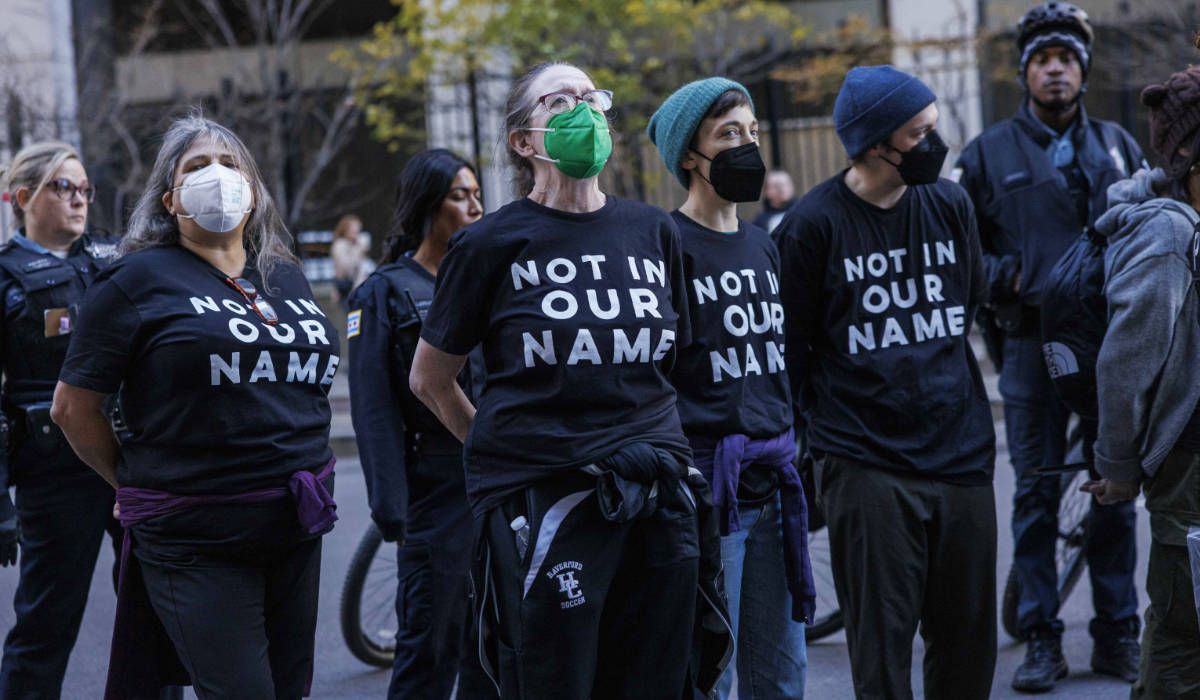
This is what it has come to. The Jewish community has become irrevocably divided between those who stand with Israel – or apologize for its behavior – and those who believe Israel is a settler colonial apartheid state that is committing a genocide in our name. There is no more big tent, if there ever was one. There is little use in pretending that there is any conceivable room for consensus on this issue.
While these fissures over Israel and Zionism have always been present in the Jewish community, it’s clear that they’ve been widening over the last decade or so. This past year, however, the divide broke wide open. And I honestly don’t believe we’ll ever be able to put the pieces back together again, certainly not in the way they were.
Over the years, prophetic voices in our community have been sounding the alarm over this coming schism. One such voice was the great Jewish scholar and theologian Marc Ellis, of blessed memory, who tragically died far too soon this past June. Among other things, he wrote about the rise of what he called “Constantinian Judaism.” This was a reference to the pivotal moment in the 4th century when the Emperor Constantine made Christianity the official religion of the Roman Empire, transforming what had previously been a small and persecuted religious community in the first century after Jesus, into a religion of empire and state power.
As Marc taught, after the cataclysm of the Holocaust and the birth of the state of Israel, Jewish tradition itself became Constantinian. In the 20th century, Judaism, which had previously been prophetic at its core, became wedded to systems of empire, militarism and Jewish supremacy. In very short order, Constantinian Judaism became the central focal point of Jewish life.
From the very beginning of the Zionist movement, however, there were always prophetic Jewish voices opposing Zionism. And they remained even after the founding of the state of Israel. Marc referred to them as “Jews of Conscience” – the minority of Jews who resisted Constantian Judaism, often at great cost. Because of Zionist hegemony, Jews of Conscience necessarily lived in exile, socially, religiously, and in many cases professionally from the Jewish communal establishment (as was the case, very sadly, for Marc).
Even so, every Jewish communal study over the past several years has shown that the ranks of Jews of Conscience have been growing, particularly among the younger generations. As Aviva explained to us last night, they have now burst out into the open – and the Jewish communal establishment is responding with ferocious, desperate backlash
As we contemplate this unfolding schism, I believe it’s important to reckon with the profound damage Zionism has done to sacred Jewish tradition. This marriage of Judaism and ethno-nationalism has been so deeply normalized, it often feels difficult to know where one starts and the other stops. For example, for centuries, the Hebrew word “Yisrael” which means “wrestles with God” referred to a Jewish spiritual peoplehood. It had a religious cultural meaning that spoke deeply to Jewish collective identity throughout the diaspora. It referred to our history and practice of debate, of questioning, of challenging the status quo. Today, for most Jews – and most people in the world – the word “Yisrael” means one thing only: it refers exclusively to a heavily militarized political nation state.
So too with the word “Zion,” which was always much more than a physical location. In Jewish liturgy, Zion is a signifier of our highest spiritual aspirations: the world to come that we were actively working to manifest in our day. After it was appropriated by Zionism, however, it became synonymous with a political movement whose realization tragically resulted in the dispossession and oppression of millions of people.
There are so many other examples. The glorification of militarism we instill in our children in our religious schools; the holidays of conquest, like Israel Independence Day that have become an indelible part of the Jewish holiday calendar. The idolatrous placement of national symbols such as Israeli flags in our sacred spaces. The list goes on and on and on.
Marc Ellis used to observe that with the fusion of Judaism with empire, we have now reached the end of ethical Jewish history. As he once put it:
We Jews, all of us, no matter our various political positions, are responsible for what Israel has done and is doing to the Palestinian people. That is why I believe that we, as Jews, dwell in the abyss of injustice. The injustice we have perpetrated upon Palestinians has brought us to the end of ethical Jewish history. The question for Jews, the only question, is what are we to do at this end?
When Marc spoke those particular words, communities of Jews of conscience were still fairly nascent. But when we founded Tzedek Chicago in 2015, we were, in a sense, answering his question “what are we to do at this end?” by creating a vibrant, Jewish spiritual community that turned away from this abyss of injustice. I know it meant a great deal to Marc to become a member of our congregation after so many years of professional exile.
When we founded Tzedek, we realized that we were one small, modest effort in this regard – but we still believed there was still a place for a dissident Jewish community such as ours. This is how I described it in 2015 in my very first Rosh Hashanah sermon:
(Ever) since our announcement, I’ve been hearing consistently from people all over the country who have told me they wish that something like Tzedek existed in their community. So while we might not statistically exist in the institutional sense, I believe we are very much alive out there in the borderlands of Jewish life. I just know in my heart that there is a place for a Jewish congregation such as ours. And while we are starting off modestly, mindful of our capacity, of what we are able and not able to do during this first year of our existence, I do believe the response we’ve received thus far indicates that the time has truly arrived for a congregation such as Tzedek Chicago.
Since that inaugural service, Tzedek has grown in ways we never could have predicted. In 2020, when we started holding our services and programs online, our membership expanded in numbers and geographically, transforming us into a global congregation. The people who told me they wished something like Tzedek existed in their community now participated in our programs and services and became members of our congregation. Many of them are among our most active members and more than a few serve on our boards and committees.
The horrors and atrocity of this past year, however, changed the Jewish community irrevocably. It has become a profoundly tragic irony that during times of particularly brutal Israeli military assaults on Palestinians, membership in anti-Zionist organizations like Jewish Voice for Peace tends to spike dramatically. During the genocide of this past year, we’ve witnessed this growth at Tzedek like nothing we’ve ever seen before, nearly doubling in size.
There were months on end that new members were literally joining us every week. As many of you know, our membership application includes a field that asks our new members to tell us why they were joining Tzedek Chicago. The statements we received were powerful and moving – and almost all of them expressed common themes: those who could no longer bear the the support of Israel’s genocide in their synagogues; those who had never belonged to a synagogue before because of the constant centering of Israel; those who were converting to Judaism but were starting to despair that it might never be possible if it required fealty to an ethnic Jewish nation-state.
One of the most powerful examples of Jewish anti-Zionist religious organizing I witnessed occurred this past Spring, during the growth of the student encampment movement on college campuses. In May, Tzedek was contacted by the student group Jews 4 Justice at DePaul, who asked if we could come lead a Shabbat service in their encampment. Adam Gottlieb and I came twice to lead Havdalah services. I’m not exaggerating when I say they were among the most inspiring ritual experiences I’ve ever experienced.
Those of you who organized or visited these encampments likely know what I’m talking about. These were organically generated, living, breathing student communities. At DePaul, as in many other student encampments, there was a food tent and a first aid tent. There were learning sessions and tutoring stations. There were workshops on deescalation tactics.
But for me, the most powerful aspect of the encampment was its grassroots, interfaith nature. Throughout the encampment there were signs that included solidarity statements from a variety of religious traditions. Hijabi women were congregating very naturally alongside Jews wearing kippot. When Adam and I arrived, there was a Muslim call to worship where the communal gathering took place. Our havdalah service was immediately followed by a ritual dance by a local indigenous dance troupe.
Needless to say, this encampment was not the bastion of antisemitic Jew-hatred that has been falsely characterized by the media and the Jewish communal establishment. The Jewish students who we met at these and other student encampments are deeply serious, passionate Jews who are creating real communities that express solidarity with Palestinians as a sacred Jewish value.
It was sad, but not at all surprising, that these encampments were eventually destroyed – overturned by state violence. But in the end, the brutality of this response only proved the students’ essential point about the world they were actively resisting – and more importantly, the one they sought to create in its stead.
Yes, over the past summer, colleges and universities have cracked down hard on regulations prohibiting students’ freedom of assembly and speech. But I have no doubt that they will continue to find creative, meaningful ways to organize. So too, I know that these young Jewish students will not be deterred in their desire to create meaningful Jewish communities where they can be their full Jewish selves. To my mind they truly represent the best of our Jewish future.
As we continue to organize these Jewish communities however, I think it’s enormously important to reckon with the tragic reason why they are growing in the first place. While the creation of these new Jewish communities of conscience is something to celebrate, there is absolutely nothing to celebrate about the circumstances that have led to their creation. Those of us who create spiritual anti-Zionist communities know that we must create them with deep sensitivity. In particular, as we craft our religious rituals, we must take care not to exploit Palestinian trauma for our own benefit.
We must also draw a meaningful distinction between private Jewish ritual services, such as we are engaged in now – and public, politicized Jewish ritual, which has a different function and different goals. In their wonderful new book, “For Times Such as These: A Radical’s Guide to the Jewish Year,” my dear friends Rabbis Jessica Rosenberg and Ariana Katz offered this important wisdom:
We’ve experienced the way bringing Jewish ritual into political actions opposing the occupation of Palestine, which primarily harms Palestinians, can recenter the action and conversation on Jews and Jewish feelings. As with all ritual, and all political action, we believe in thinking strategically about the what, where, when and why. We can make plenty of Jewish ritual prayer space that grieves and counters Zionist narratives; when we bring the ritual into the street, it must be done strategically and in partnership with Palestinian-led organizing.
So yes, while this new Jewish spiritual community organizing is exciting to witness, it is also complex and often fraught. This new Jewish transformation is occurring not as a result of a catastrophe that was inflicted on the Jewish people, but one a Jewish state is inflicting on others. This is something that is truly unprecedented in Jewish history; we cannot and should not take it for granted.
We don’t yet know what the future will hold for the Jewish community but we do know that it will never be what it once was. And we know that this schism will be painful. It is not only dividing our community, it is causing deep estrangements in families and relationships between loved ones. I’ve done my share of what I call “political-pastoral counseling” in the past year and I can attest to the very real personal pain this schism is leaving in its wake.
As Aviva told us last night, “I believe we are moving towards a Jewish future where the social norm of Zionism will become increasingly rare, and where communities like ours are not an anomaly but a standard of Jewish communities around the country.” I agree with her hopeful declaration. While it won’t be easy, I know it will happen. Why? Because we are ultimately building our communities with deep-seated, deeply held core values.
When we created Tzedek Chicago, we started by crafting our core values statement before we actually began to recruit any members. As time goes by, I’ve come to realize that this was among the smartest things we ever did. I remember thinking at the time, there are plenty of Jewish congregations out there: why does the world need another? What do we have that’s unique to offer? As I think about it, this is a critical question for any Jewish community. Do we exist just to exist or for a more transcendent purpose? Does our existence actively seek to repair the world or does it merely serve to use up Jewish community resources? Or worse still, does our communal existence contribute to harm in the world?
I’d like to finish by addressing these questions: Why should we create Jewish community in the first place? And more fundamentally, does Judaism have anything to uniquely offer the world in the 21st century?
I’d like to return to the Hebrew word “Yisrael” – the community that wrestles and struggles with God. To me this means that Jewish tradition has never been self-evident; it has always been dialectical – we have always wrestled with very different meanings of what it means to be Jewish; what kind of Judaism we want to lift up in the world. The essential question before us has never been simply “What is Judaism?” but rather, “What is the Judaism we want to affirm and bequeath to future generations?”
Let’s take the two central sacred narratives in Torah: the Creation story and the Exodus story – the two poles that form the foundation of Jewish tradition. A signature moment of the creation story is God’s creation of humanity b’tzelem elohim – in God’s image. In the Talmud, there is a famous debate between the two great rabbis, Rabbi Akiba and Rabbi Ben Azzai. They were arguing, as rabbis are wont to do, about what they considered to be the central precept in Torah. Rabbi Akiba quotes the famous verse from Leviticus, “Love your neighbor as yourself.” Which certainly seems like a strong contender. But Ben Azzai says, no, it’s the verse from the Creation story, “God created humanity in God’s image.”
At the root of this argument, I believe, is a profound debate about particularism versus universalism. “Love your neighbor as yourself” could very well be taken to mean “love your fellow community member as yourself.” In fact, there are many prominent Jewish commentators who interpret it to mean precisely this: “love your fellow Jew as yourself.” But Ben Azzai comes back with “we are created in God’s image,” pointing out that all people are of infinite worth.
This approach has profound implications for the kind of Judaism we seek to affirm. Among other things, it comes from the section in the Torah before there were nations, before there were even Israelites, before land was promised to one particular people, conquered and carved up by the victors. When we promote a universalist approach to Judaism, it is a sacrilege to value Jewish lives over any other; it is an averah – a sin – to create a system of Jewish supremacy: a nation state that literally privileges Jews over non-Jews.
Our other sacred narrative, the Exodus, includes the famous moment when God heard the cry of the oppressed and responded by demanding their liberation. Again, there are some who might understand this narrative as a particularist one: a singular story about Jewish liberation in which a Jewish God hearkens to the cry of God’s chosen people. But when we promote a Judaism of universalism, we come to understand that God hearkens to the cry of all who are oppressed. Indeed, this is a precious lesson we can learn from Liberation Theology: all who are oppressed are God’s chosen.
In the 21st century, I believe this is the sacred calculus the Jewish people have to offer the world: Creation + Exodus = Solidarity. More than ever, the Jewish communities we create simply must value solidarity as our most sacrosanct mitzvah. In an age in which we are witnessing the increased scapegoating, yes of Jews, but also of Muslims, LGBTQ+ people, people of color, disabled people, immigrants, indigenous people and so many others, our sacred tradition must promote collective liberation first and foremost.
As I contemplate the growing schism in the Jewish community, it occurs to me that it really is a microcosm of a larger coming apart we are seeing in the world. And yes, so much of it is frightening to behold. At this moment, so much is breaking wide open around us – in our community and in our world. With so much uncertainty and no guarantees, we must respond by choosing the path of solidarity above all.
I’d like to end with words from our dear friend Marc Ellis, whose voice was largely silenced by the Jewish establishment. We miss his presence and his moral witness terribly, and it feels only appropriate to give him the last word.
For Marc, the essence of being Jewish was what he called “the prophetic” – he often referred to it as “the Jewish indigenous.” The prophetic, he taught, is where Jewish particularism and universalism came together. As he often wrote and said, the only authentic way to act Jewishly today is to act prophetically; to take a moral stand against empire, against oppressive state power, even if it invariably comes at great cost.
Marc wrote a great deal about this subject in his 2014 book, “Future of the Prophetic: Israel’s Ancient Wisdom Re-presented.” This is how he concluded that book – and it is with his words that I will conclude as well:
This is where we end – now. The prophetic is always before us. When Jews – with others – embody the prophetic, the worldly powers are put on notice. What happens then we know from history. The struggle intensifies. The casualties mount. The empire, always on a war footing, intensifies the war against the prophetic. Yet history remains open. Perhaps this is the ultimate message the prophets communicate to us throughout the ages. When we come to the end, against all odds, the prophet glimpses a new beginning on the horizon. When that hope will be embraced, when it will broaden so that the global community becomes prophetic, cannot be foretold in advance. The prophet is not a soothsayer. The prophet is a gatherer of light in dark times. Gathering light, hope on the horizon, justice around the corners of our lives. Eyes wide open, Israel’s ancient wisdom, re-presented, reborn.
May these words inspire us to make real in the coming year: a new beginning on the horizon, justice around the corner, the birth pangs, at long last, of global prophetic community.
Ken Yehi Ratzon – So may it be.
 Shalom Rav