Monthly Archives: February 2025

Peter Beinart’s New Book Makes Important Political Points – But Does it Reckon With Israel’s Genocide?

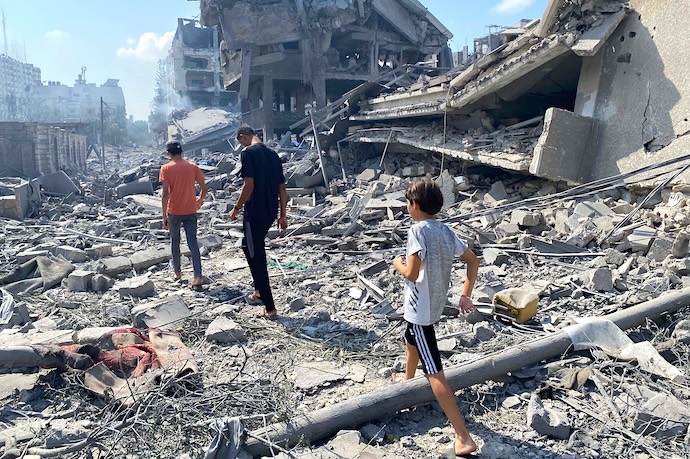
photo: Wafa/AP

Cross posted with Religion Dispatches

The ambitious intentions of Peter Beinart’s new book are evident from the title: Being Jewish After the Destruction of Gaza: A Reckoning. Responding to the current moment, Beinart has written nothing short of a spiritual manifesto for the future of Judaism. 

It’s a tall-order for such a slim volume, but it’s one that Beinart is uniquely positioned to take on. As a well-known journalist, thought leader, and editor-at-large for the journal Jewish Currents, Beinart’s ideas carry a great deal of weight among large swaths of the Jewish establishment. His 2010 article in The New York Review of Books, “The Failure of the American Jewish Establishment” and his subsequent book, The Crisis of Zionism were widely read and debated in the American Jewish community. Since then, he’s continued to push the envelope in the discourse on Israel/Palestine. His 2020 New York Times op-ed, “I No Longer Believe in a Jewish State” and his 2021 Guardian essay, “A Jewish Case for Palestinian Refugee Return” were likewise considered game-changers in the Jewish communal discussion on Israel-Palestine. 

Being Jewish, which attempts to reframe the Jewish spiritual narrative itself, is arguably his most dramatic attempt at game-changing. Following October 7 and Israel’s devastating military onslaught on Gaza, Beinart suggests that Judaism and Jewish identity have now reached a critical turning point. As he writes in the Prologue: 

Jews have told new stories to answer the horrors we endured. We must now tell a new story to answer the horrors that a Jewish country has perpetrated, with the support of many Jews around the world… [This new Jewish story must be] based on equality rather than supremacy—because the current one doesn’t endanger only Palestinians. It endangers us. 

As if this isn’t ambitious enough, Beinart also hopes his book will help heal the widening fractures over Israel/Palestine in the Jewish community. To drive this point home, he begins with a letter to a friend with whom he’s become estranged over the issue of Israel/Palestine. “I know,” he writes, “you believe that my public opposition to this war…constitutes a betrayal of our people…[and] I consider your single-minded focus on Israeli security to be immoral and self-defeating.” He ends his letter with the words: “I hope the rupture is not final, that our journey together is not done.” 

While Being Jewish was published by a mass-market publisher and is being promoted to a wide readership, Beinart states at the outset that he’s suggesting a new Jewish narrative to bring the Jewish “family” together; to mend the deep familial rifts that have widened over Israel’s destruction of Gaza. “This book,” he writes, “is for the Jews who are still sitting at that Shabbat table, and for the Jews—sometimes their own children—who have left in disgust. I yearn for us to sit together.”

Beinart thus begins his book with a formidable—perhaps unbridgeable—tension. While he’s clear about his intention to bring Jews together, he also suggests that Israel’s oppression of Palestinians is rooted in a narrative of Jewish supremacy—a view which surely won’t endear him to millions of Jews in Israel and throughout the diaspora who identify deeply with Israel and Zionism. In many ways, this tension is characteristic of Beinart’s pedagogy: he seeks to influence Jewish communal discourse even as he pushes hard on the ideological envelope. It’s a balancing act that’s become increasingly precarious with his writings over the past several years. Given the stakes of the current moment, he sets a profoundly daunting goal for himself with his latest book.  

For most of Being Jewish, Beinart does what he does best, expertly dismantling Israel’s hasbara—the propagandistic talking points used to justify Israel’s oppression of the Palestinian people. In chapter one, “They Tried to Kill Us We Survived, Let’s Eat,” for example, he interrogates the ways that Israel and Israel’s Jewish communal advocates, conveniently ignore Zionism’s colonial origins and reframe Israel’s founding to fit a Jewish narrative of victimhood:

The plot goes like this. We have finally achieved what every other people takes for granted: a state of our own. Yet in the case of Jews, and Jews alone, that right is contested. So even with a state, we remain victims.  

His repeated willingness to frame political Zionism in a colonial context is a powerful, ongoing theme for Beinart. In another chapter “To Whom Evil is Done,” he considers the ways the violence committed by Hamas and other Palestinian resistance groups on October 7 was compared to the Holocaust by Israelis and Jews around the world. He goes on to assert that such a framing “transforms Palestinians from a subjugated people into the reincarnation of monsters of the Jewish past.” Again, Beinart doesn’t hesitate to reject this comparison in favor of a settler colonial framework. A better analogy, he suggests, would be the violent attacks of colonized Haitians, Creek Indians, or Mau Mau rebels against their colonial oppressors.

In “Ways of Not Seeing,” Beinart systemically eviscerates many other familiar claims wielded by Israeli leaders and Israel advocates: from their rejections of death estimates by the Gazan Health Ministry to the canard of Hamas’ human shields. He also devotes a chapter to the issue of antisemitism, using convincing argumentation along with hard survey data to demonstrate how Israel cynically uses the claim of antisemitism—which is much more prevalent on the Right than the Left—to cudgel Palestinians and their supporters. Taking the claim that anti-Zionism equals antisemitism head on, he writes astutely:

The whole point of conflating anti-Zionism with antisemitism is to depict Palestinians and their supporters as bigots, thus turning a conversation about the oppression of Palestinians into a conversation about the oppression of Jews.

Beinart’s book is strongest when he makes these kinds of expert political arguments. Yet, as critical as they are, as I read Being Jewish I found myself increasingly wishing he would drill deeper into the themes suggested by the title. Beyond promoting a Judaism of equality over conquest, how should Jews respond to the devastating moral reality of this moment? In his final chapter, “Korach’s Children,” he attempts to do precisely this, suggesting that Jewish political nationalism has become a form of Jewish “idolatry,” arguing that the only way toward an equitable future in Israel/Palestine is a single state in Israel that guarantees full citizenship for all. 

While it’s a compelling vision, there’s little in his final chapter that he hasn’t already argued for more extensively in his 2020 and 2021 articles, which were written well before Israel’s destruction of Gaza. In this book, as with his earlier articles, Beinart offers examples from Ireland and South Africa to demonstrate how colonizers and colonized have found the political wherewithal—however imperfect—to dismantle systems of oppression and engage in processes of reconciliation. 

In the midst of his argument, however, there’s little reckoning with the possibility that anything has fundamentally changed with Israel’s genocide in Gaza. Instead, Beinart simply repeats his talking points, continuing to hold out hope for a better future for Israeli Jews and Palestinians:

Although it won’t look the same, this kind of liberation is possible for us. We can lift the weight that oppressing Palestinians imposes on Jewish Israelis, and indirectly, on Jews around the world.

But who is the “we” in this statement? It’s certainly not in the power (nor is it currently the desire) of American or Diaspora Jews to leverage a socio-political transformation of such a magnitude in Israel/Palestine. The majority of Israelis have, for their part, long rejected a one-state solution—and by all accounts, they’re farther away than ever from embracing such a vision. 

Indeed, Israelis post-October 7 are a thoroughly traumatized nation, inured to the carnage their nation is inflicting on Palestinians and according to polls, overwhelmingly supportive of Israel’s genocide in Gaza. As for Palestinians, many, if not most, are undoubtedly less inclined to imagine the realistic possibility of living side by side with Israeli Jews in a single state given the horrific reality of the past 16 months.

It’s notable that, even as Beinart doesn’t flinch from describing Israel’s onslaught in Gaza—often in terrifying detail—he largely avoids using the word “genocide” to describe it. This is more than merely a semantic issue. If we are to truly reckon with what it means to be Jewish after the destruction of Gaza, we must face this central question: what does it mean for the Jewish people that a Jewish state, founded in the wake of the Holocaust, is actively committing a genocide against another people? 

Though Beinart writes that he “yearns for us to sit together,” it’s well worth asking: can we truly create Jewish community within such a reality? Can Jews who believe Israel is committing genocide coexist in community with those who are actively supporting it—or rationalizing it away? Is it possible for Jews to pray and study and make Shabbat and celebrate holidays together under such circumstances? If Jewish ethical values are the bedrock of our spiritual life, how do we truly bridge such a massive moral divide?

Although he doesn’t answer this question in his book, Beinart did give a clue to a potential response during a recent appearance at Duke University. Admitting that Israel was no longer a “unifying force” among Jews, he responded:

What I would like people to do is to bring Jews together across the ideological, political and religious spectrum, to study Torah, to study our texts. This is what ultimately unifies us, and I think that it can be a foundation for other kinds of conversations.

This kind of response might make sense to Beinart, an Orthodox Jew who cherishes traditional Jewish study, but it’s doubtful such an approach will bring together Jews in the way he envisions. It’s optimistic, to put it mildly, to assume that Jews will be able to put aside their differences on Israel and find a foundation for fruitful conversation through the study of Torah and Jewish text. It may be time for us to admit that being Jewish after the destruction of Gaza means our community isn’t simply fractured, but separated by a deep moral abyss that may well be unbridgeable. 

As I read Beinart’s new book, I couldn’t help but be struck by the significant debt it owes to the landmark work of Jewish scholar and theologian Marc Ellis, who asserted as far back as the 1980s and 90s that post-Holocaust, the fusion of Judaism and Jewish state power had created a conquest-focused “Constantinian Judaism,” even as Israel maintained a collective myth of innocence

In fact, in 2014, during an earlier Israeli military assault on Gaza, Ellis wrote Burning Children: A Jewish View of the War in Gaza which reached strikingly similar conclusions to Beinart’s: 

The central question is how to move Jews in Israel and around the world to see that Jews can only be free if Palestinians are free as well. During the Gaza war, we could not be further from this goal. This makes it even more imperative that we begin now. 

But while Beinart’s and Ellis’ analyses of the crisis may have been similar, their prescriptions for going forward were dramatically different. As Ellis put it in a 2018 interview, Israel’s state oppression of the Palestinian people represented the “end of ethical Jewish history”:

We Jews, all of us, no matter our various political positions, are responsible for what Israel has done and is doing to the Palestinian people. That is why I believe that we, as Jews, dwell in the abyss of injustice. The injustice we have perpetrated upon Palestinians has brought us to the end of ethical Jewish history. The question for Jews, the only question, is what are we to do at this end?

Marc Ellis died in July 2024, while Israel’s genocide in Gaza was raging in full force. His question, however, offers an important counterpoint to Beinart’s. While Beinart asks how we will come together to write a new Jewish story, Ellis asks how Jews will dwell in the abyss of injustice. In the end, Beinart’s book, for all of its courage, is ultimately unwilling to take this step: to truly reckon with how Jews of conscience should respond to the ongoing moral devastation that is Israel’s genocide in Gaza.
Standing at Sinai: Interrogating our National Myths of Unity

In the week’s Torah portion, Parashat Yitro, the Israelites stand at Mt. Sinai and collectively enter into a covenant with God. With a message conveyed through Moses, God says to the people:

“(If) you will obey Me faithfully and keep My covenant, you shall be My treasured possession among all the peoples. Indeed, all the earth is Mine, but you shall be to Me a kingdom of priests and a holy nation.” (Exodus 19:5-6)

Shortly after, the Israelites collectively accept:

…All the people answered as one, saying, “All that God has spoken we will do!” (19:8)

In this mythic moment, the Israelites become a nation unified in a shared, transcendent purpose.

But do they really, though? Most of the Torah’s narrative post-Sinai is less a record of a nation united by a shared purpose than a portrayal of a deeply fractured collection of tribes struggling mightily to live up to the covenant they made with God at Mt. Sinai. This certainly tracks with the evolution of Jewish peoplehood throughout the centuries. Though the organized Jewish community routinely clings to the mythic notion that “We are One,” we have always been a nation of sub-communities: a family divided by a of myriad of assumptions over what it means to be and behave as a Jew, often rancorously.

Of course, in the current moment the Jewish people are experiencing an exceedingly powerful and painful division. As I suggested in my sermon this past Yom Kippur:

Jewish life is going through … a monumental crisis and transformation right now. I’m speaking of course, about the abyss that has opened over the issue of Zionism – an abyss that has widened considerably this past year as a result of Israel’s genocide in Gaza.  

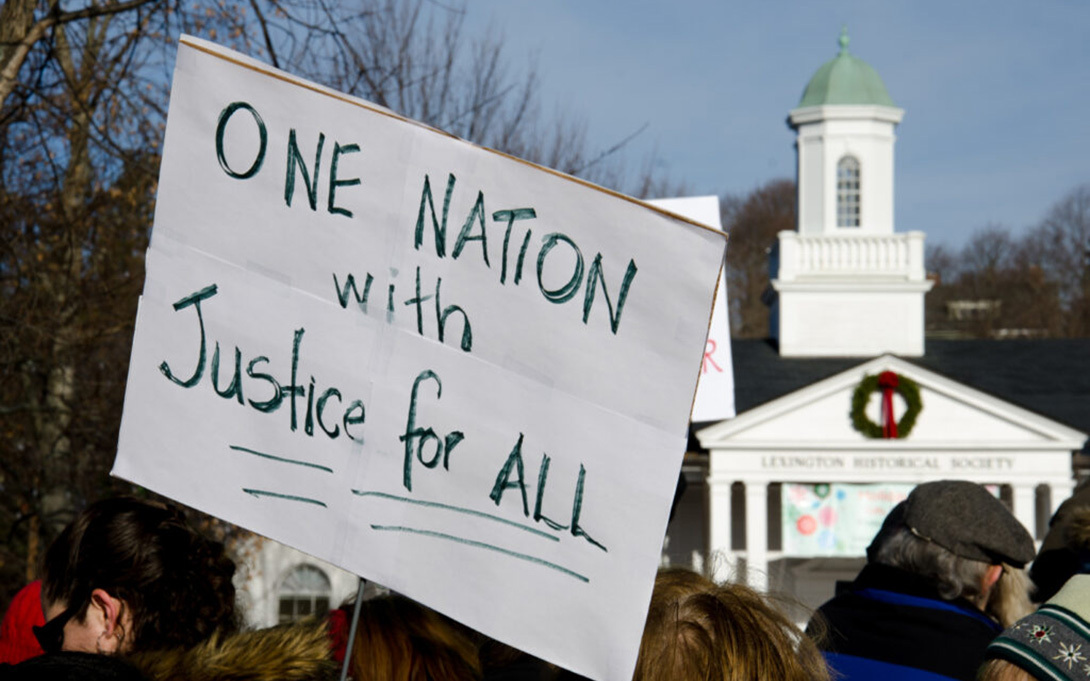
This mythology of national unity, however, is not unique to the Jewish people. Those of us raised in the US are all too familiar with such tropes, socialized as we were with the famous line from the Pledge of Allegiance: “One nation, under God, indivisible, with liberty and justice for all.” In truth, however, the US has been a deeply divided nation since the day it was founded. While the preamble of the Constitution reads “We the People,” the “people” it referred to were white, landowning men. The Naturalization Act of 1790 limited access to citizenship to “free white persons.” Later on, the US broke in two after slaveholding states succeeded – and the nation only became “one” again after fighting a bloody civil war. In too many ways, it’s a war that has never really ended.

As we see the rise of nativism and authoritarianism in nations around the world, it’s fair to say that this reckoning over national identity is truly a global phenomenon. Like many, I’ve been watching with alarm the rise of the far right nationalist AfD party in Germany (with the unabashed support of the ubiquitous Elon Musk) as they seek to build a coalition with conservative opposition parties. German Vice Chancellor Robert Habeck has warned ominously that such an alignment would “destroy Europe.”

So where does this leave us? Can we actually affirm these narratives of national unity in good faith? Do they serve us in any way – or do inevitably lead to authoritarianism and genocide?

I personally believe that national mythologies should not be literal oaths to be sworn to, but collective narratives to be interrogated deeply. In the case of the US narrative, we must ask honestly: what is the place of dispossessed indigenous nations in our national narrative? What is the place of descendants of kidnapped Africans who were brought here in chains to build up this nation? What is the place of immigrants who come to these shores seeking a better life – or to escape certain harm in in their home countries? What is the place of LGBTQ+ people, disabled people and members of other historically marginalized groups?

Those who uphold national mythologies must ask honestly, who exactly is the “we” in “We the People?” Because these narratives will only be useful if they lead to actual collective liberation for all. More critically, those of us who are committed to a truly inclusive national vision must prepare for the inevitable, often violent backlash from those who do not share our narrative. Indeed, history has proven all too often that a truly inclusive national vision never comes easily. On the contrary, it must be fought for.

At the end of the Torah, God says to the Israelites:

“I make this covenant and this oath, not with you alone, but both with those who are standing here with us this day before the ETERNAL our God and with those who are not with us here this day.” (Deuteronomy 29:13-14)

This Shabbat Yitro, as we stand once more at Sinai, let us ask ourselves: “Who are not with us on this day?” Why are they not here? What are we willing to sacrifice to ensure that they will be included in the covenant as well?”

Palestine Solidarity from the Streets to the Statehouse

From my Yom Kippur sermon this past October:

(There) are plenty of Jewish congregations out there: why does the world need another? What do we have that’s unique to offer? As I think about it, this is a critical question for any Jewish community. Do we exist just to exist or for a more transcendent purpose? Does our existence actively seek to repair the world or does it merely serve to use up Jewish community resources? Or worse still, does our communal existence contribute to harm in the world? 

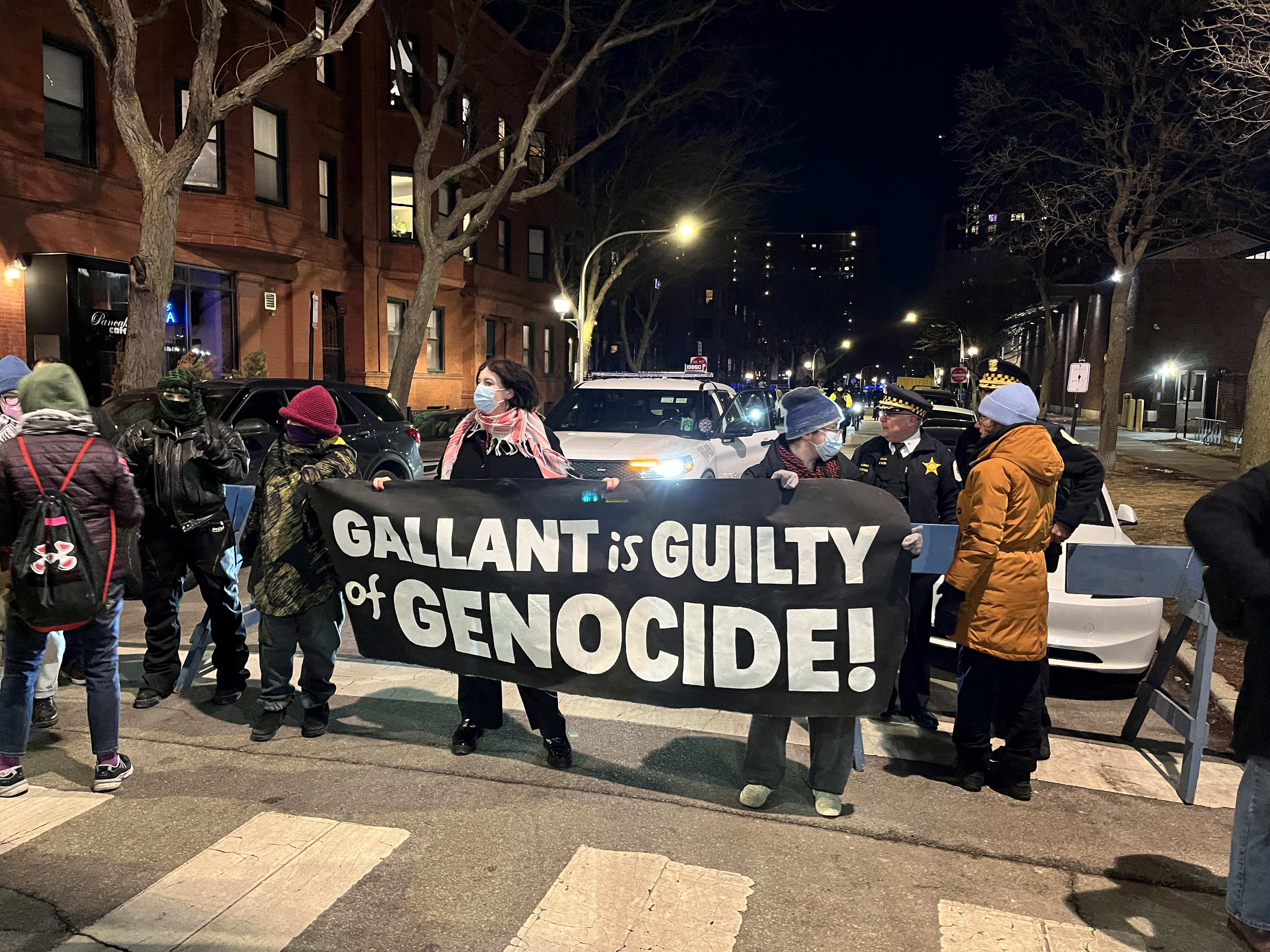
I recalled those words last week when I learned that Anshe Emet, a prominent Conservative synagogue in Chicago planned to host a program with invited guest Yoav Gallant, the former Israeli Minister of Defense and one of the primary architects of Israel’s genocide against Gaza – who currently has a warrant out for his arrest issued by the International Criminal Court.

It should go without saying, but I’ll say it out loud: it is appalling and sickening that a prominent synagogue welcomed – and in fact celebrated – a genocidal war criminal in their house of worship. I’m proud to say that a massive protest was organized by a wide coalition of Palestine solidarity groups, including US Palestine Community Network, American Muslims for Palestine, Jewish Voice for Peace and #IfNotNow to voice a message of outrage, solidarity and collective conscience.

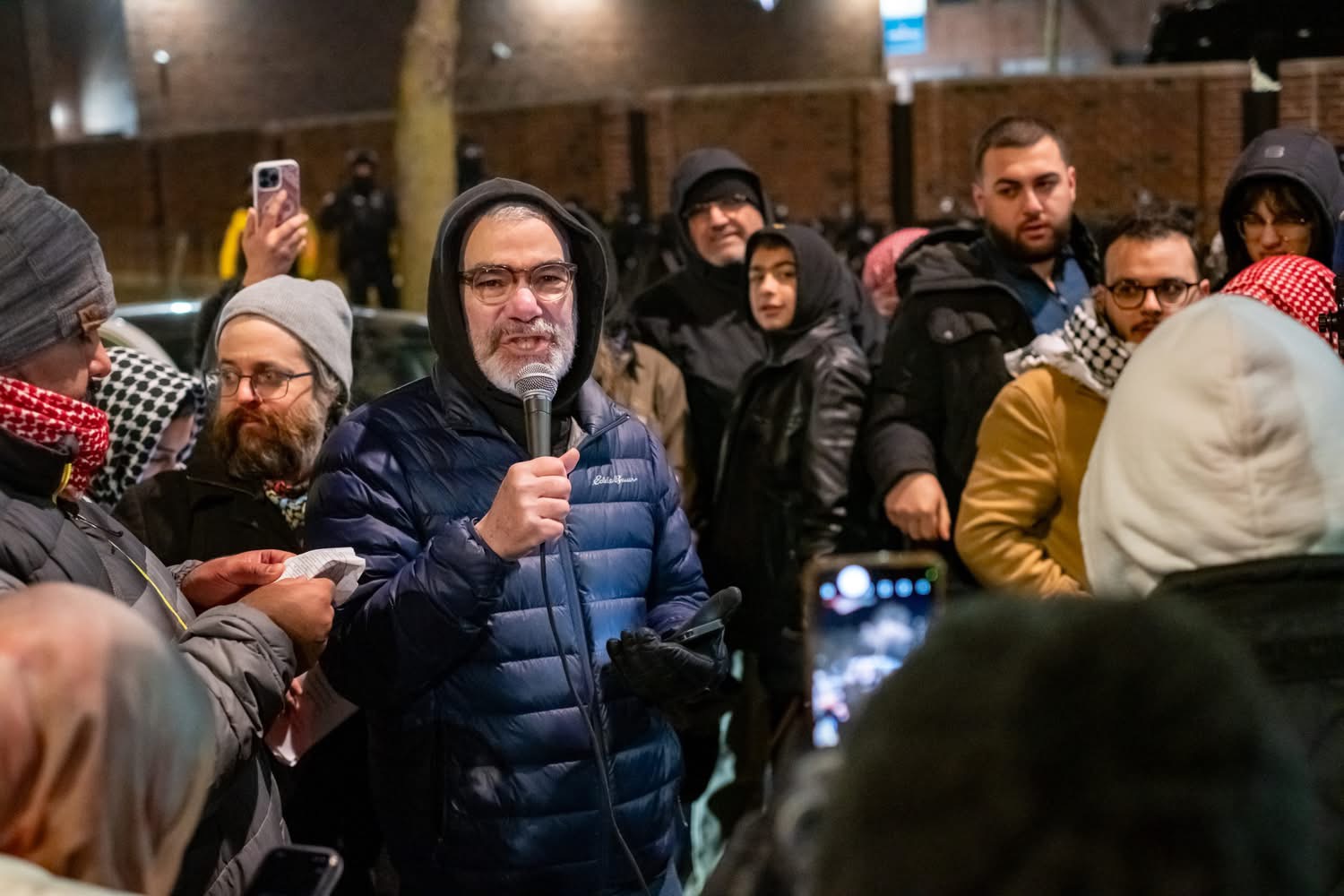
Hundreds of us gathered last night across the street from the synagogue in the freezing cold to express our outrage and mutual solidarity. There were many speakers from our diverse coalition and it was my honor to be among them. Here are my remarks, below:

photo: Love and Struggle/Sarah Ji

My name is Brant Rosen; I’m a proud member of Jewish Voice for Peace, the Jewish Voice for Peace Rabbinical Council, and I’m the founding rabbi of Tzedek Chicago – a proudly anti-Zionist synagogue here inI Chicago with members here and around the world.

In Jewish tradition there is a central concept we call Hillul Hashem. It literally means “desecration of God’s name.” This is at root a deeply moral concept that goes to the heart of what it means to be a human being. When we diminish the humanity of another, we diminish God’s presence in the world – and we commit the worst kind of Hillul Hashem when we commit the crime against genocide against another people.

In October 2023, Yoav Gallant, Israel’s then defense minister, said:

We are imposing a complete siege on Gaza. There will be no electricity, no food, no water, no fuel, everything is closed. We are fighting human animals and we are acting accordingly.

The Palestinian people know what it means to be robbed of their humanity. They have been deemed a collectively disposable people by Israel for over 100 years. Their very presence is a problem for Israel. We Jews should know all too well what happens when a state robs a people of its essential humanity.

The ICC has put a warrant out for Yoav Gallant’s arrest as a war criminal because he actively dehumanized the Palestinian people in word and in deed. Over 60,000 Palestinians killed in Gaza to date and over 100,000 injured, the majority of whom are women and children. According to one estimate, the ultimate death toll may eventually be nearly 200,000. Whole extended families, entire Palestinian bloodlines have been wiped out completely. Much of Gaza has been literally reduced to a human graveyard, with scores of bodies buried beneath the rubble of destroyed and bulldozed homes. Neighborhoods and regions have been literally wiped off the map. 

Gaza’s infrastructure and health care system has been decimated. According to the UN an “intentional and targeted starvation campaign” has led to widespread famine and disease throughout the Gaza strip. Health care workers, humanitarian workers and journalists are being killed, injured and imprisoned in massive numbers. Human rights agencies have documented widespread torture and abuse of prisoners, including sexual abuse, throughout a network of torture camps. 

This is dehumanization, this is Hillul Hashem of the worst kind. And to you Yoav Gallant, we say, “We Charge Genocide!” “You are not welcome in our city!”

But Yoav Gallant and the nation he served could not have succeeded if there where not those who normalized this genocide. And that is why we are here tonight. As a rabbi, as a Jew, as a person of conscience, I am morally outraged – I am sickened – that this war criminal is being hosted – and in fact celebrated – at a synagogue, a Jewish house of worship. This is what it has come to.

And here I want to address the members of Anshei Emet and the Jewish community of Chicago. Our community has a profound moral choice to make. What is the Judaism we will affirm? Will we uphold Zionism – and its ideology of Jewish supremacy – or will we stand for the sacred divine image of all people? Will we stand with war criminals or will we stand with those who are deemed to be disposable? Will we stand with the genocidal state of Israel or will we stand with the Palestinian people?

Now I’d like to address my friends and comrades in the Palestinian community:, please know that are so many of us in the Jewish community who stand in solidarity with you. There is nowhere else we can possibly be at this moment. And there are so many of us who are voicing the alarm, marching in the streets, taking arrest to demand justice for Palestinians

It is not an overstatement to say this: history will remember what we did or did not do in this moment. We are ready, together with you, to call out those who, in our name, are committing the worst kind of Hillul Hashem against you, whether it is in the streets of Rafah and Deir al Balah, the halls of Washington DC or a synagogue in Chicago. And we will not cease until all are free, from the river to the sea!

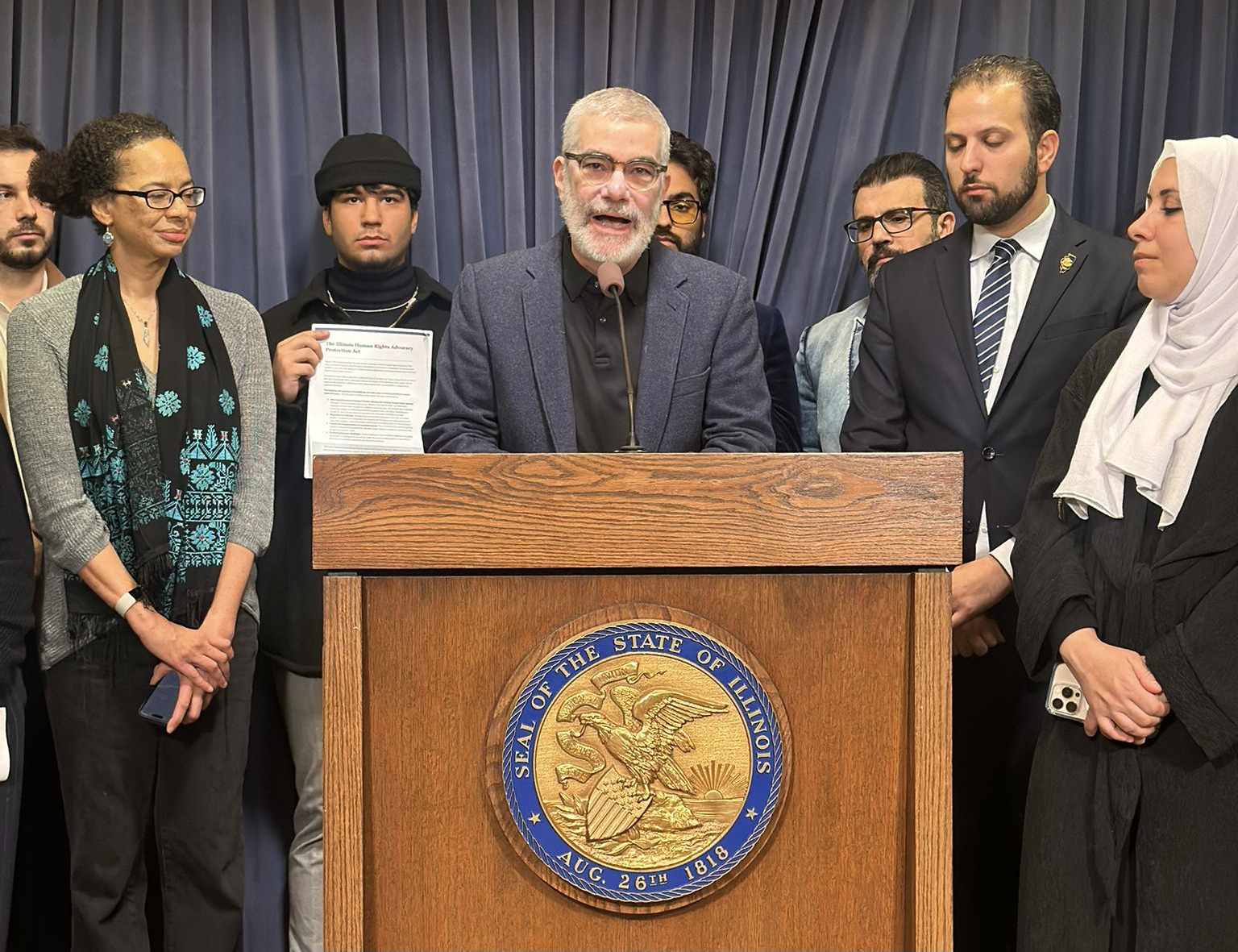
It’s been a busy week. This past Wednesday, I was in Springfield with friends and comrades to announce new IL state legislation, “The Illinois Human Rights Advocacy Protection Act,” which would repeal our state’s 2015 anti-boycott legislation that punishes advocacy for Palestinian human rights. This unconstitutional and immoral legislation, signed by then Gov. Bruce Rauner, directed the Illinois Investment Policy Board to restrict public funding to companies that use human rights filters that exclude doing business with Israel.

The new legislation, which is being introduced in the IL State House by Palestinian-American representative Abdulnasser Rashid, will “(remove) provisions requiring the Illinois Investment Policy Board to include companies that boycott Israel in its list of restricted companies.” An identical bill will be introduced in the IL Senate as well.

You can watch the entire press conference here. My remarks follow below:

Here in Illinois and around the world, we are at a critical and frightening moment. The US is governed by an administration that openly considers certain populations to be disposable. Whether it is undocumented immigrants, birthright citizens, trans youth or the Palestinian people.  Just yesterday, our president announced his intention to depopulate the entire Gaza strip of over 2 million Palestinians and turn it into the “Riviera of the Middle East.”  This after a previous administration helped to arm Israel in its crushing military assault – one that many reputable human rights organizations have termed a genocide against the Palestinian people.

In Jewish tradition, one of our most central theological tenets, which is repeated over and over, is that God responds to the cries of the oppressed. The Palestinian people have long been crying out to the international community. Over the past sixteen months, their cries have reached a fever pitch. The question before us, that has ever been before us, is how will we respond?

That is the essence of the Palestinian call for Boycott, Divestment and Sanctions. It is a call from an oppressed people who are seeking support and solidarity from the international community. It originated in 2005, when a wide coalition of Palestinian civil society organizations made a crie de cour for solidarity and support. They issued a call to the world to use the time-honored nonviolent strategy of Boycott, Divestment and Sanctions.

There are three essential demands of this call, which are all are based in international law: to end the occupation of the West Bank and Gaza, full and equal rights for Palestinian citizens of Israel, and to honor the UN mandated Palestinian right of return. Like all boycotts, it allows private citizens, companies and civil society organizations around the world to actively and meaningfully respond to the legitimate and collective cry of the Palestinian people.

It is also a form of free speech. Just like historic Montgomery Bus Boycott, the United Farm Workers Boycott, the boycott of apartheid South Africa before it. When the state of Illinois passed legislation restricting participation in this pro-peace, pro-human rights movement, it actively criminalized free speech. It was immoral and illegal to do so when it was enacted by Governor Rauner in 2015 – and it remains so today. In the current moment, when our country is ruled by a regime that is actively and unabashedly criminalizing free speech, we should see this legislation for what it is. The state of Illinois has no business aiding and abetting in this stripping of our right to free speech. It has no moral standing to stifle and stigmatize the legitimate cry of the oppressed.

In the Jewish community this week we are reading from our Torah, the Exodus story. And the Exodus story makes it very clear: that God responds to the cry of the oppressed and demands their liberation. We also read that this process began with brave people to defy and resist oppression. That is how liberation happens.

We are at just a moment right now. This is truly a which side are you on moment. Will we hearken to the cries of the oppressed, or will suppress their voices – and those who support their call for liberation?  We urge the state of Illinois to stand the right side of history.

A Jewish letter of support for the Illinois Human Rights Advocacy Act will soon be made public as well. I’ll make sure to post it when its available.