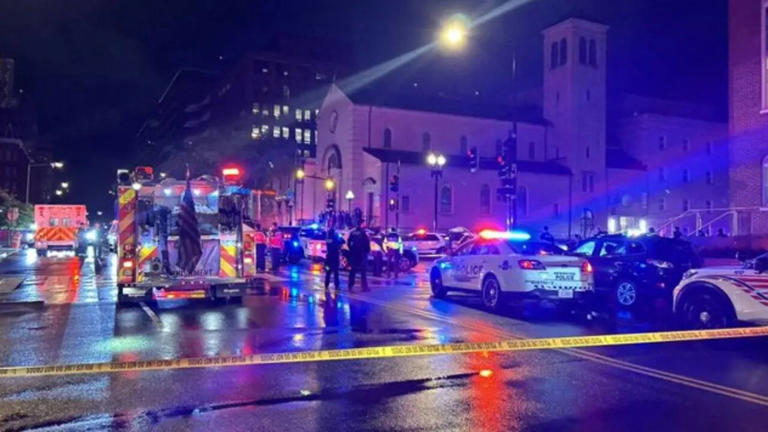
The shooting death of the two Israeli embassy workers in Washington DC this past Wednesday evening was tragic and horrific. All human life is precious – there can be no conceivable justification for this immoral act. Moreover, the man who perpetrated these murders is no hero; in addition to the lives he took and the grief he caused their families, his action has only served to harm – not help the Palestinian people. This is not what solidarity looks like.
As of this writing, there is much we don’t know about the shooting – and it would be irresponsible of me to speculate on whether the shooter was motivated by antisemitism. We do know that it was an act of political violence – and that the victims were embassy representatives of a nation that itself is engaged in an act of political violence that has killed tens of thousands of Palestinians – and is currently taking the lives of hundreds of people in Gaza every day.
Of course, there is no shortage of disingenuous politicians and media figures who are all too eager to use this act of violence for their own political advantage. But we cannot and should not equate the actions of one isolated incident with the entire movement for Palestinian liberation. Indeed, over the past nineteen months, millions of people across the US and around the world have protested peacefully for a ceasefire and an end to Israel’s genocide in Gaza. It is inaccurate – and in fact racist – to use this tragic event to make assumptions about Palestinians or collectively punish people of conscience who have been advocating for Palestinian safety and freedom. Our movement has always been about freedom, dignity and safety for all. The murderous action of one vigilante does not define us – nor should it lessen our resolve to continue advocating for an end to Israel’s genocide in Gaza.
According to one of the most sacrosanct teachings in Jewish tradition, all human beings are created in the divine image – and that all lives are equally, infinitely precious. I can’t help but think of this sacred value as I read the many poignant news stories about the young embassy workers Yaron Lischinsky and Sarah Milgrim: stories that honor the people they were as well as their hopes and dreams for the future.
At the same time, I couldn’t help but think: where are these stories in the mainstream media about the tens of thousands of Palestinians killed through political violence in Gaza over the past nineteen months? Where are the tributes to their lives, their hopes, their dreams? If they were afforded the same kinds of tributes, the media would be overwhelmed an endless cascade of stories about precious lives lost forever.
In her book, “Frames of War,” the scholar Judith Butler examines why some lives are “grievable” while others are not. Butler suggests that this selective mourning is due to a process of dehumanization, in which state powers determine which lives have the status of personhood – and thus more worthy of our grief. In short, if a person is deemed less human, they become less grievable.
When we engage in this kind of selective mourning, we become complicit in this process of anti-Palestinian dehumanization and racism. Here in the US, of course, people of color are all too familiar with this process. As Bernice Johnson Reagon powerfully wrote in her classic, “Ella’s Song:” Until the killing of black men, black mothers’ sons/Is as important as the killing of white men, white mothers’ sons/…We who believe in freedom will not rest.
How do we respond to the killings of Yaron Lischinsky and Sarah Milgrim? The same way we must respond to the tens of thousands of Palestinians who have been killed – and continue to be killed – by the Israeli military in Gaza: by continuing to protest openly and as openly as possible for an end to Israel’s genocide against the Palestinian people. By advocating for a free Palestine for all who live between the river and the sea.
And further: to insist on a world in which all may live in safety and dignity – and all people are mourned equally when they die.
 Shalom Rav