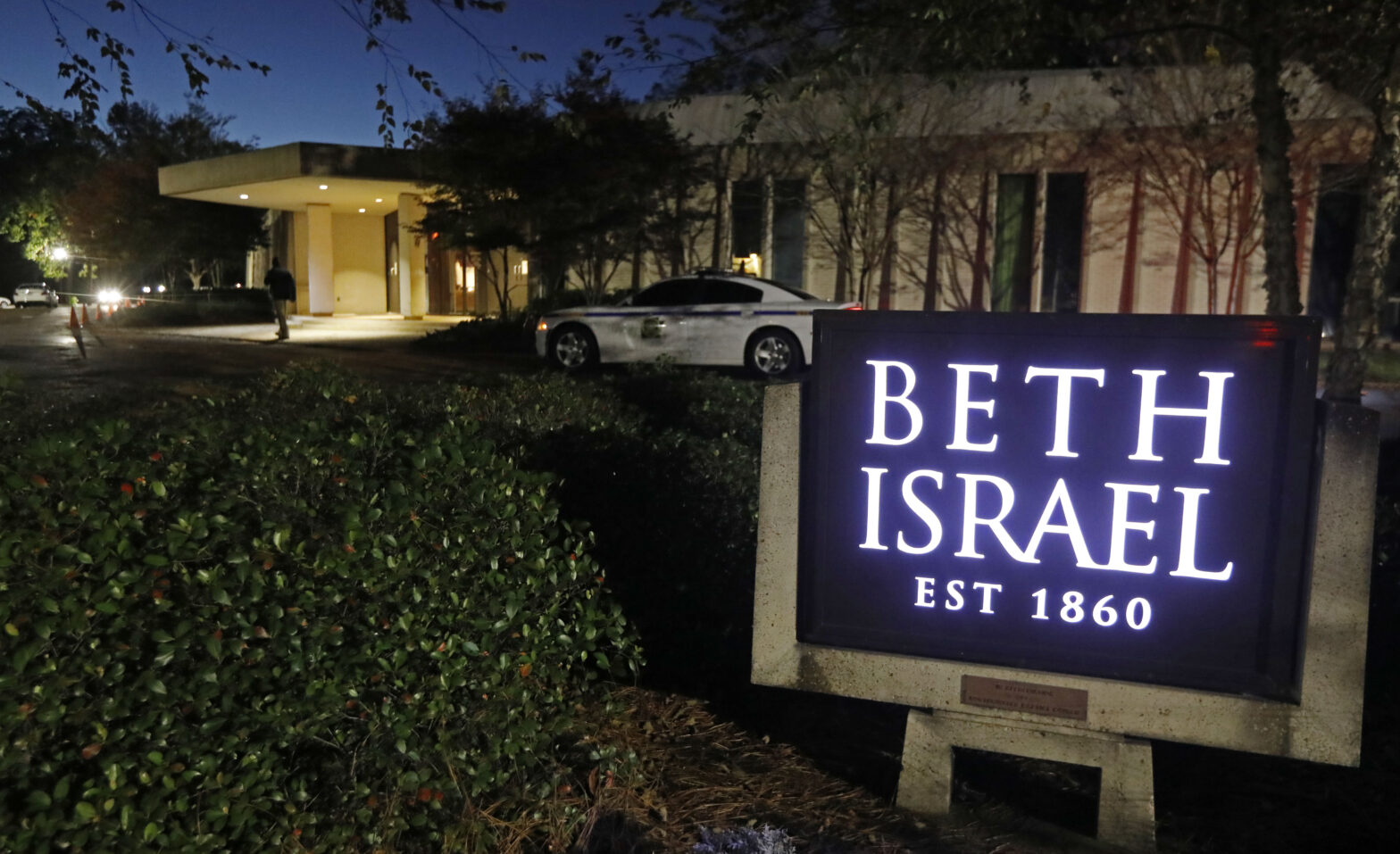
Last Shabbat the Jewish community received the devastating news that Beth Israel, the oldest synagogue in Jackson, Mississippi, was attacked by an arsonist. The fire caused extensive damage to the library and sanctuary, destroying two Torah scrolls and damaging five more. Thankfully, though the synagogue building was extensively burned, no one, other than the arsonist himself, was harmed.
The accused perpetrator, Stephen Pittman, a 19 year-old local man, was turned into the police by his father, who reported that his son texted him in real time while he was committing the crime. He later returned home with burns on his body and told his father “I finally got them.” According to reports, Pittman described Beth Israel as a “synagogue of Satan” to police investigators. When a judge read him his rights, he responded, “Jesus Christ is Lord.”
I can’t begin to imagine how I would feel if my synagogue was targeted on Shabbat with violence and religious desecration. The trauma is compounded by the reality of the current moment – a moment in which violent attacks on Jews, such the shooting attack at a Hanukkah party in Australia just last month, are one the rise. I’m sure I’m not the only one who feels as if our community is experiencing a state of permanent hypervigilance, dreading the inevitable next report of terrible, tragic news.
Even as we experience this trauma, however, I believe it’s critical to contextualize these incidents within a larger perspective. It’s important to understand that violent attacks on Jews are not exceptional or unique, but occurring within a larger rise in xenophobic violence around the world targeting vulnerable groups: Muslims, immigrants, people of color, LGBT people, among others. We know that in times of political and economic instability, this kind of scapegoating violence will inevitably rise. In other words, even as the Jewish community might feel isolated within our trauma, we must understand the ways that this is a collective, shared trauma. And that the antidote to isolation is a deeper solidarity with one another.
I would also suggest that beyond the trauma – or perhaps because of it – we must find the wherewithal to respond with clarity and understanding. In particular, we must firmly reject the weaponization of antisemitic incidents for political purposes. To put a finer point on it, for far too long Jewish communal leaders and organizations have been cynically exploiting these tragedies in order to dehumanize Palestinians. When Jewish trauma is weaponized in this way, it only serves to magnify the overwhelming trauma already being inflicted daily on one of the most vulnerable and targeted people in the world.
The cynicism of this tactic has become perversely transparent. Following this latest incident, for instance, scholar Deborah Lipstadt (and former White House “antisemitism czar”) wrote on X: “This is a major tragedy. But it’s more than that. It’s an arson attack and another step in the globalization of the intifada.” Lipstadt is not the only public Jewish figure to exploit this antisemitic incident to foment anti-Palestinian hatred and Islamophobia, even though the arsonist was clearly motivated by Christian antisemitic ideology.
Similarly, Israeli Prime Minister Netanyahu responded to the tragedy of the Bondi Beach massacre by incongruously blaming the incident on Australia’s recognition of a Palestinian state. In fact, the shooters were not Palestinian and had nothing to do with Palestinians. They were reportedly followers of ISIS – an extremist Muslim group that is rejected by the overwhelming majority of and Muslims worldwide, viewing it as a violent, heretical perversion of Islam that targets Muslims and non-Muslims alike.
In addition to seeking clarity, I’ve also found it useful to seek historical perspective. As I’ve read the reports about the arson in Jackson, Mississippi, I learned that this was not, in fact, the first time that Beth Israel was targeted with antisemitic hate. In September 1967, the synagogue was bombed by local Ku Klux Klan members because its then rabbi, Perry Nussbaum, was an outspoken civil rights activist. Two months later, Rabbi Nussbaum’s own house was firebombed by the KKK.
Following that attack, a leading Southern Baptist minister came to Rabbi Nussbaum’s home to express his sympathy. Nussbaum told him to spare his regrets. “If you really want to show your sympathies,” he said to the minister, “then tear up whatever you’re preparing for your sermon next Sunday morning and speak to the people in the front pews about their culpability in everything that’s happened not just to me . . . but to the blacks and their churches over the years.”
How do we respond when our community is increasingly under attack? Let’s take our cue from Rabbi Nussbaum. Let us respond with courage, moral clarity and solidarity.
 Shalom Rav