In the cycle of weekly Torah readings, we’ve recently begun the book of Exodus, the central sacred narrative of the Israelites’ journey from oppression to liberation. In the story, Egypt, the place of the Israelites’ servitude, is less historical than mythical, referred to in Hebrew by the word Mitzrayim, meaning “narrowness.” Mitzrayim is the Exodus story’s embodiment of systemic state oppression, signified by the constricting, crushing experience of ongoing persecution in which life becomes increasingly unlivable for the oppressed. In the opening reading of the book of Exodus, we read that Pharaoh oppressed the Israelites “be’farech,” which literally means “pulverized.” Last week we read that their “spirits were crushed” so thoroughly that they were unable to hear or respond to Moses’ message of liberation.
As we read the Exodus story this year, I can’t help but note that this narrative is playing out before us every day in real time. It is becoming brutally, tragically clear that the people of Gaza are experiencing Mitzrayim, forced to live in an increasingly narrow – and intolerable –place of genocidal oppression.
Last October, as part of the ceasefire deal between Israel and Hamas, Gaza was divided into two north-south zones divided by a “yellow line.” The eastern side of the line, which comprises roughly 58% of the Gaza strip, is under the control of the Israeli military. (It also includes most of the agricultural land used by Palestinians in Gaza before the war.) Meanwhile, over 2,000,000 Gazans have been forcibly displaced into the narrow western part of the strip, though many of them have (or had) homes on the other side of the line. As a result, this narrow strip of land – which was already one of the most densely populated places on earth, has been narrowed yet further.
Hundreds of Palestinians have already been killed since the ceasefire began – and at least 77 have been killed by Israeli gunfire near or over the line, which is not consistently delineated. Teenagers and young children have been among the slain, according to the AP. In October, an Israeli tank fired on a civilian car, killing 11 members of the Abu Shaaban family in the Zeitoun neighborhood of Gaza City. In December, two Palestinian boys were killed by an Israeli drone when they went out to gather some firewood for their father Tamer, who is paralyzed. The Israeli military announced it had killed “two suspects who crossed the yellow line, conducted suspicious activities on the ground, and approached IDF troops operating in the southern Gaza Strip, posing an immediate threat to them.”
If all of this sounds familiar, it should. The narrow space known as the “Gaza Strip” never existed until it was artificially created in 1948 following the Nakba, when it became a repository for a flood of Palestinian refugees ethnically cleansed from cities and villages in the coastal plain and lower Galilee. In the end, at least 200,000 refugees were crowded into tents in the 140 square mile strip of land. Its borders were determined by the position of Egyptian and Israeli forces when the ceasefire was announced. At the time, most of the refugees fully expected to return home – some could even see their towns and villages through the fences. Those who crossed the border to gather their possessions or harvest their crops were considered “infiltrators” by Israel and shot on sight.
In December 1948, the UN passed Resolution 194, which decreed that Palestinian refugees seeking to return home “should be permitted to do so at the earliest practicable date.” Of course, Israel proceeded to create facts on that ground to render their return impossible. Over 400 villages were completely destroyed, many of which had new Jewish settlements built upon them. In towns and cities, new Jewish immigrants moved into empty Palestinian houses that had been appropriated by Israel. To this day, “the earliest practical date” for the return of Palestinians to their homes remains unrealized.
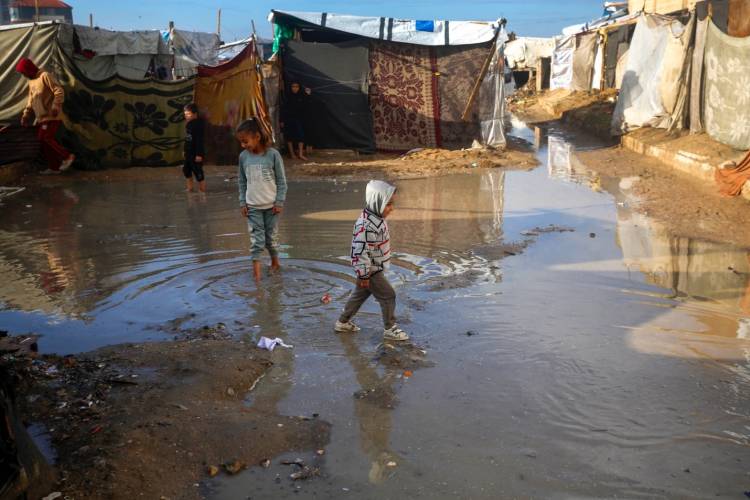
Now, almost eighty years later, Gazans have once again been dispossessed from their homes, forced into a “temporary” repository. Once again, Palestinians in Gaza are living in tents while other military powers make plans to permanently entrench their presence and power there. In the words of Palestinian scholar Rashid Khalidi, “1948 is immediately brought to mind when you see those images (of tents).”
And once again, the “temporary” lines drawn by colonial powers are inexorably becoming permanent. Last month, Israel’s military chief of staff Eyal Zamir unabashedly announced that the yellow line was now “a new border.” Even more ominously, it was reported that the Israeli military is expanding the yellow line yet further in eastern Gaza, squeezing Palestinians into an even narrower section of the narrow strip. According to Al Jazeera’s Hani Mahmoud, “The expansion of the yellow line (is) meant to eat up more of the territory across the eastern part, really shrinking the total area where people are sheltering…Everyone is cramped here. The population here not just doubled but tripled in many of the neighborhoods, given the fact that none of these people is able to go back to their neighborhoods.”
It is reasonable to assume that this intolerable status quo will go continue indefinitely, i.e., a de facto partition of Gaza east of the yellow line controlled by Israel, where it cultivates and empowers anti-Hamas Palestinian groups, and a smaller western area controlled by Hamas which will be left to languish in ruins. As Sam Rose, acting director of Gaza affairs at UNRWA has pointed out, “It’s right from the kind of typical Israeli playbook of ‘we’ll take as much as we can while there’s a process ongoing that isn’t delivering much.’ Then when it comes down to negotiations, there’s less to negotiate over.”
Given the bewildering political maneuvering of the current moment – the immediate future looks grim for the people of Gaza. Though almost none of the ceasefire’s Phase One goals have been accomplished, the US and Israel and their geopolitical partners are already proceeding with Phase Two of the plan. Trump has announced plans to hold a signing ceremony at Davos this Thursday for his “Board of Peace” – the consortium of nations and hand-picked Palestinian “technocrats” that will supposedly manage Gaza going forward. There is already controversy over Washington’s apparent effort to use the Board of Peace to usurp the United Nations from the planning process. It seems clear that the project is being largely steered by Trump cronies such as Steve Witkoff and Jared Kushner – i.e., real estate moguls who have a financial interest in how Gaza will eventually be carved up.
Like most of Trump’s foreign policy plans, this entire process has turned into a surreal circus. On Monday, when Trump was told that France was unlikely to join the Board of Peace, Trump replied, “Well, nobody wants (President Macron) because he’s going to be out of office very soon. I’ll put a 200 percent tariff on his wines and champagnes and he’ll join.” Meanwhile, Ali Shaath, a former deputy minister in the Western-backed Palestinian Authority who was chosen to lead the Palestinian technocrat committee recently said that providing relief and housing for Gaza will his committee’s first priority, adding, bizarrely, “If I bring bulldozers and push the rubble into the sea, and make new islands, new land, I can win new land for Gaza and at the same time clear the rubble. This won’t take more than three years.” (In fact, the UN has estimated it will take until 2040 and many billions of dollars to reconstruct Gaza.)
Beyond these surreal machinations, however, the pattern of this process is ultimately much the same as it ever was, dating back to post-1948 – or even the 1917 issuance of the Balfour Declaration: Western colonial powers are meeting to determine the fate and divide the spoils of historic Palestine absent any consultation with the Palestinian people themselves. In the meantime, the people of Gaza continue to languish in a contemporary Mitzrayim – an increasingly narrow place, subjected to ongoing military attack, forced to live in tents during a cold, wet winter, besieged by hypothermia and starvation.
In this week’s portion, the Israelites finally go through the waters and emerge into the wide-open spaces of liberation. Our sacred Exodus narrative makes this reality clear: the experience of Mitzrayim may be increasingly intolerable, but it cannot last forever. Pharaohs may rise, but they will inevitably fall. Though such a future may feel unbearably remote at the moment, we must hold tight to this vision. Even as the genocide continues, even as the rest of the world moves on, it will be up to us all to make this latest version of the liberation story a reality.
 Shalom Rav