Author Archives: Rabbi Brant Rosen

Unknown's avatar

About Rabbi Brant Rosen

I'm a rabbi, blogger, and activist with a special interest in Israel/Palestine justice work.

NGO Report: Palestinian Children Kept in Outdoor Cages

Ramle Prison (photo: Nir Keidar)

Ramle Prison (photo: Nir Keidar)

Earlier this week, the Public Committee Against Torture in Israel (PCATI) published a report that claimed children suspected of minor crimes were subjected to a variety of human rights abuses, including threats and acts of sexual violence and “public caging”, in which minors were held for extended periods of time in outdoor cages.

According to a group of public defenders making an official visit to Ramle prison, children were caged outside and exposed to severely cold weather during Israel’s recent winter storm. In a statement to the Israel Prison Service (IPS), the lawyers reported that “they spent several hours in the freezing cold and rain, until the transport arrived to take them to court around 6:00 am.”  The statement said that the practice had been going on for months, a fact “verified during other official visits and not denied by IPS.”

I read a number of news reports on the incident, and was particularly struck by this one from the Jerusalem Post (pay particular attention to the second paragraph):

The practice of placing the children in outdoor cages was halted when Justice Minister Tzipi Livni learned of it and immediately telephoned Public Security Minister Yitzhak Aharonovitch, telling him to end the practice…

It was unclear who within the Prisons Service initiated the practice, why it was initiated or who decided to continue it despite the adverse weather conditions, but the service responded that since it had received criticism the situation had been improved.

Livni’s attempts at fig-leaf PR notwithstanding, the issue of child detention issue far transcends this one particularly horrifying revelation. Last March, I reported on a UNICEF report that concluded the ill-treatment of Palestinian minors held within the Israeli military detention system is “widespread, systematic and institutionalized.” The 22 page report carefully examined the Israeli military court system for holding Palestinian children and found evidence of “cruel, inhuman and degrading treatment or punishment.”

A Huffington Post feature on the report noted:

In a step-by-step analysis of the procedure from arrest to trial, the report said the common experience of many children was being “aggressively awakened in the middle of the night by many armed soldiers and being forcibly brought to an interrogation centre tied and blindfolded, sleep deprived and in a state of extreme fear.”

Many were subjected to ill-treatment during the journey, with some suffering physical or verbal abuse, being painfully restrained or forced to lie on the floor of a vehicle for a transfer process of between one hour and one day.

In some cases, they suffered prolonged exposure to the elements and a lack of water, food or access to a toilet.

During my recent visit to the West Bank, our delegation spoke with Gerard Horton (formerly of Defence of Children International – Palestine and currently founder/director of Military Court Watch), who described for us this process in shocking detail. Much of what he had to tell us can be found in his article on the subject here.

As a Jew and a human being of conscience, I am sickened by Israel’s practice of child detention. Please join me in contacting Tzipi Livni (zlivni@knesset.gov.il) to tell her you agree – to let her know this is not a problem that cannot be solved with one face-saving phone call.

Why I Support the ASA Boycott of Israeli Academic Institutions

ASA-logo-tiff-1-copy

The recent decision of the American Studies Association (ASA) to endorse the academic boycott of Israel has engendered increasingly intense press coverage and social media conversation over the past several days. I’ve already engaged in more than a few of them via Facebook –  but now I’m ready now to weigh in and offer some thoughts in a more systematic fashion.

First, some background:

The ASA is according to its website, “the nation’s oldest and largest association devoted to the interdisciplinary study of American culture and history.” According to a released statement, the ASA has been discussing and debating whether or not to endorse an academic boycott since 2006. On December 4, the ASA National Council announced its support of the academic boycott. Then this past Monday, the ASA membership endorsed the boycott resolution by a two to one margin. 1252 voters participated in the election – the largest number of participants in the organization’s history.

Because there is so much misinformation regarding the precise nature of the boycott, I think it’s important to quote the ASA statement at length:

The Council voted for an academic boycott of Israeli institutions as an ethical stance, a form of material and symbolic action. It represents a principle of solidarity with scholars and students deprived of their academic freedom and an aspiration to enlarge that freedom for all, including Palestinians.

We believe that the ASA’s endorsement of a boycott is warranted given U.S. military and other support for Israel; Israel’s violation of international law and UN resolutions; the documented impact of the Israeli occupation on Palestinian scholars and students; the extent to which Israeli institutions of higher education are a party to state policies that violate human rights; and the support of such a resolution by many members of the ASA.

Our resolution understands boycott as limited to a refusal on the part of the Association in its official capacities to enter into formal collaborations with Israeli academic institutions, or with scholars who are expressly serving as representatives or ambassadors of those institutions, or on behalf of the Israeli government, until Israel ceases to violate human rights and international law.

The resolution does not apply to individual Israeli scholars engaged in ordinary forms of academic exchange, including conference presentations, public lectures at campuses, or collaboration on research and publication. The Council also recognizes that individual members will act according to their convictions on these complex matters.

For all of the concern over the resolution’s attack on academic freedom, it is important to note, as the ASA statement does, that Israel actively curtails and denies the academic freedom of Palestinian academics and students on a regular basis. Palestinian universities have been bombed, schools have been closed, scholars and students have been deported and even killed. Palestinian scholars and students have their mobility and careers restricted by a system that limits freedoms through an oppressive bureaucracy. Many Palestinian scholars cannot travel easily, if at all, for conferences or research because they are forbidden from flying out of Israel.

Though many are excoriating the Association’s decision as a denial of Israeli academic freedom, their resolution does not endorse a blanket boycott of individual academics and institutions – as was the case with the academic boycott of South Africa, for instance. The ASA endorsement responds to the call from the Palestinian Campaign for the Academic & Cultural Boycott of Israel (PACBI), which explicitly targets institutions, not individuals.  It does not endorse limiting the academic freedom of individual Israeli scholars to participate in conferences, lectures, research projects, publications etc.

Why is the ASA refusing to collaborate with Israeli academic institutions? Because it knows that every major Israeli university is a government institution that is intimately tied to the Israeli military, furnishing it with scientific, geographic, demographic and other forms of research that directly supports Israel’s human rights abuses of Palestinians.

This 2009 report by the Alternative Information Center cites a myriad of such collaborations. For example, Haifa University and Hebrew University have special programs for military intelligence and training for the Shin Bet (the Israeli security service) and members of the military and Shin Bet have served on administrative boards of Israeli universities. The Technion – Israel Institute of Technology has strong ties to Israeli military and arms manufacturers such as Elbit Systems.  And as of the date of the report, Tel Aviv University had conducted 55 research projects with the Israeli army.

Many criticize the ASA boycott endorsement by asking why, of all the odious regimes in the world, are they singling out and targeting Israel? This is probably the most commonly heard refrain against the Boycott, Divestment and Sanction movement in general, and I’ve addressed it numerous times in previous posts.

I’ll repeat it again: this accusation is abject misdirection. The academic boycott is part of a larger call for BDS that was sent out in 2005 by over 170 Palestinian political parties, organizations, trade unions and movements – the overwhelming majority of Palestinian civil society – to support their resistance against Israeli oppression through classic, time honored methods of civil disobedience.  The ASA did not initiate this boycott – it made a principled, good faith decision to respond to the Palestinian call for support. Thus the real question before us when addressing BDS is not “what about all of these other countries?” but rather “will we choose to respond to this call?” To miss this point is to utterly misunderstand the very concept of solidarity.

One of the most widely read criticisms of the ASA boycott endorsement came from Open Zion’s Peter Beinart, who wrote that the “real problem” with the boycott was the problem with BDS as a whole:

BDS proponents note that the movement takes no position on whether there should be one state or two between the Jordan River and the Mediterranean Sea. But it clearly opposes the existence of a Jewish state within any borders.  The BDS movement’s call for “respecting, protecting and promoting the rights of Palestinian refugees to return to their homes and properties” denies Israel’s right to set its own immigration policy. So does the movement’s call for “recognizing the fundamental rights of the Arab-Palestinian citizens of Israel to full equality”, which presumably denies Israel’s right to maintain the preferential immigration policy that makes it a refuge for Jews. Indeed, because the BDS movement’s statement of principles makes no reference to Jewish rights and Jewish connection to the land, it’s entirely possible to read it as giving Palestinians’ rights to national symbols and a preferential immigration policy while denying the same to Jews.

This is the fundamental problem: Not that the ASA is practicing double standards and not even that it’s boycotting academics, but that it’s denying the legitimacy of a democratic Jewish state, even alongside a Palestinian one.

This is classic Beinart: while he writes in the reasonable tones of a liberal Zionist, when you actually deconstruct his analysis, it’s really quite draconian. Beinart condemns the majority of Palestinian civil society for asking that their right of return be respected – a right that is enshrined in international law. Then he goes on to criticize Palestinians for not respecting Israel’s “right” to create preferential immigration policies that keep them from their own ancestral homes (a right that is enshrined nowhere in particular.)

As ever, Beinart seems galled that the BDS movement is not J St. No, the BDS National Committee does not respect preferential treatment for Jews. No, it is not actively lobbying for a two-state solution. While Beinart remains imprisoned in the vagaries of national rights, the BDS call is grounded in the values of universal human rights.

From the BDS National Committee Website:

The campaign for boycotts, divestment and sanctions (BDS) is shaped by a rights-based approach and highlights the three broad sections of the Palestinian people: the refugees, those under military occupation in the West Bank and Gaza Strip, and Palestinians in Israel. The call urges various forms of boycott against Israel until it meets its obligations under international law by:

1. Ending its occupation and colonization of all Arab lands occupied in June 1967 and dismantling the Wall;

2. Recognizing the fundamental rights of the Arab-Palestinian citizens of Israel to full equality; and

3. Respecting, protecting and promoting the rights of Palestinian refugees to return to their homes and properties as stipulated in UN Resolution 194.

This call takes no stand on the final political parameters of the conflict, nor should it. As a rights based call, it recognizes that the first order of business is to pressure Israel to end its violations of human rights and to adhere to international law. If at the end of the day, a two-state solution is made impossible, it will not be because of the Palestinian people’s desire for their legal right of return to be respected and recognized – rather it will be due to Israel’s ongoing colonization and Judaization of the Occupied Territories.

I’ve heard many say that this one little resolution by one American academic organization is really no big deal and doesn’t really amount to much at the end of the day. But if this was truly the case, why are so many people talking about it so often and so fervently?  Yes, the ASA is but one humble scholarly institution. But by endorsing this boycott, it is clearly becoming part of a movement – and one that is gaining in strength. Just last April, the Association for Asian American Studies broke the ice to be the first American academic institution to endorse the boycott. And immediately on the heels of the ASA, the Native American and Indigenous Studies Association has now signed on as well.

I realize that it is painful for many to see Israel isolated in such a fashion. But in the end, as long as the US government remains unwilling to use its leverage to end its oppressive behavior, this movement will only gain in strength and influence. For those who doubt its effectiveness, we have only to look at the way the international BDS campaign against apartheid South Africa eventually reached a tipping point until the Pretoria regime had no choice but to dismantle apartheid.

As the world mourns Mandela’s death, we would do well remind ourselves of the ways popular movements can help bring institutional systems of oppression to an end.

Prawer Plan Scrapped – How Will the “Bedouin Problem” be Solved?

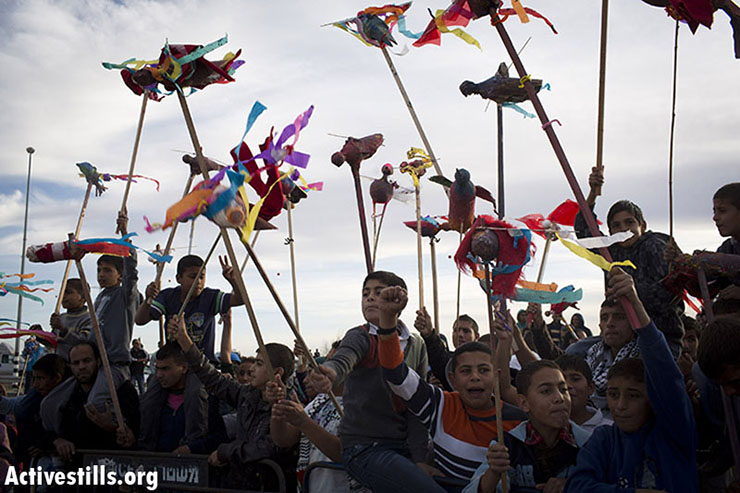
Children flying kites to the demonstration against the Prawer Plan during November 30 "Day of Rage" protest outside Hura in the Negev Desert.

Children protest against the Prawer Plan during a “Day of Rage” demonstration in the Negev town of Hura.

Received the wonderful news yesterday that Israel’s Prawer-Begin Plan – a bill which would forcibly relocate over 40,000 Israeli Bedouin from their ancestral lands – was just scrapped by the Knesset.

This is huge on a number of levels. Most importantly, it’s very welcome news for the tens of the thousands of Bedouin who were facing an unjust eviction and transfer from their homes. Up until relatively recently, in fact, the passage of Prawer seemed virtually assured. But as I mentioned in my last post, Knesset support began to unravel when Benny Begin, the co-sponsor of the bill, revealed that he had never even shown the plan to the Bedouin – putting to lie the widespread claims of government officials that the majority of Bedouins had approved of it.

After revealing a map of the actual plan, the Knesset’s right wing attacked it, claiming it actually allocated too much land to the Bedouin (even though it would have taken 61,700 acres from them and resettled them in a compound totaling 42,000 acres.) Feeling the pressure from both sides, the government was forced to scrap their plan entirely.

As I’ve followed this issue, I’ve found it utterly infuriating whenever I read supporters of the bill invoke a “Bedouin Problem” that needed to be solved, as if the economic and social issues facing the Bedouin were somehow of their own making. In truth, there is no need for a special government relocation bill to “solve” this “problem.” What the Bedouin need is for the Israeli government to officially recognize the areas in which they live so that they can finally receive basic infrastructure such as water, sewage, and electricity. They need Israel to treat them them as equal citizens, offering them full government services, to allow them to vote or run in local government elections.

But they can’t, of course, because Israel desires to create more facts on the ground in the Negev. In other words, the real “Bedouin Problem” stems from the fact that the Bedouin are not Jewish.

Of course the scrapping of this bill does not mean that the fate of the Bedouin is by any means assured. There is every possibility that the government will resubmit the plan in an even more draconian fashion. As Mairav Zonszein pointed out yesterday in +972mag:

While today’s news will at the very least delay the State’s plan to implement the largest displacement a Palestinian population since 1967, there is little reason for celebration. It it will only be the end of the current version, which  was in jeopardy mostly due to concerns from right-wing MKs that it was “too generous” to the Bedouin.  It is probable a revised bill will be drafted that will in all likelihood not be any better as far as Bedouin claims.

While this may well come to pass, it is fair to say that a more restrictive bill will undeniably be met with fierce opposition from a powerful and widespread movement of solidarity that has now coalesced to support the Bedouin’s cause. And this is another reason why the scrapping of Prawer-Begin is so significant: it speaks to the growing power and influence of the Palestinian solidarity movement.

Indeed, over the past several months, this movement was galvanized by Prawer-Begin, bringing together a wide coalition of organizations in Israel/Palestine and abroad. The tipping point was reached two weeks ago during the “Days of Rage” protests, in which hundreds of Palestinians and solidarity activists staged demonstrations in the Negev town of Hura as well as Haifa, East Jerusalem, Ramallah and Jaffa. Simultaneous protests took place throughout the world in London, Berlin, Rome, Istanbul, Cairo and in the US. There is a very real movement growing, and it is slowly but surely chalking up significant victories for the cause of justice in Israel/Palestine.

Still, while there is every reason for this movement to celebrate this latest legislative success, the need for vigilance ever continues. Many Bedouin homes and villages are still slated for demolition – and the village of Al-Araqib has already been demolished over 60 times. As this press release from Jewish Voice for Peace aptly puts it:

We can exhale for now, with relief the Prawer Plan is no more, and then take a new breath and get ready to continue the work to ensure that the Negev Bedouin, and all people in the region, have what they need to thrive.

The Horrifying Scope of Israel’s Prawer Plan

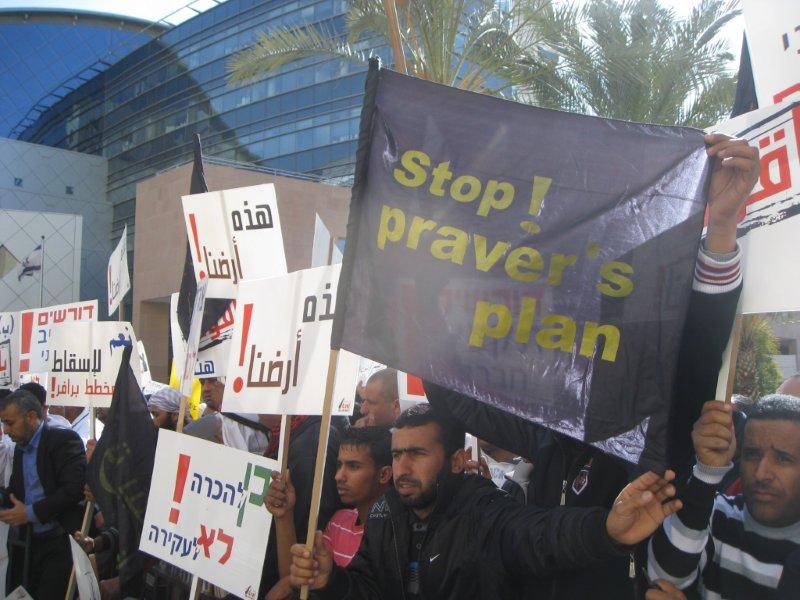
stop-prawer-plan-israel-Bedouin

By now i’ve written more than a few blog posts about Israel’s Prawer-Begin Plan which, if approved by the Knesset would displace tens of thousands of Bedouin from their ancestral home in the Negev desert.  Up until now, many defenders of the plan have claimed that this “relocation” was developed for the benefit of the Bedouin. In recent weeks, Israeli government spokespeople have responded to anti-Prawer protests by claiming 80 percent of the Bedouin population actually support the plan.

The patent falsehood of such claims have now been laid bare. A map of the project has just been released to the Knesset Interior Affairs Committee and the massive extent (and injustice) of the plan has now been brought into the light of day.

Ironically enough, according to Michael Omer-man of +972mag, the map was prepared by the Prime Minister’s Office for Housing Minister Uri Ariel, in an attempt to assuage his party’s fears that too much land would be given to the Bedouin.  (That’s right – apparently the far right Jewish Home party opposes the Prawer Plan because they believe it is too lenient to the Bedouin.)

According to the report, the bill’s co-sponsor Benny Begin has admitted Bedouin leaders have never even seen the plan until now:

Begin on Monday refuted that he ever made such statements, writing, “I have never said to anyone that the Bedouin accept my plan.”

He couldn’t have made such a claim, he explained, because he never even presented the Bedouin community with his plan, “and therefore I could not have heard their reactions to it.”

“[Because] I was not able to know their level of support for the law, it therefore follows that I couldn’t say that I know anything about their support for the law.”

According to the new map, the state of Israel will take over 250,000 dunams (61,700 acres) currently populated by Bedouins, while the Bedouins will be resettled in an area totaling 170,000 dunams (42,000 acres). Around 40,000 people will be forced to leave their homes.

I don’t know any other way to say it: if implemented, this plan would result in a crime that is truly staggering to contemplate. It will lead to the uprooting and forcible eviction of dozens of villages. Tens of thousands of residents will be stripped of their property and their historical land rights. Thousands of families will be condemned to poverty and unemployment. The communal life and social fabric of these villages will be destroyed.

This plan is decidedly not about the best interests of the Bedouin. If it is about anything, it is about a large swath of land in the south of Israel that government leaders have been attempting to “Judaize” since the days of Ben-Gurion. The only reason the Bedouin are slated for removal, quite frankly, is because they are not Jews. By any other name, such an act would be called ethnic cleansing and I am not hesitant to say so.

If you haven’t yet, please join me and the growing number of Jews and people of conscience who are voicing their opposition to the Prawer-Begin plan in no uncertain terms.

Guest Post by Rabbi Brian Walt: Welcoming My Grandson, Micah Mandela

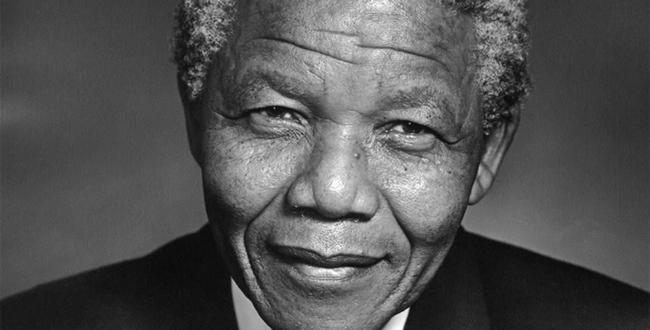
Nelson-Mandela’s-Top-Five-Contributions-to-Humanity

In memory of Nelson Mandela, I offer you this breathtaking Yom Kippur sermon that was delivered three months ago by my dear friend Rabbi Brian Walt. Brian grew up in South Africa and his activism in the anti-apartheid struggle was a defining aspect of his own spiritual/political evolution. I can think of no better tribute to Mandela’s legacy than to share the words of this visionary rabbi, whose grandson now bears Mandela’s name.

In June, when Chana and Lincoln, my daughter and son-in-law, announced at the naming/covenant ceremony that the name of their second child would be Micah Mandela Ritter, I was deeply moved. I never imagined that I would be blessed with a grandchild named Mandela. I feel so blessed to be the zeyde (grandfather) of a child who carries the name of a moral hero of our time, a man who has been central to my own life and has inspired me in so many ways.

I grew up in Cape Town, one of the most beautiful cities in the world. My family’s home was in Sea Point, a suburb that lies between the mountain and the ocean. Our home, number 14 Queens Road, was just a few houses from the ocean. If you looked up the road you could see the mountain; in the other direction, the ocean. The natural beauty that surrounded us was nothing less than spectacular: miles of oceanfront in both directions, lush vegetation, gorgeous flowers and the mountain in the background. In Habonim, my Zionist youth group, we sang, “We come from Cape Town, land of sea and mountain!” Yes, we lived in a spectacularly, beautiful place, “a land of sea and mountain” and much more.

Our family loved to go for walks on the beachfront. We would pass swimming pools, restaurants, playgrounds — all restricted to whites.  The only people of color allowed to live in our neighborhood were domestic servants who lived in separate servants quarters.  Blacks who worked in Sea Point lived in townships far from the city, came in during the day to work and had to carry a pass book confirming that they had a job in our area.

On clear days, we could see an island in the distance: Robben Island, the prison where Nelson Mandela and many of his African National Congress comrades were imprisoned for decades. The gulf between our comfortable and glorious suburb and the prison island we could see with our own eyes was enormous. It seemed unbridgeable. That tragic gap reflected the gulf between the reality of most white South Africans and that of majority of the people who lived in South Africa.

At that time it was illegal to quote Mandela or to print a photograph of him. Merely mentioning his name could make one the subject of suspicion. White South Africa and the Western world, including the United States, considered him persona non grata. He was a “communist” and a “terrorist.” The United States never took Mandela off the terrorist list until 2008 and kept the ANC on the list but made it possible for the status to be waived at times.

It was clear that if there were to be peace in our country it would involve freeing Mandela from prison, legalizing the ANC, and entering into negotiations. When I was growing up this seemed beyond any possibility. We all feared that our country was on the road to a massive and bloody civil war.

Growing up in South Africa, a country with so much racial hatred and devastating poverty and suffering alongside extraordinary privilege and wealth, was very painful for me as a child.   But I also feel profoundly blessed to have grown up in a country with moral heroes like Nelson Mandela and so many others, people who devoted their lives to the pursuit of justice and dignity for all. I am also very fortunate to have grown up in a country that went through a miraculous transformation brought about by thousands of human beings all around the world who put their lives on the line for justice.

I believe that my grandson and all of us have much to learn from Nelson Mandela. And so tonight I want to share three of the many lessons I learned from this extraordinary man: first, about justice and moral vision; second, about compassion and forgiveness; and third, about hope, community and social change.

These lessons are directly relevant to us this day as we reflect on our lives, our own moral vision and issues of forgiveness and change.  Many of us are the beneficiaries of economic and racial privilege and live in a country with a history not so different from South Africa’s.

Lesson #1:  A moral vision of justice

The Torah commands us: “Justice, justice shall you pursue!” The prophets of our tradition call us to justice. “Let justice well up like water,” says Amos. “You know what God has commanded you,” says Micah, “to act justly, love kindness and walk humbly.” The prophetic tradition which is the core of Reform Judaism and much of liberal Judaism puts justice at the center of our religious vision.

Nelson Mandela, although he is not religious, is in the line of the prophetic tradition. His life was devoted to justice and guided by a clear moral vision of a democratic country, a non — racist South Africa, where all people would enjoy equality, dignity and justice. In 1963, when I was 11 years old, Mandela was convicted along with 10 of his comrades, five of whom were Jewish, in the Rivonia Trial, which ended with Mandela sentenced to life imprisonment.

In a moving statement at the trial he articulated this moral vision. First, he described the injustices Africans suffered and what they deserve.

Africans want to be paid a living wage. Africans want to perform work which they are capable of doing, and not work which the government declares them to be capable of. Africans want to be allowed to live where they obtain work, and not be endorsed out of an area because they were not born there. Africans want to be allowed to own land in places where they work, and not to be obliged to live in rented houses which they can never call their own. Africans want to be part of the general population, and not confined to living in their own ghettos.

African men want to have their wives and children to live with them where they work, and not be forced into an unnatural existence in men’s hostels. African women want to be with their menfolk and not be left permanently widowed in the reserves. And then he articulated the most important demand:

Above all, we want equal political rights, because without them our disabilities will be permanent.

This then is what the ANC is fighting. Their struggle is a truly national one. It is a struggle of the African people, inspired by their own suffering and their own experience. It is a struggle for the right to live. During my lifetime I have dedicated myself to this struggle of the African people. I have fought against white domination, and I have fought against black domination. I have cherished the ideal of a democratic and free society in which all persons live together in harmony and with equal opportunities. It is an ideal that I hope to live for and to achieve. But if needs be, it is an ideal for which I am prepared to die.

Mandela’s vision of a “democratic and free society in which all persons live in harmony and with equal opportunities” was not only Mandela’s personal vision; it was the vision of a broad movement that was articulated in the Freedom Charter.  In 1955 the African National Congress sent 50,000 volunteers out into the countryside to ask people what freedoms they wanted. Based on this, they drafted the Freedom Charter, which was then adopted by the multiracial South African Congress Alliance.

The Charter began:

We the People of South Africa declare for our country and the world to know that South Africa belongs to all who live in it, black and white, and that no government can justly claim authority unless it is based on the will of all the people.” The document includes demands for basic human rights (many of which are still not part of the moral vision of the United States): a forty – hour week, equal pay for equal work, a national minimum wage, free compulsory universal and equal education for all children, universal health care.

The document is so inspiring. Most of it, except for the clauses that deal with nationalizing industry or redistributing land, was incorporated into South Africa’s extraordinary constitution in 1996.  Mandela’s vision was not based in any religious tradition, but it is consonant with the central core values of all religion as we understand it: that each and every human being is a child of God entitled to dignity, equality and justice.

Mandela pursued this moral vision relentlessly and at enormous personal cost. When he was offered a deal that would free him but would not guarantee voting rights, he chose to remain in prison and did not emerge until that most basic demand was met.

Mandela’s dedicated commitment to justice was integrated with a profound compassion for all people, even his enemies. This is evident in his unrelenting commitment to a non-racial democracy but also in his greatness of spirit and the forgiveness with which he approached his white oppressors. This is best exemplified in two stories about his relationships to those his enemies and those who supported him.

Lesson #2: Compassion and Forgiveness

In his inauguration address as president of the new South Africa, Mandela urged South Africans to forgive one another and to move beyond the hatred of the past. He declared:

The time for the healing of the wounds has come. The moment to bridge the chasms that divide us has come.

He called on South Africans to work toward a country in which “all South Africans, both black and white, will be able to walk tall, without any fear in their hearts, sure of the inalienable right to human dignity – a rainbow nation at peace with itself and the world.”

On that inauguration day, one of the guests of honor who received a personal invitation from the new president was a man by the name of James Gregory, one of Mandela’s jailers on Robben Island. Gregory worked there for nine years, from 1967 till 1976. When he was transferred to Cape Town, he continued to censor the letters of inmates on the island. Later he was transferred to Pollsmoor prison, and when Mandela and four other A.N.C.leaders were transferred there, Gregory was assigned to Mandela.

Gregory talks about his extraordinary relationship with Mr. Mandela during this period of time:

When he was alone I used to go and sit with him in his cell for hours at a time. We spoke about everything – his family, my family. But never politics and never trying to convince me of his views.

He always called me Mr Gregory and I addressed him as Nelson. When visitors came I would address him as Mr Mandela. After he was released he phoned me here at home and I said, “Hello, Mr Mandela,” and he said, “Where does this mister suddenly come from? You call me Nelson as you always did.”  He now calls me James.

When Mandela was released from Pollsmoor Prison in 1993 James Gregory received a white card to ‘W/O Gregory’. In neat, rounded handwriting, it said: “The wonderful hours we spent together during the last two decades end today. But you will always be in my thoughts.”

In explaining the reason for the invitation to Gregory and two other former prison wardens , Mandela said, “I invited them to come because I wanted them to share in the joys that have emanated around this day. Because in a way they have also contributed.”

What extraordinary forgiveness! To forgive those who have served as your jailers. What a powerful story for this day of forgiveness when each of us is called to ask for and grant forgiveness.

Can we forgive those who have hurt us? Will we?

Alan Brigish, a friend of mine who lives on Martha’s Vineyard and who also grew up in South Africa, tells another extraordinary story about Mandela. His father, Harry Brigish, gave Mandela a job as a law clerk in 1947 .

In 1999, Mandela’s final year as president, Alan took his dad to the doctor who told him that the President had asked him about his father and wanted to see him. Alan immediately called Mandela’s and left a message that he was Harry Brigish’s son and that he had been told the president wanted to see him. He wanted to let him know that Harry would love to see him.

A day later, six cars arrived at the apartment block and Mandela came over for a cup of tea. Alan’s mom asked the president what he was going to do now that his term of office was over. “I am going to be doing much the same as what I am doing now. I am going to find the people who helped me and meet with them to thank them personally and I am going to find the people who hurt me and meet with them and forgive them face to face.” What compassion! What humility! What menshlichkeit!

Do we have the same capacity to thank those who have loved and helped us and to forgive those who have hurt us. Will we do so?

Lesson # 3. Hope and Change

Growing up in South Africa, it was hard to imagine any future other than a massive civil and racial war in which thousands of people would be killed. And yet the determined resistance of millions of South Africans and people around the world made possible what seemed impossible. The apartheid government, facing mounting pressure from the resistance inside the country and from those around the world engaged in Boycott, Sanctions and Divestment, decided to free Nelson Mandela and the other leaders of the resistance and to negotiate with them. The relatively peaceful transfer of power in South Africa was nothing short of miraculous and it is a source of great hope for all who seek social change. Social change takes a long time and demands huge devotion, courage and many sacrifices, but it is possible. Mandela and the movement he led always held to their moral vision and their belief that change could and would happen.

What we can learn is that change is possible when people join together in movements to make change. There is an extraordinary seven-part documentary made by Connie Fields, “Have You Heard From Johannesburg”, that describes how actions in the country and around the world engaged in Boycott, Divestment and Sanctions against South Africa  made that happen.

In July, my sister Yda, a fabric artist who lives in Johannesburg, gave me a shirt she had designed with a quote from Mandela. It reads: “A winner is a dreamer who never gives up.”

A Blessing for Micah Mandela:

And so, my dear Micah Mandela: the man after whom you are named is a winner, a dreamer who never gave up. I hope carrying his name brings you blessings in your life: the blessing of living your life according to a moral vision of justice, your heart filled with compassion for all people, always offering forgiveness. A life of hope, that you always know deep in your heart that people joining together can make a difference in the world. I hope you find your particular way of joining with others to make our world a more just and decent place, and the blessing of honoring the prophetic voices of your Jewish legacy, your own prophetic voice and the prophetic voices in your world.

Always remember the Jewish prophetic legacy that you have received as a gift. Remember what the prophet Micah taught us all. It is not complicated. You know what God desires of you: Act justly, love kindness and walk humbly.

This is my blessing to you and to all your buddies, the next generation who will inherit this world.

And so my dear friends, this is my blessing to you as well. May we always follow a vision of justice, justice that is integrated with compassion and forgiveness, and may we join together in this place with others in the world who are devoted to creating a more just and democratic and peace-loving United States and a just and peaceful world.   May we forgive those who have hurt us and thank those who have helped us.  May we have compassion for those we perceive to be “enemies.”

As Nelson Mandela said in his inauguration address:

Let there be justice for all.

Let there be peace for all.

Let there be work, bread, water and salt for all.

Let each know that for each the body, the mind and the soul have been freed to fulfill themselves.

Let freedom reign. God bless Africa.

And let us add: May God bless us all.

May we all be sealed for a sweet, joyous and healthy New Year.

New Hillel and AIPAC Partnership: Open Hillel Responds

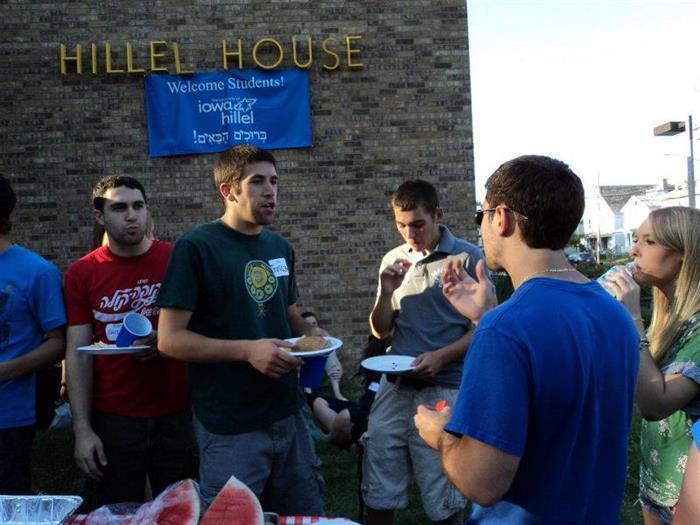
photo: iowa.hillel.org

photo: iowa.hillel.org

This just in: Eric Fingerhut, the President of Hillel and Jonathan Kessler, the Leadership Development Director of AIPAC, have just announced in the Jewish Week that Hillel and AIPAC will be formally “working together to strategically and proactively empower, train and prepare American Jewish students to be effective pro-Israel activists on and beyond the campus.”

What this means essentially is that Hillel, an organization that is meant to serve as an umbrella for the diverse Jewish student communities on college campuses nation wide, is now formally aligning itself with a lobbying group’s specific definition of what it means to be “pro-Israel.”

By way of response, I encourage you to read this statement (below) by Open Hillel, a grassroots student-run campaign that works to encourage inclusivity and open discourse at campus Hillels. I’ve long been a huge fan of OH and was not surprised to read that they had drafted an articulate and thoughtful response to Fingerhut and Kessler.

And if you agree with them that this new Hillel-AIPAC partnership will “stifle discussion and debate on issues concerning Israel, and undermine Hillel’s commitment to creating an inclusive community,” please click here and let Hillel know.

Statement of Opposition to AIPAC and Hillel’s New Partnership

Hillel has consistently demonstrated an admirable commitment to religious pluralism, welcoming students who span the full spectrum of Jewish religious practices and beliefs and encouraging students to connect with Judaism in ways that are meaningful to them. We are worried that this pluralistic spirit, so beneficial to Hillel and the Jewish community, is lacking in the political arena. In particular, we are deeply troubled by Hillel President and CEO Eric Fingerhut and AIPAC Leadership Development Director Jonathan Kessler’s recent declaration that Hillel and AIPAC “are working together to strategically and proactively empower, train and prepare American Jewish students to be effective pro-Israel activists on and beyond the campus.” We fear that this new partnership will alienate Jewish students whose views do not align with those of AIPAC, stifle discussion and debate on issues concerning Israel, and undermine Hillel’s commitment to creating an inclusive community.

AIPAC’s policy positions are highly controversial among Jewish college students and the American Jewish community at large. Thus, if Hillel operates with AIPAC’s definition of “pro-Israel” as the benchmark for what is and is not acceptable within the Jewish community on campus, it will alienate many Jewish students. For instance, Point 6 of AIPAC’s 2012 Action Plan calls for “the recognition of Jerusalem as Israel’s undivided capital.” However, since Palestinians also claim Jerusalem as their capital, many students who support a two-state solution believe that Jerusalem should be divided or shared. Indeed, 82% of American Jews support a two-state solution with an independent Palestinian state in the West Bank, Gaza, and East Jerusalem in exchange for full diplomatic recognition of Israel by the surrounding countries. Similarly, AIPAC’s national council voted down (by a large majority) a measure calling on Israel to dismantle “illegal settlement outposts” – the small minority of settlements that are illegal under Israeli law. However, nearly three times as many U.S. Jews believe that settlement construction hurts Israel’s security as do believe that it helps. Hillel is an umbrella organization serving all Jewish students, as its vision and mission statements express. AIPAC supporters can and must have a voice in Hillel. But that voice is just one voice; it is not and cannot be THE voice.

In their article, Fingerhut and Kessler describe the AIPAC-Hillel partnership as strategically necessary to combat “anti-Israel” activity on campus. However, in order for Jewish students to truly engage with Israel in a thoughtful manner, we should have the opportunity to hear a wide range of perspectives on Israel-Palestine — including voices that speak to Israel’s shortcomings and criticize its policies. For instance, in pointing to “anti-Israel organizing” at Stanford University, we assume that Fingerhut and Kessler refer to a national conference held at Stanford by Students for Justice in Palestine. SJP raises important questions about the Occupation and human rights abuses in the Palestinian Territories. Many Jewish students (and American Jews in general) from across the political spectrum care deeply about these issues; indeed, many American Jews oppose and protest the Occupation. While some seek to write off conferences and events like these as malevolent and silence their efforts, we believe that Hillel, the campus center for all Jewish students, should provide a space for discussion and debate so that students can better understand the complexity of the situation in Israel-Palestine. As one Jewish student at Stanford explained last spring, when the Jewish community refuses to talk about controversial issues, it creates an image of unity but actually divides the community and alienates students who hold ‘dissident’ views or who simply are looking for honest and open discussion.

We also are saddened that AIPAC, in Fingerhut and Kessler’s piece, implied that the success of Hillel at Stanford’s Shabbat Across Differences somehow justifies this new AIPAC-Hillel partnership. Part of what made that Shabbat event so wonderful was that it was not run by AIPAC or any other one Israel-advocacy group. Students of all different political persuasions, as well as Hillel staff, worked together to create that Shabbat — and we believe that that is a model for other schools to follow. The picture that the article painted, of Hillel needing AIPAC to rally more students on campus in support of their form of pro-Israel advocacy, was not the reality and it should not be in the future.

AIPAC deserves a place within Hillel, as one of many voices on Israel-Palestine. However, given AIPAC’s specific and narrow policy agenda, it should not define what it means to be “pro-Israel.” Even more fundamentally, no political advocacy organization should set the boundaries of what is encouraged, acceptable, and forbidden within the Jewish community on campus; and we worry that this partnership means that AIPAC will be asked to do so. Just as, at Shabbat dinner, students of all denominations come together, share their experiences, and learn from one another; Hillel should encourage students with different political views to come together and discuss relevant issues for the sake of dialogue and mutual understanding. Ultimately, a strong community is one that acknowledges and embraces its own diversity.

Black Friday in Chicago: Walmart Workers Demand Respect!

A follow-up to my 11/21 post:

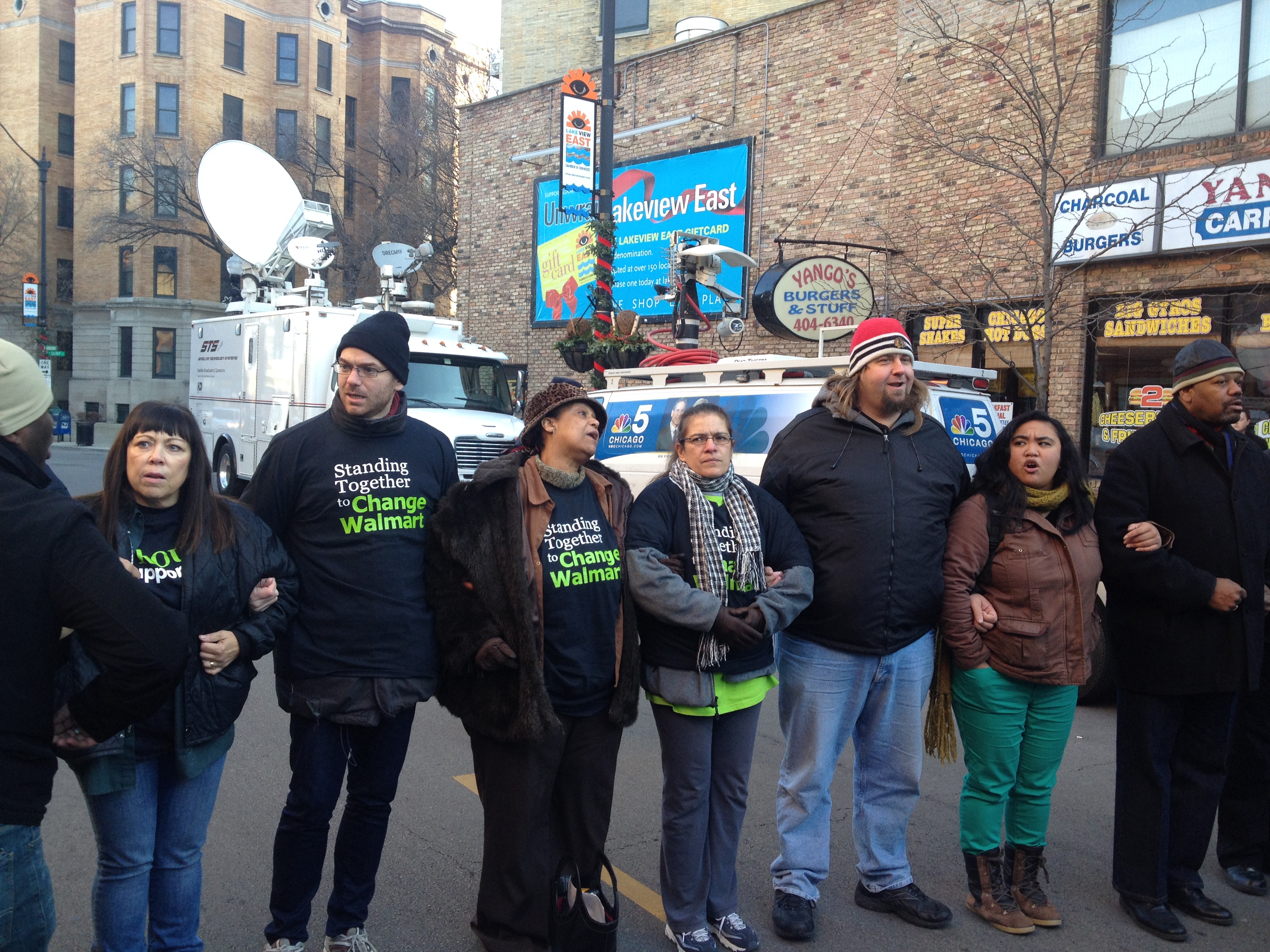
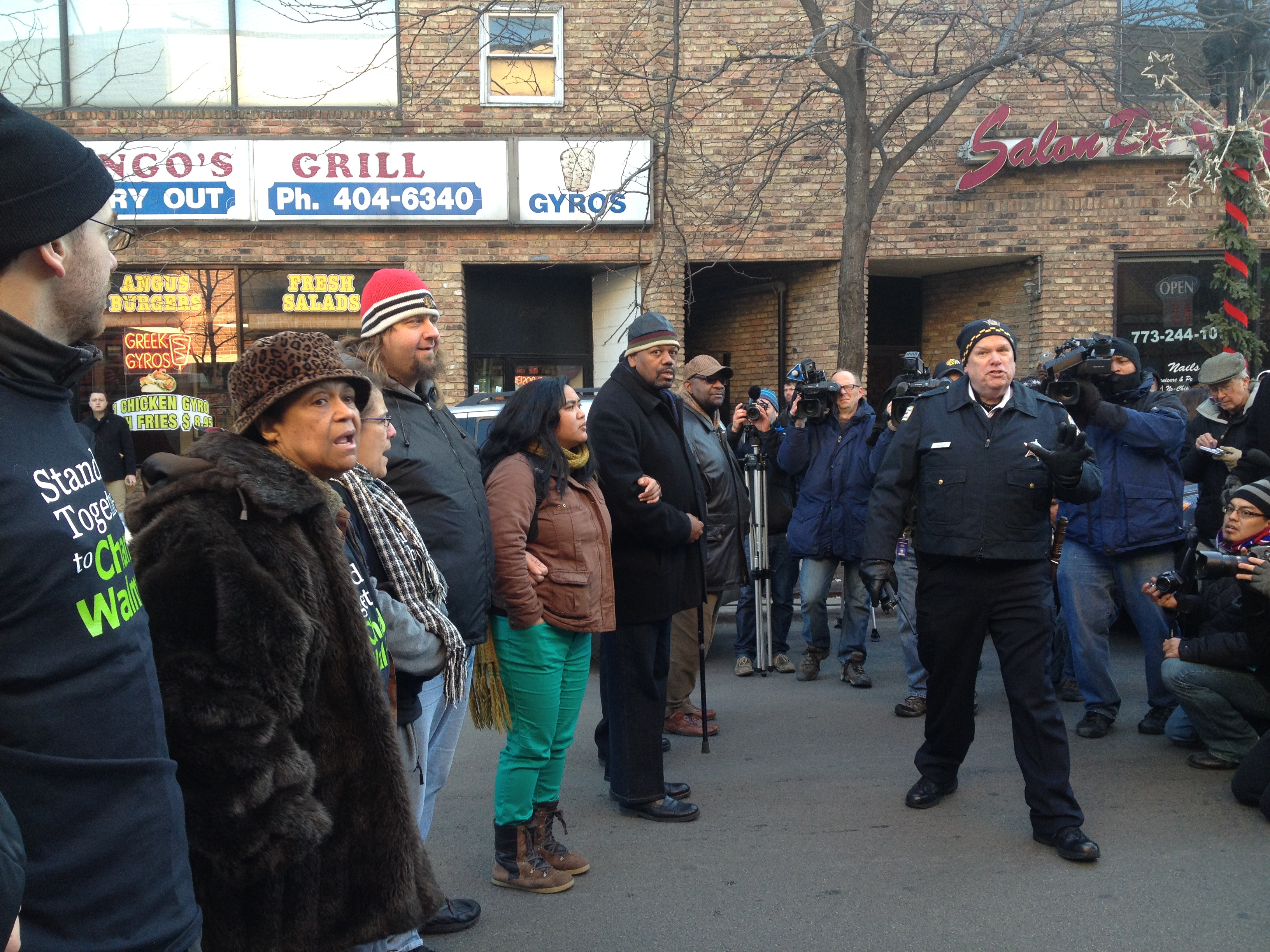
This morning I attended a Black Friday demonstration at a Walmart in the Lakeview neighborhood of Chicago. Following a rally and press conference, a group of Walmart workers and solidarity activists stood in line across Broadway Avenue until they were led away by the police (see pix below). This courageous act of civil disobedience was but one of many similar actions that took place at Walmarts across the nation today.

For a smart and intelligent discussion of Walmart’s treatment of its workers, I highly recommend this recent post in the International Business Times:

As one of the world’s most valuable companies and one of its biggest private employers with 2.2 million globally, the family-run business brought in revenues of $469 billion in 2013 and generated profit of $27.8 billion over the same period. Despite this, the average Wal-Mart salary for its lowest-paid workers for a 40-hour week is about $18,720, which would be the figure for a five-day week if the employee worked 52 weeks a year and didn’t pay any tax. OUR Walmart, a group of current and past employees, says the average salary is actually about $9 an hour and most workers only work 34 hours a week, resulting in an annual $15,500…

Incidentally, it would take the average worker around 750 years to earn the $23.2 million that CEO Mike Duke earned in 2012, approximately 1,034 times more than the company’s average worker.

walmart1walmart2

walmart3

walmart4

walmart5

Seeing Palestinian Resistance for Ourselves

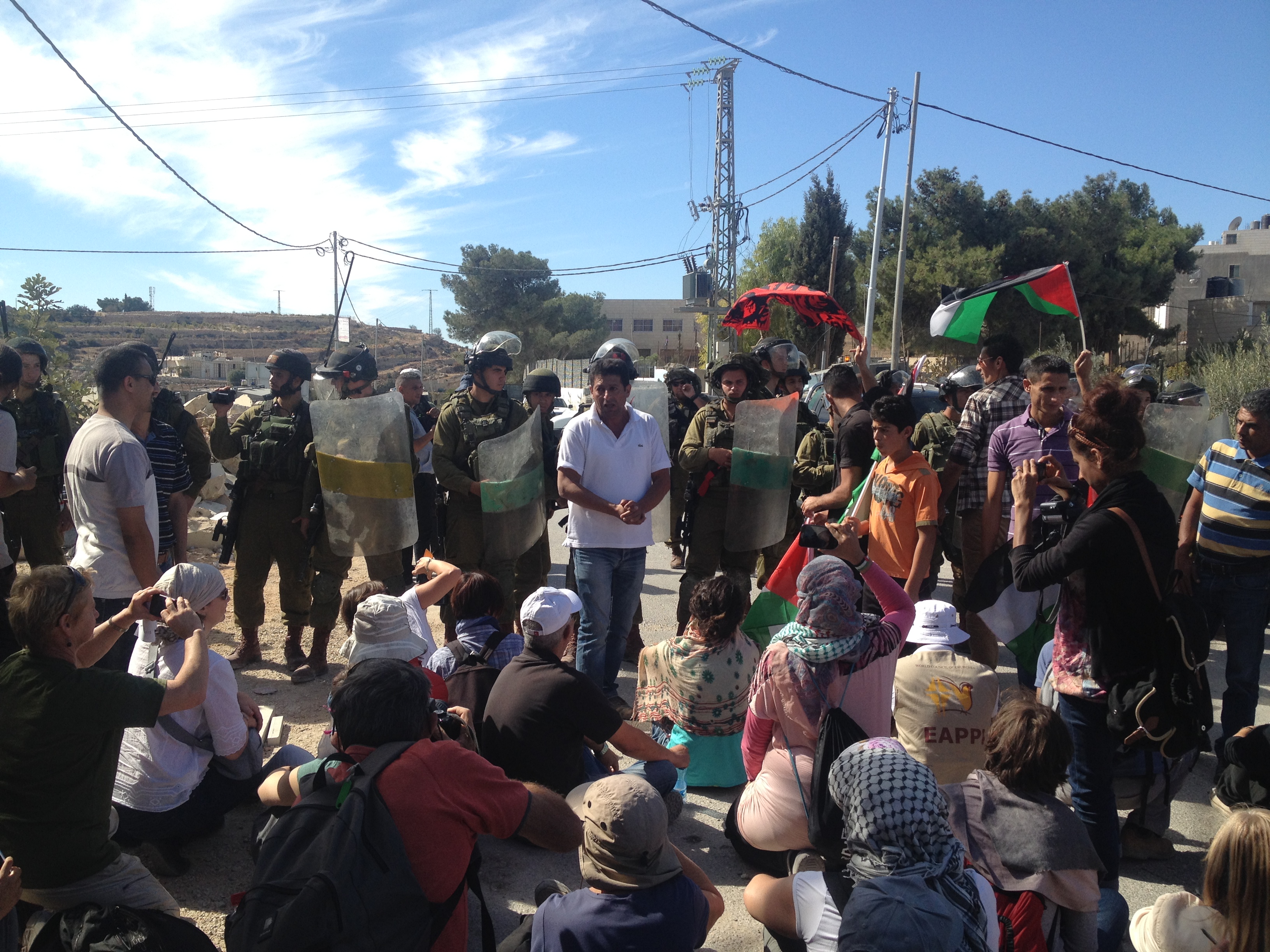
Demonstration in Al Ma'asara

Demonstration in Al Ma’asara

Cross-posted with the Jewish Forward

Who will are the change agents of our world? Are they our elected officials and politicians or the ones who march in the streets in order to hold them accountable? These questions were clarified for me in profound ways during my recent trip to the West Bank as part of a delegation of Chicago-area Jews and Palestinian Americans.

The focus of our delegation was the Palestinian popular resistance movement in the West Bank, a phenomenon that is sadly unfamiliar to the majority of Americans and American Jews. In a world far removed from the images reflected in the mainstream media and the postures of political elites, we discovered a decidedly different reality: ordinary men and women struggling to live lives of dignity while actively resisting an inequitable and oppressive military occupation.

During our weeklong stay, we were hosted in Bil’in, a village that is has, along with many other villages throughout the West Bank, long been holding weekly popular demonstrations against the occupation over the past ten years. In Bil’in, as in most villages in this movement, the focus of the protests are Israel’s Separation Wall which cuts into the heart of numerous Palestinian populations centers, devastating these communities by cutting them off from their olive groves and farmland.

These weekly demonstrations have become part of the fabric of West Bank life for the past ten years, though few Americans are even aware of their existence. They have consistently been met with overwhelming military force from the IDF. Scores of Palestinians have been injured or killed in these protests, largely from high velocity tear gas canisters, coated steel bullets and live ammunition fired directly into crowds of unarmed protesters.

As we quickly came to see, the violence faced by Palestinians under occupation is a palpable and all-encompassing aspect of their lives. While the political parameters of this conflict are often characterized by Israel’s demand for Palestinian leaders to renounce and rein in Palestinian violence, the view from the ground reveals a different picture entirely: it is the Palestinians who live within a constant daily context of violence.

This is a difficult concept to grasp for those who have not visited or lived in the Occupied Territories. Every day Palestinian mothers, fathers and children experience physical violence from soldiers and settlers who attack them with impunity. Every day, moment they experience the structural violence of checkpoints, land confiscation, and home demolitions.

Our delegation experienced three violent encounters with the IDF during our short one-week stay. While touring the refugee camp of Aida, we inadvertently walked into the line of fire as the IDF shot tear gas canisters directly at local children. One morning in Bil’in we awoke to the sounds of explosions and gunshots. When we ran outside we found the entire village shrouded in thick, choking tear gas. We later learned that the IDF had chased a suspect in a bus bombing into the area and had killed him in a cave on the edge of Bil’in. Before they left, they bulldozed olive trees, shot up the elementary school and shot tear gas throughout the entire village.

One member of our delegation, Kalman Resnick, spent a day monitoring settler attacks on the Palestinian olive harvest with Israeli organizations Rabbis for Human Rights and Yesh Din. Kalman, a seasoned immigration lawyer from Chicago well versed in the Israel/Palestine conflict returned to our group that evening shell-shocked by what he had witnessed. He showed me nearly one hundred pictures he had taken on his phone – among the wretched images were severely injured Palestinians (including one man with his head split open), rows and rows of olive trees hacked to the ground and farmers literally attempting to harvest olives from dead trees.

As Israeli journalist Mairav Zonszein recently wrote in the pages of the Forward:

These incidents — now particularly heightened during the olive harvest season — are not the aberration from the norm, but a regular feature of life in the occupied West Bank. In 2012, over 7,500 Palestinian olive trees were destroyed. In the 5-year period between 2007 and 2011, there was a 315 percent increase in settler violence

Despite this overwhelming context of everyday violence, we witnessed remarkable examples of principled steadfastness by the leaders of the Palestinian popular resistance. Perhaps the most powerful occurred during the weekly protest in the village of Al Ma’asara, who were celebrating the seven-year anniversary of their participation in the West Bank popular resistance movement.

At the outset, it felt to me that this protest resembled many other American demonstrations in which I have participated over the years. The street was filled with hundreds of individuals: young and old, locals joined together with Israeli and international solidarity activists. There was a joyous air of solidarity as we chanted through the streets and were cheered on by bystanders.

At the end of the main street, however, the tension level changed dramatically. When the marchers encountered a long line of Israeli soldiers in riot gear blocking our way to the Wall, we pressed up close against the soldiers and a standoff commenced. After a military commander announced that we were denied passage, a leader of the local popular resistance committee, Mahmoud Zwhare, stepped forward and starting chastising the soldiers in English.

Careful not to use any physical violence or violent rhetoric, he asked the soldiers why they were not allowed the right to live and assemble freely in their own village. He explained to them they could oppress the villagers all they wanted, but one day like all oppressed people, they would be free. Pointing to their riot gear, their bulletproof vests and their M-16s, he noted that all of the extensive equipment they used to protect the wall was meaningless when the real wall they needed to address was the wall “in their minds.”

The protest ended without violence, though there were some moments of pushing and shoving between soldiers and protesters – and as we left the demonstration we learned that there had been a tear gas attack in another part of the village. As I thought about our experience later, it occurred to me that this was precisely the same circumstance that occurred on the Edmund Pettus Bridge in Selma in 1965. The demand for justice was the same, the solidarity was the same, the method of civil disobedience was the same, as was the show of force by a brutal and over-militarized gauntlet. Moreover, that particular standoff ended in a way all to familiar to Palestinians. In a very real sense, Bloody Sunday is reenacted every week in villages throughout the West Bank.

In our meetings with popular resistance leaders we heard many common refrains. Our host Iyad Burnat of Bil’in and many others spoke of Ghandi, Dr. Martin Luther King and Nelson Mandela as role models. We heard a deep disillusionment with political leaders on all sides. And we heard of their desire to create a “Third Global Intifada” worldwide movement of solidarity consciously modeled on the grassroots popular resistance of the First Intifada.

At the same time, however, the Palestinian popular leadership left us with the ominous impression that their movement is fast arriving at a moment of truth. The Israeli military is successfully inhibiting the growth of the popular resistance by jailing its leaders indefinitely and dividing villages from one another through a massive occupation regime. Nearly every leader with who we spoke had spent considerable time in jail, including our Bil’in host Iyad Burnat and Bassem Tamimi of Nabi Saleh.

In numerous conversations, popular resistance leaders expressed the frustration that it is becoming increasingly difficult to maintain morale and convince new villages to join the movement as Israel’s settlements expand and their oppressive reality continues unabated. Despite the profound steadfastness of so many Palestinians, we sensed a growing fear that if the Occupation’s brutal reality is allowed to continue indefinitely, armed resistance will break out across the West Bank – i.e. that the next mass Palestinian movement will look more like the Second Intifada than the First.

It is time for those who venerate the American civil rights movement and the South African anti-apartheid movement to take a good hard look at these Palestinians who are likewise putting their bodies on the line to resist an unjust and inequitable regime. While many liberals – particularly in the American Jewish community – will clearly be loath to support a “Third Global Intifada,” it is well worth asking: will we continue to put our faith in fruitless political negotiations that only entrench an inequitable status quo or a popular Palestinian movement that is resisting this oppression in the manner of so many similar movements before them?

Who are the true change agents in the world? After living with and marching with the Palestinians throughout the West Bank, I couldn’t help but recall the words written by Dr. Martin Luther King in a Birmingham jail in response to liberal clergy colleagues who urged had urged him not to march, counseling that negotiations were a “better path:”

We know through painful experience that freedom is never voluntarily given by the oppressor; it must be demanded by the oppressed.

Stand in Solidarity with Walmart Workers this Black Friday!

If you want to do a mitzvah this Black Friday, please consider joining the growing movement that is demanding that Walmart treat its employees with human dignity and pay them a livable wage.

Emboldened by news from Walmart CEO that hundreds of thousands of Walmart workers are paid less than $25,000 a year, Walmart workers and supporters announced plans today for protests on Black Friday (November 29). Workers are demanding that Walmart to commit to improving labor standards, providing workers with more full time work at $25,000 a year and to put an end to illegal retaliation.

Today’s announcement follows revelations this week that many Walmart workers don’t have enough money to cover Thanksgiving dinner for their families, as well as the historic federal government finding that Walmart has been violating workers’ rights nationwide. In the meantime Walmart is the country’s largest retailer and employer, making more than $17 billion in profits, with the wealth of the Walton family totaling over $144.7 billion – equal to that of 42% of Americans.

Check out the new online video, above, in which the OUR Walmart campaign member Martha Sellers discusses employee’s struggles to get by on Walmart’s low pay. The video includes incredulous reactions from the media to the news that employees – not the company – are coming together to donate food to those who can’t afford a Thanksgiving dinner on their Walmart wages.

Over the past month, there have been exciting grassroots Walmart actions across the country, including the largest-ever civil disobedience against the retail giant in Los Angeles, Chicago, Miami, Seattle, Ohio and Dallas. On Black Friday last year, 30,000 Americans called for the country’s largest employer to change at over 1,000 stores in 46 states. This year is set to be even bigger, with experts like Occidental College professor Peter Dreier already calling Black Friday 2013 a “day for the history books” and a “major turning point in American history, similar to the Flint sit-down strikes of 1937.

Click here for information about a Walmart action near you (or to register one). Click here to sign an online petition started by Walmart employee Charmain Givens-Thomas that calls on President Obama to meet with strikers to “hear firsthand why they are appealing for respect and calling on Walmart to pay them enough to feed and support their families.”

I’ll see you in the streets this Black Friday!

Firebrand Rabbi Looks “Vanilla”

Vanilla-Ice-Cream-ice-cream-34732705-1528-2307Headline from a just-published feature about me and my activism from the Jewish Forward:

Brant Rosen looks every bit like a plain vanilla suburban Chicago rabbi. He doubles as a firebrand critic of Israel — and his congregation has stood by him through thick and thin.

“Plain vanilla” – my kids got a kick out of that one…
Click here to read the entire article.