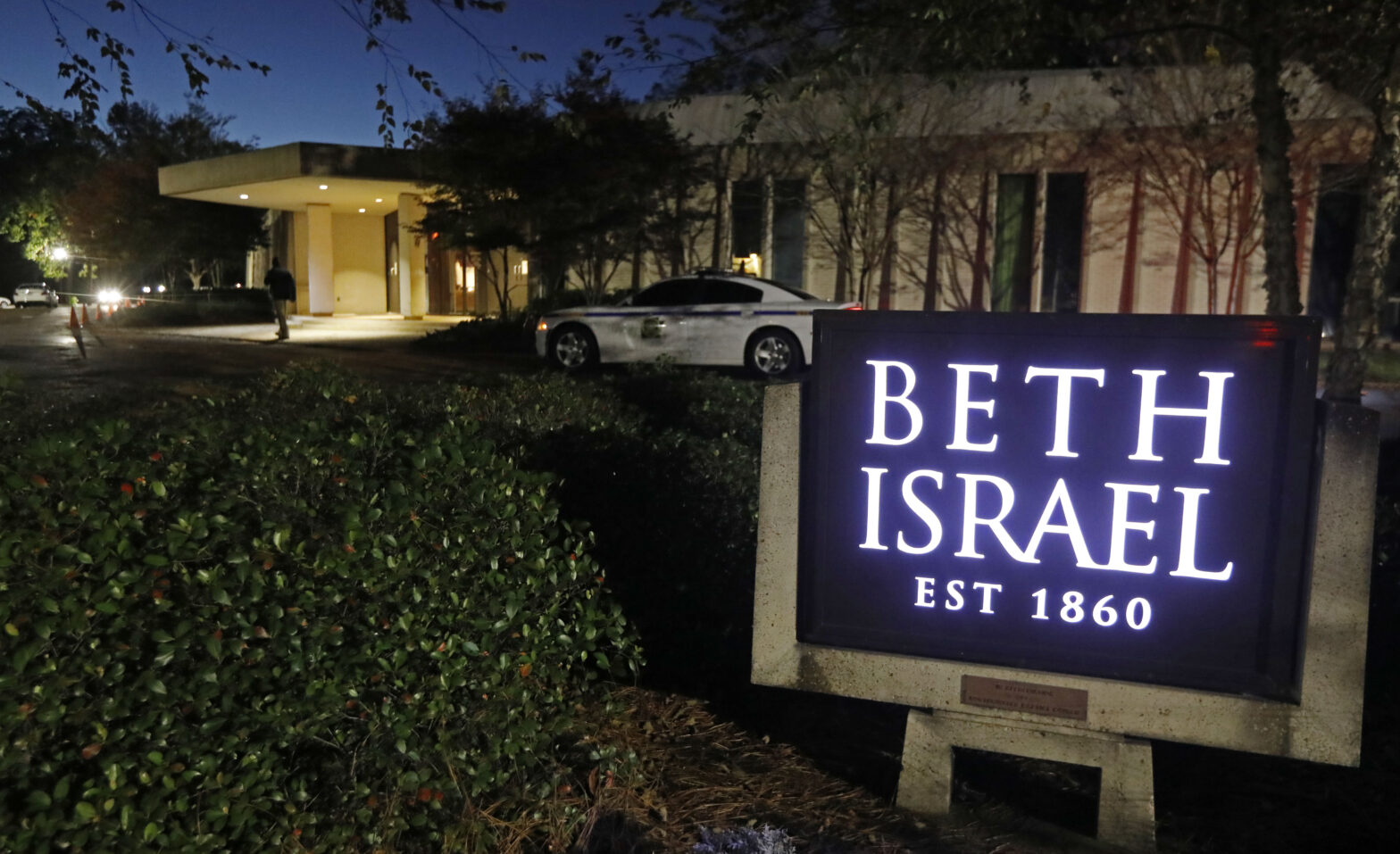
Last Shabbat the Jewish community received the devastating news that Beth Israel, the oldest synagogue in Jackson, Mississippi, was attacked by an arsonist. The fire caused extensive damage to the library and sanctuary, destroying two Torah scrolls and damaging five more. Thankfully, though the synagogue building was extensively burned, no one, other than the arsonist himself, was harmed.
The accused perpetrator, Stephen Pittman, a 19 year-old local man, was turned into the police by his father, who reported that his son texted him in real time while he was committing the crime. He later returned home with burns on his body and told his father “I finally got them.” According to reports, Pittman described Beth Israel as a “synagogue of Satan” to police investigators. When a judge read him his rights, he responded, “Jesus Christ is Lord.”
I can’t begin to imagine how I would feel if my synagogue was targeted on Shabbat with violence and religious desecration. The trauma is compounded by the reality of the current moment – a moment in which violent attacks on Jews, such the shooting attack at a Hanukkah party in Australia just last month, are one the rise. I’m sure I’m not the only one who feels as if our community is experiencing a state of permanent hypervigilance, dreading the inevitable next report of terrible, tragic news.
Even as we experience this trauma, however, I believe it’s critical to contextualize these incidents within a larger perspective. It’s important to understand that violent attacks on Jews are not exceptional or unique, but occurring within a larger rise in xenophobic violence around the world targeting vulnerable groups: Muslims, immigrants, people of color, LGBT people, among others. We know that in times of political and economic instability, this kind of scapegoating violence will inevitably rise. In other words, even as the Jewish community might feel isolated within our trauma, we must understand the ways that this is a collective, shared trauma. And that the antidote to isolation is a deeper solidarity with one another.
I would also suggest that beyond the trauma – or perhaps because of it – we must find the wherewithal to respond with clarity and understanding. In particular, we must firmly reject the weaponization of antisemitic incidents for political purposes. To put a finer point on it, for far too long Jewish communal leaders and organizations have been cynically exploiting these tragedies in order to dehumanize Palestinians. When Jewish trauma is weaponized in this way, it only serves to magnify the overwhelming trauma already being inflicted daily on one of the most vulnerable and targeted people in the world.
The cynicism of this tactic has become perversely transparent. Following this latest incident, for instance, scholar Deborah Lipstadt (and former White House “antisemitism czar”) wrote on X: “This is a major tragedy. But it’s more than that. It’s an arson attack and another step in the globalization of the intifada.” Lipstadt is not the only public Jewish figure to exploit this antisemitic incident to foment anti-Palestinian hatred and Islamophobia, even though the arsonist was clearly motivated by Christian antisemitic ideology.
Similarly, Israeli Prime Minister Netanyahu responded to the tragedy of the Bondi Beach massacre by incongruously blaming the incident on Australia’s recognition of a Palestinian state. In fact, the shooters were not Palestinian and had nothing to do with Palestinians. They were reportedly followers of ISIS – an extremist Muslim group that is rejected by the overwhelming majority of and Muslims worldwide, viewing it as a violent, heretical perversion of Islam that targets Muslims and non-Muslims alike.
In addition to seeking clarity, I’ve also found it useful to seek historical perspective. As I’ve read the reports about the arson in Jackson, Mississippi, I learned that this was not, in fact, the first time that Beth Israel was targeted with antisemitic hate. In September 1967, the synagogue was bombed by local Ku Klux Klan members because its then rabbi, Perry Nussbaum, was an outspoken civil rights activist. Two months later, Rabbi Nussbaum’s own house was firebombed by the KKK.
Following that attack, a leading Southern Baptist minister came to Rabbi Nussbaum’s home to express his sympathy. Nussbaum told him to spare his regrets. “If you really want to show your sympathies,” he said to the minister, “then tear up whatever you’re preparing for your sermon next Sunday morning and speak to the people in the front pews about their culpability in everything that’s happened not just to me . . . but to the blacks and their churches over the years.”
How do we respond when our community is increasingly under attack? Let’s take our cue from Rabbi Nussbaum. Let us respond with courage, moral clarity and solidarity.
As if there wasn’t enough drama over the candidacy of Zohran Mamdani in New York City’s mayoral race, last week saw the release of “A Rabbinic Call to Action: Defending the Jewish Future,” a statement from an ad hoc group calling itself “The Jewish Majority,” condemning Mamdani for voicing political convictions that “delegitimize the Jewish community and encourage and exacerbate hostility toward Judaism and Jews.” By the end of the week, the call had garnered over 1,000 signatures from rabbis, cantors and rabbinical students from NYC and around the US.
Notably, the statement only mentions Mamdani once. The rest of the six-paragraph letter is devoted to defending the state of “Israel’s right to exist in peace and security” and promoting Zionism as central to Judaism and Jewish identity. It’s centerpiece is a long and pointed quote from a recent sermon by Rabbi Elliot Cosgrove of Park Avenue Synagogue, in which he warned that Mamdani “poses a danger to the New York Jewish community”:
Zionism, Israel, Jewish self-determination—these are not political preferences or partisan talking points. They are constituent building blocks and inseparable strands of my Jewish identity. To accept me as a Jew but to ask me to check my concern for the people and state of Israel at the door is a nonsensical proposition and an offensive one, no different than asking me to reject God, Torah, mitzvot, or any other pillar of my faith.
Given the timing of the letter, “The Jewish Majority” statement is clearly an effort to stem Mamdani’s surging lead – and his popularity with young leftist Jews in NYC. But on a deeper level, the fundamental goal of the letter is made all-too plain: it seeks to combat the growing “political normalization of anti-Zionism.”
From what I can tell, Mamdani has never explicitly referred to himself as an “anti-Zionist.” What he has said, over and over again in response to the incessant gotcha question “does Israel have the right to exist as a Jewish state?” is that he “believes Israel has the right to exist as a state with equal rights.” Of course, the words “a state with equal rights” is enough to make him an anti-Zionist – because the only way Israel can exist as a Jewish state is by denying equal rights to Palestinians.
For me, this is the real significance of this statement – it shines a hard light on the deep moral hypocrisy of a Jewish communal establishment that is threatened by anti-Zionism: a political position that is rooted in human rights and equal rights for all. Indeed, if you listen to Mamdani’s words carefully, he takes pains to point this out: he refers to Israel’s actions in Gaza as a genocide because he agrees with the opinions of international bodies such as ICJ as well as scores of otherhuman rightsobservers. He openly says he would not welcome Netanyahu in NYC because the ICC has put a warrant out for his arrest as a war criminal.
These are not hateful or inciteful positions. What is remarkable – and galling to the Jewish communal establishment – is that Mamdani is not paying a political price for expressing them. Quite the contrary: he is the one who comes off as eminently principled and reasonable, while apoplectic Jewish leaders are having an increasingly difficult time explaining why a genocidal, apartheid nation-state is a “building block” of their Jewish identity. True to form, this clergy group is simply trotting out familiar talking points, fully expecting their morality and veracity to be self-evident.
Contrary to the claims of the statement’s signers, the increasing normalization of anti-Zionism does not “delegitimize Jewish identity and community.” As the rabbi of an openly anti-Zionist Jewish congregation, I can attest that increasing numbers of Jews are identifying as such out of genuine Jewish conscience: from a deep attachment to Jewish ethical values that mandate the pursuit of justice and hold that all human beings are equally created in the divine image.
Recent surveys certainly bear this out: according to an October 2025 Washington Post poll, of American Jews, 61% believe Israel has committed war crimes and 4 out of 10 say the country is guilty of genocide against the Palestinians, views that would certainly track with an anti-Zionist identity. As Jewish Currents editor-in-chief Arielle Angel has observed, “the catastrophic failure of Zionist Judaism” has marked “an opening for anti-Zionist Jews to step into greater influence, (to) make our case for something new.” By all accounts, the time has come for a Judaism that rejects the fusion of toxic ethno-nationalism with Judaism.
I’m also struck by another note of desperation from this ad-hoc group of Jewish clergy: they purport to speak for the Jewish majority as if that alone confers legitimacy. They of all people should know dissent is a sacred, cherished aspect of Jewish tradition. They of all people should know that in Talmudic debate, both majority and minority views are given equal weight and consideration. They of all people should know of the Torah’s sacred injunction “Do not go after the majority to do evil” (Exodus 23:2). And any student of history, Jewish or not, should know that the majority is not always right, whether it be the majority of Southern Whites who supported slavery and Jim Crow in the US, apartheid in South Africa or the injustices of Zionism today.
The real moral question here, it seems to me, is not “who is in the majority?” but rather “who is on the right side of history?”
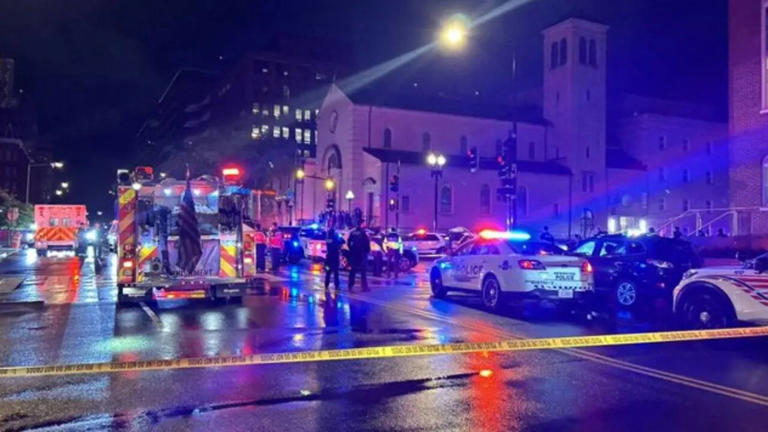
The shooting death of the two Israeli embassy workers in Washington DC this past Wednesday evening was tragic and horrific. All human life is precious – there can be no conceivable justification for this immoral act. Moreover, the man who perpetrated these murders is no hero; in addition to the lives he took and the grief he caused their families, his action has only served to harm – not help the Palestinian people. This is not what solidarity looks like.
As of this writing, there is much we don’t know about the shooting – and it would be irresponsible of me to speculate on whether the shooter was motivated by antisemitism. We do know that it was an act of political violence – and that the victims were embassy representatives of a nation that itself is engaged in an act of political violence that has killed tens of thousands of Palestinians – and is currently taking the lives of hundreds of people in Gaza every day.
Of course, there is no shortage of disingenuous politicians and media figures who are all too eager to use this act of violence for their own political advantage. But we cannot and should not equate the actions of one isolated incident with the entire movement for Palestinian liberation. Indeed, over the past nineteen months, millions of people across the US and around the world have protested peacefully for a ceasefire and an end to Israel’s genocide in Gaza. It is inaccurate – and in fact racist – to use this tragic event to make assumptions about Palestinians or collectively punish people of conscience who have been advocating for Palestinian safety and freedom. Our movement has always been about freedom, dignity and safety for all. The murderous action of one vigilante does not define us – nor should it lessen our resolve to continue advocating for an end to Israel’s genocide in Gaza.
According to one of the most sacrosanct teachings in Jewish tradition, all human beings are created in the divine image – and that all lives are equally, infinitely precious. I can’t help but think of this sacred value as I read the many poignant news stories about the young embassy workers Yaron Lischinsky and Sarah Milgrim: stories that honor the people they were as well as their hopes and dreams for the future.
At the same time, I couldn’t help but think: where are these stories in the mainstream media about the tens of thousands of Palestinians killed through political violence in Gaza over the past nineteen months? Where are the tributes to their lives, their hopes, their dreams? If they were afforded the same kinds of tributes, the media would be overwhelmed an endless cascade of stories about precious lives lost forever.
In her book, “Frames of War,” the scholar Judith Butler examines why some lives are “grievable” while others are not. Butler suggests that this selective mourning is due to a process of dehumanization, in which state powers determine which lives have the status of personhood – and thus more worthy of our grief. In short, if a person is deemed less human, they become less grievable.
When we engage in this kind of selective mourning, we become complicit in this process of anti-Palestinian dehumanization and racism. Here in the US, of course, people of color are all too familiar with this process. As Bernice Johnson Reagon powerfully wrote in her classic, “Ella’s Song:” Until the killing of black men, black mothers’ sons/Is as important as the killing of white men, white mothers’ sons/…We who believe in freedom will not rest.
How do we respond to the killings of Yaron Lischinsky and Sarah Milgrim? The same way we must respond to the tens of thousands of Palestinians who have been killed – and continue to be killed – by the Israeli military in Gaza: by continuing to protest openly and as openly as possible for an end to Israel’s genocide against the Palestinian people. By advocating for a free Palestine for all who live between the river and the sea.
And further: to insist on a world in which all may live in safety and dignity – and all people are mourned equally when they die.
With Passover starting Saturday evening, April 12, Tzedek Chicago is honored to present our annual seder supplement, “Passover as Collective Liberation.”
As we witness fascism growing in the US and around the world, Passover arrives this year with a special urgency – and a sacred opportunity. As our supplement notes:
Merely telling the story is not enough. The seder requires us to interrogate this sacred narrative: to contemplate its meaning and to examine the questions it raises for us in our own day. Most critically, Passover demands that we connect the lessons of the Exodus story to Pharaohs that arise “in every generation.”
To that end, we encourage you to use the Passover narrative as a template to understand – and respond – to the stakes of the current political moment. First and foremost, we encourage you to universalize the Exodus narrative; to view our sacred liberation story in the context of collective liberation; to understand that the Jewish struggle and liberation is ultimately inseparable from so many other liberation struggles, past and present.
I believe it is more critical than ever to make these connections. As the Columbia grad student Mahmoud Khalil wrote in his “Letter from a Palestinian Political Prisoner in Louisiana.” (which we include in our supplement):
The Trump administration is targeting me as part of a broader strategy to suppress dissent. Visa-holders, green-card carriers, and citizens alike will all be targeted for their political beliefs. In the weeks ahead, students, advocates, and elected officials must unite to defend the right to protest for Palestine. At stake are not just our voices, but the fundamental civil liberties of all.
As another Palestinian American, Noura Erakat has noted (in an article that we quote in our supplement as well):
But resisting fascism is our collective goal. We just know that in order to resist it, we have to fight it on two fronts of U.S. state violence: at home and abroad. Because if the United States, together with Israel, manages to disembowel the ICJ, the ICC, the UN, and a broader global order built after the Holocaust and World War II, no one is safe… As Colombian President Gustavo Petro warned back in December 2023, ‘“What we are seeing in Gaza is a rehearsal of the future.’”
Yes, resisting fascism must be our collective goal. Those of us who have been advocating for Palestinian liberation must understand that their liberation is irrevocably connected to the liberation of all who are targeted by state violence. At this moment, the stakes could not be higher. Under the current regime, we are witnessing a terrifying state backlash about those who have publicly voiced their support for the Palestinian people. At the moment, activists of color with student visa are the primary targets. But as Mahmoud Khalil rightly noted in his letter, soon “visa-holders, green-card carriers, and citizens alike will all be targeted for their political beliefs.”
As Jews, we have a unique role in the current political moment. Indeed, we must fail to note that this state violence is being cynically carried out in our name, justified by concern for “Jewish security,” More than ever, we must to refuse to let our safety be used as a pretense to strengthen fascist state power. We must insist that this pretense will only endanger Jewish security all the more. We must affirm in no uncertain terms that Jewish safety and security is inseparable from the safety and security of all.
This Passover, let us insist that the Exodus story must be about the liberation of all who are oppressed by the contemporary Pharaohs of our day. This Passover, may we discover the true meaning of collective liberation – and find the inspiration to make it real in our world.
Yesterday I received a DM that read: “Evil, kapo, judenrat, self hating Jew.” (If you don’t know the meaning of some of those words, let’s just say that two of them are historical terms for Jews who collaborated with the Nazis during WW II.) As this kind of thing isn’t an uncommon occurrence for me, it wasn’t particularly upsetting. I’ve been receiving these kinds of messages for over a decade now, to the point that it’s become a kind of background noise – as I’m sure it is for any Jewish activist who dares to publicly affirm the humanity of the Palestinian people.
This time, however, I received the message as I was reading news of the heinous abduction and disappearing of Columbia grad student Mahmoud Khalil – and it caused me to pause and think: given the message, who are the real Jewish collaborators at this particular moment?
As has been widely reported, Khalil (a prominent leader of the student Palestine solidarity protests at Columbia) was walking home with his wife last Saturday when they were approached plain-clothed agents from the Department of Homeland Security who informed them that the government was revoking Khalil’s student visa. When they showed them his Green Card, which made him a legal US resident, an agent made a phone call and told them they had now revoked his Green Card. When they protested, the agents threatened to abduct Khalil’s wife, who is 8 months pregnant. Then they put Khalil in a car and drove him away.
For the next several hours, Khalil’s loved ones had no idea where he was. His lawyers immediately filed a writ of habeus corpus in a New York City court; they later learned that the authorities transported Khalil to an infamous ICE detention center in Louisiana, where he will almost certainly be subjected to a more government-friendly immigration court. In the meantime, a federal judge in Manhattan has ordered the government not to remove Khalil from the US while the judge reviews his lawyer’s petition challenging his abduction and detention.
There is so much that is so deeply chilling about this story it’s difficult to know where to start. For me, however, one of the most disturbing aspects was the report that Khalil had sent multiple emails appealing to Columbia’s interim president Katrina Armstrong for protection from harassment, doxxing and the threat of ICE agents. He sent his final email to Armstrong on March 7 one day before he was abducted and disappeared:
Since yesterday, I have been subjected to a vicious, coordinated, and dehumanizing doxxing campaign led by Columbia affiliates Shai Davidai and David Lederer who, among others, have labeled me a security threat and called for my deportation.
Their attacks have incited a wave of hate, including calls for my deportation and death threats. I have outlined the wider context below, yet Columbia has not provided any meaningful support or resources in response to this escalating threat.
I haven’t been able to sleep, fearing that ICE or a dangerous individual might come to my home. I urgently need legal support, and I urge you to intervene and provide the necessary protections to prevent further harm.
Khalil’s emails, of course highlight the very real likelihood that Columbia actively collaborated with ICE and DHS, thereby compromising the physical safety and security of their own student. They also illuminate the active role of Jewish Zionist activists in the events leading to Khalil’s abduction and disappearance. Shai Davidai is an Israeli assistant professor of business at Columbia Business School who has a documented history of harassing students and school employees. David Lederer is a junior in Columbia’s School of Engineering and Applied Sciences and the co-chair of Aryeh, a self-described “student-led organization that aims to provide opportunities to engage with Israel and Zionism.”
It should not come as a surprise that Zionist activists and organizations played a part in Khalil’s abduction. Last December, it was reported that the US chapter of Betar, a worldwide Zionist youth organization (originally founded by Revisionist Zionist leader Vladimir Jabotinsky in 1923) had recently been revived. It’s Executive Director, Ross Glick, made it clear that targeting college students would be its first order of business. Most ominously, Glick revealed that Betar US “had amassed a large repository of video footage from college protests over the past year” and was employing a team of professionals using facial recognition software and relationship databases to identify foreign students appearing in the videos.
Glick has now been openly bragging about his role in the government’s abduction and disappearance of Mahmoud Khalil. In an interview with the Forward, Glick said that he had met with aides to Senators Ted Cruz and John Fetterman in DC to discuss Khalil during the Columbia encampment protests and that the senators promised to “escalate” the issue. He also said that “some members of Columbia’s board had also reported Khalil to officials.” In the interview, Glick referred to Khalil’s unmasked presence in the protests, commenting “This unfolded very quickly because it was very obvious… This guy was making it too easy for us.”
The Forward article also reported that David Lederer, circulated photos of a pamphlet labeled as coming from the “Hamas Media Office,” suggesting it was distributed at the protest. Lederer also claimed Khalil was “known to have been on a foreign visa last year.” Clearly, the government was aided and abetted by well-known Jewish Zionist activists who made no secret of their intentions to work with authorities to target Palestinians and pro-Palestine student activists who protested Israel’s genocidal violence against the Palestinian people in Gaza last spring.
The government abduction and disappearance of legal residents who exercise their right to free speech is, of course, a basic staple of fascist regimes. What can we say about Jewish activists and organizations that collaborate with such a government – a regime led by a president that actively emboldens antisemitic hate groups and has given significant power to a billionaire who promotes antisemitic theories and publicly sig heils at rallies? While I won’t use the vile terms that extremist right-wing Jews sling against Jewish activists who dare to express their solidarity with Palestinians, I do believe it’s important to name them what they truly are: collaborationists.
It’s important to note that this most recent Jewish collaboration with rising fascism is not limited to small extremist actors such as Betar US. The Anti-Defamation League itself responded to Khalil’s abduction with this statement on X: “We appreciate the Trump Administration’s broad, bold set of efforts to counter campus antisemitism — and this action further illustrates that resolve by holding alleged perpetrators responsible for their actions… We also hope that this action serves as a deterrent to others who might consider breaking the law on college campuses or anywhere.”
For its part, the Trump administration celebrated Khalil’s abduction on X with the statement “Shalom Mahmoud” – a cynical and appropriative expression of “solidarity” with the Jewish people. Even more chillingly, the statement went on: “This is the first arrest of many to come. We will find apprehend and deport these terrorist supervisors from our country ‒ never to return again.” By now we should know that Trump should be taken at his word. If Mahmoud Khalil, a legal resident of the US can be disappeared by this government, they will almost certainly continue with any American citizen whom they identify in their growing data base: and not only Palestinian Americans and Muslims.
I’ll make it plain: collaborationist Jews will not help make Jews safer. In the end, Glick, Davidi, Lederer and their ilk are extremely useful idiots who are actively working with an antisemitic regime that has zero interest in Jewish safety and security. Even more important, collaborating with fascism will not make anyone safer. It feels somehow ridiculous to have to say these words out loud, but here we are. For the sake of our collective liberation, we must all actively resist and stand down this fascist regime – as well as those who aid and abet it.
It occurs to me that this form of collaboration with illegitimate authority really is a form of idolatry. In this week’s Torah portion, the recently-liberated Israelites, who have just entered into a sacred covenant with God, construct a Golden Calf, bow down to it and exclaim, “This is your god, O Israel, who brought you out of the land of Egypt!” (Exodus 32:4) This narrative is powerfully resonant to the current moment, in which members of the Jewish community are betraying the sacred, liberatory core of Jewish tradition through idolatrous attachment to corrupt state power.
But in the end, this is a fatal form of idolatry: a Faustian bargain. And we know all too well from history where this will lead. Please join me in answering this call from Jewish Voice for Peace to contact our senators and representatives demanding that they do everything in their power to secure Khalil’s release and to protect student activists and immigrants.
The ambitious intentions of Peter Beinart’s new book are evident from the title: Being Jewish After the Destruction of Gaza: A Reckoning. Responding to the current moment, Beinart has written nothing short of a spiritual manifesto for the future of Judaism.
It’s a tall-order for such a slim volume, but it’s one that Beinart is uniquely positioned to take on. As a well-known journalist, thought leader, and editor-at-large for the journal Jewish Currents, Beinart’s ideas carry a great deal of weight among large swaths of the Jewish establishment. His 2010 article in The New York Review of Books, “The Failure of the American Jewish Establishment” and his subsequent book, The Crisis of Zionism were widely read and debated in the American Jewish community. Since then, he’s continued to push the envelope in the discourse on Israel/Palestine. His 2020 New York Times op-ed, “I No Longer Believe in a Jewish State” and his 2021 Guardian essay, “A Jewish Case for Palestinian Refugee Return” were likewise considered game-changers in the Jewish communal discussion on Israel-Palestine.
Being Jewish, which attempts to reframe the Jewish spiritual narrative itself, is arguably his most dramatic attempt at game-changing. Following October 7 and Israel’s devastating military onslaught on Gaza, Beinart suggests that Judaism and Jewish identity have now reached a critical turning point. As he writes in the Prologue:
Jews have told new stories to answer the horrors we endured. We must now tell a new story to answer the horrors that a Jewish country has perpetrated, with the support of many Jews around the world… [This new Jewish story must be] based on equality rather than supremacy—because the current one doesn’t endanger only Palestinians. It endangers us.
As if this isn’t ambitious enough, Beinart also hopes his book will help heal the widening fractures over Israel/Palestine in the Jewish community. To drive this point home, he begins with a letter to a friend with whom he’s become estranged over the issue of Israel/Palestine. “I know,” he writes, “you believe that my public opposition to this war…constitutes a betrayal of our people…[and] I consider your single-minded focus on Israeli security to be immoral and self-defeating.” He ends his letter with the words: “I hope the rupture is not final, that our journey together is not done.”
While Being Jewish was published by a mass-market publisher and is being promoted to a wide readership, Beinart states at the outset that he’s suggesting a new Jewish narrative to bring the Jewish “family” together; to mend the deep familial rifts that have widened over Israel’s destruction of Gaza. “This book,” he writes, “is for the Jews who are still sitting at that Shabbat table, and for the Jews—sometimes their own children—who have left in disgust. I yearn for us to sit together.”
Beinart thus begins his book with a formidable—perhaps unbridgeable—tension. While he’s clear about his intention to bring Jews together, he also suggests that Israel’s oppression of Palestinians is rooted in a narrative of Jewish supremacy—a view which surely won’t endear him to millions of Jews in Israel and throughout the diaspora who identify deeply with Israel and Zionism. In many ways, this tension is characteristic of Beinart’s pedagogy: he seeks to influence Jewish communal discourse even as he pushes hard on the ideological envelope. It’s a balancing act that’s become increasingly precarious with his writings over the past several years. Given the stakes of the current moment, he sets a profoundly daunting goal for himself with his latest book.
For most of Being Jewish, Beinart does what he does best, expertly dismantling Israel’s hasbara—the propagandistic talking points used to justify Israel’s oppression of the Palestinian people. In chapter one, “They Tried to Kill Us We Survived, Let’s Eat,” for example, he interrogates the ways that Israel and Israel’s Jewish communal advocates, conveniently ignore Zionism’s colonial origins and reframe Israel’s founding to fit a Jewish narrative of victimhood:
The plot goes like this. We have finally achieved what every other people takes for granted: a state of our own. Yet in the case of Jews, and Jews alone, that right is contested. So even with a state, we remain victims.
His repeated willingness to frame political Zionism in a colonial context is a powerful, ongoing theme for Beinart. In another chapter “To Whom Evil is Done,” he considers the ways the violence committed by Hamas and other Palestinian resistance groups on October 7 was compared to the Holocaust by Israelis and Jews around the world. He goes on to assert that such a framing “transforms Palestinians from a subjugated people into the reincarnation of monsters of the Jewish past.” Again, Beinart doesn’t hesitate to reject this comparison in favor of a settler colonial framework. A better analogy, he suggests, would be the violent attacks of colonized Haitians, Creek Indians, or Mau Mau rebels against their colonial oppressors.
In “Ways of Not Seeing,” Beinart systemically eviscerates many other familiar claims wielded by Israeli leaders and Israel advocates: from their rejections of death estimates by the Gazan Health Ministry to the canard of Hamas’ human shields. He also devotes a chapter to the issue of antisemitism, using convincing argumentation along with hard survey data to demonstrate how Israel cynically uses the claim of antisemitism—which is much more prevalent on the Right than the Left—to cudgel Palestinians and their supporters. Taking the claim that anti-Zionism equals antisemitism head on, he writes astutely:
The whole point of conflating anti-Zionism with antisemitism is to depict Palestinians and their supporters as bigots, thus turning a conversation about the oppression of Palestinians into a conversation about the oppression of Jews.
Beinart’s book is strongest when he makes these kinds of expert political arguments. Yet, as critical as they are, as I read Being Jewish I found myself increasingly wishing he would drill deeper into the themes suggested by the title. Beyond promoting a Judaism of equality over conquest, how should Jews respond to the devastating moral reality of this moment? In his final chapter, “Korach’s Children,” he attempts to do precisely this, suggesting that Jewish political nationalism has become a form of Jewish “idolatry,” arguing that the only way toward an equitable future in Israel/Palestine is a single state in Israel that guarantees full citizenship for all.
While it’s a compelling vision, there’s little in his final chapter that he hasn’t already argued for more extensively in his 2020 and 2021 articles, which were written well before Israel’s destruction of Gaza. In this book, as with his earlier articles, Beinart offers examples from Ireland and South Africa to demonstrate how colonizers and colonized have found the political wherewithal—however imperfect—to dismantle systems of oppression and engage in processes of reconciliation.
In the midst of his argument, however, there’s little reckoning with the possibility that anything has fundamentally changed with Israel’s genocide in Gaza. Instead, Beinart simply repeats his talking points, continuing to hold out hope for a better future for Israeli Jews and Palestinians:
Although it won’t look the same, this kind of liberation is possible for us. We can lift the weight that oppressing Palestinians imposes on Jewish Israelis, and indirectly, on Jews around the world.
But who is the “we” in this statement? It’s certainly not in the power (nor is it currently the desire) of American or Diaspora Jews to leverage a socio-political transformation of such a magnitude in Israel/Palestine. The majority of Israelis have, for their part, long rejected a one-state solution—and by all accounts, they’re farther away than ever from embracing such a vision.
Indeed, Israelis post-October 7 are a thoroughly traumatized nation, inured to the carnage their nation is inflicting on Palestinians and according to polls, overwhelmingly supportive of Israel’s genocide in Gaza. As for Palestinians, many, if not most, are undoubtedly less inclined to imagine the realistic possibility of living side by side with Israeli Jews in a single state given the horrific reality of the past 16 months.
It’s notable that, even as Beinart doesn’t flinch from describing Israel’s onslaught in Gaza—often in terrifying detail—he largely avoids using the word “genocide” to describe it. This is more than merely a semantic issue. If we are to truly reckon with what it means to be Jewish after the destruction of Gaza, we must face this central question: what does it mean for the Jewish people that a Jewish state, founded in the wake of the Holocaust, is actively committing a genocide against another people?
Though Beinart writes that he “yearns for us to sit together,” it’s well worth asking: can we truly create Jewish community within such a reality? Can Jews who believe Israel is committing genocide coexist in community with those who are actively supporting it—or rationalizing it away? Is it possible for Jews to pray and study and make Shabbat and celebrate holidays together under such circumstances? If Jewish ethical values are the bedrock of our spiritual life, how do we truly bridge such a massive moral divide?
Although he doesn’t answer this question in his book, Beinart did give a clue to a potential response during a recent appearance at Duke University. Admitting that Israel was no longer a “unifying force” among Jews, he responded:
What I would like people to do is to bring Jews together across the ideological, political and religious spectrum, to study Torah, to study our texts. This is what ultimately unifies us, and I think that it can be a foundation for other kinds of conversations.
This kind of response might make sense to Beinart, an Orthodox Jew who cherishes traditional Jewish study, but it’s doubtful such an approach will bring together Jews in the way he envisions. It’s optimistic, to put it mildly, to assume that Jews will be able to put aside their differences on Israel and find a foundation for fruitful conversation through the study of Torah and Jewish text. It may be time for us to admit that being Jewish after the destruction of Gaza means our community isn’t simply fractured, but separated by a deep moral abyss that may well be unbridgeable.
As I read Beinart’s new book, I couldn’t help but be struck by the significant debt it owes to the landmark work of Jewish scholar and theologian Marc Ellis, who asserted as far back as the 1980s and 90s that post-Holocaust, the fusion of Judaism and Jewish state power had created a conquest-focused “Constantinian Judaism,” even as Israel maintained a collective myth of innocence.
The central question is how to move Jews in Israel and around the world to see that Jews can only be free if Palestinians are free as well. During the Gaza war, we could not be further from this goal. This makes it even more imperative that we begin now.
But while Beinart’s and Ellis’ analyses of the crisis may have been similar, their prescriptions for going forward were dramatically different. As Ellis put it in a 2018 interview, Israel’s state oppression of the Palestinian people represented the “end of ethical Jewish history”:
We Jews, all of us, no matter our various political positions, are responsible for what Israel has done and is doing to the Palestinian people. That is why I believe that we, as Jews, dwell in the abyss of injustice. The injustice we have perpetrated upon Palestinians has brought us to the end of ethical Jewish history. The question for Jews, the only question, is what are we to do at this end?
Marc Ellis died in July 2024, while Israel’s genocide in Gaza was raging in full force. His question, however, offers an important counterpoint to Beinart’s. While Beinart asks how we will come together to write a new Jewish story, Ellis asks how Jews will dwell in the abyss of injustice. In the end, Beinart’s book, for all of its courage, is ultimately unwilling to take this step: to truly reckon with how Jews of conscience should respond to the ongoing moral devastation that is Israel’s genocide in Gaza.
(Rabbi) Shemiah said, “Love work. Hate authority. Don’t get too friendly with the government.” Pirke Avot, 1:10 (translation, Jacob Neusner).
This classical rabbinic saying comes from “Chapters of the Fathers,” a well-known collection of rabbinic sayings and aphorisms from the 2nd century ACE. While there are many more finessed English renderings of this particular saying (one version, offered by Talmudic scholar Dr. Joshua Kulp reads: “Love work, hate acting the superior and do not attempt to draw near to the ruling authority”), I’ve always appreciated the bluntness of Jacob Neusner’s more direct translation. We don’t know much about Shemiah, but we do know that he was a Jewish leader in the 1st century BCE and the he wasn’t a big fan of Herod, the appointed authority over Palestine during the reign of the Roman empire.
As a member of the Jewish community, I definitely appreciated Shemiah’s caution over cozying up to state power after reading reports from yesterday’s inauguration of Donald Trump, which featured a prayer from Rabbi Ari Berman, the President of Yeshiva University. Among other things Rabbi Berman hailed this “moment of historic opportunity” and prayed for the new administration to “unite us around our foundational biblical values of life and liberty, service and sacrifice, and especially of faith and morality.” (Americans who do not adhere to Biblical tradition were presumably left out of his vision of national unity.)
Needless to say, Rabbi Berman’s legitimizing of Trump’s inauguration did not speak for many of us in the Jewish community, especially when you consider that Trump has now pardoned virtually all of the Capitol insurrectionists, including their white supremacist, neo-Nazi leaders. When you consider that Proud Boys were seen marching and chanting through the streets of DC for the first time since January 6 while Trump was being sworn in as President.
Then there was the moment in which Trump’s new friend Elon Musk – who has made no secret of his support for the European far right – made two clear and unmistakable Nazi salutes at an inaugural event. As painful as this was to witness, for me the even more nauseating moment occurred when the Anti-Defamation League subsequently issued a statement dismissing the salute as an “awkward gesture,” adding: “This is a new beginning. Let’s hope for healing and work toward unity in the months and years ahead.” Apologizing for Nazi messaging at Presidential Inaugural is a truly new low for the ADL – and that is saying a lot.
I also couldn’t help but think of Shemiah’s teaching yesterday as I watched so many public figures, corporate leaders and politicians (from both sides of the aisle) flashing cheerful smiles as they were wined and dined in Washington by this new authoritarian administration – on MLK Day, of all days. “Don’t get too cozy with the government” would have been particularly good advice to New York Mayor Eric Adams, who reportedly cancelled previously scheduled appearances at events celebrating MLK after he received a last-minute invitation to attend the inauguration.
There has been much commentary about how dramatically different Trump’s inauguration feels in comparison to his previous inaugural in 2106, when the resistance was actively organizing and protests would soon fill the streets. This time around, the main theme seems to be political resignation and capitulation. I have no doubt that Michigan’s Democratic governor Gretchen Whitmer spoke for many in her party when she said last week, “My job is to try to collaborate and find common ground wherever I can.” (Couldn’t she have at least chosen a better word than colloborate?”)
As yesterday mercifully came to a close, I finally decided on a new rendering of Rabbi Shemiah’s teaching – one more apropos to the current political moment:
Love the work of resistance. Hate fascism. And don’t expect politicians to save you.
In this week’s Torah portion, Parashat Vayishlach, Jacob prepares for a meeting with his long-estranged brother, who is coming to meet him with a retinue of four hundred. Understandably frightened, Jacob divides his family up into groups and sends them ahead separately, hoping to placate Esau with tribute. He then spends the night alone on the bank of the Jabbok River.
During the night, Jacob wrestles by the riverbank with a mysterious man until the break of dawn. When the man sees that he cannot prevail against Jacob, he wrenches his hip at the socket. Jacob demands a blessing from the stranger, who renames him Israel (Hebrew for “wrestles with God”) adding, “you have struggled with beings divine and human and you have prevailed.” Jacob names the place of this encounter Peniel, (“God’s face”), saying, “I have seen a divine being face to face and have survived.”
The next morning, Jacob/Israel approaches Esau. Esau runs to greet him and weeping, they embrace and kiss one another. During the course of their reunion, Esau asks why Jacob had sent him gifts. “I have enough, my brother,” he says, “Let what you have remain yours.” But Jacob insists, “No, please do me this favor by accepting this gift, for to see your face is like seeing the face of God.”
There’s so much to say about this short, powerful story. Like much of Genesis, since many characters are representative of nations, we can read it on two levels simultaneously: as a narrative about an extended family and as a symbolic allegory about the relations of nations in the ancient Near East. Here, Jacob represents Israel and Esau is Edom; thus, we are reading both about the struggles of twin siblings and the origins of the fraught relations between the Israelites and Edomites.
Since these two peoples have a largely antagonistic relationship in the Hebrew Bible, classical commentary has not been kind to Esau and the Edomites. The Rabbis famously associated Esau with the Romans, the “wicked empire” who persecuted the Jews before and after the destruction of the Temple. One vivid midrash relates that Esau didn’t kiss but rather bit Jacob in the neck! Jewish commentators later coined the term “Esau hates Jacob,” a reference to (what they believed was) the eternal, immutability of gentile antisemitism.
It has always seemed to me that this complex and poignant narrative of twin brothers struggling toward reconciliation belies this simplistic interpretation of “good Israel” vs. “evil Esau.” I’m struck that the first time we met Jacob and Esau, they are wrestling with each other in utero – and when they are reunited, they embrace. This is not just a simple story about the struggle for personal/national dominance. The struggle we read about here is much deeper and far more profound than that.
I would argue that it is far too reductive – and even dangerous – to view the Torah as a narrative about the heroic Israelite wars with antagonistic nations. Embedded in Biblical tradition, there is a much deeper and more profound portrayal of deep love and solidarity between different peoples who are described as a complex, yet loving extended family. There are numerous examples: Abraham’s sons Isaac and Ishmael reunite to bury their father (as Jacob and Esau do when Isaac dies at the end of our portion). Moses marries Zipporah, the daughter of the Midianite High Priest Jethro (who is his spiritual mentor). Ruth, a Moabite, shows great love and loyalty to her Israelite mother-in-law Naomi, and later marries an Israelite, beginning the lineage that leads to King David.
In this fearful current moment, when war and fascism is escalating in too many places around the world, it seems to me that these sacred streams of our spiritual tradition are speaking out to us with renewed urgency. Let us reject the voices in Judaism – and all traditions – that preach the immutability of hatred and war. Let us live up to our inherited spiritual legacy as Israel/Godwrestlers. Let us lift up the Torah of struggle that leads to reconciliation and collective liberation.
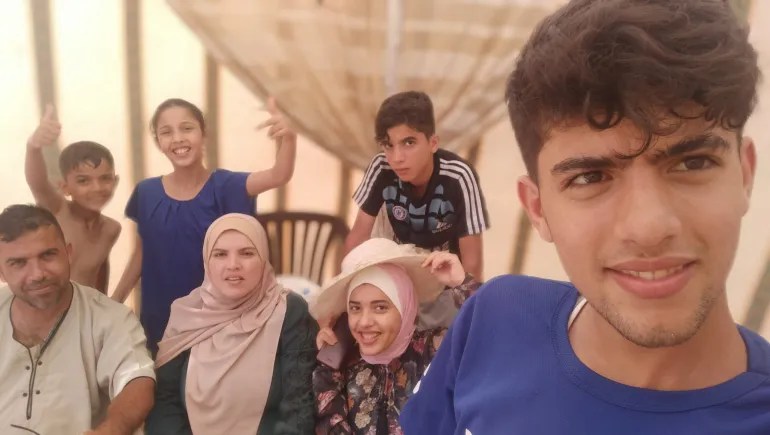
A few days before Sukkot, the world witnessed the unbearably tragic image of 19-year-old Sha’ban al-Dalou, a software engineering student burning to death after Israel bombed Gaza’s Al-Aqsa Hospital in Deir al-Balah in Gaza. In the horrifying video footage, Sha’aban’s was lying on a hospital gurney, screaming as the flames engulfed him and onlookers screamed for help. His mother and younger brother also died in that fire. It was recently reported that his younger sister Farah has succumbed to her burns as well. May their memories be for a blessing.
Before his death, Sha’aban had recorded videos asking for help to move his family to safety in Egypt. In one video, he described his and his families life attempting to survive amidst the genocide: “I’m taking care of my family, as I’m the oldest,” adding that his parents, two sisters and two brothers were displaced five times before finding refuge on the hospital’s grounds. “The only thing between us and the freezing temperatures is this tent that we constructed by ourselves.”
Shaban al-Dalou with his parents and siblings [Photo courtesy of the al-Dalou family]
Like so many, I was shattered after learning of Sha’aban’s life and death. I was particularly devastated to learn that he burned to death while he was recovering from a previous attack and was receiving medical treatment in a shelter he had constructed to protect his family.
As it would turn out, all of this transpired as the Jewish community was preparing for the Sukkot holiday, in which we build fragile, makeshift shelters to dwell and eat in during our week-long festival. Like all of the Jewish festivals, Sukkot has now taken on an entirely new and immediate meaning after witnessing more than a year of Palestinians being driven from their homes, forced to life in flimsy makeshift tent shelters, which all too often have served as the place of their final, terrifying moments on earth.
As has been the case with other Jewish holidays this past year, many of us were unable to treat the Sukkot festival as “business as usual.” Rather, this holiday which sanctifies the literal creation of shelter, has provided us a ritual means to express our sacred solidarity with the Palestinian people during a time of genocide. And not unsurprisingly, college students across the country have once again led the way for us. According to Nate Cohn, the National Campus Organizer for Jewish Voice for Peace, almost 30 “solidarity sukkot” have been built – or are planning to be built – on campuses around the US. At least four that we know of have already been destroyed by police forces.
In the wake of the student Palestine solidarity encampment movement last spring, college administrations have spent the summer devising ways to crack down on its resurgence by developing draconian new rules designed to severely restrict freedom of assembly and speech. Of course, when it comes to Jewish students constructing sukkot on their campuses, it adds in the critical issue of freedom of religious expression. Moving, dismantling or destroying sukkot is, quite simply, act of religious desecration.
(Photo: JVP NU)
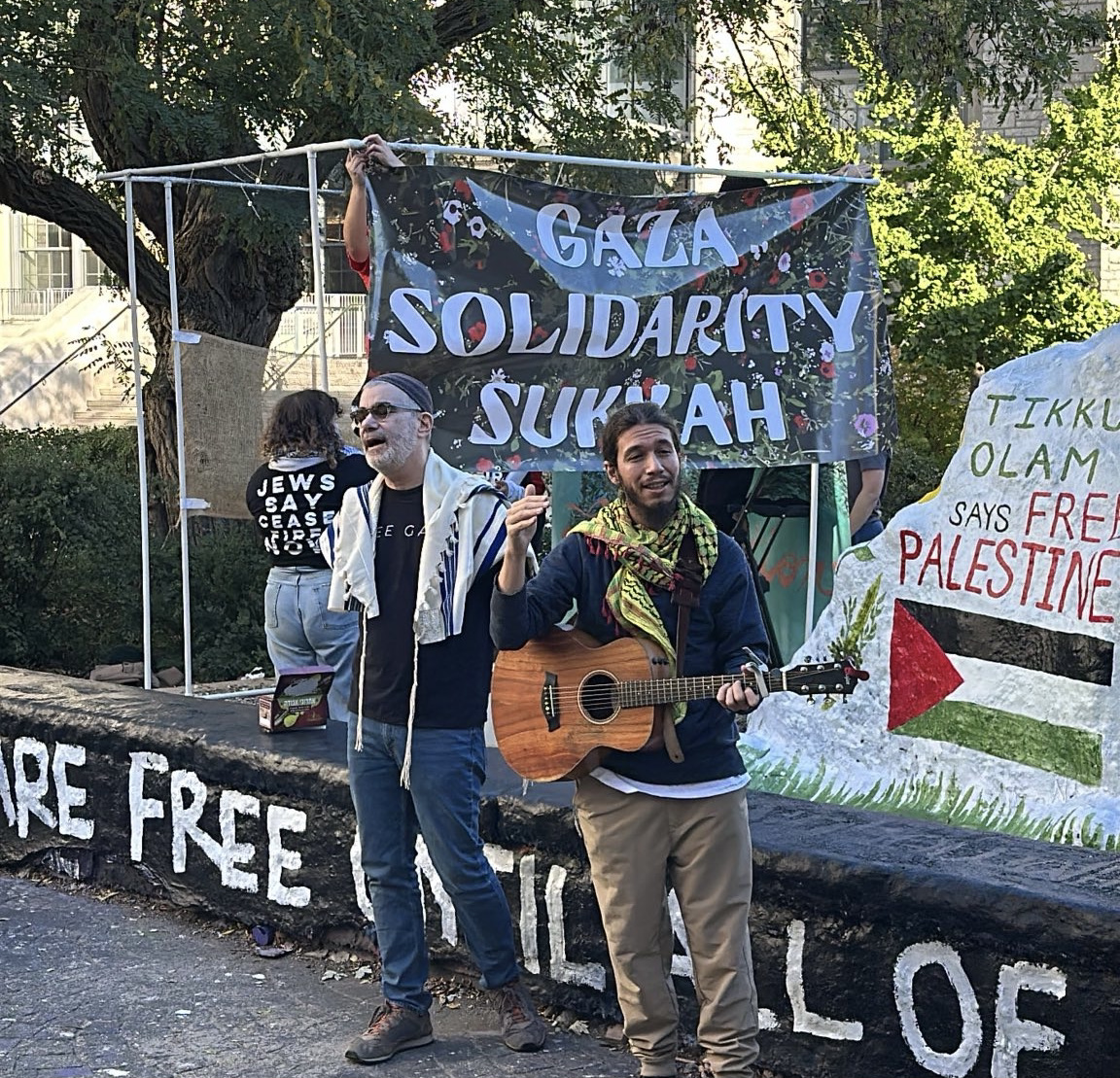
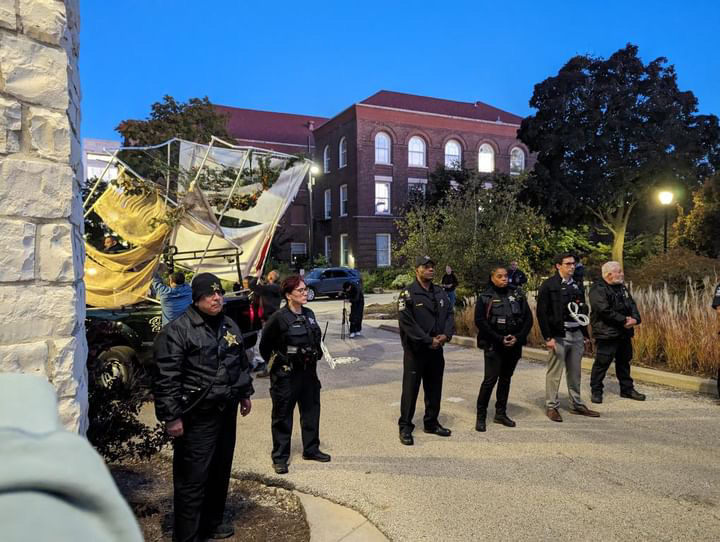
At Northwestern University, in my hometown of Evanston, the campus chapter of Jewish Voice for Peace attempted in vain to receive a permit to build a sukkah on their campus. On the eve of Sukkot last Wednesday evening, they put up a solidarity sukkah in Deering Meadow, a large open grassy area on campus (see above) – and within hours it was destroyed by campus police. With no other options, they decided to rebuild their sukkah last Friday at The Rock, a centrally located and historically protected space of expression which is the only area on campus where tents are techincally permitted.
Leaders of JVP NU reached out to my congregation, Tzedek Chicago, to support and protect their rebuilding, which took place on the eve of Shabbat. And so when the time came, Tzedek cantorial soloist Adam Gottllieb and I led a Shabbat service (see top pic) as students constructed the sukkah next to The Rock, on which they had painted the messages “TIkkun Olam Means Free Palestine” and “None of Us are Free Until All of Us are Free.” Dozens of people enthusiastically in the ceremony, which culminated in the final touches on the structure and the communal blessing for dwelling in the sukkah.
Two hours after the end of the service, we learned that campus police had come, thrown the student’s sukkah in a truck and drove it away.
(Photo: JVP NU)
There is little more to be said: this is what things have come to in American Jewish life. Jewish religious expression of solidarity with an oppressed people is deemed “antisemitic” while college campuses are desecrating sacred Jewish ritual with impunity. These facts tell you everything you need to know about the moment we are currently in.
In the end, however, the destruction of these symbolic fragile structures must not and should not be viewed primarly as an act of repression against Jewish college students. This would be an egregious misreading of the true meaning of Sukkot 2024. Rather, I fervently believe these acts must only serve to further sensitize us and deepen our outrage a desecration that is far more egregious and tragic: i.e., the genocidal violence that Israel has been inflicting on the Palestinians of Gaza, who have been seeking in vain for shelter for over a year.
And even more importantly, it must strengthen our resolve to do everything we can to create a real and lasting shelter – by finally bringing this heinous genocide to an end.
The course of Jewish history has never been a straight line. Throughout the centuries, the evolution of Jewish life has been shaped by a series of crises, tension points – and outright cataclysms. More often than not, these tumultuous events have even transformed the very nature of Judaism itself.
To offer just a few examples: classical Judaism as we know it emerged out of a catastrophe: the destruction of the Temple in Jerusalem by the Romans in 70 ACE. The Spanish Inquisition in 1492 ended the Golden Age of Jewish life in Muslim Spain and initiated the spread of Sephardic Judaism throughout Europe, Africa and the Middle East; the Hasidic movement was born out of tensions in Eastern European Jewish life in the 17th century; the onset of modernity and the Enlightenment in Western Europe, created a wide constellation of movements whose legacies still influence Jewish life today.
I’m making this point because there’s every indication that Jewish life is going through just such a monumental crisis and transformation right now. I’m speaking of course, about the abyss that has opened over the issue of Zionism – an abyss that has widened considerably this past year as a result of Israel’s genocide in Gaza. .
Last night, Aviva Stein described how she painfully crossed this divide when she shared her own personal Jewish journey with us. I’d like to thank Aviva for her powerful words, which were truly a gift to our community. In my remarks to you today, I’d like to pick up where she left off. I want to begin by responding to her painful point about the increasing exile of young Jews from the Jewish community:
There is an epidemic in the Jewish community – young people are losing and leaving their jobs, and the Jewish community is losing the passion, critical thinking, and vitality that their best and brightest brought to their work. So many Jewish organizations are breaking this way – the big tent, so to speak, has collapsed, and Jews of conscience, Jews who say no to genocide and no to Islamophobia and war mongering, find ourselves on the outside.
Just two weeks ago, there was an extensive investigative article in the journal “In These Times,” which documented how “US Jewish institutions are purging their staffs of anti-Zionists.” The author of the article, Shane Burley observed:
If the trend continues, it could contribute significantly to one of the sharpest breaks in the history of American Jewish life, forcing out a generation of progressive Jews and furthering the crisis of legitimacy plaguing much of the communal Jewish infrastructure.
In other words, we’re currently witnessing a fundamental divide in the Jewish community – even a potential schism in the making. While it’s far too early to predict how it will play out, one thing seems clear to me: just as Israel is fast losing its legitimacy in the international community, Zionism is just as quickly losing its legitimacy in the Jewish community itself.
Of course we can’t write Zionism’s obituary just yet. There are still plenty of staunch Zionists in our community who have a decidedly different view of the past year – who insist that Israel is doing what it has to do to defeat its existential enemies. And there are also many liberal Zionists who refuse to recognize the reality of Israel’s genocide, who still point to the “complexities” of the “conflict.”
This is what it has come to. The Jewish community has become irrevocably divided between those who stand with Israel – or apologize for its behavior – and those who believe Israel is a settler colonial apartheid state that is committing a genocide in our name. There is no more big tent, if there ever was one. There is little use in pretending that there is any conceivable room for consensus on this issue.
While these fissures over Israel and Zionism have always been present in the Jewish community, it’s clear that they’ve been widening over the last decade or so. This past year, however, the divide broke wide open. And I honestly don’t believe we’ll ever be able to put the pieces back together again, certainly not in the way they were.
Over the years, prophetic voices in our community have been sounding the alarm over this coming schism. One such voice was the great Jewish scholar and theologian Marc Ellis, of blessed memory, who tragically died far too soon this past June. Among other things, he wrote about the rise of what he called “Constantinian Judaism.” This was a reference to the pivotal moment in the 4th century when the Emperor Constantine made Christianity the official religion of the Roman Empire, transforming what had previously been a small and persecuted religious community in the first century after Jesus, into a religion of empire and state power.
As Marc taught, after the cataclysm of the Holocaust and the birth of the state of Israel, Jewish tradition itself became Constantinian. In the 20th century, Judaism, which had previously been prophetic at its core, became wedded to systems of empire, militarism and Jewish supremacy. In very short order, Constantinian Judaism became the central focal point of Jewish life.
From the very beginning of the Zionist movement, however, there were always prophetic Jewish voices opposing Zionism. And they remained even after the founding of the state of Israel. Marc referred to them as “Jews of Conscience” – the minority of Jews who resisted Constantian Judaism, often at great cost. Because of Zionist hegemony, Jews of Conscience necessarily lived in exile, socially, religiously, and in many cases professionally from the Jewish communal establishment (as was the case, very sadly, for Marc).
Even so, every Jewish communal study over the past several years has shown that the ranks of Jews of Conscience have been growing, particularly among the younger generations. As Aviva explained to us last night, they have now burst out into the open – and the Jewish communal establishment is responding with ferocious, desperate backlash
As we contemplate this unfolding schism, I believe it’s important to reckon with the profound damage Zionism has done to sacred Jewish tradition. This marriage of Judaism and ethno-nationalism has been so deeply normalized, it often feels difficult to know where one starts and the other stops. For example, for centuries, the Hebrew word “Yisrael” which means “wrestles with God” referred to a Jewish spiritual peoplehood. It had a religious cultural meaning that spoke deeply to Jewish collective identity throughout the diaspora. It referred to our history and practice of debate, of questioning, of challenging the status quo. Today, for most Jews – and most people in the world – the word “Yisrael” means one thing only: it refers exclusively to a heavily militarized political nation state.
So too with the word “Zion,” which was always much more than a physical location. In Jewish liturgy, Zion is a signifier of our highest spiritual aspirations: the world to come that we were actively working to manifest in our day. After it was appropriated by Zionism, however, it became synonymous with a political movement whose realization tragically resulted in the dispossession and oppression of millions of people.
There are so many other examples. The glorification of militarism we instill in our children in our religious schools; the holidays of conquest, like Israel Independence Day that have become an indelible part of the Jewish holiday calendar. The idolatrous placement of national symbols such as Israeli flags in our sacred spaces. The list goes on and on and on.
Marc Ellis used to observe that with the fusion of Judaism with empire, we have now reached the end of ethical Jewish history. As he once put it:
We Jews, all of us, no matter our various political positions, are responsible for what Israel has done and is doing to the Palestinian people. That is why I believe that we, as Jews, dwell in the abyss of injustice. The injustice we have perpetrated upon Palestinians has brought us to the end of ethical Jewish history. The question for Jews, the only question, is what are we to do at this end?
When Marc spoke those particular words, communities of Jews of conscience were still fairly nascent. But when we founded Tzedek Chicago in 2015, we were, in a sense, answering his question “what are we to do at this end?” by creating a vibrant, Jewish spiritual community that turned away from this abyss of injustice. I know it meant a great deal to Marc to become a member of our congregation after so many years of professional exile.
When we founded Tzedek, we realized that we were one small, modest effort in this regard – but we still believed there was still a place for a dissident Jewish community such as ours. This is how I described it in 2015 in my very first Rosh Hashanah sermon:
(Ever) since our announcement, I’ve been hearing consistently from people all over the country who have told me they wish that something like Tzedek existed in their community. So while we might not statistically exist in the institutional sense, I believe we are very much alive out there in the borderlands of Jewish life. I just know in my heart that there is a place for a Jewish congregation such as ours. And while we are starting off modestly, mindful of our capacity, of what we are able and not able to do during this first year of our existence, I do believe the response we’ve received thus far indicates that the time has truly arrived for a congregation such as Tzedek Chicago.
Since that inaugural service, Tzedek has grown in ways we never could have predicted. In 2020, when we started holding our services and programs online, our membership expanded in numbers and geographically, transforming us into a global congregation. The people who told me they wished something like Tzedek existed in their community now participated in our programs and services and became members of our congregation. Many of them are among our most active members and more than a few serve on our boards and committees.
The horrors and atrocity of this past year, however, changed the Jewish community irrevocably. It has become a profoundly tragic irony that during times of particularly brutal Israeli military assaults on Palestinians, membership in anti-Zionist organizations like Jewish Voice for Peace tends to spike dramatically. During the genocide of this past year, we’ve witnessed this growth at Tzedek like nothing we’ve ever seen before, nearly doubling in size.
There were months on end that new members were literally joining us every week. As many of you know, our membership application includes a field that asks our new members to tell us why they were joining Tzedek Chicago. The statements we received were powerful and moving – and almost all of them expressed common themes: those who could no longer bear the the support of Israel’s genocide in their synagogues; those who had never belonged to a synagogue before because of the constant centering of Israel; those who were converting to Judaism but were starting to despair that it might never be possible if it required fealty to an ethnic Jewish nation-state.
One of the most powerful examples of Jewish anti-Zionist religious organizing I witnessed occurred this past Spring, during the growth of the student encampment movement on college campuses. In May, Tzedek was contacted by the student group Jews 4 Justice at DePaul, who asked if we could come lead a Shabbat service in their encampment. Adam Gottlieb and I came twice to lead Havdalah services. I’m not exaggerating when I say they were among the most inspiring ritual experiences I’ve ever experienced.
Those of you who organized or visited these encampments likely know what I’m talking about. These were organically generated, living, breathing student communities. At DePaul, as in many other student encampments, there was a food tent and a first aid tent. There were learning sessions and tutoring stations. There were workshops on deescalation tactics.
But for me, the most powerful aspect of the encampment was its grassroots, interfaith nature. Throughout the encampment there were signs that included solidarity statements from a variety of religious traditions. Hijabi women were congregating very naturally alongside Jews wearing kippot. When Adam and I arrived, there was a Muslim call to worship where the communal gathering took place. Our havdalah service was immediately followed by a ritual dance by a local indigenous dance troupe.
Needless to say, this encampment was not the bastion of antisemitic Jew-hatred that has been falsely characterized by the media and the Jewish communal establishment. The Jewish students who we met at these and other student encampments are deeply serious, passionate Jews who are creating real communities that express solidarity with Palestinians as a sacred Jewish value.
It was sad, but not at all surprising, that these encampments were eventually destroyed – overturned by state violence. But in the end, the brutality of this response only proved the students’ essential point about the world they were actively resisting – and more importantly, the one they sought to create in its stead.
Yes, over the past summer, colleges and universities have cracked down hard on regulations prohibiting students’ freedom of assembly and speech. But I have no doubt that they will continue to find creative, meaningful ways to organize. So too, I know that these young Jewish students will not be deterred in their desire to create meaningful Jewish communities where they can be their full Jewish selves. To my mind they truly represent the best of our Jewish future.
As we continue to organize these Jewish communities however, I think it’s enormously important to reckon with the tragic reason why they are growing in the first place. While the creation of these new Jewish communities of conscience is something to celebrate, there is absolutely nothing to celebrate about the circumstances that have led to their creation. Those of us who create spiritual anti-Zionist communities know that we must create them with deep sensitivity. In particular, as we craft our religious rituals, we must take care not to exploit Palestinian trauma for our own benefit.
We must also draw a meaningful distinction between private Jewish ritual services, such as we are engaged in now – and public, politicized Jewish ritual, which has a different function and different goals. In their wonderful new book, “For Times Such as These: A Radical’s Guide to the Jewish Year,” my dear friends Rabbis Jessica Rosenberg and Ariana Katz offered this important wisdom:
We’ve experienced the way bringing Jewish ritual into political actions opposing the occupation of Palestine, which primarily harms Palestinians, can recenter the action and conversation on Jews and Jewish feelings. As with all ritual, and all political action, we believe in thinking strategically about the what, where, when and why. We can make plenty of Jewish ritual prayer space that grieves and counters Zionist narratives; when we bring the ritual into the street, it must be done strategically and in partnership with Palestinian-led organizing.
So yes, while this new Jewish spiritual community organizing is exciting to witness, it is also complex and often fraught. This new Jewish transformation is occurring not as a result of a catastrophe that was inflicted on the Jewish people, but one a Jewish state is inflicting on others. This is something that is truly unprecedented in Jewish history; we cannot and should not take it for granted.
We don’t yet know what the future will hold for the Jewish community but we do know that it will never be what it once was. And we know that this schism will be painful. It is not only dividing our community, it is causing deep estrangements in families and relationships between loved ones. I’ve done my share of what I call “political-pastoral counseling” in the past year and I can attest to the very real personal pain this schism is leaving in its wake.
As Aviva told us last night, “I believe we are moving towards a Jewish future where the social norm of Zionism will become increasingly rare, and where communities like ours are not an anomaly but a standard of Jewish communities around the country.” I agree with her hopeful declaration. While it won’t be easy, I know it will happen. Why? Because we are ultimately building our communities with deep-seated, deeply held core values.
When we created Tzedek Chicago, we started by crafting our core values statement before we actually began to recruit any members. As time goes by, I’ve come to realize that this was among the smartest things we ever did. I remember thinking at the time, there are plenty of Jewish congregations out there: why does the world need another? What do we have that’s unique to offer? As I think about it, this is a critical question for any Jewish community. Do we exist just to exist or for a more transcendent purpose? Does our existence actively seek to repair the world or does it merely serve to use up Jewish community resources? Or worse still, does our communal existence contribute to harm in the world?
I’d like to finish by addressing these questions: Why should we create Jewish community in the first place? And more fundamentally, does Judaism have anything to uniquely offer the world in the 21st century?
I’d like to return to the Hebrew word “Yisrael” – the community that wrestles and struggles with God. To me this means that Jewish tradition has never been self-evident; it has always been dialectical – we have always wrestled with very different meanings of what it means to be Jewish; what kind of Judaism we want to lift up in the world. The essential question before us has never been simply “What is Judaism?” but rather, “What is theJudaism we want to affirm and bequeath to future generations?”
Let’s take the two central sacred narratives in Torah: the Creation story and the Exodus story – the two poles that form the foundation of Jewish tradition. A signature moment of the creation story is God’s creation of humanity b’tzelem elohim – in God’s image. In the Talmud, there is a famous debate between the two great rabbis, Rabbi Akiba and Rabbi Ben Azzai. They were arguing, as rabbis are wont to do, about what they considered to be the central precept in Torah. Rabbi Akiba quotes the famous verse from Leviticus, “Love your neighbor as yourself.” Which certainly seems like a strong contender. But Ben Azzai says, no, it’s the verse from the Creation story, “God created humanity in God’s image.”
At the root of this argument, I believe, is a profound debate about particularism versus universalism. “Love your neighbor as yourself” could very well be taken to mean “love your fellow community member as yourself.” In fact, there are many prominent Jewish commentators who interpret it to mean precisely this: “love your fellow Jew as yourself.” But Ben Azzai comes back with “we are created in God’s image,” pointing out that all people are of infinite worth.
This approach has profound implications for the kind of Judaism we seek to affirm. Among other things, it comes from the section in the Torah before there were nations, before there were even Israelites, before land was promised to one particular people, conquered and carved up by the victors. When we promote a universalist approach to Judaism, it is a sacrilege to value Jewish lives over any other; it is an averah – a sin – to create a system of Jewish supremacy: a nation state that literally privileges Jews over non-Jews.
Our other sacred narrative, the Exodus, includes the famous moment when God heard the cry of the oppressed and responded by demanding their liberation. Again, there are some who might understand this narrative as a particularist one: a singular story about Jewish liberation in which a Jewish God hearkens to the cry of God’s chosen people. But when we promote a Judaism of universalism, we come to understand that God hearkens to the cry of all who are oppressed. Indeed, this is a precious lesson we can learn from Liberation Theology: all who are oppressed are God’s chosen.
In the 21st century, I believe this is the sacred calculus the Jewish people have to offer the world: Creation + Exodus = Solidarity. More than ever, the Jewish communities we create simply must value solidarity as our most sacrosanct mitzvah. In an age in which we are witnessing the increased scapegoating, yes of Jews, but also of Muslims, LGBTQ+ people, people of color, disabled people, immigrants, indigenous people and so many others, our sacred tradition must promote collective liberation first and foremost.
As I contemplate the growing schism in the Jewish community, it occurs to me that it really is a microcosm of a larger coming apart we are seeing in the world. And yes, so much of it is frightening to behold. At this moment, so much is breaking wide open around us – in our community and in our world. With so much uncertainty and no guarantees, we must respond by choosing the path of solidarity above all.
I’d like to end with words from our dear friend Marc Ellis, whose voice was largely silenced by the Jewish establishment. We miss his presence and his moral witness terribly, and it feels only appropriate to give him the last word.
For Marc, the essence of being Jewish was what he called “the prophetic” – he often referred to it as “the Jewish indigenous.” The prophetic, he taught, is where Jewish particularism and universalism came together. As he often wrote and said, the only authentic way to act Jewishly today is to act prophetically; to take a moral stand against empire, against oppressive state power, even if it invariably comes at great cost.
This is where we end – now. The prophetic is always before us. When Jews – with others – embody the prophetic, the worldly powers are put on notice. What happens then we know from history. The struggle intensifies. The casualties mount. The empire, always on a war footing, intensifies the war against the prophetic. Yet history remains open. Perhaps this is the ultimate message the prophets communicate to us throughout the ages. When we come to the end, against all odds, the prophet glimpses a new beginning on the horizon. When that hope will be embraced, when it will broaden so that the global community becomes prophetic, cannot be foretold in advance. The prophet is not a soothsayer. The prophet is a gatherer of light in dark times. Gathering light, hope on the horizon, justice around the corners of our lives. Eyes wide open, Israel’s ancient wisdom, re-presented, reborn.
May these words inspire us to make real in the coming year: a new beginning on the horizon, justice around the corner, the birth pangs, at long last, of global prophetic community.


 Shalom Rav