Category Archives: Anti-Semitism

“Israeli Apartheid and the Path to Teshuvah” – A Statement by the JVP Rabbinical Council

An Open Letter to the Jewish Community from the Jewish Voice for Peace Rabbinical Council

We, the Rabbinical Council of Jewish Voice for Peace, stand by the recent reports which use the term ‘apartheid’ to describe Israeli rule over Palestinians. The past year’s reports by B’tselem, Human Rights Watch and now Amnesty International contain well-documented evidence describing how the State of Israel maintains a system of identity-baseddomination over Palestinians. This detailed evidence demonstrates the systemic and shocking human rights violations and extreme violence and cruelty unleashed upon Palestinians living both under Israeli military and civil jurisdiction. 

Rabbi Brian Walt, one of the signers of this letter, grew up in South Africa under Apartheid. He writes: “The finding that Israel is an Apartheid state is shocking to me – and it should be to every Jew and person of conscience.  Instead of demonizing these human rights organizations, we who care about our Jewish ethical and spiritual heritage must grapple with the harsh and deadly reality documented in these three reports.” 

As people deeply committed to Jewish life and culture, we believe Jews should read these reports in the spirit of prophetic witness and atonement, like the texts we read on Yom Kippur, which challenge us to turn from violence and break the bonds of oppression so a new dawn can burst forth. Many of us have witnessed these realities on the ground for decades. The reports confirm what Palestinians have been telling us all along: Israel’s system of control is based on the idea of Jewish supremacy. 

It is with deep sorrow that we once again witness leadership in Jewish institutional life ignore, dismiss or condemn the reports as antisemitic. On the day of the public release of Amnesty International’s report, leaders of the Reform movement issued an email calling on Reform rabbis and member congregations to condemn the report, claiming the decades-long research was “replete with discredited and inaccurate allegations, including a deeply wrong accusation of apartheid.”  

Denial is a common response that surfaces when we are asked to face difficult realities that upend deeply held views. However, B’Tselem, Human Rights Watch and Amnesty International detail at length how Israel’s systemic policies, rooted in racism, have brought suffering to millions of Palestinian lives. Shouldn’t these claims cause us to at least read the reports and hear the direct testimony of thousands upon thousands of Palestinians?

We believe that we must face the moral challenge that these reports present to us. As Hillel said, “Go study!” We call on all people of conscience, including Jewish people in our communities, to read the reports carefully. Secondly, we call on the leaders of the Jewish community, rabbinic and lay, to facilitate open discussion on the reports, including inviting representatives of the organizations to talk about the report in your community and to answer questions.  We also encourage rabbis and leaders to facilitate open and respectful dialogue and debate in our communities about the issues raised in these reports.  We cannot work for healing justice if we live in denial of the reality Palestinians have been facing every day since 1948.

As Jews of conscience, Israel’s system of apartheid has created a moral emergency for us. We cannot turn away. Instead, we long for the kinds of conversation which accurately reflect the reality on the ground, a reality that B’Tselem calls Jewish Supremacy. The conclusion reached by these three well-respected human rights organizations that Israeli governance fits within the international definition of apartheid is a renewed calls to people of conscience. We must examine how the claims of these reports reveal the ways we are complicit in sustaining Israeli apartheid, and commit to repair for the systemic injustice choking Palestinian lives. May our study lead to active repair of the harms of apartheid. This is the only path to teshuvah.

– The Jewish Voice for Peace Rabbinical Council

A Jewish Congregation Considers Affirming Anti-Zionism as a Core Value

At our December 2021 meeting, board of my congregation, Tzedek Chicago, voted unanimously to recommend amending our core values statement to state explicitly that anti-Zionism (rather than “non-Zionism”) should be articulated as one of our core values.

Recognizing the significance of such a step, the board also agreed unanimously that this decision should be processed, discussed and ultimately put to a membership vote. To this end, Tzedek Chicago is holding a series of town hall meetings and will send out an online ballot to members in March.

Here, below, is the text of a Q/A that the Tzedek board drafted and sent out to its members to explain its decision:

Why did Tzedek Chicago originally include “Non-Zionism” as part of our core values?

When our congregation was established in 2015, our founders developed a set of core values to provide the ideological foundation for our congregational life. In our final values statement, we included the following words in the section entitled, “A Judaism Beyond Nationalism”:

While we appreciate the important role of the land of Israel in Jewish tradition, liturgy and identity, we do not celebrate the fusing of Judaism with political nationalism. We are non-Zionist, openly acknowledging that the creation of an ethnic Jewish nation state in historic Palestine resulted in an injustice against its indigenous people—an injustice that continues to this day.

From the outset, our founders made a conscious decision to state that Tzedek Chicago would not be a Zionist congregation. Most Jewish congregations in North America are Zionist by default. Among other things, Tzedek Chicago was created to provide a Jewish congregational community for those who did not identify as Zionists—and who did not want to belong to congregations that celebrated Zionism as a necessary aspect of Jewish life.

Why is the board recommending the change from Non-Zionist” to Anti-Zionist?

Zionism, the movement to establish a sovereign Jewish nation state in historic Palestine, is dependent upon the maintenance of a demographic Jewish majority in the land. Since its establishment, Israel has sought to maintain this majority by systematically dispossessing Palestinians from their homes through a variety of means, including military expulsionhome demolitionland expropriation and revocation of residency rights, among others.

It is becoming increasingly difficult to deny the fundamental injustice at the core of Zionism. In its 2021 report, the Israeli human rights group B’Tselem concluded that Israel is an “apartheid state,” describing it as “a regime of Jewish supremacy from the river to the sea.” In the same year, Human Rights Watch released a similar report stating Israel’s “deprivations are so severe that they amount to the crimes against humanity of apartheid and persecution.”

Given the reality of this historic and ongoing injustice, we have concluded that it is not enough to describe ourselves as “non-Zionist.” We believe this neutral term fails to honor the central anti-racist premise that structures of oppression cannot be simply ignored; on the contrary, they must be transformed. As political activist Angela Davis has famously written, “In a racist society, it is not enough to be non-racist, we must be anti-racist.”

What about the claim that anti-Zionism is antisemitism?

While there are certainly individual anti-Zionists who are antisemites, it is disingenuous to claim that opposition to Zionism is fundamentally antisemitic. Judaism (a centuries-old religious peoplehood) is not synonymous with Zionism (a modern nationalist ideology that is not exclusively Jewish). Since the founding of the Zionist movement in the 19th century, there has always been active Jewish opposition to Zionism.

While Jewish anti-Zionists are still a minority in the Jewish community today, their numbers have been increasing, particularly among those under 30 years of age. Not coincidentally, we are witnessing increasingly vociferous calls from the Israeli government, Israel advocates and Jewish institutions to label anti-Zionism as antisemitism. There have also been public calls to categorize anti-Zionist Jews as “Un-Jews” and “Jews in name only.” Given the tenor of the current moment, we believe the need for public stances by principled Jewish anti-Zionists is all the more critical.

Anti-Zionist” describes what we oppose—but what are we positively advocating for?

While we affirm that Tzedek Chicago is an anti-Zionist congregation, that is not all we are. This value is but one aspect of a larger vision we refer to in our core values statement as a “Judaism Beyond Borders.” Central to this vision is an affirmation of the diaspora as the fertile ground from which Jewish spiritual creativity has flourished for centuries. Indeed, Jewish life has historically taken root, adapted and blossomed in many lands throughout the world. At Tzedek Chicago we seek to develop and celebrate a diasporic consciousness that joyfully views the entire world as our homeland.

Moving away from a Judaism that looks to Israel as its fully realized home releases us into rich imaginings of what the World to Come might look like, where it might be, and how we might go about inhabiting it now. This creative windfall can infuse our communal practices, rituals, and liturgy. We also believe that Jewish diasporic consciousness has the real potential to help us reach a deeper solidarity with those who have been historically colonized and oppressed. As we state in our core values:

We understand that our Jewish historical legacy as a persecuted people bequeaths to us a responsibility to reject the ways of oppression and stand with the most vulnerable members of our society. In our educational programs, celebrations and liturgy, we emphasize the Torah’s repeated teachings to stand with the oppressed and to call out the oppressor.

Does Tzedek Chicago expect every member to personally adhere to this new position?

As is the case with all of our core values, this position is not an ideological “litmus test” for membership at Tzedek Chicago. It is, rather, part of our collective vision as a religious community. We understand that every individual member of our congregation will struggle with these issues and must come to their own personal conclusions. The main question for all of Tzedek’s members is not “must I personally accept every one of these core values?” but rather, “given these values, is this a congregation that I would like to support and to which I would like to belong?”

What will this decision mean for our congregation going forward?

We believe the core value of anti-Zionism will open up many important opportunities for our community. It will guide us in the programs we develop, the Jewish spiritual life we create, the coalitions we join and the public positions we take. In a larger sense, we believe this decision will create space for other Jewish congregations to take a similar stand—to join us in imagining and building a Jewish future beyond Zionism.

In the end, we are advocating for this congregational decision in the hopes that it may further catalyze Jewish participation in the worldwide movement to dismantle all systems of racism and oppression. May it happen בִּמְהֵרָה בְּיָמֵינוּ—bimheira beyameinu—soon in our own day.

Christian Zionists Leaving their Legacy on the Way Out

In the waning days of the Trump presidency, it’s become painfully clear that this administration is engaged in a political scorched earth campaign – i.e., doing everything it can to ram through its most harmful policies before Inauguration Day – and to do so in ways that will make them difficult to undo by the incoming Biden administration. Secretary of State Mike Pompeo’s visit to the West Bank yesterday, where he unabashedly unveiled the Trump administration’s “parting gifts to the Israeli right,” is the latest case in point – and a particularly harmful one at that.

Speaking from the illegal West Bank settlement of Psagot, Pompeo announced two new policies. The first was the State Department’s designation of products made in West Bank settlements as being “Made in Israel,” which now paves the way for US approval of Israel’s formal annexation of Area C of the West Bank.

The second gift came with this announcement:

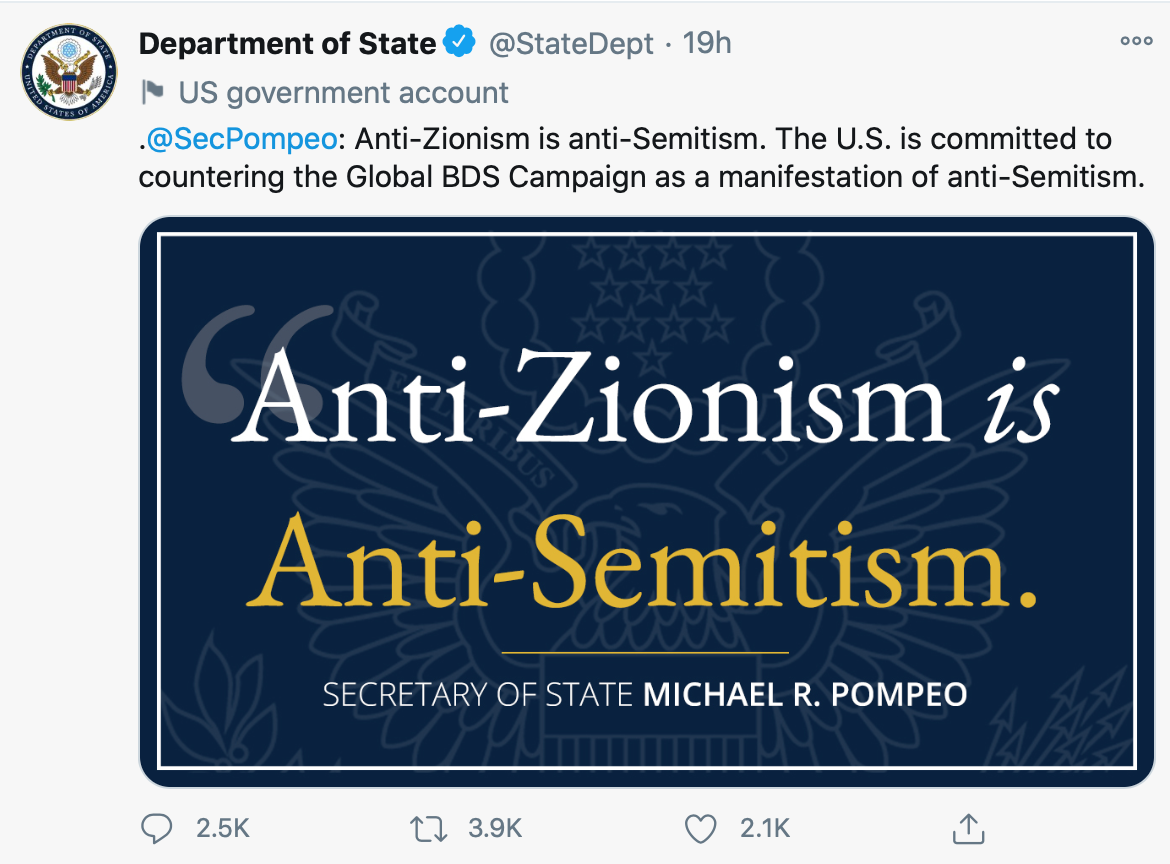
As we have made clear, anti-Zionism is anti-Semitism.  The United States is, therefore, committed to countering the Global BDS Campaign as a manifestation of anti-Semitism.

Pompeo’s statement further directed the Office of the Special Envoy to Monitor and Combat Anti-Semitism “to identify organizations that engage in, or otherwise support, the Global BDS Campaign… to ensure that their funds are not provided directly or indirectly to organizations engaged in anti-Semitic BDS activities.” In a joint statement with Israeli Prime Minister Netanyahu, Pompeo put a finer point on his intentions:

“Look, we want to stand with all other nations that recognize the BDS movement for the cancer that it is. And we’re committed to combating it. Our record speaks for itself. During the Trump administration, America stands with Israel like never before.”

While there is clearly much to parse here, I’d like to unpack Pompeo’s pronouncement that “Anti-Zionism is Anti-Semitism.”

When considering the implications of this new policy, it’s essential to note that Mike Pompeo himself is a fervent Christian Zionist who adheres to an eschatological ideology that seeks a Jewish return to the Holy Land as a precursor to the apocalypse and the Second Coming of the Messiah. Pompeo has in fact, made no secret of his extreme religious beliefs. In 2015, when he was a congressman, he uttered these immortal words from the pulpit of a Kansas church:

We will continue to fight these battles. It is a never-ending struggle. Until that moment … until the Rapture be part of it, be in the fight.

I’ve written a great deal about Christian Zionism and it’s influence within the Trump administration before, so I won’t go into great detail here about this dangers of this extreme religious ideology. For now, I’d just like to contextualize Pompeo’s presumptuous equation of Anti-Zionism = Antisemitism with a few points:

• Zionism does not equal Judaism. In fact, Zionism is not an exclusively Jewish movement. It is rather, a fundamentally interfaith movement “that has informed and propelled Christian Zionists into the very halls of power.”

• There are far more Christian Zionists in the world than Jewish Zionists (or Jews for that matter). There are 9 million members of the organization Christians United for Israel alone. While American Jewish attachment to Israel is declining, Evangelical Christian support is growing significantly.

• Christian Zionism is itself an antisemitic religious ideology that objectifies the Jewish people as pawns in a cosmic drama that seeks to further the coming of the Christian messiah.

• There has always been principled Jewish opposition to Zionism.

• There are increasing numbers of Jews who support BDS as an expression of intrinsically Jewish values.

We should make no mistake: even if they are no longer in the administration, the threat of this Christian extremist movement will remain very real. But as ever, for Palestinians and those of us who stand in solidarity with them, the struggle will continue – no matter who happens to live in the White House.

Which Side are You On? A Moment of Reckoning for American Jews

ezi-jxxwoaelrn--1

photo: Martha Raddatz

Cross-posted with Jewish Voice for Peace

As is the case for many I’m sure, the refrain, “which side are you on?” has been echoing through my heart and soul this past week as the American legacy of structural racism and state violence has been so brutally laid bare in our country. In fact, I can’t recall a time in my own lifetime in which this question has ever been more critically relevant. 

As I write these words, hundreds of cities around the US are being rocked by street protests in response to the murder of George Floyd by the Minneapolis police. Police departments are responding to protesters in turn by deploying tear gas and rubber bullets. In Louisville, police shot live ammunition into a crowd and killed a local businessman. In New York, a police van was driven straight into a crowd of protesters. Philadelphia police fired tear gas directly into a crowd of protesters trapped with nowhere to run. And on Monday, after Trump vowed to deploy “thousands and thousands of heavily armed soldiers, military personnel, and law enforcement officers,” federal police were directed to use tear gas and flash grenades to disperse peaceful protesters so that he could visit a nearby church for a photo op.

Yes, if ever there was a “which side are you on?” moment, this is it. Thus, when I saw a recent article in the Jewish Forward written by three liberal Jewish leaders bearing the headline, “Every Jew must decide which side they’re on,” I read it with great interest. In the end, however, I was profoundly let down by their message, which I found to be disappointingly equivocal – and at times even harmful. 

Authors Rabbi Sharon Kleinbaum, Matt Nosanchuk, and Rabbi Rachel Timoner begin their article on a promising note, noting that “the promise of ‘equal justice under the law’ remains out of reach in a system infected with structural racism.” They go on to say that this work “begins at home,” adding that for the Jewish community, this work “has only just begun.” 

Sadly, however, they betray their own internal call to action with their statement, “we must show our black and brown siblings that we see the racism coursing through our society,” a statement grounded in the assumption that white = Jewish, summarily ignoring the significant percentage of Jews of color in the American Jewish community. 

The authors’ error is particularly egregious as it comes in the wake of an infamous article recently published by the two editors of the American Jewish Yearbook that made deeply problematic claims about the number of Jews of color in the US. With their painfully ill-considered comment, Kleinbaum, Nosanchuk and Timoner reinforce long-held assumptions of whiteness in regard to the American Jewish community. They do indeed prove their point that “our work has only begun” when it comes to anti-racist work in the Jewish community – though clearly not in the way they originally intended. 

Later in their article, the authors further betray their own call with this statement:

If we want to stand on the side of civil rights, we must respond to attacks on people of color as we would a white student facing anti-semitism on campus, or a Hasidic man beaten on the streets of Brooklyn: We must see their pain and commit to disrupting the forces that cause it.

Though it’s not completely clear, I can only surmise they are referring here to the Boycott, Divestment and Sanctions (BDS) campaigns led by Palestine solidarity activists on college campuses. If this is indeed the case, their casual conflation of racist state violence with tensions over campus activism is a muddled and harmful equation. 

The canard of antisemitism has long been cynically wielded toward pro-Palestinian student activism by Israel advocacy organizations. To assert that BDS is inherently antisemitic is problematic for a host of reasons – but it is perhaps even more harmful to casually conflate so-called “campus antisemitism” with the structural racism faced by people of color in the US. Such a claim ignores the legacy of white supremacy that has long been woven into the very fabric of our country. And if there is anything we’ve learned from the current political moment, it is that we ignore the dangers of white supremacy at our peril. 

The authors also engage in false equivalence when they invoke the recent violence against Hasidic Jews in New York. While these attacks, perpetrated largely by African Americans most certainly deserve our condemnation, it is not at all helpful to compare them to the racist violence perpetrated against people of color by state institutions. While insidious, this violence perpetrated against Jews is not part of an organized ideology or single movement. And, unlike structural racism against people of color,  it certainly does not have the power of state institutions behind it. 

Moreover, as in the case of the backlash to BDS, these events are being politically weaponized by many in the Jewish community as an example of “antisemitism on the left.” This is, to be sure, a fraught and dangerous claim. As journalist Rebecca Pierce has observed, “(using) Black antisemitism as a cudgel against the left further divides the Jewish and Black communities at the expense of actually understanding and fighting antisemitism.” We must remember that the anti-Jewish conspiracy theories embraced by some African Americans are ultimately part of the same white supremacist power structure that has long oppressed their communities. In the face of this common enemy, we would do well to cultivate solidarity rather than sow further division with facile comparisons such as these.

Finally, Kleinbaum, Nosanchuk and Timoner state, “we must be prepared to take responsibility not only for our transgressions, but also for our silence.” This is an interesting choice of words, considering that they remain completely silent on the issue of Israel’s racist state violence against the Palestinian people. Since the authors frame their call to action in terms of Jewish collective responsibility, it is remarkable that they have absolutely nothing to say about Israel’s violations of Palestinian rights, inarguably the most important moral challenge facing the contemporary Jewish community today.

No doubt there are many in the Jewish community who will reject such a comparison, claiming that one has nothing to do with the other. But in fact, they have everything to do with each other. We simply cannot call out structural violence against communities of color in the US while failing to note its intrinsic relationship to structural violence against Palestinians in Israel. 

It’s been fascinating to witness so many Jewish communal institutions – who routinely defend or rationalize away Israel’s human rights abuses of Palestinians – now passionately taking a stand against systemic racism. But in truth, it is not a tremendously heavy lift for a Jewish institution to condemn the sickening events of the past few days. Even the Anti-Defamation League – the epitome of a Jewish establishment organization – took it upon itself to issue a statement in “solidarity” with the Black community.

But of course, this is the same ADL that coordinates exchange programs that bring police departments from around the US to Israel to coordinate with the Israeli military the very tactics they use to oppress communities of color – and currently, against unarmed protestors across this country. If the ADL was truly serious about systemic change of a racist and unjust system, it certainly wouldn’t actively empower the militarization of police, harming the community with whom it hypocritically purports to stand in solidarity. 

In the end, if  “every Jew needs to decide which side we are on,” then we cannot simply issue no-brainer statements that condemn the most open and obvious examples of state violence in our midst. Kleinbaum, Nosanchuk and Timoner are absolutely right: “it starts at home.” But the white Jewish community cannot claim to take a stand against racist structural violence at home while remaining silent on Israel’s racist structural violence against Palestinians. As long as support for the Jewish state remains at the core of the official Jewish communal agenda, we must see fit to name this connection at every turn. 

As the authors themselves so eloquently put it, “we must be prepared to take responsibility not only for our transgressions, but also for our silence.”

The People’s Trial of Donald Trump: My Testimony

replace_trump_1

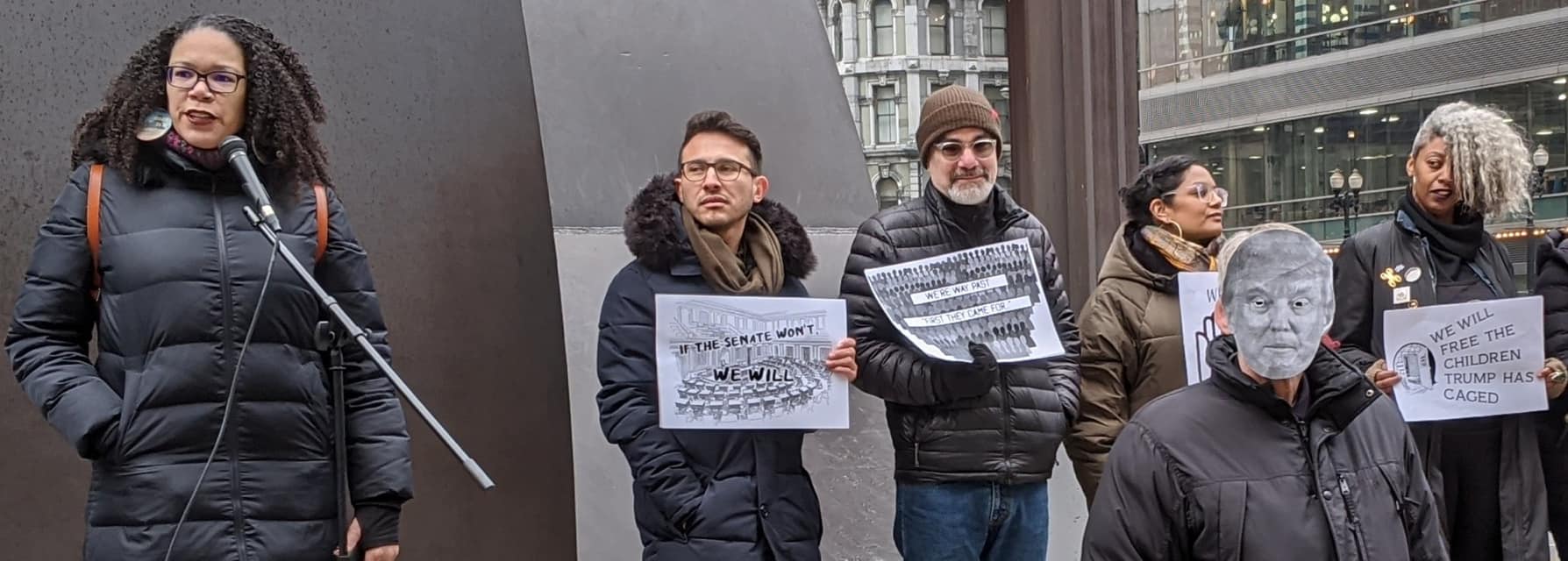
Here, below, is my testimony from “The People’s Removal Trial of Donald Trump” – a street theater-style event that took place yesterday at Daley Plaza in Chicago. It was organized as an alternative to the sham impeachment trial that will almost surely acquit Trump next week. At our trial, various community members testified about some of Trump’s worst crimes – his attacks on immigrants, Muslims, Jews, the disabled, the environment reproductive rights and his deadly neglect of Puerto Rico.

This was much more than an exercise in wish-fulfillment, however. It was a ultimately an opportunity to celebrate the world we we want to see, then redouble our pledge to fight for it – and for one another.  In the words of lead organizer Kelly Hayes, who spoke powerfully at the end of the event:

I want you to think for a moment about what it feels like — the difference between being held in place by your own strength, and how immovable we become when we are anchored to each other. Because to do the work ahead of us, we cannot simply be a crowd of concerned individuals. We will have to be a collective force.

Kelly’s words – and the other testimonies – can be found on the Facebook event page


If my grandmother were alive today, she’d probably say something like this:
Vi tsu derleb ikh Donald Trump shoyn tsu bagrobn.” (“I should outlive Donald Trump long enough to bury him.”)

Or maybe she’d say something like this:

“Gut zol oyf Donald Trump onshikn fin di tsen-makos di beste.” (“God should visit upon Donald Trump the best of the Ten Plagues.”)

I know for a fact that the overwhelming majority of American Jews would agree with my Bubbe. I’m honored to testify on their behalf today.

Why should Donald Trump be removed? We’ve already heard many compelling reasons – here’s one more: Donald Trump is an antisemitic pig whose words and deeds pose a clear and present danger to American Jews.

This became all too clear to us during the last election, when he publicly and openly spewed the most noxious antisemitic tropes. In a speech to the Republican Jewish Coalition, Trump said, “Is there anyone in this room who doesn’t renegotiate deals? Probably 99% of you. Probably more than any room I’ve ever spoken in” He also said: “Stupidly, you want to give money… But you’re not going to support me because I don’t want your money…You want to control your own politicians.”

Later in that campaign, he tweeted an image of Hillary Clinton’s face next to a pile of cash, a Star of David and the phrase, “Most Corrupt Candidate Ever!” He also released a TV ad suggesting prominent Jewish figures were part of a “global power structure” that has “robbed our working class” and “stripped our country of its wealth.” Folks shook their heads – did he really say what we thought he said? Yes, he did. Then we elected him president.

After his inauguration, Trump announced to the press that he was “the least antisemitic person you’ve ever seen in your life.” This while he surrounded himself in the White House with alt-right scum like Steve Bannon and Sebastian Gorka. This while he cynically trotted out his Jewish daughter and son in-law (aka “the ones who shall not be named”) and his advisor Stephen Miller (now officially tied with Henry Kissinger for the “Embarrassment to the Jewish People” Award.) “Just look at them,” says Trump, “How can I be an anti-Semite?” Well Donald, you’re an anti-Semite alright. And we see right through your Jewish human shields.

We accuse Donald Trump of incitement. On August 2017, the Nazis emboldened by Trump finally crawled out of the sewers and into the bright light of day. With their polo shirts and their tiki torches, they marched through the streets of Charlottesville chanting “Jews shall not replace us.” The next day, men in fatigues armed with semi-automatic weapons stood across from a synagogue during Shabbat morning services. Then a neo-Nazi pig drove his car into a crowd of counter-protesters, injuring several and killing Heather Heyer, of blessed memory. When the dust settled on Charlottesville, Trump uttered his immortal words of comfort: “You had a group on one side that was bad, and you had a group on the other side that was also very violent.”

We accuse Donald Trump of incitement. On October 2018, a neo-Nazi piece of shit entered the Tree of Life synagogue in Pittsburgh on Shabbat and gunned down Jewish worshippers. He killed eleven and wounded six. In his manifesto, he accused Jews of conspiring to flood the US with immigrants in order to cause a white genocide. His final words were “Screw your optics, I’m going in.” When asked for comment, Trump blamed the congregants for their own murder. “If they had some kind of protection inside the Temple,” he said, “maybe it could have been a very much different situation.”

We accuse Donald Trump of incitement. In the infamous August of 2019, another piece of Nazi scum entered a synagogue during the festival of Passover with an AR-15 and shot up the worshippers. One woman was killed and three were injured, including the synagogue’s rabbi, whose fingers were blown off. Trump later commented, “We will get to the bottom of it. We’re gonna get to the bottom of a lot of things going on in this country,”

We accuse Donald Trump of inciting antisemitism – and weaponizing it against Jews critical of Israel. That’s right: Trump inspires Jew-hatred, yet condemns the bad Jews who “don’t love Israel enough.” He encourages Nazis to kill us, yet scolds the bad Jews who condemn Israel’s ongoing human rights abuses. He embraces Christian Zionists who believe that Jews should be destroyed in Armageddon, yet criminalizes the bad Jews who stand in solidarity with Palestinians.

But we see through it all. Donald Trump is no friend of the Jewish people. And we will not stand for his cynical posturing. He must be removed.

I will end my testimony with the words from our comrade, Linda Sarsour, who offered these words to the American Jewish community following the Tree of Life massacre last year:

We stand in solidarity with our Jewish family, especially the community in Pittsburgh, after today’s horrific shooting at the Tree of Life Synagogue.

In the face of overwhelming hate, we choose unrelenting love and unity. We recommit ourselves to dismantling anti-Semitism and all forms of racism.

We call on everyone, especially elected officials and political leaders, to take a stand against anti-Semitism and make clear that it has no place in our society.

Donald Trump, you have proven to us that you are unwilling and unable to take a stand against racism and antisemitism in our society. On the contrary, you foment it for your own political gain. But we see you. We’re on to you. And we have now concluded: we will replace you.

On Hanukkah, Let’s Rededicate Our Commitment to Environmental Justice

2019_1222-hannukah-2400x1606

TOMERTU / SHUTTERSTOCK

Cross-posted with Truthout

The central story commemorated on Hanukkah comes from books 1 and 2 Maccabees, which tells of a small group of Jews in the land of Israel that fought to liberate their community from the increasingly oppressive reign of the Seleucid empire. Under Antiochus IV Epiphanes, the empire had imposed their Hellenistic culture upon the Jewish community; in 167 BCE, Antiochus intensified his campaign by defiling the temple in Jerusalem and banning Jewish practice. The Jewish band known as the Maccabees subsequently waged a three-year campaign that culminated in the cleaning and rededication of the temple and ultimately, the establishment of the second Jewish commonwealth.

The meaning of Hanukkah has historically been understood and interpreted in many different ways by Jewish communities throughout the centuries. For the rabbis of the Talmud, who sought to downplay the militarism and violence of the story, the holiday is emblematic of God’s miraculous power, symbolized famously by the Talmudic legend (quoted above) of a miraculous cruse of oil in the rededicated Temple that lasted for eight days. The Zionist movement and the state of Israel celebrate Hanukkah as a nationalist holiday, glorifying the Maccabees’ military struggle for political independence. In many nations throughout the Jewish diaspora, the festival is often understood as an expression of Jewish minority pride and a celebration of religious freedom.

More recently, some American Jewish religious leaders have been reinterpreting Hanukkah as a holiday of sacred environmental concern, framing the legend of the oil as a lesson about the importance of energy sustainability. Jewish environmental activist Rabbi Arthur Waskow, for instance, has proposed observing “Eight Days of Environmental Action” during Hanukkah, suggesting that the legend “is a reminder that if we have the courage to change our lifestyles to conserve energy, the miracle of our own creativity will sustain us.” The website of the Reform movement’s Religious Action Center (RAC) now devotes an entire section to “Green Resources for Hanukkah.” The Jewish environmental organization Hazon also offers extensive resources for the holiday, including “10 Ways to Make your Hanukkah More Sustainable.”

While these new approaches are certainly meaningful as far as they go, it is worth questioning why the environmental dimensions of Hanukkah must begin and end with green personal behaviors. Given that the festival celebrates a struggle for liberation, Hanukkah also offers us a powerful opportunity to highlight and celebrate the emergent global movement for environmental justice.

This connection is particularly relevant since this struggle is unfolding in critical ways in the land where the Hanukkah story actually took place. In fact, the state of Israel has a well-documented history of monopolizing and exploiting the natural resources of historic Palestine — all too often at the expense of the Palestinian people themselves. If we are truly serious about celebrating Hanukkah as a “green holiday,” we should also use these eight days to shine a light on the myriad environmental injustices being committed in Israel/Palestine — and further, to rededicate ourselves to the movement for environmental justice there and around the world.

“Green Colonialism” in Israel/Palestine

Environmentalism has always been central to the myth of Zionist pioneers who described themselves as having “greened the barren desert” of Palestine. Like many of my generation who came of age in American Jewish religious schools, I well remember being taught that helping the Jewish National Fund (JNF) plant pine trees in Israel was an act of almost sacred significance. Like generations of Hebrew school students before and after us, we were encouraged to regularly put coins in the iconic blue-and-white JNF collection boxes and were given certificates as gifts whenever a tree was planted in our honor or for a special occasion.

The reality beneath this mythos, however, reveals a much more problematic and troubling history. We didn’t learn the crucial colonial goal behind the JNF’s forestation policy throughout Palestine — that the widespread planting of pine groves and forests was instrumental in the dispossession of Palestinians. We certainly didn’t learn about Yosef Weitz, director of the JNF from 1932 to 1948, who was a primary architect of the Zionist policy of Palestinian Arab “transfer,” often advocating for this policy openly and unabashedly.

At a meeting of the Transfer Committee in 1937, for instance, Weitz stated:

The transfer of Arab population from the area of the Jewish state does not serve only one aim — to diminish the Arab population. It also serves a second, no less important, aim which is to advocate land presently held and cultivated by the Arabs and thus to release it for Jewish inhabitants.

It is now known that pine forests planted by the JNF were widely used as national and recreational parks to hide the remains of destroyed Palestinian villages and neighborhoods that were depopulated by force in 1948. According to scholars Ilan Pappé and Samer Jaber, “covering ethnic cleansing with pine trees is probably the most cynical method employed by Israel in its quest to take over as much of Palestine as possible with as few Palestinians in it as possible.” The Israeli organization Zochrot estimates that “more than two-thirds of [JNF] forests and sites — 46 out of 68 — conceal or are located on the ruins of Palestinian villages demolished by Israel.”

In a recent conference call sponsored by Jewish Voice for Peace (JVP), journalist/activist Naomi Klein referred to this practice as “green colonialism,” pointing out that “the use of conservation and tree planting and forest protection as a tool of settler colonialism is not unique to Israel” and that “the creation of state parks and national parks (in North America) are seen by Indigenous people in these settler colonial contexts in similar ways.” According to Klein, “there is a long and ongoing history of conservation … where the land is declared a park and the traditional inhabitants and users of the land are locked out.”

The cumulative environmental impact of nonindigenous pine trees throughout historic Palestine has been devasting. European pines, which were consciously planted to evoke the memory of the forests familiar to Zionist settlers, have largely failed to adapt to the local soil, requiring frequent replanting. As they have aged, non-native pines also have demanded more and more water, rendering them more vulnerable to disease. Moreover, falling pine needles have acidified the soil, inhibiting the growth of native species.

This practice, coupled with the steadily soaring temperatures in the region, has increasingly led to devastating forest fires such as the Carmel wildfire in 2010, estimated to be the worst in Israel’s history. Given its grievous environmental impact, the 2010 fire subsequently precipitated a widespread reassessment in Israel of early Zionist tree-planting policies. In 2011, Yisrael Tauber, director of forest management for the JNF, grudgingly admitted, “Planting is still important, but in many cases we have to make a kind of change in our consciousness.…We are now building sustainable forestry after these pioneering pines did a wonderful job for the first generation.”

Of course, given the rising threat of the global climate crisis, this admission arrives as too little, too late. Increasingly dangerous conflagrations are now a regular occurrence throughout Israel; this past summer, three simultaneous wildfires necessitated the evacuation of hundreds of residents across the country. This trend is particularly ominous given that this region is among the hardest hit by the climate crisis. At the UN Climate Conference in Madrid this month, the Israeli Ministry of Environmental Protection issued a report listing a number of devastating projections, including an expected rise in the risk of natural disasters.

“Water Apartheid” in the West Bank

The struggle over water resources is another important example of historic and ongoing climate injustice in Israel/Palestine. Israel has almost complete control over water sources in the region, a monopoly the human rights group Al-Haq refers to as “water apartheid.” According to Amnesty International, Palestinian consumption in the Occupied Palestinian Territories is about 70 liters a day per person (well below the 100 liters per capita daily recommended by the World Health Organization) whereas Israeli daily per capita consumption is about 300 liters. In some rural communities, Palestinians survive on 20 liters per day.

Those who visit the West Bank cannot help but be struck by the sight of Israeli settlements, with lush, well-watered lawns looming over Palestinian towns and villages surrounded by rocky soil and sparse vegetation. This is largely due to the fact that Israel uses more than 80 percent of the water from the Mountain Aquifer, the only source of underground water in the West Bank, as well as all of the surface water available from the Jordan River, which is completely denied to Palestinians.

As a result of this inequitable system, some 180,000 to 200,000 Palestinians in rural communities have no access to running water. In towns and villages which are connected to the water network, water rationing is common, many Palestinians have no choice but to purchase additional supplies from mobile water tankers which deliver water of often dubious quality at a much higher price. (The Mountain Aquifer, one of the most valuable natural resources in the region, is situated almost completely east of the Green Line, a key factor in Israel’s inexorable annexation of the West Bank.)

Over the years, Israel’s over-pumping of underground aquifers has lowered the groundwater table below sea level and caused saline water intrusion in many areas. The average flow of the Jordan River has been decreasing dramatically and has become so polluted by Israeli settlement and industry run-off that it was declared unsafe for baptism by Friends of the Earth Middle East in 2010 (known today as EcoPeace Middle East). The Dead Sea has shrunk into two separate and rapidly evaporating bodies of water, increasingly polluted by Israeli companies that pump out its salts for cosmetic products.

Environmental Injustice in Gaza

When it comes to Gaza, Israel’s crushing 12-year-old blockade has almost completely depleted the supply of drinkable water for the nearly 2,000,000 Palestinians who live in this small strip of land. Gaza’s only water resource, the Coastal Aquifer, is insufficient for the needs of the population, and Israel does not allow the transfer of water from the West Bank to Gaza. In the meantime, the aquifer has been steadily depleted and contaminated by over-extraction and by sewage and seawater infiltration, and 97 percent of its water has been contaminated and unfit for human consumption.

Stringent restrictions imposed in recent years by Israel on the entry into Gaza of material and equipment necessary for the development and repair of infrastructure have caused further deterioration of its water and sanitation situation. For the past several years, sewage has been flowing into the Mediterranean at a rate of 110 million liters a day. At present, 97 percent of Gaza’s freshwater is unsuitable for human consumption and only 10 percent of Gaza’s residents have access to safe drinking water.

However, as is invariably the case with issues of environmental injustice, what goes around comes around. This past June, EcoPeace Middle East reported that the collapsing environmental situation in Gaza was creating a “national security risk” to Israel, warning that “the collapsing water, sewage and electricity infrastructure in the Gaza Strip pose a material danger to (Israel).” In a particularly perverse example of victim-blaming, the Israeli military recently urged the World Health Organization to condemn the “ecological catastrophe” caused by the burning of tires by Palestinians on the border during the weekly Great March of Return protests.

In addition to water pollution, there have also been reports of rapidly increasing soil contamination due to Israel’s regular military assaults on Gaza. According to a report by the New Weapons Research Group, Israeli bombings in Gaza Strip have left a high concentration of toxic metals, such as tungsten, mercury, molybdenum, cadmium and cobalt in the soil. These metals can cause tumors and problems with fertility, and they can have serious and harmful effects on newly born babies.

Hanukkah and Global Climate Justice

What does this current environmental reality bode for the future of the Jewish state? British journalist Robert Cohen powerfully concludes that the climate crisis, coupled with Israel’s steady over-exploitation of resources, has functionally rendered Zionism “obsolete.”

“How,” writes Cohen, “can Israel present itself as a Jewish safe haven from a hostile world when its water security is at high risk, crop yields will soon be falling and fires will be raging all year round…? When it comes to climate change, national borders will offer no protection from antisemitism. Climate has no interest in faith or ethnicity or in historical or religious claims to a particular piece of land.”

Cohen’s point can certainly be applied to the world at large. The climate crisis clearly knows no borders. But while no one will ultimately be safe from its devastating effects, we can be sure that the more powerful will increasingly seek to safeguard themselves and their interests at all costs at the expense of the less powerful. Such is the harsh reality of “green colonialism”: as the climate crisis renders more and more of the world uninhabitable, we are clearly witnessing increased state efforts at border militarization, population control and the warehousing of humanity.

What then, is to be done? In a recent op-ed for The Nation, journalist Ben Ehrenreich offered this compelling prescription: “it is time to shout, and loudly, that the freedom of all the earth’s people to move across borders must be at the center of any response to the climate crisis.… If we are to survive as a species, we must know that no boat can save us except the one we build together.” In her JVP presentation, Naomi Klein echoed this challenge in similarly powerful terms:

What is clear is that the space for humanity to live well is contracting…. So, the core question is what kind of people are we going to be as we live in greater density? And if we look to Israel/Palestine, we see a really terrifying example of how to lose your humanity and how to fail to share land — and the monstrousness it requires to fail to share….

This is a global process that is happening now … so we’re going to have to start practicing solidarity and mutual aid. And we’re going to have to practice love and show each other what love looks like in public more and more. Because a lot of people have lost faith that they can do it.

There can be no better Hanukkah message for the 21st century. Given the realities of our current age, the nationalist dimensions of the holiday are not merely irrelevant, but dangerous. In the words of poet/liturgist Aurora Levins Morales, “this time it’s all of us or none.” If Hanukkah is to be a true celebration of environmental justice, it must become a “rededication” to fight for a more universal vision of liberation, for a world of solidarity, mutual aid and open borders.

Or to put it another way, the Maccabees’ struggle must now be broadened to represent the universal struggle of all who are committed to showing what love looks like in public, for the sake of all humanity. For the age of global climate crisis, the stakes could not be higher.

On Trump’s Executive Order, BDS and the Real Threat of Antisemitism

Donald Trump, Melania Trump

photo credit: AP/Manuel Balce Ceneta

It’s certainly been a strange and surreal week for the American Jewish community. As is all too painfully well known by now, this past Tuesday, the New York Times reported that Donald Trump would sign an Executive Order that would “interpret Judaism as a race or nationality” to prompt a federal law penalizing colleges and universities that failed to protect Jewish students from the threat of BDS activism. This news caused an almost immediate upheaval, with vociferous protest emanating from a wide swath of the Jewish community concerned that this order could easily enable the antisemitic canard of Jewish “dual loyalties.”

While I certainly shared the outrage upon hearing this news, I harbored a deeper concern that I shared on my congregation‘s Facebook group page:  i.e., that the Jewish community was making this issue exclusively about us, ignoring the fact that Trump’s order was ultimately aimed at silencing Palestinians and those who stand in solidarity with them. “As ever,” I wrote:

I would suggest the most important response we can make to this latest cynical maneuver is to redouble our solidarity with the Palestinian people and to rededicate our support of the BDS movement – not merely for the sake of “free speech” but for a free Palestine. We must recommit ourselves to the central goals of the BDS call from Palestinian civil society itself: for a land where all who live between the river and the sea are full and equal citizens.

As it turned out, the New York Times report turned out to be false. The actual text of the Executive Order, which Trump signed at a bizarre White House Hanukkah reception, did not explicitly define Jews as a nationality (though it did rely on Title VI of the Civil Rights Act, which “prohibits discrimination on the basis of race, color and national origin” but not religion). Upon hearing this news, many in the Jewish community seemed to breathe a sigh of relief. Others dismissed the order itself, saying it was just a reaffirmation of the Obama administration’s policy and that “it wouldn’t change much at all.”

Whatever else this might mean, we certainly shouldn’t downplay the threat posed by this cynical Executive Order, which essentially puts into law what Israel advocates and their allies in Congress were unable to do with the stalled, ill-fated “Antisemitism Awareness Act.” Going forward, agencies and departments charged with enforcing Title VI can now “consider” using the International Holocaust Remembrance Alliance’s (IHRA) definition of antisemitism, which was never intended to be used to be enforce standards on college campuses.

There are a myriad of problems with the IHRA definition. In one oft-quoted line, for instance, it prohibits “applying double standards by requiring of it a behavior not expected or demanded of any other democratic nation.” However, as journalist Paul Waldman recently pointed out in the Washington Post, while “someone might apply double standards to Israel out of antisemitism, the idea that doing so is inherently antisemitic is preposterous. We can decry double standards, but people use them all the time in policy debates without being defined as bigoted.” Moreover, Waldman wrote, “‘saying criticism of Israel similar to that leveled against any other country’ is not antisemitic would mean criticisms of Israel would have to meet a higher standard than criticism of other countries or else they’re antisemitic.”

Additionally, the IHRA definition deems it antisemitic to “deny the Jewish people their right to self-determination.” This is a muddy and subjective standard that comes dangerously close to making the fallacious claim that anti-Zionism is synonymous with antisemitism. In fact, there are many different definitions of self-determination other than political nation-statism.  It could well be argued (as I have on several occasions) that the Jewish people have no more inherent “right” to create a political nation state in a specific piece of land than any other people might have – and it is certainly not antisemitic to say so. On the other hand, it would be immensely antisemitic to suggest that Jews do not have a right to self-determination as minority communities of the nations in which they live.

I certainly realize that how events of this past week may have conjured up the the deepest fears of American Jews. And I know full well that we cannot and must not be sanguine about the threat of resurgent antisemitism. But I would also suggest that is critically important that we remember where this threat is actually coming from – and where it is not. Indeed, it is critical to note that while the American Jewish community was tying itself up in knots around the issue of the so-called “antisemitic threat” of BDS on college campuses, four people, including two Jews, were killed in a kosher market in Jersey City, an incident the police is now investigating as a hate crime.

In an age where Jews are being regularly targeted and murdered by extremists, it is not only disingenuous of our government to spend so much time, energy and resources on combatting BDS – a nonviolent movement rooted in human rights for all – it is downright dangerous. It is time to stand down the false and pernicious equation of antisemitism coming from both the “right and the left.” We know full well where the most dangerous and deadly antisemitism is truly coming from – and we need to make this clear to the world in no uncertain terms.

In the end, I believe the most telling commentary on the events of this past week came in an op-ed by Kenneth Stern, one of the authors of the definition of antisemitism used in Trump’s Executive Order. I’ll let him have the last word:

Rather than champion the chilling of expressions that pro-Israel Jews find disturbing, or give the mildest criticism (if any) of a president who repeatedly uses antisemitic tropes, why weren’t those Jewish officials who were present when Trump signed the executive order reminding him that last year, when he demonized immigrants and called them “invaders”, Robert Bowers walked into a Pittsburgh synagogue because he believed Jews were behind this “invasion” of brown people as part of a plot to harm white people, and killed 11 of us?

White Supremacy is Coming For All of Us

safe_image

(Crossposted with Newsweek)

If ever there was a moment of clarity for us, it’s now.

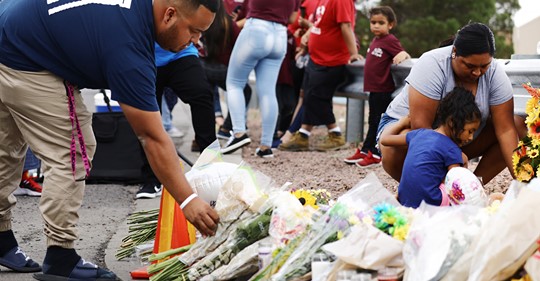
As we witness and grieve the carnage of two back-to-back mass shootings, we cannot afford to ignore the clear signs that the ascendance of white supremacy in our nation is all too real. 2018 saw a national increase in hate crimes, with nearly all extremist homicides carried out by the far right. Last May, the head of the FBI’s counter-terrorism unit, Michael McGarrity, testified to Congress that the bureau was investigating about 850 cases of domestic terrorism. Read this again: 850. We know conclusively that white nationalist extremists have killed more people in the United States than any other category of domestic extremists since September 11, 2001.

Many of these crimes might seem different on the surface: When a white supremacist killed nine Bible study students at Mother Emanuel Church in Charleston, SC, the victims were African-American; when eleven worshippers were gunned down by a white supremacist at the Tree of Life Synagogue in Pittsburgh, the targets were Jews; the white supremacist who killed 20 at an El Paso mall last Saturday was gunning for Latinix immigrants, according to his manifesto. And within 24 hours another mass shooting occurred in Ohio, the motivation of which is still unclear as of this writing.

We can’t deny the influence of one massacre on another. One empowered white male with guns is invariably followed by another. Indeed, the manifesto attributed to the El Paso gunman is clearly inspired by the New Zealand shooter’s manifesto, which promoted a white supremacist theory called “the great replacement”—an ideology that claims elites in Europe have been working to replace white Europeans with immigrants from the Middle East and North Africa. This is akin to the “white genocide” theory affirmed by the Pittsburgh shooter.

The needs of this moment could not be clearer. The time has come for a structural intervention. We should rightly expect every branch of government to take clear and unmistakable actions to halt the growth of white supremacy in our nation. We must demand of every politician, every media figure, every pundit and faith leader to name and call out this toxic racism wherever it may come from, including—especially—when it comes from the White House.

It can no longer be up for debate whether or not our president is emboldening this rise in white supremacy and the increase in mass shootings. He is. There is no way to question this in good faith. The same person who inspired a crowd to chant “send her back” to Somalian-American Representative Ilhan Omar, the same person whose tweets are increasingly racist, the same person who welcomes white supremacists to the White House, is more than a part—a huge part—of the problem. He is the catalyst to much of this violence.

But this is also a time of action—a time to stand up and reach out to those who are being targeted. And those of us who are members of these targeted minorities must stand in common cause and solidarity with one another. For instance, as a Jew, I cannot begin to say how heartened and supported I felt when, in the wake of the Pittsburgh synagogue shooting, I learned that the Muslim American community responded immediately by raising hundreds of thousands of dollars to support the families of the victims.

I am likewise proud of the work of Never Again Action, a new Jewish network working with local allies around the country to organize actions of civil disobedience at ICE detention centers. History will judge how we responded in this time, and we are now well past the wake-up call. We must prioritize the fight against white supremacy in this country and beyond.

This weekend will mark the Jewish observance of Tisha B’Av (the “ninth of the month of Av”)—a fast day that mourns the tragedies that have befallen the Jewish people, symbolized by the destruction of the ancient Temple in Jerusalem. One of the central lessons of this day is that the Temple was not destroyed by any external enemy, but by the sinat chinam—“baseless hatred”that ultimately destroyed the Jewish community from within.

This Tisha B’Av, I am all too aware of the toxic sinat chinam of white supremacy that is so clearly on the rise, corroding our nation and our global community. At the same time, I cannot but redouble my commitment to the growing diverse social justice movement in all its forms, welcoming and uniting our struggles, mourning our loses and striving to protect one another, over and over again.

During this horrible, clarifying moment, I take heart in the sacred power of solidarity.

Playing Politics with Human Rights: Thoughts on the Recent Anti-BDS House Bill

651A9984

photo: Mohammed Asad/Middle East Monitor

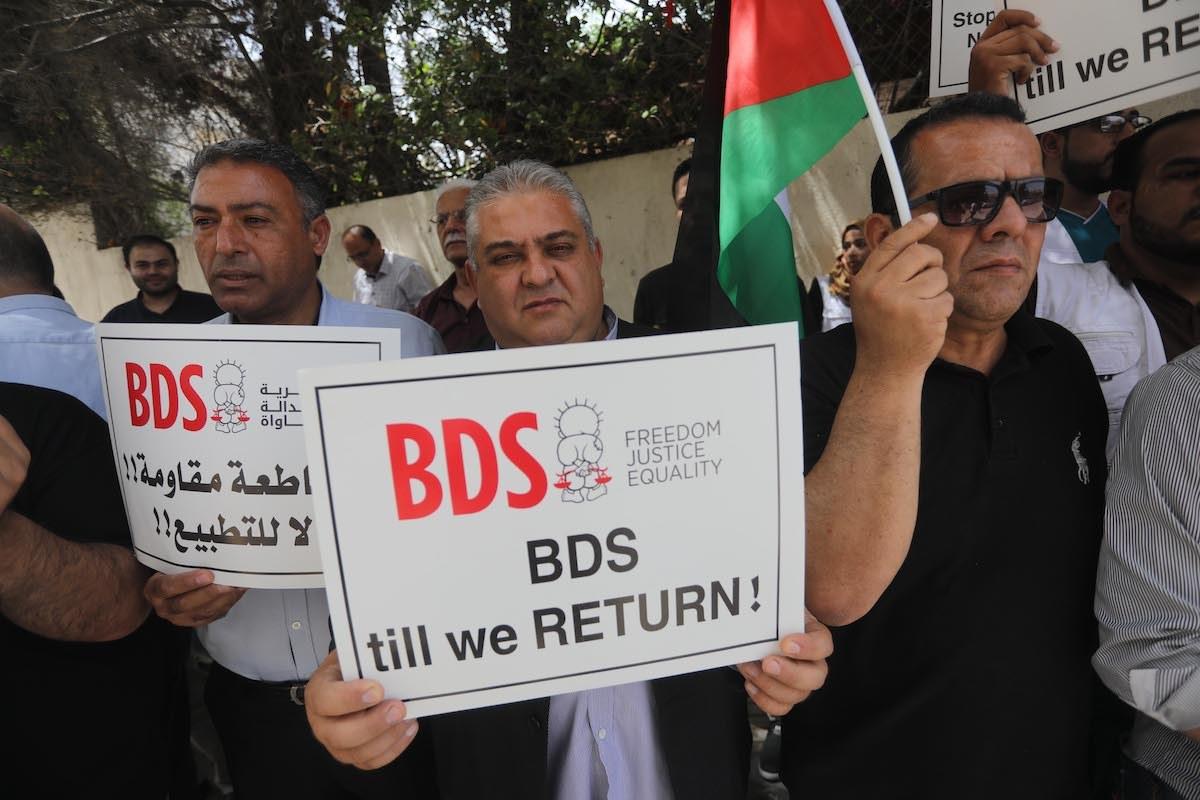
Last Tuesday, the House voted overwhelmingly to pass an anti-BDS bill with the strong support of progressive democrats (including “squad” member Ayanna Pressley). I know there are many who are asking how and why did this happen? As I see it, the answer, as always, is pure politics.

Just a bit of history: the genesis of the bill known as H. Res. 246 dates back to the AIPAC convention last March, when a number of liberal Jewish groups, including  J Street, Ameinu, National Council of Jewish Women, Partners for Progressive Israel and Reconstructing Judaism (my own denomination), met informally to give their preliminary approval to this prospective bill. As they saw it, this was a strategic move. The bill was designed to give cover to liberal Democrats who had previously voted against anti-constitutional bills that virtually criminalized BDS. This new bill would allow them to vote on the record for a non-binding bill that criticized BDS without curtailing freedom of speech or labeling it as antisemitic. It would also give Democrats aligned with liberal Zionist groups the opportunity to reaffirm their support for the two state solution.

Like I said, pure politics.

Still, no matter how much liberal Democrats might rationalize their support for H. Res. 246, (Rep. Pressley explained on Twitter that her vote affirmed to her “constituents raised in the Jewish faith Israel’s right to exist”) no amount of explaining can wash away the fact that this resolution is a cynical political move that unfairly and incorrectly attacks a genuinely non-violent movement for human rights – and will do little to advance the cause of real justice in Israel/Palestine.

Just a few responses to the actual text of the resolution:

• While the resolution mentions “rising anti-Semitism,” it is completely silent on anti-Palestinian oppression and the threat of Islamophobia. Even the simple term “occupation” is nowhere to be found.

• The resolution claims that the BDS “seeks to exclude the State of Israel and the Israeli people from the economic, cultural, and academic life of the rest of the world.” In fact, this is not the goal of BDS; the very suggestion reduces the entire movement to an essentially nefarious aim. Rather, the Palestinian civil society call for BDS advocates for non-violent economic activism as a tactic toward three rights-based goals: an end to the occupation, equal rights for Palestinian citizens of Israel, and a recognition of the right of return for Palestinian refugees.

• The resolution claims that BDS “undermines the possibility for a negotiated solution to the Israeli-Palestinian conflict by demanding concessions of one party alone and encouraging the Palestinians to reject negotiations.” The three goals of BDS above are not “concessions” – they are basic rights enshrined in international law that have been patently ignored or denied in previous negotiations. There is nothing in the BDS call that “rejects negotiations.”

• The resolution quotes BDS leader Omar Barghouti (who addressed Tzedek Chicago on the eve of Passover this year) thus: “We oppose a Jewish state in any part of Palestine. No Palestinian, rational Palestinian, not a sell-out Palestinian, will ever accept a Jewish state in Palestine.” While this quote is genuine, it crucially omits the first part of his statement: “A Jewish state cannot but contravene the basic rights of the land’s indigenous Palestinian population and perpetuate a system of racial discrimination that ought to be opposed categorically, as we would opposed a Muslim state or a Christian state or any kind of exclusionary state…”

Here, Barghouti calls into question whether an exclusively Jewish state – as opposed to one state of all its citizens – can ever be truly democratic. This is an important question that deserves genuine consideration and debate. This egregiously truncated quote, however, only serves to imply Barghouti and the BDS movement seeks nothing more than the “destruction of the Jewish state.”

• The resolution states that the BDS movement ” targets … individual Israeli citizens of all political persuasions, religions, and ethnicities, and in some cases even Jews of other nationalities who support Israel.” This is a false and spurious accusation that the resolution offers with no evidence whatsoever. The targets of BDS campaigns have always been institutions, not individuals. (The government of Israel and Israel advocacy organizations, however, routinely target individuals with blacklisting websites such as Canary Mission and by barring entry of Palestine solidarity activists into the country.)

• The resolution states “BDS does not recognize the right of the Jewish people to self-determination.” There is no universal consensus that self-determination for any group of people must ipso facto mean the establishment of an independent nation state on a particular piece of land. Self-determination goes by many definitions and takes many forms. There are millions of Jews around the world who are happy to enjoy individual self determination in the nations in which they live. (It’s also worth noting that the Israeli government recently passed a law declaring that only Jews have a right to self-determination in Israel.)

• The resolution states that BDS “leads to the intimidation and harassment of Jewish students and others who support Israel.” Here again, the resolution is putting out a damaging claim without offering any evidence whatsoever. What can be stated however, is that however uncomfortable some Jewish students may be made to feel by pro-divestment campaigns on their campuses, pro-Israel activist students enjoy significant support from college and university administrations. By contrast, Palestine solidarity activists (including many Jewish students) experience routine suppression of their freedom of speech. Palestine Legal reports that “seventy-six percent of the incidents Palestine Legal responded to in 2018 were campus related” and that they “responded to 51 administrative complaints against Palestine activists, double the number from 2017.”

• The resolution states “in contrast to protest movements that have sought racial justice and social change, the Global Boycott, Divestment and Sanctions Movement targeting Israel is not about promoting coexistence, civil rights, and political reconciliation but about questioning and undermining the very legitimacy of the country and its people.” To this, I can only say, see bullet point #2 above. In fact, the BDS call is actually very much akin to “protest movements that have sought racial justice and social change.” Nowhere does it “delegitimize” the state of Israel. Anyone who take the time to read the actual call will see it focuses exclusively on the basic, essential rights that Israel routinely denies Palestinians.

To this final point, it was quite sobering to contemplate that on the very day that the House voted to condemn a nonviolent Palestinian call for human rights, House members were notably silent in response to Israel’s massive demolition of homes in East Jerusalem that took place at the very same moment.

In the end, despite the cynical politics behind this particular bill, I cannot personally view this as merely a political issue alone. As a Jew and a person of faith, I view the BDS call as nothing short of a religious imperative. I said as much in an address I was honored to deliver at the American Academy of Religion two years ago:

I realize there may be some in this room who cannot bear to hear me say these words, but I – and increasing numbers of people around the world – believe them to be true, no matter how painful it feels to hear them. Israel is oppressing Palestinians. And when a people are oppressed, they will inevitably resist their oppression – yes sometimes violently.

In this case, however, a nonviolent call for popular resistance has been placed before us. Thus, for those of us that believe God hears the cry of the oppressed and demands that we do the same, the BDS call represents a direct challenge to our faith. Will we be like God, and hearken to their cries, or will we be like Pharaoh and ignore them?

As a Jew, as an American, as a person of conscience, I would suggest this call presents us with nothing less than the most consequential spiritual challenge of our time.

Blessed are the ones who hearken to the cry of the oppressed.

On Alice Walker and Antisemitism

American Masters - Alice Walker: Beauty in Truth

The Jewish interwebs have been abuzz regarding Yair Rosenberg’s December 17 Tablet article in which he criticized the New York Times Book Review for its interview with Alice Walker. In last Sunday’s “By the Book” column, the Times asked Walker what books she had on her nightstand; among those she cited was a book by British antisemitic conspiracy theorist David Icke entitled, “And the Truth Shall Set You Free.” Walker commented, “In (his) books there is the whole of existence, on this planet and several others, to think about. A curious person’s dream come true.”

In his article, Rosenberg listed a litany of odious excerpts from Icke’s book, including his praise of “The Protocols of the Elders of Zion,” his claims that the B’nai B’rith was behind the slave trade and his belief that the Rothschilds bankrolled Adolf Hitler. He also offered a long list of the numerous times Walker has endorsed Ickes’ ideas, including her posting of his video interview (now blocked by YouTube) with Infowars’ Alex Jones, of which she wrote:

I like these two because they’re real, and sometimes Alex Jones is a bit crazy; many Aquarians are. Icke only appears crazy to people who don’t appreciate the stubbornness required when one is called to a duty it is impossible to evade.

Rosenberg also posted in full, a deeply disturbing poem written by Walker in 2017 entitled “It is Our (Frightful) Duty to Study the Talmud.” This excerpt should give you a good idea about the tone and substance of Walker’s piece:

For a more in depth study
I recommend starting with YouTube. Simply follow the trail of “The
Talmud” as its poison belatedly winds its way
Into our collective consciousness.

I will sadly confess that I was unaware of Alice Walker’s history of antisemitic attitudes, even though this was apparently common knowledge among many on the left. During the Twitter eruption that followed Rosenberg’s piece for instance, Roxane Gay commented:

IMG_5155

Those of us who were hearing of Walker’s antisemitic proclivities for the first time were particularly saddened to learn that this eloquent champion of anti-racism had been expressing such poisonous ideas toward Jews and Judaism. Journalist/filmmaker Rebecca Pierce spoke for many of us when she tweeted this response:

IMG_5152

In his article, Rosenberg made mention of Walker’s anti-Israel politics, challenging “the progressive left” to call out antisemitism that is “presented in the righteous guise of ‘anti-Zionism.’” Although I don’t share Rosenberg’s conservative Israel politics, I accept his challenge. And yes, it’s painfully true that Walker’s Talmud poem egregiously cites Jewish religious tradition as the root cause of Israel’s oppression of Palestinians (as well as American police brutality, mass incarceration and “war in general”):

For the study of Israel, of Gaza, of Palestine,
Of the bombed out cities of the Middle East,
Of the creeping Palestination
Of our police, streets, and prisons
In America,
Of war in general,
It is our duty, I believe, to study The Talmud.
It is within this book that,
I believe, we will find answers
To some of the questions
That most perplex us.

Walker’s claim that the Talmud is “evil” and “poisonous” – a common antisemitic trope – is worth unpacking here. First of all, what is referred to as “The Talmud” is actually a vast corpus of Jewish civil and ritual law mixed with freewheeling legend and Biblical commentary composed between 200 and 500 CE. Though it is one of Jewish tradition’s foundational texts, Talmudic literature is not, to put it mildly, immediately accessible to the untrained reader. It’s typically studied by traditional Jews in the rarified world of schools known as yeshivot, where students’ primary focus is on the unique pedagogy of Talmudic argumentation.

Like all forms of religious literature, Talmudic tradition expresses a wide spectrum of ideas and attitudes. The contemporary reader would likely find its content to be alternately inscrutable, inspiring, challenging, archaic – and yes, at times even repugnant. It contains passages for example, that are profoundly misogynistic. And as Walker pointed out in her poem, it also contains occasional material that is decidedly anti-Gentile, including a notorious passage that depicts Jesus condemned to suffer in hell in a vat of burning excrement. (Yep, it’s true.) There are also texts that unabashedly claim Jewish lives must take precedence over non-Jewish lives – an idea that was also advocated centuries later by Moses Maimonides.

These texts are undeniably, inexcusably offensive and they must be called out, full stop. At the same time however, it is exceedingly disingenuous to judge a religion on the basis of its most problematic pronouncements. This attitude simplistically accepts these texts at face value, devoid of any context or historical background. It also ignores the fact that almost all faith traditions address the offensive, archaic or inconsistent elements in their sacred literature through the use of hermeneutics – that is, principles and methods that help readers understand their meaning in ever-changing societal contexts.

How for instance, might a contemporary religious feminist read and understand a blatantly misogynist Talmudic text? In an article entitled “When Sages are Wrong: Misogyny in Talmud,” Dr, Ruhama Weiss, of Hebrew Union College offers one hermeneutical approach:

(These Talmudic traditions) caused me a powerful disturbance. They forced me to think and react; to think about mechanisms of power and control and about the ability to be free from them. To make an effort to find and highlight additional voices, earlier voices, buried and hidden in misogynist rabbinic discussions.

Most importantly, these difficult sources teach me a lesson in modesty; from them I learn that unequally talented and wise people with good intentions can bequeath to subsequent generations difficult and bad traditions. I see the moral blind spots of my ancestors, and I am obligated to examine my own moral blind spots. Bad and disturbing sources make me think.

Indeed, this same hermeneutic method can be applied to Talmud’s xenophobic, anti-Gentile content as well. That is to say, these texts can challenge us to see “the moral blind spots of our ancestors and thus to examine our own moral blind spots.” They can help us confront “mechanisms of power and control” and contemplate the ways we might be able to “free ourselves of them.” These bad and disturbing sources can “make us think.”

Of course there are those who will read the texts of their faith through a more literal, fundamentalist hermeneutic. In such cases, it is up to those who cherish their religious tradition and the value of human rights for all to challenge such interpretations, particularly when the lines between church and state power become increasingly blurred.

On the subject of state power, I must add that I find it exceedingly problematic when folks criticize Talmudic tradition for its xenophobic attitudes without acknowledging the fundamentally anti-Jewish attitudes that are embedded deep within Christian religious tradition. It’s also important to note that antisemitic church teachings were historically used to inspire centuries of anti-Jewish persecution throughout Christian Europe, while the Talmud was written and compiled in a context of Jewish political powerlessness.

Today, in this relatively new era of Jewish power, it is certainly important to remain vigilant over the ways Jewish tradition is used to justify the oppression of Palestinians. Indeed, since the establishment of the State of Israel, this subject has been intensely debated throughout Israel and the Jewish Diaspora. As I write these words in fact, I’m recalling a blog post I wrote back in 2009 about then Chief Rabbi of the Israeli Defense Forces Avichai Rontzki, who made a comment, based on Jewish religious texts, that soldiers who “show mercy” toward the enemy in wartime will be “damned”:

How will we, as Jews, respond to the potential growth of Jewish Holy War ideology within the ranks of the Israeli military?  How do we  feel about Israeli military generals holding forth on the religious laws of warfare? Most Americans would likely agree that in general, mixing religion and war is a profoundly perilous endeavor.  Should we really be so surprised that things are now coming to this?

I do not ask these questions out of a desire to be inflammatory. I ask them only because I believe we need to discuss them honestly and openly – and because these kinds of painful questions have for too long been dismissed and marginalized by the “mainstream” Jewish establishment.

In the end, every faith tradition has its good, bad and ugly. And in the end, I would submit that the proper way to confront these toxic texts is for people of faith to own the all of their religious heritage – and to grapple with it seriously, honestly and openly. And while we’re at it, it’s generally a good rule of thumb to avoid using the bad, ugly stuff in any religion’s textual tradition to make sweeping historical or political claims about that religion and/or the folks who adhere to it.

What is not at all helpful is for people such as Alice Walker to cherry-pick and decontextualize quotes from one particular religious tradition and warn that its “poison” is “winding its way into our collective consciousness.”

Like many of my friends who are just now learning about her adherence to antisemitic tropes, I fervently hope she will come to understand, as Rebecca Pierce put it, that the attitudes she endorses “are part of the same white supremacist power structure she so deftly fought through her written work in the past.”