Category Archives: Anti-Semitism

“Zionism Unsettled” – A Smart and Gutsy New Church Study Guide

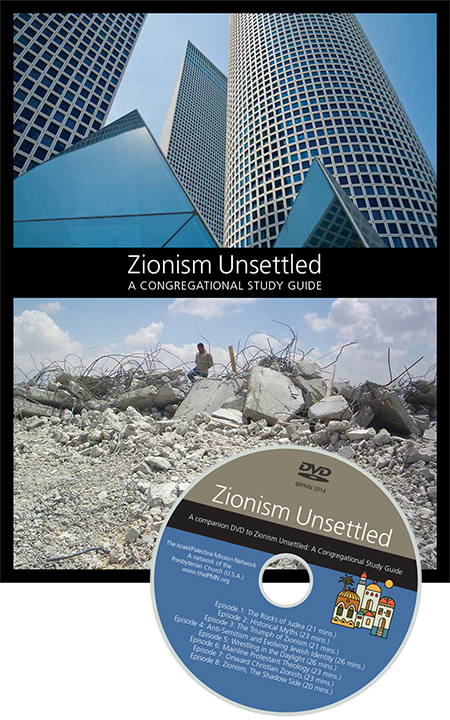
ZU-cover_DVDSo great to receive my copy of “Zionism: Unsettled” – an exciting new church study guide published by the Israel/Palestine Network of the Presbyterian Church (USA). As someone who has been collaborating with Protestant church denominations on the issue of Israel/Palestine for a number of years now, I can say without hesitation that this is a much-needed resource: smart and gutsy and immensely important.

“Zionism Unsettled” is based on the upcoming anthology, “Zionism and the Quest for Justice in the Holy Land,” to be published this summer by Wipf and Stock. While the anthology will be fairly academic in tone, “Zionism Unsettled” has digested its contents into a book and DVD for use by laypeople in congregational study settings. I’m thrilled that the IPMN has made this resource available to reach a much wider audience. (It was my honor to contribute an essay to that book, which has been adapted for a chapter in this study guide.)

ZU unsparingly examines Jewish and Christian forms of Zionism – with special attention to the way they have historically provided theological and ideological “cover” for the the dispossession of the Palestinian people. It’s a critical emphasis; indeed while there are no lack of political analyses on this subject, far less attention has been paid to the ways in which religious ideology has shaped the political context in Israel/Palestine.

This guide fills that void powerfully with careful, impressively researched chapters on the history of political Zionism as well as examinations of evangelical and mainline Protestant Zionism. My own chapter, “A Jewish Theology of Liberation” proposes a Jewish alternative to land-based nationalism – namely, a Judaism based in values of universal values of justice and dignity for all who live in the land.

As a Jew, I’m especially appreciative that while ZU is strongly critical of Zionism, it doesn’t flinch from extensive Christian self-criticism. The guide is particularly candid in its examination of the oppressive legacy of the post-Constantinan Church, replacement theology – and Christian anti-Semitism in general. In fact, throughout the guide there is a strong and palpable critique of exceptionalism of all stripes. In the end, the most basic criticism of “Zionism Unsettled” is leveled against triumphalist claims of every empire that has conquered and colonized this land throughout the centuries:

Exceptionalism is not unique to Zionism; rather it is present whenever exceptionalist religious ideology is fused with political power. Christian exceptionalist beliefs and actions contributed to the Nazi Holocaust, the genocide of Native Americans, and countless other instances of tragic brutality. Exceptionalist doctrines and behaviors within Islam have contributed to grievous human rights abuses such as the massacres during the closing days of the Ottoman Empire which crescendoed with the Armenian genocide in 1915.

I will say I do not personally agree with everything in this guide. In particular I’m at all comfortable with the theological analysis of Dr. Gary Burge, who rightly criticizes Christian replacement theology (the belief that the Jewish covenant with God has been “replaced” by the new covenant in Christ), yet seems to reaffirm it when he suggests a concept of a “’suspended blessing’ that will be restored at the end of history when ‘all Israel will be saved’”(p. 47).  It’s not at all clear to me how this conception differs fundamentally from the Christian “one covenant” theology he purports to disavow.

I was also disappointed by the chapter entitled “A Palestinian Muslim Experience with Zionism,” which does not at all apply kind of critical pedagogy to Islam that characterizes the chapters on Christianity and Judaism. While this chapter rightly spotlights “the inclusive theology of the Qur’an,” it fails to explore the exceptionalist manifestations of Islam in the same unsparing manner that pervades the rests of the book. As a result, this chapter feels to me somewhat tacked-on and represents a bit of a missed opportunity.

Despite my issues with “Zionism Unsettled,” however, I nonetheless find it to be a courageous work that has the potential to be a genuine game changer in interfaith conversations over Israel/Palestine. While I have no doubt it will be enormously controversial in many liberal religious circles, I believe it is an essential resource that boldly reframes the terms of interfaith encounter in ways that are long overdue.

I deeply admire its bravery and look forward to the conversations it will most certainly inspire.
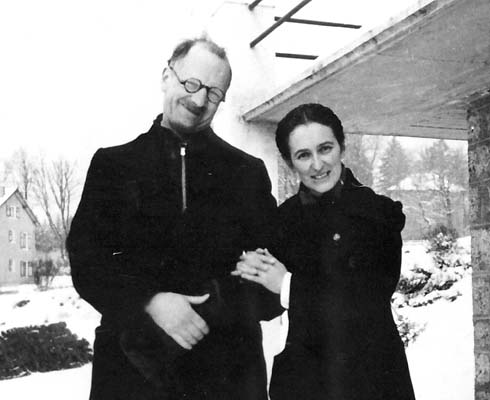
For Yom Hashoah: A Tribute to Pacifist Heroes André and Magda Trocmé

Andre Trocme

In honor of Yom Hashoah, please read about the sacred work of Pastor André and Magda Trocmé, the courageous pacifist Christians who saved 3,000-5,000 Jews from certain death in South Central France. May their memory be for a blessing.

The biography below is reposted from the Swarthmore College Peace Collection:

André and Magda Trocmé are perhaps best known for their work in the small French town of Le Chambon-sur-Lignon where, during World War II, they inspired the villagers to help protect and sometimes to assist in the escape of Jews and other poltiical refugees. This quiet and courageous assistance was given without resorting to violence. Historians estimate that about 3,500 Jews were harbored in the area in and around Le Chambon.

André Trocmé (1901-1971) was born in St. Quentin in the north of France to Huguenot parents. After seminary in Paris and graduate work at Union Theological Seminary in New York, he was ordained into the French Reformed Church and served for eight years among the coal miners and steel workers of Maubeuge and Sin-le-Noble, two small towns in the north of France. He preached nonviolence at a time when such views were unpopular in France. In 1934 André Trocmé accepted a call to be pastor in the remote Huguenot village of Le Chambon-sur-Lignon on the Plateau Vivarais-Lignon in South Central France. These parishioners were more sympathetic to his views on nonviolence.

Magda Trocmé (1901-1996) was born in Italy to an Italian father and a Russian mother. She graduated from the University of Florence with a degree in literature and earned further degrees in French. She and André Trocmé met in the United States while she was attending the New York School of Social Work, and they were married in 1926. The couple had four children, Nelly, Jean-Pierre, Jacques, and Daniel.

In 1938, André Trocmé, and his pacifist colleague Édouard Theis, founded L’Ecole Nouvelle Cévenol in Le Chambon, a Protestant, co-educational secondary school. In addition to the usual French secondary school curriculum, tolerance, honesty, and nonviolence were taught as well. L’Ecole Nouvelle Cévenole soon gained an international focus, and after World War II the name of the school was changed to Collège Cévenol. Magda Trocmé taught Italian at this school which is still in operation today.

During the first part of World War II Le Chambon was located in the “free”( unoccupied) zone of France. By 1942 the Germans had occupied the entire country. However, the population of the Plateau Vivarais-Lignon continued to aid an increasing number of refugees. In 1943, André Trocmé, Édouard Theis, and the head of the public school, Roger Darcissac were interned in a camp by the Vichy police. These men were arrested for their part in assisting the refugees of the area. Trocmé, Theis, and Darcissac were released from prison after one month, but Trocmé and Theis went into hiding for the next ten months.

In the late 1940s André and Magda Trocmé traveled as European Secretaries for the International Fellowship of Reconciliation (IFOR). After their move to Versailles (France) in 1950, the Trocmé’s founded La Maison de la Réconciliation. The Maison de la Reconciliation became an international peace center and the headquarters of the French and Continental Secretariat of the IFOR. During travels in the United States, under IFOR auspices, André Trocmé delivered the Robert Treat Paine lectures which became the basis for his book The Politics of Repentance, published in 1953. During the strife between France and Algeria, André Trocmé helped start Eirene (International Service for Peace), located in Morocco, which provided alternative service for conscientious objectors. He was also active in the movement against atomic weapons, becoming president of the French Federation Against Atomic Armaments in 1959. In 1960, André Trocmé accepted a call to become one of the ministers of the Saint-Gervais Church in Geneva, Switzerland. Many of the sermons he preached at Saint-Gervais were broadcast. His book, Jésus-Christ et la Revolution Non Violente was published in French in 1961 and subsequently in other languages (Orbis Books edition, 2004). In 1965, André Trocmé accompanied a peace mission to Vietnam.

After World War II André Trocmé was awarded the Rosette de la Résistance by the French government. The story of the Trocmé’s pacifist leadership inspired Philip P. Hallie, a professor at Wesleyan University, to write the book Lest Innocent Blood by Shed, published in 1979. Eleven years later Pierre Sauvage produced the documentary Weapons of the Spirit (1988), explaining how his family survived Word War II, through the efforts of the people of Le Chambon.

André Trocmé died in Geneva on June 5, 1971, just a few weeks after he had been scheduled to receive the Médaille des Justes from the government of Israel. As more and more people were recognized as “Righteous Gentiles,” the Yad Vashem honored all the residents of Le Chambon-sur-Lignon and the surrounding area. In their memory an engraved stele and rock garden were installed in the park of Yad Vashem (Israel).

After the death of her husband Magda Trocmé moved to Paris with Alice Reynier (“Jispa”), a close family friend who had lived with the Trocmé family since 1942. Alice Reynier shared their family life and their work. Magda Trocmé received an honorary degree from Haverford College in 1981 in the name of the people of Le Chambon and the surrounding area She died in Paris in 1996. André, Magda, their sons Jean-Pierre and Daniel, and Jispa, are all buried as a family in the cemetery of Le Chambon-sur-Lignon.

My “Wrestling” Interview with Truthout

Check out my wide-ranging and freewheeling conversation with Truthout’s Mark Karlin, which focuses on my book, but also touches on subjects such as Zionism, BDS, the two-state solution and Palestinian solidarity, among others.

Here’s a taste, below. Click here for the full interview.

Mark Karlin: Stereotyping any group of people is dangerous. In polls during peaceful periods, most Palestinians and Israelis appear to support peace. A lot of what Netanyahu appears to do is stir up the pot so that there will never be a long enough period to negotiate a peace. That’s not to excuse those in Hamas and Hezbollah who have their own motives in heating up the conflict now and then, along with other parties who have vested interests in stalling peace. When you talk of your Palestinian solidarity, some critics accuse you of abandoning Jewish solidarity and not sufficiently condemning those Arab extremists who are in the “destroy Israel” industry as much as Netanyahu is in the suppression-of-Palestinian-rights industry. How do you respond?

Brant Rosen: At the end of my book I addressed this issue directly:

As a Jew, I will also say without hesitation that I reject the view that I must choose between standing with Jews or standing with Palestinians. This is a zero-sum outlook that only serves to promote division, enmity and fear.

For me, the bottom line is this: the cornerstone value of my religious tradition commands me to stand in solidarity with all who are oppressed. It would thus be a profound betrayal of my own Jewish heritage if I consciously choose not to stand with the Palestinian people.

In other words, I believe my Jewish liberation to be intrinsically bound up with Palestinian liberation. It’s really that simple.

I’ve come to believe that solidarity should ultimately be driven by values, not tribal allegiances. It should be motivated by the prophetic vision that demands that we stand with the powerless and call out the powerful. Of course, in the case of Israel, this form of solidarity presents a very painful challenge to many Jews. I understand that. But at the very least, shouldn’t we be talking about this challenge and what it represents for us?

Does my solidarity mean that I agree with everything that is done by Palestinians in furtherance of their liberation? Of course not. When you stand in solidarity with a people, it is inevitable that you will find yourself standing next to some people whose actions and beliefs you will find odious. That comes with the territory when you choose to take a stand. And I might add that this is the case for liberal Zionists who stand in solidarity with Israel as well.

Rabbi Rebecca Lillian on the Malmö JCC Attack

Photo: AFP (via Tablet)

Please read this blog post by my dear friend Rabbi Rebecca Lillian, who currently lives in Malmö, Sweden. You may know that Malmö has experienced its share of anti-Semitism of late and that some members of the Jewish community have left the city as a result.

Sadly, the Malmö Jewish Community Center was damaged last week by an explosive device and rocks that were thrown through the Center’s windows.  Rebecca, who happens to live in the JCC, wrote powerfully about her experience of the attack – as well as the subsequent show of solidarity by Malmö’s Network for Faith and Understanding (which includes local churches and mosques.)

In her post, she also has some choice words to say about how the Jewish press and the Simon Wiesenthal Center in particular has been egregiously misrepresenting the situation in Malmö for political purposes:

The real jolt came after Shabbat, as I read the Jewish press. That ubiquitous hyperbolic headline about the blast “rocking” our building irritated me, but the articles were essentially accurate. I was disappointed that nobody had followed up with a story about the multi-faceted vigil. Readers all over the world who have been following the story of anti-Semitic hate crimes in Malmö should also learn about our concerned neighbors who literally rushed to our side. What made me explode, though, was that the Jewish Journal of LA had the chutspa to publish a Reuters photo of the vigil next to an indefensible rant by the Simon Wiesenthal Center’s Rabbi Abraham Cooper.

Rabbi Cooper has already declared Malmö an unsafe travel destination for Jews. Now he suggests that those of us who live here might soon need to flee for Israel or elsewhere. “Ayn Soamchin Al Haness” — we cannot rely on miracles to secure the safety of Jewish children. “Clearly time is running out for Malmö,” he writes, along with other overstated claims.

Rabbi Cooper must know that it is dry season in the Jewish blogosphere. Pamela Geller, she of the Isalmophobic ads on New York City buses, borrowed from Cooper’s screed to come to the offensive conclusion that “Malmo has become as bad for Jews as Berlin at the height of the WWII. With its very large Muslim population, Islamic attacks against the Jews are part of the social fabric in Malmo. It’s pure hell.”  Such mendacity desecrates the memory of those Jews who died in Berlin and dishonors those who survived. She cynically uses their name to buttress her anti-Muslim fabrications, which have zero to do with the Jewish community of Malmö.

Time has not run out for us. On the contrary, while the bursts of hate are anonymous and cowardly, the eloquent expressions of support are said aloud by well-known community leaders and residents from all over the region. It is time for Cooper and Geller and the countless Jewish bloggers who quote them to stop crying wolf.

Judaism Without Tribalism: A Sermon for Rosh Hashanah 5773

From my Rosh Hashanah sermon last Monday:

However – I also wonder if Jewish tribalism is starting to come at a cost.  I especially wonder what it means for the Jewish community to be tribal in this day and age, when we are experiencing openness and freedom in historically unprecedented ways.  Given the global realities of our 21st century world, I wonder if there might be new models for Jewish identity – ones that value tribalism less than a deeper sense of engagement and kinship with the world outside.

Click below to read the entire sermon:

Continue reading

Parsing the (Odious) New Term, “Jew-Washing”

photo: Jewish Voice for Peace

Cross-posted in the “Forward Thinking” blog of the Jewish Daily Forward:

In his latest column, Philologos correctly parses the linguistic problems with Yitzhak Santis and Gerald M. Steinberg’s invented term, “Jew-washing.” His political analysis, alas, fails miserably.

Philologos has it completely wrong when he speaks of the “anti-Semitism in boycotts of Israel.” To begin with, Santis and Steinberg did not use the term “Jew-washing” in reference to a boycott of Israel as a whole, but rather to a resolution recently brought to the Pittsburgh General Assembly of the Presbyterian Church (USA) that called for divestment of their pension funds from three specific companies that profit from Israel’s brutal and illegal occupation of the West Bank.

Regardless, it is highly disingenuous for Philologos to accuse the Presbyterian Church of anti-Semitism. Our Christian friends’ response to the Palestinian civil society call for Boycott, Divestment and Sanctions (BDS), reflects their deeply held commitment to justice in a land their tradition also considers holy.

Philologos asks, “Have the Presbyterians considered boycotting China because of Tibet? India because of Kashmir? Russia because of Chechnya?” This, of course, is classic misdirection. The issue at hand is not global human rights, but a very specific call from Palestinian civil society for international support in ending their oppression.

The real question before them (and us) is not “what about Tibet, Kashmir and Chechnya?”  The question, rather, is: “will we or won’t we respond to the Palestinian call?” To this question, many members of the Presbyterian Church are courageously responding “we will.” So too are increasing numbers of Jews who believe that our legacy of anti-Jewish oppression leads us to stand with Palestinians being denied basic human rights in our name.

No, we are not being used as pawns by Christian partners to further some nefarious “anti-Semitic plot”. Rather, we are standing in solidarity with the oppressed, as the most basic of our Jewish teachings demand that we do.  What irony that other Jews should stand in the way of the Jewish imperative to end injustice. How heartbreaking that some in the Jewish community pervert this imperative by labeling the best intentions of our Christian friends as “anti-Semitism.”

We do, however, fully share Philogos’ distaste for the term “Jew-washing,” the coining of which is a sign of abject desperation that itself crosses the line of anti-Semitism, as blogger Jeremiah Haber pointed out last week. We predict that odious terms such as this will soon be relegated to the history books as part of a last, flailing effort by a fearful generation of Jewish leaders unwilling to recognize the moral urgency of the moment. It also reflects the short-sightedness of an establishment that continues to support war and occupation while deliberately alienating itself from the next generation of courageous Jewish leaders.

The Olympic Moment of Silence and the Politics of Victimhood

I’ve been following with some interest a cyber-dustup between Emory University Jewish Studies professor Deborah Lipstadt and Elisheva Goldberg, Assistant Editor of the Open Zion blog. In its way, I think it shines an interesting light on the ways the Jewish community deals with its sense of victimhood in public discourse.

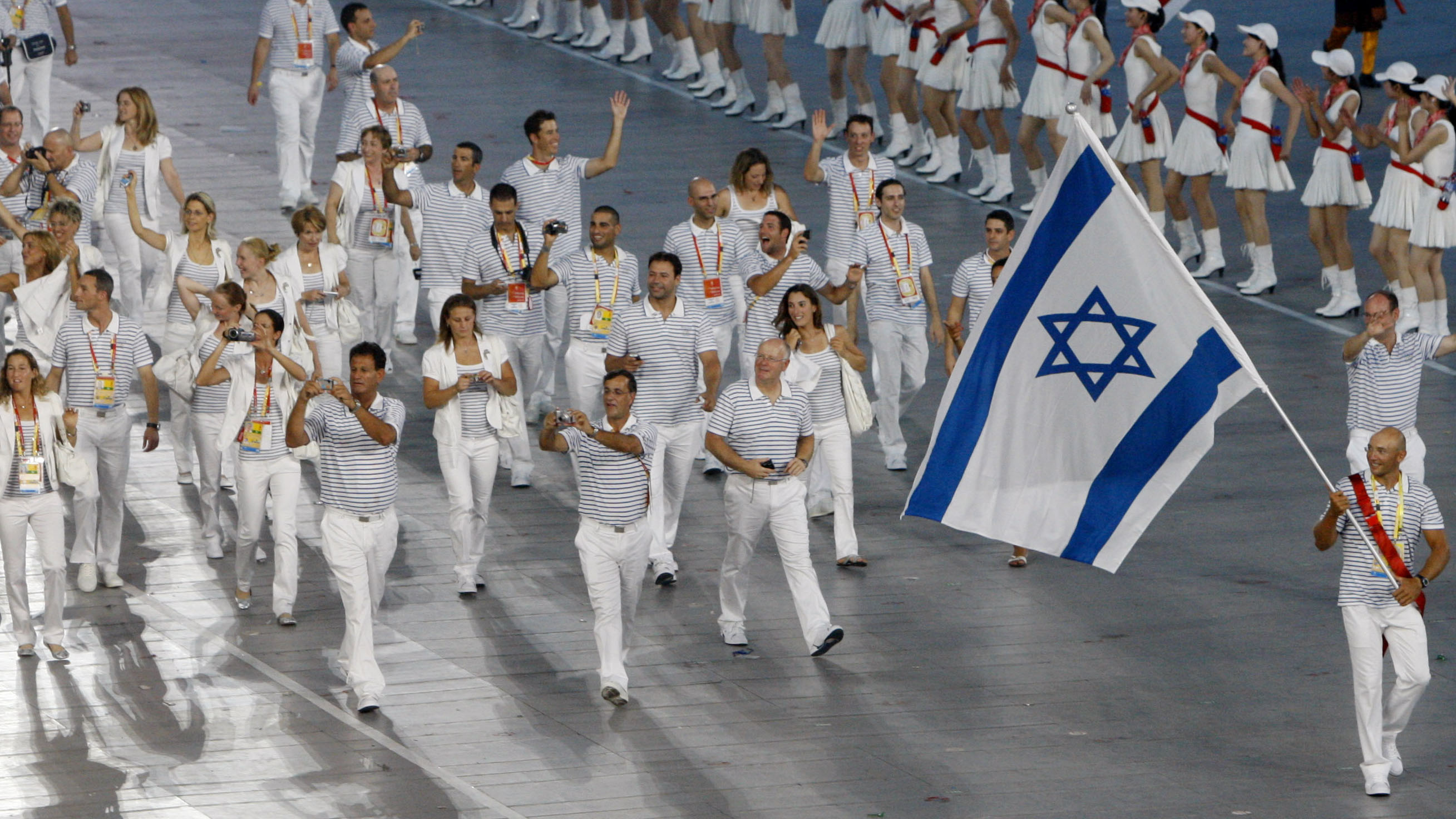
The debate began with a piece Lipstadt wrote for Tablet on July 17, entitled “Jewish Blood is Cheap.” In her article, she inveighed against the International Olympic Committee for refusing requests to hold a one minute moment of silence during Opening Ceremonies to commemorate the 40th anniversary of the murder of 11 Israeli athletes in Munich. Lipstadt explored the various reasons given by the IOC for its refusal: that the IOC has honored the athletes repeatedly in other venues, that the Games should be “apolitical,” and that a commemoration of this sort was inappropriate at a “celebratory event.”

Lipstadt would have none of it:

The IOC’s explanation is nothing more than a pathetic excuse. The athletes who were murdered were from Israel and were Jews—that is why they aren’t being remembered. The only conclusion one can draw is that Jewish blood is cheap, too cheap to risk upsetting a bloc of Arab nations and other countries that oppose Israel and its policies.

…This was the greatest tragedy to ever occur during the Olympic Games. Yet the IOC has made it quite clear that these victims are not worth 60 seconds. Imagine for a moment that these athletes had been from the United States, Canada, Australia, or even Germany. No one would think twice about commemorating them. But these athletes came from a country and a people who somehow deserve to be victims. Their lost lives are apparently not worth a minute.

When I first read Lipstadt’s words, I strongly recoiled at her statement “Jewish blood is cheap” – and her claim that the IOC was motivated by anti-Semitism. Whether or not one agrees with the IOC’s decision, I found Lipstadt’s rhetoric to be incendiary and distinctly smacking of “victim politics.”

So, it seems did Elisheva Goldberg, who gently chided Lipstadt in a post for Open Zion. Goldberg pointed out that in fact, IOC President Jacques Rogge did make a statement and lead a minute of silence during a ceremony last Monday at the athlete’s village promoting the Olympic Truce (a UN backed initiative calling on warring parties around the world to end hostilities during the period of the games).  In her post, Goldberg asked what I thought was a valid question: when it comes to public commemoration of these kinds of tragedies, how much is really enough?  Or as she put it, “when will we be satisfied?”

To my dismay, Lipstadt did not think this question worthy of serious consideration – she responded to Goldberg instead with a petulant smackdown. In a Tablet piece entitled “No, Open Zion, Deborah Lipstadt Won’t Shut Up,” she concluded thus:

In making a statement on Monday, the IOC’s president tried to throw the victims’ families a bone. Goldberg has caught it, and is happily gnawing away. I, and many others, have no intention of being so easily satisfied.

While I agree with Lipstadt that Rogge is disingenuous in claiming the Games aren’t “political,” it bears noting that the Jewish establishment’s full court press on this issue has been highly politicized.  The minute of silence has been now pressed on the IOC by Israel’s Foreign Ministry (who produced a one minute video as part of the campaign), it has been introduced as a US House Resolution, and now of course, the obligatory campaign year statements of support have been elicited from President Obama and Mitt Romey. At this point, even if the IOC did assent to minute of silence at the ceremonies, it would resonate more as a moment of political victory than a genuine act of remembrance.

And that’s the problem I have with Lipstadt and the “many others” who have chosen to press the issue in this manner. They – and we – would do well to ask: when does the desire for public commemoration cross the line into cynical politicking?  On a deeper level, we might well ask: at what point does our need for the world to acknowledge Jewish suffering give way to a collective victim mentality?

To me, these are the critical questions, regardless of what does or doesn’t take place at Opening Ceremonies this Friday.

Anti-Semitism in Kiev? What is our Response?

photo: World Forum of Russian Jewry

I’ve been thinking all day about a recent article in the Forward that documented the vicious beating of a 25 year old yeshiva student in Kiev – and the Jewish reactions it has engendered.

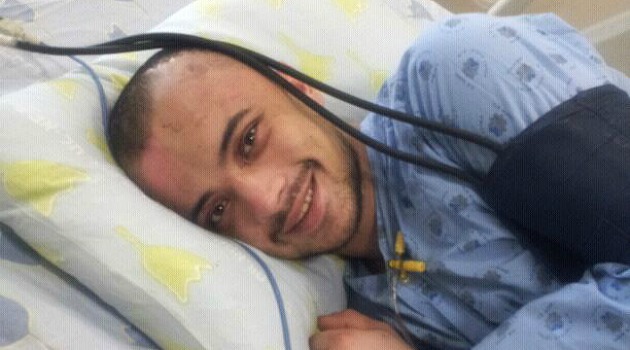
According to the article, Alexander “Aron” Goncharov left the hostel of Kiev’s Brodsky Synagogue on the second night of Passover and never returned. Yeshiva authorities found him the next day in hospital, barely alive after suffering massive head wounds.  A few days later, Goncharov was flown to a Tel Aviv hospital for emergency treatment and was put in a medically induced coma. When he awoke one week later, he said that his attackers had yelled “Yid” as they beat him.

Not surprisingly, the Israeli establishment was quick to make political hay out of the incident:

Israel’s chief rabbi Yona Metzger visited Goncharov on Holocaust Remembrance Day, underlining his new status as a symbol of contemporary anti-Semitism. Goncharov told Metzger that he hoped to immigrate to Israel, calling it “the safest place for Jews.”

What I found interesting, however, was reaction of many in Kiev’s Jewish community itself. While some attributed it to anti-Semitism, others flatly denied it:

“It has nothing to do with anti-Semitism,” said Yaakov Dov Bleich, rabbi of Kiev’s Podol Synagogue and one of several rabbis who claim the mantle of chief rabbi of Ukraine. “The fact he was taken to Israel will probably stop any [police] investigation in its tracks.”

I was also struck by this response:

Vyacheslav Likhachev, a researcher focused on racism, said there was little evidence that the attack was anti-Semitic. Likhachev, who has studied anti-Semitism in Ukraine for the Euro-Asian Jewish Congress for 10 years, told the Forward that anti-Semitic incidents have fallen in Ukraine in recent years…

“I don’t want to say there is no Nazi violence in Ukraine,” Likhachev hastened to say. But he said that Africans and Asians suffer much more than Jews. In an article published soon after the attack, Likhachev noted that on the same night Goncharov was injured, an African student was severely beaten. He said that the following week, a court case opened into a “racist pogrom” which resulted in four students from India, Azerbaijan and Turkmenistan being seriously injured.

Likhachev went on to point out that while Ukrainian President Viktor Yanukovych publicly condemned the attack on Goncharov, he “did not deem it necessary to make a statement on these crimes.”

And this for me is the rub: whether or not this was an act of anti-Semitic violence, what should be our response? For me the answer is clear: it is not to let anti-Jewish actions to drive us from our homes. And it is not to insist that Jews will only truly be safe if they retreat into a nation-state ghetto of their own making.

Rather, we must understand Jew-hatred as no different from any other form of prejudice.  And if we do agree that this is the case, then it would behoove us to find common cause with all minorities targeted with racism.

What Must Be Said: We All Profit from Occupations

There’s been a great deal of analysis written about German writer Gunther Grass’ now-infamous new poem, “What Must Be Said” (in which Grass criticized Israel’s nuclear program as endangering an “already fragile world peace.”)  For me, the most astute response by far comes from Mideast historian Mark LeVine, writing in Al-Jazeera.

LeVine skillfully parses the psychology and the politics behind the uproar – but it is his identification of the larger context of the issue that resonates most powerfully for me. Here’s a long excerpt from a much longer article. The entire piece is well worth reading:

Israel has always sought to portray itself as a “normal” country, yet goes out of its way to ensure no one “names it” – to use Grass’ words – as what it is, a colonial state that every day intensifies its occupation of another people’s land. And so Grass has taken it upon himself to “say what must be said”, to name Israel as what it is, a “nuclear power” that “endangers the already fragile world peace”. It’s worth noting he doesn’t even mention the occupation, which is the far greater threat to world peace.

I have no idea if Grass really believed himself to be “bound” to Israel; if he did, we can imagine the bond is broken today, at least by Israel, now that he’s banned from returning. But Grass’ feelings are not what’s interesting or important. What’s important is the larger context, all the other “facts” which refuse to be accepted as “pronounced truths”.

These facts are that Israel, however egregious its crimes – and anyone who denies them is either completely ignorant or a moral idiot – is but one cog in a much larger global machine, one that includes too many other cases of occupation, exploitation, and wanton violence to list comprehensively here (we can name a few – Syria, China, Russia, India, Sudan, Saudi Arabia, Iran, Bahrain, Uzbekistan, Sri Lanka, the Congo, and of course, NATO and the United States – whose oppression, exploitation, and murder of their own or other peoples is a far more concrete “fact” than the potential for mass destruction caused by Israel’s nuclear programme)…

The larger fact is that the global economy is addicted to war, to militarism, oil and the rape of the planet for the minerals and resources that fuel the now globalised culture of hyperconsumption that will doom our descendants to a fate we dare not contemplate. Israel’s gluttony for Palestinian territory, and its willingness to encourage a regional nuclear arms race to keep it, is ultimately no different than the the gluttony for the 60-inch TV, the iPhone/Pad, the cavernous homes and cars, the ability to live at levels of consumption that are only sustainable if most of the world lives in poverty that increasingly defines all our cultures.

Israel has gotten Palestine on the cheap, and it costs relatively little to continue the occupation. Far less than it would cost to end it. So why bother? Especially when everyone else is doing, more or less, the same thing and, it’s clear, no one really cares anymore. Germany, whose remarkable economic stability in the recent global financial crisis is in good measure due to its central role in this global economy of hyper-consumption (think of all the energy and resources that go into making and driving all those fancy German cars), is certainly playing its role all too well.

If Grass is right that we must talk about the threat to world peace posed by Israel’s nuclear programme – and far more by its ongoing occupation – then we must also talk about the threat to global peace posed by the sick global system of which Israel is merely one of the more easily identifiable symptoms. Unlike my parents, I’m happy that Germans finally feel secure enough publicly to speak critically about Israel. But if they want their words to have a chance of bringing about a change in its behaviour, they, and everyone else, needs to broaden the discourse to include their own role in enabling and profiting from the system that Israel’s actions so benefits, and the global scope of the victims it daily produces.

Of course, this discourse would require a much longer and more complex poem, written by an even better poet than Grass. If someone manages to write it, I hope it will get the same publicity as “What Must Be Said”.

Sorry Newt, but there is no Anti-Semitism at Occupy Wall St.

Accusations of anti-semitism in the Occupy Wall Street movement are flying fast and furious now. Newt Kingrich leveled the charge today on the CBS’s Early Show. David Brooks insinuated it in the NY Times not long ago. And Bill Kristol’s Emergency Committee on Israel has actually bought air time in New York and DC to run a laughably misleading ad that implores viewers to “Tell Obama and Leader Pelosi to stand up to the (anti-semitic, anti-Israel) mob.”

Watch the above clip for the real story.  Then read this thorough piece by commentator MJ Rosenberg. It would all be pretty hilarious if it wasn’t such a horribly cynical exploitation exploit the real pain and fear of anti-semitism to slow down a movement committed to justice and dignity for all – which is, in the end, what Judaism is all about.