Category Archives: BDS

JVP Rabbis Call Out: “Open Hillel!”

I’ve just returned from an inspiring sojourn at the Jewish Voice for Peace National Members’ Meeting in Berkeley, CA (you can read more about the event here.) While I was there, I took the opportunity to film a few of my colleagues on the JVP Rabbinical Council voicing their support for the Open Hillel campaign (a recent and very important student-run initiative about which I blogged not too long ago.)

Here ’em testify!  From top to bottom, Rabbis Brian Walt, Lynn Gottlieb, David Mivasair, Margaret Holub, David Bauer and Alissa Wise:

My “Wrestling” Interview with Just World Books

mikeClick here to listen to a podcast interview I did with Just World Books last February.

In this podcast, Rabbi Brant Rosen, author of ‘Wrestling in the Daylight: A Rabbi’s Path to Palestinian Solidarity,’ shared his reflections on his book and how it has impacted his understanding of “what to do” with his beliefs and convictions as well as provided his insights about the effects of Operation Cast Lead, the Gaza flotilla incident, and other Israeli actions on both the views of young American Jews and the Arab Spring. He also offers his opinion on what President Obama should do in his second term about the Israeli-Palestinian conflict.

On Open Hillel, Open Debate and Open Minds

logo

Last November, Harvard’s Progressive Jewish Alliance prepared to sponsor “Jewish Voices Against the Occupation.” One week before it was set to take place at Harvard Hillel, Hillel decided to pull the plug on the program. Why? Because Harvard College Palestine Solidarity Committee was a co-sponsor.

In defense of its position, Harvard Hillel cited the guidelines of Hillel International that state Hillel organizations “will not partner with, house, or host organizations, groups, or speakers” that support the “boycott of, divestment from, or sanctions against the state of Israel.” And since the Harvard PSC promotes boycott, divestment and sanctions, this was enough for Hillel to kibosh a program sponsored by a Jewish student group.

If this sounds vaguely like deja vu to you, that’s because back in March 2011, Brandeis University Hillel refused to allow student chapter of Jewish Voice for Peace to affiliate under its umbrella, citing the very same guidelines. Then senior Lev Hirschorn commented at the time:

We feel like we deserve a seat at the Jewish communal table, but there is a sense that dissent on the question of Israel is not really acceptable.

As open debate and discussion have been indelible aspects of Jewish culture from time immemorial these attempts at muzzling students’ voices are particularly egregious. Hillel International’s guidelines (which are not obligatory for local Hillels) essentially ensure that there will be no honest and open Jewish conversations about Israel on campuses across the country. They will most certainly exclude growing Jewish student groups such as JVP – and they will also prevent Hillels from inviting co-sponsorship or dialogue with Palestinians, since almost all Palestinian campus groups support BDS.

Trust me on this: this has everything to do with the Jewish establishment’s fear of letting young Jews think for themselves on the subject of Israel. Not convinced? Just read this recent piece in the Washington Jewish Week, in which Rabbi Stuart Weinblatt (chairperson of the Jewish Federations of North America Rabbinical Council) offered up this choice observation:

I think it is important to begin to help prepare our children for what they are going to encounter on college campuses in regard to pro-Palestinian groups, the anti-Israel groups on Israel and radical fringe groups like Jewish Voices for Peace.

These are not J Street. Our kids are relatively sheltered, and they go to college and are confronted with hostility and misinformation. I want them to be equipped with the knowledge and understanding of the historical justification for the existence of the state of Israel.

Well that certainly says it all. We need to protect our poor, vulnerable, non-critically thinking young people from Jewish Voice for Peace and other groups that advocate for the rights of Palestinians.  Since we can’t trust college students to think for themselves, we must “equip” them with what we deem to be the acceptable historical Jewish opinions on Israel. This profoundly patronizing, pseudo mind-controlling approach to Jewish outreach explains why the Jewish establishment is fast making itself irrelevant to young people – and why it feels compelled to allocate hundreds of millions of dollars yearly to send college students on all expenses paid Birthright junkets and free trips to the National AIPAC Convention.

Please join me in advocating for a Jewish student community that respects a plurality of Jewish student voices on Israel/Palestine. Please sign this petition by Open Hillel, a coalition of students that seek to change the “standards of partnership” in Hillel International’s guidelines and encourages local campus Hillels to adopt policies that “allow for free discourse on all subjects within the Hillel community.”

From the Open Hillel website:

We believe deeply in the ideal, expressed in Hillel International’s mission statement, of a vibrant, pluralistic Jewish community on campus, in which all people, regardless of their religious observance, past Jewish experience, or personal beliefs, are welcome. In many ways, Hillel has been remarkably successful at fostering such a pluralistic and inclusive community, bringing together students from different backgrounds to learn from and support one another, as well as to openly debate and discuss their differing views. We believe that this pluralism should be extended to the subject of Israel, and that no Jewish group should be excluded from the community for its political views.

In addition, we believe that inter-community dialogue and free discourse, even on difficult subjects, is essential in the context of an educational institution and a democratic society. Open discussion and debate is a Jewish value, and we are proud of our culture’s long tradition of encouraging the expression of multiple, even contradictory, views and arguments. However, Hillel International’s current guidelines encourage Jewish students to avoid seriously engaging with Palestinian students or other students on campus with differing views on Israel-Palestine. This is detrimental to the goal of encouraging mutual understanding, cooperation, and peace. Thus, we believe it is essential that Hillel-affiliated groups be able to partner with other campus groups in order to share perspectives, cooperate in those areas where we agree, and respectfully debate in those areas where we disagree.

Sure doesn’t sound like the words of “sheltered,” “unequipped” young people to me…

Rabbi Margaret Holub Explores Life During and After Apartheid

Jsmalltown jews4My dear friend and colleague Rabbi Margaret Holub (who recently joined me as co-chair of the JVP Rabbinical Council) has just traveled to South Africa to spend the next six weeks in Cape Town. It’s her second sojourn there and in addition to reconnecting with old friends, she’ll be spending her time interviewing clergy in the Dutch Reformed Church about their life during and after the fall of apartheid.

The DRC is the Afrikaans-speaking church which was famous – or notorious – for more or less inventing apartheid and upholding it all the way through to its end in the 1990s.  The Church has come a long way since then – their leaders recanted the doctrine of apartheid, appeared before the Truth and Reconciliation Commission to publicly ask forgiveness and have made moves to integrate their churches.

As a self-described rabbi “edging into the world of organizing about ending Israel’s occupation of Palestine,” Margaret is particularly interested in learning more about the experience of white South African clergy:

What was it like, I wonder, for the rest of them as the world’s banks and universities and entertainers boycotted South Africa, as other churches condemned and isolated the DRC?  What was it like as it became clear that white rule and the separation of the races were going to end?  Did they feel cornered?  Did these ministers have misgivings about their church’s teachings?  Did they  feel like they had to defend them even so?  Were their certain messages that penetrated their defenses?  What would they say to rabbis today, twenty years after apartheid ended, about being on the wrong side of history?  Maybe, with all this hindsight, they’d even have some advice…  I really don’t know, but I look forward to asking.

The quote above came from Margaret’s blog, “Summer in Winter,” in which she promises to faithfully chronicle her experiences on this amazing trip. I plan to follow her adventures faithfully and recommend that you do too!

Interfaith Coalition Launches Boycott of SodaStream

sodastream-protest

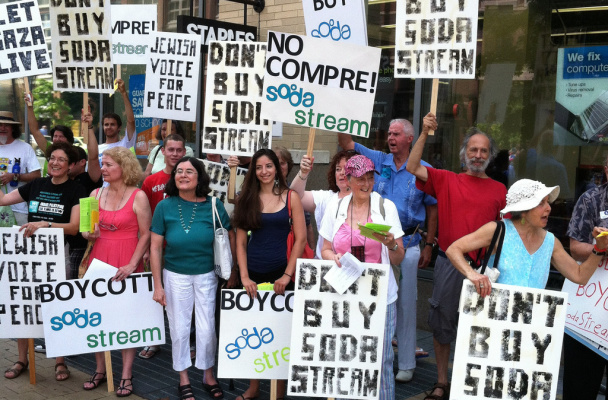
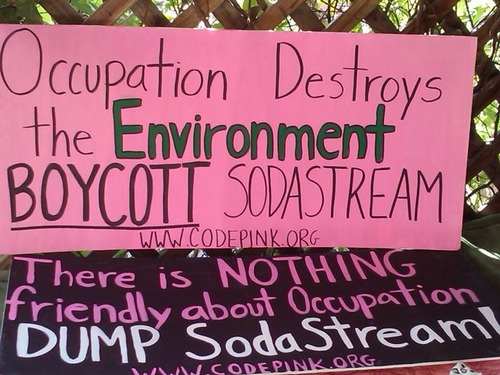
Since my previous post on the SodaStream boycott, I’ve received a number of questions regarding which specific campaign/s to support. While there have been a number of great local actions around the country, I’m happy to announce that a new interfaith coalition has just launched a national boycott effort that includes a petition as well as a spoof ad contest. I hope you will join me in signing on to this important campaign.

For more information on SodaStream, here is an excellent point by point response to the claims made by the company, courtesy of Stop SodaStream – Italy:

1. “SodaStream is headquartered in Tel Aviv, Israel, and manufactures its products in 12 production plants distributed in many countries, including factories in China (2), Germany, Sweden, New Zealand, Australia, South Africa, Netherlands, the US and two in Israel, one of which is Mishor Adumim … “

Even if there were hundreds of “production facilities” all over the world, it would not change the fact that the factory in Mishor Adumim is built on land stolen from the Palestinians and thus violates human rights and international law.

In any event, Sodastream’s annual report clearly demonstrates that the factory in Mishor Adumim is also the company’s main production facilities:

  • At 15,256 m2, the plant is four times larger than the headquarters in Tel Aviv, and eight times that of the other Israeli plant at Ashkelon, which produces only flavors for soft drinks.
  • The plant in China produces only “certain components”.
  • The “production facilities” in Germany, Sweden, New Zealand, Australia, South Africa, the Netherlands and the USA are mere sales and marketing offices and refill stations for CO2 cylinders.

Source: Sodastream International Ltd. Annual Report for the Fiscal Year Ended December 31, 2010, “Manufacturing and Production,” p. 37 and “Facilities,” p. 40.

2. “… where approximately 160 Palestinians receive full social and health services in accordance with, and exceeding, Israeli law, including pension contributions and insurance. Labor law in Israel requires an employer to pay wages and contributions 4 times higher than those required by the Palestinian Authority. If you consider that, on average, each employee is responsible for 10 Palestinian dependents, considering the rate of unemployment in the Palestinian Authority (estimated at 30%), the company provides food and shelter to 1,600 people. In addition, SodaStream also provides benefits that include: daily hot meals, clothing, transportation and overtime pay for up to 200% as required by Israeli law. “

The fact that a company such as SodaStream, which profits from the Israeli occupation regime, considers itself a benefactor of the Palestinians is downright bizarre. Even if working conditions for the Palestinians at the Mishor Adumim factory were as described (something that has been proven false in the past by the Israeli organization Kav LaOved), the fact remains that, as subjects an occupation regime, these workers do not enjoy civil rights (including the right of workers to organize) and are under constant threat of having their permits to work in the settlement revoked by the company at any moment.

Palestinian workers often have no choice but to work in the settlements, with high unemployment rates that are a direct result of the Israeli occupation. The 2011 United Nations Conference on Trade and Development report explicitly links the decline in Palestinian agricultural and industrial sectors and the dire humanitarian conditions with Israeli government policies, in particular the confiscation of land and natural resources, restrictions on movement of people and goods, and isolation from international markets. Only a colonial mindset could claim to provide jobs to the very same people whose land and freedom have been stolen.

Sources:
– Kav LaOved, “Palestinian Workers in Israeli West Bank Settlements – 2009”; “Employees at Soda Club fired without wages (follow up report)”
Report on UNCTAD assistance to the Palestinian people: Developments in the economy of the occupied Palestinian territory

3. “Among the 700 employees at the Mishor Adumim factory are Jews, Palestinians, Christians, Russians, Ethiopians, Bedouins, and Americans. In SodaStream’s view, this is a splendid example of peaceful coexistence that will lead to economic prosperity on which everyone benefits. The company regularly celebrates the holidays of all and has fostered cultural exchange.”

To speak of “peaceful coexistence” between people who do not have equal rights and equal social, economic and political opportunities is absurd. Among Sodastream employees, there is a marked difference between the conditions of the occupiers and those who suffer under occupation. For example, just as in Apartheid South Africa the black majority was allowed to enter areas reserved for whites only in order to work, so do the Palestinians depend on the occupying power for work permits.

Furthermore, the Jahalin Bedouin, who had already been driven from their lands in the Negev in the 1950s, were then expelled from the very area where the Sodastream has its factory.

Sources:
– Kav LaOved, “Palestinian Workers in Israeli West Bank Settlements – 2009”;
– Human Rights Watch, Separate and Unequal, “Jahalin Bedouin and Ma’ale Adumim”

4. “As you know, Sodastream recently decided not to expand the factory at Mishor Adumim, but rather to build one inside the Green Line. The construction is already underway, as decided by the Board of Directors.”

Committing to not to expand an illegal activity, which according to the company website, Sodastream has been carrying out since 1996, counts for very little. The fact remains that the main production facilities are located in an illegal Israeli settlement in violation of international law.

Source: Sodastream web site, History of the Sodastream Group

5. “SodaStream does not currently benefit from low rents and could rent other facilities in the uncontested territories of Israel for much less. The same applies to incentives, the company enjoys the same tax incentives as any other industrial area of Israel, regardless of whether it is located in the disputed territories or not.”

Sodastream’s annual report lists among its “risk factors” the possibility, due to negative publicity and boycotts, of having “to transfer a significant portion of manufacturing activities to a location outside of the West Bank” that would “limit certain of the tax benefits for which we are currently eligible”.

In fact, according to the web site for the Mishor Adomim Industrial Park, it is designated as “Development Zone ‘A'”, which enjoys the highest tax incentives from the Israeli state.

And finally, the Palestinian territories are occupied, not “disputed”, as recognized by the International Court of Justice, the International Committee of the Red Cross and the Conference of High Contracting Parties to the Fourth Geneva Convention, among others.

Sources:
Sodastream International Ltd. Annual Report for the Fiscal Year Ended December 31, 2010, “Risks related to our Location in Israel,” p. 17
– Adumim Industrial Park, Business Benefits
– International Court of Justice: Legal Consequences of the Construction of a Wall in the Occupied Palestinian Territory; International Committee of the Red Cross; Conference of High Contracting Parties to the Fourth Geneva Convention: Declaration,

6. “With regards to Coop Sweden, yes it is true that on July 19 they decided to suspend sales of these products, however it is also true that, after a brief investigation, they then decided to put them back on the shelves.”

Swedish activists inform us that COOP Sweden claims to have the results of an investigation that justify, in their view, the marketing of Sodastream products. COOP Sweden has refused, however, to share the report with the Swedish activists. If Sodastream would like to provide us with the report, we would be happy to comment on it.

7. “SodaStream is also under tight control by the Office for Environmental Protection of Israel, leading to surprise inspections, and the company adheres to the highest environmental standards.”

It is well known that Israeli and international companies consider Israeli laws on environmental protection inapplicable with regard to factories in the occupied West Bank. According to 2009 report by the Israeli organization B’Tselem, Israel does not enforce environmental laws in the settlements and industrial areas in the occupied West Bank.

As for surprise inspections, according to Bloomberg Businessweek and the Corporate Watch website, the Sodastream Factory in Mishor Adumim is “the most heavily protected in the area, with multilevel electric fencing protecting its perimeters and cameras monitoring everything going on outside of them.”

Sources:
– B’Tselem, “Foul Play: Neglect of wastewater treatment in the West Bank
– Corporate Watch, “Occupation Industries: The Israeli industrial zones
– Bloomberg Businessweek, “EU Eyes Exports from Israeli Settlements

8. “Following the publication of false reports, the company also decided to host visits and inspections, in particular social audits, including the internationally accepted BSCI (Business Social Compliance Initiative) audit, with the conclusion that they no corrective actions are necessary.”

Clearly, an auditing organization that certifies a factory located in the occupied Palestinian territories has no credibility whatsoever.

The Stop Sodastream campaign will continue to challenge the deceptions of Sodastream, organizing initiatives to reveal the truth that the company wants to hides and promoting a boycott of its products.

Why I’m Boycotting SodaStream

boycott_sodastream_smaller

Israel’s settlement juggernaut continues at full speed, creating apartheid conditions on the occupied West Bank while making a mockery of any hope of a two state solution. Since no nation or institution seems willing to hold Israel accountable, it seems to me the least any concerned citizen can do is to refuse to patronize companies that directly profit from this brutal and unjust occupation.

At the moment, Exhibit A is SodaStream – a company that produces home carbonating devices. Promoting its product as eco-friendly, SodaStream is sold in 39 countries in 35,000 stores worldwide, including Macy’s, Bed Bath and Beyond, Bloomingdale’s, Sears, and Kmart.

It is also manufactured in the Israeli settlement of Mishor Adumim.

A bit of history: Mishor Adumim is the industrial park section of Ma’aleh Adumim, the largest settlement in the West Bank.  The land for both of these settlements originally belonged to the Palestinian towns of Abu Dis, Azarya, Atur, Issauya, Han El Akhmar, Anata and Nebbi Mussa, but was expropriated by Israel in the 1970s.  Today, Ma’aleh and Mishor Adumim are a key part of the Israeli government’s plan to create Jewish facts on the ground around Arab East Jerusalem.

The SodaStream boycott is a particularly instructive action since the company actively promotes itself as an environmentally concerned enterprise. This is a tactic known as “greenwashing” – a cynical attempt to hide behind liberal environmental values in order to divert attention away from egregious violations of human rights. On this subject, I was profoundly saddened to read a post today by Rabbi Jason Miller, who sang the environmental praises of SodaStream and encouraged folks support Israel (and celebrate the Jewish festival of Tu B’shvat) by buying their product.

And what about the fact that the company says its product is “Made in Israel”, yet is based in the West Bank? By way of answer, Rabbi Miller approvingly quoted the company CEO Daniel Birnbaum, who he claims is “a strong proponent of human rights”:

(Birnbaum) said that thanks to SodaStream thousands of local Palestinians in Mishor Adumim have good paying jobs. Those workers, he explains, would not be able to support their families without their jobs in SodaStream’s manufacturing plant.

Wow. My jaw nearly hit the floor when I read that one. I’m not sure that resorting to a colonial “white man’s burden” argument is the surest way to defend entrepreneurial activity in occupied territory.

It’s also patently untrue. I strongly recommend this report by “Who Profits” for an important and in-depth expose of SodaStream, including the manner in which it exploits Palestinian laborers who come from the villages surrounding Mishor Adumim.

Jordan Ash, writing in the Twin Cities Daily Planet has also recently addressed this issue:

As with the Maquiladoras along the U.S.-Mexican border, the high unemployment rate means that many Palestinians are forced to try to earn a living through jobs in the settlements, despite the low pay and harsh working conditions.

Palestinian workers in the settlements do not enjoy the full protection of Israeli labor laws.   They must get special permits and security clearance just to be able to enter these factories.   Involvement in a labor dispute constitutes a security risk and can result in the loss of not only a worker’s current job but their ability to work in settlements in the future.   Thus, many Palestinian workers do not demand their legal employment rights due to fear of losing their work permit.

At the SodaStream factory, when workers protested that they were being paid less than half of the minimum wage and were forced to work 12 hour days, they were fired. On another occasion, when workers who were fired and were still owed a month’s wages went to the factory to request their pay, SodaStream had them removed from the factory and banned from the entire industrial park.

As with all business in the illegal settlements, SodaStream pays taxes to Israel, not to the Palestinian Authority.  The municipal taxes that SodaStream pays are used exclusively to support the growth and development of the settlement through things such as roads, education, and sewage treatment.

While I certainly don’t have any illusions that this boycott will bring the Israeli economy to their knees, I do believe it provides us with the means to take a public moral stand against the injustices Israel is committing in the occupied West Bank – and to stand in solidarity with those whose lives are impacted by this oppression.

It is a particularly timely action since the company has spent $3.8 million on a 30-second spot during next month’s Super Bowl. Apparently the commercial advocates “setting the bubbles free”. Those concerned with human rights should know that freedom for real, living breathing human beings is what is truly at stake here.

My “Wrestling” Interview with Truthout

Check out my wide-ranging and freewheeling conversation with Truthout’s Mark Karlin, which focuses on my book, but also touches on subjects such as Zionism, BDS, the two-state solution and Palestinian solidarity, among others.

Here’s a taste, below. Click here for the full interview.

Mark Karlin: Stereotyping any group of people is dangerous. In polls during peaceful periods, most Palestinians and Israelis appear to support peace. A lot of what Netanyahu appears to do is stir up the pot so that there will never be a long enough period to negotiate a peace. That’s not to excuse those in Hamas and Hezbollah who have their own motives in heating up the conflict now and then, along with other parties who have vested interests in stalling peace. When you talk of your Palestinian solidarity, some critics accuse you of abandoning Jewish solidarity and not sufficiently condemning those Arab extremists who are in the “destroy Israel” industry as much as Netanyahu is in the suppression-of-Palestinian-rights industry. How do you respond?

Brant Rosen: At the end of my book I addressed this issue directly:

As a Jew, I will also say without hesitation that I reject the view that I must choose between standing with Jews or standing with Palestinians. This is a zero-sum outlook that only serves to promote division, enmity and fear.

For me, the bottom line is this: the cornerstone value of my religious tradition commands me to stand in solidarity with all who are oppressed. It would thus be a profound betrayal of my own Jewish heritage if I consciously choose not to stand with the Palestinian people.

In other words, I believe my Jewish liberation to be intrinsically bound up with Palestinian liberation. It’s really that simple.

I’ve come to believe that solidarity should ultimately be driven by values, not tribal allegiances. It should be motivated by the prophetic vision that demands that we stand with the powerless and call out the powerful. Of course, in the case of Israel, this form of solidarity presents a very painful challenge to many Jews. I understand that. But at the very least, shouldn’t we be talking about this challenge and what it represents for us?

Does my solidarity mean that I agree with everything that is done by Palestinians in furtherance of their liberation? Of course not. When you stand in solidarity with a people, it is inevitable that you will find yourself standing next to some people whose actions and beliefs you will find odious. That comes with the territory when you choose to take a stand. And I might add that this is the case for liberal Zionists who stand in solidarity with Israel as well.

Parsing the (Odious) New Term, “Jew-Washing”

photo: Jewish Voice for Peace

Cross-posted in the “Forward Thinking” blog of the Jewish Daily Forward:

In his latest column, Philologos correctly parses the linguistic problems with Yitzhak Santis and Gerald M. Steinberg’s invented term, “Jew-washing.” His political analysis, alas, fails miserably.

Philologos has it completely wrong when he speaks of the “anti-Semitism in boycotts of Israel.” To begin with, Santis and Steinberg did not use the term “Jew-washing” in reference to a boycott of Israel as a whole, but rather to a resolution recently brought to the Pittsburgh General Assembly of the Presbyterian Church (USA) that called for divestment of their pension funds from three specific companies that profit from Israel’s brutal and illegal occupation of the West Bank.

Regardless, it is highly disingenuous for Philologos to accuse the Presbyterian Church of anti-Semitism. Our Christian friends’ response to the Palestinian civil society call for Boycott, Divestment and Sanctions (BDS), reflects their deeply held commitment to justice in a land their tradition also considers holy.

Philologos asks, “Have the Presbyterians considered boycotting China because of Tibet? India because of Kashmir? Russia because of Chechnya?” This, of course, is classic misdirection. The issue at hand is not global human rights, but a very specific call from Palestinian civil society for international support in ending their oppression.

The real question before them (and us) is not “what about Tibet, Kashmir and Chechnya?”  The question, rather, is: “will we or won’t we respond to the Palestinian call?” To this question, many members of the Presbyterian Church are courageously responding “we will.” So too are increasing numbers of Jews who believe that our legacy of anti-Jewish oppression leads us to stand with Palestinians being denied basic human rights in our name.

No, we are not being used as pawns by Christian partners to further some nefarious “anti-Semitic plot”. Rather, we are standing in solidarity with the oppressed, as the most basic of our Jewish teachings demand that we do.  What irony that other Jews should stand in the way of the Jewish imperative to end injustice. How heartbreaking that some in the Jewish community pervert this imperative by labeling the best intentions of our Christian friends as “anti-Semitism.”

We do, however, fully share Philogos’ distaste for the term “Jew-washing,” the coining of which is a sign of abject desperation that itself crosses the line of anti-Semitism, as blogger Jeremiah Haber pointed out last week. We predict that odious terms such as this will soon be relegated to the history books as part of a last, flailing effort by a fearful generation of Jewish leaders unwilling to recognize the moral urgency of the moment. It also reflects the short-sightedness of an establishment that continues to support war and occupation while deliberately alienating itself from the next generation of courageous Jewish leaders.

Why I Support Kairos USA

Last week a group of US clergy, theologians and laypersons unveiled Karios USA, a powerful and important American Christian spiritual call for justice in Israel and Palestine.  As a religious Jew, I am inspired by its prophetic courage, its unabashed call for justice and its heartfelt model of compassion. It truly deserves to be shared and studied by all who who seek a genuinely religious call for justice in this land that is so central to so many peoples and spiritual traditions.

Kairos USA is modeled on the religious testimony of Kairos Palestine, a document that was drafted by prominent Palestinian Christian leaders in 2009 (which was itself inspired by the 1985 South African Kairos statement).  Despite these important influences, however, Kairos USA stands on its own as a uniquely American Christian call for justice in Israel/Palestine.

Indeed, this unique mission is evoked in the statement’s Preamble at the very outset:

In June 2011, a group of U.S. clergy, theologians and laypersons, cognizant of our responsibility as Americans in the tragedy unfolding in Israel and Palestine, and mindful of the urgency of the situation, met to inaugurate a new movement for American Christians. We have been inspired by the prophetic church movements of southern Africa, Central and South America, Asia and Europe that have responded to the call of their Christian sisters and brothers in occupied Palestine. This is our statement of witness and confession—and our response as U.S. Christians to the Palestinian call.

And more specifically, from the Introduction:

As U.S. Christians we bear responsibility for failing to say “Enough!” when our nation’s ally, the State of Israel, violates international law. Our government has financed Israel’s unjust policies and has shielded its government from criticism by the international community. At the outset of the current U.S. administration, our government led Palestinians to believe that at last we would pursue a political solution based on justice. But the “peace process” has continued to be no more than a means for the continuing colonization of the West Bank and East Jerusalem, the imprisonment of Gaza and the intensification of the structures of oppression.

I have no doubt at all that like Kairos Palestine, Kairos USA will be excoriated by many self-appointed leaders of the American Jewish establishment.  As for myself, now that I’ve read the document carefully, I can say without hesitation that I believe this statement is a truly sacred testimony, offered in good faith and with genuine religious integrity.

I was particularly moved to read how sensitively Kairos USA treads over some of the most complex hot-button issues in the Jewish-Christian relationship. For instance, on the issue of historical church anti-Semitism, the statement includes the following confession:

As Christians addressing the Palestinian cause we must also acknowledge our shameful role in the historic persecution of the Jewish people. We recognize the dehumanizing and destructive power of doctrines and theologies that denigrated Judaism. Our predecessors perpetuated anti-Semitic stereotypes, practiced scapegoating and cloaked prejudice, hostility and murder itself in the robes of our religion. We confess that our churches failed to resist, and sometimes even aided and abetted pogroms, mass dislocations of Jews, and the calamity of the Nazi Holocaust itself. In so doing, they betrayed the teaching and example of the one we claim to follow. We speak for and with our forbears in expressing deep remorse. With a commitment to never forget those failures and to be instructed by them, we pledge ourselves to growth in faithfulness, compassion and justice.

The statement goes on, however, to state that Christians’ honest desire to repent for the church’s historic crimes against Jews must not inhibit them from speaking out against injustices perpetrated by Israel against Palestinians. To my mind, this is a call for real and honest interfaith relations – dialogue that is not defined by guilt or emotional blackmail, but rather by a willingness to venture into and openly discuss the more difficult and painful places:

We acknowledge with sadness and distress that because of the powerful impulse on the part of Christians to atone for their sins against the Jewish people, vigilance against anti-Semitism today has come to trump working for justice in Palestine and Israel. The Christian need to rectify centuries of anti-Jewish doctrine and actions and to avoid even the perception of anti-Jewish feeling has served to silence criticism of Israel’s policies and any questioning of the consequences of U.S. government support for Israel. Differences between anti-Semitism and legitimate opposition to Israeli actions are avoided or explained away. Responsible discourse about Zionism is often denounced as hostility toward Israel and its citizens or branded as anti-Semitism. We believe that in our dialogue with our Jewish friends, family members and colleagues and in our relationships with the Jewish community on institutional levels, we must confront this pattern of avoiding, denying or suppressing discussion of issues that may cause conflict or discomfort. The fact that anti-Semitism still exists makes it all the more important to differentiate between actual anti-Jewish feelings and criticism of the actions of a nation state. Uncomfortable though it may be, we cannot be afraid to address the urgent issue of justice and human rights in Israel and Palestine with our Jewish sisters and brothers here in the United States.

I also deeply admire the statement’s willingness to directly address the charged issue of so-called Christian “replacement” or “supersessionist” theology (a view that promotes Christianity – and not Judaism – as the genuine fulfillment of Biblical tradition):

We are aware that in denying a theology of entitlement that gives the Jewish people exclusive rights to the Holy Land, we risk the charge of reviving the Christian doctrine known as replacement theology (sometimes known as supersessionism). In this view, the Church takes the place of Israel in God’s purposes, denigrating Judaism itself and condemning the Jews to suffering for rejecting the Gospel. Christians have rightly wished to distance themselves from this destructive and divisive doctrine. We repudiate the anti-Semitic legacy of the church’s past and the theology that undergirds it.

As a Jew who rejects a sense of Jewish entitlement just as strongly as I reject any religious viewpoint that makes an exclusive claim to the land, I particularly appreciate Kairos USA’s religious approach on this point:

Our core Christian belief is that God’s promise in the Gospel is a promise to all nations. This means that God’s kingdom work in Christ is a promise to everyone regardless of race. We believe that the Church has found in Christ a fulfillment of all that God promised in Abraham, and that both Jews and Gentiles have been invited equally into this promise of a world renewed in love and compassion. The Church does not replace Israel. Jews continue to have a place in God’s plan for the world. In Christ, all nations can be blessed (Genesis 18:18, 22:18; Galatians 3:8). In these times of growing international conflict and cultural mistrust, this is a significant promise. Theologies that privilege one nation with political entitlements to the exclusion of others miss a central tenet of the Gospel and inspire increased conflict.

I believe the above statement provides a crucial challenge to both American Jews and Christians.  From a theological point of view, I believe it is time to reframe the issue. The real debate is not about which religious tradition or people has a more compelling religious “right” to the land of Israel, rather, it is between those who make exclusivist theological claims and those whose theology makes room for all peoples who live on or feel a connection to this land.

I also have no doubt that many in the American Jewish establishment will reject out of hand Kairos USA’s positive advocacy of BDS (“Boycott, Divestment and Sanctions”).  But here again, I find that the statement deals with a hot-button issue with sensitivity and integrity:

Participation in the BDS movement by U.S. churches, notably in the form of initiatives to divest church funds from companies profiting from the occupation of the West Bank and the blockade of Gaza, has generated critically-important discussions at local, denominational and ecumenical levels about the responsibility of the church to act. It has also generated intense controversy. Opposition, from Jewish organizations as well as from voices within the churches, has often been fierce, claiming that such actions will inflict grievous damage on hard-won positive relationships with the Jewish community. Many express fear that these actions may encourage anti-Semitism. We note with distress that many have confused these actions with anti-Jewish discrimination and persecution in the Christian past. But BDS is directed at Israeli policy, not the state itself or its citizens, and certainly not against the Jewish people. Divestment and other forms of socially responsible investing (SRI) are not directed against groups, nor are they intended to hurt individuals, corporations or states. They are, rather, directed at unjust, oppressive policies and are about promoting our own values and stated commitments by noncooperation with evil. Furthermore, methods to exert economic pressure on governments and companies, in addition to being a legal, ethical and time-tested way of influencing the political process and corporate behavior, serve to increase awareness, promote open discussion and create the grassroots support required to urge governments to take effective action and to change unjust policies. We urge congregations, clergy and church leaders to become educated about the BDS movement and to consider the many forms that it can take on personal, local and national levels.

As I American Jew who is deeply distressed by the American Jewish establishment’s abject vilification of BDS, I don’t think I could possibly put it any better.

I urge all people – whether religious and secular, Christian, Jewish or Muslim – to read, share, discuss and respectfully debate this important new American statement of faith.  My deepest gratitude to those (including my good friends Mark Braverman and Father Cotton Fite) who helped spearhead and draft Kairos USA.  May it inspire us all to reframe a new religious response to the sorrows of Israel/Palestine – and lead the way to a better future to all who call this land home.

Some More Thoughts on Caterpillar Divestment


A follow-up on my last post:

I just read an interesting article in the Jewish Telegraphic Agency by Ron Kampeas that concludes the sale of Caterpillar tractors to Israel was a factor (if not the “determining one”) in the MSCI and TIAA-CREFF decisions to delist Caterpillar from its portfolios.

For such a mainstream Jewish publication, it was a fairly bold admission. Of course the article also contained the obligatory statements from Caterpillar and Jewish establishment reps downplaying CAT’s responsibility in the sale of armored/weaponized bulldozers to the Israeli military.  In one instance, Kampeas’ article quoted a Caterpillar statement that denied the direct sales of the infamous D9 Track-Type bulldozers to Israel:

“This is how it works,” corporate spokesman Jim Dugan said. “Caterpillar sells equipment to the U.S. government, which then transfers the equipment to the Israeli government, which then transfers it to the Israeli military.  Israeli is one of about 150 countries that take part in the program, which supports U.S. allies. For the D9s, the protective armor plating, the bullet resistant glass and other modifications take place after the machine has been transferred to the Israeli government by the U.S. government.  These changes happen after the sale, not in our factories.”

Actually, it’s misleading in the extreme to claim that Caterpillar “sells its equipment to the US government.”  In truth, the US government acts as a intermediary between the CAT and the Israeli military through the US Foreign Military Sales program (FMS).  Caterpillar certainly knows full well that it is entering into a contract with the Israeli military – every FMS sale is preceded by a notification to Congress that lists the government purchasing the equipment and the contractor providing it.

It is also highly disingenuous to claim CAT has nothing to do with the armoring and weaponizing of the D9s.  In fact, these massive bulldozers are retrofitted by ITE – Caterpillar’s sole representative in Israel, who is also responsible for the D9’s ongoing maintenance and support during operations, including military operations.

To put it simply, the relationship between CAT and the Israeli military are a key part of the military-corporate alliance that enables the occupation.

I was also struck by this quote from Ethan Felson, the vice president of the Jewish Council for Public Affairs:

Felson … said that linking Caterpillar to Israeli practices was “nonsensical,” noting that it had no say in how the US military resells the tractors, and that it could not legally turn down the U.S. military as a client.

In fact, Felson’s statement is beyond “nonsensical.”  CAT has “no say in how the US resells the tractors?”  The US Foreign Military Sales program exists for the specific purpose of facilitating individual contracts between companies and foreign governments. Moreover, Caterpillar certainly has the right and the ability not to renew its contract with Israel’s military if it determines its equipment is being used to violate human rights.

Yes, there were likely many factors considered in this latest divestment decision, but as the article points out, the efforts of divestment activists certainly played an important part. And it is also important to bear in mind that this is not ultimately about MSCI or TIAA-CREFF or even Caterpillar – it is about exposing the human rights abuses committed by Israel in pursuance of its brutal and illegal occupation.

The professional apologists can spin or distort the facts all they want – but in the end, the dogged efforts of divestment activists are helping, slowly but surely, to bring Israel’s egregious policies out into the light of day.

UPDATE 6/27/12: In a just-released statement, MSCI stated that the “on-going controversy associated with use of the company’s equipment in the occupied Palestinian territories” was a “key factor” in their decision to drop Caterpillar.