Category Archives: Christianity

From Interfaith Dialogue to Interfaith Solidarity: Sermon for Rosh Hashanah 5784

(AP photo by Adam J. Dewey/NurPhoto)

During the course of my rabbinical career, I’ve participated in a good number of interfaith dialogues. These were facilitated conversations, usually involving the three so-called Abrahamic traditions – Christians, Muslims and Jews – in which we would explore our respective faith traditions together. The goal of the dialogues, generally speaking, was to achieve a deeper level of interfaith appreciation and understanding – to walk away with a respect for our differences as well as the underlying values we had in common. 

I haven’t participated in an interfaith dialogue in many years. If truth be told, I’m not sure I really believe in them anymore. It’s not that I don’t think it’s a good thing for people of different religions to learn from one another – I certainly do. It’s just that our dialogues never seemed to go much further than the talking. While our conversations were often substantive, we generally avoided more uncomfortable political topics. The underlying assumption seemed to be that religion and politics didn’t mix.

During Jewish – Christian conversations in particular, we rarely delved too deeply into issues such as Christian hegemony, white supremacy and antisemitism. When we did, we tended to treat such issues as part of the past. We seemed to be guided by the liberal assumption that such things belonged to a bygone, less enlightened age than our own. 

I can’t help but think such assumptions feel downright quaint today, in an age in which White Christian Nationalism is openly amassing political power. In which a mob wielding crosses and Christian banners literally stormed the Capitol in a coup attempt. In which Republican politicians have openly declared themselves to be Christian nationalists and a Republican candidate for president has called on his followers to “put on the full armor of God.” In the current political age, I think it’s safe to say the interfaith need of the moment goes far beyond liberal religious dialogue. The stakes are now far too serious – and far too consequential – for that.

Over the past two years, there’s been a great deal of analysis of the political threat posed by White Christian Nationalism: an ethno-nationalist movement that espouses a toxic combination of Christian exceptionalism and white supremacist ideology. White Christian Nationalists are guided by the belief that God has destined America, like Biblical Israel, for a special role in history – and that it will receive divine blessing or judgment depending on its obedience. It also promotes Replacement theory and actively demonizes Muslims, Jews, LGBTQ+ people, immigrants, and all others who do not fit into their white Christian ideal.

In the age of Trump, this movement has become entrenched in the Republican Party – and while they’re still a minority, their power has become critical to the GOP’s political strength. According to polls, most Republicans support declaring the US to be Christian nation, even if such a move would be unconstitutional. And among White Christian nationalists as a whole, 40% believe ​that “true patriots might have to resort to violence to save our country.”

Though this movement has emerged in a specific political moment, it is not uniquely of the moment. It actually dates as far back as the early days of European colonialism. Experts trace its roots back to the Doctrine of Discovery: a 15th century papal decree proclaiming European civilization and western Christianity to be superior to all other religions and cultures. The Doctrine of Discovery, of course, was an important driving force behind European colonial domination of the so-called New World and the conversion of the native peoples who lived there. 

This movement is also deeply rooted in white supremacist ideology. In his book, “White Too Long: The Legacy of White Supremacy in American Christianity,” Robert P. Jones wrote powerfully about this connection: how a wide spectrum of white Christians – from evangelicals in the South to mainline Protestants in the Midwest and Catholics in the Northeast – developed theologies that justified American slavery and Jim Crow. 

This legacy of white supremacy in American Christianity is alive and well in 2023. In 2015, a white supremacist entered Mother Emanuel AME Church in Charleston, South Carolina and murdered nine African American members of the congregation during a Bible study. Though there was extensive press at the time about his white supremacist beliefs, there was relatively little discussion of his Christian faith. In fact, his manifesto was filled with Christian imagery, including a drawing of a resurrected white Jesus rising from the tomb. He also wrote in his journal a call to action to white people to transform American Christianity from being “this weak cowardly religion” to “a warrior’s religion.”

Of course, Jews have every reason to be alarmed by such a movement as well. It was a brutal wake-up call indeed to watch torch carrying marchers in Charlottesville calling to “reclaim” America as a Christian nation while chanting “Jews will not replace us!” That wake-up call became downright deafening on a Shabbat in 2018, when a Bible quoting white supremacist murdered 11 Jewish worshippers at the Tree of Life synagogue in Pittsburgh.

At the same time, the Jewish community has been the recipient of genuine solidarity from Christian allies and friends. I’ve experienced this first hand more than once. This past February, for instance, when it was reported that Christian nationalists were planning to mobilize a “Day of Hate” against the Jewish community, my colleague and comrade, Reverend Tom Gaulke, wrote these beautiful words in a letter to our congregation:

As we hear of Christian Nationalists and Christian Supremacists calling for a “day of hate,” I would like to renew a promise on my own behalf and on behalf of the communities I’ve served:

For over a decade, we have marched side by side. And we’re not going to stop. As your family, we’ve got your back, come what may. Together, we’ve got a love that will conquer hate and a love that can only overcome.

To my mind, this gesture sums up the critical need of our new political moment: not so much interfaith dialogue, as interfaith solidarity. We must find a way to mobilize an interfaith movement that, in Tom’s words, ‘will conquer hate and can only overcome.”

If we are truly serious about this level of solidarity, however, each of our religious communities will need to engage in a great deal of deep discernment in our own backyards. I know there are many examples of white Christian communities who are doing this work in important ways; who understand that white solidarity must go hand in hand with justice and reparation. In his book, Robert Jones wrote about one white Baptist minister whose congregation has entered into an ongoing relationship with a black Baptist church. In describing that relationship, the minister said:

I’ve stopped using the word reconciliation…for what we’re doing. I’ve started using justice work more… When we throw around the word reconciliation, especially as white Christians, white people, we’re betraying our desire to just kind of move through all of the hard stuff to get to the happy stuff. So, when we’re talking about justice work, for me we’re getting into these much stickier questions of what has been lost, what is owed. 

Christian solidarity with non-Christians can also be hampered when well-meaning Christians fall back on a myth of innocence – when they distance themselves from White Christian Nationalism by saying “it’s not my religion.” I’ve witnessed this repeatedly – last year, for instance, the presiding Episcopal Bishop stated that White Christian Nationalism was “not Christianity.” Another progressive Christian activist has written it is a “political ideology rather than a religious one.” 

While I understand the good intentions behind these kinds of statements, I believe it’s deeply problematic when Christians disavow the more unsavory aspects of their religious tradition. In so doing, they avoid accountability for centuries of their own history and invisiblize its victims. As I’ve often commented, no religion is pure – all religions have their good, their bad and their ugly. In the end, I would submit that the proper way to confront the toxicity in our traditions is for people of faith to own the all of our religions – and to grapple with them seriously, honestly and openly. 

This will be a reckoning for the Jewish community as well. For one thing, in order to confront White Christian Nationalism, we will need to honestly interrogate persistent myths about Jews and whiteness. While white Jews understandably feel vulnerable at this particular moment, we still dwell under a shelter of white privilege. We must not assume that the threat of White Christian Nationalism poses a danger to all members of the Jewish community equally. White Jews will have to reckon with the fact that we are protected from this threat in ways that Jews of color are not. In other words, for the Jewish community, intra-communal racial solidarity will be just as critical as interfaith solidarity.

There is another issue facing the Jewish community that is perhaps even more challenging: if we are to truly stand down this movement – this toxic fusion of religion and nationalism – we’ll have to do so without exception. That means that Israel cannot get a pass. 

Though it may be troubling for many to consider, there are clear parallels between white Christian Nationalism and Zionism. Consider this: the Doctrine of Discovery holds that America was “discovered,” glorifying the noble innocence of the nation’s original “pioneers.” The ideology of Manifest Destiny is deeply connected to a vision of European Christian chosenness, viewing America as a “new Zion.” 

For its part, Zionism is rooted in a similar colonial view of a “land without a people for a people without a land.” It venerates the heroism of the chalutzim – the pioneers who “drained the swamps” and cultivated the land. And Zionism’s central narrative also comes from the Bible, utilizing texts that emphasize Jewish chosenness and exclusive entitlement to the land. 

Even more to the point, both White Christian nationalism and Zionism are forms of ethno-nationalism: movements that seek to establish and maintain nation-states predicated on the identity of one specific group of people. In its way, these two movements are religious nationalist mirror-images of each other, both seeking to create exclusive, homogeneous nation-states at the expense of their native inhabitants. 

Believe me, I know all too well that there are many in the Jewish community who will vociferously object to this kind of analysis. But painful as it may be, we can no longer cling to this myth of innocence when it comes to Israel. I think it’s absolutely critical that we find the strength to say these things out loud: to admit that after centuries of persecution at the hands of Christian empire, a modern Jewish movement is now actively following in its footsteps. 

All of this means that Jews, Christians – and all people of faith will need to reckon seriously with the issue of power – and in particular, the fusing of religion and state power. After all, don’t we know all too well from history where this road leads? We know what happens when religion is used by nations as a weapon of conquest. When God is invoked by the state to demonize others and exert their power over them. And make no mistake, religions that follow Biblical tradition will find ample justification for conquest and domination in that particular text.

But there is, however, another, decidedly different religious vision: it is a sacred act to resist oppressive state power. This path comes from the Bible as well; it is embodied by the Exodus narrative, the sacred story that lifts up the God of Liberation, and stands down the god of conquest. That puts the oppressed, not the oppressor at the center. That views the Promised Land not as a territory to be conquered by a chosen few but a land of equity and justice that is open to all.  We don’t have to look far to find contemporary examples of this sacred narrative in action. To name but two examples, it is exemplified by the Latin American liberation theology movement and the American black church: both of which lift up sacred visions of resistance that have leveraged genuine socio-political change.

This sacred narrative of liberation runs mightily through Jewish tradition as well. We are currently witnessing an emergent movement of radical, liberative Judaism that is truly exciting to behold. And I am so proud that Tzedek Chicago is an active and important participant in this movement. As we’ve done this work together, it’s been striking to me how integral and basic these values of solidarity and liberation are to Jewish tradition: from the weekly radical revolution that is Shabbat, to our deep-seated culture of study, questioning and Godwrestling, to our holidays, all of which contribute to a sacred drama that enact and re-enact the possibility of change and transformation in our world.

We enact these sacred values, in fact, each and every Rosh Hashanah. One of the central themes of the New Year is malchuyot – “divine sovereignty.” As I’ve come to understand it, this concept doesn’t have to refer to a literal belief in an all-powerful supernatural God sitting on his Kingly throne. Another way of understanding malchuyot, is as an affirmation of a Force Yet Greater – greater than any human or institution in our world: a power greater than Pharaoh in Mitzrayim, greater than the mightiest empire – and yes, even greater than systems of colonialism and white supremacy. 

Rosh Hashanah is also the day in which we stand before the open gates of heaven and sound the shofar as a wake-up call for the new year. We declare Hayom Harat Olam – “today the world was created,”affirming the eternal potential for transformation in our world. Over the next ten days, we will dig deeply into our individual and collective souls and discern what needs changing. Then, at the close of Yom Kippur, we will sound the shofar once final time as a call to action to go forth and create the world we know is possible. 

I’d like to close now with the words of a contemporary religious leader who truly embodies these ideas and values of interfaith solidarity: the great Rev. William Barber, co-chair of the Poor People’s campaign and president of Repairers of the Breach. May his words be our call to action this Rosh Hashanah:

The world doesn’t change when powerful people get new ideas. The world changes when people who’ve been rejected come together and realize that they are blessed to show their neighbors that another world is possible. Change happens when those who have been otherized decide we ain’t takin’ it no more…

There’s some stuff wrong in America and there’s no way to mend the flaws of this nation and be one nation under God with liberty and justice for all, unless the rejected people are at the center.

May this be the year we discover the true source of our collective power. May this be the year we transform the world that is into the world we know is possible. 

On Alice Walker and Antisemitism

American Masters - Alice Walker: Beauty in Truth

The Jewish interwebs have been abuzz regarding Yair Rosenberg’s December 17 Tablet article in which he criticized the New York Times Book Review for its interview with Alice Walker. In last Sunday’s “By the Book” column, the Times asked Walker what books she had on her nightstand; among those she cited was a book by British antisemitic conspiracy theorist David Icke entitled, “And the Truth Shall Set You Free.” Walker commented, “In (his) books there is the whole of existence, on this planet and several others, to think about. A curious person’s dream come true.”

In his article, Rosenberg listed a litany of odious excerpts from Icke’s book, including his praise of “The Protocols of the Elders of Zion,” his claims that the B’nai B’rith was behind the slave trade and his belief that the Rothschilds bankrolled Adolf Hitler. He also offered a long list of the numerous times Walker has endorsed Ickes’ ideas, including her posting of his video interview (now blocked by YouTube) with Infowars’ Alex Jones, of which she wrote:

I like these two because they’re real, and sometimes Alex Jones is a bit crazy; many Aquarians are. Icke only appears crazy to people who don’t appreciate the stubbornness required when one is called to a duty it is impossible to evade.

Rosenberg also posted in full, a deeply disturbing poem written by Walker in 2017 entitled “It is Our (Frightful) Duty to Study the Talmud.” This excerpt should give you a good idea about the tone and substance of Walker’s piece:

For a more in depth study
I recommend starting with YouTube. Simply follow the trail of “The
Talmud” as its poison belatedly winds its way
Into our collective consciousness.

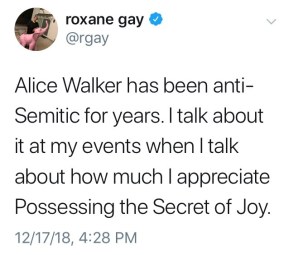
I will sadly confess that I was unaware of Alice Walker’s history of antisemitic attitudes, even though this was apparently common knowledge among many on the left. During the Twitter eruption that followed Rosenberg’s piece for instance, Roxane Gay commented:

IMG_5155

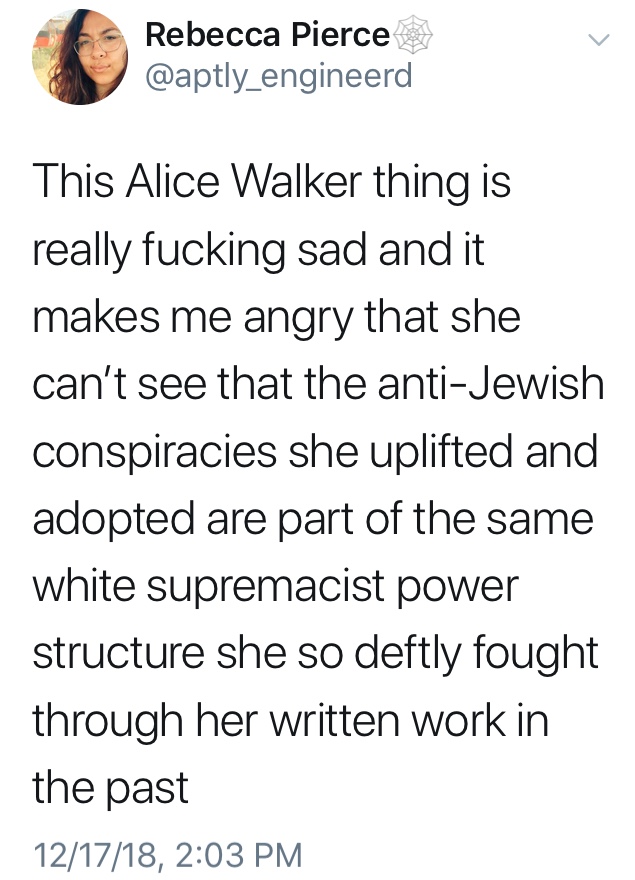
Those of us who were hearing of Walker’s antisemitic proclivities for the first time were particularly saddened to learn that this eloquent champion of anti-racism had been expressing such poisonous ideas toward Jews and Judaism. Journalist/filmmaker Rebecca Pierce spoke for many of us when she tweeted this response:

IMG_5152

In his article, Rosenberg made mention of Walker’s anti-Israel politics, challenging “the progressive left” to call out antisemitism that is “presented in the righteous guise of ‘anti-Zionism.’” Although I don’t share Rosenberg’s conservative Israel politics, I accept his challenge. And yes, it’s painfully true that Walker’s Talmud poem egregiously cites Jewish religious tradition as the root cause of Israel’s oppression of Palestinians (as well as American police brutality, mass incarceration and “war in general”):

For the study of Israel, of Gaza, of Palestine,
Of the bombed out cities of the Middle East,
Of the creeping Palestination
Of our police, streets, and prisons
In America,
Of war in general,
It is our duty, I believe, to study The Talmud.
It is within this book that,
I believe, we will find answers
To some of the questions
That most perplex us.

Walker’s claim that the Talmud is “evil” and “poisonous” – a common antisemitic trope – is worth unpacking here. First of all, what is referred to as “The Talmud” is actually a vast corpus of Jewish civil and ritual law mixed with freewheeling legend and Biblical commentary composed between 200 and 500 CE. Though it is one of Jewish tradition’s foundational texts, Talmudic literature is not, to put it mildly, immediately accessible to the untrained reader. It’s typically studied by traditional Jews in the rarified world of schools known as yeshivot, where students’ primary focus is on the unique pedagogy of Talmudic argumentation.

Like all forms of religious literature, Talmudic tradition expresses a wide spectrum of ideas and attitudes. The contemporary reader would likely find its content to be alternately inscrutable, inspiring, challenging, archaic – and yes, at times even repugnant. It contains passages for example, that are profoundly misogynistic. And as Walker pointed out in her poem, it also contains occasional material that is decidedly anti-Gentile, including a notorious passage that depicts Jesus condemned to suffer in hell in a vat of burning excrement. (Yep, it’s true.) There are also texts that unabashedly claim Jewish lives must take precedence over non-Jewish lives – an idea that was also advocated centuries later by Moses Maimonides.

These texts are undeniably, inexcusably offensive and they must be called out, full stop. At the same time however, it is exceedingly disingenuous to judge a religion on the basis of its most problematic pronouncements. This attitude simplistically accepts these texts at face value, devoid of any context or historical background. It also ignores the fact that almost all faith traditions address the offensive, archaic or inconsistent elements in their sacred literature through the use of hermeneutics – that is, principles and methods that help readers understand their meaning in ever-changing societal contexts.

How for instance, might a contemporary religious feminist read and understand a blatantly misogynist Talmudic text? In an article entitled “When Sages are Wrong: Misogyny in Talmud,” Dr, Ruhama Weiss, of Hebrew Union College offers one hermeneutical approach:

(These Talmudic traditions) caused me a powerful disturbance. They forced me to think and react; to think about mechanisms of power and control and about the ability to be free from them. To make an effort to find and highlight additional voices, earlier voices, buried and hidden in misogynist rabbinic discussions.

Most importantly, these difficult sources teach me a lesson in modesty; from them I learn that unequally talented and wise people with good intentions can bequeath to subsequent generations difficult and bad traditions. I see the moral blind spots of my ancestors, and I am obligated to examine my own moral blind spots. Bad and disturbing sources make me think.

Indeed, this same hermeneutic method can be applied to Talmud’s xenophobic, anti-Gentile content as well. That is to say, these texts can challenge us to see “the moral blind spots of our ancestors and thus to examine our own moral blind spots.” They can help us confront “mechanisms of power and control” and contemplate the ways we might be able to “free ourselves of them.” These bad and disturbing sources can “make us think.”

Of course there are those who will read the texts of their faith through a more literal, fundamentalist hermeneutic. In such cases, it is up to those who cherish their religious tradition and the value of human rights for all to challenge such interpretations, particularly when the lines between church and state power become increasingly blurred.

On the subject of state power, I must add that I find it exceedingly problematic when folks criticize Talmudic tradition for its xenophobic attitudes without acknowledging the fundamentally anti-Jewish attitudes that are embedded deep within Christian religious tradition. It’s also important to note that antisemitic church teachings were historically used to inspire centuries of anti-Jewish persecution throughout Christian Europe, while the Talmud was written and compiled in a context of Jewish political powerlessness.

Today, in this relatively new era of Jewish power, it is certainly important to remain vigilant over the ways Jewish tradition is used to justify the oppression of Palestinians. Indeed, since the establishment of the State of Israel, this subject has been intensely debated throughout Israel and the Jewish Diaspora. As I write these words in fact, I’m recalling a blog post I wrote back in 2009 about then Chief Rabbi of the Israeli Defense Forces Avichai Rontzki, who made a comment, based on Jewish religious texts, that soldiers who “show mercy” toward the enemy in wartime will be “damned”:

How will we, as Jews, respond to the potential growth of Jewish Holy War ideology within the ranks of the Israeli military?  How do we  feel about Israeli military generals holding forth on the religious laws of warfare? Most Americans would likely agree that in general, mixing religion and war is a profoundly perilous endeavor.  Should we really be so surprised that things are now coming to this?

I do not ask these questions out of a desire to be inflammatory. I ask them only because I believe we need to discuss them honestly and openly – and because these kinds of painful questions have for too long been dismissed and marginalized by the “mainstream” Jewish establishment.

In the end, every faith tradition has its good, bad and ugly. And in the end, I would submit that the proper way to confront these toxic texts is for people of faith to own the all of their religious heritage – and to grapple with it seriously, honestly and openly. And while we’re at it, it’s generally a good rule of thumb to avoid using the bad, ugly stuff in any religion’s textual tradition to make sweeping historical or political claims about that religion and/or the folks who adhere to it.

What is not at all helpful is for people such as Alice Walker to cherry-pick and decontextualize quotes from one particular religious tradition and warn that its “poison” is “winding its way into our collective consciousness.”

Like many of my friends who are just now learning about her adherence to antisemitic tropes, I fervently hope she will come to understand, as Rebecca Pierce put it, that the attitudes she endorses “are part of the same white supremacist power structure she so deftly fought through her written work in the past.”


Celebrating a New Jewish Diasporism: A Sermon for Rosh Hashanah 5777

tunisia

A synagogue in Djerba, Tunisia

As I’m sure you know, Tzedek Chicago has received a great deal of attention – some might call it notoriety – for calling ourselves a “non-Zionist” congregation. But contrary to what our most cynical critics might say, we didn’t choose this label for the publicity. When we founded Tzedek Chicago last year, used this term deliberately. We did so because we wanted to create an intentional community, based on specific core values. Our non-Zionism is not just a label. It is comes from our larger conviction to celebrate “a Judaism beyond nationalism.”

This is how we explain this particular core value:

While we appreciate the important role of the land of Israel in Jewish tradition, liturgy and identity, we do not celebrate the fusing of Judaism with political nationalism. We are non-Zionist, openly acknowledging that the creation of an ethnic Jewish nation state in historic Palestine resulted in an injustice against its indigenous people – an injustice that continues to this day.

I think it’s important that we named this value out loud. We need Jewish congregations that refuse draw red lines over the issue of Zionism, or at best to simply “tolerate” non or anti-Zionists in their ranks as long as they stay quiet. We need congregations that openly state they don’t celebrate a Jewish nation built on the backs of another people. That call out – as Jews – a state system that privileges Jews over non-Jews.

However, I realize that this core value begs another question – and its one I get asked personally from time to time. It’s usually some variant of: “Saying you are non-Zionist only tells me what you’re not. But what is it that your Judaism does celebrate?”

It’s a fair question – and I’d like to address it in my words to you this morning.

Continue reading

The Presbyterian Divestment Vote: Toward a New Model of Community Relations

Cross-posted with Tikkun Daily

Jews and Presbyterians pray together during deliberations at the 2014 Presbyterian General Assembly in Detroit

In the wake of the Presbyterian Church (USA)’s recent decision to divest from three companies that profit from Israel’s occupation, Jewish establishment leaders have been expressing their displeasure toward the PC(USA) in no uncertain terms.

Anti-Defamation League director Abe Foxman stated last week that church leaders have “fomented an atmosphere of open hostility to Israel.” Rabbi Noam Marans director of interreligious relations at the American Jewish Committee, declared that “the PC(USA) decision is celebrated by those who believe they are one step closer to a Jew-free Middle East.” And Rabbi Steve Gutow, president of the Jewish Council for Public Affairs, publicly accused the PC(USA) of having a “deep animus” against “both the Jewish people and the State of Israel.”

Given such extreme rhetoric, it may come as a surprise to many that the same overture that called for the Presbyterian Foundation and Board of Pensions to divest from Caterpillar, Inc., Hewett-Packard and Motorola Solutions also included the following resolutions:

– (To) reaffirm Israel’s right to exist as a sovereign nation within secure and internationally recognized borders in accordance with the United Nations resolutions;

– (To) declare its commitment to a two-state solution in which a secure and universally recognized State of Israel lives alongside a free, viable, and secure state for the Palestinian people;

– (To) reaffirm PC(USA)’s commitment to interfaith dialog and partnerships with the American Jewish, Muslim friends and Palestinian Christians and call for all presbyteries and congregations within the PC(USA) to include interfaith dialogue and relationship-building as part of their own engagement in working for a just peace.

– (To) urge all church institutions to give careful consideration to possible investments in Israel-Palestine that advance peace and improve the lives of Palestinians and Israelis.”

Do these sound like the words of a “hostile” church committed to a “Jew-free Middle East?”

In truth, these are the words of a religious community struggling in good faith to walk the path of justice while still remaining sensitive to the concerns of their Jewish sisters and brothers.

Such a description certainly comports with my own personal experience. I attended the Presbyterian General Assembly last week as part of the Jewish Voice for Peace delegation and had lengthy conversations with numerous GA commissioners. When I asked them to share their feelings about the divestment overture, the majority responded with a similar refrain: in their hearts they wanted to vote in favor, but they hesitated because they were worried what it might do to their relationships with their Jewish family and friends and colleagues.

This theme occurred repeatedly during the committee and plenum debates as well. Commissioners who opposed the overture relied less on political arguments than upon their concern for their personal relationships with Jews and with the Jewish community at large. Many commissioners who spoke in favor of the overture expressed similar concerns even as they decided to cast their votes as a matter of deeply held conscience.

In the end, the process that led up to the final vote on divestment was one of genuine discernment and faithful witness. To be sure, the final wording of the overture is a nuanced statement by a church that clearly seeks to follow its sacred mission of justice in Israel/Palestine even as it cherishes its long-standing relationship with the Jewish community.

As a Jew, I was deeply saddened that so many Jewish establishment leaders saw fit to resort to what can only be called emotional blackmail in order to fight against a Presbyterian overture that they didn’t like. But for all the undue pressure, I have no doubt that the heavy-handed nature of these tactics ultimately contributed in no small way to the success of the final divestment overture.

Notably, during the plenum discussion, one commissioner commented that he was “offended” to see some Jewish opponents to the overture wearing T-shirts that said “Love us or Leave Us.” Another asked if Reform movement President Rabbi Rick Jacob’s offer to broker a meeting in Jerusalem between Presbyterian leaders and Benyamin Netanyahu if they voted down the overture was somehow a thinly veiled threat.

As a Jewish supporter of divestment, I will say without hesitation that this vote was first and foremost a victory for Palestinians, who continue to suffer under Israel’s illegal and immoral occupation. On a secondary level, however, we might say that this was a victory for a religious community that refused to let its sacred convictions be stymied by cynical pressure.

As for us, the Jewish community is left with the very real question: Are we truly prepared to write off one of the largest American Christian denominations over this vote – a vote that was taken in good faith and with profound deliberation? And on a deeper level, we might well ask ourselves honestly, have the Jewish communal establishment’s bullying tactics finally reached the end of their usefulness?

Indeed, when it comes to the issue of Israel/Palestine, the unwritten rule of the Jewish establishment has always been, “toe our line or feel our wrath.” By voting for divestment, the PC(USA) declared itself ready to stand down this ultimatum.

There is now every reason to believe other denominations will now follow suit. Will our community continue to respond with cynical threats or will we finally be ready to model an approach to community relations grounded in trust, understanding and mutual respect?

God of Scarcity, God of Plenitude: My Address to the IPMN

IMG_0458

This past Monday it was my honor to give the keynote speech at a dinner sponsored by the Israel Palestine Mission Network of the Presbyterian Church (USA). The event took place in Detroit during the Presbyterian General Assembly and was attended by longtime Christian peace activists, many of whom have become become my dear friends and colleagues in the growing interfaith movement for a just peace in Israel/Palestine. 

Here is a text of my remarks:

I am humbled and honored to have been asked to speak to you tonight – and I’m particularly moved to look around the room and see so many people who have become my friends and colleagues in this amazing and growing movement that means so much to us all. I’d particularly like to thank  (Reverend) Katherine Cunningham (moderator of the IPMN) for being such a gracious host and guide to me during my stay here in Detroit.

I’d like to start by sharing a little bit of my journey and to try to explain how it is that I have come to stand before you today.

In most ways, you might describe me as a pretty average American Jew: I went to a Jewish Community Center pre-school, I grew up in a synagogue, had a Bar Mitzvah and belonged to my Temple Youth group. And like many American Jews, my Jewishness has been indelibly tied up with Israel for my entire life. My Jewish identity has been profoundly informed by the classic Zionist narrative: the story of a small underdog nation forging a national and cultural rebirth out of the ashes of its near-destruction. It is, at its heart, a redemptive narrative – and it has assumed a quasi-sacred status for me, as it has for many American Jews of my generation and older.

Politically speaking, I’ve identified with what tends to be referred to today as “liberal Zionism.” I’ve long been inspired by Israel’s Labor Zionist origins, and I’ve generally aligned myself with positions advocated Israeli peace movement. I’ve always been very willing to openly criticize the actions of the Israeli government that I believed were counter to the cause of peace. At the same time, however, I generally viewed these kinds of actions as “blemishes” on an otherwise stable democracy and a noble national project. At the end of the day, I understood the essence of this conflict to be a clash between two national movements, each with compelling and valid claims to the same small piece of land.

Over the years, however, I confess, I struggled with gnawing doubts over the tenets of my liberal Zionist narrative. Although I was able to keep these doubts at bay for the most part, I was never able to successfully silence them. As an outspoken critic of American militarism, for instance, I would occasionally ask myself why I wasn’t equally as outspoken about Israeli militarism – why I habitually would give a pass to what was, after all, the one of the most militarized countries in the world.

I would also entertain nagging questions about the ethnic nationalism at the heart of Zionism. Israel’s very existence as a Jewish state was bound up with its maintenance of a Jewish majority within its borders. Like many liberal Zionists, I’d often base my arguments for a two state solution by pointing to the population growth of Palestinians as a “demographic threat” to the national character of the Jewish state. As an American, I’d never dare describe an ethnic minority in the US as somehow posing a “demographic threat” to our national American character. Why, then, was I so willing to invoke this concept about so freely when it pertained to the Jewish state?

And in the darkest, wee hours of the night, I’d even question the very concept of a Jewish nation-state-ism itself. I’d ask myself, what does it mean to maintain an exclusively Jewish state in a land that has historically been multi-ethnic and multi-religious for centuries? Was it even possible to create a Jewish state that was truly democratic? How could a state define itself as “Jewish” and not view its non-Jewish population, in one way or another, as a problem to be dealt with?

When I was ordained as a rabbi in 1992, the stakes were raised on my personal political views. Given the ideological centrality of Zionism in the American Jewish community, my questions now carried very real consequences. As I’m sure you know, rabbis and Jewish leaders are under tremendous pressure by the American Jewish organizational establishment to maintain unflagging support for the state of Israel. Congregational rabbis in particular take a very real professional risk when they criticize Israel publicly. To actually stand in solidarity with Palestinians would be tantamount to communal heresy. So you might say I put those inner questions in a lock box and made a safe and comfortable home in liberal Zionism for the first decade of my rabbinate.

As Israel’s occupation over the Palestinians became more patently oppressive and widespread however, it became increasingly difficult for me to ignore my questions. The breaking point for me occurred in December of 2008, as it did for many American Jews. This was, of course, Israel’s military assault on Gaza, known as Operation Cast Lead.

I remember reading the news out of Gaza with utter anguish. Like many rabbis, my e-mail inbox filled with official Jewish communal talking points about how to respond to the events in Gaza: “This was about Israel’s security pure and simple.” “Like every nation, Israel had a responsibility to ensure the safety of its citizens.” “If Hamas hadn’t launched rockets into Israel, they wouldn’t have had to resort to such drastic military measures.”

In the past, I might have dutifully taken these talking points to heart, along with the obligatory apology: “of course we regret the deaths of innocent civilians.” But this time, I responded differently. In spite of my anguish, or perhaps because of it, I finally felt as if I was approaching this issue with something approaching clarity. The magnitude of Israel’s military onslaught was so disproportionate, so outrageous. By the end of Operation Cast Lead, over 1,400 Palestinians had been killed, 300 of them children. Whole neighborhoods had been reduced to rubble, Gaza’s infrastructure was left in ruins. By contrast, on the Israeli side, 13 people had been killed. Of these, 10 were soldiers, four of whom by friendly fire.

As I read the increasingly tragic news coming out of Gaza, I came to realize this was not about Israel’s security at all. This was about bringing the Palestinian people to their knees. If Israel was truly seeking its security, it was clear to me that it was the kind of security that came from wiping out the other side with the overwhelming strength of its military might. But of course this approach had never and would never bring peace and security to either Israelis or Palestinians.

This is when my paradigm for understanding the Israel/Palestine “conflict” fundamentally shifted. I came to accept that this was not a conflict between two equal sides with claims to the same piece of land. This was about the oppressor and the oppressed.

Although I had always considered myself to be part of the peace camp when it came to Israel – I now came to realize just how hollow it was to invoke the notion of peace without reckoning just as seriously with the concept of justice. I was now ready to accept and to say out loud that Israel’s very founding was irrevocably tied up with a very real injustice to the Palestinian people – an injustice that continues to this very day. And I knew in my heart that until this injustice was fully faced openly and honestly, there would never truly be peace in this land.

There is much more I could say about my own personal trajectory since that time, but for now, I’ll only say that six years after my break from Liberal Zionism, I have gradually found a home in the growing Palestinian solidarity movement. Much to my surprise and delight, I have found I can actually do this as a Jew. For this I owe a great debt to Jewish Voice for Peace for providing a genuinely Jewish home for those Jews who believe as I do, that Jewish tradition demands that we stand with the oppressed and stand down the oppressor – yes, even when it comes to the state of Israel.

I also continue to serve my congregation in Evanston. That doesn’t mean it has been easy. Needless to say, there are many members of my congregation who do not share my views – and there are some who are deeply pained by my activism. But the fact that I can still remain employed at the congregation that I love and continue to make my home in the Jewish community gives me hope that the parameters of Jewish discourse on this issue are widening in significant ways.

I’m often asked, how can I, as a Jew, take the kind of stands that I do? To this I can only reply: it is because I am a Jew that I take this stand. I believe that standing in solidarity with Palestinians is the most Jewish thing I can do. As a rabbi, as a Jew, and as a human being, I am primarily motivated by the prophetic strains of Jewish tradition. I am driven by religion that speaks hard truth to power. By a faith that holds unmitigated human power to account.

I fervently believe that when religion advocates the cause of the powerless, when it stands with those who are victimized by the powerful, when religion proclaims that God stands with the oppressed and seeks their liberation – this is historically when religion has been at its very best. And conversely, when religion is used to promote empire, when it is used as by the powerful to justify their rule, when it is wedded to militarism, nationalism and political power – this is, tragically, when we witness religion at its worst.

I cannot help but read Jewish tradition with prophetic eyes. As a Jew, I’ve always been enormously proud of the classic rabbinical response to empire. I believe that the Jewish people have been able to survive even under such large and mighty powers because we’ve clung to a singular sacred vision. That there is a Power even greater. Greater than Pharaoh, greater than Babylon, even greater than the Roman empire that exiled us and dispersed our people throughout the diaspora. It is a quintessentially Jewish vision best summed up by the prophetic line from the book of Zechariah: “Lo b’chayil v’lo b’koach” – “Not by might and not by power, but by my spirit, says the Lord of Hosts.”

Now, there are many who challenge such a religious vision as naive, as over-idealistic, as noble but unrealistic. They tell me it’s all well and good to promote justice, but in the real world “the perfect is the enemy of the good.” In the real world, we need to make hard compromises to achieve peace.

Whenever I hear these kinds of comments, I can’t help but think back to Martin Luther King’s “Letter from a Birmingham Jail,” in which he addressed the liberal clergy who had told him to stay away from Birmingham and not to rock to boat – and to give them the chance to negotiate with the Jim Crow authorities. I can’t help but think of those who criticized those who advocated for divestment from South African apartheid, who said that such measures would antagonize the apartheid regime and counseled “positive engagement” instead.

In all these cases and so many more, peace was viewed as synonymous with “not disturbing the status quo” and justice was seen as the enemy of the good. But of course, today we now openly venerate these struggles for justice and liberation. And these movements succeeded because they were led by people who understood, as King put it so well in his letter, that “Power is never given voluntarily by the oppressor; it must be demanded by the oppressed.”

I’d like to end by addressing another way in which my theological understandings have been impacted by my participation in this movement. I mentioned earlier that I used to understand the essence of this conflict to be a clash between two national movements, each with compelling and valid claims to the same small piece of land. As well meaning as such an understanding might be, the problem with this kind of idea is that it is rooted in the notion that any people or nation can actually “stake a claim” on a piece of land. Such a notion can surely be traced back to the Biblical notion of a God that apportions the land and entitles one people to it. To be sure, this is a zero-sum theological model in which there is only enough room on the land for one people – a people who is, moreover, commanded to take possession of the land by dislodging others.

But when we shift the question from “which people has a right to this land?” to “how do we extend full human and civil rights to all who live on the land?” we discover a decidedly different Biblical vision. We lift up the God who tells us that all humanity is made in the divine image – and that when push comes to shove, the land does not ultimately belong to any of us, but to God and we are all but strangers upon it.

I submit to you that our movement is deeply rooted in this theological vision – one that invokes the God of plenitude, not scarcity. After all, when we define our entitlements to a finite commodity such as land, we only doom ourselves to a future filled with endless upheaval and violence. The Bible describes our lot in this regard only too well.

However, when come to understand that our ultimate entitlement is to a boundless commodity such as human rights and human dignity, we ensure a future of true peace for ourselves and our children. This, I believe, is the Biblical vision we share and to which I know we are all so passionately and fervently committed.

It is my honor to share this vision with all of you – and to help build the movement that will one day make it a reality.

From the Presbyterian GA: Jews and Christians in Support of Divestment

brantandlynn

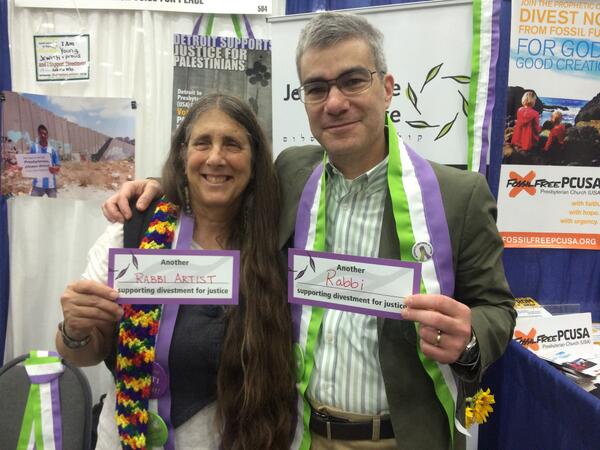
With Rabbi Lynn Gottlieb at the JVP booth, PC (USA) General Assembly, Detroit, June 15. 2014.

I’ve just returned from two days in Detroit at the Presbyterian Church (USA) General Assembly, where I joined together with Christian and Jewish friends and colleagues to help support overtures being brought to the plenum that support the cause of justice in our country and around the world – particularly in Israel/Palestine.

During my very full sojourn in downtown Detroit, I had the opportunity to testify in a committee meeting that was deliberating on an overture that presented new parameters for Interfaith Relations. I also attended the extensive committee discussions on the overture that is garnering a great deal of attention from around the world: divestment of the PC (USA)’s funds from three companies that profit from Israel’s occupation: Caterpillar, Motorola Solutions, and Hewlett-Packard. (See my previous post for more on this subject).

BqQmTzGIUAE498N

As I wrote in my previous post, this overture has long, ten year history behind it. Although it has been brought to previous GA’s, each convention brings brand-new commissioners, so while many attendees are all too familiar with this particular overture, many (if not most) of the ones who will actually be voting are relatively new to the issues involved. Even so, I had the pleasure of speaking with a number of commissioners who are considering this overture with an impressive level of thoughtfulness and seriousness.

BqQhXIOIEAAwQjB

Some of the most profound moments of my experience at the GA came from the realization that I am truly part of a large and growing interfaith movement for justice that has fast become an important spiritual home for me. I came to the GA with a large delegation from Jewish Voice for Peace, who has worked closely with PC (USA) members who have engaged on this issue for nearly a decade. (You can meet just a few of them above and below).

At the same time, I worked hand in hand with many inspired Presbyterian activists who have become dear friends and true spiritual teachers. This past Monday night it was my great honor to offer a keynote speech at a dinner sponsored by the Israel Palestine Network of the Presbyterian Church (USA). As I spoke, I was deeply moved to look out at the room and see so many old and new colleagues, all part of this very special community of conscience. (I will be posting my remarks in a subsequent post. Stay tuned).

BqQjgN2IAAASDxl

There is much more to unfold as the GA continues to deliberate this week. As of this writing, the committee discussing the divestment overture will soon be deciding whether or not to refer it to plenum. In the meantime, I highly recommend to you two important pieces on this issue recently written by my colleagues on the JVP Rabbinical Council.

From Rabbi Margaret Holub, writing in the Forward:

Our greatest hope is that the Jewish people would hear selective divestment from these corporations as what it is — a form of tochechah. It is a rebuke from our neighbors in the American religious landscape, calling us to task for a cruel policy that brings pain to their own brothers and sisters in the Palestinian Christian community and to all who live under Israeli occupation. Far from being hate speech, it is the speech of conscience.

We believe in fact that the Presbyterian Church has many new friends to gain in the Jewish community and beyond it through its courageous witness. We may not share all of our beliefs or political commitments. Such is the beauty and difficulty of coalition work, or of any kind of spiritual companionship. We have much to learn from each other, and in long-term relationships our differences are as important as our points of convergence.

And from Cantor Michael Davis, in Tikkun:

I, an Israeli national who served three years in the IDF, and who has served the Jewish community in Chicago for over 20 years, support the right of our Presbyterian friends to freely explore their conscience on divesting from American companies that benefit from Israel’s illegal occupation of the West Bank. I will be at the Presbyterian General Assembly arguing for divestment. I believe, along with a growing number of Jews and Israelis that BDS is the best non-violent option to stop the downward spiral to inevitable violence. For Jews – and for Christians – divestment is a principled position. As a supporter of BDS myself, I know how much effort the mainstream Jewish community is putting into shutting down this debate and excluding BDS supporters from the Jewish community. I would challenge those who are trying to shut down the Presbyterian debate to show how the motives of those supporting divestment are anything less than honest. This is unworthy of us as Jews and particularly egregious when directed at our Christian neighbors.

BqStgWGCcAACxJu

Presbyterian Divestment Redux: All Eyes on Detroit!

ga1-580x580While the public criticism and upheaval over BDS continues apace, this movement is slowly and inexorably tallying victory after victory. Last week, the Gates Foundation announced that it was fully divesting from G4S – a British/Danish security firm that has been severely criticized for its operations in the occupied Palestinian territories and in prisons and detention centers in Israel, including those housing children and “administrative detainees” held without charge or trial.

Now just this week, we’ve learned that the United Methodist Church – the largest mainline Protestant church in the United States – will be pulling all its investments from G4S as well. This news is huge – and a dramatic precursor to the General Assembly of the Presbyterian Church (USA), which will be convening in Detroit next week. I can’t help but think the BDS tide is turning significantly, particularly in the arena of church divestment campaigns.

I’ve long participated with colleagues in Protestant church groups who have been actively involved in promoting the principled and targeted divestment of their denominations’ funds from companies that profit from Israel’s illegal and oppressive occupation of Palestinians. I was, in fact, an active supporter of the divestment “overture” brought to the last Presbyterian GA two years ago and wrote extensively about these efforts.

This is what I wrote at the time:

I support this resolution without reservation and urge other Jewish leaders and community members to do so as well. I am deeply dismayed that along every step of this process, Jewish community organizations (among them, the Anti-Defamation League, the Simon Wiesenthal Center and the Jewish Council on Public Affairs) that purport to speak for the consensus of a diverse constituency have been intimidating and emotionally blackmailing the Presbyterian Church as they attempt to forge their ethical investment strategy in good faith.

It is extremely important to be clear about what is at stake here. First of all, this is not a resolution that seeks to boycott or single out Israel. Divestment does not target countries – it targets companies.  In this regard speaking, the PC (USA)’s ethical investment process seeks to divest from specific “military-related companies” it deems are engaged in “non-peaceful” pursuits.

We’d be hard-pressed indeed to make the case that the Israeli government is engaged in “non-peaceful pursuits” in the Occupied Territories and East Jerusalem.  I won’t go into detail here because I’ve been writing about this tragic issue for many years: the increasing of illegal Jewish settlements with impunity, the forced evictions and home demolitions, the uprooting of Palestinian orchards, the separation wall that chokes off Palestinians from their lands, the arbitrary administrative detentions, the brutal crushing of non-violent protest, etc, etc.

All Americans – Jews and non-Jews alike – have cause for deep moral concern over these issues.  Moreover, we have cause for dismay that own government tacitly supports these actions. At the very least, we certainly have the right to make sure that our own investments do not support companies that profit from what we believe to be immoral acts committed in furtherance of Israel’s occupation.

As the co-chair of the Jewish Voice for Peace Rabbinical Council, I am proud that JVP has initiated its own divestment campaign which targets the TIAA-CREF pension fund, urging it to divest from companies that profit from Israel’s occupation. Among these are two of the three companies currently under consideration by PC (USA): Motorola and Caterpillar.

Why the concern over these specific companies? Because they are indisputably and directing aiding and profiting the oppression of Palestinians on the ground. Caterpillar profits from the destruction of Palestinian homes and the uprooting of Palestinian orchards by supplying the armor-plated and weaponized bulldozers that are used for such demolition work.  Motorola profits from Israel’s control of the Palestinian population by providing surveillance systems around Israeli settlements, checkpoints, and military camps in the West Bank, as well as communication systems to the Israeli army and West Bank settlers.

And why is Hewlett-Packard under consideration for divestment by the PC (USA)? HP owns Electronic Data Systems, which heads a consortium providing monitoring of checkpoints, including several built inside the West Bank in violation of international law.  The Israeli Navy, which regularly attacks Gaza’s fishermen within Gaza’s own territorial waters and has often shelled civilian areas in the Gaza Strip, has chosen HP Israel to implement the outsourcing of its IT infrastructure.  In addition, Hewlett Packard subsidiary HP Invent outsources IT services to a company called Matrix, which employs settlers in the illegal settlement of Modi’in Illit to do much of its IT work at low wages.

I repeat: by seeking to divest from these companies the PC (USA) is not singling out Israel as a nation.  The Presbyterian Church has every right to – and in fact does – divest its funds from any number of companies that enable non-peaceful pursuits around the world.  In this case specifically, the PC (USA) has reasonably determined that these particular “pursuits” aid a highly militarized, brutal and oppressive occupation – and it simply does not want to be complicit in supporting companies that enable it.

I encourage you to read the entire post, which also includes a detailed history of the process undertaken by the Presbyterian Church (USA). The current overture, like the one two years ago, seeks divestment from the same three companies: Hewlett-Packard, Motorola and Caterpillar.

And inevitably, like before, the overture’s sponsors and their supporters have been subjected to an unrelenting barrage of criticisms and accusations from certain quarters of the Jewish establishment. I am particularly dismayed to learn that J St. – ostensibly an anti-occupation organization – is once again joining forces with those who hope to quash this principled, good faith proposal.

On this point, I’m in full agreement with Israeli journalist Larry Derfner, who recently wrote:

J Street was instrumental in beating back the same motion in 2012, when it failed before the church’s General Assembly by a vote of 333–331. But that was then. Then it was possible to argue (although I’d already stopped) that there was still hope that the United States would pressure Israel into making peace. Then it was still at least reasonable for J Street President Jeremy Ben-Ami to tell the Presbyterian Church, “Reject divestment, and embrace full-on pursuit of the diplomatic efforts necessary to create genuine and lasting peace for Israel and the Palestinian people.”

But now? What argument can an anti-occupation movement make to the Presbyterian Church in June 2014 about why it should not divest from Caterpillar’s bulldozers, Hewlett-Packard’s ID system for Palestinians and Motorola’s surveillance machines? Because it would interfere with U.S. diplomacy in the Middle East? Because it would harden the Netanyahu government’s stance in the peace talks?

From an anti-occupation perspective, what is there to lose by a Presbyterian Church vote for divestment? Nothing. But what is there to gain? A blow against injustice, the kind that has been scaring the Netanyahu government and Israel lobby like nothing else — certainly not the Obama administration — which is a very good sign that the BDS campaign is on to something.

With the failure of the peace process and Israel’s recent announcement of 1,500 new settlements, it is clear that political pressure has been utterly ineffective in bringing a just solution to this unjust occupation. Why then, must we block attempts at the popular, nonviolent pressure tactics such divestment – particularly when such efforts have been demonstrably effective in other parts of the world?

I will be posting much more about the divestment overture at Presbyterian GA in the coming week. Stay tuned.

The Pope Prays in Bethlehem, Lets Graffiti Do the Talking

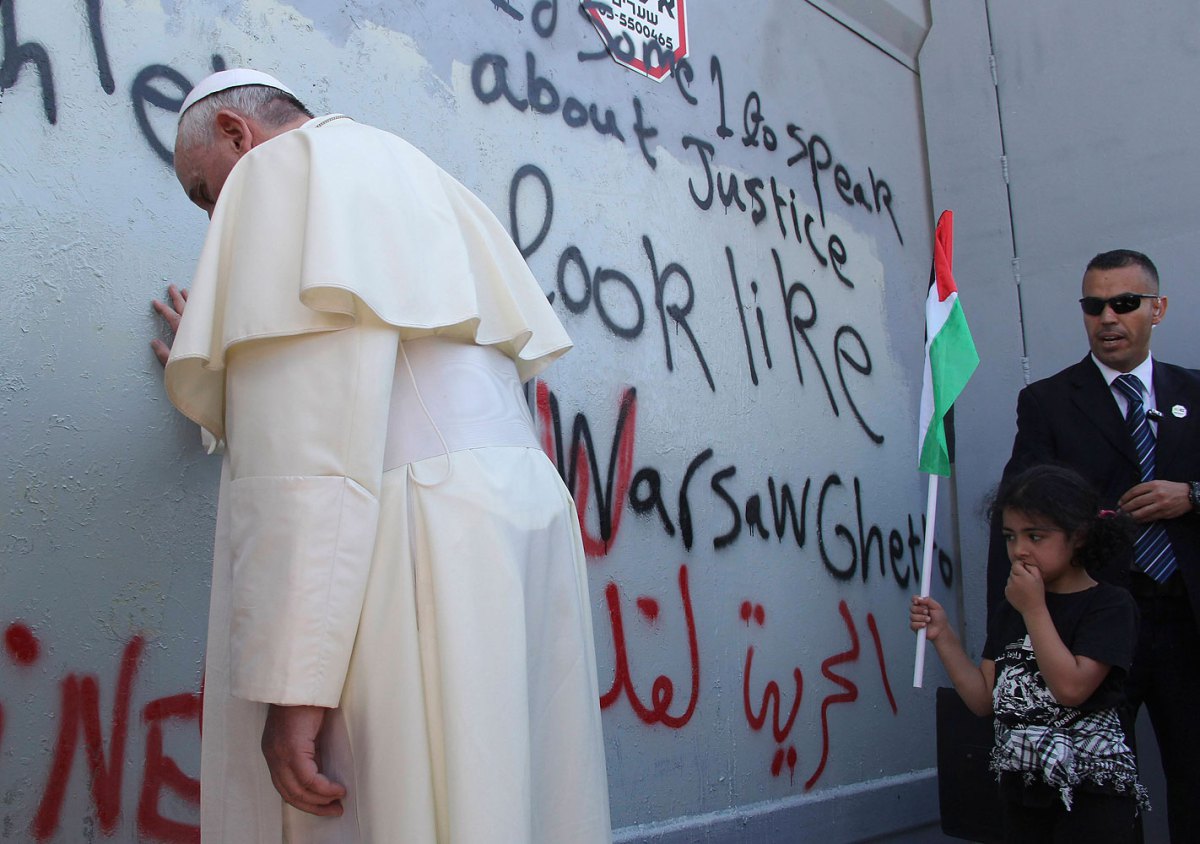
Pope Francis touches the wall that divides Israel from the West Bank in the West Bank city of Bethlehem

In the wake of Pope Francis’ recent visit to Israel/Palestine, many watchers have commented on his unscheduled visit to the separation wall in Bethlehem – and are already referring to the picture taken there as “iconic.”  It is indeed a powerful image: with the Pope leaning his head against the wall in prayer standing next to a young girl holding a Palestinian flag. Emblazoned across the wall, the graffiti pointedly reads, “Pope, we need some 1 to speak about justice” and “Pope, Bethlehem look like the Warsaw ghetto.”

Though the Pope made many stops at both Palestinian and Israeli sites, it is safe to say that his visit to the wall in Bethlehem will provide the most enduring image of the trip. Here we see the Pope praying at a very different kind of “wall.” While Popes and other religious dignitaries have long visited the Western Wall in Jerusalem as a matter of course, this was the first time a Pope had ever prayed at the separation wall. In his way, Pope Francis reminded us that while Israel has its wall, the Palestinians also have theirs. It was difficult to ignore the sacred symbolism of these parallel acts.

It was also difficult to ignore the powerful message imparted by the words of graffiti that framed the Pope as he leaned his head against the wall in prayer. By all accounts, there is every reason to believe that Pope Francis consciously chose this precise spot to alight from his Pope-mobile and engage in this impromptu prayer-session. In an eye-opening blog post , Bethlehem-based photojournalist Kelly Lynn has written about Mohammed Abu Srour, the young Palestinian activist who sprayed the graffiti message in advance of the Pope’s visit. Apparently, Mohammed and his comrades played an extensive game of cat and mouse with IDF soldiers and PA security before he was able to successfully spray his direct message just in time for the Pope’s arrival:

A few minutes before Pope Francis arrived, spray cans surfaced and activists from the previous day’s action began to paint over the newly, newly-painted wall and gate.  Mohammed climbed his friend’s shoulders and because of the frenzy, security personnel could not be bothered. “They painted all of the wall silver, you couldn’t see anything we did yesterday, so we decided to write again for the Pope.  We want him to pay attention to our issues as normal Palestinians,” explained Abu Srour.

And then, in a glass-covered pristine white pick-up truck, he came.

“I didn’t expect the Pope to go down and start to read the sentences and meet the children and people there.  He shocked us,” said Abu Srour.

For his part, the Pope’s driver later told the Wall Street Journal that when the Pope saw the graffiti, he asked him to stop the car:

Francis suddenly asked to pull over so he could step out. He opened the door and wandered toward the wall as his security detail scrambled to keep up with the 77-year-old pope.

Below the watchtower, Francis reached out to near where the graffiti had been scrawled and painted over two times before. He closed his eyes and began to pray.

In most other ways, Pope Francis’ visit represented a boiler plate Papal visit to the Holy Land, as he balanced his time and nuanced his statements with Israelis and Palestinians with the skill of a seasoned tight rope walker. Other than a reference in his sermon to “the State of Palestine,” he largely avoided pointed political comments. He used the safe language of “two states for two peoples” and extended an invitation to Israeli President Shimon Peres and Palestinian President Abbas to visit the Vatican in June to pray together.  In the words of a Vatican spokesman:

The pope does not have a political agenda and does not have a proposal for diplomatic dialogue. This is not his mission. This is not what he desires.

Perhaps, but it is difficult to shake the now enduring image of the moment Pope Francis consciously chose to go off script. Even if protocol would not allow him to say so personally, he still allowed one young Palestinian’s spray painted plea to say it for him.

People You Should Know About: Sister Pat Murphy and Sister JoAnn Persch

Jo and Pat

This past Friday morning, members of my congregation and I participated in an interfaith vigil at the immigrant detention facility in Broadview, IL. We’ve come to this spot many times over the years and I’ve written about the vigil many times before. It was founded several years ago Sister JoAnn Persch (right) and Sister Pat Murphy (left) of the Sisters of Mercy – two of my spiritual heroes.

During the vigil, Sister Jo joyfully announced that the Marie Joseph House of Hospitality, a home that provides shelter, meals, transportation, and community support for people awaiting their immigration proceedings, was finally open. Sister Jo and Sister Pat have been indefatigably working to create this community-based alternative to detention of undocumented immigrants, who are typically treated as “inventory” during deportation hearings. Her announcement provided one small but profound ray of hope in an otherwise dark and dismal reality for those fighting for compassionate immigration reform.

In a recent article about the Marie Joseph House, Sister Pat and Sister Jo pointed out that this new facility will be able to provide these services for significantly less than the $122 to $164 per day ICE says it pays to hold someone in jail. The home will have 18 bedrooms and extra space for short-term residents. It’s a small capacity compared to the 33,400 people ICE typically detains each night, but as Sister Pat and Jo rightly note, it’s a start:

We are not alone in our efforts. A network of similar shelters is emerging across the country. The outpouring of financial, in-kind, and volunteer support we receive from communities of all backgrounds shows us the immense generosity Americans have when people are in need.

As Alabama Republican Congressman Spencer Bachus observed during a recent House Judiciary hearing, “It seems there is an overuse of detention.” John Morton said that “alternatives to detention” programs are promising. We agree. Outside detention, people have better access to lawyers, doctors, and other support. Congress should use new immigration legislation to allow ICE to invest in alternatives rather than prisons. To get it right, they need to consult with communities and groups like ours.

I’ve known and worked alongside Sister Pat and Sister Jo for many years now, and am consistently inspired by their example of deep faith, abiding compassion and dogged persistence. For the past 45 years they have worked together in Chicago to minister to immigrants, refugees, older persons, and homeless families – and to advocate for their basic rights. In 2008, they helped to spearhead an intense lobbying drive to pass historic legislation that allows all immigrant detainees held in Illinois jails the same access to clergy as those imprisoned for other crimes. As a result, many professional and lay ministers can now serve the pastoral needs of undocumented immigrants who would otherwise be locked away and forgotten by everyone but their families.

Sister Pat and Sister Jo’s work has not gone unnoticed in the wider world. They were profiled in the play Home/Land (produced by Chicago’s Albany Park Theater Project) and more recently in the documentary film, “Band of Sisters,” (below) which explores the social justice activism of American nuns throughout the country. Though this kind of attention is much deserved, Sister Pat and Sister Jo would be the first to say that they are simply living out their faith in the most basic of ways: to minister to the needs of the most vulnerable members of society and to demand that our system do the same.

Sister Pat and Sister Jo are truly my spiritual teachers and I am so grateful to know and work alongside them. I know of few others who model compassion and justice with such decency and grace.


Land and Liberation: An Interview with Reverend Naim Ateek

brantandnaim

This past weekend, I had the great pleasure to engage in an extended interview with Reverend Naim Ateek, founder of Sabeel Ecumenical Liberation Theology Center, during a brief visit he made to Chicago. I’ve known Rev. Ateek for several years and am honored to call him a friend and colleague – and I’ve written before about his important work in the development of Palestinian liberation theology.  Since he’s been the object of unrelenting attack by the Jewish institutional establishment, I was particularly grateful for the opportunity to model a different kind of Jewish-Christian engagement on his life and his work.

An edited version of our conversation follows here:

Continue reading