I’ve decided not to celebrate Yom Ha’atzmaut today. I don’t think I can celebrate this holiday any more.
That doesn’t mean I’m not acknowledging the anniversary of Israel’s independence – only that I can no longer view this milestone as a day for unabashed celebration. I’ve come to believe that for me, Yom Ha’atzmaut is more appropriately observed as an occasion for reckoning and honest soul searching.
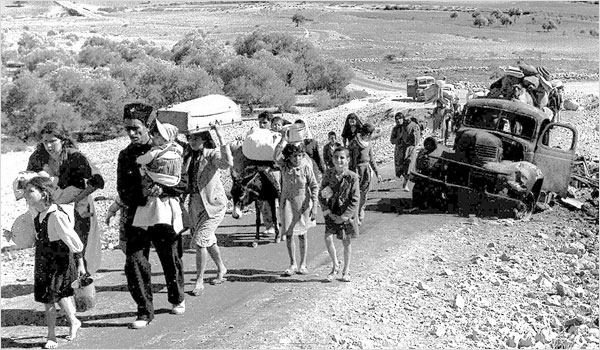
As a Jew, as someone who has identified with Israel for his entire life, it is profoundly painful to me to admit the honest truth of this day: that Israel’s founding is inextricably bound up with its dispossession of the indigenous inhabitants of the land. In the end, Yom Ha’atzmaut and what the Palestinian people refer to as the Nakba are two inseparable sides of the same coin. And I simply cannot separate these two realities any more.
I wonder: if we Jews are ready to honestly face down this “dual reality” how can we possibly view this day as a day of unmitigated celebration? But we do – and not only in Israel. Indeed, there is no greater civil Jewish holiday in the American Jewish community than Yom Ha’atzmaut. It has become the day we pull out all the stops – the go-to day upon which Jewish Federations throughout the country hold their major communal Jewish parades, celebrations and gatherings.
I wonder: how must it feel to be a Palestinian watching the Jewish community celebrate this day year after year on the anniversary that is the living embodiment of their collective tragedy?
I can’t yet say what specific form my new observance of Yom Ha’atzmaut will take. I only know that it can’t be divorced from the Palestinian reality – or from the Palestinian people themselves. Many of us in the co-existence community speak of “dual narratives” – and how critical it is for each side to be open to hearing the other’s “story.” I think this pedagogy is important as far as it goes, but I now believe that it’s not nearly enough. It’s not enough for us to be open to the narrative of the Nakba and all it represents for Palestinians. In the end, we must also be willing to own our role in this narrative. Until we do this, it seems to me, the very concept of coexistence will be nothing but a hollow cliche.
Toward a new understanding of Yom Ha’atzmaut, I commend to you this article by Amaya Galili which was published today in the Israeli newspaper Yediot Achronot. Galili is affiliated with Zochrot – the courageous Israeli org that works tirelessly to raise their fellow citizens’ awareness about the Nakba.
An excerpt:
The Israeli collective memory emphasizes the Jewish-national history of the country, and mostly denies its Palestinian past. We, as a society and as individuals, are unwilling to accept responsibility for the injustice done to the Palestinians, which allows us to continue living here. But who decided that’s the only way we can live here? The society we’re creating is saturated with violence and racism. Is this the society in which we want to live? What good does it do to avoid responsibility? What does that prevent us from doing?
Learning about the nakba gives me back a central part of my being, one that has been erased from Israeli identity, from our surroundings, from Israeli education and memory. Learning about the nakba allows me to live here with open eyes, and develop a different set of future relationships in the country, a future of mutual recognition and reconciliation between all those connected to this place.
Accepting responsibility for the nakba and its ongoing consequences obligates me to ask hard questions about the establishment of Israeli society, particularly about how we live today. I want to accept responsibility, to correct this reality, to change it. Not say, “There’s no choice. This is how we’ve survived for 61 years, and that’s how we’ll keep surviving.” It’s not enough for me just to “survive.” I want to live in a society that is aware of its past, and uses it to build a future that can include all the inhabitants of the country and all its refugees.
Click here to read the article in the original Hebrew. Click below to read the entire English version. (Heartfelt thanks to my friend Mark Braverman for sending it along.)
 Shalom Rav