In this week’s Torah portion, Parashat Va’era, God’s tells Moses to return to Mitzrayim and say to the Israelites:
“I am יהוה. I will free you from the labors of the Egyptians and deliver you from their bondage. I will redeem you with an outstretched arm and through extraordinary chastisements.” (Exodus 6:6)
But when Moses attempts to impart this message of liberation to the people, they weren’t able to hear it as “their spirits were crushed (kotzer ruach) by cruel bondage.” (6:9)
This one verse says so much about the trauma of personal and systemic abuse. The Hebrew word ruach means both “spirit” and “breath/wind.” On one level this could mean that their oppression was so severe that individual Israelites could barely breathe. On a deeper level, it might indicate that their collective spirit was so damaged they couldn’t even begin to comprehend the possibility of liberation.
The dual meaning of the word ruach in Jewish tradition suggests that the divine spirit is embodied by our very breath: the life force that we share with God and all that lives. In the first chapter of Genesis, we read that the process of creation began when the ruach elohim (“God’s breath”) rippled across the primordial waters. Humanity itself came to life when God breathed into the first human. In Jewish liturgy, we awaken every morning expressing gratitude for “the breath of every living thing and the spirit of all flesh.”
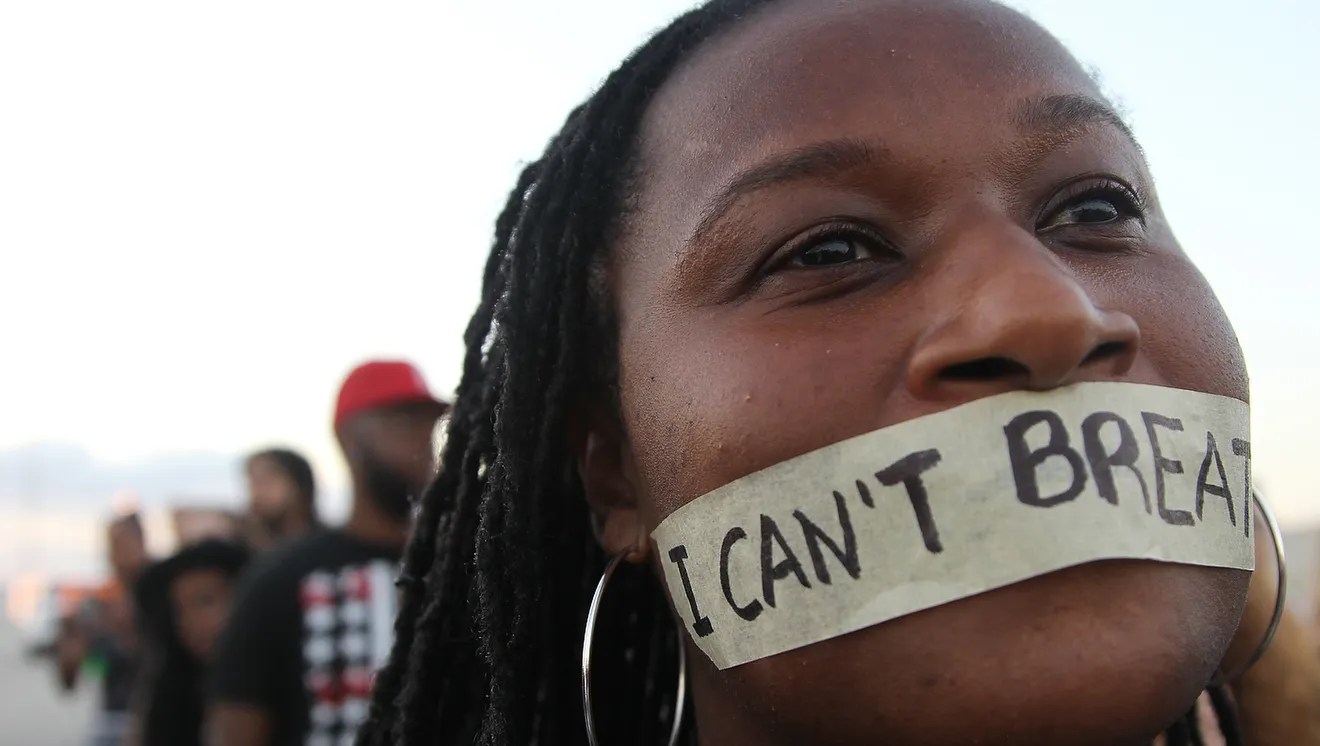
I believe there are powerful spiritual/political implications embedded in this theological concept. It suggests that when human beings – or humanly-created systems of oppression – deprive people of their ability to breathe freely, the flow of divine life force in the world is disrupted. Moreover, the demand to be able to breathe is itself a clarion call to action. We need look no farther than the phrase “I can’t breathe,” the final words of George Floyd and Eric Garner, whose deaths at the hands of systemic racism provided a powerful spark for the Black Lives Matter movement. Nigerian writer/poet Ben Okri has suggested that these three words “should become the mantra of oppression,” from the racist systems in our communities to the life-choking forces of global climate change.
In this regard, we might view the Jewish practice of giving thanks for our breath every morning as much more than a simple prayer discipline: it is nothing less than a statement of connection and solidarity with all that lives. Those who can breathe easily tend to regard the act of breathing as a natural, involuntary reflex. But as those with chronic respiratory illnesses will surely attest, it is no small thing to be able to take a breath. And in the age of COVID and climate change, millions throughout the world are increasingly becoming chronically kotzer ruach as a result of systemic oppression and corporate profit.
In other words, a commitment to a world in which everyone can breathe freely is a spiritual/political act of resistance. As disability justice activist Rabbi Julia Watts Belser has written:
Let’s learn to work more slowly, move more deliberately. Let’s learn to listen, when our bones say no. Let’s mandate breaks for anyone who works outside. Let’s require air purifiers, ventilation systems and safe work environments. Let’s make sure that all of us can breathe.
It is not too hyperbolic to suggest that the current political moment has left many of us breathless. As we death-scroll through the news of Trump’s executive orders and authoritarian policies, the ferocity of this onslaught can leave us literally or figuratively gasping for air. But this is, of course, just what Trump and his movement wants: to leave us reeling through a calculated strategy of shock and awe. They want us to feel breathless, paralyzed, despairing. We must not succumb. We must not accept that breathlessness is the new existential normal of our political age. We cannot become, like the Israelites of our Torah portion, so kotzer ruach that we cannot even imagine the possibility of something better beyond this authoritarian tyranny.
In the work of resistance, the first order of business is, quite simply, remembering to take a breath. Because in the end, if we are paralyzed with breathlessness for the next four years, we will be of no use to ourselves or anyone else. Moreover, once we regain our breath and our equilibrium, we will be in a better place to discern what we can do to meet this moment. In the wise words of Chicago organizer Kelly Hayes:
When your enemy wants you disoriented, your ability to focus is an important means of self-defense. What matters to you in this moment? Most of us can meaningfully dedicate ourselves to one or two causes, at the most. What can you commit to doing something about? Where do you get trustworthy information about those subjects? Who do you connect with when deciding what to do about what you’ve learned? Is there an organization whose resources you will employ or whose calls to action you will answer? Do you have a friend group or solidarity network that will formulate a response together? Answering these questions is key to steadying yourself in these times. Remember: Vulnerable people don’t need a sea of reactivity right now. They need caring groups of people who are working together to create as much safety as they can. We need to create a rebellious culture of care. That will take focus and intention. It will take relationships and a whole lot of energy.
This Shabbat, let’s all commit to breathing more freely. Then let’s fight for a world in which that freedom is extended to all.
The High Holidays we observed in 2020 were like none we’d ever experienced before. We were in the midst of the COVID lockdown – and like every other synagogue, we held our services entirely on Zoom. It all felt utterly unprecedented and surreal – apropos of a year in which pretty much everything felt unprecedented and surreal.
On Rosh Hashanah, I addressed the pandemic directly, suggesting that we were all in a collective state of grief – both for those had died and for the world we had lost:
Amidst all of this massive change, even as we adjust to this new world, there’s that nagging question lurking in the background: how long will we actually have to do this? When will we get our lives and our world back? When will things get back to “normal?”
I think it’s safe to say we’ve come a long way in the three years since then. Just a few months after I spoke those words, the first COVID vaccine was administered – and since that time, COVID related deaths and hospitalizations have decreased dramatically. Lockdown orders have been lifted, mask mandates have disappeared and social distancing requirements are now a thing of the past. While a large percentage of the workforce are still working from home, increasing numbers are returning to their workplaces.
We’re also receiving a confident political message that things are getting “back to normal.” A year ago, President Biden publicly declared that the pandemic was over during an appearance in 60 Minutes. This past May, his administration ended the Public Health Emergency Declaration, dramatically reducing funding for COVID vaccines and treatments. In its announcement, the White House claimed that “(COVID-19) no longer meaningfully disrupts the way we live our lives.”
Is this actually true? Are things really getting back to normal? Technically speaking, the pandemic is not over, though we fervently wish it were. Thousands continue to die every week – in the US, nearly one hundred are dying every day. In recent weeks, a spike has caused a sharp increase in hospitalizations, a dramatic reminder that COVID is still very much a part of our lives and our world.
What’s the reason for this normalization? On a purely human level, I think it’s pretty easy to understand. We want our lives back. We don’t want to live with uncertainty and upheaval any more. We crave the connection and community that we once knew. We want things to feel normal again.
But no matter how fervently we might back our days of old, things are still not normal. On so many levels.
In the first place, things are not certainly normal for the loved ones of the millions who have died of COVID. Almost 7,000,000 people have died from COVID globally since the pandemic began – including over 1,000,000 in the US. The mass grief caused by this pandemic is still very palpable and very real. For those who are just beginning to struggle with the loss of a parent, a partner, a child, the suggestion that it is time for things to “get back to normal” is quite simply, profane.
This insistence on normalcy dismisses the massive, life-altering consequences of these losses. Many who died of COVID were the primary or sole wage earner in their household. Moreover,hundreds of thousands of children in the US – and over 10 million children worldwide – have lost a parent or caregiver to COVID. According to a report last December by the Covid Collaborative, more than 13,000 children have lost their sole caregiver; children who were already more socially and economically at risk.
COVID normalization also amounts to an abject abandonment of elderly people in our communities. Hospital admissions, while dropping, are more than five times higher among people over 70 than those in their 50s. COVID also disproportionately affects immunocompromised, disabled and chronically ill people, whose humanity is routinely dismissed by US government and health officials that treat their conditions as expected, and thus somehow more acceptable.
In a recent New York Times article about the latest COVID spike, I read one subtle paragraph that sums up the prevailing attitude toward those who are at higher risk of illness and death:
At the moment, the numbers suggest that Americans should tailor their behavior to their own risks, some experts said. Those who are the most vulnerable to COVID — older adults, pregnant women and those with weakened immune systems — might well choose to take the utmost precautions, such as masking most or all of the time and avoiding crowded indoor spaces.
In other words, those who are the most vulnerable people are essentially on their own. Their welfare is their individual responsibility – it is not the problem of the communities in which they live.
The changes to our world wrought by the virus remain so profound. The increasing numbers of people who have developed the post-virus condition known as long COVID will attest to its debilitating and life-altering symptoms. Scores of children have lost years of their education. Teachers, health care workers and essential service workers continue to live with acute trauma and anxiety. We’ve witnessed the massive loss of small businesses and the devastation of whole economies. The list goes on and on. Truly, it would take a great deal of willful denial to regard any of this as normal.
The politicalmotives behind COVID normalization, of course, are clear – and it is causing very real harm. When the Biden administration terminated the Public Emergency Declaration in May, it was essentially capitulating to congressional Republicans, who months earlier had passed a bill they called “The Pandemic is Over Act.” In so doing, it ended a vital series of protections for millions of Americans, causing what the Nation Magazine referred to as “a public health disaster.”
In the meantime, the Biden administration is also preparing to transfer COVID vaccines to the private market. For their part, Pfizer and Moderna have announced that they plan to increase the price of their vaccines by 400%, which will cost uninsured Americans anywhere from $110 to $130 per dose. Such is the human price of the new normalcy. It is, in the end, really just the entrenchment of the old normalcy.
This human price, of course, is symptomatic of a deeper dysfunction: a system that has always divided humanity into those who count and those who do not. In their important and powerful new book “Let This Radicalize You,” Mariame Kaba and Kelly Hayes put it perfectly:
(Capitalism) requires an ever-broadening disposable class of people in order to maintain itself, which in turn requires us to believe that there are people whose fates are not linked to our own: people who must be abandoned or eliminated.
When the COVID pandemic first broke out, it occurred to me that this virus was presenting us with a fundamentally different way to live. It was challenging us to live according to an ethic of collectivity rather than radical individualism. COVID was a dramatic reminder that our neighbors’ fates were linked to our own. And that if we were to literally survive, we had to accept that our personal well-being was inextricably tied to the well-being of all.
People in disenfranchised communities have long understood this truth. When you live in a system that doesn’t care about you, that regards you as disposable, you learn how to care for one another. Indeed, long before the pandemic descended, poor people, people of color, disabled people, LGBTQ+ people and Native people have been creating their own communities of care through powerful mutual aid projects.
The term mutual aid refers to grassroots groups that organize collectively outside the mainstream and are not dependent on the largess of external charity. While mutual aid projects have long existed in various forms, they mobilized and proliferated during the pandemic in ways that were truly inspiring to behold. As Kaba and Hayes have described it:
In spring 2020, unprecedented numbers of people organized mutual aid efforts to help their neighbors survive. Using technology to overcome the physical barriers imposed by the pandemic, tens of thousands of people started new groups and built new mechanisms within existing organizations to meet the needs of people who were struggling. From delivering groceries and medicine to helping people access remote therapy after the loss of loved ones, people across the country devised ways to care for one another. Contrary to fictitious, popular depictions of people in dire straits, many people coping with the grief, uncertainty, and isolation of the pandemic longed to connect through acts of aid and care and they did. Grassroots groups redistributed millions of dollars to people who were struggling. Empty refrigerators were stocked. Countless people in crisis were met with compassion and assistance. In a society where we are taught to fear each other, many were moved by the realization that we were and are each other’s best hope amid catastrophe.
To my mind, these words are a powerful description of what the new normal should be. Though we must always fight to hold them accountable, governments are not going to save us. Nor will philanthropic charities, crisis response or nonprofit organizations. Collective care will ultimately be created by communities of people honoring their interconnectedness. By those who understand that they are each other’s best hope.
As the world increasingly looks to mutual aid groups as a model for living, it will be important for privileged folks not to tokenize disenfranchised people or co-opt their efforts. But having said this, I do believe that the idea of mutual aid models a way of living for all people. One that values a culture of care: interdependence over individualism. Thriving and not merely surviving. A way of creating community that centers innate altruism and a long-term commitment to one another.
In her book, “A Paradise Built in Hell,” Rebecca Solnit pointed out that contrary to the dominant narrative, the natural human response to disaster is not an apocalyptic, individualistic “everyone for themselves” mentality. Through examining the human response to several different catastrophes, Solnit concluded, “The image of the selfish, panicky or regressively savage human being in times of disaster has little truth to it.” Rather, “most people are altruistic, urgently engaged in caring for themselves and those around them, strangers and neighbors as well as friends and loved ones.” This, I would suggest, is the true normal: a more natural culture of mutuality,notself-interest and abandonment.
As you know, last month, the Tzedek Chicago board passed a COVID safety policy for our High Holiday services requiring all in-person attendees to wear N95 masks and have up to date vaccinations. Our board’s decision was prompted by a request from chronically ill and disabled members of our congregation, which inspired our leadership to engage in honest process of discernment. It occurred to me that these conversations were utterly appropriate to our season – a time for interrogating how we can do better in our lives and in our communities.
Though mask mandates have become politicized to an absurd degree, two-way masking is still the most effective way to mitigate the spread of the COVID virus. When healthy, younger, abled people put the burden of masking on those at greater risk, whether they realize it or not they are sending the message that they health is not their problem. As one public health expert has written:
I get it—wearing a mask can suck. I don’t exactly enjoy it, and like most people, I’d rather be living life like it is 2019. That’s the final problem with one-way masking: If we can all relate to masking being uncomfortable, why would we suggest that the immunocompromised and disabled be relegated to wearing a mask in perpetuity?
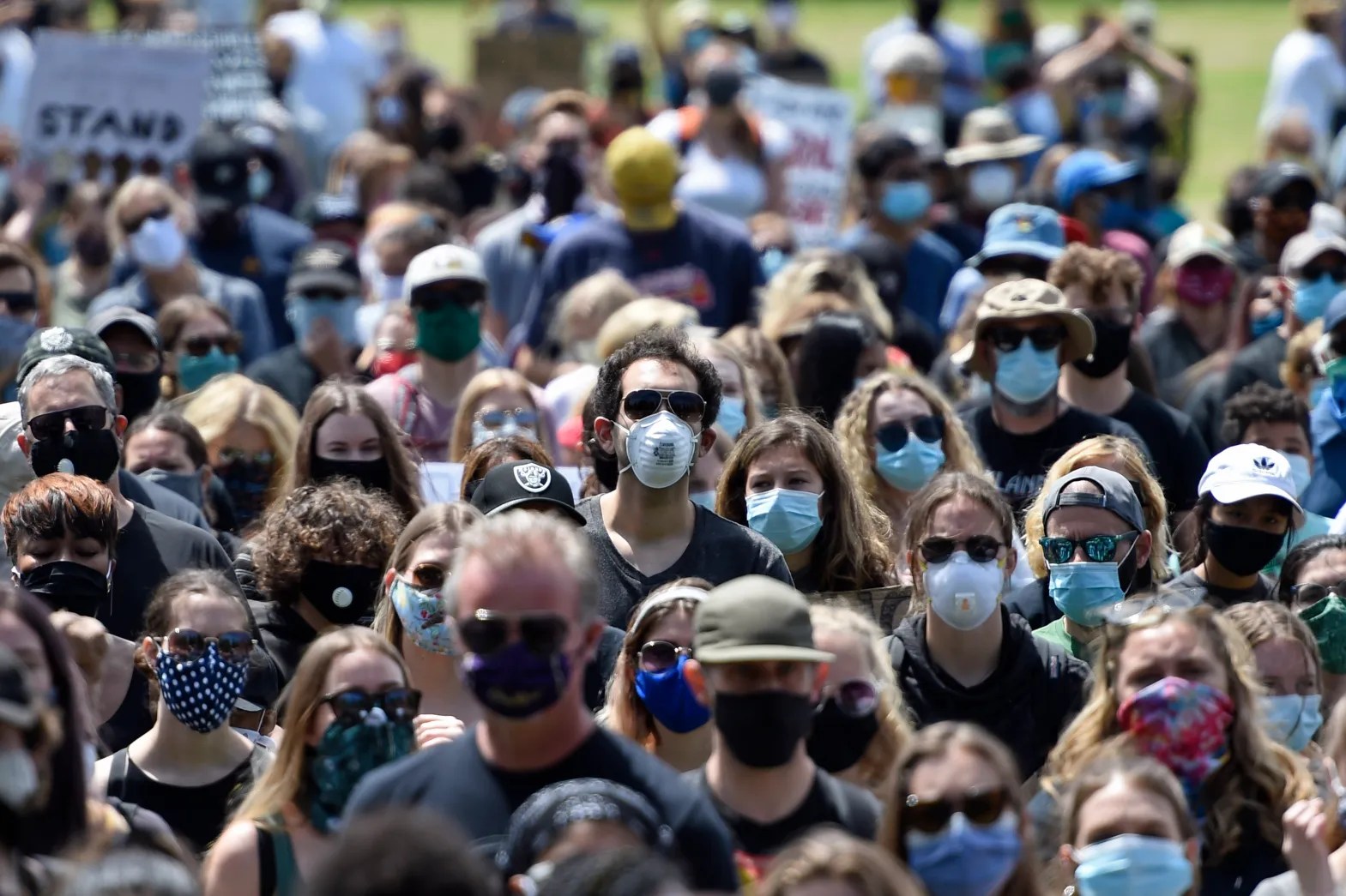
As I look out into our sanctuary now, to a room full of masked people gathering for Yom Kippur, I see a powerful visual of one community’s commitment to the health of all its members. This what the new normal should look like.
In my High Holiday sermon three years ago, I quoted the great activist poet Sonya Renee Taylor who wrote these words at the outset of the pandemic:
We will not go back to normal. Normal never was. Our pre-corona existence was not normal other than we normalized greed, inequity, exhaustion, depletion, extraction, disconnection, confusion, rage, hoarding, hate and lack. We should not long to return my friends. We are being given the opportunity to stitch a new garment. One that fits all of humanity and nature.
Today, three years after those words were written, powerful interests are trying to convince us that it is time to “go back to normal.” We must not let them. We must continue to hold on to Taylor’s beautiful vision of a new garment, even in the face of such daunting odds. We must cherish this vision and resist the cynical voices telling us that what they are giving us is the best we can hope for.
Because we should hope for more. We should aspire to more. After all, isn’t this what Yom Kippur is ultimately all about? Every year, at this season, we’re commanded to take a hard, unflinching look at the status quo, openly admit what needs changing, and commit to the hard work it will take to transform it. It’s an inherently radical idea: to proclaim every year that the status quo is unacceptable and that nothing short of genuine intervention will do. If our Yom Kippur prayers are to mean anything at all, we must be prepared to act upon this radical idea.
This is also the season in which we stand before the open gates of heaven, before the open books of life and death, and pray that we may be written in the book of life for the coming year. But we also affirm that repentance, prayer and acts of justice can “avert the decree.” To me that means that we cannot wait passively for that choice to be made for us. In the end, we’ll need to take responsibility for writing our own names and the names of our neighbors in the Book of Life. If we’re going to be sealed for life, it is we who must affix that seal.
So this new year, let us affix that seal by recommitting ourselves to the value of pikuachnefesh – the moral imperative that views the saving of life as sacrosanct. Let us resist a “return to a normalcy” that values some lives over others. Let’s enter this new year affirming not only in word, but in deed, that it must be all of us or none.
When I tried to think of the most appropriate saying I could offer you this Rosh Hashanah, I kept coming back to those famous Yiddish words from The Partisans Song: mir zaynen do – “we are here.” It somehow feels right to invoke words of resistance at this particular moment, doesn’t it? It’s been a hard and painful battle for us all this past year, but we are here. Tragically, too many of our comrades are no longer with us, but, nevertheless, mir zaynen do. We are here.
In an age of pandemic, just surviving itself can feel like a victory. So here we are: to date, COVID has claimed 640,000 lives in the US and over 4.5 million worldwide. And though it felt as if we’d finally turned a corner last spring, the arrival of the Delta variant was a brutal reminder that the pandemic is not at all behind us. The number of deaths is climbing again. Hospitals around the country are filling up, in some states to over-capacity. And though Trump is no longer our President, the Republican party continues to politicize the pandemic with ever-astonishing cynicism.
Despite a slight rebound last spring, things are still economically dire in our country. The percentages of those who are unemployed and uninsured are still shamefully high. Just this last August, the Supreme Court struck down eviction protections for most of the US, putting as many as 3.5 million households at risk of losing their homes, including hundreds of thousands of tenants this year alone.
Last Rosh Hashanah, I suggested that, in a very real way, we’re all in a state of grief over the world we’ve lost. If we were to continue with this metaphor – and I still believe it’s an apt one – we’ve now gone through one full year of mourning. In Jewish tradition, the year following a loss is a spiritually intense time for mourners, traditionally marked by the regular recitation of Kaddish. When the first year is up, the intensive part of our observance is lifted and we begin our reemergence back into the world. We know, however, that we won’t be reentering the world as it was. That world has been forever changed.
And so, even though the year of formal mourning is over, we’ll continue to say Kaddish regularly for the rest of our lives. We will never stop grieving what we’ve lost. The pain may come and go, but it never goes away entirely. Indeed, sometimes it will grip us when we least expect it. At the same time, however, we know that thingscan get better. If we work at it. If we affirm the truth of our healing and actively participate in the healing process.
So all of this to say yes, it is one year later and yes, we are still experiencing the pain of the loss of the world we once knew. But while the reality of what was lost is still brutally painful for us, it is also true that there has been healing. We are not, in fact, in the same place that we were last year.
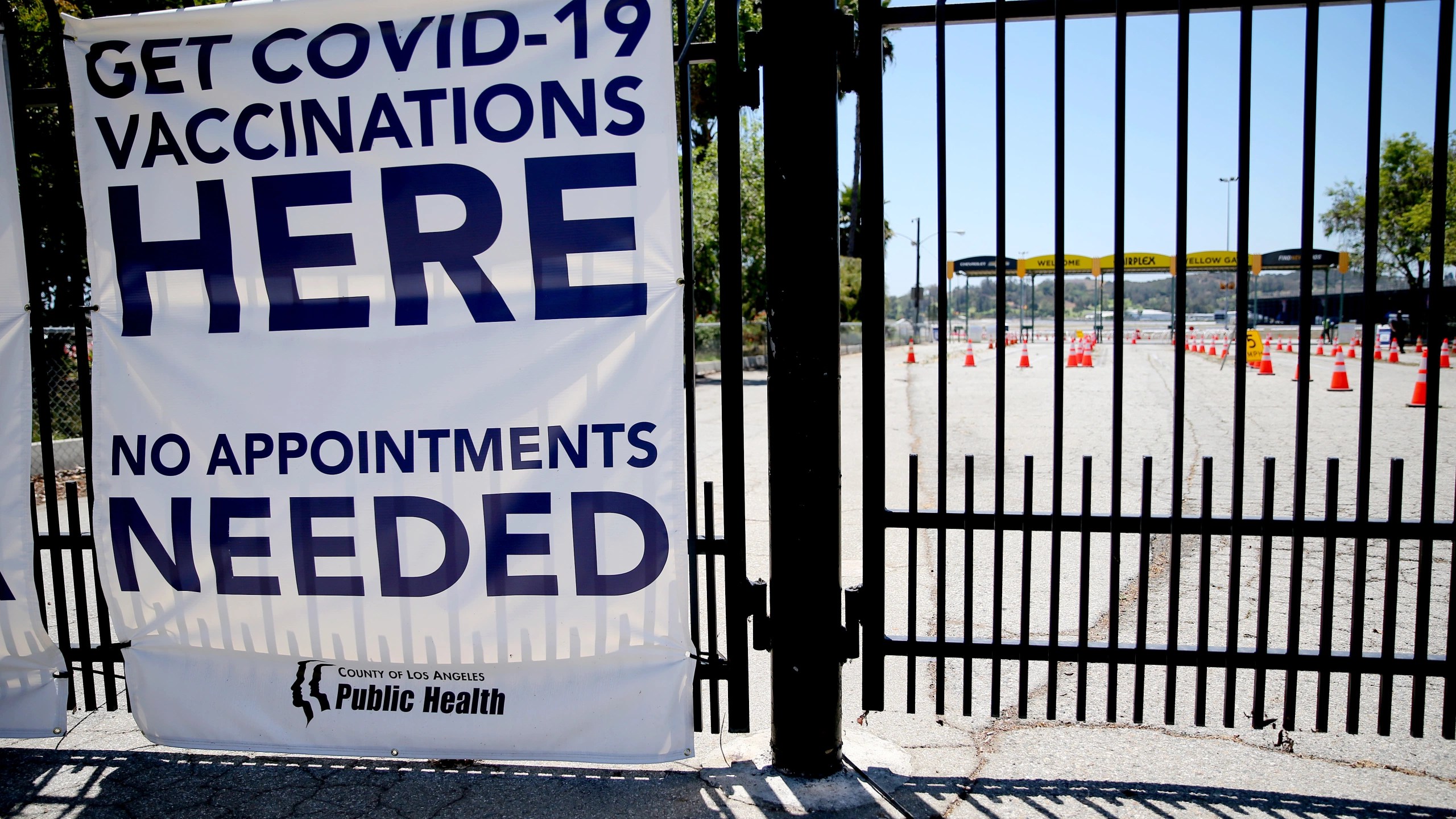
Most obviously – and most importantly – last Rosh Hashanah, I don’t think any of us would dare to imagine that we would see a COVID vaccine any time soon. Then just a few months later, the first fully-tested immunization was approved. Let’s pause now and just try to grasp the enormity of this. It is actually unprecedented in scientific history to go from the onset of a deadly new virus to the creation of a tested vaccine in less than a year. There is really no other word for it: the vaccine is a blessing. It is saving scores of lives as we speak and it remains our greatest hope to finally reach the end of this pandemic.
It has often occurred to me, when we gather for the High Holidays and pray to be written in the Book of Life for the coming year, we’re essentially coming to grips with the terrifying truth of our mortality. Every Rosh Hashanah we say the unsayable out loud: this time next year, some of us will still be alive and some of us will not. The Book of Life is a stark liturgical metaphor of this immensely painful truth.
But it also occurs to me that maybe it’s not quite that simple. Maybe the book is a work in progress. Maybe, just maybe, there are a myriad of ways that we take the radical, audacious step to write ourselves into the Book of Life. If we ever needed a reminder of this, just think: last year, after the holidays were over and the gates were supposedly closed, so many people from around the world: doctors and scientists and researchers and immunologists and donors and vaccine developers and caregivers heroically took it upon themselves to write scores of human souls into the Book of Life.
So before I continue any further, I’d like us to pause and honor the blessing of this moment – to offer a blessing of gratitude for having been kept alive long enough to reach this New Year. Please join together with me:
Blessed are you, spirit of the universe, you have given us life, you kept us alive and you have brought us all to arrive at this season together.
Now of course, while the arrival of a vaccine has been a game changer, it has decidedly not brought about the end of the pandemic. And in some ways I think this kind of magical thinking has contributed to the pain and confusion of our current moment. Last spring, when the shelter orders ended and the re-openings began, we all experienced a collective euphoria and elation that the world was finally getting back to normal. That’s why the mutations of the virus and the arrival of variants has been so brutal. That’s why we’re asking the questions now: will this ever end? Will it ever get any better?
Again, these are the very same questions we ask when we go through the experience of grief: will things ever get back to normal? Will it ever get any better? Yes, the questions are the same – and the answers are the same as well. No, things will not get back to “normal.” But yes, it canget better. If we work at it.
We know that this coronavirus will never be eradicated completely. The key is to suppress it to the point that it no longer poses a significant threat to us. When enough people have gained some immunity through either vaccination or infection – preferably vaccination – the coronavirus will transition from pandemic to “endemic.” It won’t be eliminated, but it won’t upend our lives anymore. It won’t cause our ICUs to overflow, force us to shelter at home and wreak havoc with our economy. We can learn to live with it.
So therein lies both the blessing and the challenge for us this Rosh Hashanah. The arrival of the vaccine last year was an undeniable blessing. And this year, it seems to me, our challenge is to not squander that blessing. Our challenge is to advocate in no uncertain terms for the blessing of this vaccine to be spread as widely as is humanly possible in this country and throughout the world.
I would go as far as to say that vaccine advocacy is, in fact, nothing short of a sacred obligation. In Jewish tradition, the mitzvah of pikuach nefesh – saving a life – is our most sacred religious value, the one that supersedes all others. That means fighting misinformation is pikuach nefesh. Advocating for vaccine mandates is pikuach nefesh. Making vaccines available to underserved populations that lack access to health care is pikuach nefesh.
And there is every reason to believe we can succeed in these efforts. Strategically speaking, I don’t think it makes much sense to try to convince people who utterly refuse to get vaccinated to change their minds. I think the more effective strategy is to make the vaccine as widely available as possible to anyone and everyone. According to a recent poll, nearly four out of five adults in this country say they are ready and willing to get vaccinated. As well, the number of parents who report they are planning to vaccinate their children are increasing – more than at any other time during the pandemic. This is particularly critical, given that vaccines for children five years old and up will likely be authorized soon – and clinical trials are currently underway for children as young as six months old.
I also want to stress that this sacred obligation is not merely local but global. Truly, one of the most shameful aspects of 2020 – and this was a year that had no shortage of shameful moments – is the phenomenon known as “vaccine apartheid.” The development of vaccines was indeed the result of the unprecedented cooperation between researchers, governments, and businesses throughout the world. But when it came time to roll them out, wealthy countries hoarded enough to vaccinate their citizens several times over. Now these countries are already administering booster shots – while fewer than 1% of people in low-income countries have received any vaccinations at all.
But ironically enough, it is actually in our self-interest to ensure global vaccine distribution. Because the longer the world goes unvaccinated, the greater the risk for new variants to emerge that are even more dangerous than Delta – and the longer it will take for those of us in wealthy countries to achieve endemic status. This is one of the many tragic realities of the current moment: in this age of rising nativism and hyper-nationalism, we’re discovering that viruses don’t respect national borders. Economically powerful countries might find safety for their citizens in the short term, but as ever, our well-being is ultimately tied to the well-being of all who dwell on earth.
Here are some links that will give you more information about how you can participate in advocacy for global vaccine distribution. I encourage you to get involved in this sacred effort, whether in your own home country or abroad, to ensure that this life-saving blessing is made as widely available as possible.
On Rosh Hashanah, we undertake a cheshbon nefesh – a soul accounting – of ourselves and of the greater community. We examine deeply and unsparingly the ways we as individuals are accountable to the collective. In our 21st century world, I believe it’s imperative that we define the collective as nothing less than the global community. I can’t think of a better kavanah – spiritual intention – for the New Year than that: to affirm that our well-being is irrevocably tied to the well-being of all who dwell on earth.
So this Rosh Hashanah, let us joyously say to one another, Mir Zaynen Do – We are here. Let us grieve those we’ve lost and celebrate the lives we’ve saved. Let’s continue to show up for one another. Let us fight every moment of this New Year to write ourselves and our neighbors into the Book of Life.
May it be a Shanah Tovah – a good year, a Shanah Bri’ah – a year of health, a Shanah Shel Hayyim – a year of life – for us all.
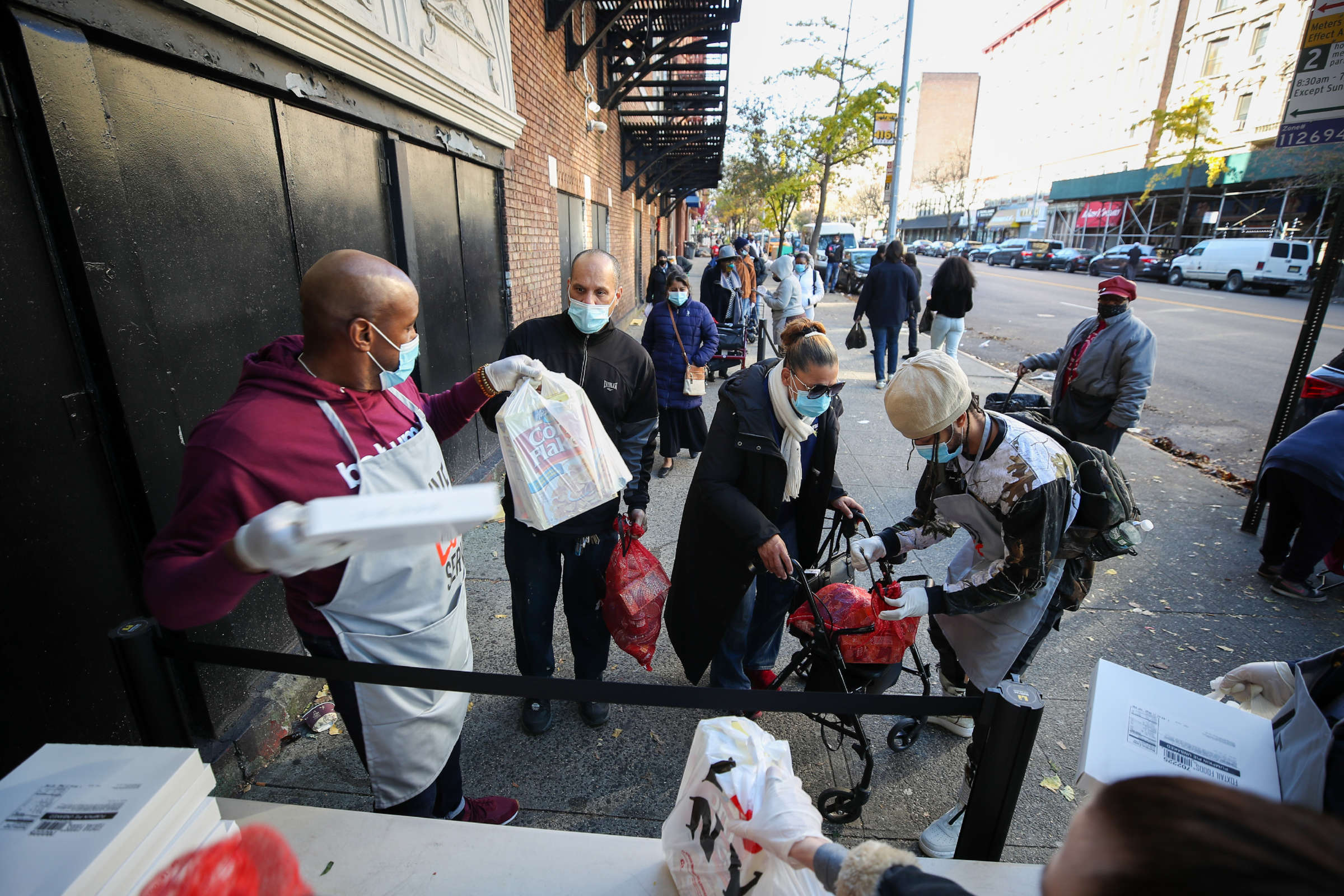
Volunteers from a nonprofit organization provide food supplies to people who line up ahead of Thanksgiving amid the COVID-19 pandemic in the Harlem neighborhood of New York City on November 20, 2020. (TAYFUN COSKUN / ANADOLU AGENCY VIA GETTY IMAGES)
With Hanukkah now upon us, the internet is abuzz with articles offering guidance on how to celebrate the holiday in the age of COVID-19. While most of them focus on practical issues such as socially distanced Hanukkah parties and Zoom candle lightings, I’ve been thinking a great deal on what the story of Hanukkah might have to offer to all of us as we gear up for a winter like none we’ve ever experienced in our lifetimes.
Hanukkah, of course, is based upon the story of the Maccabees, the small group of Jews who successfully liberated themselves from the oppressive reign of the Seleucid Empire in 167 BCE. The legacy of this story, however, is a complex one because the Jewish struggle against religious persecution took place within the context of a bloody and destructive Jewish civil war. In contemporary times, the meaning of Hanukkah has become even more complicated given its proximity to Christmas, subjecting it to the uniquely American religion of unmitigated commercialism.
Beyond all these complications, I’d argue that the essence of Hanukkah is the theme of resistance. At its core, the Hanukkah story commemorates the victorious resistance of the people over the power and might of empire. On a deeper level, we might say that the festival celebrates the spiritual strength of our resistance to an often harsh and unyielding world.
In this regard, it is significant that Hanukkah takes place in the winter. Apropos of the season, the festival prescribes resistance to an increasingly colder and darker world by lighting increasing numbers of candles during this eight-night festival. Those of us who celebrate this holiday are instructed to place our menorahs in our windows as an act of “spiritual defiance,” directing the light outward into the night where it may clearly be seen by the outside world.
There have indeed been moments in Jewish history in which lighting the menorah was literally an act of resistance. One powerful example can be seen offered in a single image: the famous photograph taken in 1932 Germany showing a menorah on the window sill of a Jewish home, with a Nazi flag clearly visible across the street. Another well-known moment of Hanukkah resistance occurred in 1993 when, after a brick was thrown through the window of a Jewish home in Billings, Montana, scores of citizens showed their solidarity with the Jewish community by taping paper menorahs in their windows. More recently, on the Hanukkah after the Pittsburgh synagogue shooting, one local Jewish leader commentedthat the menorah is “not just something that we display in our homes for ourselves … but something we light so that passersby can see. For us, this year that feels like an act of resistance.”
In 2020, we find Hanukkah arriving amid a winter that medical experts are calling “the darkest days of the pandemic” and “COVID hell.” In a recent interview, Michael Osterholm, director of the Center for Infectious Disease Research and Policy at the University of Minnesota, said, “the next three to four months are going to be, by far, the darkest of the pandemic.” Another expert has predicted that more lives will be lost in December than the U.S. saw in March and April combined.
With such an unprecedented and terrifying winter bearing down upon us, I’d suggest that the ideal of Hanukkah resistance is more powerfully relevant than ever. This resistance, of course, presents us with profound challenges. After living with the pandemic for the better part of a year, so many throughout the U.S. are succumbing to “COVID fatigue” — following months of social isolation and anxiety, increasing numbers of people are becoming less vigilant about the pandemic practice of masking and social distancing, even as infection rates spike precipitously.
With the darkest days of the pandemic ahead of us — even as we agitate for rent cancellation, eviction resistance and universal health care — we have another form of resistance at our disposal: We can resist government inaction/abandonment of its citizens by participating in the grassroots, self-organized networks of support known as mutual aid.
While these community-based efforts are not new, they have proliferatedwidely since the onset of the pandemic. As Jia Tolentino pointed out in a New Yorker article last May:
[Mutual aid] is not a new term, or a new idea, but it has generally existed outside the mainstream. Informal child-care collectives, transgender support groups, and other ad-hoc organizations operate without the top-down leadership or philanthropic funding that most charities depend on. Since COVID, however, mutual aid initiatives seemed to be everywhere.
The concept of mutual aid was coined in 1902 by the Russian anarchist/scientist/economist/philosopher, Peter Kropotkin, who arguedthat mutual aid could be traced to the “earliest beginnings of evolution.” Kropotkin posited that solidary provided the human species with the best chance of survival, particularly given the emergence of private property and the rise of the State:
It is not love and not even sympathy upon which Society is based in mankind. It is the conscience — be it only at the stage of an instinct — of human solidarity. It is the unconscious recognition of the force that is borrowed by each man from the practice of mutual aid; of the close dependence of every one’s happiness upon the happiness of all; and of the sense of justice, or equity which brings the individual to consider the rights of every other individual as equal to his own. Upon this broad and necessary foundation, the still higher moral feelings are developed.
Some of the most well-known examples of mutual aid in U.S. history, in fact, were the survival programs created by the Black Panther Party (BPP) and the community-based initiatives organized by the Puerto Rican Young Lords Party in the 1960s and ’70s. FBI Director J. Edgar Hoover himself grasped the radical power of these mutual aid projects. In a now infamous internal memo, he wrote that the Black Panther breakfast programs represented “the best and most influential activity going for the BPP, and is as such, the greatest threat to efforts by authorities.”
Another important aspect of mutual aid is the understanding that disenfranchised people cannot ultimately depend on state institutions to save them. According to Puerto Rican scholar Isa Rodríguez, “‘Solo el pueblo salva al pueblo’ — ‘Only the people save the people,’ became a rallying cry for Puerto Ricans following the devastation of Hurricane Maria in 2017 as multiple organizations — mostly based on grassroots groups that existed prior to the hurricane — quickly organized to channel aid.”
The community-based solidarity of mutual aid is also fundamentally different from the approach of private humanitarian charities in which the needy are “saved” through the beneficence of those of greater means. And it must not be viewed through the lens of “crisis response.” Mutual aid, rather, is rooted in long-term alliances between people engaged in a common struggle. As historian/writer, Elizabeth Catte has observed:
Mutual aid can be a form of resistance, but the practice itself requires discipline. We can’t do it because it helps us sugarcoat our trauma, or because it lets us say we have claimed goodness in a world where it is often lacking. Mutual aid is incompatible with charity and should offer no pleasure to the well-resourced person or do-gooder who hopes to find worthy recipients of their kindness, because the practice of mutual aid is intended to destroy categories of worth.
Since mutual aid is rooted in the ideal of solidarity, the first step for anyone interested is to cultivate genuine and accountable relationships within their own local communities. This will be undeniably challenging in a time of pandemic, when our mutual safety literally depends upon socially distancing from one another.
Mutual aid projects, however, are adapting to meet these challenges through creative use of commercial internet platforms, online databasesand toolkits. Additionally, mutual aid projects in the age of COVID insist on strict adherence to public health protocols.
In the words of anarchist organizer Cindy Milstein: “While ‘social’ aka ‘physical’ distancing, hand washing, and mask wearing are necessary tools to help stop the spread of this virus, they will only be effective if it’s grounded in an ethics and practice of social solidarity and collective care.”
The most famous Hanukkah story says that when the Maccabees entered the Temple to relight the menorah, they only found enough oil to last for one day. Miraculously, however, the menorah burned for eight days. At the core of this seemingly simple parable are profound lessons about the power of sustainability and resilience. We know from history that popular movements of resistance have the ability to succeed even against the most daunting of foes.
The prospect of the coming winter — and the new year ahead — are undeniably daunting. Amid it all lie fundamental questions: Where will we find the strength to meet these challenges? How will we keep the fire of our commitment to each other from burning out? Who can we depend upon to see us through the coming season and beyond?
The resistance embodied by mutual aid provides us with a compelling answer — in the end, we have each other. As Dean Spade, who recently published a book titled Mutual Aid: Building Solidarity During this Crisis (and the Next), so aptly puts it, “what happens when people get together to support one another is that people realize that there’s more of us than there is of them.”
True resistance can never occur as long as we expect an external human force to somehow show up to save us. In the end, the true miracle of resistance occurs when we show up for one another.
On Rosh Hashanah, Jewish tradition comes to tell us every new year that everything we’ve ever known is on the line. The zodiac sign for Tishrei, the first Jewish month of the year, is the scale, and for good reason. Over and over again our liturgy tells us that the world is hanging in the balance. The Books of Life and Death have yet to be sealed and we pray the rawest of prayers, literally pleading for another year of life. In ancient times, so we’re told, the Jewish people would gather outside the Temple in Jerusalem, hoping against hope that the High Priest would emerge from the Holy of Holies to let them know the world would indeed be sustained for one more year.
I don’t think we’ve ever experienced a Rosh Hashanah in which it felt more viscerally that the world was indeed actually hanging in the balance. In our communities, throughout our country, around the world, the new year is arriving in time that feels completely and utterly uncertain. For me – and I suspect for you as well – our Rosh Hashanah prayers this year have a powerful, even unnerving resonance.
It’s difficult to know where to even start, and it’s almost unbearable to contemplate all at once: a global pandemic has taken over 200,000 lives in the US and almost one million worldwide. It has permanently changed our world in ways we’ve barely begun to understand. Our health system is overwhelmed and overtaxed. The leaders of our country have been criminally negligent in their response to the pandemic. As a result, in a moment when we desperately need to come together, they are politicizing community health measures like mask-wearing and social distancing, further tearing our national community apart.
And of course, none of this is occurring in a vacuum. It’s astonishing to witness how quickly COVID has unleashed this terrifying domino effect of economic chaos in our country and around the world, leaving increasing numbers of people unemployed, homeless and uninsured. And contrary to the cliche, the pandemic is not a great equalizer: its impact has been particularly devastating for communities of color, the poor and too many other disenfranchised communities in our midst.
There is no getting around it: this Rosh Hashanah, we’re greeting this new year in a state of genuine grief over the sheer enormity over what we have already lost and fear over what is yet to come. That’s why, I believe, the first order of business this new year is to give ourselves the space and permission to grieve our collective loss and name these fears out loud. To acknowledge what is no more and affirm openly and honestly that the world has been forever changed in ways we cannot yet fully grasp. Frankly, I don’t know how we can pray these prayers unless we find a way to acknowledge this together.
I think grief is an apt metaphor for this moment. As anyone who has experienced grief knows all too well, there is a period of deep shock and disbelief that occurs immediately after the loss of someone we love. In many ways, this feels like what we’re going through now: the disbelief, the magical thinking, the inability to fully grasp our new reality, the uncertainty of everything except the hard truth that nothing in our lives will ever be the same.
When we grieve, however, we do know some things for sure. We know that isolation is our enemy. We know that we have to depend upon each other to move forward. We know that we need community more than ever before. Though this new world is a painful and uncertain place, we mustresist the temptation to withdraw from it. This will be a particular challenge in this new age of social distancing: when our survival literally depends upon our being physically apart, we know instinctively that we must find new ways to connect with one another if we are to survive.
Over the last few months, people have found ways to connect with each other with resilient creativity. Yes, life in the COVID era is surreal, frustrating, and often downright bizarre. Yes, I never, ever dreamed I would one day find myself leading a High Holiday Zoom service, and yes, I’m very sure you never expected you would ever attend one. But over the last few months, as we’ve negotiated this brave new world in our congregation, we’ve discovered that these challenges have come hand in hand with new opportunities we never could have anticipated.
Here at Tzedek Chicago, since the pandemic began, we’re busier than ever before. We now have four weekly programs and our attendance has grown exponentially. We’ve inaugurated a communal care Hesed Committee to check in on the immediate needs of our members. We now have new members participating regularly in our services and programs from across the country and around the world, from as far away as New Zealand and the UK. In the end, however, this isn’t just a matter of greater access. On a deeper level, I think, this new growth is a testament to the deep desire folks have to connect with others, to overcome their isolation, to find new ways to create community in this moment of profound loss.
At the same time, amidst all of this massive change, even as we adjust to this new world, there’s that nagging question lurking in the background: how long will we actually have to do this? When will we get our lives and our world back? When will things get back to “normal?” Again, as with the experience of grief, I personally think it’s important to challenge this kind of magical thinking; to resist the temptation to assume that this is only a temporary moment; a period we just have to muscle through before things get back to the way they were. As with the experience of grief, I think it’s important for us to accept that the world we once knew is gone. Something will indeed come in its place, but whatever it is, we need to accept that things will never be the same.
It occurs to me that Rosh Hashanah might actually be coming at just the right time to help us with this acceptance. After all, when we pray the words “t’chadeish aleynu shanah tovah u’metukah” – “renew us for a good and sweet new year” – we’re not asking for the world the way it used to be. On Rosh Hashanah, we center renewal. Over and over again we proclaim throughout our liturgy that every new year, the world can be recreated and reborn.
This idea is actually the exact opposite of that famous line from the book of Lamentations,“chadeish yameninu ke’kedem;– “renew our days as days of old.” Whatever else it may be, Rosh Hashanah was never meant to be an exercise in nostalgia, a yearning for an idealized, mythic time that never really was. On the contrary, it is an occasion for dreaming of the world that might yet be.
No, we will not go back to “normal.” But amidst the grief, it’s worth asking, do we really want to? Should we want to? The great activist poet Sonya Renee Taylor has written powerfully to this point:
We will not go back to normal. Normal never was. Our pre-corona existence was not normal other than we normalized greed, inequity, exhaustion, depletion, extraction, disconnection, confusion, rage, hoarding, hate and lack. We should not long to return my friends. We are being given the opportunity to stitch a new garment. One that fits all of humanity and nature.
That’s right. For far too long, too many in this country have assumed it’s somehow normal to live in a world with a deep and deepening economic divide separating rich from poor, to tolerate a toxic environmental crisis, to treat endemic state violence and systemic racism as just a given. But none of this has been in any way “normal.”
In truth, we’ve been living unsustainably for far too long. Deep down, we must have known that one day this bubble would burst. And now it has. The world as we knew it has broken wide open. So yes, if there is a spiritual imperative to this particular moment, it’s not “renew our days as in days of old” – it must be “recreate this word anew.”
Judaism actually gives us a powerful paradigm for this – a framework for living when the only world we’ve ever known has fallen away from beneath us. It is, in fact, one of the central mythic moments at the heart of Jewish tradition itself: namely the destruction of the Temple in Jerusalem in 70 ACE. Jewish spiritual memory views this as the formative moment in our history: the cataclysmic moment when Jewish life was cracked wide open. As we have come to understand it, this was the moment when everything in our world changed forever.
Yes, the destruction of the Temple constituted a massive collective crisis for the Jewish people – but it’s also important to note that it represented an opportunity to stitch a new garment as well. After all, this was the moment that Judaism as we know it came into being. The diaspora might have been a place of exile, but it was also the fertile ground upon which the Jewish people staged their spiritual rebirth. In short, when the only world we ever knew was shattered, we responded in the spirit of hope, resilience and creativity.
A line from a famous midrash teaches, “when the people of Israel were exiled, God went into exile with them.” Among other things, this means that God wasn’t destroyed along with the Temple. God accompanied us into this new and unknown world. And while this spiritual truth may speak directly to the Jewish experience, it’s certainly not unique to it. It’s a universal truth: at the moments of our deepest loss, we become more spiritually attuned. We can see God more clearly: in the hearts that have been broken and in the wells of strength we never knew we had. In the memory of those we’ve lost, the faces of those we love and who have suffered loss as well. And I would suggest it is this very Presence that is accompanying us right now as we face this uncertain new world.
So, if we are ready to fully enter this changed and changing new kingdom, what do we do now? I think it goes without saying that the order of the moment is care for each other. Too many lives have been devastated already and we know that this devastation will continue in the coming year. For now – and forever more – we must view mutual aid as a mitzvah – a sacred imperative. I know many of you are involved in these kinds of projects, which are founded on the ethics of solidarity and not mere charity. At Tzedek Chicago, we’ve been compiling an ongoing list of efforts in which we can participate locally – mutual aid that supports those who were already economically vulnerable before the onset of the pandemic, in particular low-income workers, day laborers, domestic workers, those who work in the gig economy. If you know of initiatives that are not on our list, please let us know about them so we can make them available to our membership.
It’s also important for us to bear in mind that radical empathy is not only a means to an end. Yes, we empathize with each other because we are social animals that depend on each other for our survival – and this must certainly never be underestimated. But at the same time, it’s worth considering that our empathic support for another actually creates the world we want to see in real time. When we support and find comfort in one another, we need not yearn for the world to come because in a sense, it’s here right now. Beyond the pain, beyond the loss, we would do well to realize that the world we’ve been struggling for all along is being built by our love and support for one another.
And how do we find hope when that pain and loss feels like it is too much to bear? For me, I’ve always been taken with the definition of hope offered by folks like Vaclav Havel and Cornell West. Optimism, they say, is the shallow expectation that things will naturally get better. Hope, however, is the conviction that some things are worth fighting for no matter what may happen. Hope is the courage to act, even in – especially in – those times when doubt might be warranted.
So let this be my blessing for us all this Rosh Hashanah-like-no other, when so much in our world is hanging in the balance as never before: let us grieve for the world that we’ve lost, show up for those who need it most, and fight like hell for the world we know is possible.
 Shalom Rav