Like all of you, I’m sure, I’m still in deep shock and anguish over Donald Trump’s electoral victory this past Tuesday. And while I certainly have my opinions about how this terrifying outcome could have possibly happened, I’m going to resist the urge to engage in post-election punditry. There’s more than enough to go around right now, some of it interesting, some of it clarifying, but to my mind, much of it tone-deaf and destructive. There will be time for the analysis, the interrogating and the strategizing. For now, however, I think it is critical that we sit with what has happened and give ourselves space to grieve and respond emotionally to the enormity of what has just occurred.
Of course, none of this happened overnight. Well before last Tuesday, were all too aware of the growth of fascism in the US and around the world, the scourge of state violence and mass incarceration, the loss of reproductive freedoms, the genocide against Palestinians, political targeting of immigrants, LGBTQ+ people, Muslims, disabled people, and other vulnerable minorities. After Tuesday, however, the stakes of these threats have reached a terrifying new level. Yes, what happened this week was shocking and heartbreaking. But it was also clarifying. We should no longer have any illusions about what we are up against.
I know that many of us who have been on the front line of the resistance to these threats are feeling exhausted and demoralized. Those who are members of targeted groups are understandably feeling a new level of fear for their own well-being. That is why, I believe to the core of my being, that the most important thing that those of us who have been organizing movements for justice can do in this moment is to reaffirm our commitment and care for one another.
In order to do that, we will need to resist the politics of division lest they infect the movements of solidarity we’ve been building so carefully and lovingly. During this past election, there was strong and passionate disagreement on whether a vote for Kamala Harris was a vote for genocide or a vote to hold back a Trump presidency. There were good, principled arguments to be made on both side of that debate. Even so, it was immensely painful to witness what this election did to the Palestine solidarity movement. Those who chose to vote for Harris were accused of “supporting genocide.” Those who chose withhold their vote for Harris were accused of being “MAGA enablers.” Our movement was faced with a profoundly untenable choice. There were times I feared it would rip us apart.
But after last Tuesday’s election, none of this really matters anymore. We simply cannot afford to turn on each other. Not now. We need each other more than ever.
I don’t yet know what kind of political strategies we will need to employ to resist the fascist reality posed by the MAGA movement – but I do know that whatever happens, we will need to show up for one another now more than ever. We will need to protect and defend one another. We will need to be clearer than ever about the values we hold sacred and be prepared to ground everything we do in the conviction that every single human life is of infinite worth – and is worth fighting for.
We will need to be clear-eyed about the challenges ahead and stand together to face them. For those of us in the Jewish community, that means lifting up solidarity as our most central sacred imperative. All the rest is mere commentary. As I said this past Yom Kippur:
In the 21st century, I believe this is the sacred calculus the Jewish people have to offer the world: Creation + Exodus = Solidarity. More than ever, the Jewish communities we create simply must value solidarity as our most sacrosanct mitzvah. In an age in which we are witnessing the increased scapegoating, yes of Jews, but also of Muslims, LGBTQ+ people, people of color, disabled people, immigrants, indigenous people and so many others, our sacred tradition must promote collective liberation first and foremost.
The predominant theme in this week’s Torah portion, Lech Lecha, is the act of going forth into the unknown with nothing but a promise of blessing and liberation. But unlike the literal meaning of the words in our portion, we must affirm that this liberation cannot be for one privileged group of people alone. We must affirm a Lech Lecha of collective liberation, where all people are God’s people and all people are chosen and the boundaries of the Promised Land extend to include all who dwell on earth.
In this moment, like Abraham and Sarah, we are all being called into a land we do not yet know. But as we read in our portion, it is a collective going-forth – for the sake of both the living and future generations.
Yes, in this current moment, there is much we do not yet know. But we do know that we will have the hearts and minds to resist what is to come. That there is still a world worth fighting for. And that the way to that world is through our solidarity and care for one another.
Why do we sound the shofar on Rosh Hashanah? Over the centuries, commentators have offered us a variety of reasons. Moses Maimonides famously called it a wake-up call to personal atonement; others view it a call to action or a tribute to God’s power. This new year, however, I believe one reason stands out among all others. Today, this Rosh Hashanah, we sound the shofar as a call to moral accountability.
Today, we begin the holiest season of the year. Over the next ten days, we’ll be challenged to break open the shells of inertia and complacency that have built up over the past year. We’ll sound the shofar to herald the inauguration of a deep, collective soul searching: to look deep within, to face honestly what must be faced, if we are to truly begin our new year anew.
To put it frankly, I honestly cannot remember a Rosh Hashanah when the collective moral stakes were any higher for the Jewish community than this year. I would even go as far to say that this may be the most morally consequential High Holiday season of our lifetimes. As we begin this new year, the shofar calls us to account for a genocide, ongoing even as we speak, perpetrated by a nation acting in the name of the Jewish people.
How can we begin to fathom a moral accounting of such a magnitude? Over 41,000 Palestinians killed in Gaza to date and over 95,000 injured, the majority of whom are women and children. According to one estimate, the ultimate death toll may eventually be nearly 200,000. Whole extended families, entire Palestinian bloodlines have been wiped out completely. Much of Gaza has been literally reduced to a human graveyard, with scores of bodies buried beneath the rubble of destroyed and bulldozed homes. Neighborhoods and regions have been literally wiped off the map.
Gaza’s infrastructure and health care system has been decimated. According to the UN an “intentional and targeted starvation campaign” has led to widespread famine and disease throughout the Gaza strip. Polio has now broken out – relief workers are literally working to deliver vaccines to children as bombs and missiles fall around them.
Health care workers, humanitarian workers and journalists are being killed, injured and imprisoned in massive numbers. Human rights agencies have documented widespread torture and abuse of prisoners, including sexual abuse, throughout a network of torture camps.
Please note that this unspeakable litany is not a review of the past year. It is a description of a nightmare that continues as I speak, with no end in sight.
As we contemplate this inhuman status quo, it occurs to me that this Rosh Hashanah, the broken sound of the shofar is more than a mere all to accounting. It is a broken wail of grief – and a desperate moral challenge. This year the shofar calls out to us in no uncertain terms: We Charge Genocide.
This is not a point upon which we can equivocate. Not today. On this day, we face what must be faced and say out loud what must be said. To argue this point now would frankly be a sacrilege.
From a purely legal point of view, a myriad of academic and legal experts have long since confirmed the charge of genocide. As far back as October, Holocaust and Genocide scholar Raz Segal has called Israel’s actions in Gaza “a textbook case of genocide.” On October 18, almost 800 scholars, lawyers and practitioners called on “all relevant UN bodies…as well as the Office of the Prosecutor of the International Criminal Court to immediately intervene…to protect the Palestinian population from genocide.” More recently, Omer Bartov, a respected historian of the Holocaust and Genocide Studies at Brown University accused Israel of “systematic war crimes, crimes against humanity and genocidal actions.”
But beyond the legal arguments, there is a critical, moral imperative behind this claim. For many Jews, it’s impossible to imagine – let alone say out loud – that a Jewish state, founded in the wake of the Holocaust, could possibly be perpetrating a genocide.
I understand the pain behind this refusal. I know it confronts many Jews with an unimaginable prospect: to accept that we have become our own worst nightmare. But if we cannot admit the truth on this of all days, then why bother gathering for Rosh Hashanah in the first place? To dither on this point would make a sham of a festival we dare to call the holiest season of the year.
Not long ago I had a long conversation with my dear friend and colleague Rachel Beitarie, director of the Israeli organization Zochrot. Rachel is among the precious few Israeli activists who are in unabashed solidarity with Palestinians. You may remember her presentation to our Tzedek community several months ago. Among other things, she spoke about what it was like to be an Israeli activist for Palestinian liberation who grew up on a kibbutz near the Gaza border, who personally knew Israelis who were killed and taken hostage on October 7.
During our recent conversation, Rachel and I talked in particular about the way Israel metabolizes the traumatic memory of the Holocaust as a way to rationalize away its genocidal violence in Gaza. In a follow up letter to our conversation, Rachel wrote the following words to me:
As years go by and most Holocaust survivors are no longer with us, the identification and reliving of the trauma of former genocide seems to only grow, in direct relation to the crimes committed under the excuse of the right to defend ourselves and “prevent a second Holocaust.”
Because of this unrelenting propaganda, the linkage of the Hamas attack of October 7 to the Holocaust was made immediately, even though it was logically bogus. It was understandable at first, especially from people – many of my friends and acquaintances among them – who personally experienced the horrors of that day, waiting for help that took many hours to come.
Having grown up in Israel, exposed as we are to re-traumatizing Holocaust education, the associative connection was almost inevitable. Soon however, it became clear that this linkage was being overblown and manipulated to justify the annihilation of Gaza; to justify, dare I say it, another Holocaust.
Many outside of Israel have made the linkage between October 7 and the Holocaust as well. Almost immediately in fact, the terrible massacres of that day were openly characterized as “the worst mass murder of Jews since the Holocaust.” As Rachel pointed out, the two events have nothing to do with each other whatsoever. Still, it is indeed painfully poignant to consider that this mass killing occurred in a state founded in the wake of the Holocaust in order to safeguard Jewish lives once and for all.
We can only imagine what on earth will be said about October 7 on its one year anniversary, which will arrive exactly between Rosh Hashanah and Yom Kippur. From what I’ve read about officially sponsored Jewish community commemorations, the dominant message will be thoroughly suffused with a Holocaust-informed victim mentality: “Bring them home,” “We stand with Israel,” “It’s us against the world,” with nary a mention of the vengeful carnage Israel has been unleashing on Gaza for the better part of a year.
In contrast to this particular messaging, however, I would suggest that sacred Jewish tradition presents us with an important opportunity on this anniversary. Yes, the Days of Awe are an occasion to mourn the losses of the past year – but this season is also a time to seek out a deeper understanding. To do a genuine accounting and to take real accountability.
As we start to reckon with the events of October 7, I would suggest that the first step would be to admit that this date was not a starting point. If we are to truly and honestly commemorate this tragic anniversary, we must understand it in the context of the ongoing violence and injustice known as the Nakba – a nightmare that began decades ago and is still ongoing.
As Israel’s violence in Gaza escalated during the final months of 2023, Tzedek Chicago’s board had numerous conversations about whether or not to issue a congregational statement. I’ll make a confession: I wasn’t originally in favor of it. To be honest, I was starting to become dubious about the value of these kinds of gestures. At a moment when so many of us were working overtime organizing on behalf of the Palestine solidarity movement, it seemed like a waste of time to spend our time on a congregational statement. It felt as if the only statement that needed to be made, over and over again in the streets, was “Ceasefire Now!”
Eventually, however, I came to agree with our board that Tzedek Chicago – as an avowedly anti-Zionist congregation – had a unique voice to offer on this issue. And so, during the month of December, we worked together to craft a statement titled, “In Gaza, Israel is Revealing the True Face of Zionism.”
Here’s an excerpt:
We … know there was a crucial, underlying context to (the) horrible violence (of October 7). We assert without reservation that to contextualize is not to condone. On the contrary, we must contextualize these events if we are to truly understand them – and find a better way forward.
The violence of October 7 did not occur in a vacuum. It was a brutal response to a regime of structural violence that has oppressed Palestinians for decades. At the root of this oppression is Zionism: a colonial movement that seeks to establish and maintain a Jewish majority nation-state in historic Palestine.
While Israel was founded in the traumatic wake of the Holocaust to create safety and security for the Jewish people, it was a state founded on the backs of another people, ultimately endangering the safety and security of Jews and Palestinians alike. Israel was established through what Palestinians refer to as the Nakba: the ethnic cleansing of 750,000 Palestinians from their homes in 1948. And since that time, Israel has subjected Palestinians to a regime of Jewish supremacy in order to maintain its demographic majority in the land.
This ongoing Nakba is the essential context for understanding the horrifying violence of the past three months. Indeed, since October 7, Israeli politicians have been terrifyingly open about their intentions, making it clear that the ultimate end goal of their military assault is to ethnically cleanse Gaza of its 2.2 million Palestinian residents. One prominent member of the Israeli government put it quite plainly: “We are now rolling out the Gaza Nakba. Gaza Nakba 2023. That’s how it’ll end.” More recently, Prime Minister Netanyahu was reported as saying that he is actively working to transfer Palestinians out of Gaza. The problem, he said, “is which countries will take them.”
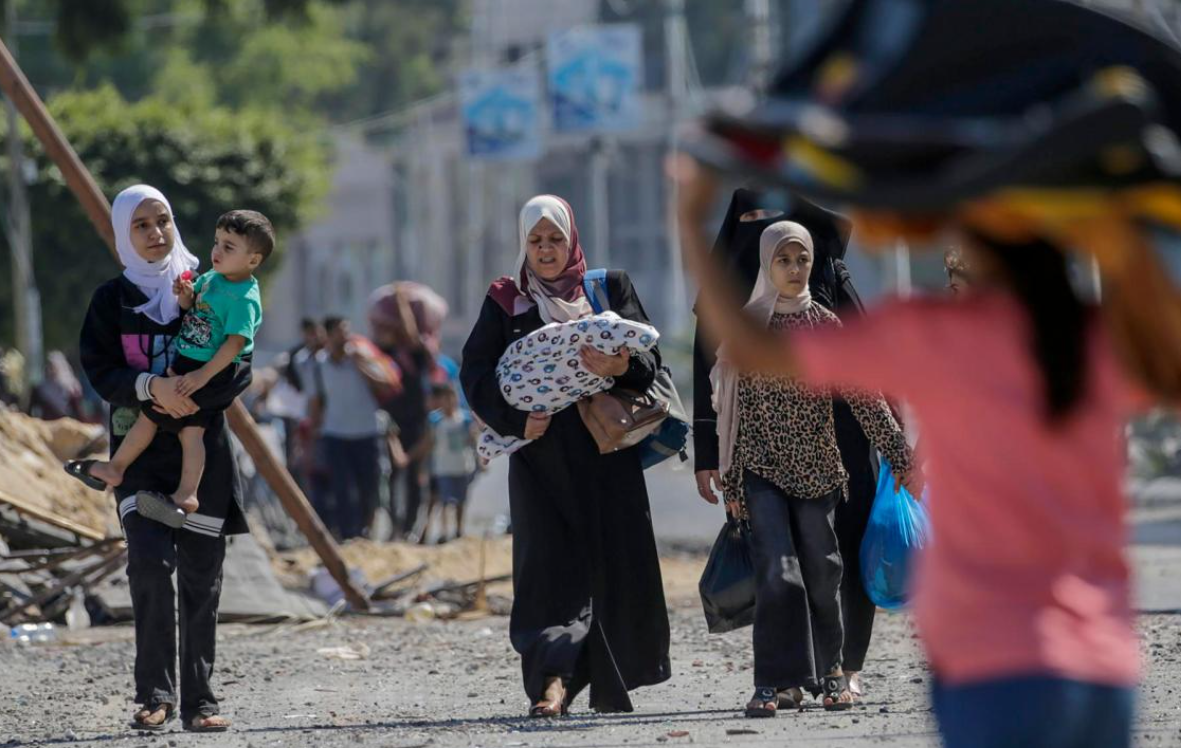
Israeli leaders are being true to their word: we are witnessing the continuation of the Nakba in real time. As in 1948, Palestinians are being driven from their homes through force of arms. As in 1948, families are being forced to march long distances with hastily-collected possessions on their backs. As in 1948, entire regions are being razed to the ground, ensuring that they will have no homes to return to. As in 1948, Israel is actively engineering the wholesale transfer of an entire population of people.
It is now eight months since we released that statement and I believe it is more accurate than ever. In her letter to me, Rachel observed the irony that more and more Israelis are now threatening a “second Nakba” when “until recently Israelis denied that the Nakba ever happened.” Now however, many Israelis are using the term with unabashed vengeance. Through word and deed, Israel’s ultimate end game is becoming all too clear: it is the ethnic cleansing of Gaza.
This past August, in fact, the Israeli press revealed the presence of a government plan for Israel’s long term occupation of Gaza on “the day after.” According to the plan:
Israel will control the northern Gaza Strip and drive out the 300,000 Palestinians still there. Major Gen.Giora Eiland, the war’s ideologue, proposes starving them to death, or exiling them, as a lever with which to defeat Hamas. The Israeli right envisions a Jewish settlement of the area, with vast real estate potential of convenient topography, a sea view, and proximity to central Israel… The southern Gaza Strip will be left for Hamas, which will have to care for the destitute residents under Israeli siege, even after the international community loses interest in the story and moves on to other crises.
In other words, a “real time Nakba” is being discussed openly in Israeli political and academic circles. More recently, on September 15, Professor Uri Rabi, a prominent researcher at Tel Aviv University, actually said these words in a radio interview: “Remove the entire civilian population from the north, and whoever remains there will be lawfully sentenced as a terrorist and subjected to a process of starvation or extermination.”
As we engage in moral accounting over the next ten days, we must reckon seriously with words such as these. Indeed, from the very beginning of this genocide, Israeli leaders and politicians have been all too transparent about their intentions. Just as the founders of the Zionist movement themselves, from Theodor Herzl to David Ben-Gurion promoted the “transfer” of the native Palestinian population to make way for a majority Jewish state. Then, as now, we must take these leaders at their word. We must take them very seriously. We can never say we didn’t know.
More than ever before, this High Holiday season calls to us to reckon seriously with what Zionism has wrought. Not only in Gaza, but throughout the West Bank, where violence and ethnic cleansing is running rampant and in Lebanon, which is now experiencing its own carnage and displacement, bringing the entire region ever closer to all-out war.
How could it be otherwise? This is what comes of an ideology and movement that from the beginning viewed Jewish safety as zero sum; in which our security can only be achieved at the expense of others, empowerment gained through the sheer power of superior military technology, stronger weapons and higher walls.
And finally, this High Holiday season, we must take this opportunity to ask ourselves collectively: where have we fallen short? This is a critical question in particular for those of us who have been active in the Palestine solidarity movement.
If this is indeed the season for hard truths, we must face the fact that despite all our efforts this past year, we failed to stop a genocide. For all our calls for ceasefire, on street corners and in the halls of city governments, for all of the mass protests and acts of civil disobedience, for all of the courageous student activism on college campuses, a ceasefire seems farther away than ever at the moment.
This is not to say that there has not been genuine progress this past year. But how do we measure these successes against the mass killing that has occurred and continues to occur every single day? On this point, I’d like to share with you the words of Sumaya Awad, of the Adalah Justice Project, who offered us this powerful challenge at the plenary for the Socialism 2024 conference here in Chicago last month:
We know that there has been a massive shift in the United States around Palestine. We have seen poll after poll show that the majority of Americans support an arms embargo, the majority of Americans don’t want to support Israel, are critical of Israel and yet we haven’t seen that translate into the mass action we need.
Despite this massive shift, we grapple with the fact that this shift came at the expense of how many lives lost? How many people murdered? Who paid the price for these people to shift? And it’s not to say that this shift is not tremendous and incredible and good – it is all of those things, but we must also grapple with the fact that lives are being lost on the daily. And that it is all by design and that it all can be stopped in basically a moment.
And I say all of this not to pity Palestinians, quite the opposite, nor that we must grieve more. Grief is necessary, but that’s not the answer. I say it all because … we have to keep asking ourselves – you have to ask yourselves – what am I doing with this knowledge? What am I doing with this education? How is it translating into action? How does it translate into action that does not preach to the choir, but preaches to those who are not yet where we need them to be?
And you have to have an answer to that question. Because a year from now, when you are back here, you have to have an answer. Don’t find yourself just asking the same question. Be ready to answer, what have I done in the last year?
Though Sumaya spoke these words in a very different context, I find them nonetheless appropriate to the sacred imperative of this new year. A year from now, when we are back here, we will have to have an answer. We can’t find ourselves just asking the same question. We must be ready to answer: what did we do in the last year to bring this genocide to an end?
I know this in my heart and soul as well: years from now, we will likewise have to stand in judgment. When the story of this genocide is written, we will be asked: did we speak out? And if so, what did we say? What did we risk?
For now, that book is still open, even if every new page is becoming increasingly unbearable to read. Even if the world would rather move on to another story. How will we write ourselves into this book when it is finally recorded?
May we all play our part in bringing this book of the genocide to a finish. May it come to an end soon, in our own day. And when it does, may we come to understand it was only part of a larger story – an even greater book that will conclude with these glorious words: “then Palestine was finally free, from the river to the sea.”
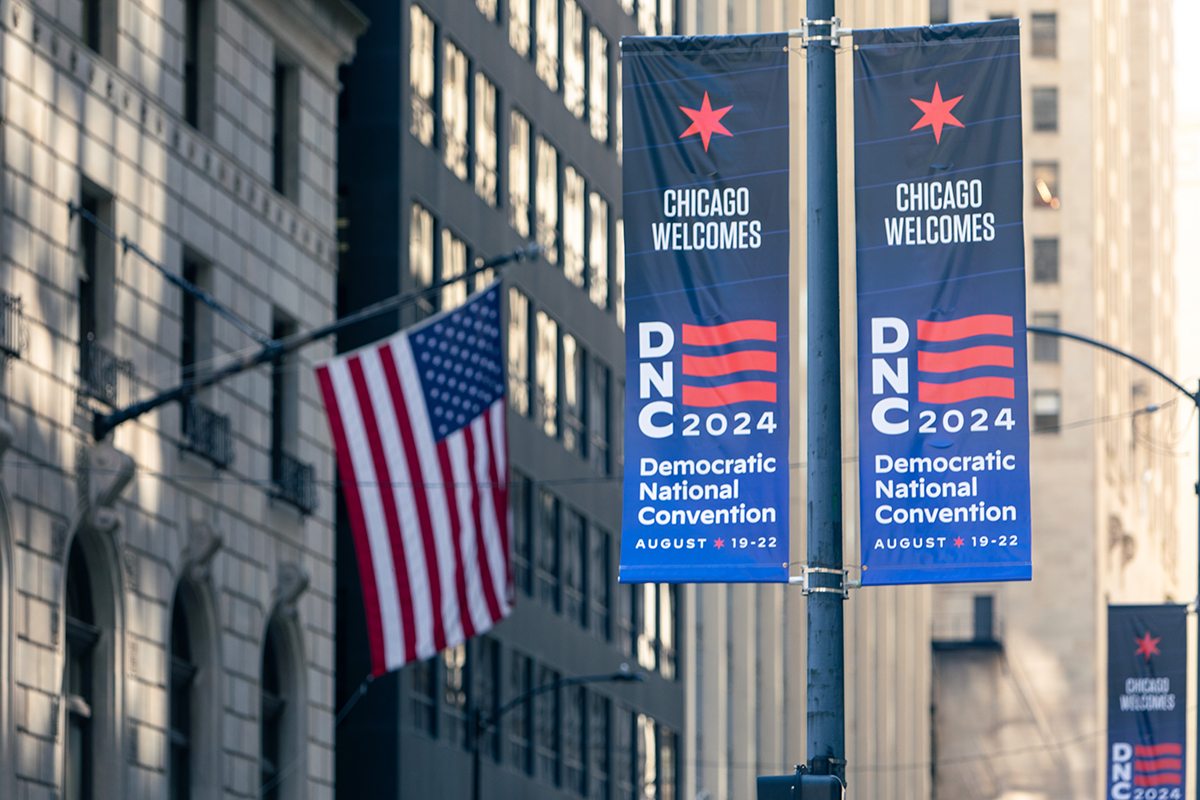
As I’ve written previously, a large coalition of leftist groups has been preparing to take to the streets when the Democratic National Convention comes to Chicago next week. Although there will be a variety of different demands leveled at the DNC during the course of the convention, one key issue clearly stands out as a central common thread through them all – namely, an immediate US arms embargo and a permanent ceasefire to end Israel’s genocide in Gaza.
To name but one example: a rally and march for reproductive justice (of which my congregation, Tzedek Chicago, is a co-sponsor) will take place this Sunday, on the eve of the convention. As “Bodies Outside of Unjust Laws” organizers have made clear, however, the demands of this protest are not limited to issues of domestic reproductive justice alone:
Reproductive justice inherently includes ending the reproductive genocide in Palestine. As U.S. citizens, it is our duty to call on our own government to end the funding of weapons to Israel that enable this nightmare to continue and robs us of funds at home. As feminists and reproductive justice activists, we must also highlight a horrific aspect of the war on Palestinians: it is a war against women and children, who suffer in uniquely cruel ways.
Likewise, the Coalition to March on the DNC, a group of over 200 national and local organizations is calling for an “End to US Aid to Israel” along with demands on immigrant justice, police crimes, healthcare, housing and the environment. Here again, justice for Palestinians is not viewed in isolation from other issues. As protest organizers correctly understand, these issues are irrevocably interlinked and intertwined.
During the course of this election cycle, those of us who have been demanding an arms embargo and ceasefire in Gaza have become all too familiar with one recurrent criticism in particular: that we are “one issue voters.” I find this to be a dangerous attitude for a number of reasons. More than anything, it’s an egregiously dismissive stand to take in an age of genocide, smacking of “it’s not my problem” American isolationism during the 1940s. For the Palestinian people, of course, Israel’s genocide in Gaza is not simply one issue – it’s the issue.
Witness, for instance, the news from this past weekend:
Officials in Gaza say more than 100 people were killed Saturday in an Israeli attack on a school and mosque where thousands of displaced Palestinians had sought shelter. The attack on the al-Tabin school in Gaza City was one of the deadliest individual attacks since Israel’s war on Gaza began over 10 months ago. Rescue workers said they did not find a “single full body” among the deceased — just body parts often destroyed beyond recognition. Survivors said Israel attacked the school during morning prayers…
CNN has confirmed a US-made GBU-39 small diameter bomb was used in the Israeli strike on the school. The attack came two days after the Biden administration notified Congress that it was preparing to provide Israel with an additional $3.5 billion to spend on US weapons and military equipment. Congress had approved the money as part of a $14 billion package for Israel in April. Zeteo reports part of the new US package includes a direct sale of 6,500 joint direct action munitions to Israel.
First and foremost, the genocide in Gaza is a crime against humanity that should concern us all. But as citizens of the nation that is funding and abetting this genocide, we Americans cannot look away from the blood that is surely on our collective hands. Nor can we ignore the shock waves that resonate far outside the borders of Palestine/Israel: the threat of an all-out regional war, the profits enjoyed by the arms and surveillance industry at taxpayer expense, the devastating environmental impact – the list goes on and on. Palestinian human rights lawyer and activist Noura Erakat put it perfectly on Twitter/X recently: “PSA: ending a genocide is not ‘a single issue’ it is an entire universe of issues.”
Another refrain I’ve been hearing repeatedly is the critique that protesting at the DNC “will only help Trump.” Harris herself leveled this argument at a campaign rally in Detroit when she sternly admonished pro-Palestinian protesters: “If you want Donald Trump to win, then say that. Otherwise, I’m speaking.” To be sure, it was an astonishingly tone-deaf and dismissive response to make in Michigan, the very birthplace of the Uncommitted Campaign. But on a more fundamental level, Harris’s response denied the very real impact of her own administration’s policies. As one of the protesters later put it, “When people are demanding a ceasefire and arms embargo and an end to the genocide and you say that we want Donald Trump to step in—it just shows a lack of accountability. It shows a lack of leadership, a lack of responsibility and a lack of ownership.”
In essence, Harris’s comment was just the latest version of the “shut up and vote” message that the Democratic party routinely sends progressives during every election cycle. In an age of US-supported genocide, however, the cynical emptiness of this message has become patently, painfully obvious. As journalist Masha Gessen has rightly pointed out. “These voters are not choosingbetween Harris and Trump. They are choosing between their sense of themselves as moral beings if they vote for Harris and their sense of themselves if they vote for a third-party candidate or for no one at all.”
Of course those who will be protesting at the DNC next week do not want to see Trump elected in November. But even from a purely strategic point of view, what has a better chance of helping the Democrats fortunes in November? We know that a strong majority of American voters across the political spectrum support a permanent ceasefire in Gaza. What would be the more winning strategy: telling those who want to end a genocide to shut up, or exert real leadership that will bring about a ceasefire and an end to the threat of a devastating regional war?
While party conventions function largely as candidate-coronations, they still function as places where parties express their collective vision and finalize their political platforms. On this score, I’m not at all optimistic that an arms embargo to Israel and a permanent ceasefire will find any purchase at the DNC. There are a mere 30 Uncommitted delegates out of 4,600 – and while they are pushing for a voice at the convention (they’ve asked that Dr. Tanya Haj-Hassan, a pediatric intensive care doctor who has volunteered in Gaza, speak from the convention floor), they have still not been offered a slot. Harris’s national security advisor has also made it clear that she opposes an arms embargo to Israel. By every indication, it certainly feels like “shut up and vote” will be the dominant Democratic party message coming out of the convention next week.
I have enormous respect for the Uncommitted delegates who will engage within the convention, particularly co-founder Layla Elabed, who has said even if they are not given a speaking slot, delegates will make their presence known with “news conferences, candle light vigils, tables to distribute literature and, they hope, guest testimonies about life in war-torn Gaza.” When it comes to political advocacy, however, there is always an inside game and an outside game. That’s why those of us who are not delegates will (quite appropriately) be making our presence known outside the walls of the convention hall as well.
Protest organizers have no illusions about the overwhelming militarized presence that will greet us when we gather next week. Federal authorities have divided the area surrounding the United Center, where the main speaking events of the convention will take place, into “soft” and “hard” zones – the latter being off limits to cars and non-credentialled delegates. But even in the soft zones, movement has been heavily restricted. The main protests have been given approved routes far from the convention site, and at one point goes through narrow residential side streets, that will be completely inadequate to handle thousands of protesters. While organizers have appealed the march route, as of this writing there has been no response from the city of Chicago.
When we talk about the potential for police violence next week, of course, the specter of the 1968 Democratic convention in Chicago looms very large. A great deal of ink has been spilled analyzing the differences and similarities between Chicago 1968 and Chicago 2024 – and while I’m loath to venture too far into this rabbit hole, there is one point of commonality I believe bears noting. In general, the mythos around the 1968 DNC protests tend to lay the blame for the Democrats’ defeat on the protest movement that “divided the party.” Often lost in this discussion is the fact that in 1968, those protests were directed toward a political party that had been prosecuting an increasingly unpopular war in Vietnam. Today, as then, I find it deeply misguided to blame protesters and not the immoral policies of the Democratic party itself.
While it’s not particularly helpful to use Chicago 1968 to heighten hysteria over the DNC, protestors are certainly justified in being vigilant over the very real possibility of police violence. I’m not the only one who finds it ominous that the city is doubling down on armed presence in the city. In advance of the convention, the Secret Service agent in charge of “security” has commented that “Chicago has a proven track record when it comes to putting on huge events” – citing the city’s response to Lollapalooza, the NASCAR Chicago Street Race and the Chicago Air & Water Show – as if the DNC is just another tourist event to showcase to the public.
No, we cannot deny of the very real moral and political reality that will be at stake in Chicago next week. We cannot deny that state violence directed against Palestinians is one and the same with so many other forms of state violence that are routinely normalized as “necessary.” And we must resist the call to dismiss any form of systemic violence as just “one issue.” As my friend and comrade, organizer Kelly Hayes has so wisely written:
We have to recognize victims of police brutality, Palestinians, our disabled and unhoused neighbors, and so many others who are subject to forgetting as worthy of grief, outrage and action. Everyday people who are fleeing violence, hunger, and militarism, everyday people whose cites are running out of water or are in danger of disappearing beneath rising flood waters, everyday people who are dying right now because they lack air conditioning amid heat waves – these are the people whose plights and fates should shape our politics. If we are going to fight for any semblance of human decency, we need to reclaim and reassert the value of our lives.
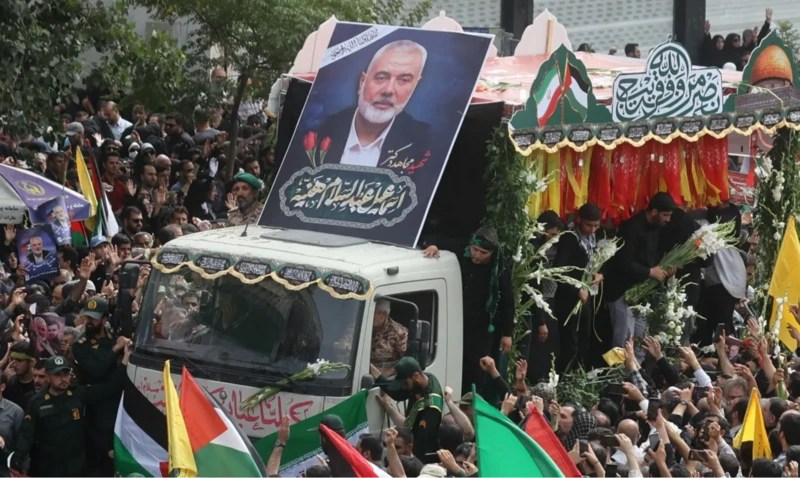
Among the myriad of news items jostling for our attention this past week was the assassination of Ismail Haniyeh, a top political leader of Hamas, who was killed by a bomb in Tehran on Wednesday. Israel is almost surely behind this act, even if it hasn’t publicly acknowledged it. While I realize that there are many in the Jewish community and around the world who are not mourning Haniyeh’s death, it’s difficult to overstate the damaging impact of Israel’s actions on the prospects for a ceasefire in Gaza.
Ismail Haniyeh may have been a leader of Israel’s sworn enemy, but he was also one of the primary figures in ongoing ceasefire negotiations. By killing its own negotiating partner, Israel has made it substantively more difficult to realistically imagine an end to its genocidal violence, a return of Israeli hostages and a Palestinian prisoner exchange any time soon. The Prime Minister of Qatar, who has been a central figure in brokering ceasefire talks put it bluntly: “How can mediation succeed when one party assassinates the negotiator on the other side?”
Why would Israel assassinate Haniyeh, knowing that it might fatally damage ceasefire talks? Many are suggesting that it is in Netanyahu’s personal/political interest to prolong this violence as long as possible – even as it endangers the lives of his own nation’s citizens. While this is no doubt true, I think there is a deeper reason: these latest targeted killings were rooted in Israel’s historic – and fatal – belief that the use of its relentless, overwhelming military force will inevitably force their enemies to submit. It’s worth noting that Haniyeh’s assassination follows the targeted killing of his three sons last April, as well as his sister and nine other members of his family in June. These actions certainly track with Netanyahu’s vow to exact a “mighty vengeance” following Hamas’ October 7 attack.
In fact, Israel has had a long history of assassinating Palestinian leaders, knowing full well that these actions ultimately serve no strategic purpose other than a satisfying show of force. The Israeli military has been assassinating Hamas’ leaders for decades – and Hamas has consistently replaced them. For all its efforts, Israel has succeeded only in increasing the number of Palestinian martyrs and strengthening Hamas’ resolve to resist all the more. In this most recent instance, many observers have pointed out that the killing of Haniyeh will now leave a vacuum to be filled by more radical leaders such as Yahya Sinwar, among others.
Meanwhile, Israel’s genocidal onslaught in Gaza continues with impunity – and nary a protest from the international community. Yesterday, Israel killed at least 15 people – including two children – and injured 40 others in an airstrike that targeted a school-turned-shelter in Gaza’s Shejaiya neighborhood. On Wednesday, the Israeli military killed two journalists from Al-Jazeera, Ismail Al-Ghoul and cameraman, Rami Al-Rifi, with an airstrike on their car. Their colleague Hind Khouri broke down as she reported on their killings, which brings the current number of journalists killed in Gaza to 113.
Israel’s most recent actions have also brought the region, terrifyingly, that much closer to all-out war. On the same day as Ismail Haniyeh’s killing, the Israeli government confirmed that it had assassinated a top Hezbollah leader, Fuad Shukr, in Beirut. The leadership of both Iran and Lebanon, and their proxies in the region are now vowing to retaliate – and the Israeli military is reportedly on “high alert.” Even more ominously, the US intelligence community reports it has received “clear indications” that Iran is planning an attack. One official said the Pentagon and US Central Command are making preparations to help defend Israel militarily, “(involving) US military assets in the Gulf, the Eastern Mediterranean and the Red Sea.”
In times such as these, we are reminded how unbearably high the stakes of a just peace in the region truly are. I understand the palpable sense of powerlessness in the current moment: it sometimes feels as if there is nothing left to do but to pray that leaders on all sides ultimately take a breath and a step back from the brink. In the end, however, we cannot be content to passively hope that the leaders who have brought us to this unthinkable moment will do the right thing.
As has often been said, hope is a discipline. We must find the wherewithal to continue the struggle: to demand a US arms embargo to Israel, an immediate ceasefire in Gaza – and a redoubling of our commitment to a just and equitable peace for all. We must advocate in no uncertain terms that the alternative is utterly unacceptable.
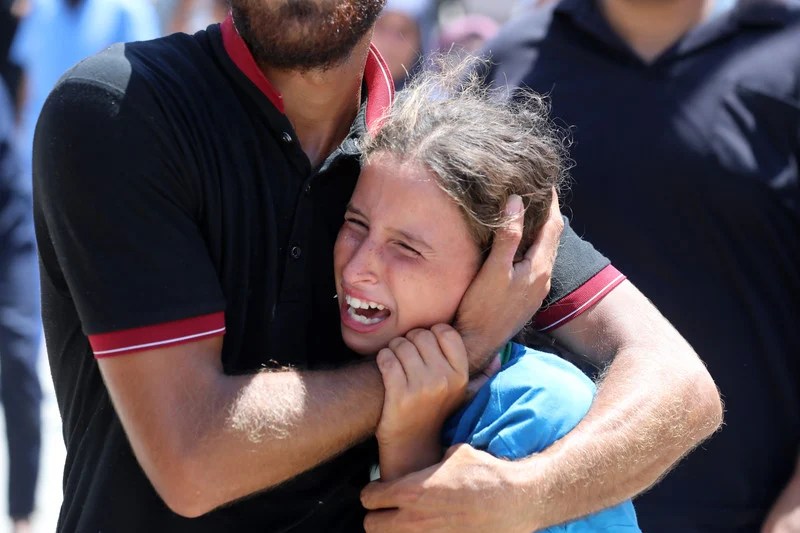
Israel killed at least 90 people in Al-Mawasi in several airstrikes on an area the military had designated as a “safe zone.” Here a child reacts as bodies are salvaged from the site on July 13. Omar AshtawyAPA images
Warning: this post contains descriptions of extreme violence.
On Saturday, while the world was riveted to the news about the assassination attempt on Donald Trump, Israel unleashed airstrikes on Al-Mawasi in Central Gaza – in an area previously designated as a “humanitarian safe zone.” Gazan health officials reported that approximately 90 people were killed and at least 300 injured in this attack. Eyewitness testimonies attested to unspeakable carnage. According to 16 year old Gazan Shaima Farwameh:
A leg hit me, and I saw dismembered bodies a few meters away. I saw a young child screaming. He lost his lower limbs and was crawling on his hands and screaming. The bombs didn’t stop, and suddenly the boy disappeared. I saw how he vanished before me while we ran and lowered our eyes to the ground, unable to do anything but run…What a life we live in these tents that we have to see the dismembered bodies of our siblings and families fly over our heads.
Yesterday, Israel bombed Southern and Central Gaza once again, killing more than 60 Palestinians. Among the targets was a UN school in Nuseirat where families were sheltering. Other strikes in Khan Younis and Rafah killed 12 people, according to medical officials and AP journalists. According to AP, “footage showed the school’s yard covered in rubble and twisted metal from a structure that was hit. Workers carried bodies wrapped in blankets, as women and children watched from the classrooms where they have been living.”
Given the reality of such hideous violence, it was difficult to ignore the irony in the rhetoric following the attempted assassination attempt last Saturday. For me, the most egregious example occurred when Biden said, In his speech to the nation, “There is no place in America for this kind of violence or for any violence ever. Period. No exceptions. We can’t allow this violence to be normalized” (emphasis mine).
This statement is truly breathtaking in its hypocrisy. The genocidal violence Israel has been unleashing on Gazans for the past ten months has long been been normalized for most, save the Palestinian people and their allies. Even as the death toll has now reached nearly 40,000. Even as a new report in the British medical journal Lancet estimates that the actual death toll in Gaza could eventually reach 186,000 or even higher — roughly 8% of Gaza’s population.
It truly takes a special kind of moral gall for Biden to say “we can’t allow violence to be normalized” when it is his very administration that is unconditionally providing Israel with the very bombs that have killing and maiming Gazans on a daily basis. In terms of sheer numbers, President Biden is enabling the deadliest political violence in the world at this very moment.
There has been a chorus of condemnation of “political violence” from across the political spectrum over the past several days. As I’ve listened to the robotic sameness of these responses, it’s occurred to me that they are all unified over one common assumption: political violence is worthy of condemnation when Americans kill other Americans for political purposes – but when the US government commits or enables political violence around the world, it amounts to mere background noise.
Of course, the US itself was created by means of political violence – through the genocide of indigenous inhabitants and the stolen labor of black slaves. This country engages in political violence every day through deadly systems of mass incarceration and policing. And of course, the US has historically expanded its imperial power and influence throughout the world by fomenting the political violence of regime change. MLK famously made this point in his speech A Time to Break Silence when he excoriated “the greatest purveyor of violence in the world today – my own government.”
So please don’t stop raising your voice about Gaza. Please don’t allow this political violence be normalized. Please heed the words of my friend and colleague Jehad Abusalim (who comes from Deir Al-Balah in Gaza):
This is annihilation. There are no words left to capture the horror. Gaza is being obliterated—people are being murdered, starved, and displaced for months on end. Repeating these words feels like a hollow echo and a useless endeavor. But we have no choice but to persevere and keep pushing for an end to the genocide, for accountability, for justice, for healing, for rebuilding, and for liberation. We on the outside have no excuse. As long as Gaza’s defenders, doctors, nurses, first responders, and volunteers keep working and pushing, we have no choice but to keep working and pushing. Gaza needs your activism, your courage, your dedication, your boycott, your presence on the streets, and your donations now more than ever. This is a battle for hope, and hope is the last thing we’ve got. Let’s not let them take it away from us.
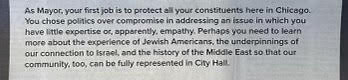
Last Sunday, this full-page ad appeared in the Chicago Tribune: a hate-filled diatribe against Mayor Brandon Johnson for his support of the recent city council ceasefire resolution. Here it is, in full, along with my commentary.
Criticizing one resolution for “doing nothing to substantively affect the outcomes in the Middle East” is a straw man argument. No one who supported this resolution has any illusions that it alone will change the terrible facts on the ground in Israel-Palestine. It does represent, however, a civic statement of conscience. To date, over 70 US cities have passed similar ceasefire resolutions. Taken together, they constitute a collective moral call for an end to the humanitarian nightmare that has been unfolding and escalating in Gaza for the past four months.
The letter makes the unsubstantiated claim that the City Council’s resolution proceedings “fanned the flames of antisemitism.” This is a serious accusation – and it is exceedingly irresponsible to level such a claim without any examples or proof. No, ceasefire resolutions do not cause antisemitism – and protesting Israel’s genocidal violence against Palestinians in Gaza is not antisemitic. It is a call for justice.
Chicago’s ceasefire resolution was based on a resolution passed by the UN last December, which emphasized that “the Palestinian and Israeli civilian populations must be protected in accordance with international humanitarian law.” It also called for “the immediate and unconditional release of all hostages, as well as ensuring humanitarian access.”
This is an exceedingly fair resolution. No, it did not absolve Hamas for the war and civilian deaths, but neither did it condemn Israel for its outrageous prosecution of a military assault that international experts and courts have have claimed fits the definition of genocide.
The letter then goes on to say that Hamas “misused humanitarian aid” – another unsubstantiated claim – and criticizes the resolution for failing to demand that Hamas disarm. Since this is an Israeli demand, to include this would be to inject an egregiously partisan statement into the resolution.
The January 30 high school walkouts were powerful demonstrations of collective student conscience that Mayor Johnson was right to support. The claim that “hundreds of CPS parents, students and teachers” were harassed during the protests is completely anecdotal and in fact, outrageous. If harassment on such a scale actually took place, there would surely be widespread press and investigations into these alleged actions. In fact, the press around the walkouts cited “worries from some CPS parents and Jewish groups that Jewish students could be targeted or made to feel uncomfortable.” There is, of course, a world of difference between “uncomfortable” and “unsafe.”
Palestinians have longpointedout that the call “from the river to the sea” is not a genocidal threat, but a demand for equality and justice for all. If that makes some Jews uncomfortable, they should interrogate their support for “the world’s only Jewish state” – an ethno-nation that does not afford equal rights to the Palestinians who happen to live between the river and the sea.
The “compromises” suggested in this letter are exceedingly more political than anything Mayor Johnson supported – and slamming him for having no expertise or empathy is hateful in its own right. What these signees really want is for him to submit to their own personal opinions about “the Jewish American experience, the underpinnings of our (sic) connection to Israel and the history and the history of the Middle East.”
For shame. These individuals speak for themselves – not for the growing numbers of American Jews who are actively protesting Israel’s genocidal violence in Gaza – and who fully support Mayor Johnson’s courageous moral leadership.
It’s safe to day that International Holocaust Remembrance Day will arrive tomorrow at a deeply fraught moment for the Jewish community. Just today, we’ve received the news that the International Court of Justice, ruling on a case brought by South Africa, has ordered Israel to take action to “prevent acts of genocide” in Gaza. And later today, a federal court in California will hear a case brought by the Center for Constitutional Rights on behalf of Palestinian human rights organizations, Palestinians in Gaza and Palestinian Americans accusing Biden and other senior US leaders of being complicit in genocide.
In short, International Holocaust Remembrance Day 2024 is arriving just as Israel and the US government are literally being judged on the world stage for an ongoing genocide against the Palestinian people.
As we contemplate the monumental nature of this moment, it’s instructive to consider the history of International Holocaust Remembrance Day itself. This annual commemoration was created by the UN in 2005, to take place annually on January 27: the day Auschwitz was liberated by allied forces. In its resolution establishing the day, the UN General Assembly made it clear that this observance would not merely be about commemorating the past; it pointedly urged member states “to develop educational programs that will inculcate future generations with the lessons of the Holocaust in order to help to prevent future acts of genocide.”
The GA also made it explicit that this remembrance would not be limited to the European Jewry alone, but should also extend to “countless members of other minorities” who were murdered en masse by the Nazi regime. As then Secretary General Ban-Ki Moon pointedly commented during the 2015 commemoration, “More than a million inmates, primarily Jews, were brutally and systematically killed in the place where the Nazis introduced the monstrous concept of ‘industrialized murder.’ Among the other victims were non-Jewish Poles, political prisoners, Soviet prisoners of war, Sinti and Roma, homosexuals, disabled persons and Jehovah’s witnesses.”
In other words, International Holocaust Remembrance Day was purposely established to universalize the memory and the lessons of the Holocaust.
There is of course, another Holocaust memorial day widely observed by the world Jewish community – namely, Yom Hashoah. In contrast, to International Holocaust Remembrance Day, Yom Hashoah is not universal in nature – it is a day set apart by the Jewish community to mourn their own in a Jewish context, as part of the Jewish festival calendar. While it is altogether appropriate for the Jewish people to honor the memories of our ancestors in such a way, it’s worth noting the history of this particular day as well.
Yom Hashoah was officially founded by an act of Israeli parliament in 1951, immediately following the founding of the state itself. It was purposefully established on Jewish date of the 27 Nisan (April/May) to begin a week of commemoration leading into Yom Hazikaron (Memorial Day), concluding with Yom Ha’atzmaut (Independence Day). In this way, Yom Hashoah served to promote the Zionist historical mythology that viewed the establishment of the state of Israel as a “rebirth,” arising out of the ashes of the Holocaust, through the brave sacrifice made by the soldiers who fought in the War of Independence.
Like many Jews growing up in America, I simply accepted Yom Hashoah as an organic part of the rhythm of the Jewish year, observed annually in synagogue services and communal commemorations. I was never taught that it was first and foremost an Israeli national holiday. And of course, I was never taught that the state of Israel was founded in the wake of the Holocaust through the ethnic cleansing of the Palestinian people from their homes.
While there should most certainly be a communal Jewish day of memorial for the six million, it’s worth questioning the prominent status afforded Yom Hashoah by world Jewry. This is, after all, a day that serves to reinforce the view that the Israel’s founding was a “redemptive” moment for the Jewish people following the tragic cataclysm of the Holocaust – utterly ignoring the reality that the state of Israel was established through the dispossession of another people. I strongly believe we should consider an entirely different Jewish frame for commemorating the Holocaust; in the meantime, however, we should have no illusions about the real agenda behind Yom Hashoah and the problematic narrative it seeks to support.
It might well be said that in this terrifying current moment, the very real implications of this Zionist mythology are being directly challenged by the universal message of International Holocaust Remembrance Day. It’s actually quite staggering to consider: as the world prepares to observe this day, compelling legal proceedings are formally accusing Israel of (and the US of abetting) genocide. Even more sobering: it arrives amidst an increasingly damning verdict in the court of public opinion in which, according to a recent poll, “more than one in three Americans believe Israel is committing genocide against Palestinians.”
I realize how painful – even unthinkable – it will be for many Jews to lift up the lessons of International Holocaust Remembrance Day to suggest Israel that is committing genocide against the Palestinian people. But as I suggested in my sermon this past Yom Kippur, we must find the courage to say out loud the words that must be spoken. If this particular day is truly is to be a day for us to apply the “lessons of the Holocaust in order to help to prevent future acts of genocide,” it is all the more critical for us to speak out and name a genocide that is literally unfolding before us in real time. No matter how uncomfortable or painful the prospect.
In this regard, I’m immensely proud to be part of a Jewish community that has the courage to say these words out loud. In a just released public letter to President Biden, the Jewish Voice for Peace Rabbinical Council is demanding that he “honor the word and spirit of the International Holocaust Remembrance Day by using (his) office to bring a ceasefire to this tragic violence — and to stop blocking efforts toward building a truly just peace for all who live between the river and the sea.”
An excerpt:
We hold the traumatic history of our people with care and sensitivity — and know how painful it is for Jews to grasp that a Jewish state could possibly commit a genocide. Nevertheless, we must agree with increasing numbers of scholars and international rights experts who have determined that Israel’s actions in Gaza constitute, in the words of Prof. Raz Segal, “a textbook case of genocide.”
We support and uplift South Africa’s recent application to the International Court of Justice claiming Israel is in breach of the 1948 Convention on the Prevention and Punishment of the Crime of Genocide. And now, Palestinian human rights organizations, together with Palestinians in the US and Gaza, are bringing a case against your administration for failure to prevent, and complicity in, the Israeli government’s unfolding genocide against them, their families, and the 2.2 million Palestinians in Gaza. We stand in support of their action as well.
According to a core teaching of Jewish spiritual tradition, humanity was created in the image of God. That means that each and every human being is of infinite value. The UN 1948 Convention on Genocide was created to uphold this very idea. The Torah also teaches that there will always be moments when we must make a critical moral choice. As Deuteronomy 30:19 says, “I have put before you life and death, blessing and curse. Choose life.” President Biden, you have chosen death. Instead of using your considerable power to prevent or end this genocide, you have directly abetted it with weapons, funds and diplomatic cover.
On this day of remembrance in 2021, you noted that, “The Holocaust was no accident of history.” As you stated, “It occurred because too many governments cold-bloodedly adopted and implemented hate-fueled laws, policies, and practices to vilify and dehumanize entire groups of people, and too many individuals stood by silently. Silence is complicity.”
President Biden, what is happening right now in Gaza is no accident of history — and your complicity has been anything but silent. We call upon you to be true to your word and end US complicity in Israel’s genocide against the Palestinian people.
This International Holocaust Remembrance Day, let us find the courage to speak the words that must be spoken. This International Holocaust Remembrance Day, let us find the courage to speak the words that must be spoken: Ceasefire now. Never again, for anyone. No more genocide.
The introduction to the book of Exodus, which we begin reading this Shabbat, has never resonated so deeply or so powerfully for me as it does this very moment.
We’re all familiar with the events that spark the Exodus narrative: a new Pharoah arises over Mitzrayim who does not know or remember Joseph. Alarmed that the Israelite minority is growing, he oppresses them with forced labor – but the more he oppresses them, the more the Israelites increase in number.
Pharoah then attempts to stem the Israelite birth rate directly by ordering the Hebrew midwives Shifra and Puah to kill every newborn boy. When they defy his order, Pharoah orders that every newborn boy be cast into the Nile. Commentators differ on why Pharoah made this very specific decree. Some say that in his paranoia, he believed the boys would eventually grow up to be soldiers and take up arms against his people. Other say his soothsayers predicted the birth of Moses. Still others say Pharoah believed that the Israelite women would intermarry and assimilate into the majority culture.
Whatever the reason, it is striking to note that Exodus’ liberation narrative begins with Pharoah’s efforts to head off the Israelite birth rate. As I’ve noted before, there are powerful parallels between this narrative and the state of Israel’s regard of the Palestinian people as a “demographic threat” to their Jewish majority. But in the midst of Israel’s genocidal assault on the people of Gaza, I’m finding that these verses now resonate with a brutal – and almost unbearable – urgency.
On November 3, less than a month into Israel’s military bombardment of Gaza, UNICEF, the World Health Organization and other NGOs reported that “Women, children and newborns in Gaza are disproportionately bearing the burden of the escalation of hostilities in the occupied Palestinian territory, both as casualties and in reduced access to health services.” More recently, the UN estimated that “around 50,000 pregnant women are currently living in Gaza, with more than 180 births taking place every day amid the ‘decimation’ of its healthcare system.”
The most devastating details on the impact of this onslaught on Gazan mothers can be read in the South African government’s application to the International Court of Justice, formally accusing Israel of committing genocide in Gaza. I strongly recommend reading this document in its entirety. Though South Africa’s claim was cynically dismissed by the White House as “meritless, counterproductive and completely without any basis in fact whatsoever,” its 84 page report is painstakingly researched, citing 574 independent sources. Though it is often near-unbearable to read, I believe it is an immensely important document and deserves the widest possible readership.
Here is a sample of the report’s findings on impact of Israel’s genocidal violence on pregnant women and newborn babies. Please be warned: the following quote it includes very graphic descriptions of traumatic violence inflicted on women and children.
Pregnant women and children –– including newborn babies –– are also particularly impacted by displacement, lack of access to food and water, shelter, clothes, hygiene and sanitation, and lack of access to health services. These effects are severe and significant. An estimated 5,500 of approximately 52,000 pregnant Palestinian women in Gaza giving birth each month are doing so in unsafe conditions, often with no clean water, much less medical assistance, “in shelters, in their homes, in the streets amid rubble, or in overwhelmed healthcare facilities, where sanitation is worsening, and the risk of infection and medical complications is on the rise”. Where they are able to get to a functioning hospital, pregnant women are having to undergo caesarean sections without anaesthetic.
Given the lack of access to critical medical supplies, including blood, doctors are being compelled to perform ordinarily unnecessary hysterectomies on young women in an attempt to save their lives, leaving them unable to have more children. Indeed, the Minister of Health for the State of Palestine, Dr May al-Kaileh, confirms that the only option facing Palestinian women in Gaza who ‘bleed out’ after giving birth is to undergo a hysterectomy in order for their lives to be saved. The lack of available drugs, such as the anti-D injection –– given to Rhesus negative women on the birth of a Rhesus positive baby –– also seriously impacts the possibility of future healthy pregnancies for affected women.
Premature births have reportedly increased by between 25-30 per cent, as stressed and traumatised pregnant women face a myriad of challenges, including being compelled to walk long distances in search of safety, attempting to escape from bombs and being crowded into shelters in often squalid conditions. Particularly in northern Gaza, cases of placenta abruption –– a serious condition that occurs to pregnant women during childbirth which is potentially life-threatening to both mother and baby –– have more than doubled.
An ever-increasing number of Palestinian babies in Gaza are reportedly dying from entirely preventable causes, brought about by Israel’s actions: newborns up to three months old are dying of diarrhea, hypothermia, and other preventable causes. Without essential equipment and medical support, premature and underweight babies have little to no chance of survival. Palestinian newborn babies have died due to the lack of fuel to supply hospital generators; others have been found decomposing in their hospital cots, medical staff taking care of them having been forced by Israel to evacuate.
On 3 November 2023, the World Health Organisation warned that “[m]aternal deaths are expected to increase given the lack of access to adequate care”, with deadly consequences on reproductive health, including a rise in stress-induced miscarriages, stillbirths and premature births. The impact will necessarily be long lasting and severe for Palestinians in Gaza as a group. By 22 November 2023 the United Nations Special Rapporteur on violence against women and girls, its causes and consequences, has expressly warned that:
“[T]he reproductive violence inflicted by Israel on Palestinian women, newborn babies, infants, and children could be qualified as… acts of genocide under Article 2 of the Convention on the Prevention of Genocide … including “imposing measures intended to prevent births within a group”. She stressed that “States must prevent and punish such acts in accordance with their responsibilities under the Genocide Convention.”
(Sections 96-100)
If there could be any doubt as to the question of intentionality behind these barbaric measures, the section immediately following these findings includes exhaustive quotes by Israeli politicians and military leaders that make their genocidal intentions all too clear. Most chillingly, it offers this quote from 95-year old Israeli army reservist Ezra Yachin — a veteran of the Deir Yassin massacre during the 1948 Nakba — who was called up for reserve duty to “boost morale” amongst Israeli troops ahead of the ground invasion: Be triumphant and finish them off and don’t leave anyone behind. Erase the memory of them. Erase them, their families, mothers and children. These animals can no longer live. . . Every Jew with a weapon should go out and kill them. (Section 102)
In this week’s Torah portion, the cry of the oppressed Israelites rises up to God, who hears and hearkens to their pain. This year, there can be no more critical question posed by our Torah portion: will God hearken to the collective cry of the people of Gaza?
Last week, the board of my congregation, Tzedek Chicago released this statement in repsonse to Israel’s ongoing military assault in Gaza. Although it is addressed to all people of conscience, it contains a specific challenge to the Jewish community at large.I’m immensely proud of the statement, which I hope will be considered seriously even (especially) by those members of the community aren’t ready to heed its words.
Our statement is not so much an academic argument as it is a call to moral action. As we say in our statement, “We are witnessing the continuation of the Nakba in real time…Now more than ever, it is time for Jews of conscience to call out the essential injustice at the heart of Zionism in no uncertain terms.“
The full statement follows below:
The unspeakable violence currently unfolding in Gaza is confronting the Jewish community with the most critical moral challenge of our lifetime.
As of this writing, over 21,000 Palestinians have been killed by the Israeli military, almost half of them children. According to the UN, nearly two million people have been internally displaced, confining them to less than one-third of the Gaza Strip’s territory. Disease and starvation are rampant, subjecting one in four households into “catastrophic conditions.” As the Secretary General of the UN recently described, “(Gaza) is at a breaking point. There is a high risk of a total collapse of the humanitarian system.”
Together with Jews and allies around the world, we grieve the massive loss of life that occurred as a result of Hamas’ heinous violence in Israel on October 7. We join with those around the world who are demanding the safe return of the remaining hostages currently being held in Gaza. We unreservedly condemn Hamas’ actions on that terrible day – there can be no justification for this brutal attack on civilian life.
We also know there was a crucial, underlying context to this horrible violence. We assert without reservation that to contextualize is not to condone. On the contrary, we must contextualize these events if we are to truly understand them – and find a better way forward.
The violence of October 7 did not occur in a vacuum. It was a brutal response to a regime of structural violence that has oppressed Palestinians for decades. At the root of this oppression is Zionism: a colonial movement that seeks to establish and maintain a Jewish majority nation-state in historic Palestine.
While Israel was founded in the traumatic wake of the Holocaust to create safety and security for the Jewish people, it was a state founded on the backs of another people, ultimately endangering the safety and security of Jews and Palestinians alike. Israel was established through what Palestinians refer to as the Nakba: the ethnic cleansing of 750,000 Palestinians from their homes in 1948. And since that time, Israel has subjected Palestinians to a regime of Jewish supremacy in order to maintain its demographic majority in the land.
This ongoing Nakba is the essential context for understanding the horrifying violence of the past three months. Indeed, since October 7, Israeli politicians have been terrifyingly open about their intentions, making it clear that the ultimate end goal of their military assault is to ethnically cleanse Gaza of its 2.2 million Palestinian residents. One prominent member of the Israeli government put it quite plainly: “We are now rolling out the Gaza Nakba. Gaza Nakba 2023. That’s how it’ll end.” More recently, Prime Minister Netanyahu was reported as saying that he is actively working to transfer Palestinians out of Gaza. The problem, he said, “is which countries will take them.”
Israeli leaders are being true to their word: we are witnessing the continuation of the Nakba in real time. As in 1948, Palestinians are being driven from their homes through force of arms. As in 1948, families are being forced to march long distances with hastily-collected possessions on their backs. As in 1948, entire regions are being razed to the ground, ensuring that they will have no homes to return to. As in 1948, Israel is actively engineering the wholesale transfer of an entire population of people.
In a statement last week, the UN Special Rapporteur on the human rights of internally displaced persons warned:
As evacuation orders and military operations continue to expand and civilians are subjected to relentless attacks on a daily basis, the only logical conclusion is that Israel’s military operation in Gaza aims to deport the majority of the civilian population en masse.
In short: Israel’s military onslaught on Gaza is revealing the true face of Zionism.
From its founding, Tzedek Chicago has openly rejected the conflation of Judaism with Zionism. As expressed in our congregation’s core values statement: We are anti-Zionist, openly acknowledging that the creation of an ethnic Jewish nation state in historic Palestine resulted in an injustice against the Palestinian people – an injustice that continues to this day.
Since Israel’s most recent military assault on Gaza began, Tzedek Chicago has been a proud and active participant in the cease-fire movement, which has been steadily growing in the Jewish community. This movement is collectively motivated by the Jewish mitzvah of pikuach nefesh – the sacred imperative to save life. At the same time, however, it is critical to assert the Jewish value of “tzedek, tzedek tirdof” – “justice, justice shall you pursue.” Beyond ceasefire, we must acknowledge and call out the human dispossession that is at the root of Israel’s latest assault on Gaza.
Now more than ever, it is time for Jews of conscience to call out the essential injustice at the heart of Zionism in no uncertain terms. This is a critical moment for our Jewish communal organizations as well. We know it is not easy for Jewish institutions to reject Zionism, but we believe it’s critical that they do. In particular, we ask synagogues that are proudly “standing with Israel” to morally reckon with whom they are choosing to stand and consider the real human costs of their position.
There are some Jewish congregations that maintain an inclusive “wide tent” that makes room for both Zionists and anti-Zionists alike. While this may seem like a welcome development, we encourage these synagogues to consider how this inherently contradictory position nonetheless enables the violence Israel is perpetrating against Palestinians. We also invite congregations that publicly support “Palestinian liberation” to be clear about what this liberation will ultimately look like. Will it be a liberation in name only or will it include the dismantling and transformation of the colonial Zionist project once and for all?
The moral challenge of the moment is clear. We invite other Jews of conscience to join us in the creation of a thriving movement of Judaism beyond Zionism. A Judaism that lifts up a diasporic consciousness that doesn’t express entitlement over land. A Judaism that rejects ethno-nationalism, militarism and dispossession and celebrates our spiritual tradition of justice, liberation and solidarity with all who are oppressed.
Let our call for ceasefire be but the first step toward a greater liberation: one that extends true justice and equality for all who live between the river and the sea.
According to Jewish law, it is forbidden to mourn on Shabbat: between sundown on Friday and sundown on Saturday, funerals do not take place and the public aspects of shiva observance are suspended. For many, the very notion “forbidding mourning” can feel harsh and emotionally insensitive. I’ve often heard from mourners who resist this idea of “suspending their grief.” More than one congregant has pointed this out to me over the years: “Grief isn’t something I can just turn on and off. How do I possibly stop my grieving for this one day? Should I pretend that Shabbat will just magically make everything better?”
One way to answer to this question is to understand the difference between grief and mourning. While grief is an emotional state; mourning refers to the rituals and practices we observe to help us manuever through our experience of loss. Of course, we cannot turn our grief on and off, nor should we be expected to. Grief by its very nature cannot be scheduled to our convenience. As anyone who has experienced the loss of a loved one will attest, the emotions that attend grief will invariably grip us with unsettling randomness – often when we least expect it.
When we suspend certain mourning practices on Shabbat, however, even in the midst of intense grief, we affirm a life beyond the loss, beyond the pain. Shabbat is our weekly reminder of this: our regular opportunity to experience olam haba – “the world as it should be.” When we suspend these rituals on Shabbat, we make a point of affirming healing during the most painful times in our lives. In some ways, it feels like nothing less than an act of spiritual defiance.
For over a month now, it has been a time of unimaginable, exponential, cascading grief on a scale few of us have ever seen. Israelis and scores of Jews the world over are still experiencing deep shock and trauma over Hamas’ brutal attack on October 7. Even as I write these words, we do not know the full extent of these massacres and abductions – many still do not know if their loved ones are alive or dead, whether they were killed or taken hostage. We are still learning the heinous nature of the attacks that unfolded on that terrible day. How does one even begin to mourn when faced with grief of such magnitude?
Tragically, we were never given the opportunity to learn the answer to this question. Only a few days after this attack, the Israeli government chose to respond with a vengeful military onslaught. As so many have now observed, Israel “weaponized its grief” against an imprisoned population of 2.2 million Palestinians trapped in Gaza with nowhere to run. The exponential human loss Israel has unleashed is truly beyond comprehension: to date, the current death toll: 12,000 people, including 5,000 children.
For so many of us, the only work of the past six weeks has been to voice our collective conscience as loudly, as often and as fiercely as possible. We have been bearing witness to the most sacred values of our tradition: pikuach nefesh – saving a life is sacrosanct and tzelem elohim – affirming that all humanity is created in the divine image. All of these values are embodied in the two sacred words we’ve been chanting over and over and over again: “Ceasefire Now!” To end this vengeful, genocidal violence. To negotiate a homecoming for hostages and prisoners. To begin the process of rebuilding and healing through a process of just peace for all.
No, as Shabbat falls this evening, we will not “switch off our grief.” We will not deny this all-pervading, still unfolding pain. But we will affirm a world beyond it.
We know all too well that in moments of brokenness, it is difficult to imagine a world beyond. We know from experience that brokenness, by definition, involves loss. We know that what is broken can never be put back exactly the same way it was. But beyond the loss, Shabbat comes to remind us that no matter what, we never forfeit the chance to rebuild and heal. While grief can break us open, it also has the potential to transform us: opening us up to new visions, new opportunities, new worlds that we never may have dreamed possible.
In this moment, when so much around us seems to be shattering into so many painful shards, let us hold tightly to this truth.






 Shalom Rav