Category Archives: Environmentalism

Outside Does Not Mean Alone: A Guest Sermon for Erev Yom Kippur 5785

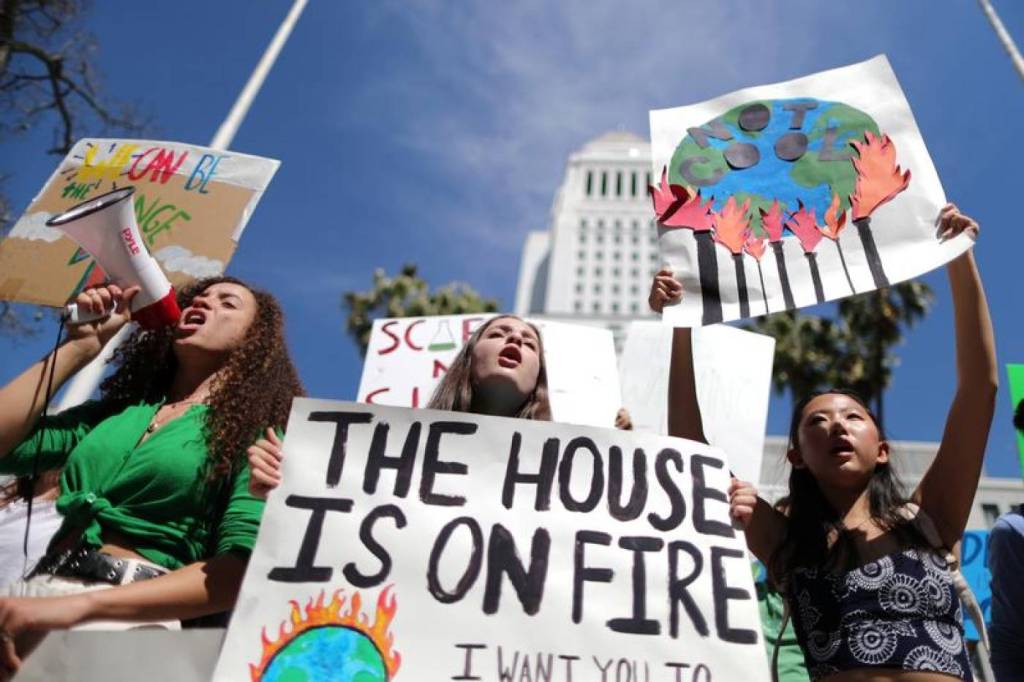
 (photo: Irfan Khan / Los Angeles Times via Getty Images)

Guest sermon at Tzedek Chicago’s Erev Yom Kippur service by Tzedek staff member Aviva Stein on October 11, 2024:

Good Yuntif.

I am honored to have the opportunity to speak to you all tonight. I began working at Tzedek Chicago as our Family Program Coordinator in early 2019. In July of this year I became Tzedek Chicago’s second full-time staff person, serving as the community and organizational director for this inspiring congregation.

I am speaking to you now at Kol Nidre of Yom Kippur in the year 5785, as a genocide is being carried out against the Palestinian people. 

For the past many months, and particularly on this day of reflection, as the gates of heaven open wide for our most intimate and vulnerable supplication, my mind keeps coming back to the question–how could we let this happen? 

One answer I keep returning to is that this tragedy is in part a product of the decades-long campaign by American Jewish institutions to build nationalist, dogmatic support for the state of Israel within our communities, and particularly in our children. When reflecting on my own upbringing, the clarity with which I can see the indoctrination of my Jewish education as a young person is chilling.

From my summer camp’s obligatory High School Israel trip, where we dressed up in IDF uniforms and took pictures for instagram, to “Israeli club,” the only Jewish affinity space at my public high school, which I later learned was funded by an Orthodox “youth education” organization, to the march for Israel being an annual youth group event to singing the Israeli national anthem in Hebrew school. When I look back, I see the many ways nationalist fervor a created an ersatz version of Jewish identity for me as a child. I had been taught that being Jewish was loving Israel, and I believed it. By the time I was in college, I had become a successful product of what all that institutional Zionist funding had set out to do. 

I got my first job after college in 2014 as a teacher’s aide at the local Jewish day school. It was sitting in on the daily “Jewish Studies” class, where I for the first time was able to clearly see the ideological manipulation of the Israel education machine. At that point, I did not identify as a Zionist – I didn’t feel I had enough political knowledge to know what that meant. I know now that internalized sense of ignorance is a tool well-used by the zionist establishment – telling us that it was “too complicated” and that “we didn’t understand” was a reliable way to suppress dissent among their targets. At that time I did, though, feel an obligation to the state of Israel as a Jewish person. 

Watching those children create maps of Israel that highlighted popular tourist destinations, making pita on Israel day, and hanging pictures of Jewish men praying at the Western Wall, I had the perspective I needed to question the establishment in which I was raised and in which I was watching these children grow up. Wasn’t Israel a country, just like the US, and wasn’t it a country at war? My family openly objected to the war in Iraq – why not in Israel?  I had questions that I as a young adult knew were too taboo to ask. But I had a new perspective in my position as a teacher of experiential and inquiry-based education: wasn’t being afraid to ask questions an indicator that something was very, very wrong?

That same year, #IfNotNow held its first public action, when a small group of young Jewish activists read the Mourner’s Kaddish in New York City in recognition of the Palestinian lives lost in the assault on Gaza that summer. And, also in 2014, my childhood rabbi, Brant Rosen, left the synagogue in which I had grown up in the wake of his increased outspokenness about human rights violations in Palestine that were being committed in our names as Jews. My questioning came at a moment in US history when objection to the occupation of Palestine in the Jewish community was more visible than ever. Without looking very hard, I was able to find community that ultimately carried me through the process of unlearning Zionism. I recognize that opportunity of being guided in loving, joyful Jewish community towards a Judaism of solidarity as a real gift for my generation, one that was not afforded to so many Jews of conscience in the decades before me. 

My heart breaks when I see the same cycle of propaganda and silencing posing as pedagogy continue in Jewish education today. Six years ago I took a job at a religious school where I felt it was special that I was allowed to teach there while being open with leadership about my politics. It was challenging to work somewhere where I was not politically aligned, but it was a job, and I could manage. In October of last year, something broke in that community. Donors who had made their contributions with strings attached started pulling those strings, and leadership, which had prided itself on a liberal and open perspective on Palestine, quickly adopted the right-wing politics of their biggest donors. This spring, after months of censorship posing as policy, when my coworker was told that they could not wear a keffiyeh for explicitly Islamophobic reasons, we quit. 

I am ashamed of the choice that synagogue made to uphold racism to shield its community from critical engagement with the devastation of Palestine. But my coworker and I were not alone – since March, eleven full and part time staff people at that “progressive” organization have left their jobs. In the past year, Adam and Leah, Tzedek Chicago’s cantorial team, both have left Jewish education jobs in solidarity with Palestine. Around the country, I know of a dozen more people who have left their jobs this past year, by being fired or quitting. There is an epidemic in the Jewish community –young people are losing and leaving their jobs, and the Jewish community is losing the passion, critical thinking, and vitality that their best and brightest brought to their work. So many Jewish organizations are breaking this way – the big tent, so to speak, has collapsed, and Jews of conscience, Jews who say no to genocide and no to Islamophobia and anti-Arab racism and war mongering, find ourselves on the outside. 

But outside does not mean alone. Over the past 10 years at Tzedek Chicago, our membership has seen tremendous growth to nearly 400 member households. Our family program community has grown from four families to seven to more than twenty, and for the past six years, we’ve seen our children build joyful Jewish space rooted in solidarity with Palestine. Our membership has grown as a blended community across generations and our most active members range from movement elders to very young children, all of whom are committed to this new Jewish future we are building together. 

These past 10 years have experienced a blossoming in Jewish communal life beyond zionism not just at Tzedek Chicago but around the world. Making Mensches in New York, Tirdof in Denver, and Makom in North Carolina are all explicitly anti zionist Jewish ritual communities. Organizing spaces #IfNotNow and JVP have become household names. The Jewish Liberation Fund has successfully challenged the status quo in philanthropy and offers grants for proudly anti-Zionist Jewish work (of which Tzedek Chicago has been a beneficiary). Tzedek UK/Ireland is a thriving community. In Chicago, we are now home to two prayer communities beyond Zionism, Tzedek Chicago and Higaleh Nah. There are of course many more chavurot, friend groups, and organizing communities around the country making meaningful Jewish life that reject Zionism. 

So much has changed in the last ten years. And I believe it with all my heart when I say that we have entered a paradigm shift, where the politicized young, queer, disabled and neurodivergent people we have relied on to staff our Hebrew schools and summer camps will no longer accept propaganda and nationalism as normal. We don’t have to. We can choose to work in Jewish organizations that are actually values aligned rather than those that just “allow” us our politics. Of course these opportunities are few relative to Zionist institutions, but I believe we are moving towards a Jewish future where the social norm of Zionism will become increasingly rare, and where communities like ours are not an anomaly but a standard of Jewish communities around the country. 

It has been truly meaningful to see what had felt like such a lonely landscape become so varied and rich. And, as heartening as this change is, it feels essential that we acknowledge that this is nowhere near enough. It breaks my heart that this is considered such a radical concept: a joyful community of people who are committed to a world beyond colonialism and oppression, and who say so, full stop. It breaks my heart that the victories we have to celebrate are about staffing and organizational capacity as we watch the devastation of Palestine in real time.

Twelve years ago I was pursuing a degree in environmental studies, and I remember very clearly a class where we discussed the mounting science pointing to the inevitability of climate collapse, just a couple years after it had become remotely socially acceptable to even use the term “global warming.”

 “Something really big is going to happen,” we said, “and people will realize, something will change, something has to give.” This was seven years after Hurricane Katrina, and two years after the Deepwater Horizon oil spill. Still, we found ourselves saying, “something really big is going to happen, and then, and then…” 

This memory haunts me as we consider the fight for Palestinian liberation. Climate collapse is here – I don’t need to list the many ways we experience its consequence. We know it’s here. We are right now seeing the extent of the destruction brought by Hurricanes Helene and Milton, record breaking storms inarguably exacerbated by rapidly warming seas. The consequence of our inaction is here.

The Nakba happened. The ethnic cleansing of hundreds of thousands of Palestinians from their homes, creating the largest refugee population in the world, happened. The occupation of millions of Palestinians happened. This year, at least 40,000 people, (though we know in truth many, many more) have been murdered. Entire family lines are gone from this earth and we suffer for the loss of each one of those lives. There is nothing bigger, nothing greater that will awaken our collective consciousness. The consequence of our inaction is here. The unthinkable has happened, and it’s happening right now as we sit here, gathered on this holiest day, the gates of heaven open wide. 

We will never get back the biodiversity that once blanketed the earth, nor the beauty, and freedom and abundance that it provided. And, the earth is not lost. Song birds migrate, leaves change their color, networks of fungus communicate through untold billions of channels under our feet. 

I mourn for the world we might have lived in had those tens of thousands of lives not been lost. The world and our souls are irrevocably damaged by this unthinkable loss of life. 

And, in the face of this unimaginable loss we, as Jewish people, as Americans, as living beings on this earth, owe Palestine our radical imagination. We owe our steadfast belief that Palestine will be free. Palestine will be free, nation states will fall, families will flourish, and we will live in a world where everyone is fed, and everyone is housed, and children will play in river beds and groves of olive trees.

We are painfully far from that dream. Our small successes in the face of unspeakable evil are just that: small. 

Kabbalah teaches that every time a person performs a mitzvah, they bring us that tiniest step closer to Olam Haba, the world to come. I do not believe that a Messiah will come and save us from the world we have created for ourselves. I do believe that when we make visible our refusal to participate in the Judaism of violence and supremacy that is normative in our institutions, we become that small bit more visible to the people who are looking for us. To the young people first entering a critical perspective of Israel, to the people who need to leave their job but don’t know where they can go, to the people who love being Jewish and don’t believe that it makes their safety more important than anyone else’s, they can find us. We’re here.

 And no, the visibility of Jews who reject Zionism will not free Palestine. But our communities are growing. And as we grow, and our voices become louder, and as we send our money and march in the streets and dedicate our prayer and build our power, we bring more and more people into the sacred responsibility of radical imagination. As Aurora Levins Morales writes in “V’ahavta:” 

When you inhale and when you exhale
breathe the possibility of another world
into the 37.2 trillion cells of your body 
until it shines with hope. 
Then imagine more.

We are here tonight, on the eve of Yom Kippur, to release all vows we have not fulfilled and to recommit ourselves to the holy work of teshuvah, of imagining more. Thank you for being here. We will be here. And Palestine will be free, soon and in our days.

G’mar chatimah tova. 

On Tu B’Shevat, Our Call for Ceasefire Affirms the Sacredness of All Life

Guest Post by Maya Schenwar

Remarks by Maya Schenwar, from last night’s Tu B’shvat gathering sponsored by Tzedek Chicago and the Jewish Fast for Gaza. (Maya is director of the Truthout Center for Grassroots Journalism. She is also a coordinator of the Jewish Fast for Gaza and a member of Tzedek Chicago.)

Many of those of us involved in Jewish Fast for Gaza are breaking our fast tonight. We’ve been fasting weekly on Sundays since mid-October, and we will keep fasting weekly until a ceasefire. We donate the money we would’ve spent on food to organizations supporting people in Gaza in this time of starvation and mass death. And each week, we are also reflecting on and renewing our commitment to solidarity with our Palestinian co-strugglers and people around the world who are calling for an end to this genocide, an end to US funding for Israel’s weapons, an end to colonization and apartheid.

When we call for a ceasefire, when we fast for a ceasefire, we are uplifting a call for life. In the months since October 7, I’ve heard many people quote Ruth Wilson’s Gilmore’s sacred words, “Where life is precious, life is precious.” And one of the things Ruthie is saying, with that message, is that in societies where life is actually treated as precious—where they don’t have the death penalty and life sentences and large-scale state violence and state-sanctioned environmental devastation—in those places, violence is less likely overall, the culture is less violent, because life is affirmed.

We should bear in mind that as the US fuels Israel’s genocide in Gaza, here in the US, Alabama is preparing to carry out the US’s first execution via nitrogen gas—which is torture—on the day of Tu B’Shvat.

People are more likely to treat life as precious when their own lives are treated as precious. So we have to create the conditions in which everyone’s life is treated as inherently sacred and irreplaceable. That work is on all of us.

Our Fast for Gaza draws inspiration from the Jewish tradition of fasting as an act of mourning, and it also draws inspiration from Palestinians incarcerated inside Israeli jails, who have launched many hunger strikes to protest their incarceration, and the incarceration of all Palestinians under occupation, to INSIST that their lives are precious.

When Ruth Wilson Gilmore first introduced this idea—where life is precious, life is
precious—she was at an environmental justice conference for youth, where, among other things, the youth denounced the effects of pesticides, including on humans– and of course, pesticides also have impacts on native plants and animals. I think this is significant, for Tu B’Shvat. Recognizing that all life is precious means recognizing our interconnection with all life around us. It means we need to, in the words of Thich Nhat Hahn, “awaken from the illusion of our separateness.” It means recognizing the ways that trees have been weaponized to push Palestinians off their land. It means recognizing Israel’s mass destruction of olive trees.

Trees themselves recognize that where life is precious, life is precious. Forests are social
systems in which trees support each other through their root systems, through chemical signals in their leaves, through the social climate they create. As we celebrate the trees’ birthday today, we can also celebrate their preciousness, the preciousness of all the life they nurture and that nurtures them. And we can express that through our urgent calls for a ceasefire, for Palestinian liberation, and for collective liberation.

When we say ceasefire now, we are also saying environmental justice now. When we say ceasefire now, it is a call for Indigenous liberation now, from Palestine to Turtle Island and beyond.

Ceasefire now can be a call to stop death penalties of all kinds, including this execution that is set to happen in our own country on the day of Tu B’Shvat. Let’s insist on the preciousness of people, and of trees, and of the interconnectedness of all beings.

Chag Sameach and peace to you all.

Shabbat as Revolution: Sermon for Erev Yom Kippur 5783

If asked to pick one aspect of Jewish spiritual tradition that was the most important, the most valuable, the most genuinely impactful, it would be no contest. I’d answer without hesitation: it’s Shabbat. 

Shabbat just looms so large and is so basic to the Jewish experience, I don’t think we stop enough to consider how revolutionary it truly is. Once a week, Shabbat arrives to overturn the status quo. While the High Holidays represents our annual spiritual shake-up, Shabbat provides us with this radical reboot opportunity every single week.  

Jewish tradition gives us multiple rationales for keeping Shabbat: it’s a day of rest and renewal, a day to refrain from the creative work of the week, a day for drawing a distinction between the sacred and mundane. It’s also been called a weekly taste of Olam Haba – or “the World to Come.”  The Talmud, for instance, teaches that Shabbat is one sixtieth of Olam Haba. A classic midrash relates that at the moment God gave the Torah to the Israelites, they asked, “Sovereign of the Universe, show us an example of the World to Come,” and God replied, “It is Shabbat.” 

So, what exactly is this World to Come that we get to taste every Shabbat? The rabbis don’t give us any definite answers to this question. In classical Jewish sources, it’s a general term for the hereafter, a place where the souls of the righteous go after they die. In other instances, the World to Come is synonymous with the messianic age: a future time in which the dead will be resurrected and the world will be united under the rule of God. 

But we do know this: whatever Olam Haba might look like, it will definitely be better than the world we’re living in now. In the Talmud, for instance, we read this classic description:

The World to Come is not like this world. In the World to Come there is no eating, no drinking, no procreation, no business negotiations, no jealousy, no hatred, and no competition. Rather, the righteous sit with their crowns upon their heads, enjoying the splendor of the Divine Presence.

(Berachot 17a)

In recent years there’s been an emergent new reframing of Olam Haba, particularly in leftist and radical corners of the Jewish community. According to this new approach, the World to Come is viewed in the context of social and political transformation: a vision of a world in which systems of oppression have been dismantled and replaced by systems that work for the well- being of all. 

I personally view this vision of Shabbat as being deeply informed by the contemporary abolitionist movement. Those who are active in this movement will immediately understand this. When abolitionist activists call for defunding the police and dismantling the prison industrial complex, we’re not merely advocating for specific political goals: we’re ultimately promoting a larger vision of the world as it should be. The great abolitionist organizer Mariame Kaba, describes it this way:

Abolition is a vision of a restructured society in a world where we have everything we need: food, shelter, education, health, art, beauty, clean water and more things that are foundational to our personal and community safety.

from “We Do This ‘Til They Free Us”, by Mariame Kaba,  p. 2.

Like the traditional Olam Haba, abolitionist Olam Haba isn’t just an ethereal, aspirational concept: it’s meant quite literally. It doesn’t mean “the world we dream might be possible” or “the world we know is not possible but in the meantime maybe we can reform the world to make it a little less horrible.” When contemporary abolitionists talk about transforming oppressive systems, we are advocating for a vision that is practical and real. It’s rooted in the belief that we have the wherewithal to build a world that will work for all, not just a privileged few.

For those who view Shabbat this way, every seventh day is nothing short of a weekly revolution – a regular opportunity to live in the world we know is possible. Ana Levy-Lyons, describes it this way in her essay, “Sabbath Practice as Political Resistance:”

The goal of a Sabbath practice is not to patch us up and send us back out to the violent secular world, but to represent in the now what redemption looks like, what justice looks like, what a compassionate social order looks like. It is to reconstruct the rest of time from the viewpoint of the Sabbath as unjust and untenable.

While this is a compelling new understanding of Shabbat, it’s worth asking: what would such a Shabbat practice actually look like? What would it mean to observe it? Can we observe Shabbat in a way that honors these values of political resistance? I think it’s altogether appropriate to explore these questions tonight, on Yom Kippur – the day when we vow together that a better world is possible; a world free of injustice, oppression and violence. What better time than Yom Kippur to think seriously about what we must do to make the World to Come a reality?

I’ll start here: Shabbat challenges us to rethink the way we commodify time itself.  As Rabbi Abraham Joshua Heschel, famously wrote in his classic book, “The Sabbath,” on Shabbat we become attuned to the holiness of time rather than space. During the six days of the week, we find meaning in the creative endeavors of the material world – but when Shabbat arrives, we affirm the sanctity inherent in the rhythms of time. 

But we can only do this if we are prepared to give up our futile attempts to dominate time. This is particularly challenging in a capitalist society, in which time itself has become monetized – in which our worth is literally determined by the amount of time we spend at work. Rabbi Zalman Schacter Shalomi refers to the six days of the week as “commodity time.” “Commodity time,” he writes, “is the price we pay for organic time. In order to earn a living, this is the bargain you strike: you give your employer work, in return for which he gives you money. While you are working, your time belongs to your employer, and it’s used to create commodities of one sort or another.” 

But on Shabbat, we’re commanded to resist the commodification of time. It’s a weekly reminder that when we attempt to control or profit from time, we will inevitably become enslaved by it. In the World to Come, time may not be sold, spent, measured or exploited. On the contrary, it must be valued and cherished and savored. On Shabbat we stop punching the time clock and live according to the organic rhythms of time, from sundown to sundown.

Is it even possible to imagine non-commodified work? Over the past two decades, there’s been increased social and economic theorizing about a world without jobs. As machines and robotics are able to do more jobs previously done by human beings, there’s been renewed advocacy of a future in which a universal basic income is guaranteed, a future in which people are free to spend their time doing what they find purposeful and meaningful. This vision has become even more relevant and critical in the age of COVID, as record numbers of Americans are working at low wage jobs and the cost of living continues to rise. The pandemic has given rise to a new and unprecedented discourse on the meaning of work – and we should welcome this conversation.

The Shabbat prohibition on commerce and transactions suggests another way to observe Shabbat as a form of revolution. When we engage in transactions with others, we do so with the expectation that we’re entitled to receive something in return. Shabbat, however, rejects the transactional in favor of the relational. These are the most sacred relationships: the ones that are based on the building of trust – that favor long-term fulfillment over immediate gain. This is why on Shabbat, the traditional focus is on the most basic forms of human interaction: on communal meals, prayer and study, on physical intimacy between lovers. In the World to Come, relationships will not be exploitative or negotiable – they will, rather, model devekut – sacred at one-ness and coming together. 

A third suggestion: It’s been suggested that there are profound connections between Shabbat and the values of the disability justice movement. One of the central Principles of Disability Justice, affirms that the labor of disabled people is too often invisible to a system that defines labor by able-bodied standards. The disability justice movement makes this point very clearly and unabashedly: “our worth is not dependent on what and how much we can produce.”

This principle is rooted in one of the most basic values in Jewish tradition: that every human being is created in the image of God – b’stelem elohim. As Rabbi Julia Watts Belser, a prominent Jewish disability justice activist has written,

Jewish tradition affirms that the measure of a person’s worth does not rest upon what they can do, how much they produce, or how quickly they think. For all that our tradition praises right action, our fundamental value as people does not depend on our accomplishments or achievements; it is rooted in our very being. We all of us mirror the image of God.

Another one of the Principles of Disability Justice has a direct connection to the values of Shabbat: the principle of sustainability:

We learn to pace ourselves, individually and collectively, to be sustained long-term. We value the teachings of our bodies and experiences, and use them as a critical guide and reference point to help us move away from urgency and into a deep, slow, transformative, unstoppable wave of justice and liberation.

This is Shabbat wisdom through and through. On Shabbat, we, all of us, learn to pace ourselves, to be sustained for the long term. And what better definition of the World to Come could there be than a “deep, slow, transformative, unstoppable wave of justice and liberation?” 

A fourth and final suggestion: the traditional laws of Shabbat require us to cease our exploitation of the earth’s natural resources. There are many categories of forbidden work on Shabbat, for instance, that involve changing, transforming and extracting. In the World to Come, of course, the resources of the natural world will be nurtured to enhance life, not exploited for profit. 

Jewish scholar Jonathan Schorsch, who has founded an initiative called the “Green Sabbath Project, has written extensively about this idea. As Schorsch puts it:

Shabbat can and must be a radical ritual within which we can digest anew the biblical prophets’ warnings against the corruption of the rich and powerful, the oppression of the poor and the self-centered pursuit of short-sighted pleasures, understanding how relevant such warnings are to the ecological devastation wrought by hypercapitalism. Sabbath properly practiced offers a weekly interruption of the suicidal econometric fantasy of infinite growth, a weekly divestment from fossil fuels, a weekly investment in local community. 

These are but a few suggestions of where we might start to explore a new form of Shabbat observance – and I’m excited by the prospect of discovering more. At the same time, I realize that these approaches have inherent challenges. When we talk about the World to Come in this manner, we’re essentially talking about structural change – and I have no illusions that personal disciplines alone will themselves effect the wholesale changes we seek. 

At the same time, however, I strongly believe that Shabbat has the genuine potential to motivate us to keep the struggle going – to inspire us to continue building the movement for the long haul. As I like to put it, when Shabbat arrives every Friday evening, these rituals invite us to cease the struggle and experience together the world we are ultimately struggling for. Shabbat can renew and replenish us so that ideally, when it ends on Saturday evening, we are that much more inspired to go out and make that world a reality.

I’m also aware that not everyone will have the ability to observe Shabbat in the ways that I have outlined here. I know full well that there are those who cannot afford to take every Saturday off to resist the commodification of their labor. There are those who do not have the luxury of weekends, who must work sometimes multiple jobs just to get by. And I also know how challenging it is in the digital age to leave work at work, in an era where our work mail follows us electronically 24 hours a day, 7 days a week. But to my mind, this reality drives home the sacred importance of Shabbat all the more. Shabbat reminds us that we must continue to struggle for jobs that pay livable wages, for saner working hours, for the ability to live lives of purpose, for the right to spend our time in more meaningful and fulfilling ways.

I like to think of Tzedek Chicago as a spiritual laboratory where we can explore new ways of celebrating Shabbat as a revolution, where we can, on a regular basis, live in the world we know is possible. Those of you who have come to our Friday evening online services and candle lightings will know what I’m talking about. I’m fairly sure that not a Shabbat goes by when we don’t mention the World to Come – and try to make it real for one another. And I’m sure we’re not the only ones. 

Those of you who join us for Shabbat services also know that I like to write contemporary Shabbat liturgy that evoke the spiritual reframing that I’ve described to you tonight. I’d like to end with one of them: a prayer for Havdalah – the service that ends Shabbat on Saturday evening. I offer it in honor of this Yom Kippur, the day in which we vision of the world that might yet be – and vow to do what we must to make it a reality:

Savor this eternal moment
and hold it close,
before you leave the world to come
and re-enter the world as it is,
before your sweet dream
reverts back to hard truth.

For this much we know:
long after the day is done
the melody of this song will
reverberate through our souls,
driving us forward until the day
that liberation is finally won.

One day very soon,
the song will lead us
to a dream fulfilled, to a place
where light and gladness,
joy and wonder, justice and salvation
flow without cease.

But for now we’ll prepare ourselves
for the work ahead –
let’s light the fire, raise the cup
and breathe in the sweetness
of this moment.
With strength renewed
and spirit re-inspired it’s time
to rejoin the struggle.

Blessed is the One who separates
between inspiration and fulfillment,
exile and return,
struggle and liberation,
hard work and sweet victory,
between the world we know
and the world we know is possible.

Amen.

Surviving the Apocalypse: Sermon for Rosh Hashanah 5783

Hayom Harat Olam – “Today is the birthday of the world.” It’s one of the signature lines of Rosh Hashanah, and it might be the best, most basic definition of the holiday. Every new year, we celebrate the renewal of yet another cycle. Every Rosh Hashanah we anticipate a new round of possibilities for our lives and our world.

Judaism is deeply rooted in multiple cycles, actually: daily, weekly and yearly rhythms that revolve around each other simultaneously. We observe them as a way of maintaining our own personal balance and equilibrium – but also as an expression of our empowered faith. As Jewish tradition would have it, when we live according to these sacred cycles, it is said, we help maintain the equilibrium of the world itself.

Rabbi Arthur Waskow described this phenomenon beautifully in his classic book “Seasons of our Joy:” 

Long ago our people believed that if we celebrated the cycle, the cycle was more likely to continue. The rains would come when they were due, the sun would shine more warmly in its season, the crops would grow – and die, and grow again. 

And if we celebrated the cycle, we believed, our deliverance from slavery would come again. The spiral of history would keep on circling upward if we lived through the spirals of our past… And the cycle would also help us as individuals. It is intended to help us feel more deeply, more intensely, the cycle of feelings that make us fully human. 

While I’ve always connected with this spiritual approach, I’ll confess it hasn’t come so easily to me in recent years. Over the past few Rosh Hashanahs, I’ve wondered: what does it mean to affirm a cyclical worldview in the era of global climate change? With each passing year, we render our planet that much less livable. Every Rosh Hashanah, we seem to inch ever closer to a deadline that represents the earth’s point of no return. How do we celebrate the birthday of the world when the world itself is literally unraveling before us?

It isn’t just an academic question. There’s a strong case to be made that the disruption of our planet’s rhythm is affecting the natural rhythm of our lives as well. In a sense, it’s flattening out our cyclical view of the world and making it more linear. We’re experiencing the world less in terms of cycles and more as “beginning, middle and end.” 

There’s a time-honored word for this ominous concept, and I’ll put it plainly: it’s called apocalyptic thinking.

Now I know this is a religious term, but when I use it, I’m not just talking about theology. I’m interested in something deeper. I’m interested in the ways we ourselves engage in apocalyptic thinking – those of us who aren’t religious extremists, or even religious for that matter. I want to explore how end-of-days thinking has become culturally normalized in this 21st century moment to become part of the very oxygen we breathe. 

Statistics seem to bear this claim out. It’s been reported that over the past two decades, there’s been a marked increase in the stockpiling of food, provisions and weapons in preparation for an upcoming cataclysm. According to one study, nearly three in 10 adults in the US think it’s likely that there will be an apocalyptic disaster in their lifetime.  There’s also been increasing enrollment in survivalist courses; schools that train people in the practical skills they need to live in the wake of catastrophe. The owner of one such course recently commented on this phenomenon in the press: “I feel like people sense an impending doom … they feel like something’s about to happen, a shift in our society, a shift in our way of life – and they want to be prepared for whatever, be able to forage off the land, be able to do whatever it takes to get by.”

On a less quantifiable level, I believe that apocalyptic thinking is harbored even by those of us who aren’t hoarding food and drafting survival plans. I’m willing to wager that a growing number of folks are fantasizing about leaving it all behind to live off the grid – if not in anticipation of an upcoming disaster, then at least to move to higher ground. To escape to a place where they can keep the perils of 21st century life at bay.

It’s been observed that this attitude has become an indelible part of our cultural zeitgeist, reflected, among other things, in the explosion of post-apocalyptic movies, TV shows and video games. It’s certainly not difficult to understand the appeal of these dystopian fantasies. They function as a kind of cathartic outlet of our innermost fears, yet at the same time, they reassure us. They simplify the complex, overwhelming truth of our world. They give us the chance to start over again. After the apocalypse, life might be hard, but it would be simpler and more understandable. The good guys and bad guys would be clear and obvious. We’d have a straightforward sense of what we needed to do to survive. 

While I enjoy a good zombie movie as much as anyone, I do think these entertainments are a reflection of something very deep in our collective subconscious. And that’s what scares me – even more than the zombies. Indeed, there’s something deeply conservative and reactionary at the core of these dystopian fantasies. They almost always look to a strong hero or a messiah to save the day. By definition, there is always an in-group and an out-group: those who will be included in the future world and those who must be annihilated. They always focus on the journey to a better, safer future for the survivors. At their core, these stories reflect a deeper desire to wipe the slate clean and recreate a kind of mythic idyllic past that never actually was. 

More than anything, I think, these dystopian narratives reflect the fears of a privileged group that feels its power slipping away. Bear this in mind the next time you watch the armies of the undead coming to eat the flesh of the brave survivors. Just remember the rhetoric of many white Evangelicals and QAnon followers: how they utterly dehumanize and demonize those who don’t fit into their view of the world. As we indulge in our post-apocalyptic fantasies, we shouldn’t forget that there are increasing numbers of religious extremists in the US who are actively laying the political groundwork for the apocalypse in order to remake the world in their image.

On another level, when we engage in apocalyptic thinking, whether we realize it or not, we’re engaging in a form of surrender. We’re essentially admitting that it’s over – that we’ve lost. Apart from the abject defeatism of this attitude, I can’t help but think that it’s a profoundly privileged way of thinking. Because, quite frankly, there are millions of disenfranchised people in our own communities and around the world who are already living through the apocalypse and have been for some time. Perhaps we need to stop fearing the future and pay closer attention to the cataclysm that’s going on right now.

This is, for me, the most insidious thing about apocalyptic thinking: it focuses on the future at the expense of the present. Even as there’s every indication that the climate-related apocalypse that so many fear has actually been well underway. As I speak these words to you, Puerto Rico is reeling from the devastation of yet another hurricane – one that left the entire island without power and most of its residents without running water. In Pakistan, heavy monsoons have washed away whole villages, displacing more than 33 million people. Last year, over 59 million people became involuntary migrants – most of them displaced by climate related disasters. Yes, there are millions in our own backyard and around the world who are already experiencing the apocalypse in a real way right now, in real time.

One of the most impactful books I read this past year was “The Next Apocalypse: The Art and Science of Survival.” It was written by Chris Begley, an anthropologist, archaeologist and wilderness survival instructor who has studied the collapse of ancient civilizations throughout history. Begley convincingly argues that everything we assume about the coming apocalypse is wrong. He points out that most civilizational collapses were not the product of abrupt cataclysms. Rather, they were the result of extensive, multiple crises that had various causes that took place over a long period of time. In general, collapses of societies tend to be characterized less by sudden catastrophe than by change and transformation

Begley also makes it clear that when it comes to global climate-change we need to accept that this process of change is, in fact, already underway. He writes,

From our data about the past, I imagine that the process of collapse has already started, with environmental problems as one cause and political and social issues – particularly inequities in wealth and power exacerbated by neoliberal policies over the last half century – as the other. How quickly the unraveling will proceed, and how long until we realize that the process is going on, are harder to devine. Some processes, like climate change, are understood sufficiently well that, while unknowns exist, evidence suggests it will create profound and negative changes on a global scale. 

As a survival course teacher himself, Begley definitely advocates being prepared for emergencies – and he writes extensively about the skills that will likely be needed to survive the cataclysms that are most likely to occur in our lifetimes. But he also points out that survival skills are short term solutions, designed for the self-preservation of individuals. In the long term, he writes,

Adaptability and flexibility will be key to survival. Surviving and thriving after the next apocalypse will be all about community. None of us will be able to go it alone…If we are tempted to exclude people, we must find another route through the disaster. We must include everybody, or we are not in a sustainable pattern.

“Surviving and thriving after the next apocalypse will be all about community.” I can’t think of a better antidote to apocalyptic thinking. So often this mindset starts and ends with “how will I make it through?” “How will I protect myself and my loved ones?” But if or when a cataclysm occurs, our sustainability will ultimately depend upon our ability to cooperate for the long haul. We will have to accept that in the end, it must be all of us or none. 

What does this mean in practical terms? One example comes immediately to mind: in the face of unprecedented climate migration, I strongly believe we must become unabashed advocates for a world beyond borders. On this particular subject, I’d like to quote to from another must-read book for Rosh Hashanah: “Nomad Century: How to Survive the Climate Upheaval,” by Gaia Vince:

Migration, whether from disaster to safety, or for a new land of opportunity, is deeply interwoven with cooperation – it is only through our extensive collaborations that we are able to migrate, and it’s our migrations that forged today’s global society. Migration made us. It is our national identities and borders that are the anomaly…

I’ve visited people in refugee camps in different countries across four continents, where millions of people live in limbo, sometimes for generations…As our environment changes, millions more risk ending up in these nowhere places. Globally, this system of sealed borders and hostile migration policy is dysfunctional. It doesn’t work for anyone’s benefit.

Here’s another practical example: those of us who live in the Global North, who are responsible for around half of all emissions since the Industrial Revolution, who produce a carbon footprint 100 times greater than that of the world’s poor nations combined, must continue the fight to reduce the carbon emissions that are endangering life on our planet. And locally, we must keep fighting for emergency funding, for stronger infrastructure, for rapid response capacities, most particularly for our most vulnerable communities. According to Jewish tradition, pikuach nefesh – saving a life is sacrosanct. And even as we pass various doomsday deadlines, yes, even in the midst of an apocalypse, these kinds of policies and measures still have the very real power to save lives. 

Finally, we would do well to remind ourselves that the most committed and inspired climate activists are those who are most directly affected by climate change. Indigenous peoples in particular have long been on the front lines of this struggle. We would do well to learn about their efforts, support them, and most important, to follow their lead. Because if they have not succumbed to despair, then neither can we. In the words of the great Cherokee leader and activist, Wilma Mankiller, z”l: “The secret of our success is that we never, never, give up.”

When we engage in apocalyptic thinking, we reduce the climate crisis to a singular future cataclysm, while holding tight to the illusion that everything is still somehow “normal.” But if we resist the impulse to project our dread into the future, we can better recognize and respond to the transformative changes that are occurring even as we speak. Particularly those of us who have the luxury to live in parts of the world that are relatively safe from the disastrous impact already being experienced by so many. 

Accepting that it is already happening frees us up to discern more clearly what we can do right now. It allows us to live in the world and to respond to its changes with knowledge, creativity and compassion. When we admit that this transformation is already underway, we can stand down the fear and dread that is so prevalent in our culture. It gives us permission to move with these changes. It reminds us there is still a great deal we can – and must – do.

After all, as our liturgy will remind us, even in the midst of the most devastating of changes, our actions “ma’avirin et ro’ah ha’gezeirah” – “avert the severity of the decree.” Or as Chris Begley puts it, “there are no natural disasters, only natural phenomena that we convert into disasters via our responses.” When you think about it, the essential message of the High Holidays is the polar opposite of apocalyptic thinking. On Rosh Hashanah, we are asked to look deep into the latest turn of the cycle and face the all of our world. Then, and only then, can we go forth and greet the new year. 

So, this Rosh Hashanah, let us continue to dance to the rhythms of the cycle even when it becomes increasingly painful to do so. After all, it has ever been thus. Every new year, we pray these prayers that are filled with trepidation. We will say out loud that in the coming year there will be no guarantees – that some of us will live and some of us will die. But at the same time, we will affirm that this world is worth fighting for, no matter what may happen in the coming year and beyond. And most important we will affirm this all together. Because we know that however much time we have left, it must be all of us or none.

Shanah Tovah – may it be a healthy and liberating New Year for all. And may we commit together to making it so.

We Are All Strangers on the Land

This week’s Torah portion, Parashat Behar, describes the Sabbatical and Jubilee years, the latter of which was an economic “rebooting” every 50th year when slaves and prisoners were set free, debts were forgiven and all land was returned to its original owners. While there is much to say about the radical economic philosophy embedded in the laws of the Jubilee year, I’d like to focus attention on one verse in particular:

But the land must not be sold beyond reclaim, for the land is Mine; you are but strangers resident with Me. (Leviticus 25:23)

Earlier, God describes the land given to the Israelites as an “achuzzah” – or tenured land (see verse 13). As commentator Baruch Levine points out, “The Israelites are God’s tenants, so to speak. They do not possess or rule the land as a result of conquest, and they do not have the right to dispose of it as if it were entirely their own.” (“The JPS Torah Commentary: Leviticus,” p. 172.)

It is also notable that the Israelites are referred to as gerim (translated here as “strangers”), a legal term that denotes a resident non-citizen. It is the same term used in the well-known and oft-repeated commandment “Do not oppress the stranger, because you were once strangers in the land of Egypt.” In those cases, the commandment was presented to the Israelites as they prepare to assume a position of power in the land. But in the context of the Jubilee year, the Torah is very clearly leveling the playing field – saying to the Israelite nation in a sense, “When it comes right down to it, you are all strangers here.”

While God’s statement, “all the land is Mine and you are but strangers resident with Me” certainly has powerful economic and environmental implications, it also has a great deal to teach us in the age of Zionism – an era in which an ethic of Jewish entitlement to a specific piece of land has run rampant. Indeed, while Zionists commonly claim “God gave this land to us,” the laws of the Jubilee suggest otherwise. The land does not “belong” to anyone but God, and we are at best tenants upon it.

In the end, although many Zionists treat the Torah as the Jews “deed of sale” to the land of Israel, it might be more accurate to describe it as a “lease with very explicit conditions.” Later, in Deuteronomy, this conditional language reaches its apex. As the Israelites prepare to enter the land of Israel, Moses reminds them that they could be exiled from the land in an instant if they do not remain faithful to God’s covenant (see for instance, Deuteronomy 28).

This much seems clear: we will not be worthy of the land if we betray our own religious teachings and cling to misguided, exclusivist claims. As the Torah teaches us: those who insist that the land “belongs” to them and them alone will only endanger the collective future of all who live upon it.

The World to Come: Sermon for Rosh Hashanah 5781

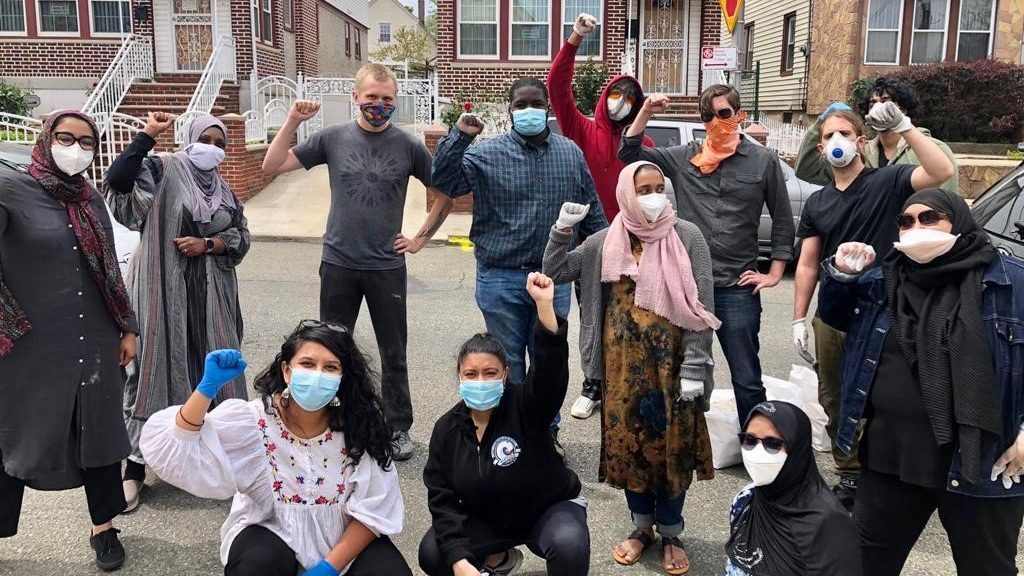
photo: Thahitun Mariam/Bronx Mutual Aid Network

On Rosh Hashanah, Jewish tradition comes to tell us every new year that everything we’ve ever known is on the line. The zodiac sign for Tishrei, the first Jewish month of the year, is the scale, and for good reason. Over and over again our liturgy tells us that the world is hanging in the balance. The Books of Life and Death have yet to be sealed and we pray the rawest of prayers, literally pleading for another year of life. In ancient times, so we’re told, the Jewish people would gather outside the Temple in Jerusalem, hoping against hope that the High Priest would emerge from the Holy of Holies to let them know the world would indeed be sustained for one more year.

I don’t think we’ve ever experienced a Rosh Hashanah in which it felt more viscerally that the world was indeed actually hanging in the balance. In our communities, throughout our country, around the world, the new year is arriving in time that feels completely and utterly uncertain. For me – and I suspect for you as well – our Rosh Hashanah prayers this year have a powerful, even unnerving resonance.

It’s difficult to know where to even start, and it’s almost unbearable to contemplate all at once: a global pandemic has taken over 200,000 lives in the US and almost one million worldwide. It has permanently changed our world in ways we’ve barely begun to understand. Our health system is overwhelmed and overtaxed. The leaders of our country have been criminally negligent in their response to the pandemic. As a result, in a moment when we desperately need to come together, they are politicizing community health measures like mask-wearing and social distancing, further tearing our national community apart. 

And of course, none of this is occurring in a vacuum. It’s astonishing to witness how quickly COVID has unleashed this terrifying domino effect of economic chaos in our country and around the world, leaving increasing numbers of people unemployed, homeless and uninsured. And contrary to the cliche, the pandemic is not a great equalizer: its impact has been particularly devastating for communities of color, the poor and too many other disenfranchised communities in our midst. 

There is no getting around it: this Rosh Hashanah, we’re greeting this new year in a state of genuine grief over the sheer enormity over what we have already lost and fear over what is yet to come. That’s why, I believe, the first order of business this new year is to give ourselves the space and permission to grieve our collective loss and name these fears out loud. To acknowledge what is no more and affirm openly and honestly that the world has been forever changed in ways we cannot yet fully grasp. Frankly, I don’t know how we can pray these prayers unless we find a way to acknowledge this together.  

I think grief is an apt metaphor for this moment. As anyone who has experienced grief knows all too well, there is a period of deep shock and disbelief that occurs immediately after the loss of someone we love. In many ways, this feels like what we’re going through now: the disbelief, the magical thinking, the inability to fully grasp our new reality, the uncertainty of everything except the hard truth that nothing in our lives will ever be the same. 

When we grieve, however, we do know some things for sure. We know that isolation is our enemy. We know that we have to depend upon each other to move forward. We know that we need community more than ever before. Though this new world is a painful and uncertain place, we must resist the temptation to withdraw from it. This will be a particular challenge in this new age of social distancing: when our survival literally depends upon our being physically apart, we know instinctively that we must find new ways to connect with one another if we are to survive. 

Over the last few months, people have found ways to connect with each other with resilient creativity. Yes, life in the COVID era is surreal, frustrating, and often downright bizarre. Yes, I never, ever dreamed I would one day find myself leading a High Holiday Zoom service, and yes, I’m very sure you never expected you would ever attend one. But over the last few months, as we’ve negotiated this brave new world in our congregation, we’ve discovered that these challenges have come hand in hand with new opportunities we never could have anticipated. 

Here at Tzedek Chicago, since the pandemic began, we’re busier than ever before. We now have four weekly programs and our attendance has grown exponentially. We’ve inaugurated a communal care Hesed Committee to check in on the immediate needs of our members. We now have new members participating regularly in our services and programs from across the country and around the world, from as far away as New Zealand and the UK. In the end, however, this isn’t just a matter of greater access. On a deeper level, I think, this new growth is a testament to the deep desire folks have to connect with others, to overcome their isolation, to find new ways to create community in this moment of profound loss. 

At the same time, amidst all of this massive change, even as we adjust to this new world, there’s that nagging question lurking in the background: how long will we actually have to do this? When will we get our lives and our world back? When will things get back to “normal?” Again, as with the experience of grief, I personally think it’s important to challenge this kind of magical thinking; to resist the temptation to assume that this is only a temporary moment; a period we just have to muscle through before things get back to the way they were. As with the experience of grief, I think it’s important for us to accept that the world we once knew is gone. Something will indeed come in its place, but whatever it is, we need to accept that things will never be the same.  

It occurs to me that Rosh Hashanah might actually be coming at just the right time to help us with this acceptance. After all, when we pray the words “t’chadeish aleynu shanah tovah u’metukah” – “renew us for a good and sweet new year” – we’re not asking for the world the way it used to be. On Rosh Hashanah, we center renewal. Over and over again we proclaim throughout our liturgy that every new year, the world can be recreated and reborn.

This idea is actually the exact opposite of that famous line from the book of Lamentations,“chadeish yameninu ke’kedem;– “renew our days as days of old.” Whatever else it may be, Rosh Hashanah was never meant to be an exercise in nostalgia, a yearning for an idealized, mythic time that never really was. On the contrary, it is an occasion for dreaming of the world that might yet be.

No, we will not go back to “normal.” But amidst the grief, it’s worth asking, do we really want to?  Should we want to?  The great activist poet Sonya Renee Taylor has written powerfully to this point:

We will not go back to normal. Normal never was. Our pre-corona existence was not normal other than we normalized greed, inequity, exhaustion, depletion, extraction, disconnection, confusion, rage, hoarding, hate and lack. We should not long to return my friends. We are being given the opportunity to stitch a new garment. One that fits all of humanity and nature. 

That’s right. For far too long, too many in this country have assumed it’s somehow normal to live in a world with a deep and deepening economic divide separating rich from poor, to tolerate a toxic environmental crisis, to treat endemic state violence and systemic racism as just a given.  But none of this has been in any way “normal.” 

In truth, we’ve been living unsustainably for far too long. Deep down, we must have known that one day this bubble would burst. And now it has. The world as we knew it has broken wide open. So yes, if there is a spiritual imperative to this particular moment, it’s not “renew our days as in days of old” – it must be “recreate this word anew.” 

Judaism actually gives us a powerful paradigm for this – a framework for living when the only world we’ve ever known has fallen away from beneath us. It is, in fact, one of the central mythic moments at the heart of Jewish tradition itself: namely the destruction of the Temple in Jerusalem in 70 ACE. Jewish spiritual memory views this as the formative moment in our history: the cataclysmic moment when Jewish life was cracked wide open. As we have come to understand it, this was the moment when everything in our world changed forever. 

Yes, the destruction of the Temple constituted a massive collective crisis for the Jewish people – but it’s also important to note that it represented an opportunity to stitch a new garment as well. After all, this was the moment that Judaism as we know it came into being. The diaspora might have been a place of exile, but it was also the fertile ground upon which the Jewish people staged their spiritual rebirth. In short, when the only world we ever knew was shattered, we responded in the spirit of hope, resilience and creativity. 

A line from a famous midrash teaches, “when the people of Israel were exiled, God went into exile with them.” Among other things, this means that God wasn’t destroyed along with the Temple. God accompanied us into this new and unknown world. And while this spiritual truth may speak directly to the Jewish experience, it’s certainly not unique to it. It’s a universal truth: at the moments of our deepest loss, we become more spiritually attuned. We can see God more clearly: in the hearts that have been broken and in the wells of strength we never knew we had. In the memory of those we’ve lost, the faces of those we love and who have suffered loss as well. And I would suggest it is this very Presence that is accompanying us right now as we face this uncertain new world. 

So, if we are ready to fully enter this changed and changing new kingdom, what do we do now? I think it goes without saying that the order of the moment is care for each other. Too many lives have been devastated already and we know that this devastation will continue in the coming year. For now – and forever more – we must view mutual aid as a mitzvah – a sacred imperative. I know many of you are involved in these kinds of projects, which are founded on the ethics of solidarity and not mere charity. At Tzedek Chicago, we’ve been compiling an ongoing list of efforts in which we can participate locally – mutual aid that supports those who were already economically vulnerable before the onset of the pandemic, in particular low-income workers, day laborers, domestic workers, those who work in the gig economy. If you know of initiatives that are not on our list, please let us know about them so we can make them available to our membership.

It’s also important for us to bear in mind that radical empathy is not only a means to an end. Yes, we empathize with each other because we are social animals that depend on each other for our survival – and this must certainly never be underestimated. But at the same time, it’s worth considering that our empathic support for another actually creates the world we want to see in real time. When we support and find comfort in one another, we need not yearn for the world to come because in a sense, it’s here right now. Beyond the pain, beyond the loss, we would do well to realize that the world we’ve been struggling for all along is being built by our love and support for one another. 

And how do we find hope when that pain and loss feels like it is too much to bear? For me, I’ve always been taken with the definition of hope offered by folks like Vaclav Havel and Cornell West. Optimism, they say, is the shallow expectation that things will naturally get better. Hope, however, is the conviction that some things are worth fighting for no matter what may happen. Hope is the courage to act, even in – especially in – those times when doubt might be warranted.

So let this be my blessing for us all this Rosh Hashanah-like-no other, when so much in our world is hanging in the balance as never before: let us grieve for the world that we’ve lost, show up for those who need it most, and fight like hell for the world we know is possible.

Shanah Tovah to you all. 

“It’s Time for All-Out Freedom” A Passover Guest Post by Maya Schenwar

c2tzcfgxgaitcn3

Remarks delivered by Maya Schenwar (editor of Truthout and author of “Locked Down, Locked Out” and the upcoming “Prison by Any Other Name”) at the Tzedek Chicago Passover Seder, April 14, 2020. 

A few months ago, which feels like a few centuries ago, Brant and I discussed the idea of me saying something at this seder about the difference between reform and liberation. I’d been writing about how popular prison reforms such as electronic monitoring, drug courts, and psychiatric institutions are actually entrenching the prison-industrial complex. I thought, what better occasion than Passover to talk about how we shouldn’t be pursuing fake liberation, and how we don’t want nicer-looking reforms that are still forms of oppression? What better occasion to affirm that we have to demand all-out freedom and stick with it?

Now, in these terrifying new times, it feels even more imperative to make vast, sweeping demands—demands that rise higher than we might think we can dream. In the midst of a worldwide plague that, in one way or another, engulfs us all, it’s time for that all-out freedom call.

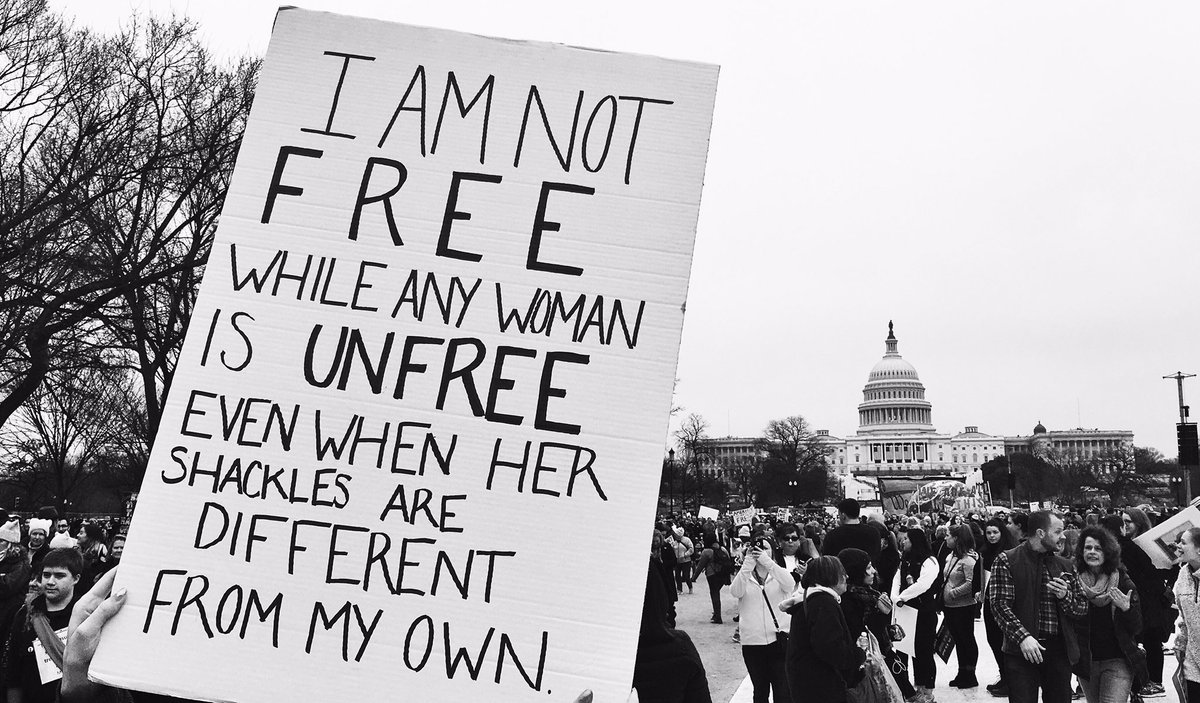
What do I mean by “all-out freedom”? I’m thinking about the refrain that “no one is free while others are oppressed.” I’m thinking about Audre Lorde saying, “I am not free while any woman is unfree, even when her shackles are very different from my own.” The COVID-19 crisis has deeply and horribly impacted our own communities — and communities everywhere. Marginalized people have, of course, been disproportionately impacted. (Consider that approximately 70% of people who’ve died from COVID-19 in Chicago are Black.)

Right now, we are coming to understand that none of us are healthy while others are sick. As long as anyone is in peril, more will be in peril. And liberation for only some is not liberation.

Yet, in a lot of different arenas, we’ve come to accept small offerings from our political representatives and leaders—a bailout mostly geared toward banks and corporations, a slight reduction in drug prices, a few people freed from prisons, some limits on carbon emissions. We say, “Well, something is better than nothing,” even when the something is far from enough, and when the something leaves many people to die.

Even in the face of coronavirus, the health care plan of the presumptive Democratic presidential nominee would leave many millions of Americans uninsured. At this moment in which all of our lives are threatened, it’s time to call for Medicare for All—and much more. We need comprehensive cost-free mental and physical health services, including treatments that go well beyond doctors and hospitals. We need to recognize that plentiful nutritious food, housing, sleep, free time, relaxation, and self-determination are also part of health and survival—and part of liberation. This is the moment to demand universal housing, universal food access, and drastically improved labor practices, which are key to building the kind of freedom that sacrifices no one.

And, at a time when unemployment is skyrocketing and the climate crisis is amplifying the effects of COVID, where is our Green New Deal? Where is our jobs guarantee, our income guarantee for those who don’t work—and our guarantee that our leaders will do everything in their power to confront the climate emergency, which is on track to kill billions? These aren’t far-off dreams or hypotheticals; they are steps that it makes sense to implement now to directly address the public health and economic crises enveloping our country.

At a time when we’re witnessing a shortage of life-saving equipment – ventilators and protective gear – we can issue a pragmatic call for the end of the war industry. In fact, we can challenge the existence of the military-industrial complex as a whole. Has there ever been a clearer moment to say no to the machinery of death, and to demand a mass shift of funds away from the Pentagon and toward public health?

It’s not a time for compromise—not a time to save some and not others.

Moses abided by this philosophy in his dealings with Pharaoh. He said to Pharaoh, “Let us go into the wilderness and worship our own God!” In response, Pharaoh proposed compromises—little reforms, fake liberations.

Pharaoh’s first compromise proposal was for the Jews to stay in Egypt, but worship their own God there. Some people might have said, “Take what you can get! Stop there, Moses! It’s better than nothing.”

But Moses declined the compromise, which was a little better than nothing—but it wasn’t freedom.

So then some plagues happened, as we know, and Moses asked again. Pharaoh scrounged up another compromise: He would let the men go off into the wilderness, but the women and children would have to stay in Egypt. Of course, women and children were groups that were more vulnerable—multiply oppressed, within the oppressed group. And in this compromise, they’d be thrown under the bus.

This compromise reminds me of the “moderate” reforms we see all over the political stage right now, reforms that modestly benefit some people, while throwing other people entirely under the bus:

For example – the proposal that a few more people can have health care, but there will still be millions and millions who are uninsured. Some would say, It’s better than nothing!

And there are the proposals to let some people with nonviolent first-time drug offenses out of prison, while millions of others will be left in cages. Some would say, It’s better than nothing!

And of course, there’s the compromise that younger people with no criminal record will temporarily not be deported, while older people and people with criminal records are condemned to deportation. Some would say, It’s better than nothing!

These are reforms that throw people away. Liberation refuses to throw anybody away.

Moses said no to the compromise, and we have to say no to the politics of disposability, too.

So then there were more plagues, and Pharaoh issued a final compromise: The Jews, including the women and children, could go into the wilderness – but they’d have to leave their animals behind. Basically, they’d have to be released from captivity with barely any resources.

There’s no freedom without some means to survive, and even thrive. A country where many millions are without health care in the middle of a pandemic is not a free country. A country in which people are starving because they’ve suddenly lost their jobs and have no safety net is not a free country. A country in which a few people are released from jails because of a pandemic, but are released into homelessness, is not a free country. In fact, a country in which people experience homelessness is not a free country.

My longtime pen pal and friend Lacino Hamilton, who is incarcerated in Michigan, wrote me a letter about the experience of the pandemic behind bars. He is hoping to be released soon: After 26 years in prison, his challenge to his conviction appears to be on the verge of being recognized. But, Lacino wrote, “I’m worried that I’ll leave here and materially my life will worsen.” He wrote, “Returning citizens are supposed to be happy with dead-end opportunities, the kind that offer only a ‘piece of a life.’ I want a whole life.”

Everyone should have a whole life. Without that, it’s not real liberation.

So, Moses said “no” to the no-animals compromise, because it was not freedom at all.

Eventually, after the most gruesome and horrifying plague of all, the one we hate to talk about, Pharaoh agreed to the whole package.

Of course, that wasn’t the end of the story. Pharaoh tried to prevent the actual implementation of the plan, necessitating some miracles from God to allow the Jews to truly leave.

Some miracles are probably necessary now, too, because the forces of power are never going to agree to full liberation. But I personally don’t think those miracles will be bestowed by a powerful God (who, to be honest, sometimes comes across in parts of the Torah as another angry dictator). I think we have to make those miracles ourselves.

What would it look like for us to create miracles, in the uniquely brutal time we’re currently living through? A couple of weeks ago, Arundhati Roy wrote a beautiful piece about the COVID-19 crisis, in which she talked about this time as one that forces us into a kind of magic. She wrote,

Historically, pandemics have forced humans to break with the past and imagine their world anew. This one is no different. It is a portal, a gateway between one world and the next. We can choose to walk through it, dragging the carcasses of our prejudice and hatred, our avarice, our data banks and dead ideas, our dead rivers and smoky skies behind us. Or we can walk through lightly, with little luggage, ready to imagine another world. And ready to fight for it.

I love that passage, and it speaks to something important. I don’t think the miracle of a full-scale societal transformation that allows for the possibility of liberation will come from above. As far as I know, God cannot unilaterally snap their fingers and provide a universal health care plan or a Green New Deal, or end white supremacy or incarceration, or provide a home for every human being. We will need to grow these things. And I believe that we can, if we remember that no one is safe and healthy until everyone is safe and healthy, and that liberation cannot mean throwing anyone away.

There are many ways to take action right now to pursue liberatory goals, from mutual aid efforts that address urgent needs and build organizing infrastructure for the world we want to live in, to critical housing and labor campaigns, to racial justice movements working to release people from jails and prisons, to environmental campaigns that are drawing connections between this moment and the looming climate emergency, to the ongoing battle for Medicare for All, and much more. Brant is going to share some links in the chat for this Zoom call that will point you toward ways to get involved. These are only a smattering of the many crucial efforts currently underway.

I don’t think we need to drop horrible plagues on our enemies in order to refuse harmful compromises. Instead, we need to unite against horrible plagues – including the plagues of injustice, inequity, and mass violence – and for mass liberation.

I believe that we can enter the portal and fight for that new world, if we are prepared to do it together.

____________________________________________________________________________________________

Action items (National and Chicago-Based):

* The People’s Bailout: a coalitional effort by environmental, economic, racial and health justice groups to advocate a transformative economic package in response to COVID-19. 

#FreeThePeoplea coalition of advocacy organizations who do work to support imprisoned community members across the state of Illinois.

Physicians for a National Health Plan’s COVID-19 and Medicare for All

•  National Nurses United’s broad-based Medicare for All effort. 

Chicago COVID-19 Help & Hardship Page:  a mutual aid effort for direct food and housing assistance.

Rogers Park Food Not Bombs: Saves food from the waste stream while highlighting the inequities of our society.

Brave Space Alliance’s Crisis Food Pantry and Trans Relief Fund.

Greater Chicago Food Depository.

Restore Justice Illinois: to help provide for someone being released from prison.

Help Love & Protect: to make masks for people in women’s prisons:

Autonomous Tenants Union​: an all-volunteer organization committed to organizing for housing justice from below and to the left.

Lift the Ban: to advocate for lifting the ban on rent control in Chicago.

Organized Communities Against Deportations: resistance movement against deportations and the criminalization of immigrants and people of color in Chicago and surrounding areas.

The People’s Trial of Donald Trump: My Testimony

replace_trump_1

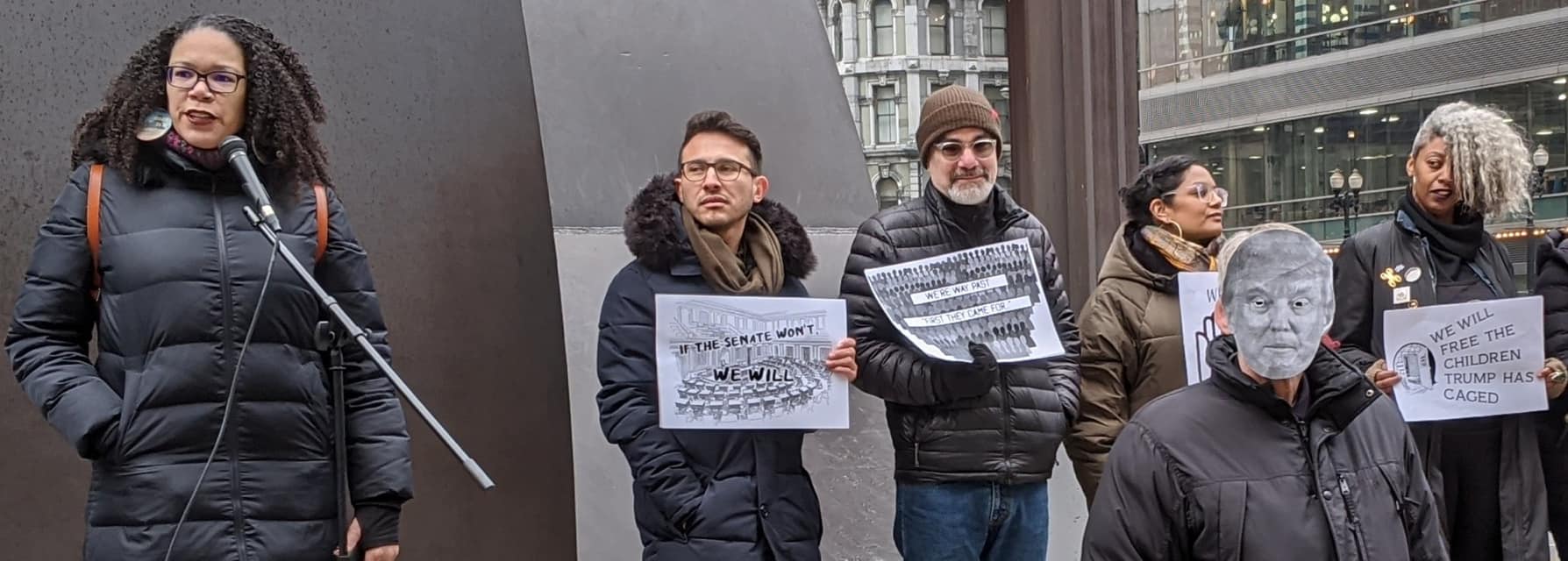
Here, below, is my testimony from “The People’s Removal Trial of Donald Trump” – a street theater-style event that took place yesterday at Daley Plaza in Chicago. It was organized as an alternative to the sham impeachment trial that will almost surely acquit Trump next week. At our trial, various community members testified about some of Trump’s worst crimes – his attacks on immigrants, Muslims, Jews, the disabled, the environment reproductive rights and his deadly neglect of Puerto Rico.

This was much more than an exercise in wish-fulfillment, however. It was a ultimately an opportunity to celebrate the world we we want to see, then redouble our pledge to fight for it – and for one another.  In the words of lead organizer Kelly Hayes, who spoke powerfully at the end of the event:

I want you to think for a moment about what it feels like — the difference between being held in place by your own strength, and how immovable we become when we are anchored to each other. Because to do the work ahead of us, we cannot simply be a crowd of concerned individuals. We will have to be a collective force.

Kelly’s words – and the other testimonies – can be found on the Facebook event page


If my grandmother were alive today, she’d probably say something like this:
Vi tsu derleb ikh Donald Trump shoyn tsu bagrobn.” (“I should outlive Donald Trump long enough to bury him.”)

Or maybe she’d say something like this:

“Gut zol oyf Donald Trump onshikn fin di tsen-makos di beste.” (“God should visit upon Donald Trump the best of the Ten Plagues.”)

I know for a fact that the overwhelming majority of American Jews would agree with my Bubbe. I’m honored to testify on their behalf today.

Why should Donald Trump be removed? We’ve already heard many compelling reasons – here’s one more: Donald Trump is an antisemitic pig whose words and deeds pose a clear and present danger to American Jews.

This became all too clear to us during the last election, when he publicly and openly spewed the most noxious antisemitic tropes. In a speech to the Republican Jewish Coalition, Trump said, “Is there anyone in this room who doesn’t renegotiate deals? Probably 99% of you. Probably more than any room I’ve ever spoken in” He also said: “Stupidly, you want to give money… But you’re not going to support me because I don’t want your money…You want to control your own politicians.”

Later in that campaign, he tweeted an image of Hillary Clinton’s face next to a pile of cash, a Star of David and the phrase, “Most Corrupt Candidate Ever!” He also released a TV ad suggesting prominent Jewish figures were part of a “global power structure” that has “robbed our working class” and “stripped our country of its wealth.” Folks shook their heads – did he really say what we thought he said? Yes, he did. Then we elected him president.

After his inauguration, Trump announced to the press that he was “the least antisemitic person you’ve ever seen in your life.” This while he surrounded himself in the White House with alt-right scum like Steve Bannon and Sebastian Gorka. This while he cynically trotted out his Jewish daughter and son in-law (aka “the ones who shall not be named”) and his advisor Stephen Miller (now officially tied with Henry Kissinger for the “Embarrassment to the Jewish People” Award.) “Just look at them,” says Trump, “How can I be an anti-Semite?” Well Donald, you’re an anti-Semite alright. And we see right through your Jewish human shields.

We accuse Donald Trump of incitement. On August 2017, the Nazis emboldened by Trump finally crawled out of the sewers and into the bright light of day. With their polo shirts and their tiki torches, they marched through the streets of Charlottesville chanting “Jews shall not replace us.” The next day, men in fatigues armed with semi-automatic weapons stood across from a synagogue during Shabbat morning services. Then a neo-Nazi pig drove his car into a crowd of counter-protesters, injuring several and killing Heather Heyer, of blessed memory. When the dust settled on Charlottesville, Trump uttered his immortal words of comfort: “You had a group on one side that was bad, and you had a group on the other side that was also very violent.”

We accuse Donald Trump of incitement. On October 2018, a neo-Nazi piece of shit entered the Tree of Life synagogue in Pittsburgh on Shabbat and gunned down Jewish worshippers. He killed eleven and wounded six. In his manifesto, he accused Jews of conspiring to flood the US with immigrants in order to cause a white genocide. His final words were “Screw your optics, I’m going in.” When asked for comment, Trump blamed the congregants for their own murder. “If they had some kind of protection inside the Temple,” he said, “maybe it could have been a very much different situation.”

We accuse Donald Trump of incitement. In the infamous August of 2019, another piece of Nazi scum entered a synagogue during the festival of Passover with an AR-15 and shot up the worshippers. One woman was killed and three were injured, including the synagogue’s rabbi, whose fingers were blown off. Trump later commented, “We will get to the bottom of it. We’re gonna get to the bottom of a lot of things going on in this country,”

We accuse Donald Trump of inciting antisemitism – and weaponizing it against Jews critical of Israel. That’s right: Trump inspires Jew-hatred, yet condemns the bad Jews who “don’t love Israel enough.” He encourages Nazis to kill us, yet scolds the bad Jews who condemn Israel’s ongoing human rights abuses. He embraces Christian Zionists who believe that Jews should be destroyed in Armageddon, yet criminalizes the bad Jews who stand in solidarity with Palestinians.

But we see through it all. Donald Trump is no friend of the Jewish people. And we will not stand for his cynical posturing. He must be removed.

I will end my testimony with the words from our comrade, Linda Sarsour, who offered these words to the American Jewish community following the Tree of Life massacre last year:

We stand in solidarity with our Jewish family, especially the community in Pittsburgh, after today’s horrific shooting at the Tree of Life Synagogue.

In the face of overwhelming hate, we choose unrelenting love and unity. We recommit ourselves to dismantling anti-Semitism and all forms of racism.

We call on everyone, especially elected officials and political leaders, to take a stand against anti-Semitism and make clear that it has no place in our society.

Donald Trump, you have proven to us that you are unwilling and unable to take a stand against racism and antisemitism in our society. On the contrary, you foment it for your own political gain. But we see you. We’re on to you. And we have now concluded: we will replace you.

On Hanukkah, Let’s Rededicate Our Commitment to Environmental Justice

2019_1222-hannukah-2400x1606

TOMERTU / SHUTTERSTOCK

Cross-posted with Truthout

The central story commemorated on Hanukkah comes from books 1 and 2 Maccabees, which tells of a small group of Jews in the land of Israel that fought to liberate their community from the increasingly oppressive reign of the Seleucid empire. Under Antiochus IV Epiphanes, the empire had imposed their Hellenistic culture upon the Jewish community; in 167 BCE, Antiochus intensified his campaign by defiling the temple in Jerusalem and banning Jewish practice. The Jewish band known as the Maccabees subsequently waged a three-year campaign that culminated in the cleaning and rededication of the temple and ultimately, the establishment of the second Jewish commonwealth.

The meaning of Hanukkah has historically been understood and interpreted in many different ways by Jewish communities throughout the centuries. For the rabbis of the Talmud, who sought to downplay the militarism and violence of the story, the holiday is emblematic of God’s miraculous power, symbolized famously by the Talmudic legend (quoted above) of a miraculous cruse of oil in the rededicated Temple that lasted for eight days. The Zionist movement and the state of Israel celebrate Hanukkah as a nationalist holiday, glorifying the Maccabees’ military struggle for political independence. In many nations throughout the Jewish diaspora, the festival is often understood as an expression of Jewish minority pride and a celebration of religious freedom.

More recently, some American Jewish religious leaders have been reinterpreting Hanukkah as a holiday of sacred environmental concern, framing the legend of the oil as a lesson about the importance of energy sustainability. Jewish environmental activist Rabbi Arthur Waskow, for instance, has proposed observing “Eight Days of Environmental Action” during Hanukkah, suggesting that the legend “is a reminder that if we have the courage to change our lifestyles to conserve energy, the miracle of our own creativity will sustain us.” The website of the Reform movement’s Religious Action Center (RAC) now devotes an entire section to “Green Resources for Hanukkah.” The Jewish environmental organization Hazon also offers extensive resources for the holiday, including “10 Ways to Make your Hanukkah More Sustainable.”

While these new approaches are certainly meaningful as far as they go, it is worth questioning why the environmental dimensions of Hanukkah must begin and end with green personal behaviors. Given that the festival celebrates a struggle for liberation, Hanukkah also offers us a powerful opportunity to highlight and celebrate the emergent global movement for environmental justice.

This connection is particularly relevant since this struggle is unfolding in critical ways in the land where the Hanukkah story actually took place. In fact, the state of Israel has a well-documented history of monopolizing and exploiting the natural resources of historic Palestine — all too often at the expense of the Palestinian people themselves. If we are truly serious about celebrating Hanukkah as a “green holiday,” we should also use these eight days to shine a light on the myriad environmental injustices being committed in Israel/Palestine — and further, to rededicate ourselves to the movement for environmental justice there and around the world.

“Green Colonialism” in Israel/Palestine

Environmentalism has always been central to the myth of Zionist pioneers who described themselves as having “greened the barren desert” of Palestine. Like many of my generation who came of age in American Jewish religious schools, I well remember being taught that helping the Jewish National Fund (JNF) plant pine trees in Israel was an act of almost sacred significance. Like generations of Hebrew school students before and after us, we were encouraged to regularly put coins in the iconic blue-and-white JNF collection boxes and were given certificates as gifts whenever a tree was planted in our honor or for a special occasion.

The reality beneath this mythos, however, reveals a much more problematic and troubling history. We didn’t learn the crucial colonial goal behind the JNF’s forestation policy throughout Palestine — that the widespread planting of pine groves and forests was instrumental in the dispossession of Palestinians. We certainly didn’t learn about Yosef Weitz, director of the JNF from 1932 to 1948, who was a primary architect of the Zionist policy of Palestinian Arab “transfer,” often advocating for this policy openly and unabashedly.

At a meeting of the Transfer Committee in 1937, for instance, Weitz stated:

The transfer of Arab population from the area of the Jewish state does not serve only one aim — to diminish the Arab population. It also serves a second, no less important, aim which is to advocate land presently held and cultivated by the Arabs and thus to release it for Jewish inhabitants.

It is now known that pine forests planted by the JNF were widely used as national and recreational parks to hide the remains of destroyed Palestinian villages and neighborhoods that were depopulated by force in 1948. According to scholars Ilan Pappé and Samer Jaber, “covering ethnic cleansing with pine trees is probably the most cynical method employed by Israel in its quest to take over as much of Palestine as possible with as few Palestinians in it as possible.” The Israeli organization Zochrot estimates that “more than two-thirds of [JNF] forests and sites — 46 out of 68 — conceal or are located on the ruins of Palestinian villages demolished by Israel.”

In a recent conference call sponsored by Jewish Voice for Peace (JVP), journalist/activist Naomi Klein referred to this practice as “green colonialism,” pointing out that “the use of conservation and tree planting and forest protection as a tool of settler colonialism is not unique to Israel” and that “the creation of state parks and national parks (in North America) are seen by Indigenous people in these settler colonial contexts in similar ways.” According to Klein, “there is a long and ongoing history of conservation … where the land is declared a park and the traditional inhabitants and users of the land are locked out.”

The cumulative environmental impact of nonindigenous pine trees throughout historic Palestine has been devasting. European pines, which were consciously planted to evoke the memory of the forests familiar to Zionist settlers, have largely failed to adapt to the local soil, requiring frequent replanting. As they have aged, non-native pines also have demanded more and more water, rendering them more vulnerable to disease. Moreover, falling pine needles have acidified the soil, inhibiting the growth of native species.

This practice, coupled with the steadily soaring temperatures in the region, has increasingly led to devastating forest fires such as the Carmel wildfire in 2010, estimated to be the worst in Israel’s history. Given its grievous environmental impact, the 2010 fire subsequently precipitated a widespread reassessment in Israel of early Zionist tree-planting policies. In 2011, Yisrael Tauber, director of forest management for the JNF, grudgingly admitted, “Planting is still important, but in many cases we have to make a kind of change in our consciousness.…We are now building sustainable forestry after these pioneering pines did a wonderful job for the first generation.”

Of course, given the rising threat of the global climate crisis, this admission arrives as too little, too late. Increasingly dangerous conflagrations are now a regular occurrence throughout Israel; this past summer, three simultaneous wildfires necessitated the evacuation of hundreds of residents across the country. This trend is particularly ominous given that this region is among the hardest hit by the climate crisis. At the UN Climate Conference in Madrid this month, the Israeli Ministry of Environmental Protection issued a report listing a number of devastating projections, including an expected rise in the risk of natural disasters.

“Water Apartheid” in the West Bank

The struggle over water resources is another important example of historic and ongoing climate injustice in Israel/Palestine. Israel has almost complete control over water sources in the region, a monopoly the human rights group Al-Haq refers to as “water apartheid.” According to Amnesty International, Palestinian consumption in the Occupied Palestinian Territories is about 70 liters a day per person (well below the 100 liters per capita daily recommended by the World Health Organization) whereas Israeli daily per capita consumption is about 300 liters. In some rural communities, Palestinians survive on 20 liters per day.

Those who visit the West Bank cannot help but be struck by the sight of Israeli settlements, with lush, well-watered lawns looming over Palestinian towns and villages surrounded by rocky soil and sparse vegetation. This is largely due to the fact that Israel uses more than 80 percent of the water from the Mountain Aquifer, the only source of underground water in the West Bank, as well as all of the surface water available from the Jordan River, which is completely denied to Palestinians.

As a result of this inequitable system, some 180,000 to 200,000 Palestinians in rural communities have no access to running water. In towns and villages which are connected to the water network, water rationing is common, many Palestinians have no choice but to purchase additional supplies from mobile water tankers which deliver water of often dubious quality at a much higher price. (The Mountain Aquifer, one of the most valuable natural resources in the region, is situated almost completely east of the Green Line, a key factor in Israel’s inexorable annexation of the West Bank.)

Over the years, Israel’s over-pumping of underground aquifers has lowered the groundwater table below sea level and caused saline water intrusion in many areas. The average flow of the Jordan River has been decreasing dramatically and has become so polluted by Israeli settlement and industry run-off that it was declared unsafe for baptism by Friends of the Earth Middle East in 2010 (known today as EcoPeace Middle East). The Dead Sea has shrunk into two separate and rapidly evaporating bodies of water, increasingly polluted by Israeli companies that pump out its salts for cosmetic products.

Environmental Injustice in Gaza

When it comes to Gaza, Israel’s crushing 12-year-old blockade has almost completely depleted the supply of drinkable water for the nearly 2,000,000 Palestinians who live in this small strip of land. Gaza’s only water resource, the Coastal Aquifer, is insufficient for the needs of the population, and Israel does not allow the transfer of water from the West Bank to Gaza. In the meantime, the aquifer has been steadily depleted and contaminated by over-extraction and by sewage and seawater infiltration, and 97 percent of its water has been contaminated and unfit for human consumption.

Stringent restrictions imposed in recent years by Israel on the entry into Gaza of material and equipment necessary for the development and repair of infrastructure have caused further deterioration of its water and sanitation situation. For the past several years, sewage has been flowing into the Mediterranean at a rate of 110 million liters a day. At present, 97 percent of Gaza’s freshwater is unsuitable for human consumption and only 10 percent of Gaza’s residents have access to safe drinking water.

However, as is invariably the case with issues of environmental injustice, what goes around comes around. This past June, EcoPeace Middle East reported that the collapsing environmental situation in Gaza was creating a “national security risk” to Israel, warning that “the collapsing water, sewage and electricity infrastructure in the Gaza Strip pose a material danger to (Israel).” In a particularly perverse example of victim-blaming, the Israeli military recently urged the World Health Organization to condemn the “ecological catastrophe” caused by the burning of tires by Palestinians on the border during the weekly Great March of Return protests.

In addition to water pollution, there have also been reports of rapidly increasing soil contamination due to Israel’s regular military assaults on Gaza. According to a report by the New Weapons Research Group, Israeli bombings in Gaza Strip have left a high concentration of toxic metals, such as tungsten, mercury, molybdenum, cadmium and cobalt in the soil. These metals can cause tumors and problems with fertility, and they can have serious and harmful effects on newly born babies.

Hanukkah and Global Climate Justice

What does this current environmental reality bode for the future of the Jewish state? British journalist Robert Cohen powerfully concludes that the climate crisis, coupled with Israel’s steady over-exploitation of resources, has functionally rendered Zionism “obsolete.”

“How,” writes Cohen, “can Israel present itself as a Jewish safe haven from a hostile world when its water security is at high risk, crop yields will soon be falling and fires will be raging all year round…? When it comes to climate change, national borders will offer no protection from antisemitism. Climate has no interest in faith or ethnicity or in historical or religious claims to a particular piece of land.”

Cohen’s point can certainly be applied to the world at large. The climate crisis clearly knows no borders. But while no one will ultimately be safe from its devastating effects, we can be sure that the more powerful will increasingly seek to safeguard themselves and their interests at all costs at the expense of the less powerful. Such is the harsh reality of “green colonialism”: as the climate crisis renders more and more of the world uninhabitable, we are clearly witnessing increased state efforts at border militarization, population control and the warehousing of humanity.

What then, is to be done? In a recent op-ed for The Nation, journalist Ben Ehrenreich offered this compelling prescription: “it is time to shout, and loudly, that the freedom of all the earth’s people to move across borders must be at the center of any response to the climate crisis.… If we are to survive as a species, we must know that no boat can save us except the one we build together.” In her JVP presentation, Naomi Klein echoed this challenge in similarly powerful terms:

What is clear is that the space for humanity to live well is contracting…. So, the core question is what kind of people are we going to be as we live in greater density? And if we look to Israel/Palestine, we see a really terrifying example of how to lose your humanity and how to fail to share land — and the monstrousness it requires to fail to share….

This is a global process that is happening now … so we’re going to have to start practicing solidarity and mutual aid. And we’re going to have to practice love and show each other what love looks like in public more and more. Because a lot of people have lost faith that they can do it.

There can be no better Hanukkah message for the 21st century. Given the realities of our current age, the nationalist dimensions of the holiday are not merely irrelevant, but dangerous. In the words of poet/liturgist Aurora Levins Morales, “this time it’s all of us or none.” If Hanukkah is to be a true celebration of environmental justice, it must become a “rededication” to fight for a more universal vision of liberation, for a world of solidarity, mutual aid and open borders.

Or to put it another way, the Maccabees’ struggle must now be broadened to represent the universal struggle of all who are committed to showing what love looks like in public, for the sake of all humanity. For the age of global climate crisis, the stakes could not be higher.

“Birthday of a World on Fire” – A Sermon for Rosh Hashanah 5780

photo credit: Reuters

One of the signature moments on Rosh Hashanah is the sentence traditionally proclaimed after the shofar is sounded: “Hayom Harat Olam” (“Today is the birthday of the world.”) On Rosh Hashanah, tradition tells us, we celebrate a world reborn, joyfully acknowledging the order and balance of God’s creation and the awesome power embedded deep within it. What better way to celebrate the potential for our own renewal in the year ahead than by looking to a world that renews itself every year according to the sacred rhythms of birth and rebirth?

While I personally find this idea to be among the most profound of this season, I’ll confess, I’ve been struggling with it in recent years. With the hard reality of the global climate crisis hitting home deeper and deeper every year, I find myself asking, what does it mean to gather every Rosh Hashanah to reaffirm creation even as we are literally undoing it?  How can we honestly celebrate the power embedded in God’s world, even as human power is steadily destroying it? Even as the world is literally on fire? To be completely honest, in this era of global climate crisis, I’m not sure the traditional understanding of Rosh Hashanah really makes much sense any more.

And it is indeed a crisis. Many are suggesting, in fact, that we’ve moved beyond crisis and have entered the category of emergency. And we can’t say we haven’t been warned. As far back as 1992, 1700 scientists around the world issued a famous statement called a “warning to humanity,” declaring that we were on a “collision course” with the natural world if we did not “fundamentally change” the way we lived upon it. 

More than 25 year later, almost all of their chilling predictions are now in full swing. Last year, the UN Intergovernmental Panel on Climate Change (IPCC) issued the first in a series of three reports that describe in vivid detail the effects of greenhouse gas emissions throughout the world. The first of three reports, which came out last October, warned that we have only a dozen years to keep global warming to a maximum of 1.5 degrees Celsius beyond pre-industrial levels. If we go up even half a degree beyond this, we will significantly worsen the risks of drought, floods, extreme heat and poverty for hundreds of millions of people. 

However, this was not merely a prediction: the report made it clear that this crisis was already well underway. The world is currently 1.1 degrees warmer than pre-industrial levels. The average global temperature for 2015–2019 is already the hottest of any five-year period on record. The Amazon rainforest, even as I speak now, is still burning. It’s been estimated that we’ve already lost 50% of the planet’s biodiversity in the past four decades. 20% of the earth’s coral reefs have died. The Antarctic ice sheet has lost three trillion tons of ice in the last 25 years. In roughly that same amount of time, the rate of global ocean warming has doubled. Many, if not most, of these losses are irreversible. 

And these losses are increasing exponentially. Every new half degree will cause rapidly increasing and irreversible chain reactions: growing species extinction, greater food insecurity, the disappearance of coastal cities and island nations, increased migration and social conflict, more wildfires and hurricanes, the destruction of polar ice, the loss of entire ecosystems. 

It’s important to note however, that the IPCC report did not conclude that all is lost. The scientists repeatedly stressed that it was still possible to limit warming to 1.5 degrees. But they also made it clear it will take a radical global effort to achieve this goal. Jim Skea, Co-Chair of IPCC Working Group put it this way: “Limiting warming to 1.5°C is possible within the laws of chemistry and physics, but doing so would require unprecedented changes.”

Unprecedented indeed. Given our voracious dependance upon fossil fuels – and the economic interests in the companies that produce them – the hard truth is that we have only twelve years to reverse the growth of global capitalism itself. This is not a radical statement – I’d argue it’s actually quite reasonable under the circumstances. Those who dismiss advocate structural proposals such as the Green New Deal as naive, “pie in the sky” ideas routinely miss this one essential point: we need radical solutions if we are to take on the unfettered economic greed that has brought us to this terrifying moment in human history.

Now I know that many, if not most of you have heard these facts and figures before. But even so, as I pondered what to talk about this Rosh Hashanah, it felt enormously important to me that the findings of the IPCC report be spoken out loud. We need to say them out loud. Otherwise, I’m really not sure if the rest of our prayers really make much sense.

I realize how depressing, how enormous – how terrifying – it is to contemplate all of this. But as we gather for Rosh Hashanah, I really can’t think of a more important issue for us to talk about. And so this morning, I’d like to push a brief pause on our celebration of creation’s power and face the ways we are willfully degrading that power. I’d like to offer a few thoughts on how we might reframe our understanding of this crisis so that we might avoid the inevitable overwhelm, paralysis and despair that comes with it. Ultimately, I suppose, what I’d really like to do is offer a measure of hope in the face of an increasingly hopeless reality. To take our cue from the new year and imagine a world reborn – so that we might feel that much more ready to go forth and actually make it so. 

When most of us confront the overwhelming reality of the global climate crisis, I think we tend to do what comes naturally: we compartmentalize it. We silo it into its own separate category the way we do with so many other complex social issues. We view it as one issue among many in the desperate hope that if we isolate it, we might be able to find a way to somehow address it. 

But in truth, the climate crisis isn’t one issue. In fact, I would say it is in many ways the issue. It’s the one universal issue that connects all others. The changes we are causing to the earth’s temperatures have direct causal relationships to immigration, to human rights, to poverty, to housing, to war, to so many examples of social and political upheaval worldwide. 

So yes, addressing this crisis means we must advocate for policies that will keep global temperatures from reaching the 1.5 mark. But it cannot only mean that. It must also mean that we must stand with the scores of people around the world who are already suffering from the effects of the climate crisis. In the end, there is really no contradiction between working for justice and climate activism. They are, in fact, intimately intertwined. 

We know full well that the primary brunt of the global climate crisis is being borne by the poor and communities of color. It has been estimated that the global climate crisis could push more than 120 million more people into poverty by 2030. Even if we do manage to increase to only 1.5 degrees by 2100, extreme temperatures in the global south will leave disadvantaged populations increasingly food insecure, with less incomes and worsening health. Increasing numbers of people will have to make the agonizing choice between starvation or migration. 

Here in the US, we can see the connection between the climate crisis and structural racism all too well. Polluting facilities are routinely built in low-income neighborhoods and communities of color, which means that people with marginalized identities experience more asthma, a greater likelihood of heart attacks and premature death. The disadvantages that come with those health issues create a cycle of poverty and lack of access to opportunity for people of color and the poor in the United States.

It’s a sad irony that the ones least responsible for the climate crisis are bearing the brunt of it – and have the least capacity to protect themselves. This phenomenon has been referred to as “environmental racism” or “climate apartheid” – in which the wealthy have the means to escape overheating, hunger and conflict while the rest of the world is left to fend for itself. 

We witnessed climate apartheid in full swing when the devastating Hurricane Dorian slammed into the Bahamas earlier this month. In advance of the hurricane, the ultra-wealthy homeowners on Abaco Island hired local workers to board up their vacation houses, while they escaped to their primary homes in the US or Europe. The Baker’s Bay Golf & Ocean Club hired a private security team, equipped with helicopters and assault rifles, to protect their property. The rest of the island’s residents, made up mostly of undocumented Haitians, had nowhere to go and had to ride out the storm in shanty towns and church shelters. Within hours, the community was almost completely flattened. Dozens of poor residents were killed and thousands more are still missing. 

As Jews, we need to acknowledge that climate apartheid is deeply enmeshed throughout Israel/Palestine as well. Since the Middle East is among the hardest hit by global warming, the issue of justice in Israel/Palestine is directly related to the control of water resources – and Israel has almost complete control over water sources in the region. The so-called Mountain Aquifer, the most critical water source in Israel/Palestine, is situated almost completely east of the Green Line. This goes a long way to explain why Israel has not and likely will never give up the West Bank – as doing so would mean surrendering its most valuable water source. 

The environmental situation in Gaza is even more dire, due largely to Israel’s crushing blockade. At present, 97% of Gaza’s freshwater is unsuitable for human consumption, and only 10% of Gaza’s two million people have access to safe drinking water. As a result of Israel’s regular military assaults, 110 million liters of raw and untreated sewage are pouring directly into the Mediterranean every day, creating a massive sanitation crisis. 

But, as is invariably the case in all forms of climate apartheid, what goes around comes around. This past June, Ha’aretz reported on the effects of Gaza’s toxic pollution on Israel. The headline read: “Collapsing Environmental State of Gaza Poses Threat to Israel’s National Security, Report Warns.” Tellingly, even as it maintains total control over natural resources, Israel cannot escape the devastating impact of the growing climate crisis.

My friend and colleague, Robert Cohen, a writer and blogger from the UK, recently wrote a post in which he argued that “the climate emergency makes Zionism obsolete.” In it, he made this very compelling argument:

How can Israel present itself as a Jewish safe haven from a hostile world when its water security is at high risk, crop yields will soon be falling and fires will be raging all year round. In a region already fraught with conflict, climate analysts expect temperature rise to have a multiplier effect that exacerbates and accelerates wars and mass migrations. Promoting Zionism starts to look like an invitation to Jews to jump from the metaphorical frying pan into the literal fire.

When it comes to climate change, national borders will offer no protection from antisemitism. Climate has no interest in faith or ethnicity or in historical or religious claims to a particular piece of land. Climate change is staunchly apolitical, ahistorical and agnostic.

Of course, climate change won’t make antisemitism go away. But like much else that’s wrong and unfair about the world, the Climate Emergency compels us to look at things differently, consider the root causes, and understand the interconnectedness of injustice. As well as terrible threats, climate change forces upon us the possibility of a profound ethical revolution.

I believe Robert hits the nail on the head with this analysis. In a way, the Israel/Palestine issue is a microcosm of a much larger, universal issue. In the face of global climate crisis, nationalism will not save us. Stronger borders will not save us. Sooner or later this crisis will come for us all. In the meantime, however, we can be sure that those who have more power will do everything they can to protect themselves from its effects until the very bitter end – at the expense of everyone else. 

This is where, as Robert Cohen puts it, the “profound ethical revolution” comes in. Yes, to address the climate crisis, we must be advocating for policies and practices that decrease our global carbon output – but it must mean standing in solidarity with those most affected by the crisis as well. There can be no separation between the two. And in this regard, we all have a part to play. 

The first step, I believe, is to resist the temptation toward overwhelm and despair. This is, quite frankly, a luxury we cannot afford. While it can be tempting to adopt a fatalistic, “all is lost” attitude, we would do well to remind ourselves that some of the most committed, inspired climate activists are those who are most directly affected by it. If they have not succumbed to despair, than neither can we.

In fact, the movement for climate justice is being led by members of indigenous nations worldwide. This past April in Brazil, an estimated 4,000 indigenous peoples from various tribes gathered for three days in that nation’s capital to protest for their rights, demonstrate their traditions and confront congressional leaders. This nonviolent mobilization, called Free Land Camp, has taken place every year since 2004 and is organized by the Articulation of Indigenous Peoples of Brazil — an alliance of indigenous communities and organizations from several regions of the country. 

Closer to home, the resistance by at Standing Rock has been at the vanguard of the fight for climate justice in this country. And as this movement is increasingly youth led, we need to be lifting up the work of indigenous youth activists – young people such as 15 year old Autumn Peltier, of the Wiik-wem-koong First Nation in Northern Ontario who recently spoke at the UN and 19 year old Naelyn Pike, of the San Carlos Apache tribe in Arizona, who had this to say in her speech at a youth leadership gathering in 2017:

I’m saying no! And many people, millions of people in this world, are saying no! We have so many sacred lands that are going to be desecrated, so many fights to protect Chaco Canyon, to protect Bears Ears, to protect Indigenous land, food, water, the right to live, our identity. We’re fighting against so many pipelines. And the thing is that these generations behind us had told us this prophecy.

But there’s another prophecy: That the youth is going to stand. And that’s us today. That’s us here and now.

In addition to Indigenous-led movements, there are any number of growing climate justice movements that deserve our attention and support – and I know many in this room have long been active in these efforts: the Sunrise Movement, the Climate Strike, +350 and Extinction Rebellion, to name a few. And as I mentioned earlier, given everything that is at stake, we need to wage an all-out political fight against the economic interests that make greater profit through increased greenhouse gas emissions. In this country, this fight is primarily being waged nationally via the Green New Deal, but it is also being fought on state and local levels as well. As I said before, there is a part we can all play. The main thing is to connect the dots, to understand that the climate crisis is at heart a justice issue – and that all struggles for justice are ultimately bound up with the movement to roll back the climate crisis. 

So what can Rosh Hashanah mean at this moment in human history, in this unprecedented time when the very future of our world is literally hanging in the balance? I want to suggest that we can no longer celebrate the new year – the birthday of the world – without explicitly spelling out what is at stake. Yes, it is a day of hope, but this hope must be celebrated together with a hard and sober realism. 

We know that the task ahead of us will be daunting. We know that some of the effects of climate change can yet be turned back. But we also know that some of the damage we’ve inflicted upon the earth is permanent. We do have a window of time in which we can stop or decrease global temperatures, but it will take a Herculean world-wide effort to achieve this. We’ve been told by scientists that we have 12 years before the social and economic fabric we take for granted starts to unravel beyond the point of no return. We need to admit this and say it out loud if these New Year’s rituals are to retain any meaning for us whatsoever any more. 

In the end, it may well be that the High Holidays will hold more meaning than ever before. After all, when the new year is through, when we move toward Yom Kippur, our prayers will literally evoke a world that hangs in the balance. We will ask “who shall live and who shall die?” We will plead to be written into the Book of Life. We will ask ourselves honestly, how can we change our ways to ensure it shall be so? It seems to me that these prayers have never had more universal, global meaning than right now.

One of the things I love most about Judaism and Jewish culture in general, is that it invites us to work toward the world to come, the world as it should be. Yes, this work can be a struggle, but it can also be filled with joy and celebration. And there are yet times during the struggle when we create a microcosm – when we get a glimpse of the world to come. These moments remind us we must continue to live with a spirit of joyous resistance, even if we know full well that world we seek may never be at hand.

How do we possibly do this? How do we find the strength to fight a fight we know we may not win? And to so joyfully? Let me share with you the words of indigenous activist and organizer, Kelly Hayes, who offers us as eloquent a manifesto for the new year as I can imagine:

I would prefer to win, but struggle is about much more than winning. It always has been. And there is nothing revolutionary about fatalism. I suppose the question is, are you antifascist? Are you a revolutionary? Are you a defender of decency and life on Earth? Because no one who is any of those things has ever had the odds on their side. But you know what we do have? A meaningful existence on the edge of oblivion. And if the end really is only a few decades away, and no human intervention can stop it, then who do you want to be at the end of the world? And what will you say to the people you love, when time runs out? If it comes to that, I plan on being able to tell them I did everything I could, but I’m not resigning myself to anything and neither should you. Adapt, prepare, and take the damage done seriously, but never stop fighting. Václav Havel once said that “Hope is not the conviction that something will turn out well, but the certainty that something is worth doing no matter how it turns out.” I live in that certainty every day. Because while these death-making systems exist both outside and inside of us, so do our dreams, so long as we are fighting for them. And my dreams are worth fighting for. I bet yours are too.

This new year, let us commit to fight like hell for the world of our dreams, for a world reborn anew. Let us fight with joy, commitment and solidarity, knowing full well that this is a fight for the survival of the world as we know it. And let us fight not with the certainty that we will ultimately be victorious, but with the faith that it is worth waging no matter what.             

Ken Yehi Ratzon – May it be our will this new year – and every new year from this time forward.

Shanah Tovah.