Category Archives: Gaza

Ta’anit Tzedek Sponsors Conference Call with Congressman Brian Baird


The next Ta’anit Tzedek fast day will take place on Thursday, November 18. To mark the day, we will present a conference call, “After the Elections: US Policy, Israel and Gaza” – A Conversation with Congressman Brian Baird.

Congressman Baird is the outgoing Representative for Washington state’s 3rd District. Prior to being elected in 1998, Congressman Baird practiced as a licensed clinical psychologist in Washington state and Oregon. He also worked in state and Veterans Administration psychiatric hospitals, community mental health clinics, substance abuse treatment programs, and institutions for juvenile offenders.

Congressman Baird is also notable for being one of the few members of Congress who is willing to openly advocate for Palestinian human rights. He has visited Gaza on three separate occasions and had this to say after his visit in February 2009 (immediately following Israel’s Operation Cast Lead):

The amount of physical destruction and the depth of human suffering here is staggering… Entire neighborhoods have been destroyed, schools completely leveled, fundamental water, sewer, and electricity facilities hit and relief agencies heavily damaged. The personal stories of children being killed in their homes or schools, entire families wiped out, and relief workers prevented from evacuating the wounded are heart wrenching – what went on here, and what is continuing to go on, is shocking and troubling beyond words.

After his third visit to Gaza in February 2010, Baird called on the US to break Israel’s blockade of the strip to deliver humanitarian aid. He was also one of the few members of the House to vote against a bill that “unequivocally opposed any endorsement or further consideration” of the Goldstone Report. (Click the clip above to watch his passionate defense of report on the House floor.)

Our conference call will take place on Thursday, November 18 at 12:00pm (EST). During our conversation, we will ask Congressman Baird to discuss his experiences in Gaza, to comment on current efforts to lift the blockade and to share his views on the search for a just peace in Israel/Palestine in light of the recent midterm elections.

Congressman Baird will also address the wrongful death trial, brought by Craig and Cindy Corrie against the Israeli government, for the death of their daughter Rachel (who was crushed by an Israeli bulldozer in Gaza in 2003). As the Corrie’s congressman, Rep. Baird has long supported the Corrie family in their quest for justice and personally testified in the trial last May.

Here’s the call-in info:

Dial the Access Number: 1.800.920.7487
Participant Code: 92247763#

As always, we encourage you to join the call and spread the word.
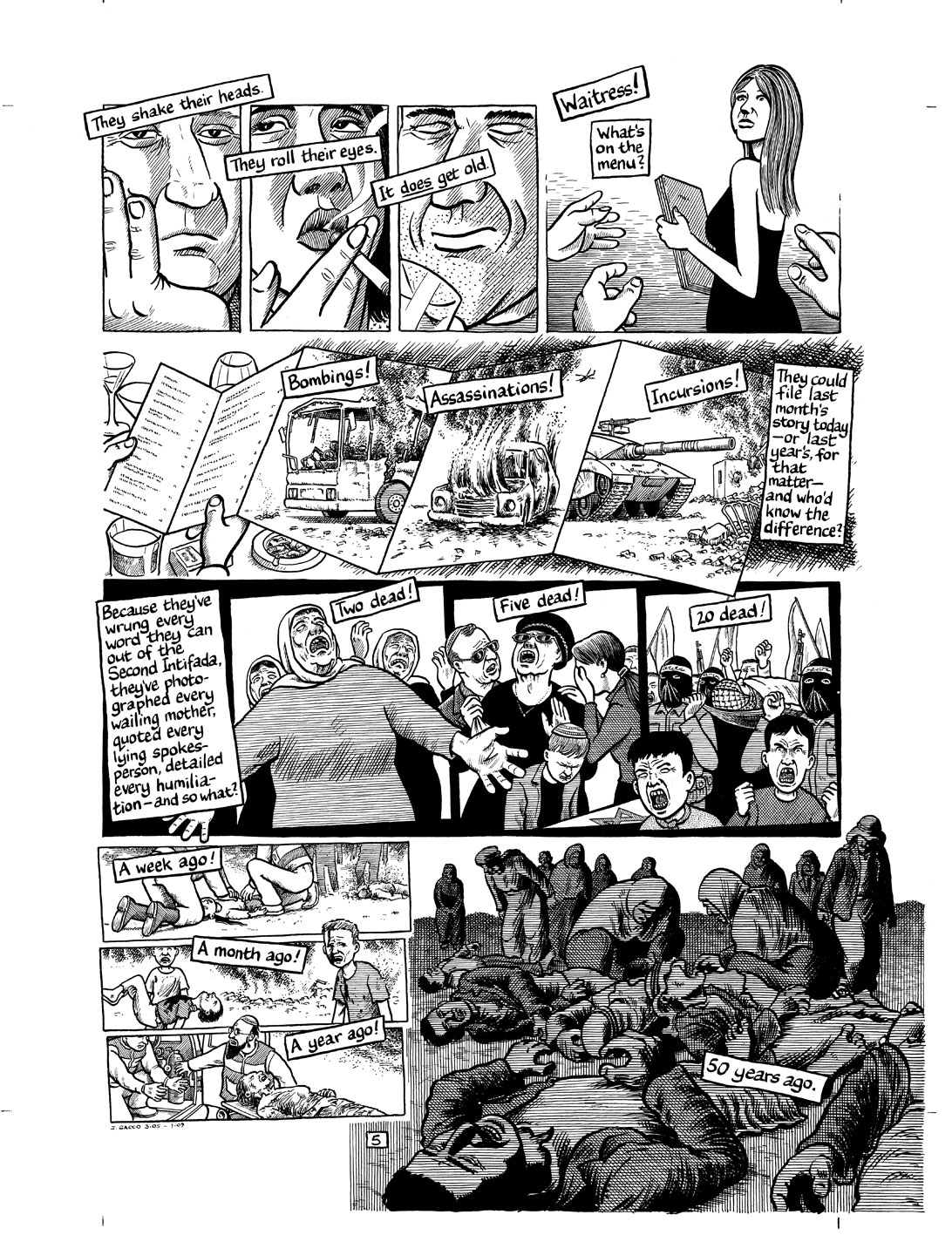
Footnotes in Gaza: Sacco’s Profound Testimony

I just noticed that Joe Sacco’s brilliant graphic novel “Footnotes in Gaza” has just come out in paperback. I can safely say without hesitation that this is the best book I’ve ever read about Gaza (and trust me, I’ve read a lot).

Sacco composed “Footnotes” as a first person account of his own experiences in Gaza. He begins by portraying his efforts to document the 1956 massacre in Khan Younis, in which the IDF briefly occupied the Egyptian-ruled Gaza Strip and killed 275 Palestinians. During the course of his investigation, Sacco learns about another, lesser known incident that occurred around the same time in the neighboring town of Rafah, in which Israeli forces killed 110 Palestinians in what should have been a standard “screening operation.”

It’s hard for me to convey the effect this book had on me when I read it last year. It unfolds in a myriad of layers: it’s a mediation on history, on war, on memory, and on the way the past seems to continuously, inevitably inform the present. Especially in this day and age, in which the 24 hour news cycle chops events up into disconnected bits, Sacco’s testimony on the events of 1956 are a critical reminder that Gaza’s current agony is only the latest chapter in a much, much longer story that still continues to unfold. In short: those of us who want to understand the Gaza conflict today must learn this history.

It took me a very long time to read “Footnotes.” Its narrative is dense, its subject matter is profoundly painful, and its depiction of violence so unflinchingly raw. There were several times I had to just stop and put the book down for a few days or weeks just to absorb what I had just taken in. A year after reading it, many of its words and images still resonate powerfully for me.

It’s actually pretty remarkable to think that a comic book accounting of two little known historical “footnotes” that occurred in this tiny strip of land that could provide such a deep and profound testimony. But trust me, it does. I can’t recommend it highly enough.

Maguire and Shapira on Justice for Gaza

Ta’anit Tzedek hosted a powerful and inspirational conference call today with Irish Nobel Laureate Mairead Maguire and Israeli human rights activist Yonatan Shapira. Both spoke movingly about their activism and their participation on the latest Freedom Flotilla to Gaza.

Click here to listen. Please send it on.

Addendum 10/21: The Velveteen Rabbi has just posted a long piece about the call , complete with extensive background and transcriptions. Thanks, Rachel!

Mavi Marmara Post Mortems

I finally finished reading the full report commissioned by the UN Human Rights Council to investigate the IDF attacks on the Mavi Marmara last May. I can’t begin to describe how chilling these findings are.

The mission’s conclusion:

The circumstances of the killing of at least six of the passengers were in a manner consistent with an extra-legal, arbitrary and summary execution. Furkan Doğan and İbrahim Bilgen were shot at near range while the victims were lying injured on the top deck. Cevdet Kiliçlar, Cengiz Akyüz, Cengiz Songür and Çetin Topçuoğlu were shot on the bridge deck while not participating in activities that represented a threat to any Israeli soldier. In these instances and possibly other killings on the Mavi Marmara, Israeli forces carried out extralegal, arbitrary and summary executions prohibited by international human rights law, specifically article 6 of the International Covenant on Civil and Political Rights.

Although the Israeli military described the event as a “lynching” of its soldiers by brutal provocateurs, the post-mortem description of the victims makes it pretty clear who the real victims were that night. Witness, for example, this post-mortem description of the body of teenage victim Furkan Dogan:

Furkan Dogan, a nineteen-year old with dual Turkish and United States citizenship, was on the central area of the top deck filming with a small video camera when he was first hit with live fire. It appears that he was lying on the deck in a conscious, or semi-conscious, state for some time. In total Furkan received five bullet wounds, to the face, head, back thorax, left leg and foot. All of the entry wounds were on the back of his body, except for the face wound which entered to the right of his nose. According to forensic analysis, tattooing around the wound in his face indicates that the shot was delivered at point blank range. Furthermore, the trajectory of the wound, from bottom to top, together with a vital abrasion to the left shoulder that could be consistent with the bullet exit point, is compatible with the shot being received while he was lying on the ground on his back. The other wounds were not the result of firing in contact, near contact or close range, but it is not otherwise possible to determine the exact firing range. The wounds to the leg and foot were most likely received in a standing position.

The fact-finding mission conducted interviews with more than 100 witnesses in Geneva, London, Istanbul and Amman – and consulted with numerous forensic and medical experts.  It is impressively thorough, especially considering Israel refused to cooperate with the investigation and still refuses to release the extensive video and documentary evidence it seized from passengers.

Not surprisingly, Israel has denounced the report as “biased and distorted” and is conducting its own investigation, the Turkel Commission. (The news from that investigation doesn’t look too promising – already we’re receiving reports that the commission is showing outright hostility to Israeli human rights groups that were called to testify.)

For a spot-on analysis of the UNHC report, I strongly recommend this piece by Salon’s Glenn Greenwald, who rightly takes the US government to task for its “appalling silence” in the face of Israel’s outrageous violation of human rights and international law:

Perhaps most illustrative of all is how inconceivable it is to imagine the U.S. Congress doing anything at all in the face of this report . . . except passing a Resolution condemning the investigators themselves while defending Israeli actions, including the actions that resulted in the death of an American teenager.  Is there any doubt that such a Resolution would pass with overwhelming bipartisan support, approaching unanimity — as happens each and every time there is a controversy involving Israel?   Thus far, the U.S. media and Government are largely silent about this U.N. Report, but if they are prodded into responding, the response will almost certainly be to condemn the report itself while defending and justifying Israeli actions even in the face of overwhelming evidence as to what really happened here, which managed to emerge despite the Israelis’ very telling efforts to keep it suppressed.

Greenwald is correct, of course. By all rights our government should be condemning this brutal assault and insist that Israel release all evidence of what occurred that night.

In the meantime, the only footage available to us is the video taken and smuggled out by Iara Lee, Executive Director of Cultures of Resistance – and one of the few Americans on the Mavi Marmara. (Part one above, part two below). While it is certainly not easy to watch, I suspect the videos Israel has locked away are infinitely more disturbing…

PS: If ploughing through a lengthy human rights commission report isn’t your cup of tea, I highly recommend the recently published anthology “Midnight on the Mavi Marmara.” Essential, essential reading.

“Why We Sailed to Gaza” – A Conversation with Mairead Maguire and Yonatan Shapira

Please mark your calendar for the next Ta’anit Tzedek fast day, Thursday, October 21, 12:00 pm (EST), which we will mark with a conference call, “Why We Sailed to Gaza” featuring Nobel Peace Prize laureate Mairead Corrigan Maguire and Israeli peace activist Yonatan Shapira.

Earlier this month, both Maguire and Shapira recently set sail on flotilla of boats attempting to break the siege of Gaza by bringing symbolic amounts of humanitarian aid to its citizens.

Maguire is a well-known Irish peace activist who co-founded the “Community for Peace People” during the period known as “The Troubles” in Northern Ireland. She  subsequently helped found the Nobel Womens Initiative, a group of six women Nobel Peace Laureates devoted to strengthening women’s rights and and advocating for justice and peace around the world.

More recently, Maguire has become involved in activism for peace and justice in Israel/Palestine. She has sailed on three boats to Gaza, in October 2008 (when they reached Gaza), on June 2009 and then on the MV Rachel Corrie in June 2010. In 2009 and 2010, the boats were intercepted by the Israeli Navy and she was arrested along with all the passengers. On her most recent attempt, Maguire remained in prison as she fought Israel’s efforts to deport her. The Israeli Supreme Court upheld the decision to deny her entry and she was deported from Israel earlier this month.

Shapira was an officer in the Israeli Air Force and flew hundreds of missions over the territories in a Blackhawk helicopter squadron during the course of his eleven year career. Following a targeted bomb assassination of a Hamas leader that killed fourteen civilians in Gaza, he became a prominent Israeli “refusenik,” authoring the Pilot’s Letter – a 2003 statement signed by 27 Israeli pilots who publicly refused to fly missions over the Occupied Territories. Since that time, Yonatan has gone on to co-found “Combatants for Peace” a prominent organization in the growing Israeli Refusenik movement.

Shapira has also become a public supporter of the internal Israeli movement for Boycott, Divestment and Sanctions (BDS) known as “Boycott from Within,” and regularly participates in Palestinian nonviolence campaign in East Jerusalem and the West Bank. According to witnesses aboard the “Jewish boat” to Gaza earlier this month, Shapira nonviolently resisted when the IDF boarded the ship and was tazered repeatedly in the heart by the senior commanding officer.

Here’s the call-in info:

Access Number: 1.800.920.7487

Participant Code: 92247763#

There will be a question and answer period during the call –  please join the conversation! (Big thanks to our co-sponsors, Jewish Voice for Peace, the Shalom Center, and Shomer Shalom Institute for Jewish Nonviolence.)

Ta’anit Tzedek Sponsors “A Conversation About Women, Health, Children and Human Rights in Gaza”

The next fast day sponsored by Ta’anit Tzedek – Jewish Fast for Gaza will take place on Thursday, August 19. To mark the occasion, we will host “A Conversation About Women, Health, Children and Human Rights in Gaza,” a conference call with Dr. Mona El-Farra, Director of Gaza Projects for the Middle East Children’s Alliance.

Dr. El-Farra is a physician by training and a human rights and women’s rights activist by practice in the Gaza Strip. She was born in Khan Younis, Gaza, and has dedicated herself to developing community-based programs that seek to improve health quality and link health services with cultural and recreational services throughout the Gaza Strip.

Our conference call will take place on Thursday, August 19, at 12:00 pm (EST).

Call info:

Access Number: 1.800.920.7487

Participant Code: 92247763#

There will be a question and answer period during the call.

Tony Judt, May His Memory Be for a Blessing

When Tony Judt passed away from ALS on August 6, the world lost a brilliant historian and a brave, unflinching observer of current political events. In the Jewish community, Judt was famous (some undoubtedly would say infamous) for his views on the Israel/Palestine conflict; particularly for a piece he wrote for the New York Review of Books in 2003:

The problem with Israel, in short, is not—as is sometimes suggested—that it is a European “enclave” in the Arab world; but rather that it arrived too late. It has imported a characteristically late-nineteenth-century separatist project into a world that has moved on, a world of individual rights, open frontiers, and international law. The very idea of a “Jewish state”—a state in which Jews and the Jewish religion have exclusive privileges from which non-Jewish citizens are forever excluded—is rooted in another time and place. Israel, in short, is an anachronism.

Judt’s historical/political analysis of Zionism, needless to say, ensured that he would become persona non grata in many Jewish circles. But whether or not you agreed with his conclusions, I believe he courageously raised crucial, if painful questions that we continue to confront today – and whose relevance, I predict, will become only more critical in the coming years.

One of his final editorials on the subject was this trenchant analysis of the recent Gaza flotilla tragedy. Click above to get a poignant glimpse of the man himself. May his memory be for a blessing.

Sari Bashi on Gaza: Control Without Responsibility

Today Ta’anit Tzedek sponsored an incredibly informative and thought-provoking conference call with Sari Bashi, Executive Director of Gisha Legal Center for Freedom of Movement.  We were also joined by Reut Katz of Physicians for Human Rights – Israel who shared information about the medical infrastructure in Gaza and the difficulties faced by Gazans needing medical treatment

Toward the end of the call, I asked Sari why the crisis in Gaza always seemed to be so central to the Palestinian-Israeli conflict. Her incisive response:

I think Gaza is a bit like the canary in the coal mine. What is being done now in Gaza is being done to a lesser extent in the West Bank and we will see some of the terrible effects in the West Bank as well if we continue on the path we are on. The concern about Israel’s behavior in Gaza is that it is exercising control without taking responsibility. It is controlling people’s lives by controlling movement and access but it is not taking responsibility for the effects of that control on a million and half civilians who need to be able to access all of the things we’ve been discussing.

In the West Bank that process is also underway. Israel is dividing up the West Bank between Jewish areas, where the settlements are, and Palestinian areas – and it is slowly disengaging from responsibility for what happens in the Palestinian areas without giving up on control of those borders and of movement and access. And it can’t be both ways: either Israel continues to control movement and access but takes responsibility for that control or if it wants to disengage from responsibility it must let go of control – and that also means letting go of checking for security reasons what leaves and enters Gaza and the West Bank.

Click here to hear the call in its entirety. The conversation begins at 1:38 minutes and includes several questions from participants.

Ta’anit Tzedek Presents “Myths and Facts About the Siege of Gaza”

To mark our July fast day Ta’anit Tzedek – Jewish Fast for Gaza is sponsoring “Myths and Facts About the Siege of Gaza,” a conference call with Sari Bashi, Executive Director of Gisha: Legal Center for Freedom of Movement on Thursday, July 15 at 12 noon EST.

Since Israel’s easing of its blockade of Gaza, international pressure to end the siege has eased as well. Does this “easing” in fact represent actual change for the people of Gaza? What kinds of good and services are Israel allowing in? What is the status of Gazans’ freedom of movement? What are the current effects of the blockade on the lives of residents?

To help us better understand these questions, we turn to Gisha, one of Israel’s leading human rights experts on the siege on Gaza. Founded in 2005, Gisha seeks to protect the freedom of movement in the Occupied Territories, offering legal assistance and public advocacy to protect the rights of Palestinian residents. Because freedom of movement is an essential precondition for the exercising of other basic rights, Gisha’s work also helps residents of the Occupied Territories gain access education, jobs, family members and medical care.

Gisha’s work in Gaza has been critical in this respect. I’ve long been referring folks to their website Gaza Gateway, an essential resource that present credible information about the amount of traffic that Israel allows to pass through the Gaza Strip border crossings. I also highly recommend Gisha’s publications for critical, up-to-date reports on the effects of the siege.

Call-in info:

Phone Number: 1.800.920.7487
Participant Code: 92247763#

As with our call last month, we will be offering the opportunity for Q&A during the call.

Click here for a recent Gisha article, “Unraveling the Closure of Gaza.” Click on the clip above to watch “Closed Zone” – a brief animated film about the basic effects of the siege created for Gisha by Yoni Goodman, Director of Animation for “Waltz with Bashir.”

Gaza: Humanitarian Crisis or Collective Punishment?

More than one Israeli politician has commented that there is “no humanitarian crisis in Gaza.” Fair enough. During Ta’anit Tzedek’s monthly conference calls with Gazans we heard over and over that Gazan citizens do not want this crisis to be viewed as a humanitarian issue.

For instance, journalist Sami Abdel-Shafi told us in March that he believed casting Gaza as a humanitarian case is ultimately harmful to Gazans (80% of whom are dependent on foreign aid to survive). That is to say, the longer Gazans are kept dependent on humanitarian largess, the longer Gaza will successfully be kept isolated from the international community:

As long as the so-called “humanitarian” classification continues, I’m afraid we can stay like this for years. But the key is, why leave a population of more than 1.5 million people almost completely deprived of being educated and being developed and of the opportunity to be effective contributors to the regional economy, in addition to the economy of the world?

The answer (as I’m sure Abdel-Shafi well knows) is that this is precisely the point. The blockade of Gaza has never been about Israel’s security. From the very beginning, its aim has always been the isolation of Hamas through the collective punishment of Gazans.

Of course Israel has long tried to make the case that its blockade was initiated to keep weapons out of Gaza, but this justification has grown increasingly hollow over the years. (The surreal revelation that coriander was on the “forbidden list” is perhaps the most infamous example.)

I’ve noticed that even Israel has become less and less inclined to defend the blockade on security grounds.  This past week, it was reported that Israel’s defense establishment is urging the government not to cave in to growing international pressure and permit Palestinians to export goods from the Gaza Strip.  As one defense official put it, “If this happens, we will lose all of our leverage over Hamas.”  When I read this, I couldn’t help but think about Abdel-Shafi’s comments. What possible security benefit could Israel gain with this kind of economic warfare?

On a more heartening note, I just read in the Israeli press that “reliable sources” report that Obama will insist on a full lifting of the blockade when Netanyahu visits Washington in two weeks. According to the report, the President considers the continuing travel ban on Gazans to be (you guessed it) “collective punishment.”

Here’s hoping…