Category Archives: Interfaith

The New Jewish Abyss: Sermon for Yom Kippur 5783

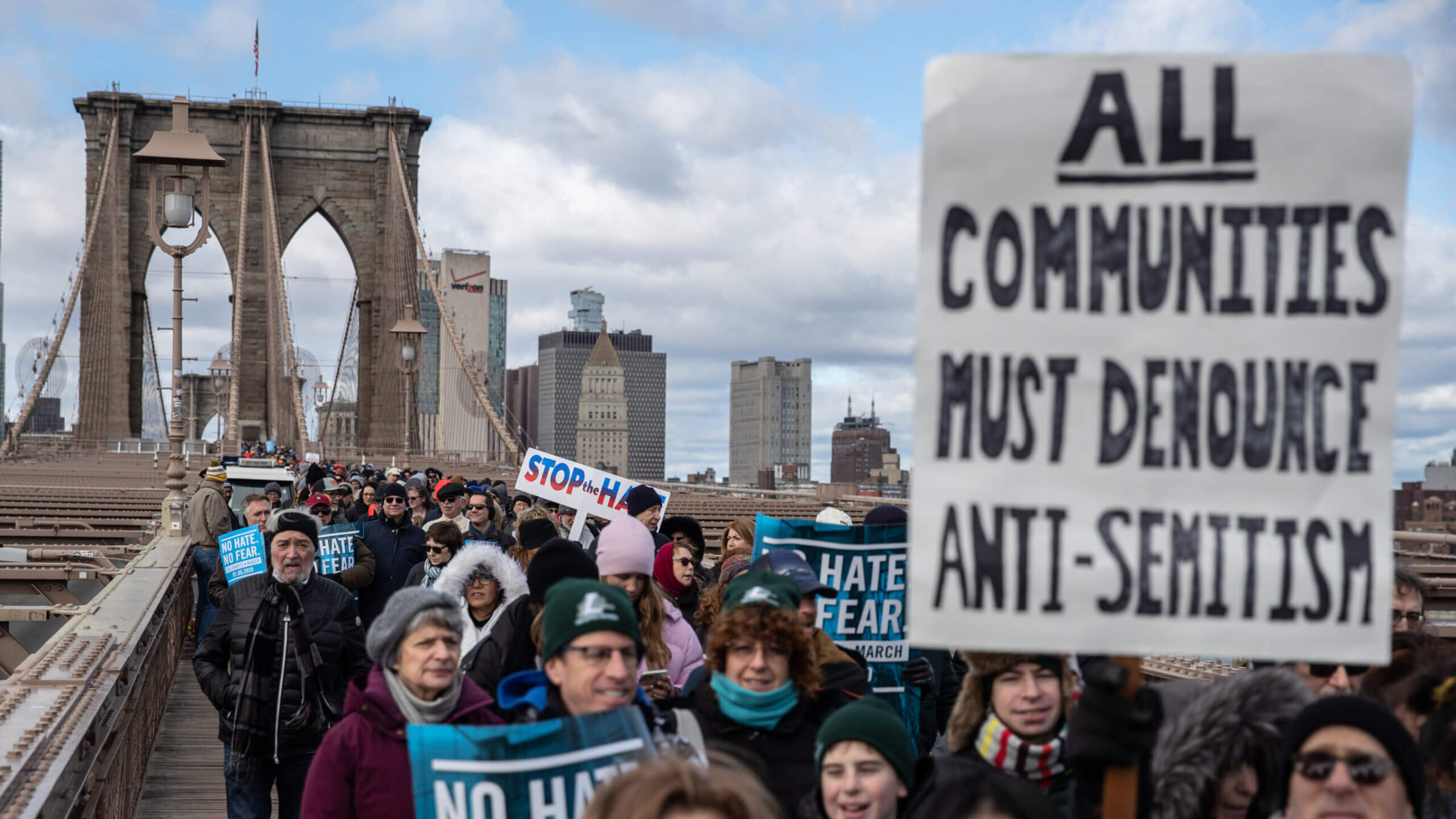
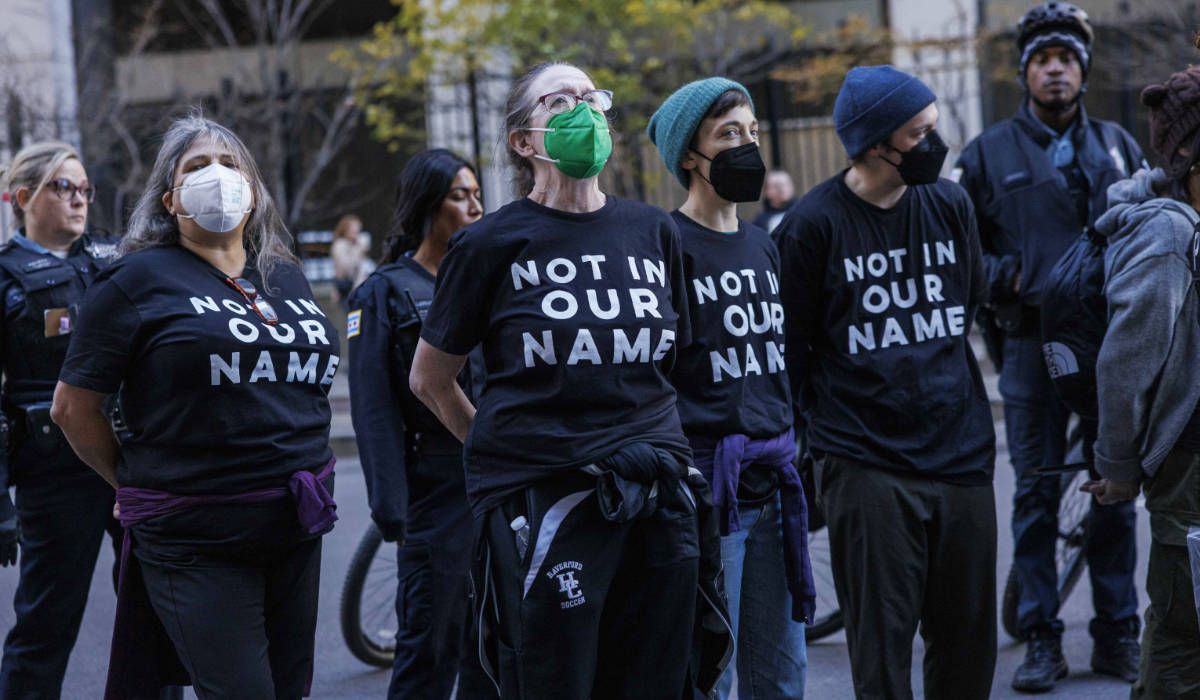
(photo: Jewish Voice for Peace)

The course of Jewish history has never been a straight line. Throughout the centuries, the evolution of Jewish life has been shaped by a series of crises, tension points – and outright cataclysms. More often than not, these tumultuous events have even transformed the very nature of Judaism itself. 

To offer just a few examples: classical Judaism as we know it emerged out of a catastrophe: the destruction of the Temple in Jerusalem by the Romans in 70 ACE. The Spanish Inquisition in 1492 ended the Golden Age of Jewish life in Muslim Spain and initiated the spread of Sephardic Judaism throughout Europe, Africa and the Middle East; the Hasidic movement was born out of tensions in Eastern European Jewish life in the 17th century; the onset of modernity and the Enlightenment in Western Europe, created a wide constellation of movements whose legacies still influence Jewish life today. 

I’m making this point because there’s every indication that Jewish life is going through just such a monumental crisis and transformation right now. I’m speaking of course, about the abyss that has opened over the issue of Zionism – an abyss that has widened considerably this past year as a result of Israel’s genocide in Gaza. . 

Last night, Aviva Stein described how she painfully crossed this divide when she shared her own personal Jewish journey with us. I’d like to thank Aviva for her powerful words, which were truly a gift to our community. In my remarks to you today, I’d like to pick up where she left off. I want to begin by responding to her painful point about the increasing exile of young Jews from the Jewish community:

There is an epidemic in the Jewish community – young people are losing and leaving their jobs, and the Jewish community is losing the passion, critical thinking, and vitality that their best and brightest brought to their work. So many Jewish organizations are breaking this way – the big tent, so to speak, has collapsed, and Jews of conscience, Jews who say no to genocide and no to Islamophobia and war mongering, find ourselves on the outside.

Just two weeks ago, there was an extensive investigative article in the journal “In These Times,” which documented how “US Jewish institutions are purging their staffs of anti-Zionists.” The author of the article, Shane Burley observed:

If the trend continues, it could contribute significantly to one of the sharpest breaks in the history of American Jewish life, forcing out a generation of progressive Jews and furthering the crisis of legitimacy plaguing much of the communal Jewish infrastructure.

In other words, we’re currently witnessing a fundamental divide in the Jewish community – even a potential schism in the making. While it’s far too early to predict how it will play out, one thing seems clear to me: just as Israel is fast losing its legitimacy in the international community, Zionism is just as quickly losing its legitimacy in the Jewish community itself.

Of course we can’t write Zionism’s obituary just yet. There are still plenty of staunch Zionists in our community who have a decidedly different view of the past year – who insist that Israel is doing what it has to do to defeat its existential enemies. And there are also many liberal Zionists who refuse to recognize the reality of Israel’s genocide, who still point to the “complexities” of the “conflict.” 

This is what it has come to. The Jewish community has become irrevocably divided between those who stand with Israel – or apologize for its behavior – and those who believe Israel is a settler colonial apartheid state that is committing a genocide in our name. There is no more big tent, if there ever was one. There is little use in pretending that there is any conceivable room for consensus on this issue. 

While these fissures over Israel and Zionism have always been present in the Jewish community, it’s clear that they’ve been widening over the last decade or so. This past year, however, the divide broke wide open. And I honestly don’t believe we’ll ever be able to put the pieces back together again, certainly not in the way they were. 

Over the years, prophetic voices in our community have been sounding the alarm over this coming schism. One such voice was the great Jewish scholar and theologian Marc Ellis, of blessed memory, who tragically died far too soon this past June. Among other things, he wrote about the rise of what he called “Constantinian Judaism.” This was a reference to the pivotal moment in the 4th century when the Emperor Constantine made Christianity the official religion of the Roman Empire, transforming what had previously been a small and persecuted religious community in the first century after Jesus, into a religion of empire and state power. 

As Marc taught, after the cataclysm of the Holocaust and the birth of the state of Israel, Jewish tradition itself became Constantinian. In the 20th century, Judaism, which had previously been prophetic at its core, became wedded to systems of empire, militarism and Jewish supremacy. In very short order, Constantinian Judaism became the central focal point of Jewish life.

From the very beginning of the Zionist movement, however, there were always prophetic Jewish voices opposing Zionism. And they remained even after the founding of the state of Israel. Marc referred to them as “Jews of Conscience” – the minority of Jews who resisted Constantian Judaism, often at great cost. Because of Zionist hegemony, Jews of Conscience necessarily lived in exile, socially, religiously, and in many cases professionally from the Jewish communal establishment (as was the case, very sadly, for Marc).

Even so, every Jewish communal study over the past several years has shown that the ranks of Jews of Conscience have been growing, particularly among the younger generations. As Aviva explained to us last night, they have now burst out into the open –  and the Jewish communal establishment is responding with ferocious, desperate backlash

As we contemplate this unfolding schism, I believe it’s important to reckon with the profound damage Zionism has done to sacred Jewish tradition. This marriage of Judaism and ethno-nationalism has been so deeply normalized, it often feels difficult to know where one starts and the other stops. For example, for centuries, the Hebrew word “Yisrael” which means “wrestles with God” referred to a Jewish spiritual peoplehood. It had a religious cultural meaning that spoke deeply to Jewish collective identity throughout the diaspora. It referred to our history and practice of debate, of questioning, of challenging the status quo. Today, for most Jews – and most people in the world – the word “Yisrael” means one thing only: it refers exclusively to a heavily militarized political nation state. 

So too with the word “Zion,” which was always much more than a physical location. In Jewish liturgy, Zion is a signifier of our highest spiritual aspirations: the world to come that we were actively working to manifest in our day. After it was appropriated by Zionism, however, it became synonymous with a political movement whose realization tragically resulted in the dispossession and oppression of millions of people. 

There are so many other examples. The glorification of militarism we instill in our children in our religious schools; the holidays of conquest, like Israel Independence Day that have become an indelible part of the Jewish holiday calendar. The idolatrous placement of national symbols such as Israeli flags in our sacred spaces. The list goes on and on and on.

Marc Ellis used to observe that with the fusion of Judaism with empire, we have now reached the end of ethical Jewish history. As he once put it:

We Jews, all of us, no matter our various political positions, are responsible for what Israel has done and is doing to the Palestinian people. That is why I believe that we, as Jews, dwell in the abyss of injustice. The injustice we have perpetrated upon Palestinians has brought us to the end of ethical Jewish history. The question for Jews, the only question, is what are we to do at this end?

When Marc spoke those particular words, communities of Jews of conscience were still fairly nascent. But when we founded Tzedek Chicago in 2015, we were, in a sense, answering his question “what are we to do at this end?” by creating a vibrant, Jewish spiritual community that turned away from this abyss of injustice. I know it meant a great deal to Marc to become a member of our congregation after so many years of professional exile. 

When we founded Tzedek, we realized that we were one small, modest effort in this regard – but we still believed there was still a place for a dissident Jewish community such as ours. This is how I described it in 2015 in my very first Rosh Hashanah sermon:

(Ever) since our announcement, I’ve been hearing consistently from people all over the country who have told me they wish that something like Tzedek existed in their community. So while we might not statistically exist in the institutional sense, I believe we are very much alive out there in the borderlands of Jewish life. I just know in my heart that there is a place for a Jewish congregation such as ours. And while we are starting off modestly, mindful of our capacity, of what we are able and not able to do during this first year of our existence, I do believe the response we’ve received thus far indicates that the time has truly arrived for a congregation such as Tzedek Chicago.

Since that inaugural service, Tzedek has grown in ways we never could have predicted. In 2020, when we started holding our services and programs online, our membership expanded in numbers and geographically, transforming us into a global congregation. The people who told me they wished something like Tzedek existed in their community now participated in our programs and services and became members of our congregation. Many of them are among our most active members and more than a few serve on our boards and committees.

The horrors and atrocity of this past year, however, changed the Jewish community irrevocably. It has become a profoundly tragic irony that during times of particularly brutal Israeli military assaults on Palestinians, membership in anti-Zionist organizations like Jewish Voice for Peace tends to spike dramatically.  During the genocide of this past year, we’ve witnessed this growth at Tzedek like nothing we’ve ever seen before, nearly doubling in size. 

There were months on end that new members were literally joining us every week. As many of you know, our membership application includes a field that asks our new members to tell us why they were joining Tzedek Chicago. The statements we received were powerful and moving – and almost all of them expressed common themes: those who could no longer bear the the support of Israel’s genocide in their synagogues; those who had never belonged to a synagogue before because of the constant centering of Israel; those who were converting to Judaism but were starting to despair that it might never be possible if it required fealty to an ethnic Jewish nation-state.

One of the most powerful examples of Jewish anti-Zionist religious organizing I witnessed occurred this past Spring, during the growth of the student encampment movement on college campuses. In May, Tzedek was contacted by the student group Jews 4 Justice at DePaul, who asked if we could come lead a Shabbat service in their encampment. Adam Gottlieb and I came twice to lead Havdalah services. I’m not exaggerating when I say they were among the most inspiring ritual experiences I’ve ever experienced. 

Those of you who organized or visited these encampments likely know what I’m talking about. These were organically generated, living, breathing student communities. At DePaul, as in many other student encampments, there was a food tent and a first aid tent. There were learning sessions and tutoring stations. There were workshops on deescalation tactics. 

But for me, the most powerful aspect of the encampment was its grassroots, interfaith nature. Throughout the encampment there were signs that included solidarity statements from a variety of religious traditions. Hijabi women were congregating very naturally alongside Jews wearing kippot. When Adam and I arrived, there was a Muslim call to worship where the communal gathering took place. Our havdalah service was immediately followed by a ritual dance by a local indigenous dance troupe. 

Needless to say, this encampment was not the bastion of antisemitic Jew-hatred that has been falsely characterized by the media and the Jewish communal establishment. The Jewish students who we met at these and other student encampments are deeply serious, passionate Jews who are creating real communities that express solidarity with Palestinians as a sacred Jewish value. 

It was sad, but not at all surprising, that these encampments were eventually destroyed – overturned by state violence. But in the end, the brutality of this response only proved the students’ essential point about the world they were actively resisting – and more importantly, the one they sought to create in its stead. 

Yes, over the past summer, colleges and universities have cracked down hard on regulations prohibiting students’ freedom of assembly and speech. But I have no doubt that they will continue to find creative, meaningful ways to organize. So too, I know that these young Jewish students will not be deterred in their desire to create meaningful Jewish communities where they can be their full Jewish selves. To my mind they truly represent the best of our Jewish future. 

As we continue to organize these Jewish communities however, I think it’s enormously important to reckon with the tragic reason why they are growing in the first place. While the creation of these new Jewish communities of conscience is something to celebrate, there is absolutely nothing to celebrate about the circumstances that have led to their creation. Those of us who create spiritual anti-Zionist communities know that we must create them with deep sensitivity. In particular, as we craft our religious rituals, we must take care not to exploit Palestinian trauma for our own benefit. 

We must also draw a meaningful distinction between private Jewish ritual services, such as we are engaged in now – and public, politicized Jewish ritual, which has a different function and different goals. In their wonderful new book, “For Times Such as These: A Radical’s Guide to the Jewish Year,” my dear friends Rabbis Jessica Rosenberg and Ariana Katz offered this important wisdom:

We’ve experienced the way bringing Jewish ritual into political actions opposing the occupation of Palestine, which primarily harms Palestinians, can recenter the action and conversation on Jews and Jewish feelings. As with all ritual, and all political action, we believe in thinking strategically about the what, where, when and why. We can make plenty of Jewish ritual prayer space that grieves and counters Zionist narratives; when we bring the ritual into the street, it must be done strategically and in partnership with Palestinian-led organizing. 

So yes, while this new Jewish spiritual community organizing is exciting to witness, it is also complex and often fraught. This new Jewish transformation is occurring not as a result of a catastrophe that was inflicted on the Jewish people, but one a Jewish state is inflicting on others. This is something that is truly unprecedented in Jewish history; we cannot and should not take it for granted. 

We don’t yet know what the future will hold for the Jewish community but we do know that it will never be what it once was. And we know that this schism will be painful. It is not only dividing our community, it is causing deep estrangements in families and relationships between loved ones. I’ve done my share of what I call “political-pastoral counseling” in the past year and I can attest to the very real personal pain this schism is leaving in its wake. 

As Aviva told us last night, “I believe we are moving towards a Jewish future where the social norm of Zionism will become increasingly rare, and where communities like ours are not an anomaly but a standard of Jewish communities around the country.” I agree with her hopeful declaration. While it won’t be easy, I know it will happen. Why? Because we are ultimately building our communities with deep-seated, deeply held core values. 

When we created Tzedek Chicago, we started by crafting our core values statement before we actually began to recruit any members. As time goes by, I’ve come to realize that this was among the smartest things we ever did. I remember thinking at the time, there are plenty of Jewish congregations out there: why does the world need another? What do we have that’s unique to offer? As I think about it, this is a critical question for any Jewish community. Do we exist just to exist or for a more transcendent purpose? Does our existence actively seek to repair the world or does it merely serve to use up Jewish community resources? Or worse still, does our communal existence contribute to harm in the world? 

I’d like to finish by addressing these questions: Why should we create Jewish community in the first place? And more fundamentally, does Judaism have anything to uniquely offer the world in the 21st century? 

I’d like to return to the Hebrew word “Yisrael” – the community that wrestles and struggles with God. To me this means that Jewish tradition has never been self-evident; it has always been dialectical – we have always wrestled with very different meanings of what it means to be Jewish; what kind of Judaism we want to lift up in the world. The essential question before us has never been simply “What is Judaism?” but rather, “What is the Judaism we want to affirm and bequeath to future generations?”

Let’s take the two central sacred narratives in Torah: the Creation story and the Exodus story – the two poles that form the foundation of Jewish tradition. A signature moment of the creation story is God’s creation of humanity b’tzelem elohim – in God’s image. In the Talmud, there is a famous debate between the two great rabbis, Rabbi Akiba and Rabbi Ben Azzai. They were arguing, as rabbis are wont to do, about what they considered to be the central precept in Torah. Rabbi Akiba quotes the famous verse from Leviticus, “Love your neighbor as yourself.” Which certainly seems like a strong contender. But Ben Azzai says, no, it’s the verse from the Creation story, “God created humanity in God’s image.”

At the root of this argument, I believe, is a profound debate about particularism versus universalism.  “Love your neighbor as yourself” could very well be taken to mean “love your fellow community member as yourself.” In fact, there are many prominent Jewish commentators who interpret it to mean precisely this: “love your fellow Jew as yourself.” But Ben Azzai comes back with “we are created in God’s image,” pointing out that all people are of infinite worth. 

This approach has profound implications for the kind of Judaism we seek to affirm. Among other things, it comes from the section in the Torah before there were nations, before there were even Israelites, before land was promised to one particular people, conquered and carved up by the victors. When we promote a universalist approach to Judaism, it is a sacrilege to value Jewish lives over any other; it is an averah – a sin – to create a system of Jewish supremacy: a nation state that literally privileges Jews over non-Jews.

Our other sacred narrative, the Exodus, includes the famous moment when God heard the cry of the oppressed and responded by demanding their liberation. Again, there are some who might understand this narrative as a particularist one: a singular story about Jewish liberation in which a Jewish God hearkens to the cry of God’s chosen people. But when we promote a Judaism of universalism, we come to understand that God hearkens to the cry of all who are oppressed. Indeed, this is a precious lesson we can learn from Liberation Theology: all who are oppressed are God’s chosen. 

In the 21st century, I believe this is the sacred calculus the Jewish people have to offer the world: Creation + Exodus = Solidarity. More than ever, the Jewish communities we create simply must value solidarity as our most sacrosanct mitzvah. In an age in which we are witnessing the increased scapegoating, yes of Jews, but also of Muslims, LGBTQ+ people, people of color, disabled people, immigrants, indigenous people and so many others, our sacred tradition must promote collective liberation first and foremost. 

As I contemplate the growing schism in the Jewish community, it occurs to me that it really is a microcosm of a larger coming apart we are seeing in the world. And yes, so much of it is frightening to behold. At this moment, so much is breaking wide open around us – in our community and in our world. With so much uncertainty and no guarantees, we must respond by choosing the path of solidarity above all.

I’d like to end with words from our dear friend Marc Ellis, whose voice was largely silenced by the Jewish establishment. We miss his presence and his moral witness terribly, and it feels only appropriate to give him the last word.

For Marc, the essence of being Jewish was what he called “the prophetic” – he often referred to it as “the Jewish indigenous.” The prophetic, he taught, is where Jewish particularism and universalism came together. As he often wrote and said, the only authentic way to act Jewishly today is to act prophetically; to take a moral stand against empire, against oppressive state power, even if it invariably comes at great cost. 

Marc wrote a great deal about this subject in his 2014 book, “Future of the Prophetic: Israel’s Ancient Wisdom Re-presented.” This is how he concluded that book – and it is with his words that I will conclude as well:

This is where we end – now. The prophetic is always before us. When Jews – with others – embody the prophetic, the worldly powers are put on notice. What happens then we know from history. The struggle intensifies. The casualties mount. The empire, always on a war footing, intensifies the war against the prophetic. Yet history remains open. Perhaps this is the ultimate message the prophets communicate to us throughout the ages. When we come to the end, against all odds, the prophet glimpses a new beginning on the horizon. When that hope will be embraced, when it will broaden so that the global community becomes prophetic, cannot be foretold in advance. The prophet is not a soothsayer. The prophet is a gatherer of light in dark times. Gathering light, hope on the horizon, justice around the corners of our lives. Eyes wide open, Israel’s ancient wisdom, re-presented, reborn.

May these words inspire us to make real in the coming year: a new beginning on the horizon, justice around the corner, the birth pangs, at long last, of global prophetic community.

Ken Yehi Ratzon – So may it be.
On Gaza: Religion, Politics and Solidarity

Here are my remarks from, “Gaza: Religion, Politics and Solidarity,” a program sponsored by Bright Stars of Bethlehem on May 5, held at the First Presbyterian Church in Evanston. It was my honor to speak in conversation with Palestinian liberation theologian Rev. Dr. Mitri Raheb (founder and President of Dar al-Kalima University College of Arts and Culture in Bethlehem), Dr, Rami Nashashibi, (founder and Executive Director of the Inner-City Muslim Action Network) and Dr. Iva E. Carruthers, (General Secretary of the Samuel DeWitt Proctor Conference).

To view the entire program, click here.

Safety in Abundance: Remembering Wadee Alfayoumi

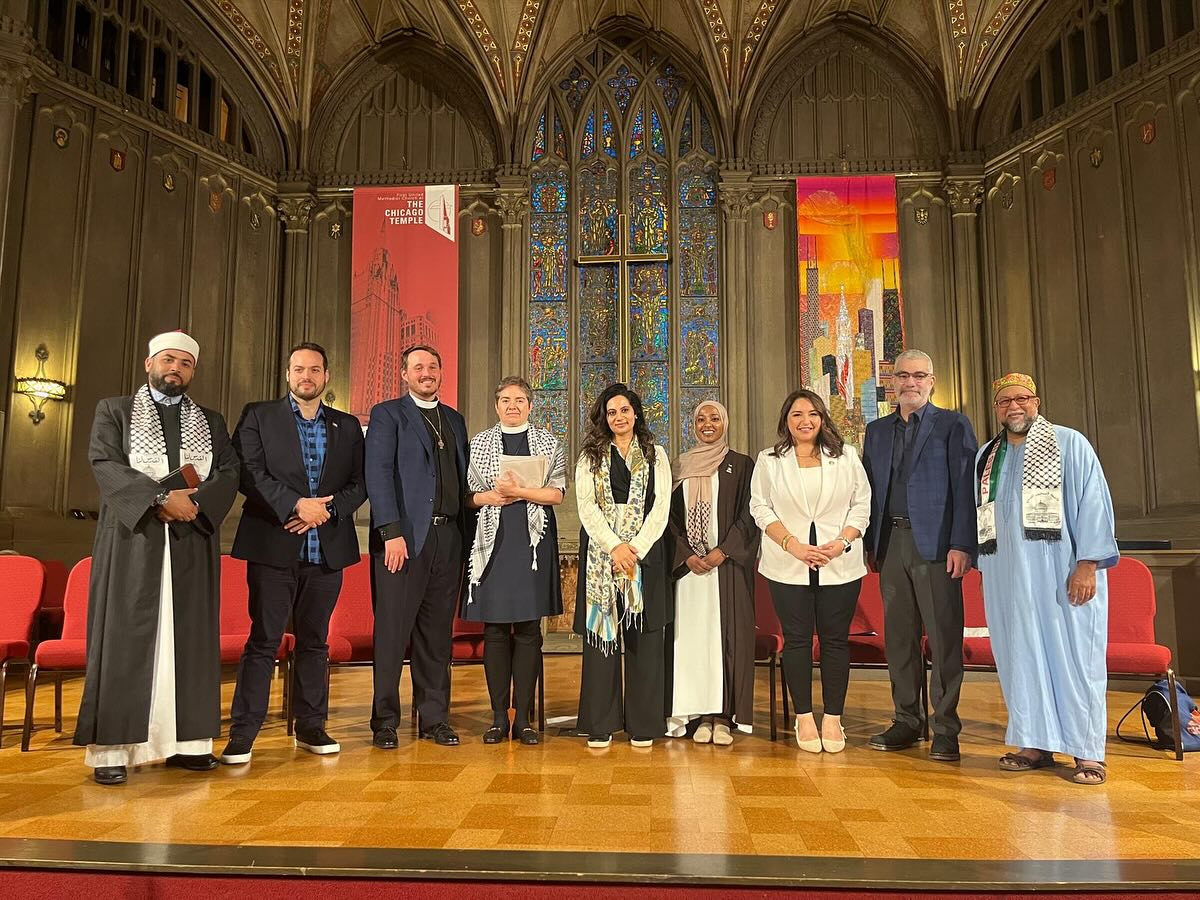
left to right: Sheikh Hassan Ali, Tarek Khalil, Rev. Michael Wolff, Rev. Anna Piela, Maaria Mozaffar, Deena Habbal, Rep. Delia Ramirez, Rabbi Brant Rosen, and Imam Hassan Aly.

My remarks from last Sunday, delivered at an interfaith memorial in Chicago for Wadee Alfayoumi, a six year old Palestinian-American boy from Plainfield, IL, who was murdered in a hate crime on. October 14. Our service also included words from IL Rep. Delia Ramirez, who is co-sponsoring a House resolution affirming that “the United States has zero tolerance for hate crimes, Islamophobia, anti-Semitism, and anti-Palestinian and anti-Arab discrimination.” 

When precious lives are unjustly taken from the world, the most essential way we can honor their memory is to ensure that they have not died in vain. Wadee’s young life was cruelly taken from us through a heinous and unjust act. While it is true that his murderer has been caught and will be tried by our legal system, our work is by no means over. We must continue to demand justice for Wadee Alfayoumi. 

While it is true that Wadee’s life was taken by one hateful, hate-filled individual, those who view this was a random, isolated incident are gravely mistaken. Wadee’s murder did not occur in a vacuum. It occurred in the toxic context of Islamophobia and anti-Palestinianism that has long been rising throughout this country and around the world. It was inspired by an ideology emanating from the state of Israel that has routinely and regularly dehumanized Palestinians for decades – a state that is, even as we speak, unleashing genocidal violence against a captive Palestinian population in Gaza. 

How can we honor the life of Wadee Alfayoumi? How can we ensure his death will not be in vain? By speaking out as loudly and unabashedly as possible against anti-Muslim, anti-Arab and anti-Palestinian hatred – and the systems that support it. By demanding that the safety and security of some groups cannot be upheld at the expense of others. By affirming the most essential of moral truths: that all people – and peoples – are equally precious in the eyes of God, and equally worthy of human dignity and respect. 

In a celebrated Talmudic debate, two rabbis, Rabbi Akiba and Rabbi Ben Azzai argued over what is the most central precept in Torah. Rabbi Akiba claims it is the famous verse from Leviticus: “Love your neighbor as yourself.” Ben Azzai disagrees, and cites the verse from Genesis: “When God created humankind, God created humankind in God’s image.” Why does Ben Azzai disagree? Some commentators suggest that while “love your neighbor as yourself” is a powerful moral imperative, it is somehow incomplete. It potentially limits our love to our immediate neighbors, to members of our community, religious or ethnic group. However when we lift up the Biblical precept that all humanity is created in the divine image, we assert our love and care for all who dwell on earth. Likewise, when we dehumanize or diminish the humanity of others, God’s presence is diminished in the world.

In other words, this divine precept is rooted in a vision of abundance. Human safety and security cannot be a zero-sum game: in the end, it must be all of us or none. There are many of us in the American Jewish community who are deeply, profoundly dismayed by the cynical accusations of antisemitism wielded by right wing political leaders who have made it abundantly clear they do not, to put it mildly, have my community’s well-being at heart. We know that the charge has less to do with Jewish safety than punishing those who stand in solidarity with Palestinians. 

We would do well to ask: why does the ignorant conflation of anti-Zionism with antisemitism merit so many hearings on Capitol Hill? Why is antisemitism being politically exceptionalized over other forms of bigotry and hatred? Why has the murder of Wadee Alfayoumi – and the shooting of three Palestinian college students in Burlington, Vermont – met with nothing but abject silence from the representatives holding these hearings? In this time of growing hatred, we must stand down this privileging of one group of people over others for cynical political gain. We must demand that our politics be leveraged to protect the safety and security for all groups targeted by hate. 

Unfortunately – tragically – we live in an age in which right-wing, white supremacists are strategically targeting their hate at Muslims, Jews, people of color, immigrants, gay, trans and disabled people, among others. Yes, as a Jewish person, I feel genuinely threatened by the rise of antisemitism in this country and around the world – but I also know full well that Christian nationalist hatred is equal opportunity in nature. I understand full well that my safety and security is inseparable from the safety and security of all. 

As remember the precious life of Wadee Alfayoumi, whose was taken from the world so unjustly, let us demand justice. Let us, as affirm, as the House Resolution introduced by Rep. Delia Ramirez and her colleagues states so plainly, that it is “the duty of elected officials and media to tell the truth without dehumanizing rhetoric when informing the public of factual information.” And that “the United States has zero tolerance for hate crimes, Islamophobia, anti-Semitism, and anti-Palestinian and anti-Arab discrimination.” 

In Jewish tradition, when we invoke the name of someone who has died, we traditionally follow with “may their life be for a blessing.” This is not only a statement of respect to the dead: it is also a moral imperative for the living. If their memories are to be a blessing, it is we that must make it so. 

I’d like to end my remarks now with the traditional Jewish prayer for the dead, El Male Rachamim (“God Full of Compassion”). We offer it now in memory of Wadee Alfayoumi, whose precious life was unjustly taken from us. Let it’s resonance be a blessing to all whose lives have been ended by bigotry – and an inspiration to us all to dismantle the systems that enable hate and oppression once and for all:

Oh God filled with compassion, whose loving presence ever surrounds us, bring final rest to the soul of Wadee Alfayoumi, who has returned to his source. May the memory of his life shine forth like the brilliance of the skies above, as it brightens our own lives and even now. Source of mercy, please shelter him beneath the softness of you wings, that he may be protected in your presence for eternity, that he may rest in peace and power.

Amen.

From Interfaith Dialogue to Interfaith Solidarity: Sermon for Rosh Hashanah 5784

(AP photo by Adam J. Dewey/NurPhoto)

During the course of my rabbinical career, I’ve participated in a good number of interfaith dialogues. These were facilitated conversations, usually involving the three so-called Abrahamic traditions – Christians, Muslims and Jews – in which we would explore our respective faith traditions together. The goal of the dialogues, generally speaking, was to achieve a deeper level of interfaith appreciation and understanding – to walk away with a respect for our differences as well as the underlying values we had in common. 

I haven’t participated in an interfaith dialogue in many years. If truth be told, I’m not sure I really believe in them anymore. It’s not that I don’t think it’s a good thing for people of different religions to learn from one another – I certainly do. It’s just that our dialogues never seemed to go much further than the talking. While our conversations were often substantive, we generally avoided more uncomfortable political topics. The underlying assumption seemed to be that religion and politics didn’t mix.

During Jewish – Christian conversations in particular, we rarely delved too deeply into issues such as Christian hegemony, white supremacy and antisemitism. When we did, we tended to treat such issues as part of the past. We seemed to be guided by the liberal assumption that such things belonged to a bygone, less enlightened age than our own. 

I can’t help but think such assumptions feel downright quaint today, in an age in which White Christian Nationalism is openly amassing political power. In which a mob wielding crosses and Christian banners literally stormed the Capitol in a coup attempt. In which Republican politicians have openly declared themselves to be Christian nationalists and a Republican candidate for president has called on his followers to “put on the full armor of God.” In the current political age, I think it’s safe to say the interfaith need of the moment goes far beyond liberal religious dialogue. The stakes are now far too serious – and far too consequential – for that.

Over the past two years, there’s been a great deal of analysis of the political threat posed by White Christian Nationalism: an ethno-nationalist movement that espouses a toxic combination of Christian exceptionalism and white supremacist ideology. White Christian Nationalists are guided by the belief that God has destined America, like Biblical Israel, for a special role in history – and that it will receive divine blessing or judgment depending on its obedience. It also promotes Replacement theory and actively demonizes Muslims, Jews, LGBTQ+ people, immigrants, and all others who do not fit into their white Christian ideal.

In the age of Trump, this movement has become entrenched in the Republican Party – and while they’re still a minority, their power has become critical to the GOP’s political strength. According to polls, most Republicans support declaring the US to be Christian nation, even if such a move would be unconstitutional. And among White Christian nationalists as a whole, 40% believe ​that “true patriots might have to resort to violence to save our country.”

Though this movement has emerged in a specific political moment, it is not uniquely of the moment. It actually dates as far back as the early days of European colonialism. Experts trace its roots back to the Doctrine of Discovery: a 15th century papal decree proclaiming European civilization and western Christianity to be superior to all other religions and cultures. The Doctrine of Discovery, of course, was an important driving force behind European colonial domination of the so-called New World and the conversion of the native peoples who lived there. 

This movement is also deeply rooted in white supremacist ideology. In his book, “White Too Long: The Legacy of White Supremacy in American Christianity,” Robert P. Jones wrote powerfully about this connection: how a wide spectrum of white Christians – from evangelicals in the South to mainline Protestants in the Midwest and Catholics in the Northeast – developed theologies that justified American slavery and Jim Crow. 

This legacy of white supremacy in American Christianity is alive and well in 2023. In 2015, a white supremacist entered Mother Emanuel AME Church in Charleston, South Carolina and murdered nine African American members of the congregation during a Bible study. Though there was extensive press at the time about his white supremacist beliefs, there was relatively little discussion of his Christian faith. In fact, his manifesto was filled with Christian imagery, including a drawing of a resurrected white Jesus rising from the tomb. He also wrote in his journal a call to action to white people to transform American Christianity from being “this weak cowardly religion” to “a warrior’s religion.”

Of course, Jews have every reason to be alarmed by such a movement as well. It was a brutal wake-up call indeed to watch torch carrying marchers in Charlottesville calling to “reclaim” America as a Christian nation while chanting “Jews will not replace us!” That wake-up call became downright deafening on a Shabbat in 2018, when a Bible quoting white supremacist murdered 11 Jewish worshippers at the Tree of Life synagogue in Pittsburgh.

At the same time, the Jewish community has been the recipient of genuine solidarity from Christian allies and friends. I’ve experienced this first hand more than once. This past February, for instance, when it was reported that Christian nationalists were planning to mobilize a “Day of Hate” against the Jewish community, my colleague and comrade, Reverend Tom Gaulke, wrote these beautiful words in a letter to our congregation:

As we hear of Christian Nationalists and Christian Supremacists calling for a “day of hate,” I would like to renew a promise on my own behalf and on behalf of the communities I’ve served:

For over a decade, we have marched side by side. And we’re not going to stop. As your family, we’ve got your back, come what may. Together, we’ve got a love that will conquer hate and a love that can only overcome.

To my mind, this gesture sums up the critical need of our new political moment: not so much interfaith dialogue, as interfaith solidarity. We must find a way to mobilize an interfaith movement that, in Tom’s words, ‘will conquer hate and can only overcome.”

If we are truly serious about this level of solidarity, however, each of our religious communities will need to engage in a great deal of deep discernment in our own backyards. I know there are many examples of white Christian communities who are doing this work in important ways; who understand that white solidarity must go hand in hand with justice and reparation. In his book, Robert Jones wrote about one white Baptist minister whose congregation has entered into an ongoing relationship with a black Baptist church. In describing that relationship, the minister said:

I’ve stopped using the word reconciliation…for what we’re doing. I’ve started using justice work more… When we throw around the word reconciliation, especially as white Christians, white people, we’re betraying our desire to just kind of move through all of the hard stuff to get to the happy stuff. So, when we’re talking about justice work, for me we’re getting into these much stickier questions of what has been lost, what is owed. 

Christian solidarity with non-Christians can also be hampered when well-meaning Christians fall back on a myth of innocence – when they distance themselves from White Christian Nationalism by saying “it’s not my religion.” I’ve witnessed this repeatedly – last year, for instance, the presiding Episcopal Bishop stated that White Christian Nationalism was “not Christianity.” Another progressive Christian activist has written it is a “political ideology rather than a religious one.” 

While I understand the good intentions behind these kinds of statements, I believe it’s deeply problematic when Christians disavow the more unsavory aspects of their religious tradition. In so doing, they avoid accountability for centuries of their own history and invisiblize its victims. As I’ve often commented, no religion is pure – all religions have their good, their bad and their ugly. In the end, I would submit that the proper way to confront the toxicity in our traditions is for people of faith to own the all of our religions – and to grapple with them seriously, honestly and openly. 

This will be a reckoning for the Jewish community as well. For one thing, in order to confront White Christian Nationalism, we will need to honestly interrogate persistent myths about Jews and whiteness. While white Jews understandably feel vulnerable at this particular moment, we still dwell under a shelter of white privilege. We must not assume that the threat of White Christian Nationalism poses a danger to all members of the Jewish community equally. White Jews will have to reckon with the fact that we are protected from this threat in ways that Jews of color are not. In other words, for the Jewish community, intra-communal racial solidarity will be just as critical as interfaith solidarity.

There is another issue facing the Jewish community that is perhaps even more challenging: if we are to truly stand down this movement – this toxic fusion of religion and nationalism – we’ll have to do so without exception. That means that Israel cannot get a pass. 

Though it may be troubling for many to consider, there are clear parallels between white Christian Nationalism and Zionism. Consider this: the Doctrine of Discovery holds that America was “discovered,” glorifying the noble innocence of the nation’s original “pioneers.” The ideology of Manifest Destiny is deeply connected to a vision of European Christian chosenness, viewing America as a “new Zion.” 

For its part, Zionism is rooted in a similar colonial view of a “land without a people for a people without a land.” It venerates the heroism of the chalutzim – the pioneers who “drained the swamps” and cultivated the land. And Zionism’s central narrative also comes from the Bible, utilizing texts that emphasize Jewish chosenness and exclusive entitlement to the land. 

Even more to the point, both White Christian nationalism and Zionism are forms of ethno-nationalism: movements that seek to establish and maintain nation-states predicated on the identity of one specific group of people. In its way, these two movements are religious nationalist mirror-images of each other, both seeking to create exclusive, homogeneous nation-states at the expense of their native inhabitants. 

Believe me, I know all too well that there are many in the Jewish community who will vociferously object to this kind of analysis. But painful as it may be, we can no longer cling to this myth of innocence when it comes to Israel. I think it’s absolutely critical that we find the strength to say these things out loud: to admit that after centuries of persecution at the hands of Christian empire, a modern Jewish movement is now actively following in its footsteps. 

All of this means that Jews, Christians – and all people of faith will need to reckon seriously with the issue of power – and in particular, the fusing of religion and state power. After all, don’t we know all too well from history where this road leads? We know what happens when religion is used by nations as a weapon of conquest. When God is invoked by the state to demonize others and exert their power over them. And make no mistake, religions that follow Biblical tradition will find ample justification for conquest and domination in that particular text.

But there is, however, another, decidedly different religious vision: it is a sacred act to resist oppressive state power. This path comes from the Bible as well; it is embodied by the Exodus narrative, the sacred story that lifts up the God of Liberation, and stands down the god of conquest. That puts the oppressed, not the oppressor at the center. That views the Promised Land not as a territory to be conquered by a chosen few but a land of equity and justice that is open to all.  We don’t have to look far to find contemporary examples of this sacred narrative in action. To name but two examples, it is exemplified by the Latin American liberation theology movement and the American black church: both of which lift up sacred visions of resistance that have leveraged genuine socio-political change.

This sacred narrative of liberation runs mightily through Jewish tradition as well. We are currently witnessing an emergent movement of radical, liberative Judaism that is truly exciting to behold. And I am so proud that Tzedek Chicago is an active and important participant in this movement. As we’ve done this work together, it’s been striking to me how integral and basic these values of solidarity and liberation are to Jewish tradition: from the weekly radical revolution that is Shabbat, to our deep-seated culture of study, questioning and Godwrestling, to our holidays, all of which contribute to a sacred drama that enact and re-enact the possibility of change and transformation in our world.

We enact these sacred values, in fact, each and every Rosh Hashanah. One of the central themes of the New Year is malchuyot – “divine sovereignty.” As I’ve come to understand it, this concept doesn’t have to refer to a literal belief in an all-powerful supernatural God sitting on his Kingly throne. Another way of understanding malchuyot, is as an affirmation of a Force Yet Greater – greater than any human or institution in our world: a power greater than Pharaoh in Mitzrayim, greater than the mightiest empire – and yes, even greater than systems of colonialism and white supremacy. 

Rosh Hashanah is also the day in which we stand before the open gates of heaven and sound the shofar as a wake-up call for the new year. We declare Hayom Harat Olam – “today the world was created,”affirming the eternal potential for transformation in our world. Over the next ten days, we will dig deeply into our individual and collective souls and discern what needs changing. Then, at the close of Yom Kippur, we will sound the shofar once final time as a call to action to go forth and create the world we know is possible. 

I’d like to close now with the words of a contemporary religious leader who truly embodies these ideas and values of interfaith solidarity: the great Rev. William Barber, co-chair of the Poor People’s campaign and president of Repairers of the Breach. May his words be our call to action this Rosh Hashanah:

The world doesn’t change when powerful people get new ideas. The world changes when people who’ve been rejected come together and realize that they are blessed to show their neighbors that another world is possible. Change happens when those who have been otherized decide we ain’t takin’ it no more…

There’s some stuff wrong in America and there’s no way to mend the flaws of this nation and be one nation under God with liberty and justice for all, unless the rejected people are at the center.

May this be the year we discover the true source of our collective power. May this be the year we transform the world that is into the world we know is possible. 

#DayofHate: How Should we Respond?

Photo by Jeenah Moon/Getty Images

Over the past week or so, there was rising alarm over reports that some neo-Nazi groups had called for a “Day of Hate” against the American Jewish community. While the day thankfully came and went with no reports of any incidents, it seems to me that there are several important takeaways from this frightening “non-event.”

The first, of course, is that we should never take the threat of anti-Jewish violence for granted. In the wake of the “Day of Hate” warning, there was increased security at synagogues and Jewish institutions in major cities throughout the US. This response was certainly understandable, particularly following the news of a recent shooting of two Jewish worshippers outside an LA synagogue.

At the same time, as I wrote last Friday to my congregation, I was particularly heartbroken to know that extra police presence at synagogues would surely cause many in our community – particularly Jews of color – to feel less safe in their own houses of worship. As Erika Gatson, a black-Jewish activist and writer recently wrote:

I very deeply understand the need for some sort of security at synagogue, but it does not make for a comforting expereince. As a Black Jew, if feels like I have to continue to worry about not being protected by those brought in to protect the community.

It should also be noted that authorities made a point of saying there was no evidence of any imminent threat to the Jewish community. The initial report of the threat came from a leaked internal memo by the New York Police Department’s Intelligence and Counterterrorism Bureau, originally stemming from a January 4 message left on the encrypted messaging app Telegram, by members of Crew 319, an Iowa-based white supremacist group whose most visible action to date had been a relatively minor flier campaign. Indeed, one ADL leader noted that “the activism of the day will most likely be limited to small demonstrations with banner drops or graffiti, rather than violent acts.”

It might well be said that under the circumstances, the strong Jewish community response was justified, However it can also be argued that it was overblown – that in the end, the attention given to this news was disproportionate to that threat and ultimately counterproductive. A report released yesterday by the Network Contagion Research Institute, in fact, came to this very conclusion:

The recent “National Day of Hate” event planned by an obscure Iowa-based white
nationalist group received little attention (roughly 20 likes) within its own subcultural
ecosystem on Telegram, yet received widespread amplification from mainstream media and organizations such as the ADL. There is little publicly available evidence to suggest larger white nationalist groups engaged with posts associated with the planned event or were planning to participate…

Sounding an undue alarm about low-signal extremist content can potentially elevate
security risks and embolden bad actors, as they see the attention generated by their
actions as a sign of success and validation, and may be motivated to carry out further
extremist activities.

It is sobering to consider that the ADL and other similar organizations helped to drive up #DayofHate to over 100,000 tweets while a post on an underground site from a small and little-known hate group received 20 likes. It’s worth asking whether this kind of “undue alarm” may have boosted the profile of Crew 319 while simultaneously emboldening their followers. As Ben Lorber, an analyst at Public Research Associates tweeted in response, “Is this what keeping Jews safe looks like?”

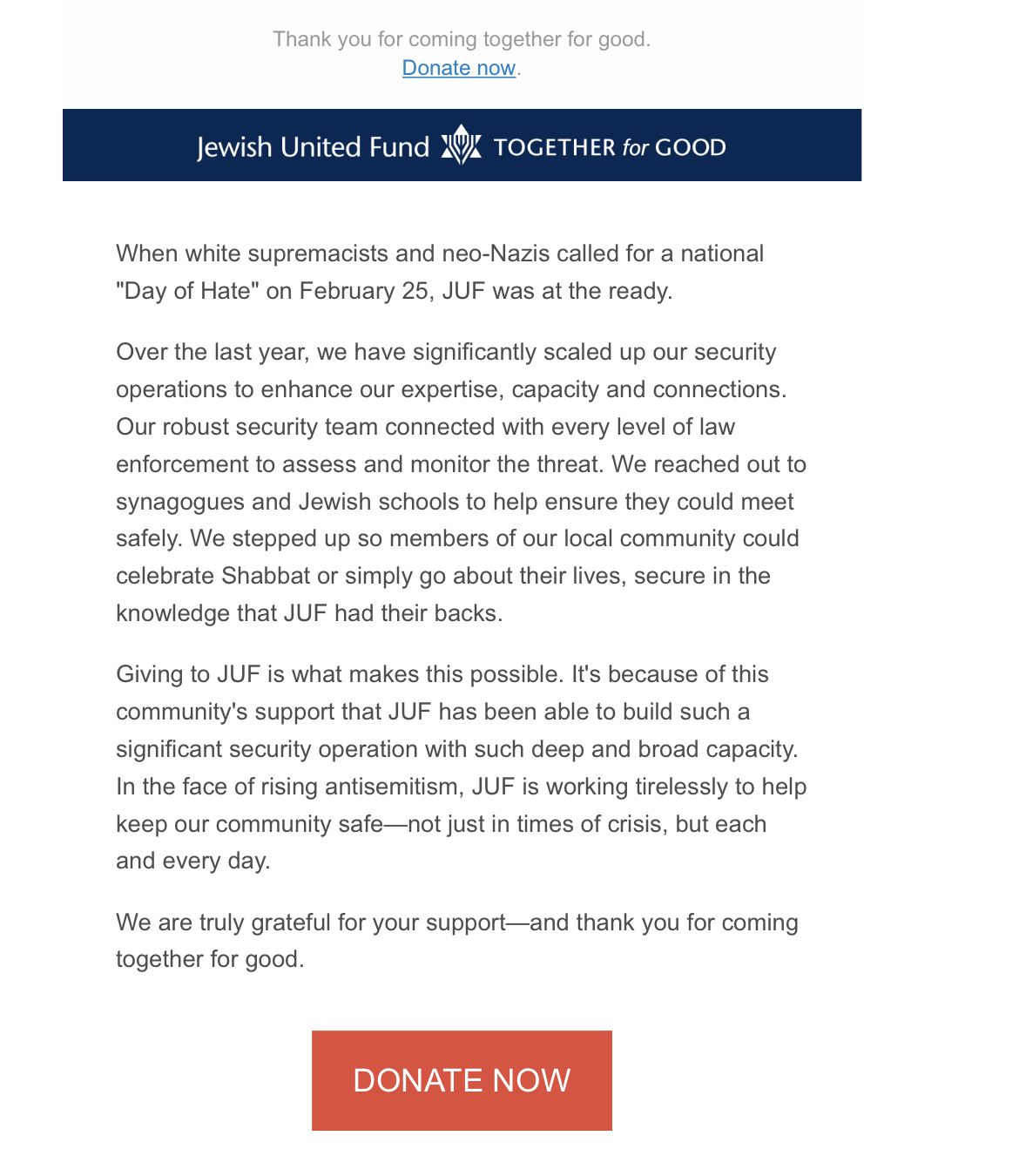
And while we’re on the subject of Jewish communal response to the threat of antisemitism, this disconcerting mass email from the Jewish United Fund of Greater Chicago landed in my inbox just this morning:

Whatever we might think about the wisdom and effectiveness of the Jewish communal reaction to the “Day of Hate,” I would say it’s generally a good rule of thumb to avoid cynically capitalizing on a non-existent antisemitic event in order to raise money for your organization.

In the end, if there were any positive takeaways from this horrid affair at all, I found it in the numerous messages of heartening solidarity from our friends and allies in the greater community, including several that I received personally. I was particularly heartened by a message to my congregation from my friend and colleague Rev. Tom Gaulke of Gethsemane Lutheran Church in Cicero, Illinois, who ended his remarks with these beautiful words: “As your family, we’ve got your back, come what may. Together, we’ve got a love that will conquer hate and a love that can only overcome.”

What else can I say to that but Amen?

Living a Judaism Beyond Zionism: Sermon for Yom Kippur 5783

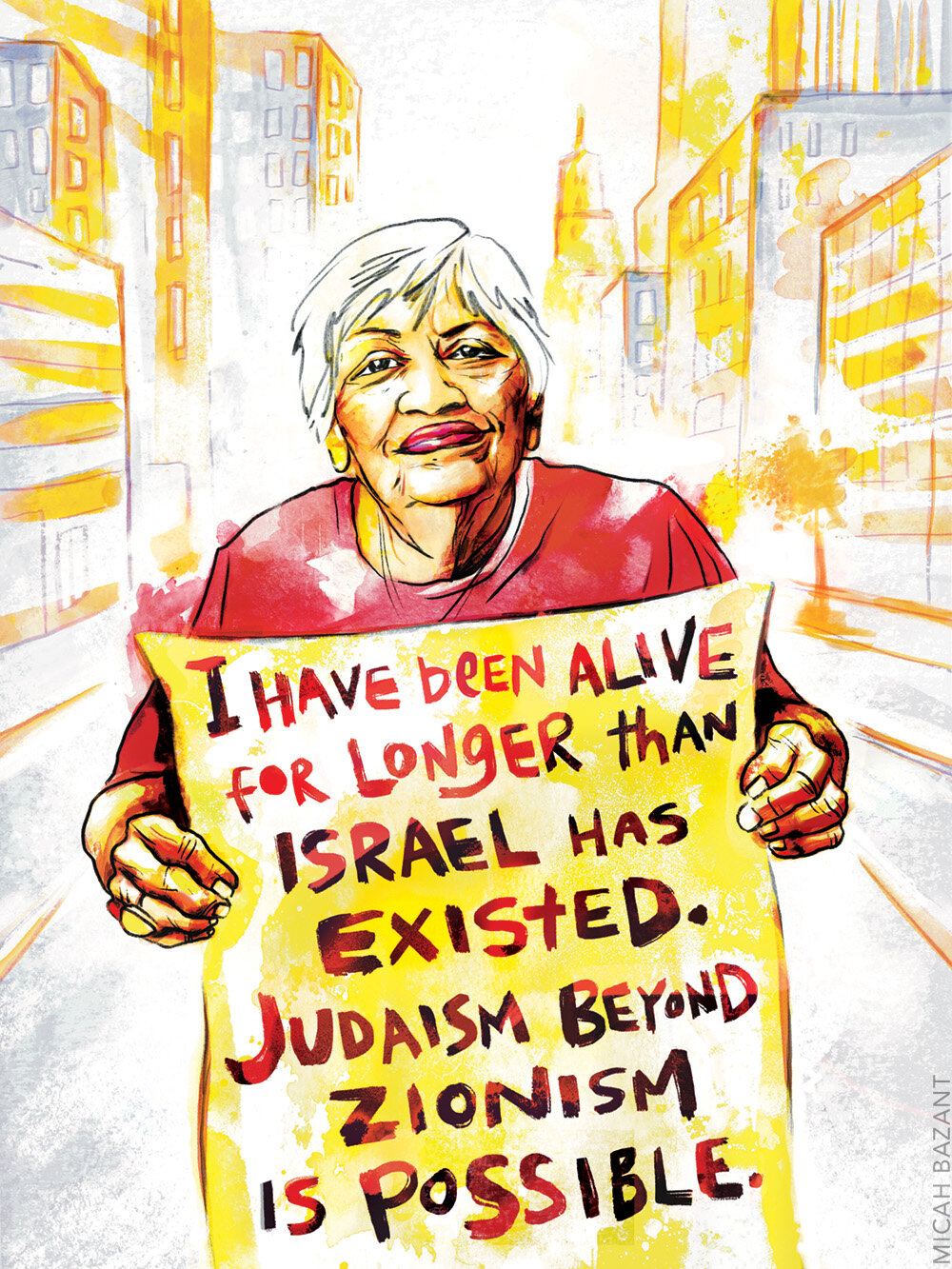
Art by Micah Bazant

Last month, Michigan Representative Rashida Tlaib spoke at an organizing seminar for Palestine solidarity activists. It was an in-house event, and it likely would not have garnered much attention except for one part of her speech:

It has become clear that you cannot claim to hold progressive values, yet back Israel’s apartheid government. And we will continue to push back on and not accept this idea that you are “progressive except for Palestine.” 

I’m opening with Rashida Tlaib’s words because I believe they’re deeply relevant to Yom Kippur. This is, after all, the day for facing up to hard truths, particularly the ones that affect our community. And I frankly cannot think of a more important, more critical moral challenge facing the Jewish community than the issue of Palestine-Israel. 

As you might expect, after Rep. Tlaib made her remarks, the wrath of the titans rained down upon her. Jonathan Greenblatt, the CEO of the Anti-Defamation League, berated her on Twitter and accused her of being an antisemite. So did Rep. Debbie Wasserman Schultz. Scores of her Democratic colleagues condemned her for slandering the “Jewish and Democratic state of Israel.” 

Tellingly, however, none of her critics actually responded to the essential claim of her comment – namely, that Israel is an apartheid state. None of them mentioned that Human Rights Watch, Amnesty International and B’tselem, the most prominent Israeli human rights organization, have all determined that Israel is an apartheid regime. B’tselem’s report concludes, in words that are powerfully appropriate for Yom Kippur:

As painful as it may be to look reality in the eye, it is more painful to live under a boot. The harsh reality described here may deteriorate further if new practices are introduced – with or without accompanying legislation. Nevertheless, people created this regime and people can make it worse – or work to replace it. That hope is the driving force behind this position paper. How can people fight injustice if it is unnamed? Apartheid is the organizing principle, yet recognizing this does not mean giving up. On the contrary: it is a call for change.

Fighting for a future based on human rights, liberty and justice is especially crucial now. There are various political paths to a just future here, between the Jordan River and the Mediterranean Sea, but all of us must first choose to say no to apartheid.

But you really don’t need to pore through human rights reports to grasp this reality. The bottom line is this: Zionism promotes a Jewish majority state in historic Palestine. In order to keep that majority, Israel must pursue policies that are patently undemocratic. It must create and enforce laws that fundamentally privilege Jews over non-Jews. It must dispossess and disenfranchise Palestinians. It must maintain what B’tselem calls “a regime of Jewish supremacy” from the river to the sea. 

So yes, as Rashida Tlaib put it, you can’t be progressive and support apartheid. Unless you define the term “progressive” in a way that is devoid of any meaning whatsoever, you cannot support a Jewish supremacist state and claim to be a progressive. It’s interesting to note that virtually every one of Rep. Tlaib’s critics slammed her for creating a “litmus test” for progressives. But in truth, I don’t believe she was interested in creating a test for her colleagues. She was simply arguing for moral consistency.

When I read about this dustup, I was reminded of Rev. Martin Luther King’s 1963 “Letter from a Birmingham Jail.” Whenever I hear so-called progressives defending injustice in the name of progressive values, I invariably think of King’s letter. It was written to liberal white clergy in Birmingham who had signed a public statement telling King to stay away and not make trouble in their city. At one point they wrote, “We feel that inflammatory and rebellious statements can lead only to violence, discord, confusion and disgrace for our beloved state.” 

Now fast forward to 2022. This was Debbie Wasserman Schultz’s angry response to Rep. Tlaib:

Proud progressives do support Israel’s right to exist as a Jewish and democratic state. Suggesting otherwise is shameful and dangerous. Divisive rhetoric does not lead to peace.

In the end, it’s really just a distraction to make this a debate about what is or isn’t “progressive.” It’s an issue of basic morality. For the Jewish community it’s a challenge that goes to the very core of our spiritual and ethical tradition. I don’t believe you can identify as a Jew in the age of Zionism and dither on this issue. Every single day, Israel’s actions present us with this basic question: will we support apartheid, dispossession and militarism in our name or will we not? 

I’m sure all of you know that the Tzedek Chicago membership voted last March to change our core values to articulate that we were an anti-Zionist congregation. Our decision followed a unanimous board vote and a month’s long series of congregational meetings. As those who attended will attest, these conversations were inspiring in their depth and thoughtfulness. No matter what their position, members who participated in this process shared their opinions openly, honestly, and with deep respect for one another. 

In the end, 72% of our membership quorum voted in favor of the change. Yes, there were those who voted against, but I’m heartened that as far as I know, no members have left our congregation as a result of our decision. In fact, we actually gained several new members, many of whom said that this was the first time they had joined a synagogue – that they had wanted to be part of a Jewish congregation, but the issue of Zionism had consistently kept them at bay.

I can’t understate what a powerful statement we’ve made. Yes, we are one small congregation, but the bottom line is that as a result of our decision there is now a new fact on the ground. There is now a progressive (yes, progressive) Jewish synagogue that is openly and unabashedly promoting a Judaism beyond Zionism. Tzedek Chicago has taken a public, principled stand on the most important, most critical moral challenge facing the Jewish community today. 

And by the way we don’t stand alone. At this very moment, the Mending Miyan, an anti-Zionist congregation in New Haven, is celebrating its first High Holidays with its new student rabbi, May Ye, who many of you will remember was Tzedek Chicago’s rabbinical intern in 2018. Just a few days ago, I was contacted by a friend who told me that a group of Jewish anti-Zionists, inspired by what we have done here in Chicago, had held their first Rosh Hashanah service together in Denver. And I have no doubt there are others – that this is only the beginning. 

Our decision is also important because we are currently witnessing a very real and very dangerous campaign that seeks to equate anti-Zionism with antisemitism. The Israeli government and the Jewish institutional establishment are clearly doubling down to stem the growing number of Jews in the US  — particularly young Jews — who are openly identifying as non or anti-Zionist. This backlash has been fierce, and at times perverse, actually calling into question our very status as Jews. In a widely read essay last year, Natan Sharansky labeled anti-Zionist Jews as “un-Jews.” Last May, immediately following Israel’s military onslaught on Gaza, a Reform rabbi in the Chicago area gave a sermon in which she called anti-Zionist Jews “Jews in name only” who must be “kept out of the Jewish tent.”

Given the tenor of the current moment, I believe the need for public stances by principled Jewish anti-Zionists is more critical now than ever. Most importantly, Jewish anti-Zionists create cover for Palestinians, the ones who are most directly impacted by these accusations of antisemitism. Right now, public figures such as Rashida Tlaib, as well as scores of Palestinian activists on college campuses and communities across North America, are being subjected to withering attack. We know how devastating the accusation of antisemitism can be. It destroys careers and ruin lives. And right now, this accusation is being weaponized by Israel and its institutional supporters in profoundly harmful ways. 

The most insidious thing about this accusation: when we equate anti-Zionism with anti-Semitism, we effectively brand just about every Palestinian in the world as an anti-Semite. How could it be otherwise? The direct product of Zionism was the Nakba – the forced expulsion of over 700,000 Palestinians from their homes in 1948, creating what is today the largest refugee population in the world. The creation of an exclusively Jewish nation state in historic Palestine has led to the ongoing dispossession and oppression of the Palestinian people that continues to this very day. How could we honestly expect Palestinians to be anything other than anti-Zionist? By this definition, Palestinians are guilty of being antisemites just for being Palestinian. 

We can’t underestimate the power of this current backlash against anti-Zionism. After Tzedek Chicago made our announcement, we garnered, as you might expect, some “responses” from the Jewish institutional community. While we did get some positive and thoughtful press, there was the inevitable nastiness, particularly and inevitably on Twitter. I don’t have much to say about that, except for this: amidst all the horribleness and toxicity, I noticed an interesting common denominator. Over and over, our attackers made the claim that Zionism was essential to Judaism – and that our being anti-Zionist was tantamount to being anti-Jewish. This, I would like to address:

Of course, the claim that Eretz Yisrael is intrinsic to Jewish tradition is absolutely correct. It would be ignorant to claim otherwise. However – and this is a big however – the notion of creating a sovereign Jewish nation state was never part of the Jewish land tradition until the rise of political Zionism in 19th century Europe. And herein lies the central fallacy of the Zionism equals Judaism argument: for most of Jewish history, the yearning for Zion has been rooted in an idealized messianic vision. The very idea of a mass migration to the land in order to establish a 3rd Jewish commonwealth was commonly considered to be an anathema – a “forcing of God’s hand” – by traditional rabbinic authorities.

Those who say Zionism is central to Judaism consistently and conveniently neglect this point: political Zionism did not arise until relatively recently in Jewish history. Yes, Zionism is undeniably a Jewish movement, and a successful one at that. But it is also a quintessential movement of Jewish modernity that represented a conscious and radical break with traditional Judaism as it was understood and practiced until that time. While it has clearly been embraced by a majority of Jews in Israel and throughout the diaspora, the claim that Zionism is somehow intrinsic to Judaism is false and in fact, deeply disingenuous.

In the end, however, this struggle isn’t over what is or isn’t Judaism. Rather, it is over what kind of Judaism we want to affirm in the world. I don’t believe in essentializing Judaism – or any religion, for that matter. The fact that Zionism was “a modern movement that broke with traditional Judaism” is not in itself a bad thing. After all, modernity gave rise to a host of Jewish movements that broke with traditional Judaism. My own denomination, Reconstructionist Judaism is most certainly such a movement. 

I often think of this when I hear liberal Christians respond to the hateful things said and done by white Christian nationalists by saying, “that is not Christianity.” No, in fact it is Christianity. The Christian church certainly has a great deal to live down from its history up until present day. But to the Christians who seek to promote humane Christianity, I would suggest that the answer is not to deny the more problematic or toxic manifestations of their tradition. The answer is to recognize that every religious tradition, every religious community has its good, its bad and yes, it’s ugly. And if we want the good to prevail, it seems to me, we must be ready to confront the all of our religious traditions. 

The same goes for the Jewish community. Even if Zionists deny us our Jewishness, It’s not intellectually honest, nor is it particularly productive, to deny Zionists theirs’. The question before us is not who is the most “authentic” Jew? The real question is: what kind of Judaism do we want to lift up in the world, to live out, to bequeath to future generations?

This is why I feel so blessed to be a part of Jewish congregation that is ready to stand up and say we seek a Judaism beyond Zionism, beyond apartheid and settler colonialism. A Judaism that views the diaspora as the fertile ground for Jewish creativity, a Judaism that seeks the Divine wherever we may happen to live, that affirms the whole earth is filled with God’s glory. A Judaism that values spiritual power over physical power. A Judaism that makes its home in the margins, because that’s where our sacred sparks of creativity have always resided. A Judaism of solidarity, that knows our place is alongside all who are marginalized, demonized and oppressed for who they are. 

So, this Yom Kippur and for every day forward, let this be our prayer:

May the dream of a world complete become reality soon, in our own day, that every land may be a Zion, every city a Jerusalem, every home a sanctuary offering welcome to all. May the world be rebuilt upon a foundation of compassion, equity and justice, as it is written, compassion and truth will meet; justice and peace will kiss. Baruch atah adonai, boneh ha’olam b’tzedek v’rachamim – Blessed are you, who rebuilds the world in justice and compassion. 

Amen.

Christian Zionists Leaving their Legacy on the Way Out

In the waning days of the Trump presidency, it’s become painfully clear that this administration is engaged in a political scorched earth campaign – i.e., doing everything it can to ram through its most harmful policies before Inauguration Day – and to do so in ways that will make them difficult to undo by the incoming Biden administration. Secretary of State Mike Pompeo’s visit to the West Bank yesterday, where he unabashedly unveiled the Trump administration’s “parting gifts to the Israeli right,” is the latest case in point – and a particularly harmful one at that.

Speaking from the illegal West Bank settlement of Psagot, Pompeo announced two new policies. The first was the State Department’s designation of products made in West Bank settlements as being “Made in Israel,” which now paves the way for US approval of Israel’s formal annexation of Area C of the West Bank.

The second gift came with this announcement:

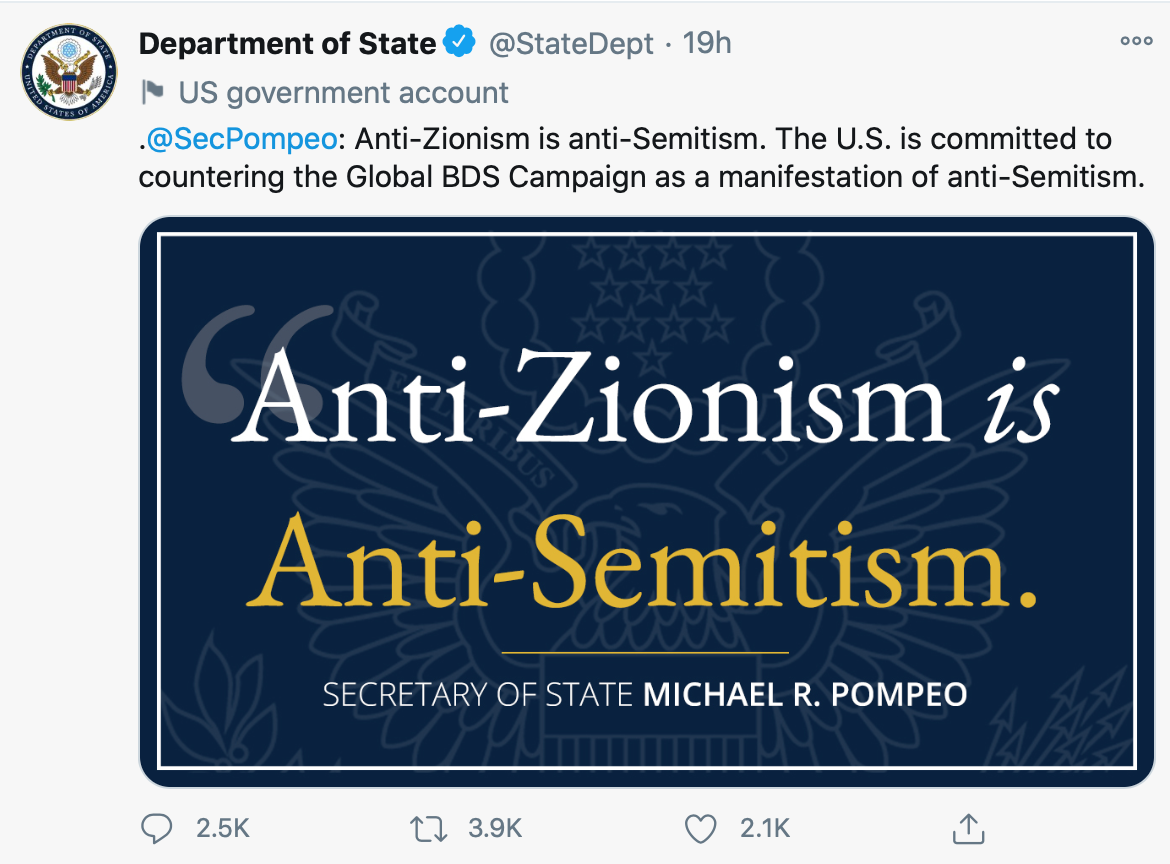
As we have made clear, anti-Zionism is anti-Semitism.  The United States is, therefore, committed to countering the Global BDS Campaign as a manifestation of anti-Semitism.

Pompeo’s statement further directed the Office of the Special Envoy to Monitor and Combat Anti-Semitism “to identify organizations that engage in, or otherwise support, the Global BDS Campaign… to ensure that their funds are not provided directly or indirectly to organizations engaged in anti-Semitic BDS activities.” In a joint statement with Israeli Prime Minister Netanyahu, Pompeo put a finer point on his intentions:

“Look, we want to stand with all other nations that recognize the BDS movement for the cancer that it is. And we’re committed to combating it. Our record speaks for itself. During the Trump administration, America stands with Israel like never before.”

While there is clearly much to parse here, I’d like to unpack Pompeo’s pronouncement that “Anti-Zionism is Anti-Semitism.”

When considering the implications of this new policy, it’s essential to note that Mike Pompeo himself is a fervent Christian Zionist who adheres to an eschatological ideology that seeks a Jewish return to the Holy Land as a precursor to the apocalypse and the Second Coming of the Messiah. Pompeo has in fact, made no secret of his extreme religious beliefs. In 2015, when he was a congressman, he uttered these immortal words from the pulpit of a Kansas church:

We will continue to fight these battles. It is a never-ending struggle. Until that moment … until the Rapture be part of it, be in the fight.

I’ve written a great deal about Christian Zionism and it’s influence within the Trump administration before, so I won’t go into great detail here about this dangers of this extreme religious ideology. For now, I’d just like to contextualize Pompeo’s presumptuous equation of Anti-Zionism = Antisemitism with a few points:

• Zionism does not equal Judaism. In fact, Zionism is not an exclusively Jewish movement. It is rather, a fundamentally interfaith movement “that has informed and propelled Christian Zionists into the very halls of power.”

• There are far more Christian Zionists in the world than Jewish Zionists (or Jews for that matter). There are 9 million members of the organization Christians United for Israel alone. While American Jewish attachment to Israel is declining, Evangelical Christian support is growing significantly.

• Christian Zionism is itself an antisemitic religious ideology that objectifies the Jewish people as pawns in a cosmic drama that seeks to further the coming of the Christian messiah.

• There has always been principled Jewish opposition to Zionism.

• There are increasing numbers of Jews who support BDS as an expression of intrinsically Jewish values.

We should make no mistake: even if they are no longer in the administration, the threat of this Christian extremist movement will remain very real. But as ever, for Palestinians and those of us who stand in solidarity with them, the struggle will continue – no matter who happens to live in the White House.

White Supremacy is Coming For All of Us

safe_image

(Crossposted with Newsweek)

If ever there was a moment of clarity for us, it’s now.

As we witness and grieve the carnage of two back-to-back mass shootings, we cannot afford to ignore the clear signs that the ascendance of white supremacy in our nation is all too real. 2018 saw a national increase in hate crimes, with nearly all extremist homicides carried out by the far right. Last May, the head of the FBI’s counter-terrorism unit, Michael McGarrity, testified to Congress that the bureau was investigating about 850 cases of domestic terrorism. Read this again: 850. We know conclusively that white nationalist extremists have killed more people in the United States than any other category of domestic extremists since September 11, 2001.

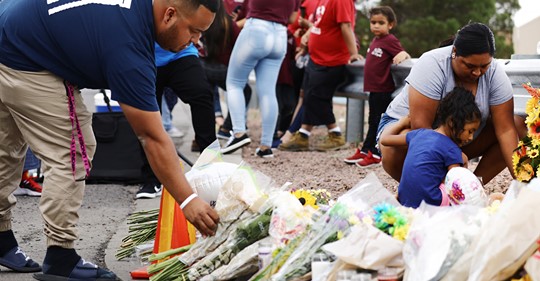
Many of these crimes might seem different on the surface: When a white supremacist killed nine Bible study students at Mother Emanuel Church in Charleston, SC, the victims were African-American; when eleven worshippers were gunned down by a white supremacist at the Tree of Life Synagogue in Pittsburgh, the targets were Jews; the white supremacist who killed 20 at an El Paso mall last Saturday was gunning for Latinix immigrants, according to his manifesto. And within 24 hours another mass shooting occurred in Ohio, the motivation of which is still unclear as of this writing.

We can’t deny the influence of one massacre on another. One empowered white male with guns is invariably followed by another. Indeed, the manifesto attributed to the El Paso gunman is clearly inspired by the New Zealand shooter’s manifesto, which promoted a white supremacist theory called “the great replacement”—an ideology that claims elites in Europe have been working to replace white Europeans with immigrants from the Middle East and North Africa. This is akin to the “white genocide” theory affirmed by the Pittsburgh shooter.

The needs of this moment could not be clearer. The time has come for a structural intervention. We should rightly expect every branch of government to take clear and unmistakable actions to halt the growth of white supremacy in our nation. We must demand of every politician, every media figure, every pundit and faith leader to name and call out this toxic racism wherever it may come from, including—especially—when it comes from the White House.

It can no longer be up for debate whether or not our president is emboldening this rise in white supremacy and the increase in mass shootings. He is. There is no way to question this in good faith. The same person who inspired a crowd to chant “send her back” to Somalian-American Representative Ilhan Omar, the same person whose tweets are increasingly racist, the same person who welcomes white supremacists to the White House, is more than a part—a huge part—of the problem. He is the catalyst to much of this violence.

But this is also a time of action—a time to stand up and reach out to those who are being targeted. And those of us who are members of these targeted minorities must stand in common cause and solidarity with one another. For instance, as a Jew, I cannot begin to say how heartened and supported I felt when, in the wake of the Pittsburgh synagogue shooting, I learned that the Muslim American community responded immediately by raising hundreds of thousands of dollars to support the families of the victims.

I am likewise proud of the work of Never Again Action, a new Jewish network working with local allies around the country to organize actions of civil disobedience at ICE detention centers. History will judge how we responded in this time, and we are now well past the wake-up call. We must prioritize the fight against white supremacy in this country and beyond.

This weekend will mark the Jewish observance of Tisha B’Av (the “ninth of the month of Av”)—a fast day that mourns the tragedies that have befallen the Jewish people, symbolized by the destruction of the ancient Temple in Jerusalem. One of the central lessons of this day is that the Temple was not destroyed by any external enemy, but by the sinat chinam—“baseless hatred”that ultimately destroyed the Jewish community from within.

This Tisha B’Av, I am all too aware of the toxic sinat chinam of white supremacy that is so clearly on the rise, corroding our nation and our global community. At the same time, I cannot but redouble my commitment to the growing diverse social justice movement in all its forms, welcoming and uniting our struggles, mourning our loses and striving to protect one another, over and over again.

During this horrible, clarifying moment, I take heart in the sacred power of solidarity.

Bearing Witness to Root Causes at Radio Progreso

46777697824_ea82dba68c_k

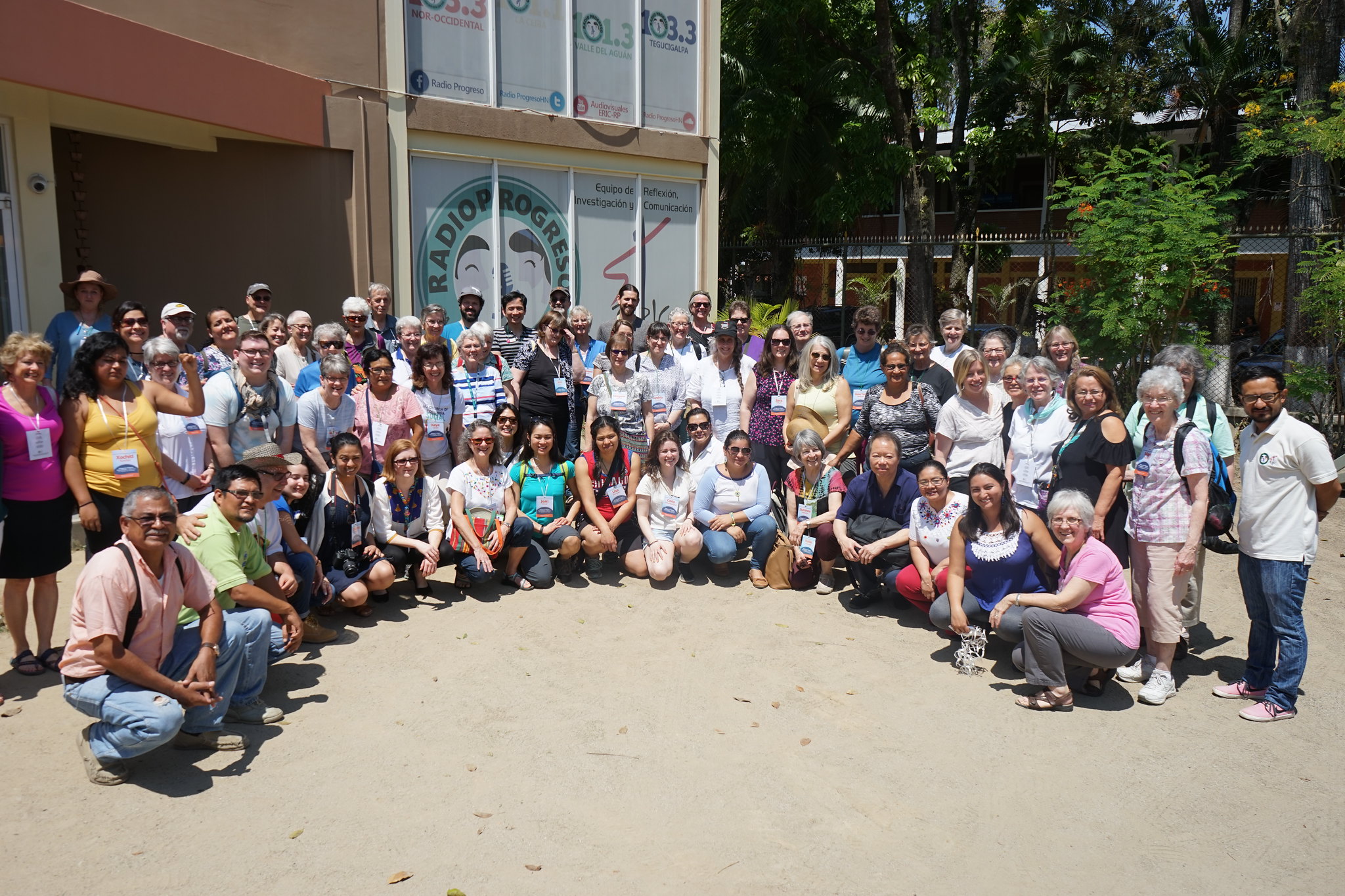
The invitation for our Root Causes Pilgrimage to Honduras came from Radio Progreso, a Jesuit-owned radio station based in the city of El Progreso. As one of the few independent media voices in Honduras Radio Progreso does extensive work in advancing human rights, promoting peace, supporting community-based initiatives, and advocating for environmental justice across the country. The station broadcasts its transmissions in nearby San Pedro Sula and the Honduran capital of Tegucigalpa to an estimated audience of 1.5 million people.

Radio Progreso is led by Father Ismail Moreno, known to everyone in Honduras as “Father Melo.” Father Melo is one of the most important grassroots leaders in the country and a fierce proponent of human rights.  In a time of increasing threats to freedom of speech, Radio Progreso is one of the most fiercely dependable sources of truth in the country.

In 2001, Padre Melo founded a companion project of Radio Progreso — Equipo de Reflexión, Investigación y Comunicación (ERIC), which provides grassroots investigation and reporting of the many forms of injustice and violence that plague Honduran activists and peasants working to reform the political and economic structures that stifle the development of the country’s poor and marginalized people. Melo has been the director of the radio station since 2006.

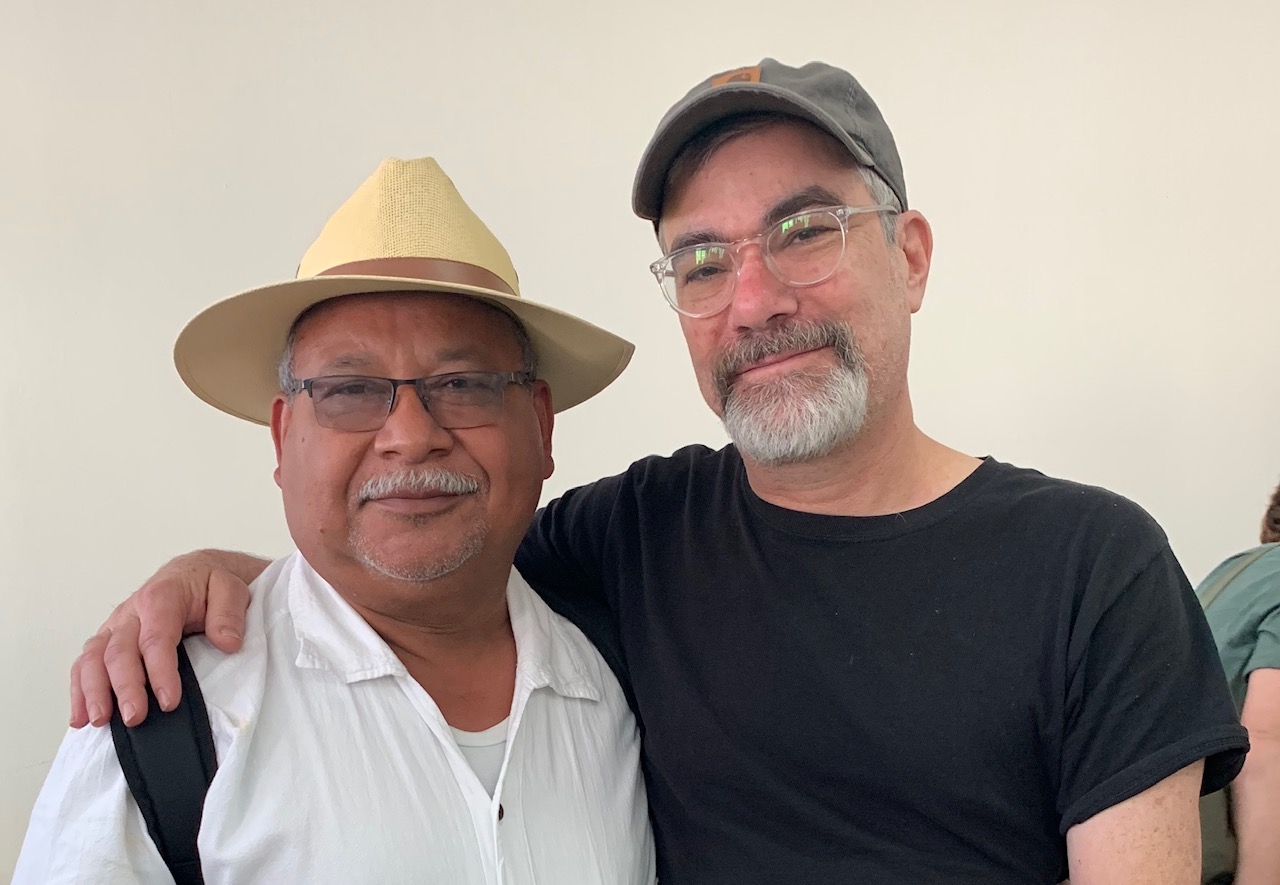
It’s difficult to understate the courage of institutions like Radio Progreso. In 2011, correspondent Nery Jeremias was gunned down; three years later, marketing manager Carlos Mejia was stabbed to death. The station has also been vandalized repeatedly over the years, After the station was critical of the fraudulent 2017, its antenna was destroyed by vandals. Father Melo himself lives with the constant threat to his life and well-being; his entry into public activism followed the brutal 1989 assassinations of his mentor, Jesuit Fr. Ignacio Ellacuría, and five confreres at the University of Central America in El Salvador.brant_melo

We also spent the morning touring the station and learning about its work from the staff. As I quickly learned, Radio Progreso understands its work as a radio station in service of its role as an advocacy organization on behalf of the Honduran people. As it was explained to us, RIC plays an important role in researching and conveying news to its listeners on critical issues such as:

  • Political malfeasance;
  • The corruption of the electoral system;
  • The effects of the highly militarized local and national police;
  • Threats, intimidation and murder delivered against local people, human rights activists, environmentalists and farmers who oppose the ongoing environmental destruction caused by internationally-financed hydroelectric dams, extractive industries, agribusiness and the newly developed tourism industry;
  • The violence of criminal drug cartels which frequently have links to Honduran government officials or the grieving families whose migrating children who have mysteriously disappeared on the way to the US.

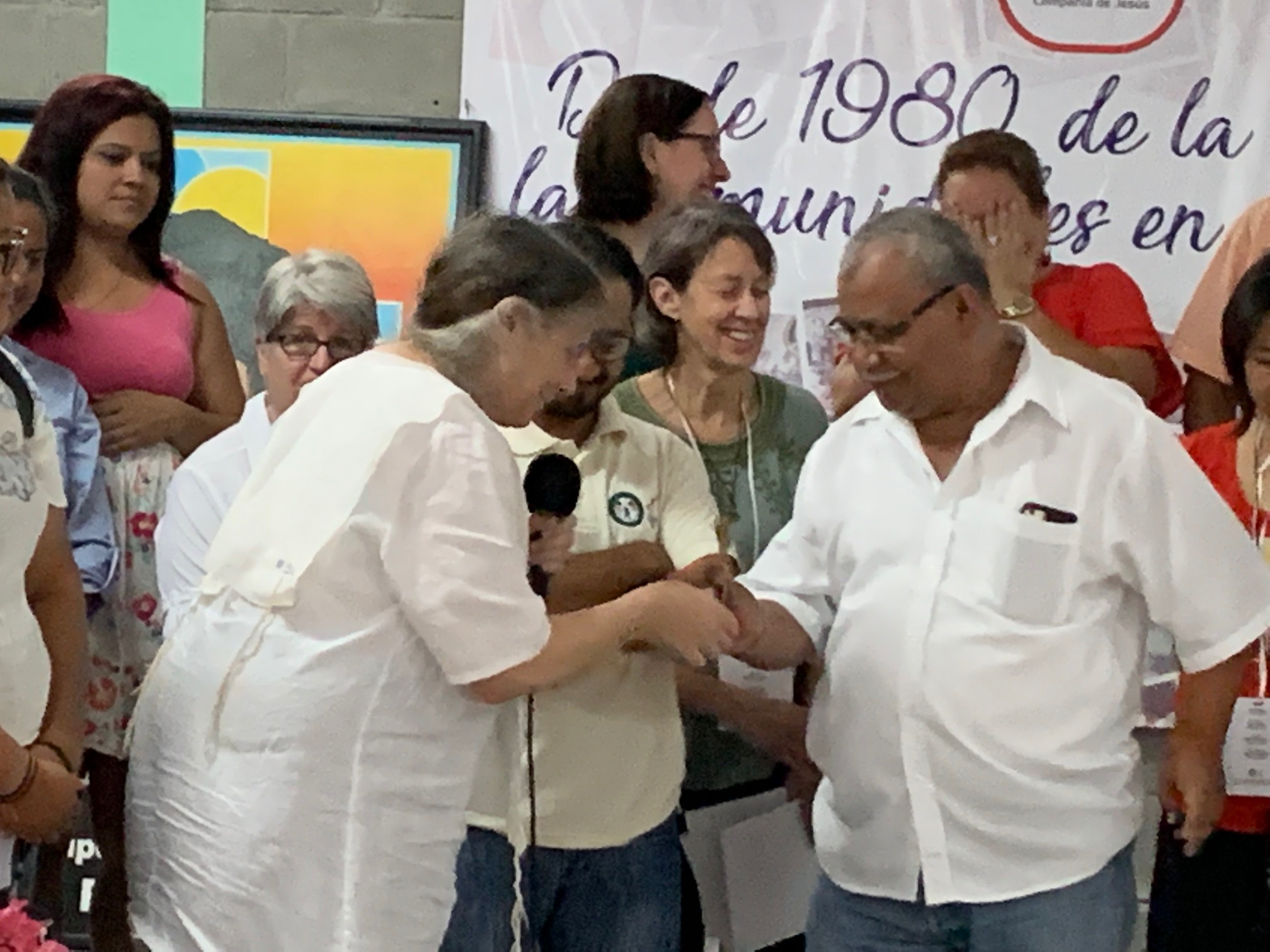
During a presentation by Father Melo and the staff, we participated in a moving IMG_0315ceremony which included an offering of gifts from our delegation. Among others, my friend and colleague Rabbi Lynn Gottlieb brought Father Melo a braid of sweet grass (at right) from the Lakota tribe at Standing Rock as a symbol of friendship and shared resistance.
After visiting the station, our delegation broke up into three groups and boarded buses for trips to different regions throughout the county. My group embarked on a 6 hour ride to Bajo Aguán. We made many stops along the way, however, including \a lovely seaside stop at La Ceiba beach on the northern coast.

We arrived in time for dinner and a briefing on the political situation in Bajo Aguán. It was an unforgettable visit – I’ll go into detail in my next post.

More soon.

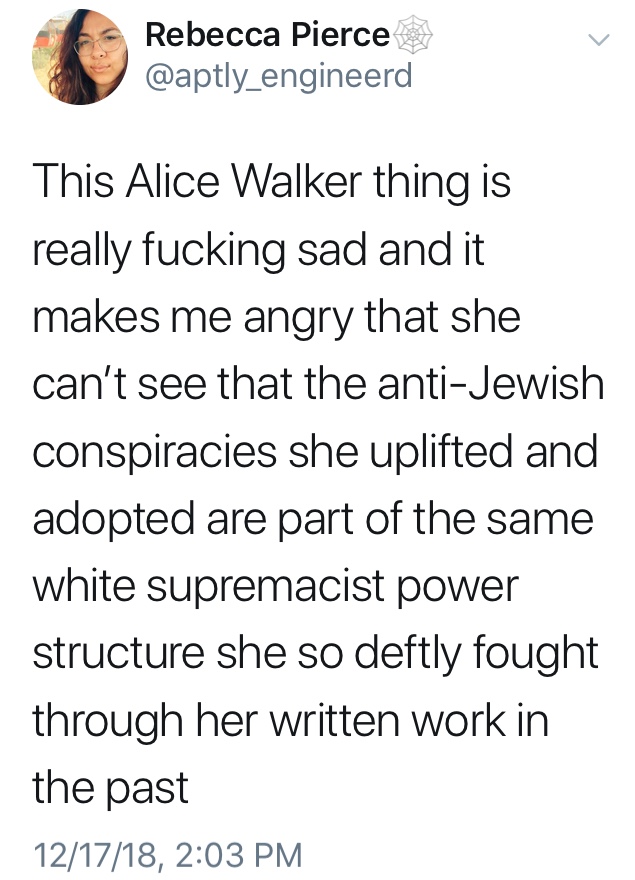
On Alice Walker and Antisemitism

American Masters - Alice Walker: Beauty in Truth

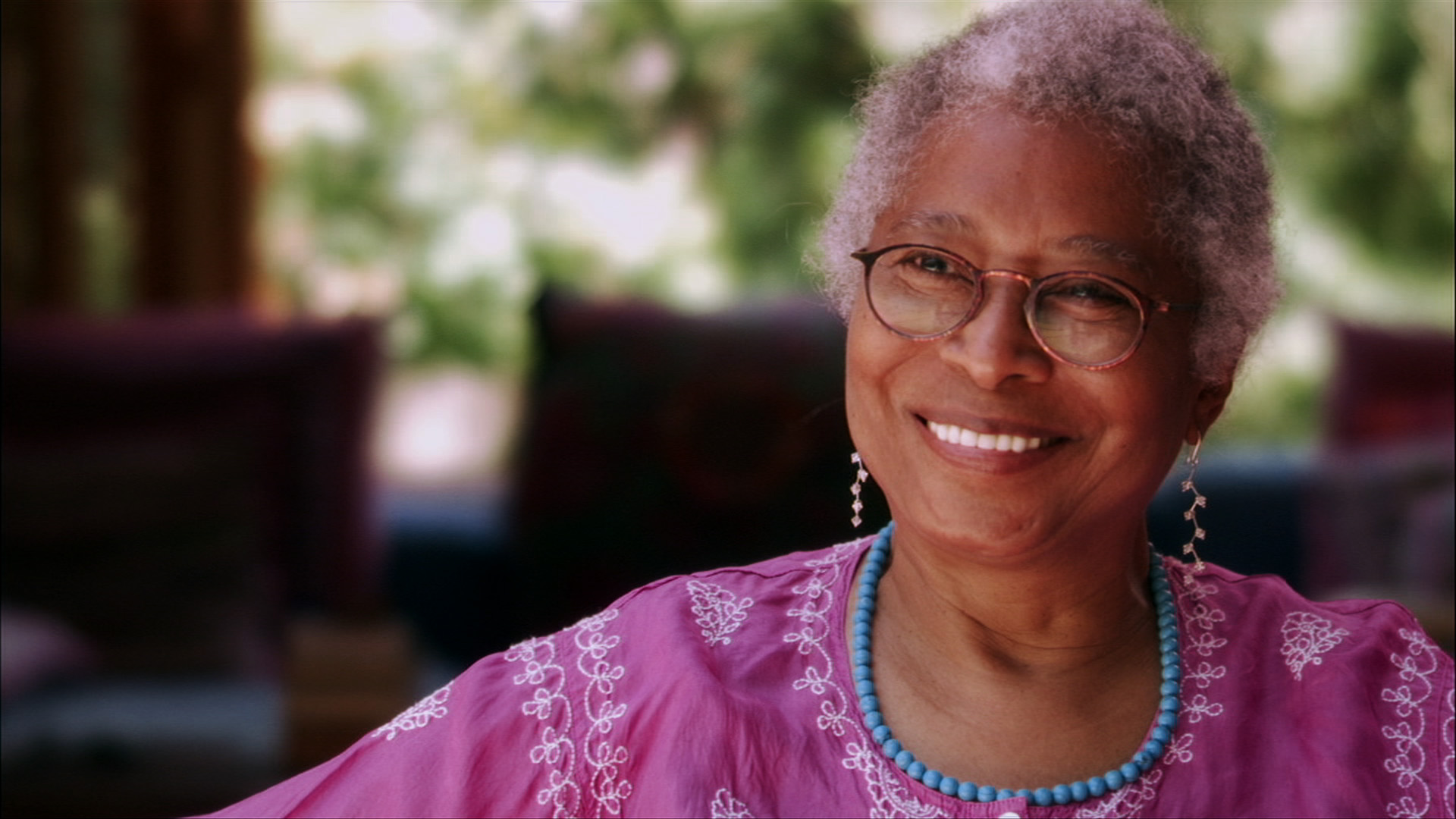
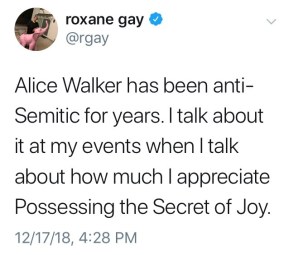
The Jewish interwebs have been abuzz regarding Yair Rosenberg’s December 17 Tablet article in which he criticized the New York Times Book Review for its interview with Alice Walker. In last Sunday’s “By the Book” column, the Times asked Walker what books she had on her nightstand; among those she cited was a book by British antisemitic conspiracy theorist David Icke entitled, “And the Truth Shall Set You Free.” Walker commented, “In (his) books there is the whole of existence, on this planet and several others, to think about. A curious person’s dream come true.”

In his article, Rosenberg listed a litany of odious excerpts from Icke’s book, including his praise of “The Protocols of the Elders of Zion,” his claims that the B’nai B’rith was behind the slave trade and his belief that the Rothschilds bankrolled Adolf Hitler. He also offered a long list of the numerous times Walker has endorsed Ickes’ ideas, including her posting of his video interview (now blocked by YouTube) with Infowars’ Alex Jones, of which she wrote:

I like these two because they’re real, and sometimes Alex Jones is a bit crazy; many Aquarians are. Icke only appears crazy to people who don’t appreciate the stubbornness required when one is called to a duty it is impossible to evade.

Rosenberg also posted in full, a deeply disturbing poem written by Walker in 2017 entitled “It is Our (Frightful) Duty to Study the Talmud.” This excerpt should give you a good idea about the tone and substance of Walker’s piece:

For a more in depth study
I recommend starting with YouTube. Simply follow the trail of “The
Talmud” as its poison belatedly winds its way
Into our collective consciousness.

I will sadly confess that I was unaware of Alice Walker’s history of antisemitic attitudes, even though this was apparently common knowledge among many on the left. During the Twitter eruption that followed Rosenberg’s piece for instance, Roxane Gay commented:

IMG_5155

Those of us who were hearing of Walker’s antisemitic proclivities for the first time were particularly saddened to learn that this eloquent champion of anti-racism had been expressing such poisonous ideas toward Jews and Judaism. Journalist/filmmaker Rebecca Pierce spoke for many of us when she tweeted this response:

IMG_5152

In his article, Rosenberg made mention of Walker’s anti-Israel politics, challenging “the progressive left” to call out antisemitism that is “presented in the righteous guise of ‘anti-Zionism.’” Although I don’t share Rosenberg’s conservative Israel politics, I accept his challenge. And yes, it’s painfully true that Walker’s Talmud poem egregiously cites Jewish religious tradition as the root cause of Israel’s oppression of Palestinians (as well as American police brutality, mass incarceration and “war in general”):

For the study of Israel, of Gaza, of Palestine,
Of the bombed out cities of the Middle East,
Of the creeping Palestination
Of our police, streets, and prisons
In America,
Of war in general,
It is our duty, I believe, to study The Talmud.
It is within this book that,
I believe, we will find answers
To some of the questions
That most perplex us.

Walker’s claim that the Talmud is “evil” and “poisonous” – a common antisemitic trope – is worth unpacking here. First of all, what is referred to as “The Talmud” is actually a vast corpus of Jewish civil and ritual law mixed with freewheeling legend and Biblical commentary composed between 200 and 500 CE. Though it is one of Jewish tradition’s foundational texts, Talmudic literature is not, to put it mildly, immediately accessible to the untrained reader. It’s typically studied by traditional Jews in the rarified world of schools known as yeshivot, where students’ primary focus is on the unique pedagogy of Talmudic argumentation.

Like all forms of religious literature, Talmudic tradition expresses a wide spectrum of ideas and attitudes. The contemporary reader would likely find its content to be alternately inscrutable, inspiring, challenging, archaic – and yes, at times even repugnant. It contains passages for example, that are profoundly misogynistic. And as Walker pointed out in her poem, it also contains occasional material that is decidedly anti-Gentile, including a notorious passage that depicts Jesus condemned to suffer in hell in a vat of burning excrement. (Yep, it’s true.) There are also texts that unabashedly claim Jewish lives must take precedence over non-Jewish lives – an idea that was also advocated centuries later by Moses Maimonides.

These texts are undeniably, inexcusably offensive and they must be called out, full stop. At the same time however, it is exceedingly disingenuous to judge a religion on the basis of its most problematic pronouncements. This attitude simplistically accepts these texts at face value, devoid of any context or historical background. It also ignores the fact that almost all faith traditions address the offensive, archaic or inconsistent elements in their sacred literature through the use of hermeneutics – that is, principles and methods that help readers understand their meaning in ever-changing societal contexts.

How for instance, might a contemporary religious feminist read and understand a blatantly misogynist Talmudic text? In an article entitled “When Sages are Wrong: Misogyny in Talmud,” Dr, Ruhama Weiss, of Hebrew Union College offers one hermeneutical approach:

(These Talmudic traditions) caused me a powerful disturbance. They forced me to think and react; to think about mechanisms of power and control and about the ability to be free from them. To make an effort to find and highlight additional voices, earlier voices, buried and hidden in misogynist rabbinic discussions.

Most importantly, these difficult sources teach me a lesson in modesty; from them I learn that unequally talented and wise people with good intentions can bequeath to subsequent generations difficult and bad traditions. I see the moral blind spots of my ancestors, and I am obligated to examine my own moral blind spots. Bad and disturbing sources make me think.

Indeed, this same hermeneutic method can be applied to Talmud’s xenophobic, anti-Gentile content as well. That is to say, these texts can challenge us to see “the moral blind spots of our ancestors and thus to examine our own moral blind spots.” They can help us confront “mechanisms of power and control” and contemplate the ways we might be able to “free ourselves of them.” These bad and disturbing sources can “make us think.”

Of course there are those who will read the texts of their faith through a more literal, fundamentalist hermeneutic. In such cases, it is up to those who cherish their religious tradition and the value of human rights for all to challenge such interpretations, particularly when the lines between church and state power become increasingly blurred.

On the subject of state power, I must add that I find it exceedingly problematic when folks criticize Talmudic tradition for its xenophobic attitudes without acknowledging the fundamentally anti-Jewish attitudes that are embedded deep within Christian religious tradition. It’s also important to note that antisemitic church teachings were historically used to inspire centuries of anti-Jewish persecution throughout Christian Europe, while the Talmud was written and compiled in a context of Jewish political powerlessness.

Today, in this relatively new era of Jewish power, it is certainly important to remain vigilant over the ways Jewish tradition is used to justify the oppression of Palestinians. Indeed, since the establishment of the State of Israel, this subject has been intensely debated throughout Israel and the Jewish Diaspora. As I write these words in fact, I’m recalling a blog post I wrote back in 2009 about then Chief Rabbi of the Israeli Defense Forces Avichai Rontzki, who made a comment, based on Jewish religious texts, that soldiers who “show mercy” toward the enemy in wartime will be “damned”:

How will we, as Jews, respond to the potential growth of Jewish Holy War ideology within the ranks of the Israeli military?  How do we  feel about Israeli military generals holding forth on the religious laws of warfare? Most Americans would likely agree that in general, mixing religion and war is a profoundly perilous endeavor.  Should we really be so surprised that things are now coming to this?

I do not ask these questions out of a desire to be inflammatory. I ask them only because I believe we need to discuss them honestly and openly – and because these kinds of painful questions have for too long been dismissed and marginalized by the “mainstream” Jewish establishment.

In the end, every faith tradition has its good, bad and ugly. And in the end, I would submit that the proper way to confront these toxic texts is for people of faith to own the all of their religious heritage – and to grapple with it seriously, honestly and openly. And while we’re at it, it’s generally a good rule of thumb to avoid using the bad, ugly stuff in any religion’s textual tradition to make sweeping historical or political claims about that religion and/or the folks who adhere to it.

What is not at all helpful is for people such as Alice Walker to cherry-pick and decontextualize quotes from one particular religious tradition and warn that its “poison” is “winding its way into our collective consciousness.”

Like many of my friends who are just now learning about her adherence to antisemitic tropes, I fervently hope she will come to understand, as Rebecca Pierce put it, that the attitudes she endorses “are part of the same white supremacist power structure she so deftly fought through her written work in the past.”