Category Archives: Interfaith

American Civil Rights Leaders: End the Violence and Secure a Just Peace

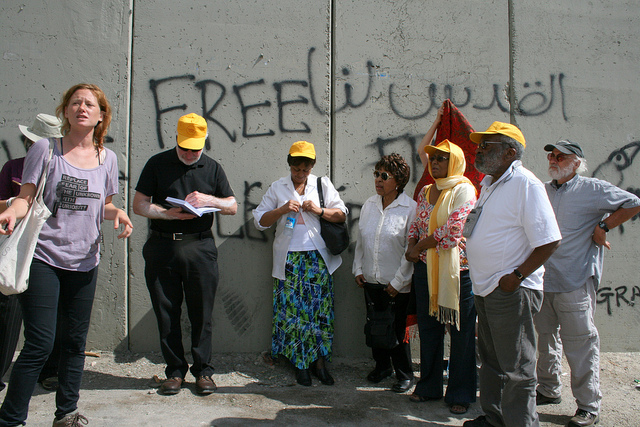
Delegates on a tour led by Ruth Edmonds of the Israeli Coalition Against Home Demolitions (photo: Allie Perry)

Received from my friend and colleague Rabbi Brian Walt:

“Our lives begin to end the day we become silent about the things that matter.”

Dr. Martin Luther King, Jr.

An immediate end to Israel’s assault on Gaza, “Operation Pillar of Defense,”matters. An immediate end to the violence—the onslaught of missiles, rockets, drones, killing, and targeted assassination—matters. An end to Israel’s ongoing blockade of Gaza matters.  An end to Israeli’s 45-year occupation of Palestine matters. A resolution of the issue of Palestinian refugees expelled from their homes in 1948, many of whom live in Gaza matters.  Equality, security, and human rights for everyone matters.

We write as individuals who recently traveled to the West Bank with the Dorothy Cotton Institute’s 2012 Civil and Human Rights Delegation, organized by Interfaith Peace-Builders.  We cannot and will not be silent.  We join our voices with people around the world who are calling for an immediate cease-fire. Specifically, we implore President Barack Obama to demand that Israel withdraw its forces from Gaza’s borders; make U.S. aid to Israel conditional upon Israel’s adherence with relevant U.S. and international law; work with Israeli and Palestinian leaders to bring an end to Israel’s occupation of the Palestinian territories and to secure a just peace that ensures everyone’s human rights.

In the words of Dr. Martin Luther King, Jr., “Returning violence for violence multiplies violence, adding deeper darkness to a night already devoid of stars.”  As Prime Minister Yitzhak Rabin declared in 1993, “Enough of blood and tears.”  Enough!

We deplore the firing of rockets on civilian areas in Israel.  We also deplore and are outraged by the asymmetry, the disproportionality, of Israel’s bombardment of Gaza, evidenced by the growing number of Palestinian civilian deaths and casualties.  This is not a conflict between equal powers, but between a prosperous occupying nation on one hand, armed and sanctioned by 3 billion dollars in annual U.S. military aid, and on the other, a population of 1.7 million besieged people, trapped within a strip of land only 6 miles by 26 miles, (147 square miles) in what amounts to an open-air prison.

United States military support to Israel is huge.  From 2000 to 2009, the US appropriated to Israel $24 billion in military aid, delivering more than 670 million weapons and related military equipment with this money.  During these same years, through its illegal military occupation of the Palestinian West Bank, East Jerusalem and Gaza Strip, Israel killed at least 2,969 Palestinians who took no part in hostilities.

During our trip to the West Bank, we witnessed for ourselves the injustice and violence of the Israeli occupation and the suffering inflicted on the Palestinians, in violation of international law and UN resolutions.

In the Palestinian village of Nabi Saleh, for just one example, we observed a weekly nonviolent protest.   The neighboring Israeli settlement of Halamish was illegally built on Nabi Saleh’s land.  This settlement has also seized control of the Nabi Saleh’s water spring, allowing villagers to access their own spring water for only 7-10 hours a week.  Demonstrators of all ages participated in the protest, including several who, in recognition of the civil rights veterans in our delegation, carried posters with quotations from Dr. Martin Luther King, Jr.  We watched in horror as heavily armed members of the Israel Defense Forces (IDF) responded to this peaceful assembly with violence, strafing the demonstrators with a barrage of tear gas canisters, rubber bullets, gas grenades, and even a round of live ammunition.

The IDF assault in response to these weekly nonviolent demonstrations can be deadly.  Rushdi Tamimi, a young adult Nabi Saleh villager, died this past week while he was protesting Israel’s attack on Gaza.  The IDF fired rubber bullets into Rushdi’s back and bullets into his gut, and slammed his head with a rifle butt.

Israel’s assault on Gaza is exponentially more violent than what we witnessed in the West Bank, but the context–the oppression of the Palestinian people—is the same.  Most of the inhabitants of Gaza are refugees or descendants of refugees expelled from their homes in Israel in 1948.   This dispossession of the Palestinians that they call the Nakba (The Catastrophe) continues on the West Bank where Israel has built extensive Jewish settlements on confiscated Palestinian land. We saw with our own eyes how this settlement expansion and the systemic discrimination has further dispossessed the Palestinian people and is creating a “silent transfer” of Palestinians who are either forced or decide to leave because of the oppression.   This injustice—Israel’s decades-long oppression of the Palestinian people—has to be addressed by honest and good-faith negotiations and a genuine agreement to share the land.  The alternative is a future of endless eruptions of aggression, senseless bloodshed, and more trauma for Palestinians and Israelis. This surely matters to all people of good will.

To President Obama, we say, use the immense power and authority United States citizens have once again entrusted to you, to exercise your courage and moral leadership to preserve lives and protect the dignity and self-determination, to which the Palestinian people and all people are entitled.   Israel relies upon the economic, military, and strategic cooperation and support of the United States.  You have the power to not only appeal to Israel to show restraint, but to require it.

Feeling ourselves deeply a part of “We the People,” sharing so much of your own tradition of organizing for justice and peace, we believe it is just, moral and in keeping with the best spirit of Dr. King to urge you to:

§  Call for an end to violence by all parties and an immediate cease-fire for the sake of all people in the region.

§  Use your power to demand that Israeli Prime Minister Benjamin Netanyahu and the IDF cease the bombardment of Gaza and withdraw their armed forces immediately.

§  Join with the international community in using all diplomatic, economic, and strategic means to end Israel’s illegal, brutal siege of Gaza.

§  Insist that the United States condition aid to Israel on compliance with U.S. law (specifically the U.S. Arms Export Control Act) and with international law.

§  Work with the leaders of Israel and Palestine to secure an end to Israel’s occupation and to negotiate a just peace.

As citizens of the United States, we are responsible for what our government does in our name, and so we will not be silent.  Justice, peace and truth matter.  The future of the children of Israel and Palestine matter.  We cannot be silent and neither can you.

Members of the The Dorothy Cotton Institute 2012 Civil and Human Rights Delegation:

(List in formation)
Continue reading

Chicago Clergy to Dick Durbin: Don’t Deal Away Our Most Vulnerable!

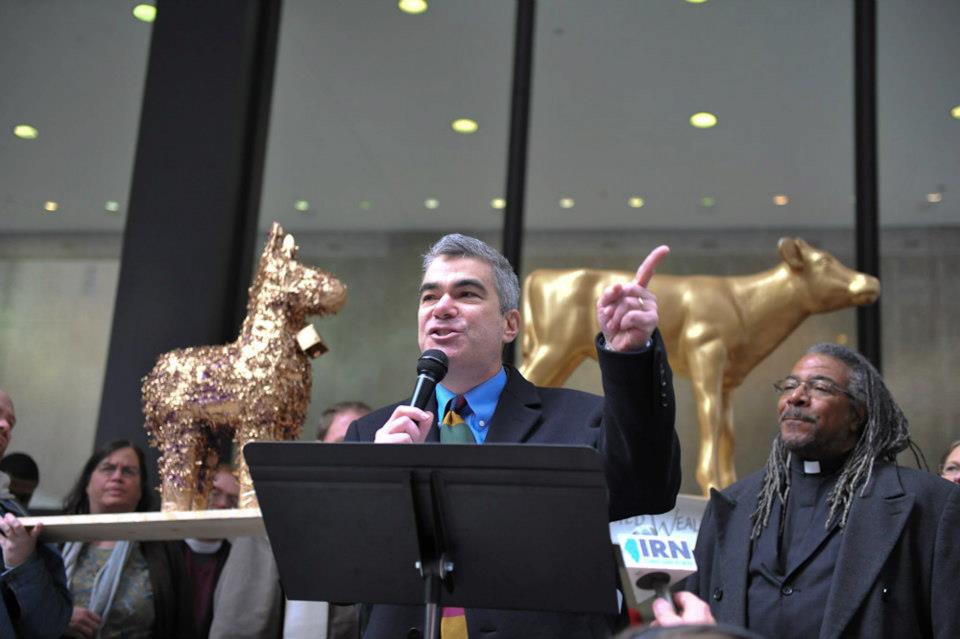
Had the honor this morning to participate in an interfaith ceremony at Chicago’s Daley Plaza that called on Illinois Senator Dick Durbin to resist devastating cuts to Federal programs in the upcoming “fiscal cliff” budget talks.  It was quite a dramatic and inspiring gathering, organized by IIRON, Make Wall Street Street Pay – Illinois and other local organizing initiatives. Over 40 members of the Chicago clergy community marched to Daley Plaza, where we encountered two Golden Calves symbolizing the idolatrous motivations behind Wall St. greed and wealth disparity. After hearing from several speakers, one of the calves (a piñata, as it turned out) was smashed open, gold coins scattering in every direction.

We didn’t focus on Dick Durbin simply because he happens to our senator.  As the Majority Whip for the Democratic Party, Durbin is one of the most important players in Washington, officially charged with leading the Democrats who control the Senate. And thus far, there is ample reason for concern that his leadership bodes ill for the more vulnerable members of our society.

Since Congress has kicked the budgetary can down the road, critical social programs in this country stand to lose $600 billion dollars on January 1 unless they choose to act. Durbin has already indicated that he favors a “grand bargain” with Republicans that may entail cuts to Social Security, Medicare and/or Medicaid. Just as ominously, Durbin has still not signed an open letter written by Congressmen Harry Reid and Bernie Sanders (and signed by 29 senators) calling on the members of Congress not to cut Social Security.

For our part, the interfaith community of Chicago has written a letter – to Senator Durbin:

Dear Senator Durbin:

Our message to you comes from Deuteronomy 30:15-19 & Joshua 24:15 as we ask you “to choose this day whom you will serve…!” We urge you to choose life and to reject “Simpson-Bowles” or any other “grand bargain” that cuts vital services to vulnerable Americans. We urge you to make absolutely to make absolutely no cuts to Social Security, Medicare or Medicaid.

Working Americans did not create this economic crisis or this false and manufactured “fiscal crisis”. Wall Street’s speculative bubble, made possible by Congressional deregulation crashed the global economy. As a result, the American people have suffered unemployment, underemployment, foreclosure, homelessness, and have lost their savings, retirements and wealth. Congress used working people’s taxes to bail out Wall Street banks instead of assisting underwater homeowners, creating jobs or rescuing state and local governments. The people have suffered enough. Doing further harm to working people is morally unconscionable.

It is immoral to make any further cuts to vital federal programs and services when wealthy individuals and big corporations are not paying their fair share to care for the broader community of whom they are part and on whom they rely. In this time of unparalleled income inequality and concentrated wealth, we will not accept any solution to the federal budget deficit other than raising revenue from those who have not done their share and can easily afford to do much more.

The kinds of cuts being discussed under Simpson-Bowles and other “deals” will literally result in sickness and death for many and will fall upon the poor and vulnerable in order to provide for the excess for the wealthy.  Senator Durbin, you now face a choice between serving the false gods of greed and excessive wealth or implementing policies that promote life and shared prosperity. It is important that as a key leader in the Senate you stand firmly on the side of those who stand to lose so much.  Therefore we bring to you four demands:

– Block any reductions in benefits for Social Security, Medicare, or Medicaid

– Block any extension of the Bush Tax Cuts for people with taxable income above $250,000 per year

– Block the “sequestration” cuts to domestic programs set to occur in January 2013

– Support progressive sources of taxes including a robust estate tax, taxing capital gains at a rate equal or higher to wages and pass a strong Financial Transaction Tax (aka the Robin Hood Tax)


To Chicago residents: A myriad of local organizing initiatives is holding a rally on Friday, November 9 in Pritzker Park (State and Van Buren) at 3:00 pm. Together we will tell our elected officials: “We Won’t Pay for Your Crisis!” and demand that the wealthy and big corporations must “Pay Their Fair Share”.

Rabbi Brian Walt: Christian Leaders Cannot be Cowed into Silence

Please read my friend Rabbi Brian Walt’s new piece in Ha’aretz. He has recently returned from a remarkable interfaith delegation to the West Bank; I will be posting more of his writings about his experiences in the near future.

In his recent Haaretz op-ed, “Heading toward an irreparable rift between U.S. Jews and Protestants,” my colleague, Rabbi Eric Yoffie, sharply criticized the recent letter to Congress by leaders of Protestant churches that called for U.S. military aid to Israel to be contingent on Israeli compliance with American law. Nowhere in his article, however, did Yoffie mention the central concern of the Christian leaders’ letter: the overwhelming evidence of systematic human rights violations by the Israeli military against Palestinians.

Over the past two weeks, I had the privilege of leading an interfaith delegation including several leaders of the civil rights movement, younger civil and human rights leaders, Christian clergy, academics, and several Jews, on a two-week trip to the West Bank.

We were all shocked by the widespread human rights violations that we saw with our own eyes and that we heard about from both Palestinians and Israelis. Several black members of our group, including those who participated actively in the civil rights movement, remarked that what they saw on the West Bank was “frighteningly familiar” to their own experience, a systemic pattern of discrimination that privileged one group (in this case, Jews) and denigrated another (Palestinians).

Continue reading

American Christians Dare to Speak Their Conscience on Israel/Palestine

My recent op-ed for the Jewish Telegraphic Agency:

CHICAGO (JTA) — There has long been an unwritten covenant between the Jewish establishment and Christian leaders when it comes to interfaith dialogue: “We can talk about any religious issues we like, but criticism of Israel’s human rights violations is off limits.”

Over the past few weeks, we’ve painfully witnessed what can happen when Christians break this covenant by speaking their religious conscience.

Continue reading

More Fallout from the Protestant Leaders’ Letter on Aid to Israel

Two spot on responses to the recent NY Times article, “Church Appeal on Israel Angers Jewish Groups:”

The first comes from the Daily Beast’s Andrew Sullivan:

It seems to me that aid of all kinds should have basic human rights strings attached to it. I would have suspended all aid to Israel when it refused to stop its settlement policy on the West Bank, but that’s a little like being in favor of an immediate space station on Mars, given the Greater Israel lobby’s grip on Congress.

So let me just reiterate something that has no chance of ever happening, but I might as well put on the record: we should treat Israel as any other recipient of US aid. If a country is occupying and settling land conquered through war, if it’s treating a minority population with inhumanity, the US should stand up for Western values. It should not single Israel out; but we have to stop treating Israel as the exception to every other US foreign policy rule.

Rev. Jim C. Wall (Contributing Editor of the “Christian Century”) in an unflinchingly honest blog post:

To begin with, the 15 church leaders are heavyweights, top officials for their denominations. They include the leaders of the Presbyterian Church (U.S.A.), Evangelical Lutheran Church in America, the United Methodist Church, the National Council of Churches, the United Church of Christ, the Christian Church (Disciples of Christ), the American Friends Service Committee (a Quaker agency) and the Mennonite Central Committee. Two Catholic leaders also signed, not including the Catholic Council of Bishops.

These are not just leaders of a few religious groups, which a Protestant version of the Jewish Council of Public Affairs could corral into an interfaith dialogue meeting. These are the major-domos of American Protestantism, which raises the question of what exactly gives the JCPA and its scattered letter signers, these “outraged Jewish groups” as the Times calls them,  the right to claim religious standing in this conversation. Many of these Jewish groups are secular and function as part of the Israel Lobby, a collection of lobbying organizations that have Israel, not Judaism as their primary client…

The JCPA and its letter signers have no dogs in this hunt. They can be as outraged as they want.  This is still a free country. But the 15 church leaders have made the right religious, not political, move. They are speaking the language of “moral responsibility” in a letter directed to the U.S. Congress on the matter of U.S. funds used by Israel to violate the human rights of the Palestinian people.

Interfaith dialogue has always been nothing more than a device used by American Jewish groups to intimidate the American churches into keeping the ecumenical deal. By this intimidation, these groups have followed the example set by the government of Israel which has long used the so-called “peace process” to sustain its occupation and expand its borders, always to the detriment of the Palestinian people.

It is the right time for the leaders of the American churches to make their moral demand to the Congress. With their letter, they have done so, courageously, considering the political climate of our time. Interfaith dialogue can wait.

As things stand now, the Jewish groups have called for a “summit” for the top leaders of Christian churches to “discuss” the situation with them – and they are reportedly considering it. I hope the Christian leaders will stand firm.  It is not the role of these Jewish organizations to dictate how Christian religious leaders can live out their conscience or their values. These Jewish leaders have chosen to walk away from the table – they are in no position to demand the terms by which “dialogue” may resume.

We can only hope this sad turn of events will lead to a more honest interfaith conversation about Israel-Palestine – one based on honesty, respect and justice rather than emotional blackmail.

Rabbinical Support for the End of Unconditional Military Aid to Israel

Cross-posted with The Palestinian Talmud:

The undersigned members of the Jewish Voice for Peace Rabbinical Council stand with our American Christian colleagues in their recent call to “make U.S. military aid to Israel contingent upon its government’s compliance with applicable US laws and policies.”

We are as troubled as our Christian colleagues by the human rights violations Israel commits against Palestinian civilians, many of which involve the misuse of US – supplied weapons. It is altogether appropriate – and in fact essential – for Congress to ensure that Israel is not in violation of any US laws or policies that regulate the use of US supplied weapons.

The US Foreign Assistance Act and the US Arms Export Control Act specifically prohibit assistance to any country which engages in a consistent pattern of human rights violations and limit the use of US weapons to “internal security” or “legitimate self-defense.”  The Christian leaders’ letter points out, in fact, that the most recent 2011 State Department Country Report on Human Rights Practices covering Israel and the Occupied Territories detailed widespread Israeli human rights violations committed against Palestinian civilians, many of which involve the misuse of US – supplied weapons such as tear gas.

It is certainly not unreasonable to insist that foreign assistance be contingent on compliance with US laws and policies. Mideast analyst MJ Rosenberg has rightly pointed out that during this current economic downturn, Congress has been scrutinizing all domestic assistance programs -– including Social Security and food stamps –- to ensure that they are being carried out legally in compliance with stated US policy.  Why should US military aid to Israel be exempt from the same kind of scrutiny?

While some might feel that requiring assistance to be contingent with compliance would compromise Israel’s security, we believe the exactly the opposite is true. As Israel’s primary ally, the US alone is in a place to create the kind of leverage that might challenge Israel to turn away from policies that impede the cause of a just peace for Israelis and Palestinians –- and true security for all who live in the region.

As Jews we acknowledge that the signers of the letter, and the churches they represent, have ancient and continuing ties to the land of Israel just as we do, and that their concerns for the safety and dignity of Christians in Israel and in the occupied Palestinian territories is as compelling as our concern for the safety and dignity of Jews there.

We are troubled that several Jewish organizations have cynically attacked this faithful and sensitive call – and we are deeply dismayed that the Anti-Defamation League has gone so far as to pull out of a scheduled Jewish-Christian dialogue in protest.  We believe that actions such as these run directly counter to the spirit and mission of interfaith dialogue. True dialogue occurs not simply on the areas where both parties find agreement, but in precisely those places where there is disagreement and divergence of opinion. We call on all of our Jewish colleagues to remain at the table and engage our Christian colleagues on this painful issue that is of such deep concern to both our communities.

We express our full support for the spirit and content of this statement and likewise call upon US citizens to urge their representatives to end unconditional military aid to Israel.

Signed (list in formation):

Rabbi Brant Rosen
Rabbi Margaret Holub
Rabbi Alissa Wise
Rabbi Elizabeth Bolton
Rabbi Lynn Gottleib
Rabbi Brian Walt
Rabbi Julie Greenberg
Rabbi David Mivasair
Rabbi Joseph Berman
Cantor Michael Davis
Rabbi Shai Gluskin
Rabbi Tirzah Firestone
Jessica Rosenberg, Rabbinical Student
Ari Lev Fornari, Rabbinical Student

Rabbi Rebecca Lillian on the Malmö JCC Attack

Photo: AFP (via Tablet)

Please read this blog post by my dear friend Rabbi Rebecca Lillian, who currently lives in Malmö, Sweden. You may know that Malmö has experienced its share of anti-Semitism of late and that some members of the Jewish community have left the city as a result.

Sadly, the Malmö Jewish Community Center was damaged last week by an explosive device and rocks that were thrown through the Center’s windows.  Rebecca, who happens to live in the JCC, wrote powerfully about her experience of the attack – as well as the subsequent show of solidarity by Malmö’s Network for Faith and Understanding (which includes local churches and mosques.)

In her post, she also has some choice words to say about how the Jewish press and the Simon Wiesenthal Center in particular has been egregiously misrepresenting the situation in Malmö for political purposes:

The real jolt came after Shabbat, as I read the Jewish press. That ubiquitous hyperbolic headline about the blast “rocking” our building irritated me, but the articles were essentially accurate. I was disappointed that nobody had followed up with a story about the multi-faceted vigil. Readers all over the world who have been following the story of anti-Semitic hate crimes in Malmö should also learn about our concerned neighbors who literally rushed to our side. What made me explode, though, was that the Jewish Journal of LA had the chutspa to publish a Reuters photo of the vigil next to an indefensible rant by the Simon Wiesenthal Center’s Rabbi Abraham Cooper.

Rabbi Cooper has already declared Malmö an unsafe travel destination for Jews. Now he suggests that those of us who live here might soon need to flee for Israel or elsewhere. “Ayn Soamchin Al Haness” — we cannot rely on miracles to secure the safety of Jewish children. “Clearly time is running out for Malmö,” he writes, along with other overstated claims.

Rabbi Cooper must know that it is dry season in the Jewish blogosphere. Pamela Geller, she of the Isalmophobic ads on New York City buses, borrowed from Cooper’s screed to come to the offensive conclusion that “Malmo has become as bad for Jews as Berlin at the height of the WWII. With its very large Muslim population, Islamic attacks against the Jews are part of the social fabric in Malmo. It’s pure hell.”  Such mendacity desecrates the memory of those Jews who died in Berlin and dishonors those who survived. She cynically uses their name to buttress her anti-Muslim fabrications, which have zero to do with the Jewish community of Malmö.

Time has not run out for us. On the contrary, while the bursts of hate are anonymous and cowardly, the eloquent expressions of support are said aloud by well-known community leaders and residents from all over the region. It is time for Cooper and Geller and the countless Jewish bloggers who quote them to stop crying wolf.

Standing Down Rep. Joe Walsh’s Islamophobic Bigotry

Shortly after a gunman killed six worshipers in a Wisconsin Sikh temple and a Joplin Missouri mosque was burned to the ground, Illinois Congressman Joe Walsh felt perfectly comfortable uttering incendiary anti-Muslim comments at a town hall meeting last Wednesday, warning that “there is a radical strain of Islam in this country…trying to kill Americans every week.”  Offering no evidence or backup for his allegations, he continued: “It’s here. It’s in Elk Grove, it’s in Addison, it’s in Elgin. It’s here.”

Then he poured it on:

I’m looking for some godly men and women in the Senate, in the Congress, who will stand in the face of the danger of Islam in America without political correctness.  Islam is not the peaceful, loving religion we hear about.

Shortly after Walsh’s town meeting remarks, pellet rifle shots were fired at a mosque in Morton Grove, IL.

I don’t know about a domestic “radical Islamic plot” but by now it should be abundantly clear that there is a deadly strain of Islamophobia in our country. In such a climate, I’d say it is the height of irresponsibility for public servants to issue remarks such as these.

It was my honor to stand, together with interfaith colleagues, with my good friends at CAIR – Chicago to express our outrage at Walsh’s sick bigotry (clip above). If you stand with us, please, please let Rep. Walsh know how you feel.

Why I Support Kairos USA

Last week a group of US clergy, theologians and laypersons unveiled Karios USA, a powerful and important American Christian spiritual call for justice in Israel and Palestine.  As a religious Jew, I am inspired by its prophetic courage, its unabashed call for justice and its heartfelt model of compassion. It truly deserves to be shared and studied by all who who seek a genuinely religious call for justice in this land that is so central to so many peoples and spiritual traditions.

Kairos USA is modeled on the religious testimony of Kairos Palestine, a document that was drafted by prominent Palestinian Christian leaders in 2009 (which was itself inspired by the 1985 South African Kairos statement).  Despite these important influences, however, Kairos USA stands on its own as a uniquely American Christian call for justice in Israel/Palestine.

Indeed, this unique mission is evoked in the statement’s Preamble at the very outset:

In June 2011, a group of U.S. clergy, theologians and laypersons, cognizant of our responsibility as Americans in the tragedy unfolding in Israel and Palestine, and mindful of the urgency of the situation, met to inaugurate a new movement for American Christians. We have been inspired by the prophetic church movements of southern Africa, Central and South America, Asia and Europe that have responded to the call of their Christian sisters and brothers in occupied Palestine. This is our statement of witness and confession—and our response as U.S. Christians to the Palestinian call.

And more specifically, from the Introduction:

As U.S. Christians we bear responsibility for failing to say “Enough!” when our nation’s ally, the State of Israel, violates international law. Our government has financed Israel’s unjust policies and has shielded its government from criticism by the international community. At the outset of the current U.S. administration, our government led Palestinians to believe that at last we would pursue a political solution based on justice. But the “peace process” has continued to be no more than a means for the continuing colonization of the West Bank and East Jerusalem, the imprisonment of Gaza and the intensification of the structures of oppression.

I have no doubt at all that like Kairos Palestine, Kairos USA will be excoriated by many self-appointed leaders of the American Jewish establishment.  As for myself, now that I’ve read the document carefully, I can say without hesitation that I believe this statement is a truly sacred testimony, offered in good faith and with genuine religious integrity.

I was particularly moved to read how sensitively Kairos USA treads over some of the most complex hot-button issues in the Jewish-Christian relationship. For instance, on the issue of historical church anti-Semitism, the statement includes the following confession:

As Christians addressing the Palestinian cause we must also acknowledge our shameful role in the historic persecution of the Jewish people. We recognize the dehumanizing and destructive power of doctrines and theologies that denigrated Judaism. Our predecessors perpetuated anti-Semitic stereotypes, practiced scapegoating and cloaked prejudice, hostility and murder itself in the robes of our religion. We confess that our churches failed to resist, and sometimes even aided and abetted pogroms, mass dislocations of Jews, and the calamity of the Nazi Holocaust itself. In so doing, they betrayed the teaching and example of the one we claim to follow. We speak for and with our forbears in expressing deep remorse. With a commitment to never forget those failures and to be instructed by them, we pledge ourselves to growth in faithfulness, compassion and justice.

The statement goes on, however, to state that Christians’ honest desire to repent for the church’s historic crimes against Jews must not inhibit them from speaking out against injustices perpetrated by Israel against Palestinians. To my mind, this is a call for real and honest interfaith relations – dialogue that is not defined by guilt or emotional blackmail, but rather by a willingness to venture into and openly discuss the more difficult and painful places:

We acknowledge with sadness and distress that because of the powerful impulse on the part of Christians to atone for their sins against the Jewish people, vigilance against anti-Semitism today has come to trump working for justice in Palestine and Israel. The Christian need to rectify centuries of anti-Jewish doctrine and actions and to avoid even the perception of anti-Jewish feeling has served to silence criticism of Israel’s policies and any questioning of the consequences of U.S. government support for Israel. Differences between anti-Semitism and legitimate opposition to Israeli actions are avoided or explained away. Responsible discourse about Zionism is often denounced as hostility toward Israel and its citizens or branded as anti-Semitism. We believe that in our dialogue with our Jewish friends, family members and colleagues and in our relationships with the Jewish community on institutional levels, we must confront this pattern of avoiding, denying or suppressing discussion of issues that may cause conflict or discomfort. The fact that anti-Semitism still exists makes it all the more important to differentiate between actual anti-Jewish feelings and criticism of the actions of a nation state. Uncomfortable though it may be, we cannot be afraid to address the urgent issue of justice and human rights in Israel and Palestine with our Jewish sisters and brothers here in the United States.

I also deeply admire the statement’s willingness to directly address the charged issue of so-called Christian “replacement” or “supersessionist” theology (a view that promotes Christianity – and not Judaism – as the genuine fulfillment of Biblical tradition):

We are aware that in denying a theology of entitlement that gives the Jewish people exclusive rights to the Holy Land, we risk the charge of reviving the Christian doctrine known as replacement theology (sometimes known as supersessionism). In this view, the Church takes the place of Israel in God’s purposes, denigrating Judaism itself and condemning the Jews to suffering for rejecting the Gospel. Christians have rightly wished to distance themselves from this destructive and divisive doctrine. We repudiate the anti-Semitic legacy of the church’s past and the theology that undergirds it.

As a Jew who rejects a sense of Jewish entitlement just as strongly as I reject any religious viewpoint that makes an exclusive claim to the land, I particularly appreciate Kairos USA’s religious approach on this point:

Our core Christian belief is that God’s promise in the Gospel is a promise to all nations. This means that God’s kingdom work in Christ is a promise to everyone regardless of race. We believe that the Church has found in Christ a fulfillment of all that God promised in Abraham, and that both Jews and Gentiles have been invited equally into this promise of a world renewed in love and compassion. The Church does not replace Israel. Jews continue to have a place in God’s plan for the world. In Christ, all nations can be blessed (Genesis 18:18, 22:18; Galatians 3:8). In these times of growing international conflict and cultural mistrust, this is a significant promise. Theologies that privilege one nation with political entitlements to the exclusion of others miss a central tenet of the Gospel and inspire increased conflict.

I believe the above statement provides a crucial challenge to both American Jews and Christians.  From a theological point of view, I believe it is time to reframe the issue. The real debate is not about which religious tradition or people has a more compelling religious “right” to the land of Israel, rather, it is between those who make exclusivist theological claims and those whose theology makes room for all peoples who live on or feel a connection to this land.

I also have no doubt that many in the American Jewish establishment will reject out of hand Kairos USA’s positive advocacy of BDS (“Boycott, Divestment and Sanctions”).  But here again, I find that the statement deals with a hot-button issue with sensitivity and integrity:

Participation in the BDS movement by U.S. churches, notably in the form of initiatives to divest church funds from companies profiting from the occupation of the West Bank and the blockade of Gaza, has generated critically-important discussions at local, denominational and ecumenical levels about the responsibility of the church to act. It has also generated intense controversy. Opposition, from Jewish organizations as well as from voices within the churches, has often been fierce, claiming that such actions will inflict grievous damage on hard-won positive relationships with the Jewish community. Many express fear that these actions may encourage anti-Semitism. We note with distress that many have confused these actions with anti-Jewish discrimination and persecution in the Christian past. But BDS is directed at Israeli policy, not the state itself or its citizens, and certainly not against the Jewish people. Divestment and other forms of socially responsible investing (SRI) are not directed against groups, nor are they intended to hurt individuals, corporations or states. They are, rather, directed at unjust, oppressive policies and are about promoting our own values and stated commitments by noncooperation with evil. Furthermore, methods to exert economic pressure on governments and companies, in addition to being a legal, ethical and time-tested way of influencing the political process and corporate behavior, serve to increase awareness, promote open discussion and create the grassroots support required to urge governments to take effective action and to change unjust policies. We urge congregations, clergy and church leaders to become educated about the BDS movement and to consider the many forms that it can take on personal, local and national levels.

As I American Jew who is deeply distressed by the American Jewish establishment’s abject vilification of BDS, I don’t think I could possibly put it any better.

I urge all people – whether religious and secular, Christian, Jewish or Muslim – to read, share, discuss and respectfully debate this important new American statement of faith.  My deepest gratitude to those (including my good friends Mark Braverman and Father Cotton Fite) who helped spearhead and draft Kairos USA.  May it inspire us all to reframe a new religious response to the sorrows of Israel/Palestine – and lead the way to a better future to all who call this land home.

My Congregation Presents “Untold Stories” of Life Under Occupation

My hometown paper, the Evanston Roundtable, has just published a thorough feature on “Untold Stories,” a program initiated by my congregation’s Peace Dialogue Task Force that features Palestinians sharing their personal stories of their lives under occupation.

“Untold Stories” was initiated after we invited two Chicago-area Palestinians  – a man from Gaza and a woman from the West Bank – two speak about their lives during our Rosh Hashanah discussion groups. The presentation was so successful and well-received, the Peace Dialogue decided to make it an ongoing program – and eventually invite other faith communities in Evanston to participate as well.

From the article:

This fall, St. Nicholas Church will host another chapter of “Untold Stories,” knowing the narratives lend themselves to surprise endings. They allow (Palestinian presenter) Daniel Bannoura to learn that in Chicago, some of his best friends can be Jewish. And (JRC’s Peace Dialogue chairperson) Sallie Gratch can discover that her involvement with Palestinians and their stories “sticks closer to my Jewish values than anything I’ve ever done.”