Category Archives: Israel

Day of Disgrace: Bibi Has His Way With Congress

What happened today in Congress was a disgrace. I really don’t know any other word for it.

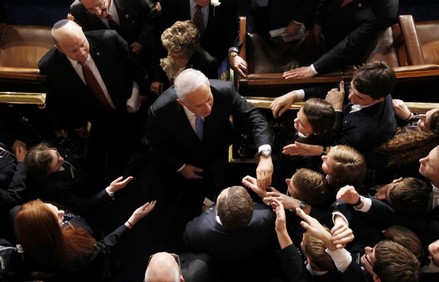
The Israeli Prime Minister comes to our Capitol, thumbs his nose at a two-state solution and receives no less than 29 standing ovations from Congress?

A few pieces that speak my heart perfectly right now. First, Akiva Eldar, writing in Ha’aretz:

Netanyahu’s peace plan, if that is the right phrase for the collection of unrealistic terms he presented to Congress yesterday, leads straight to the burial of the Israeli-Palestinian peace process, an international crisis and a UN declaration of a Palestinian state.

MJ Rosenberg:

Netanyahu today essentially returned to the policies that Israel pursued before Yitzhak Rabin and Yasir Arafat agreed on mutual recognition and the joint pursuit of peace.

And the worst part is not the appalling things Netanyahu said, but how Congress received them. Even Netanyahu’s declaration that there is no Israeli occupation was met with thunderous applause with the Democrats joining the Republicans in ecstatic support. Every Netanyahu statement, no matter how extreme, was met with cheers.

Gideon Levy, also in Ha’aretz:

How can an Israeli prime minister dare to say his country “fully supports the desire of Arab peoples in our region to live freely” without spitting out the entire bitter truth – as long as they aren’t Palestinian. Suddenly Netanyahu marvels at the Arab Spring, but where was he when it began? He was on his standard scare campaign, warning of the dangers of an extremist Islamic regime and rushing to build a fence along our border with Egypt. And yesterday, suddenly, it’s “the promise of a new dawn.” Apparently there is no end to hypocrisy.

And finally, please read Justin Elliot’s invaluable piece in Salon, where he counts 29 standing ovations for Bibi (more than Obama got in his State of the Union Address) providing important commentary for each and every one.

At this point, I’d usually urge you to call your senators and congresspeople, but I really don’t see the point any more. Today the overwhelming majority of Congress – Republicans and Democrats alike – have made it embarrassingly clear that they are utterly irrelevant to the search for a just peace in Israel/Palestine.

If there were any redemptive words uttered in that chamber at all today, they came from my friend Rae Abileah – a courageous young Jewish activist – who interrupted Bibi’s speech from the gallery with “No more occupation, stop Israeli war crimes, equal rights for Palestinians, occupation is indefensible.” Rae was immediately assaulted by spectators who caused serious injuries to her neck and shoulders. She was then taken to George Washington Hospital where she was promptly arrested.

Said Rae from her hospital bed:

I have been to Gaza and the West Bank, I have seen Palestinians homes bombed and bulldozed, I have talked to mothers whose children have been killed during the invasion of Gaza, I have seen the Jewish-only roads leading to ever-expanding settlements in the West Bank…

As a Jew and a U.S. citizen, I feel obligated to rise up and speak out against stop these crimes being committed in my name and with my tax dollars.

Amidst the abject hypocrisy demonstrated in Congress today, Rae’s courage should be an example for us all.

Bibi Fails AIPAC Bible Test

For me the most significant part of Bibi’s AIPAC speech last night came at the very end, when he invoked the famous Leviticus verse on the Liberty Bell:

Now, as Prime Minister of Israel, I can walk down the street and see an exact replica of that bell in Jerusalem’s Liberty Park. On both bells is the same inscription. It comes from the Bible, from the book of Leviticus “Proclaim liberty throughout the land.”

Actually, what’s most significant is what he left out. Bibi only quoted the first half of Leviticus 25:10 – the entire verse reads:

Proclaim liberty throughout all the land unto all the inhabitants thereof.

(Emphasis mine.)

Obama Tames the Lion’s Den

For me, Obama’s speech at AIPAC yesterday was on the same level of rhetorical and political brilliance as his much-vaunted 2008 “race speech.”  I’m really not sure quite how he did it, but he managed to strike an impossibly perfect balance between statements of political necessity:

The bonds between the United States and Israel are unbreakable and the commitment of the United States to the security of Israel is ironclad.

hard-nosed reality:

There’s a reason why the Palestinians are pursuing their interests at the United Nations.  They recognize that there is an impatience with the peace process, or the absence of one, not just in the Arab World — in Latin America, in Asia, and in Europe.  And that impatience is growing, and it’s already manifesting itself in capitals around the world.

political courage:

I know very well that the easy thing to do, particularly for a President preparing for reelection, is to avoid any controversy.  I don’t need Rahm to tell me that.  Don’t need Axelrod to tell me that.  But I said to Prime Minister Netanyahu, I believe that the current situation in the Middle East does not allow for procrastination.

and moral conviction:

The Talmud teaches us that, “So long as a person still has life, they should never abandon faith.”  And that lesson seems especially fitting today.

For so long as there are those across the Middle East and beyond who are standing up for the legitimate rights and freedoms which have been denied by their governments, the United States will never abandon our support for those rights that are universal.

And all this while repeatedly bringing the AIPAC audience to their feet in applause.

Wow.

If I had any doubts about the power of this one speech, the reaction of the leftist blogosphere – where the criticism of Obama’s efforts in Israel/Palestine has been witheringly critical of late – was the ultimate indicator.

Here’s Phil Weiss:

Today’s speech by Barack Obama to AIPAC was a historic speech, maybe the most remarkable speech he has ever given. For a masked and calculating man, it was incredibly sincere. For just below the politically-hogtied phrases and praises for the Israel lobby that controls his future, it was filled with rage. When he spoke over and over of a Jewish democratic state and then said that the world was changing, and spoke about that Jewish state upholding universal values that Americans also share, I heard vicious irony: You want a religious state, you have the power to demand it of me, because you are the Israel lobby, well time is running out on you.

MJ Rosenberg:

Yes, he gave AIPAC the usual Israel boilerplate. He’ll veto a unilaterally declared Palestinian state, etc. But all that stuff is standard and subject to change as situations change. However, the overarching message was the necessity for two states and the unsustainability of the occupation.

And AIPAC applauded. Strongly.

The President did a masterful job. The neocons are outraged. And I expect that Netanyahu, seeing AIPAC’s reaction to their President, will cut his losses and back down.

Bravo, Mr. President. You even brought out the best in AIPAC.

Even Ali Abunimah, in a post that otherwise excoriated US policy in Israel/Palestine, grudgingly admitted that Obama’s speech contained “a number of interesting elements” and “a hard-headed realism about the deep trouble Israel is in.”

Now, however, the real test begins. I’ve made no secret that I believe we’ve passed the point of no return on a two state solution – and I continue to fear that for all of his political courage, Obama’s efforts are arriving too late. As I write, Israel’s settlement juggernaut continues apace, making a mockery of Obama’s stated hope for a “sovereign and contiguous Palestinian state.”  Meanwhile, Netanyahu’s political strategy is patently obvious: keep building settlements, stall Obama as long as possible, cozy up to his personal congressional friends, and do what he can to stoke the fires for a Republican victory in 2012 that will make all this unpleasantness just go away.

No matter how impossible the odds, however, I remain in awe of Obama’s speech, if only that he proved a sitting President does not need to roll over for the Israel Lobby. Could we venture to hope that AIPAC’S financially-driven stranglehold on American foreign policy, its craven bullying of politicians, and its “Israel right or wrong” myopia is now being exposed for what it really and truly is?

Click on the clip above for the entire speech. The good stuff begins at about 14:00 or so.

The Nakba Isn’t Over

There are many  in the Jewish community who view the Nakba as simply a historical fait accomplis. The attitude goes something like this: “Yes, during the creation of the state of Israel, Palestinians were displaced. That’s how nations get created. Today the state of Israel is just a fact – it’s time to get over it.”

The problem with this attitude – beyond the sheer injustice of it – is that the Nakba isn’t actually over.  In truth, government-sponsored displacement of Palestinians from their land has been continuing apace for the past 63 years.

One recent example: Ha’aretz recently revealed that Israel used a covert procedure to banish Palestinians from the West Bank by stripping them of their residency rights between 1967 and 1994:

(The) procedure, enforced on Palestinian West Bank residents who traveled abroad, led to the stripping of 140,000 of them of their residency rights. Israel registered these people as NLRs − no longer residents − a special status that does not allow them to return to their homes…

The sweeping denial of residency status from tens of thousands of Palestinians and deporting them from their homeland in this way cannot be anything but an illegitimate demographic policy and a grave violation of international law. It’s a policy whose sole purpose is to thin out the Palestinian population in the territories.

The ongoing Nakba was also evident in news last month of a new military order that will enable the military to summarily deport tens of thousands of Palestinians from the West Bank:

The order’s vague language will allow army officers to exploit it arbitrarily to carry out mass expulsions, in accordance with military orders which were issued under unclear circumstances. The first candidates for expulsion will be people whose ID cards bear addresses in the Gaza Strip, including children born in the West Bank and Palestinians living in the West Bank who have lost their residency status for various reasons.

Israel’s founders understood full well that the Arab population of Palestine was the most significant barrier to the creation of a Jewish state. At the beginning of the 20th century, the population of Palestine was around 4% Jewish and 96% Arab. Although the events of 1948 tipped that scale significantly, it’s common parlance in Israel to view the growing presence of Palestinians as a “demographic threat.” So it’s not difficult at all to understand why Israel continues to institute these kinds of “thinning out” policies.

In a lengthy (but highly recommended) +972 post entitled “Why Jews need to talk about the Nakba,” Israeli blogger Noam Sheizaf writes:

The Palestinians won’t forget the Nakba. In many ways, it seems that with each year, the memory is just getting stronger.

It’s an interesting, counter-intuitive phenomenon: one would expect that the the memory of displacement would fade as the event itself recedes into the past and new facts in the ground take hold. In fact, the exact opposite seems to be happening. There are doubtless many explanations for this, but primary among them must be the fact that displacement continues to be the very real experience of succeeding generations of Palestinians.

This fact was very much on my mind as I read news reports that thousands of Palestinian refugees crossed Israel’s borders during Nakba Day demonstrations last Sunday.  As I watched scores of unarmed Palestinians willing to face live ammunition as they jumped the border fences, it was clear to me that they weren’t simply commemorating a “long-past” event.

For them, as for Israel, the Nakba isn’t over yet.

AIPAC: Dangerous for Jews and Other Living Things

I encourage you to read this important guest post by Alice Rothchild:

The American Israel Public Affairs Committee is holding its annual conference May 22-24, where Congress people and many of our national leaders will rush headlong into the committee’s open arms and bountiful coffers. In an increasingly bizarre time warp they will congratulate each other and kvell about Israel’s special relationship with the US, our strategic partnership, and Israel’s commitment to democratic ideals in a “sea of dictatorships” (to quote the website).

What they will not talk about is reality. US Jews are increasingly uncomfortable with a lobby that claims to represent us, but is deeply committed to the militaristic and rightwing policies of successive Israeli governments. Jews in the US tend to be politically progressive, but we are being asked to suspend our liberal beliefs when it comes to Israel. While maintaining a steady dream beat for war against Iran and a world view that, “Israel continues to fulfill its ancient obligation as a ‘light unto the nations,’” AIPAC lobbyists with their Christian Zionist allies guarantee billions of dollars in military aid for Israel each year . Much of this goes towards buying US military weapons and machinery, cementing the massive, interconnected, and lucrative military-industrial-security complex that now exists between our two countries.

Not only has this made a brutal 43 year military occupation possible, but it also provides military and political support to the current Netanyahu government. Let’s be clear. Netanyahu is committed to building Jewish settlements in the West Bank and East Jerusalem, undermining any possibility for a two-state solution. He is building Jewish settler-only roads and roads for Palestinians funded by USAID. He tightly controls Palestinian movement through checkpoints, permits, and the Separation Wall which has stolen thousands of acres of Palestinian land and destroyed the lives and livelihoods of people whose families have lived in the region for centuries. His idea of Palestinian statehood, (should he still have one), is a scattering of weak enclaves surrounded by Israeli military. The recently released Palestine Papers painfully documented the degree to which Palestinian negotiators were willing to sell their souls while Israeli negotiators refused to accept any concessions. The US was revealed twisting the arms of Palestinians diplomats to give up basic demands and the massive security coordination between the Israelis and the Palestinian Authority was exposed.

Within Israel, there is a rightwing crackdown on human rights activists, and laws brewing in the Knesset that will criminalize:

1. Nonviolent protests (in Israel and internationally) that advocate boycotts, divestments, and sanctions;

2. Providing information that could lead to Israeli war crime charges;

3. Any activity against Israeli soldiers or State symbols including nonviolent legitimate resistance to the occupation;

4. Commemorations of the Nakba, the Palestinian experience of 1948

At the same time there are over 20 laws that maintain the second class status for Palestinians with Israeli citizenship.

While Israeli activists worry about rising fascism in Israeli society, Palestinians are celebrating the Arab Spring that is blossoming in the region and Fatah and Hamas are gingerly talking about unity and democratic elections. Arabs from Tunisia to Yemen are putting their lives on the line for equality and freedom of speech. This breathtaking political moment is changing the political discourse in the Middle East and the US Congress needs to take notice and shake itself free of the world view that is promoted by AIPAC lobbyists. Fear of anti-Semitism and the traumas of the Holocaust do not justify Israeli exceptionalism, militarism, racism towards Arabs, or a belief in permanent Jewish victimization.

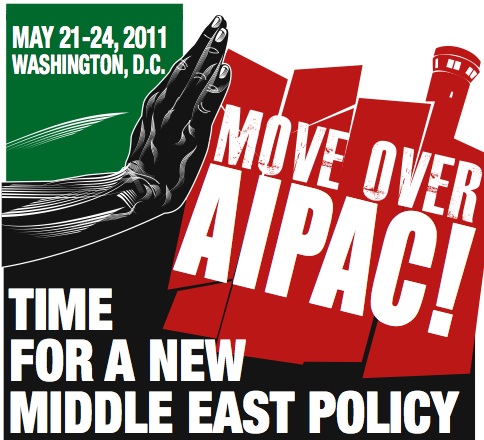
Peace in the Middle East is more urgent than ever, but it needs to be based on international law, human rights, and UN resolutions. AIPAC and its supporters are deluding themselves, promoting a perpetual state of war and hostility, living in a world that does not match reality. At the same time, over 100 peace organizations will be meeting in Washington. Under the call: Move Over AIPAC: Building a New US Middle East Policy, they will explore the impacts of US military aid and political cover, the demand to end the Israeli occupation, and the building of a solution that respects the rights and dignity of everyone in the region. There will be no big donors there, but Congress would do well to listen.

A Reckoning for Yom Ha’atzmaut

I’ve written before that as a Jew, I no longer consider Yom Ha’atzmaut to be a day of unmitigated celebration – but rather be an occasion for honest reckoning and soul searching.  In particular, I believe we need to struggle with the very meaning of independence itself. In our profoundly interdependent world, what does the concept of “independence” ultimately mean?  Is independence a one-time occurrence or an ongoing process? And, perhaps most painfully, in what ways has Jewish independence come at a very real cost to the rights of another people?

To help us reckon with these kinds of questions, I encourage you to visit the new website, #Nakbasurvivor.  This is an amazing new project from the Institute for Middle East Understanding that invites Palestinians to tell their family’s story of the Nakba over Twitter and YouTube. It’s a brand new effort, but already the stories seem to be pouring in. (Click above for one such story.)

As Jews, we know as well as people that memory is profoundly sacred – and that it is our duty to transmit our memories to the next generation so that we might be transformed by the lessons they teach us. As I watched these videos, I felt a myriad of emotions: a sense of honor that these sacred stories were being preserved and transmitted, a sense of pain that my own people’s independence came at the cost of another’s, and a sense of responsibility to acknowledge this memory – and to speak out against the injustices that still continue to this day.

When it comes to memory of the Nakba, there is no justice. This past year, the Knesset has passed legislation that makes it illegal for any Israeli communities that hold events commemorating the Nakba on Yom Ha’atzmaut. In other words, Israel has essentially criminalized the memory of 20% of its citizens.

Today, on the first Yom Ha’atzmaut since this law was passed, Nakba demonstrations have taken place across East Jerusalem and the West Bank. There have been widespread clashes with the IDF and numerous Palestinian casualties have been reported.  (In the East Jerusalem neighborhood of Ras el-Amud, a 17 year old was shot in the stomach with live ammunition – as of this writing, he has no pulse and the doctors are now fighting for his life.)

There will be no independence for anyone – Israeli or Palestinian – until there is justice. And there will be no justice until we truly honor memory, no matter how painful.

Happy Independence Day?

Ynet Photo: Avihu Shapira

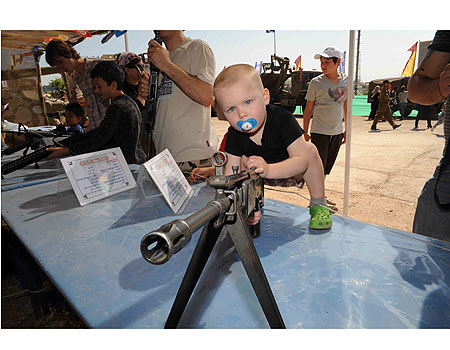
Saw this in Ynet this morning, from an article covering Yom Ha’atzmaut celebrations in Israel. Caption: “Tens of thousands visited IDF bases.”

My first thought: the famous picture of the Palestinian baby in a bomb vest that got some major play in the Jewish press some years back.

My second thought: those Jews who claim Palestinians harbor a “culture of death” should take a good long look at this picture.

My third thought: this recent picture of an Israeli preschool – another image that stopped me in my tracks.

I really don’t know what else to think…

Gaza and the Arab Spring: A Conversation with Nadia Hijab

I’m pleased to announce that Ta’anit Tzedek – Jewish Fast for Gaza will sponsor “Gaza and the Arab Spring,” a conference call with prominent Palestinian writer and human rights advocate Nadia Hijab on Thursday, May 19 at 12:00 pm EST. 

The Arab Spring – a series of popular uprisings all over the Arab world – has brought new hope for greater freedom, justice and democracy to millions of people throughout the Arab world and beyond. The uprisings have already brought about dramatic changes in several countries and the popular movement is growing in strength. How will these changes affect the Israeli-Palestinian conflict and more particularly the people of Gaza? What is impact of related developments, such as the Hamas – PA unity agreement and Egypt’s opening of the Rafah crossing into Gaza?

Our guest, Nadia Hijab was born in Syria to Palestinian parents and was raised in Lebanon. Ms. Hijab began her career as Editor-in-Chief of Middle East Magazine and later moved to New York to work for the United Nations Development Program where she served in several UNDP departments and helped organize the Program’s contribution to the 1993 World Conference on Human Rights.

After leaving the United Nations, Ms. Hijab became Executive Director of the Palestine Center, a Washington, DC-based think tank affiliated with the Jerusalem Fund. In 2000 she established her own consulting business on human rights, human development, and gender. Ms. Hijab has served as co-chair of the US Campaign to End the Israeli Occupation and is on its advisory board, and is a Past President of the Association of Arab American University Graduates.

Ms. Hijab appears frequently as an Arab-affairs commentator on television, radio and print outlets and has authored more than 100 articles and has published two books: Womanpower: The Arab Debate on Women at Work. and Citizens Apart: A Portrait of Palestinians in Israel.

To participate in the call:

Dial the Access Number: 1.800.920.7487 

When prompted, enter your Participant Code: 92247763# 

There will be a question and answer period during the call.

Participants in the call are encouraged to read one or more of the following three articles by Ms. Hijab.

The Arab revolutions and the Israeli-Palestinian Conflict

Understanding Obama’s Settlement Posture

The Palestinian Narrative: Then and Now

We are honored to welcome Ms. Hijab to our monthly conference call and invite you to join the conversation!

Palestinian Unity: In Search of a Game Changer

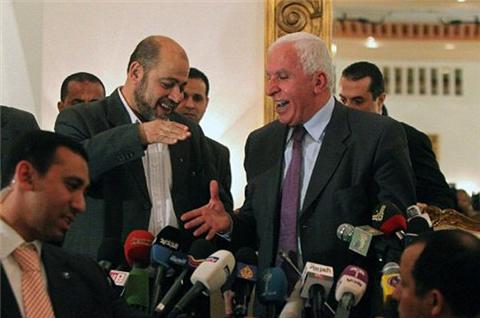
When I read of the reported “PA-Hamas reconciliation” deal, my initial response was generally positive. It seemed to me that Palestinian leaders on both sides were finally taking their constituents’ desire for unified leadership seriously. It also appeared that – together with the PA’s campaign to find international support for a declaration of statehood – Palestinian leadership had decided to proactively shake up the paralyzed status quo.

Readers of my blog know I’ve long believed that Israel, the US and the international community should end its shunning of Hamas if any real progress will be made in settling this conflict. Alas, I’m saddened but not too surprised that Bibi’s immediate response to Palestinian unity talks was to say the PA “must choose whether it is interested in peace with Israel or reconciliation with Hamas.”  For its part, the White House stated it “supports Palestinian reconciliation,” but then rejected its support in its very next sentence:

The United States supports Palestinian reconciliation on terms which promote the cause of peace. Hamas, however, is a terrorist organization which targets civilians.

At any rate, it’s fairly clear that the unity effort is likely to be more symbolic than an actual game changer. As Ali Abunimah recently pointed out, it’s difficult to imagine how a unified Palestinian leadership could ever operate effectively under current circumstances:

If there is an agreement on a joint “government” how can it possibly function without Israeli approval? Will Israel allow Hamas ministers be able to operate freely in the occupied West Bank? Will PA officials be able to move freely between the West Bank and Gaza? Israel is effectively at peace with the current Abbas wing of the Palestinian Authority and at war with Hamas. Impossible to see how such a government can operate under Israeli occupation. If anything this proves the impossibility of democracy and normal governance under Israeli military occupation.

In the end, writes Joseph Dana, the issue is not whether or not the Palestinian leadership could function with Hamas involved. The actual motive behind unity talks is not the Palestinian leadership’s desire to serve as a real functioning government – but rather its desire to co-opt the Palestinian masses who are inspired by the revolutionary spirit currently coursing though the Arab world:

 The agreement signed last night between Fatah and Hamas does not represent unity. The reconciliation agreement represents a move to appease growing popular movements on the streets of Gaza and the West Bank which are demanding real unity, one that might not even involve the PA and Hamas, in order to combat Israeli occupation.

I completely agree with Dana that the Palestinian popular nonviolent resistance movement has the power to challenge Israel in ways that the PLO and Hamas never could. Indeed, this is the kind of Palestinian unity Israel should really be taking seriously:

A unified Palestinian population in the West Bank and Gaza which adopts nonviolent resistance tactics has the potential to inflict incredible damage on the Israeli occupation. Actually, Israel does not have an effective strategy to combat Palestinian nonviolence and unity. Look at the amount of military resources Israel have used to crush small West Bank villages like Nabi Saleh, which embrace unity and nonviolence against occupation.

Unless American, Israeli and Palestinian leaders show real leadership, there is every reason to believe Palestinian people may well seize that mantle themselves. Now that would be a real game changer…

Bibi’s New “Peace Plan?” Just Watch the Facts on the Ground

Map: Peace Now

Netanyahu plans to unveil a new peace plan early next month, just before he is scheduled to address both Houses of Congress in Washington. According to reports, the plan will suggest a transfer of additional territory in the West Bank to “full Palestinian control.”

Meanwhile back in the real world, Israel’s Ministry of Housing has just announced plans to build a new neighborhood of 800 housing units south of West Bank settlement Givat Ze’ev. Peace Now correctly points out that these plans represent the true intentions of the Israeli government:

It is a strategic plan, that is meant, from the one hand, to create a territorial continuity between Jerusalem and Givat Zeev, and from the other hand to create a barrier between the Palestinian communities south-west of Ramallah, and the heart of the potential Palestinian State in East Jerusalem and Ramallah.

The construction in the “Settlement Blocs” is more of a threat to the two states solution than in the other settlements, because it creates facts on the ground that will be much harder for Israel to remove, and it limits the ability of the negotiators to find potential land-swaps that would be necessary for an agreement.

Just bear this in mind when Netanyahu unveils his latest “peace plan:” actions on the ground speak much louder than his words.