Category Archives: American Jewish Community

Big News: Jews Find a Way to Talk Civilly About Israel!

The latest issue of the Chicago Jewish News contains a wonderful cover story about my congregation and how we’ve been working to find a way to talk openly, honestly and civilly together about Israel. (The eye-grabbing headline: “HELL FREEZES OVER, CUBS WIN WORLD SERIES, JEWS FIND WAY TO DISAGREE AGREEABLY.”)

Here’s an excerpt:

“I have very strong feelings about Israel and I express them pretty openly. My activism is very public,” (Rabbi Rosen) says. “That is my own truth as a Jew and a rabbi, and it is very important to me to be true to my private personal conscience.”

But as the rabbi of JRC, “I also feel strongly that my job is to create the kind of environment where people, even those who don’t agree with me — and there are many — feel welcome to express those views and have those views heard. I respect the diversity of opinion at JRC,” he says. “We may be (perceived as) left-leaning, but on the subject of Israel, we are more diverse than people think.”

The largest group of congregants, he says, fall somewhere in the middle of a continuum, with some on both ends of the spectrum.

With these thoughts in mind, Rosen says, he and a number of congregants “decided together that rather than raise all this dust, it would be a great opportunity to use these emotions in some kind of constructive way.”

What else can I say other than that I’m enormously proud of my congregation?!

Passover Supplements Galore!

The Passover 2010 seder supplements are arriving fast and furious. In my last post I shared my JVP supplement – here are a few more you can download and use to spice up your seder meal:

– The “Moral Voices” initiative of Penn Hillel has published “From Chains to Change” – a supplement that connects the lessons of Pesach to the contemporary scourge of human trafficking;

– Workingman’s Circle’s “10 Modern Plagues” demonstrates how our contemporary bounty is diminished by the suffering of others;

– J Street’s supplement asks “Four More Questions” about the prospects for the peace process in the coming year;

Tikkun Magazine’s supplement, thoughtful as ever, is so verbose that it could be its own haggadah…

The new supplement created by American Jewish World Service focuses on disaster relief:  “Dayenu: Supporting the Long Journey from Disaster to Recovery;”

– Jewish Funds for Justice highlights immigration reform with “For We Were Strangers;”

A print-out placemat from Mazon asks a 5th question: “Why On This Night are Millions of People Going Hungry?”

A zissen Pesach – all the best for a sweet and liberating Passover…

J Street’s Bumpy Philadelphia Road

Now that Brit Tzedek has merged with J Street, we’re witnessing the rapid growth of  “J Street Locals” proliferating throughout more than 20 regions across the country.  (I’m happy to be attending the launch of J Street Chicago at Emanuel Congregation this Thursday night and even happier to hear that a healthy turnout is expected).

I’m dismayed, tho, to learn that J Street Philadelphia‘s debut is receiving more than its share of ridiculous attacks from certain corners of the Philly Jewish community.  I’ve just read that even Penn Hillel has come under fire for renting out its facility to this “anti-Israel” group.

According to the Philadelphia Jewish Exponent:

A flap over Hillel of Greater Philadelphia’s decision to lease its space to J Street — for the official launch of its Philadelphia branch — is just one local manifestation of a debate that has roiled much of the national Jewish establishment since the advocacy organization was founded nearly two years ago…

Gary Erlbaum, who sits on the Jewish Community Relations Council’s Israel advocacy committee and is also a board member of the Jewish Publishing Group, has been outspoken in his opposition to J Street, and is upset about Hillel’s decision to host the group’s Feb. 4 event.

“What makes them pro-Israel? If the Palestinians had a lobby, it would be called J Street,” said Erlbaum. “The Hillel building is an inappropriate spot for a group that’s anti-Israel.”

Oh, for God’s sake. A group committed to supporting the two-state solution through a diplomatic means while safeguarding Israel security and its future as a Jewish and democratic state is somehow “anti-Israel?”

You know, sometimes when I’m feeling really, really optimistic, I dream about what it might feel like if the American Jewish community actually could tolerate the kind of vigorous and freewheeling debate that they enjoy in the actual Jewish state itself.  (Now wouldn’t that be “pro-Israel?”)

My Favorite Rabbis: Everett Gendler

Most people probably don’t realize this, but rabbis need rabbis too.

And there are a lot of great rabbis out there. Over the years I’ve been personally inspired by many of them: remarkable, talented leaders whose work challenges me, drives me and constantly reminds me why I do what I do. So with this post I’m debuting a new series I’m calling “My Favorite Rabbis:” ongoing profiles of the contemporary rabbis whom I consider to be my own spiritual teachers.

I’ll start by introducing you to Rabbi Everett Gendler, a Conservative rabbi whose moral courage has provided Jewish leadership for some of the most important progressive causes of our day. Today, some fifty years since he became a rabbi, I believe he remains on the cutting edge of the issues that truly matter.

This MLK weekend, it is certainly appropriate to note that Rabbi Gendler was one of the first rabbis to become actively involved in the struggle for civil rights in America and played a critical role in involving American rabbinical leadership in the movement. It’s doubtful that American rabbis would have stepped up to this struggle nearly as much had it not been for Rabbi Gendler’s prophetic influence.

During the early and mid-1960s, Rabbi Gendler led groups of American rabbis to participate in numerous prayer vigils and protests throughout the South. Of course many know that the legendary Rabbi Abraham Joshua Heschel marched with Dr. Martin Luther King in Selma in 1965. I imagine far fewer are aware that it was in fact Rabbi Gendler who persuaded Heschel to do so.

Heschel biographer Edward K. Kaplan writes:

Despite fears for his safety from his wife and the twelve year old Susannah, (Rabbi Heschel) agreed to join the march at the urging of Rabbi Everett Gendler, a pacifist and former student. Gendler had led a group of rabbis to Birmingham, Alabama to work for voting rights and remained in touch with the Reverend Andrew Young, King’s Executive Assistant at the SCLC. (From “Spiritual Radical: Abraham Joshua Heschel in America,” p. 222)

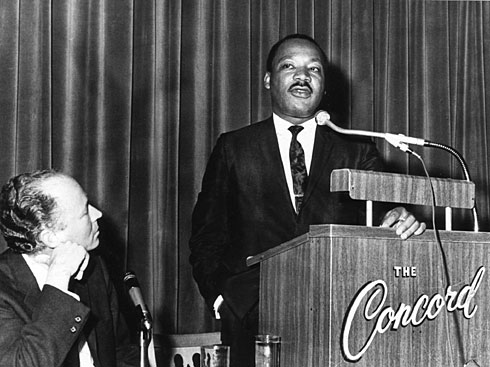
Rabbi Gendler was also instrumental in arranging Martin Luther King’s keynote address at the Rabbinical Assembly’s convention on March 25, 1968. This now-legendary speech took place at the Concord Resort hotel in New York’s Catskill Mountains just 10 days before King’s death. (That’s Rabbi Gendler to the left of Dr. King in the pic above).

Today, decades after King’s death, Rabbi Gendler remains an eloquent Jewish advocate for the path of nonviolence. His work has taken him across the world – most notably to India where he and his wife Mary teach the principles of nonviolence to Tibetan exiles.

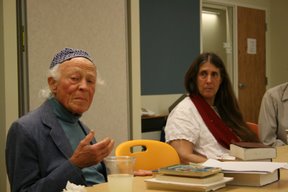
I’m personally honored to serve with Rabbi Gendler on the Elder’s Council of the Shomer Shalom Institute for Jewish Nonviolence. In this picture, he leads a workshop at JRC in 2008. Shomer Shalom founder Rabbi Lynn Gottlieb (someone whom I may well be profiling in the future) is sitting next to him.

Rabbi Gendler has also been a long time advocate for Palestinian human rights – and his courageous stands have made it possible for new generations of rabbis to find their own voices on this painful issue. When Rabbi Brian Walt and I first began Ta’anit Tzedek and were looking for rabbis to join our campaign to protest the blockade of Gaza, we immediately turned to Rabbi Gendler, who joined our effort without hesitation. It is difficult to describe how much it means to know there are rabbis out there like Everett, someone who has been putting himself on the line for so long, and upon whom we always know we can rely for guidance and support.

Rabbi Gendler was also one of the first Jewish leaders to embrace environmentalism and vegetarianism long before they became fashionable. As the rabbi of a green synagogue myself, I recognize a tremendous debt to Everett, who more than anyone helped to put environmental issues on the radar screen of the Jewish community.

From a 2008 article in the Los Angeles Jewish Journal:

On a ferociously cold evening in November 1978, Rabbi Everett Gendler climbed atop the icy roof of Temple Emanuel in Lowell, Mass., and installed solar panels to fuel the synagogue’s ner tamid (eternal light)…

Gendler’s conversion of that eternal light marks the first known action to green a synagogue, making it more spiritually and ecologically sustainable, and Gendler himself, now Temple Emanuel’s rabbi emeritus, has been hailed as the father of Jewish environmentalism.

There so much more to say about Everett and his work. I suppose the most essential thing I can say about him is that he was and remains a spiritual maverick. His work remains as relevant and courageous as ever.

As we honor Dr. King this weekend, it’s critically important to honor those who continue his to walk his path in our own day. For me and so many others, Rabbi Everett Gendler is the one who teaches us how to walk that walk.

Pogo Was Right

From today’s JTA:

The Los Angeles Police Department is investigating whether Israeli organized crime is connected to an attack at a local synagogue.

The department initially listed the Oct. 30 shooting at the Adat Yeshurun Valley Sephardic Synagogue in North Hollywood, Calif., as a hate crime, but in recent weeks police been working on the theory that the shooting was to silence someone, the Los Angeles Times reported Thursday.

Two people were shot in the legs in the parking lot of the synagogue, located in the San Fernando Valley’s Orthodox community. Police believe one of the men that was shot was the target of the attack, the newspaper reported…

Israeli organized crime has been operating in Los Angeles since the mid-1990s, according to the newspaper.

Postscript: I spoke with a friend who read the local Israeli press in LA immediately after the shooting and said that even then there was serious speculation that Israeli organized crime was behind it.

If it was indeed an “inside job,” it puts a very interesting twist on our thinking about Jewish safety in general. It was notable that the ADL, immediately after the shooting, issued a press release with the predictable language:

Statistics consistently show Jews to be far and away the most frequently targeted religious group, with 74 percent of hate crimes motivated by religion being perpetrated against Jews in Los Angeles County.

I think the issue of Jewish power vs. vulnerability in America and the diaspora at large is an important and complex one. For my part, I believe (ADL’s problematic “annual audit” notwithstanding) that we Jews have never been more secure in our history than we are in present day America. If for nothing else, this latest incident is newsworthy for adding one more complicated dimension to the issue.

On Jewish Hearts and Minds: A Response to Daniel Gordis

Just read Rabbi Daniel Gordis’ recent op-ed in the Jerusalem Post, one of several articles that have given some free publicity to Ta’anit Tzedek.  But it wasn’t Gordis’ offhand slam on TT that really bothered me – it was the decidedly patronizing way he analyzed the gulf between the American Jewish community and Israel – or as he termed it, American Jewry’s “growing abandonment of Israel.”

Gordis’ main premise: American Jewry’s newest generation is essentially self-centered (tainted “with the ‘I’ at the core of American sensibilities”) and simply cannot relate to the national sense of duty embodied by Israel:

In America, the narratives of immigrant groups are eroded, year by year, generation after generation.  In America, we are oriented to the future, not to the past, and if we cling to some larger grouping, it is to a human collective whole rather than to some “narrow” ethnic clan…

Similarly, the recreation of the State of Israel is truly powerful only against a backdrop of centuries of Jewish experience, and is spine-tingling only if my sense of self is inseparable from my belonging to a nation with a past and a people with a purpose.

In today’s individualistic America, the drama of the rebirth of the Jewish people creates no goose bumps and evokes no sense of duty or obligation. Add the issue of Palestinian suffering, and Israel seems worse than irrelevant – it’s actually a source of shame.

It’s not clear to me if Gordis is interested in winning over the hearts and minds of young American Jews, but if he is, I’d suggest that talking down to them from an Israeli ivory tower is not the way to do it.  I’m afraid that record just doesn’t play any more.

Gordis is correct when he posits that the old narratives simply aren’t working on American Jews the way they used to.  But that’s only because a new, more complex narrative is now being written by the current generation. It’s compelling in its own right, though this may be difficult to understand when viewed from the conventional Israeli vantage point.

I work with a great number of American Jews – particularly the 35 and younger demographic that Gordis cites – and from where I sit they look nothing like narcissistic, self-obsessed Americans he describes. On the contrary, most are engaged, seriously seeking Jews.  Yes, it’s true, unlike previous generations they don’t necessarily understand their Judaism in traditionally tribal terms anymore. But that doesn’t make them self-centered. Rather, they are increasingly viewing their Jewishness against a larger, more universal global reality.  In short, to be a Jew and a global citizen is what gives them “goose bumps.”

If, as Gordis suggests, American Jews are abandoning Israel, I’d suggest it’s not due to the lack of a sense of Jewish “duty or obligation” – I believe it’s because they are left cold by an Israeli national culture that appears to them to be overly tribal and collectively self-centered.

Indeed, while most young people today seem to be interested in breaking down walls between peoples and nations, Israel often appears determined to build higher and higher walls between itself and the outside world. It’s a poignant irony of Jewish history: while Zionism was ostensibly founded to normalize the status of Jewish people in the world, the Jewish state it spawned seems to view itself as all alone, increasingly victimized by the international community.

Gordis himself exemplifies this “it’s us Jews against the rest of the world” ethos in the opening paragraphs of his article:

About one thing, at least, the world seems to be in agreement: Israel is the primary culprit in the Middle East conflict, the cause of relentless Palestinian suffering and the primary obstacle blocking the way to regional peace.

The international chorus of opprobrium is growing by the day…It’s relentless, this ganging up, but it’s also not terribly new. The momentum has been building for years, and though we may not like it, we cannot honestly claim to be surprised.

While I understand the psychology of this world view, I don’t think it helps make Israel’s case for young Jews today – nor do I think it promotes a particularly healthy Jewish identity. It seems to me to be the product of self-pity, more than pride – a victim mentality that’s not likely to get us anywhere with newer generations of Jews who are feeling increasingly comfortable with the “outside world” and who don’t particularly identify with the claim that when push comes to shove, all the world really does just hate the Jews.

I will also predict that Gordis’ two cynical references to “Palestinian suffering”  will not resonate for growing numbers of Jews who are legitimately troubled by Israel’s treatment of Palestinians.  I understand full well that our criticism sounds galling to most Israeli ears. And no, I don’t believe that we American Jews can even begin to understand how Israelis feel – on so many levels.

But whether Israelis like it or not, there is a steadily growing demographic in the American Jewish community: proud, committed Jews who are deeply troubled when Israel acts oppressively, who feel implicated as Americans and as Jews in these actions, and who are galled at being labeled as traitors when they choose to speak out.

At the very least, I hope that Gordis will understand that if American Jews are identifying with organizations that protest Israel’s oppressive policies (organizations, yes, such as Ta’anit Tzedek) their affiliation does not come from a shame-filled desire to “bash” Israel. It comes from a deeper and much more Jewishly authentic place than that.

I realize that all of this may be too much to ask for. It’s long been clear that the American Jewish and Israeli Jewish communities are two very different animals with two decidedly different ways of understanding what it means to be a Jew in a rapidly changing world.  (Sociologists Steven Cohen and Charles Liebman pointed this out with great insight in their book “Two Worlds of Judaism” twenty years ago).

But it seems to me if we truly want to facilitate the Jewish future, we’re going to have to do it together. And to do that, we’ll  need to meet one another with openness and understanding, not dismissal and judgment.
On Gaza and Yom Kippur: A Call to Moral Accounting

From my op-ed in this morning’s Sunday Chicago Tribune:

The actions of the Jewish State ultimately reflect upon the Jewish people throughout the world. We in the Diaspora Jewish community have long taken pride in the accomplishments of the Jewish State. As with any family, the success of some reflects a warm light on us all. But pride cannot blind us to the capacity for error on the part of the country we hold so dear. We cannot identify with the successes, but refuse to see the failures.

As we approach Yom Kippur, I call on America’s Jews to examine the Goldstone findings, and consider their implications. In the spirit of the season, we must consider the painful truth of Israel’s behavior in Gaza, and understand that we must work, together, to discover the truth — and then urge on all relevant parties in the search for peace.

The Contradictions of Ethnic Nationalism

610x

It’s the last day before the Israeli elections, and there seems to be widespread agreement that Yisrael Beiteinu party chairman Avigdor Lieberman is going to win big – perhaps as much as 19-20 seats. They’ve already pulled ahead of the Labor party and by now it’s virtually a foregone conclusion that Lieberman will emerge from these elections with considerable political influence.

It’s also fair to say that those of us who cherish the values of liberal democracy are recoiling at the prospect of a politically ascendant Avigdor Lieberman, whose most notorious campaign promise is a requirement for all Arab citizens of Israel to sign a loyalty oath to the Jewish state:

(Lieberman’s) loyalty oath would require all Israelis to vow allegiance to Israel as a Jewish, democratic state, to accept its symbols, flag and anthem, and to commit to military service or some alternative service. Those who declined to sign such a pledge would be permitted to live here as residents but not as voting citizens.

Currently Israeli Arabs, who constitute 15 percent to 20 percent of the population, are excused from national service. Many would like to shift Israel’s identify from that of a Jewish state to one that is defined by all its citizens, arguing that only then would they feel fully equal.

Mr. Lieberman says that there is no room for such a move and that those who fail to grasp the centrality of Jewish identity to Israel have no real place in it.

These are disturbing ideas to be sure, and it’s even more troubling that they seem to finding traction with increasing numbers of the Israeli electorate.

And yet…

…and yet in the wee hours of the night, I just can’t shake the nagging feeling that the real reason Lieberman makes us squirm is that he shines a bright light on the logical contradictions of political Zionism: an ethnic nationalist movement that has always sought to create a Jewish state in a land that also happens to be populated by millions of non-Jewish inhabitants.

Take, for example, Israel’s Declaration of Independence, which refers specifically to Israel as a “Jewish state” committed to the “ingathering of the exiles” but also promises complete equality of political and social rights for all its citizens, irrespective of race, religion, or sex.  Therein lies the tension: the first principle emphasizes the creation of a state that privileges the Jewish people and the latter promises equal rights for all its citizens.

I don’t say this easily: I’m not sure this is a nut that Israel will ever fully be able to crack.  It is indeed notable that Israel has repeatedly tried and failed to create a constitution that legally guarantees equality for all citizens of this exclusively Jewish state. In the meantime, Israel’s Arab citizens suffer from what we Americans would consider significant institutional discrimination with only limited recourse to the rule of law.

So as a nice liberal American Jew fully prepared to voice my outrage at Lieberman’s likely Tuesday morning success, here are some questions I feel compelled to ponder:

– As proud citizens and beneficiaries of a secular multi-cultural nation, are we ready to face the deeper implications of Israel’s ethnic nationalism?

– Will it ever truly be possible, in a country defined as exclusively Jewish, for its Arab citizens to be considered as anything but second class citizens (or at worst, traitors)?

– If  it does indeed come down to a choice between a Jewish or a democratic state, which will we ultimately support?

I’d love to hear your responses…