Category Archives: Judaism

AIPAC: Dangerous for Jews and Other Living Things

I encourage you to read this important guest post by Alice Rothchild:

The American Israel Public Affairs Committee is holding its annual conference May 22-24, where Congress people and many of our national leaders will rush headlong into the committee’s open arms and bountiful coffers. In an increasingly bizarre time warp they will congratulate each other and kvell about Israel’s special relationship with the US, our strategic partnership, and Israel’s commitment to democratic ideals in a “sea of dictatorships” (to quote the website).

What they will not talk about is reality. US Jews are increasingly uncomfortable with a lobby that claims to represent us, but is deeply committed to the militaristic and rightwing policies of successive Israeli governments. Jews in the US tend to be politically progressive, but we are being asked to suspend our liberal beliefs when it comes to Israel. While maintaining a steady dream beat for war against Iran and a world view that, “Israel continues to fulfill its ancient obligation as a ‘light unto the nations,’” AIPAC lobbyists with their Christian Zionist allies guarantee billions of dollars in military aid for Israel each year . Much of this goes towards buying US military weapons and machinery, cementing the massive, interconnected, and lucrative military-industrial-security complex that now exists between our two countries.

Not only has this made a brutal 43 year military occupation possible, but it also provides military and political support to the current Netanyahu government. Let’s be clear. Netanyahu is committed to building Jewish settlements in the West Bank and East Jerusalem, undermining any possibility for a two-state solution. He is building Jewish settler-only roads and roads for Palestinians funded by USAID. He tightly controls Palestinian movement through checkpoints, permits, and the Separation Wall which has stolen thousands of acres of Palestinian land and destroyed the lives and livelihoods of people whose families have lived in the region for centuries. His idea of Palestinian statehood, (should he still have one), is a scattering of weak enclaves surrounded by Israeli military. The recently released Palestine Papers painfully documented the degree to which Palestinian negotiators were willing to sell their souls while Israeli negotiators refused to accept any concessions. The US was revealed twisting the arms of Palestinians diplomats to give up basic demands and the massive security coordination between the Israelis and the Palestinian Authority was exposed.

Within Israel, there is a rightwing crackdown on human rights activists, and laws brewing in the Knesset that will criminalize:

1. Nonviolent protests (in Israel and internationally) that advocate boycotts, divestments, and sanctions;

2. Providing information that could lead to Israeli war crime charges;

3. Any activity against Israeli soldiers or State symbols including nonviolent legitimate resistance to the occupation;

4. Commemorations of the Nakba, the Palestinian experience of 1948

At the same time there are over 20 laws that maintain the second class status for Palestinians with Israeli citizenship.

While Israeli activists worry about rising fascism in Israeli society, Palestinians are celebrating the Arab Spring that is blossoming in the region and Fatah and Hamas are gingerly talking about unity and democratic elections. Arabs from Tunisia to Yemen are putting their lives on the line for equality and freedom of speech. This breathtaking political moment is changing the political discourse in the Middle East and the US Congress needs to take notice and shake itself free of the world view that is promoted by AIPAC lobbyists. Fear of anti-Semitism and the traumas of the Holocaust do not justify Israeli exceptionalism, militarism, racism towards Arabs, or a belief in permanent Jewish victimization.

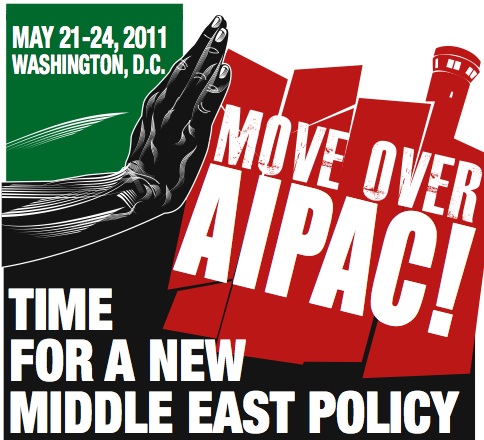
Peace in the Middle East is more urgent than ever, but it needs to be based on international law, human rights, and UN resolutions. AIPAC and its supporters are deluding themselves, promoting a perpetual state of war and hostility, living in a world that does not match reality. At the same time, over 100 peace organizations will be meeting in Washington. Under the call: Move Over AIPAC: Building a New US Middle East Policy, they will explore the impacts of US military aid and political cover, the demand to end the Israeli occupation, and the building of a solution that respects the rights and dignity of everyone in the region. There will be no big donors there, but Congress would do well to listen.

Liberate Yourself With New Passover Resources!


With the first night of Passover fast approaching, check out these great new seder resources you can bring to the table:

– Hot off the presses: the Jewish Voice for Peace 2011 Haggadah. One powerful excerpt – a new Passover poem written by Rabbi Rachel Barenblat for her “Velveteen Rabbi’s Haggadah for Pesach“:

Freedom
In remembrance of the 2011 protests in Tunisia, Egypt, Gabon, Bahrain, Libya, and elsewhere.

Liberation comes when people gather
by the tens and by the thousands
demanding that the despot who’s held the reins
step down, and in between the slogans
they dish out lentils cooked over open flame,
and homes open up so the protestors can shower
and members of one faith link hands
to protect members of another faith at prayer.
Liberation comes at a cost: not only
the horses and chariots swept away, but
innocents gunned down by their own army,
panicked children lost in the roiling crowds
activists imprisoned for speaking freely,
and when the world stops watching
they may be beaten—or worse.
It’s upon us to at least pay attention
on mobile phones and computer screens
as real people rise up to say
we have the right to congregate and to speak
we will not be silenced, we are not afraid.

A “Food and Justice” seder from Uri L’Tzedek;

– “The Labor Seder” by Jews United for Justice;

– American Jewish World Service’s “Slavery, Freedom and Migration;”

A Haggadah Insert by Jewish Solidarity with Native American People;

The 2011 Tikkun Magazine Haggadah supplement which, as always, has enough material for 10 seders.

May it be a liberating Pesach for us all!

A Blessing From Wisconsin

The following blessing was just sent to me by my friend and colleague Rabbi Laurie Zimmerman, of Reconstructionist congregation Sha’arei Shamayim in Madison, WI. It was said during the Shabbat morning Torah service for all those who participated in the many protests, vigils, or hearings at the Wisconsin State Capitol last week.  Laurie reports that 90% of the congregation and guests came up for the blessing.

Mi sheberach Avoteynu Avraham, Yitzhak, v’Ya’akov
May the One who blessed our forefathers Abraham, Isaac, and Jacob,

V’Imoteynu Sarah, Rivka, Rachel, v’Leah
And our foremothers Sarah, Rebecca, Rachel, and Leah,

Bless all of you who have come up to the Torah this morning.

No matter what happens in the next week may you be reminded that even tiny actions can affect others, create ripple effects, and make a difference in our world.

May you take responsibility for what you say, for how you behave, for what you do and for what you do not do.

May you pursue justice, act with integrity, and work hard to create a society where all are cared for, where every person has the resources that he or she needs.

May you remember to take care of yourselves and your families so that your work is sustainable.

And may you heed the words of Pirke Avot: “If I am not for myself, who will be for me?  If I am only for myself, what am I?  And if not now, when?”

And let us say, Amen.

On Rabbis and Racism

According to signator Rabbi Yosef Scheinen (left), head of the Ashdod Yeshiva: "Racism originated in the Torah"

From Ha’aretz:

A number of leading rabbis who signed on to a religious ruling to forbid renting homes to gentiles – a move particularly aimed against Arabs – defended their decision on Tuesday with the declaration that the land of Israel belongs to the Jews.

Dozens of Israel’s municipal chief rabbis signed on to the ruling, which comes just months after the chief rabbi of Safed initiated a call urging Jews to refrain from renting or selling apartments to non-Jews.

Needless to say, the reaction to this noxious ruling has been nothing short of thunderous throughout Israel and the Jewish world. Israeli politicians from Netanyahu on down have publicly called out the rabbis on their racism. The New Israel Fund is disseminating “Rabbis Against Religious Discrimination” a statement that calls upon Israeli rabbis to “take a strong public stand” against “this painful distortion of our tradition.”  At last count, 880 rabbis from around the world have signed on. Even the ADL has joined the fray in denouncing the ruling.

It’s been heartening to hear such an immediate and powerful Jewish communal response. Still, for all of the brouhaha, I’m struck – and fairly troubled – that there has been very little discussion of the fact that these rabbis are on the government payroll at all.

Indeed, it’s very easy to criticize rabbis such as this, but in truth, the mere existence of racist rabbis in Israel shouldn’t come as much of a shock to us. Truth be told, prominent Israeli rabbis have been disseminating xenophobia for some time now. Every religion has its religious extremist “spokespeople” – and Judaism is certainly no different on this score.

No, the real problem here is not the horrid personal beliefs of a handful of individual rabbis – the core issue is a political system that sees no problem in granting state authority to them – or to any clergy, for that matter. For me, this is the most disturbing aspect of this whole sorry episode: at the end of the day, these rabbis are ultimately part of a larger infrastructure of intolerance that inevitably results from wedding religion to nation-statism.

I was very happy to read that some left-wing Israeli politicians have gone as far as to call for the firing of the rabbis in question, but in the end, I’m just not convinced that this problem ultimately stems a few “rogue employees.” The real problem, I fear, has to do with a nation that claims to be both Jewish and democratic – but is finding it increasingly difficult to square that circle.

A Jew In Solidarity With the Palestinian People

As today marks the UN’s International Day of Solidarity with the Palestinian People, I’d like to take occasion of this day to publicly state, without hesitation, that I stand in solidarity with the Palestinian people.

As a Jew, I will also say without hesitation that I reject the view that I must choose between standing with Jews or standing with Palestinians. This is a zero-sum outlook that only serves to promote division, enmity and fear.

For me, the bottom line is this: the cornerstone value of my religious tradition commands me to stand in solidarity with all who are oppressed. It would thus be a profound betrayal of my own Jewish heritage if I consciously choose not to stand with the Palestinian people.

In other words, I believe my Jewish liberation to be intrinsically bound up with Palestinian liberation. It’s really that simple.

But of course, there is nothing simple or uncomplicated about it. To take such a step it is deeply painful in many ways. It means, among other things, facing down my peoples’ own potential for oppression; to admit that the state of Israel, born in the wake of persecution, has itself become a persecutor.

However, I must also admit that this pain, uncomfortable though it is, is nothing compared to the pain felt that is being experienced by the Palestinian people on a daily basis. Anyone person of privilege who stands in solidarity with the oppressed would do well to bear this in mind: while must we explore our own guilt and culpability, we must also bear in mind that it is not ultimately about us.

From a wonderful essay on white privilege, but very applicable in this case:

Solidarity…is a long-term participation in the struggle, understanding the part you play and how the issues affect you personally. As well, solidarity may very well mean not being the center of the solution, but just a small part. It may mean deferring your sense of authority and leadership. It can also mean dropping your own agenda for how change should be achieved. It can be very problematic when the leadership in an organization is people from the dominant culture. When people from the dominant culture define the issues or strategies for oppressed people it can be condescending and ineffective. So, an example of solidarity is being part of community organizing efforts led by people of color, womyn, etc in an active, but non-leadership role. Being in solidarity means seeing how you will benefit from the liberation of others.

And so today I’ll take this opportunity to say I stand in solidarity with the Palestinian people. But I’m not taking it to assuage my Jewish pain and guilt, nor to claim I personally know how this liberation must eventually be achieved.

In the end, I stand here because I know in my heart it is where I must be.

Young, Jewish and Proud – Time to Make Room at the Table

Here is some video of yesterday’s incident at the Jewish Federation GA.

After watching this clip this morning, my wife Hallie and I had a long conversation about it. Though I was eager to talk about its political/Jewish communal implications, she responded to it more as a parent of teenagers.

As she put it, “As parents, what kinds of values do we want to impart to our kids? Don’t we always say we want them to educated, to be critical thinkers, and to stand up for what they believe in? And even if we don’t approve of the places their critical thinking take them, what, are we going to disown them because we don’t agree with them?”

Take a close look at this clip and pay particular attention to the reaction of the audience in the hall. It would be quite an understatement to say the crowd disapproved of what these young people were saying. Frankly, it was something of a miracle that any of them made it out of that room in one piece.

But as Hallie pointed out to me, these young Jews were doing precisely what they were raised to do: they took a good, educated look around them, they thought critically about what they saw, and they took a stand for what they believed in. And for this they are being disowned by their Jewish family.

I’m sure many will be tempted to say, “Well, I don’t disapprove of what they said, just how they said it.”

Yes, we parents often say things like that, don’t we?  I’m pretty sure that many white parents said similar things when their children joined the Freedom Riders to protest oppression and to show solidarity with oppressed African Americans. I imagine many of their parents disapproved of their actions. But at the end of the day weren’t these young people ultimately just acting upon the values that had long been instilled in them?

I certainly have no illusions that there were also many young people in that room cheering on Netanyahu – young adults who have been given a place at the Jewish communal table. But believe me when I tell you that there are many, many young Jews who have been kept away from the table  – but who refuse to walk away. And frankly, given the extent of their alienation we should be grateful that they even seek a place at all any more.

The Jewish community is reaching a serious reckoning point. Trust me, those five young people in that hall are only the tip of the iceberg. They are growing in number, they are rapidly finding their voice, and as their new moniker indicates, they are “young, Jewish and proud.” And regardless of whether we agree what they are saying, we should be proud of them. It’s time to act like grownups, stop marginalizing them, and make room for them at the table.

Click here and read the “Young, Jewish and Proud” manifesto. What beautiful, beautiful words. I couldn’t be prouder of these young people if they were my own children.

Young Jews Raise the Roof at the Jewish Federation GA!


At the 1969 General Assembly of Jewish Federations in Boston, a group of graduate students stormed the plenum with pickets and placards and demanded a  reorganization of Federation priorities, lest it risk alienating Jewish young people.

Might history be repeating itself?

Jewish Voice for Peace has just released the following press release:

[November 8, 2010, New Orleans]  A group of young Jews with the Young Leadership Institute of Jewish Voice for Peace has traveled to the largest gathering of Jewish leaders in the US, the Jewish Federation General Assembly, to confront leaders on an approach to saving Israel’s reputation and building young Jewish identity they say actually turns young Jews away.

Five of the young adults, including 3 Israelis and Israeli–Americans, disrupted a speech this morning by Israeli Prime Minister Bibi Netanyahu with banners that said:

YoungJewishProud.org and and one of the below:

The Settlements Delegitimize Israel
The Occupation Delegitimizes Israel
The Siege of Gaza Delegitimizes Israel
The Loyalty Oath Delegitimizes Israel
Silencing Dissent Delegitimizes Israel

The young Jews’ website, www.YoungJewishProud.org,  presents the group’s Young Jewish Declaration, a compelling vision of collective identity, purpose and values written as an invitation and call to action for  peers who care about Israel and Palestine. It is also a strong challenge to elders.

These actions are in part a protest of the Jewish Federations of North America (JFNA) and Jewish Public Affairs Council (JCPA) newly announced $6 million dollar program to target campus, church, peace and human rights groups that are working to end Israel’s human rights violations through nonviolent Boycott, Divestment and Sanctions pressure campaigns. The Federations and JCPA are calling this initiative the “Israel Action Network.”  Critics say it is a “Shoot the Messenger” approach.

“We’re here to call out the elephant in the middle of the room. Israel continues to expropriate Palestinian land for Jewish-only communities, passes increasingly racist laws in the Knesset, the foreign minister wants to strip Palestinian citizens of their citizenship — these are the reasons Israel is becoming a pariah in the world, NOT the human rights groups that are using nonviolent economic pressure to hold Israel accountable. We would be dismissing the values we were raised on if we did not speak up.” (Eitan Issacson, Israeli-American, Seattle)

“The Jewish establishment thinks that all we want are free trips to Israel and feel-good service projects. That is in insult to our intelligence and to the Jewish values we were brought up on. What we want is for the American Jewish community to stand up and say that Israel’s ongoing violations of Palestinian human rights are wrong and that we will not continue to support it with our dollars, our political strength and our moral abilities. We are the next generation of American Jews, proud of our heritage, strongly committed to Jewish life. We live our Jewish values in opposing Israel’s human rights violations and we invite – no, implore –all Jews to join in this urgent struggle.
(Hanna King, Swarthmore College, Philadelphia)

“We were surprised by how many other young Jews were enthusiastic about the perspective that we brought to the General Assembly. It was scary to ask questions of sometimes hostile panelists, but in fact many people our age were supportive and even asked their own critical questions. We realized this is a terrific opportunity to organize.” (Antonia House, graduate student, NYU)

“Right now, the choice for those of us who care about the future of Israel and Palestine is between the status quo— which includes continued settlement expansion, the siege of Gaza, and the racist Israeli foreign Minister Avigdor Lieberman– or Boycotts, Divestment and Sanctions. Given that choice, Boycotts, Divestment and Sanctions will win every time.”
(Matan Cohen, Israeli, Hampshire College)

The students also announced the creation of a spoof Birthright Trip called Taglit-Lekulanu, Birthright for All, open to Palestinian and Jewish-Americans which they followed up with a spoof denial. The goal of the spoof was to highlight the one-sided narrative that Birthright presents, the ways it renders Palestinians invisible. The rebuttal laid bare the problematic assumptions underlying Birthright such as the emphasis on marrying Jews and procreating.

Participants in the institute include students from schools as diverse as UCLA, NYU, UC Berkeley, Hampshire, and Swarthmore.

A new Jewish Voice for Peace campus chapter was recently started at Brandeis University.

The Yemen Bomb Plot: Thoughts From a Chicago-Area Rabbi

More than a few people have asked me for my reaction on last week’s failed al-Qaeda bomb plot out of Yemen that reportedly targeted Chicago synagogues.

So here are a few disconnected thoughts:

First and foremost, I’ll say it was incredibly heartening to receive so many calls of concern from friends and colleagues of all faiths. The very first such calls came from two friends from the Islamic community, who expressed their shock, outrage and solidarity in no uncertain terms.

An excerpt from the statement released by the The Council of Islamic Organizations of Greater Chicago:

The Council of Islamic Organizations of Greater Chicago stands with our faith partners and the Jewish community in condemning the recent terrorist act to send explosives through cargo airlines to Jewish organizations in Chicago…

“We are thankful to our law enforcement agencies to uncover this plot before it could cause any harm,” said Dr. Zaher Sahloul, chairperson of the Council. “Illinois Muslims stand united with our Jewish partners and organizations in condemning this terrorist and heinous act. There is no place in Islam for terrorizing innocent people or spreading mayhem.”

Those who chronically ask why Muslim leaders are loath to condemn terrorism would do well to read the numerous such statements that were released last week by Islamic communities and organizations around the world.

Another thought:

Like many, I was surprised to learn that authorities eventually came to believe that the bombs were not actually meant to target synagogues, but were rather intended to explode in planes midair. Though the synagogue addresses on the packages understandably alarmed the Jewish community, it’s now becoming clear that this incident occurred within a much larger political context.

Harvard political scientist Stephen Walt rightly noted this point in a blog post:

Whatever the target may have been, the more obvious point is that these groups are still hoping to make Americans pay a price for our policies in the Middle East and elsewhere. They are angry about our close ties with Saudi Arabia, by the drone attacks the United States is conducting in Yemen and Pakistan, and by our unstinting support for Israel. And even though AQAP’s main target appears to be the Saudi regime, America’s unpopularity throughout the region makes attacking the United States a useful recruiting tool.

Salon’s Glenn Greenwald made a similar point in his inimitable style:

I’m sure that escalated military activity in Yemen along with roving bands of CIA hit squads will go a long way toward solving the problem of anti-American hatred in that country and the Muslim world generally. If only we kill more of them and bring more violence to their country, they’ll stop wanting to mail bombs to ours.

The bottom line for me: though we are justifiably concerned about anti-Semitism, we’d might at least be equally concerned over US policies and actions in the Middle East – and the ways they create a fertile breeding ground for these kinds of extremist ideas.

Still another thought:

Ironically enough, immediately before the news of this event broke, my wife and I had just watched the recent documentary “Defamation,” a film which vividly explores the ways anti-Semitism is experienced – and too often exploited – by Israel and the American Jewish community.

So yes, I’ll confess that following the incident among the many thoughts racing through my mind was the somewhat jaundiced conclusion: “Boy, will our community will make political hay out of this one…”

Sure enough, not long after we learned of the bomb plot, it was reported that several Jewish communal leaders in NYC lobbied elected officials to dramatically increase Homeland Security funding for Jewish institutions – and urged their constituents to do likewise.

I can’t help but agree with Mondoweiss’ take on the affair:

While these people may have been sincerely reacting to an immediate dramatic threat, there seems to be a bit of opportunism at play here. Naomi Klein’s book, The Shock Doctrine, details instances like this where individuals, governments, and organizations take advantage of human-made or natural crisis to promote actions that will significantly advance their political, economic, and/or ideological plans.

A final semi-related thought:

The Jewish community would be foolish not to be vigilant about anti-Semitism – as well as the safety of our communal institutions. At the same time, however, I do believe our community must resist the temptation to view anti-Semitism as somehow unique or separate from other forms of prejudice.

When these kinds of troubling events occur, our community is too often tempted to circle the wagons and view the issue somehow as “us against the world.” Too often, we fail to see how anti-Jewish prejudice is inseparable from all forms of bigotry.

At the end of the day intolerance is intolerance. Whether we’re happy to admit it or not, we’re all in this together.

On JVP, Zionism and Jewish Community Growing Pains

As the co-chair of the newly created Jewish Voice for Peace Rabbinical Council, I’ve naturally been interested in the fallout from the Anti Defamation Leagues‘s naming of JVP as one of their “Top Ten Anti-Israel Groups in America.” According to the ADL and its supporters, JVP is guilty of any number of Jewish communal sins – the most cardinal among them, apparently, is JVP’s refusal to call itself a pro-Zionist organization, thus making it trefe in the eyes of the mainstream Jewish organizational community.

From a recent article on this issue in the New York Jewish Week:

The JVP website depicts a group that clearly puts most of the onus for the ongoing conflict on Israel and conspicuously refrains from calling itself “Zionist” even as it claims its positions are based on Jewish values.

“We do not take a position on Zionism,” said JVP’s (Executive Director Rebecca) Vilkomerson, who is married to an Israeli and has lived in the Jewish state. “That’s not a useful conversation; we have Zionists, anti-Zionists and post-Zionists.”

Zionism is, of course, the litmus test of communal loyalty in the old Jewish establishment. I’ve often been struck by the fact that although political Jewish nationalism is a relatively recent phenomenon in Jewish history, it has fast become the sacred cow of the American Jewish community.

Indeed, in the organized Jewish community today, nothing will earn you a Scarlet Letter quicker than terming oneself an “anti,” “non” or “post-Zionist.” So when the JVP politely declines to display its Zionist credentials at the door, it’s inevitable that the Jewish communal gatekeepers will be poised to pounce.

Again, from the Jewish Week article:

JVP “plays a role in inoculating anti-Zionists and often anti-Jewish organizations and activists by offering a convenient Jewish voice that agrees with what they’re saying — as if that voice is not coming from a radical fringe,” said Ethan Felson, assistant executive director of the Jewish Council for Public Affairs (JCPA)…

This is nothing new. Jews have been accusing other Jews of being part of the “radical fringe” from time immemorial. This how communal authority is typically wielded: leaders determine the reach of their power by marking the boundaries of what it considers “normative” and by attempting to marginalize what it deems “beyond the norm.”

Of course, boundaries tend to be moving targets. As it invariably turns out, yesterday’s radicals become today’s establishment. The outsiders eventually move inside. And little by little, the new authorities will be compelled to redraw the boundaries of the norm yet again.

In the case of Zionism, for instance, we have a movement that was regarded as a small and insignificant Jewish fringe when it was founded in 19th century Europe. Though it feels like ancient history today, even in the years prior to the establishment of the State of Israel in 1948 there were many respectable anti-Zionist institutions in the American Jewish community (the Reform movement being the most obvious example).

And in truth, even following the founding of the State, devotion to Israel was still not considered to be the sine qua non of American Jewish identity. It was only after the Six Day War in 1967 – a mere forty years ago – that Zionism came to be considered an incontrovertible component of the American Jewish communal consciousness.

In this regard, I found this line in the Jewish Week article to be particularly noteworthy:

In another departure from the pro-Israel canon, JVP does not specifically endorse a two-state solution.

Wow. It’s an innocuous claim, but when you stop to think about it, it’s pretty astounding to consider that the two-state solution is now considered to be a mainstream element of the “pro-Israel canon.” I well remember when the mere suggestion of a Palestinian state was tantamount to heresy in the Jewish community.

A history lesson:

In 1973 a group of young rabbis and and Jewish activists founded Breira – an “alternative” Jewish organization that sought to put progressive values on the agenda of the American Jewish community. When it was created, Breira was a national membership organization of over one hundred young Reform and Conservative rabbis (including Arnold Jacob Wolf and Everett Gendler) and many important American Jewish writers (including Arthur Waskow and Steven M. Cohen). In its first (and by far most controversial) public statement, Breira called for negotiations with the PLO and advocated for a two-state solution to the Israel-Palestinian conflict.

To make a long story short, in four short years Breira – an vital organization of 1,500 members and prominent young Jewish leaders – was dead and gone, successfully blackballed by the organized Jewish community.

Today, when I hear Jewish organizations such as the ADL and the JCPA trying to marginalize JVP, I can’t help but think about Breira. I can’t help but think about the arc of Jewish communal history, and how it inevitably bends from the outside in. And I can’t help but wonder at an old school Jewish establishment trying desperately to hold on to communal paradigms that are slowly but surely slipping from their grasp.

Bottom line? Jewish Voice for Peace is an example of a new Jewish organization that speaks to a young post-national generation of Jews that simply cannot relate to Zionism the way previous generations did. Indeed, increasing numbers of Jewish young people are interested in breaking down walls between peoples and nations – and in Israel they see a nation that often appears determined to build higher and higher walls between itself and the outside world. (It’s a poignant irony indeed: while Zionism was ostensibly founded to normalize the status of Jewish people in the world, the Jewish state it spawned seems to view itself as all alone, increasingly victimized by the international community.)

Whether the old Jewish establishment likes it or not, there is a steadily growing demographic in the American Jewish community: proud, committed Jews who just don’t adhere to the old narratives any more, who are deeply troubled when Israel acts oppressively, and who are galled at being labeled as traitors when they choose to speak out.

Here is the introduction to the JVP’s mission statement. Witness the words of an organization that the JCPA’s Ethan Felson calls “a particularly invidious group.” Is it any wonder why JVP is growing steadily – and why this growth strikes fear in the hearts of the Jewish establishment?:

Jewish Voice for Peace members are inspired by Jewish tradition to work together for peace, social justice, equality, human rights, respect for international law, and a U.S. foreign policy based on these ideals.

JVP opposes anti-Jewish, anti-Muslim, and anti-Arab bigotry and oppression. JVP seeks an end to the Israeli occupation of the West Bank, Gaza Strip, and East Jerusalem; security and self-determination for Israelis and Palestinians; a just solution for Palestinian refugees based on principles established in international law; an end to violence against civilians; and peace and justice for all peoples of the Middle East.

No, I’m not surprised when I hear the invective of the Abe Foxmans and Ethan Felsons of the Jewish world. Painful as they are, I have to remind myself that their words are ultimately a sign of our Jewish communal health and vigor.

Yes, I suppose growing pains are brutal – but in the end, we shouldn’t have it any other way.

The New Jersey Standard’s Editorial Bigotry

Last week, the New Jersey Jewish Standard ran an announcement of a same-sex union – this week, after receiving pressure from local traditional/orthodox rabbis, they have announced that they will no longer “run such announcements in the future.” They defended their action by stating that their paper “has always striven to draw the community together, rather than drive its many segments apart.”

Well, I’d say the Standard is about to learn the true meaning of “communal division.” Their editorial decision is particularly appalling as it comes on the heels of the suicide of a gay New Jersey university student who was the tragic victim of cyber-bullying. We’d do well to ask which is more important: the views of a religious minority or sensitivity to prejudice that literally has life or death implications?

Please, please write to the Standard and let them know how outraged you are. If you are Jewish, I encourage you to add that this kind of bigotry has no place in our community.  Click here for the contact info.