For matter how painful the prospect, I don’t think we can afford to dodge this question. If we agree that the inequitable distribution of power and privilege is a critical problem for us and for our world, then there will inevitably be times in which we are faced with an intensely difficult question: does tribal loyalty trump solidarity with the oppressed?
Actually, I’m coming to believe that this is not the best way to frame the question. I don’t really think it’s all that helpful to view this issue as some kind of zero-sum game; to see it as a question of tribal allegiance; to insist that I either stand with my own people or I don’t. I prefer to say it this way: that it is in my self interest as a Jew to stand in solidarity with the oppressed because I believe that Jews cannot be fully human while they benefit from a system that denies others their own humanity. For those with power and privilege, the struggle against racism and oppression is fought knowing that our own liberation is also at stake.
And as I think about it, perhaps this is why we read a Martyrology on Yom Kippur. As we remember our martyrs, we search our own souls and ask ourselves honestly: what have we done in the past year to prove ourselves worthy of these profound sacrifices? What have we done to affirm that these people did not die in vain? Did we indeed honor their memories by transforming loss into justice and hope for our world?
Click below to read the entire sermon:
A JRC member recently asked why we never do the Martyrology service on Yom Kippur. I wrote back to the congregant – and I’ll confess to you now: I’ve never been a huge fan of this particular liturgy.
From my Rosh Hashanah Eve sermon last Wednesday night:
So here’s my question for this Rosh Hashanah: how will you leave the familiarity of your home in the coming year? In ways will you challenge your sense of comfort and complacency and find the strength to venture into unknown territory? To a place that holds out a promise, but no guarantees? For some of you, this coming year might be a time of a significant life transition: how might you mark this experience so that it offers you real potential for transformation and growth? For others, this year might be not all that different from the last. How will you challenge that comfortable sameness? What might you do to, in a sense to create a doorway that leads outward?
Today, UNITE HERE Local 1 members are gathering in front of Hyatt Global Headquarters in Chicago to call for a boycott at several area Hyatt Hotels—the Hyatt Regency Chicago, the Hyatt O’Hare, and the Park Hyatt. Hyatt workers will be joined by Jewish allies, who are releasing a pledge signed by over 250 Rabbis and other Jewish leaders nationwide in support of Hyatt workers across North America. The boycott and national pledge represent the latest escalation of a labor dispute with Hyatt, which has become the target of labor demonstrations across North America in recent weeks.
The boycott announcement comes almost one year after union contracts with Hyatt in Chicago have expired (Aug. 31, 2009). Hyatt workers have taken several actions in recent months, including a work stoppage on May 26, 2010, a picket of Hyatt’s annual shareholders meeting on June 9, 2010, a massive demonstration outside the Hyatt Regency Chicago on July 22, 2010, and a strike vote on July 29, 2010. Hyatt protests in Chicago have been echoed by other major demonstrations this summer in 15 cities across the U.S. and Canada.
The three Hyatt boycotts in Chicago, which join seven other active boycotts of Hyatt properties nationwide, signal a growing crisis for Chicago-based Hyatt and its billionaire owners—the Pritzker Family—who have become a symbol among hotel workers for how the wealthy are trying to take unfair advantage of the recession. Hotel workers in Chicago have endured staff cuts, reduced hours, and excessive injury rates. Frustration among area workers has deepened, as Hyatt has tried to make further job cuts and lock workers into recession contracts even as the economy rebounds.
In the clip above: behind me stands Rabbi Alison Abrams of Temple Chai in Long Grove and Cantor Michael Davis of Lakeside Congregation, Highland Park, both of whom spoke at the press conference as well.
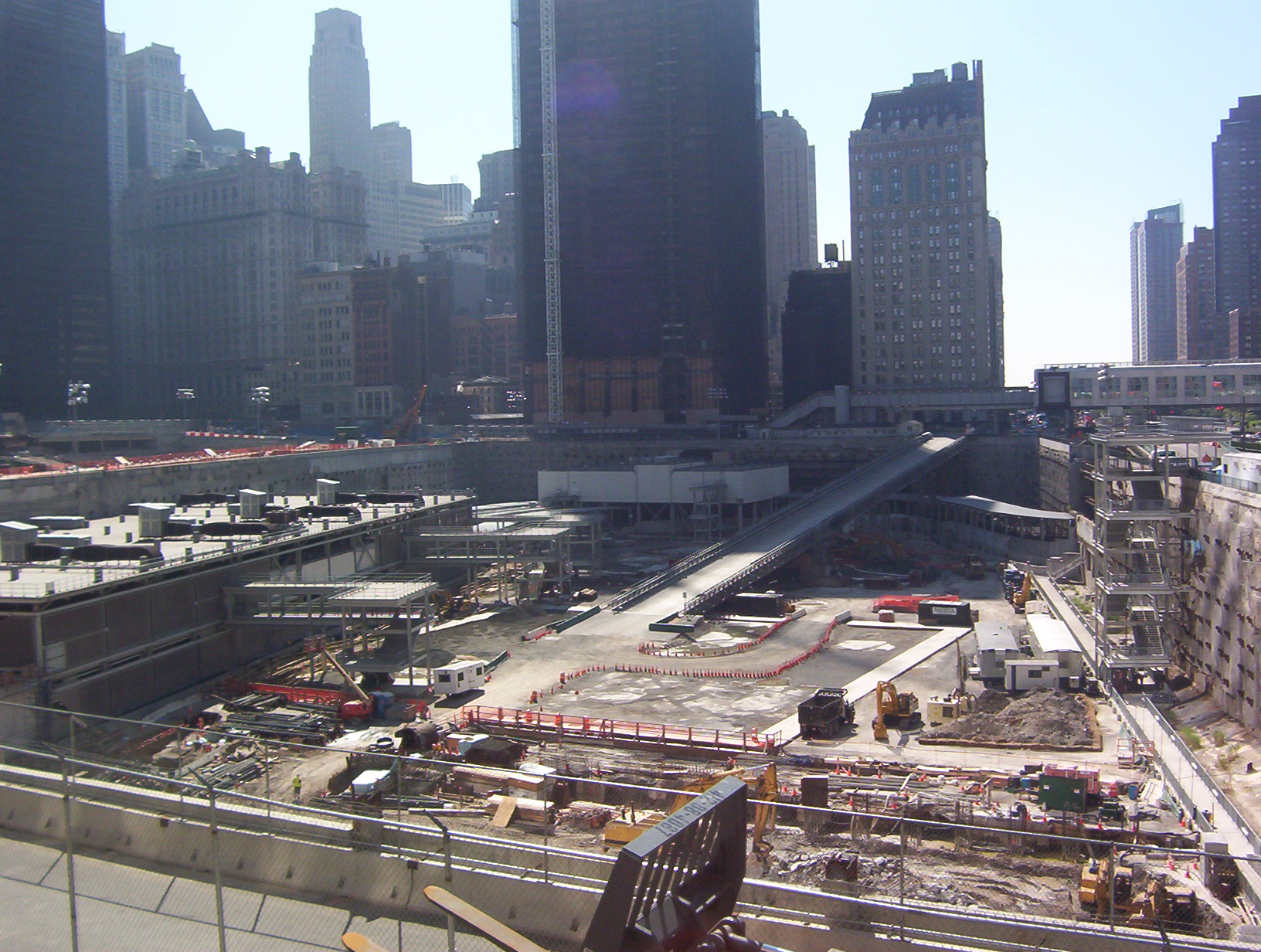
Land can be deemed “sacred ground” for many reasons, but I’m struck that much too often this concept has less to do with the experience of divinity than it does the exercise of human power.
The latest debate over the Cordoba Islamic community center is only the latest example of this phenomenon – on this point I believe blogger Paul Woodward hit the nail squarely on the head with this recent insight:
Another way of saying “sacred” is to say “off-limits.”
Something can be sanctified by placing a barrier around it constructed from rigid taboos. The most extreme among those taboos dictates not only silence but also exclusion.
In such a way, for many Americans, 9/11 has been sanctified. The sacred idea occupies a sacred space and only those willing to display sufficient awe and reverence can be allowed to enter.
Woodward is absolutely right that sacred space and exclusion can invariably go hand in hand. When we read in the Torah, for instance about the Israelites’ construction of the Tabernacle (and later in the Bible, the Temple itself), we learn that certain sacred areas correspond to the specific social hierarchies within the Israelite community. Rank and file Israelites are allowed into the outer courtyard, but the inner precincts are off limits to all but the priests. And only the High Priest himself is allowed into the innermost Holy of Holies – and only on Yom Kippur, the holiest day of the year.
Ironically enough, Jewish tradition teaches that it was precisely hierarchy and division that led to the loss of our most central of sacred spaces. According to the Rabbis, the destruction of the Second Temple was due not to the greater military might of the Romans, but because of the divisive, internecine hatreds (“sinat chinam”) harbored by the Jewish people between themselves. I often think about this teaching when I read about the power politics raging over the Western Wall or ongoing attempts to claim the areas in and around the Old City of Jerusalem in the name of the Jewish people alone.
When it comes to the area that is considered to be the holiest of places for Jews, I can’t help but think it has more often been a place of sacrilege, not sanctity. It has ever been thus: the more we press our own claims upon the places we deem sacred, the more we manage only to defile them in the end.
And so, as I have read about the horrid political wrangling over Cordoba House, it is becoming clearer and clearer to me that this little patch of land in Lower Manhattan will only truly become hallowed ground if we resist the temptation to yield exclusive political claims over it.
If there is any Biblical image we might look to for guidance, I would argue it is less the hierarchical, exclusivist priestly model than the universal, inclusive prophetic vision famously expressed in Isaiah 56:7: “My house shall be called a house of prayer for all peoples.”
To this end, I commend to you this recent statement from Faith in Public Life, to which I am honored to be a co-signer. I can think of no better definition of “sacred space” than this:
The profound tragedy of Sept. 11, 2001 revealed the horror that can unfold when a small minority of violent extremists manipulates religious language for political gain and falsely claims to represent one of the world’s great religions. We have witnessed this sinful corruption of religion across faith traditions throughout history and must condemn it without equivocation whenever or wherever it occurs. However, we fail to honor those murdered on that awful day – including Muslim Americans killed in the Twin Towers and Pentagon – by betraying our nation’s historic commitment to religious liberty, fueling ugly stereotypes about Islam and demeaning the vast majority of Muslims committed to peace. The proposed mosque would be part of Cordoba House, a center open to all Americans that will provide Islamic, interfaith and secular programs. The project aims to support “integration, tolerance of difference and community cohesion through arts and culture,” according to the Cordoba Initiative, which promotes improved “Muslim-West relations.” These are exactly the kind of efforts that foster dialogue, break down barriers and begin to build a world where religiously inspired violent extremism is less likely.
The latest issue of the Chicago Jewish News contains a wonderful cover story about my congregation and how we’ve been working to find a way to talk openly, honestly and civilly together about Israel. (The eye-grabbing headline: “HELL FREEZES OVER, CUBS WIN WORLD SERIES, JEWS FIND WAY TO DISAGREE AGREEABLY.”)
Here’s an excerpt:
“I have very strong feelings about Israel and I express them pretty openly. My activism is very public,” (Rabbi Rosen) says. “That is my own truth as a Jew and a rabbi, and it is very important to me to be true to my private personal conscience.”
But as the rabbi of JRC, “I also feel strongly that my job is to create the kind of environment where people, even those who don’t agree with me — and there are many — feel welcome to express those views and have those views heard. I respect the diversity of opinion at JRC,” he says. “We may be (perceived as) left-leaning, but on the subject of Israel, we are more diverse than people think.”
The largest group of congregants, he says, fall somewhere in the middle of a continuum, with some on both ends of the spectrum.
With these thoughts in mind, Rosen says, he and a number of congregants “decided together that rather than raise all this dust, it would be a great opportunity to use these emotions in some kind of constructive way.”
What else can I say other than that I’m enormously proud of my congregation?!
The most memorable aspect of my Pesach this year? A combination Passover – Good Friday service JRC held together with the wonderful folks at Lake Street Church of Evanston.
The whole thing was hatched somewhat by chance. A month or so ago I was having lunch with my good friend Reverend Bob Thompson of Lake St. Church (appropriately enough at Evanston’s Blind Faith Cafe) and our conversation turned to our respective upcoming rites of spring. Bob mentioned to my surprise that he hadn’t celebrated Good Friday at Lake St. in quite some time – mainly because he simply couldn’t abide by blood atonement theology – the notion that God would somehow require the bloodshed of one man to atone for all of the sins of the rest of the world.
For my part, I mentioned that Good Friday had not generally been so “good” to the Jews throughout history, since this was invariably the time in which the worst pogroms were perpetrated against European Jewish communities. As a result, for much of Jewish history Passover was a secret ritual: observed in fear and in private. Given our complicated mutual history, we both agreed that it would be enormously powerful to celebrate Passover and Good Friday together in a spirit of healing and hope.
So that is exactly what we did this last Friday. While Bob and I weren’t at all sure if this service would fly, it actually suceeded beyond our highest expectations. Hundreds of JRC and Lake St. members filled the sanctuary at Lake St. church. Together we celebrated with a service that mixed Hebrew and English, Jewish songs, Christian hymns and prayers for healing. We ended with a rousing “Down By The Riverside.” Afterwards, countless participants – both Jewish and Christian – told us that the service was an immensely moving and healing experience for them.
During the service, Bob and I had a conversation in which we both mused about what our respective holidays might look like if we recast them in the spirit of healing and hope. Bob began by saying the first thing Christians needed to do when celebrating Good Friday was to apologize to the Jewish community for the legacy of Christian anti-Semitism. He then went on to explore how Christians might recast the meaning of the crucifixion itself. Here’s what he had to say:
Every Good Friday well meaning folk gather to listen to priests and ministers talk about how Jesus was crucified, the “lamb of God,” to take away the sins of the world. In other words, Jesus died a sacrificial death to satisfy the God who demands retribution – the God who requires the shedding of blood for the forgiveness of sins.
Thankfully these days there’s an emergent form of Christianity – one that does not buy this “blood atonement theory” – and it is a theory. Today, more and more Christians are saying they do not believe that God requires the shedding of blood… The point is, violence is not a solution – it’s always a problem. We have to get to see that violence never purifies – it always defiles. In every form it is defiling.
That’s why if Jesus was standing here today, I believe he’d say, “don’t call me the lamb of God who takes away the sins of the world.” He might say rather something more like “I am a window to divinity and a mirror of humanity. What I came to do is to show you what it means to be open to the Divine and to reflect the best of who we are as human beings. And everybody can reflect this and be this window if only we have the spiritual vision to see clearly enough.”
In other words, Jesus, I believe, would not say that he suffered to keep us from suffering – he suffered because to be human is to suffer. Jesus hangs there because life is always hanging in the balance for all of us all of the time.
I was so taken by his willingness to take on the violence inherent in the crucifixion image – and I responded in kind with my remarks:
There’s no getting around it: to observe the Seder, you need to tell a story of oppression and violence. And you cannot get to what is for Christians resurrection and what is for Jews the Exodus from Egypt without going through that moment of violence…
I will also say I share with you, Bob, completely, that I do not view violence in any way as redemptive. I reject that categorically. I think we all have to. But we still have to struggle with the way violence affects us and what it does to us and what it does to our souls. We can’t ignore it. Even if we disavow it, we can’t ignore it.
As a Jew… I fear the violence that is embodied by the Seder and that has been waged against the Jewish people for centuries will turn us into a bitter people. That it will only cause us to have a sense of entitlement which means we use our pain as a weapon against the outside world because nothing we do to anyone else can be nearly as horrible as what’s been done to us. Or it will cause us to build bigger walls between us and the rest of the world and to instill a Jewish identity that basically says nothing more than “all the world really wants us dead, and that’s what it means to be a Jew. And we have to be forever vigilant because we live in a world that hates Jews.”
And while I’m not unmindful of this history and I do think we need to retell this history because those who do not study history are condemned to repeat it…I also think we need to look seriously at what this legacy of violence and oppression does to us and what we do with it.
And for me that means bearing witness to oppression in the world. If there is any sliver of redemption in violence, it means that it can open the door to empathy – and I would suggest that this idea comes from a very deep place in Biblical tradition – in the Torah.
The commandment commanded more times than any other in the Torah is some version of “Do not oppress the stranger because you were once strangers in the land of Egypt.” To me what that says is “you don’t take your pain and use it as a weapon against the outside world. You take your pain and use it as a tool for empathy with the outside world – and to bear witness against oppression no matter where it is fomented, whether it is in our community or it’s in any community.
We cannot hold on to our pain as uniquely ours, and I want to come back to something you said earlier, Bob: “We’re all in this together. It’s not some of us – it’s all of us. And violence against one people is violence against all.”
You can read some of Bob’s thoughts about our service on a piece he’s just written for Examiner.com You can also click below to hear an audio of the entire service. (The service itself begins at the 10:00 point).
The Passover 2010 seder supplements are arriving fast and furious. In my last post I shared my JVP supplement – here are a few more you can download and use to spice up your seder meal:
– The “Moral Voices” initiative of Penn Hillel has published “From Chains to Change” – a supplement that connects the lessons of Pesach to the contemporary scourge of human trafficking;
– Workingman’s Circle’s “10 Modern Plagues” demonstrates how our contemporary bounty is diminished by the suffering of others;
– J Street’s supplement asks “Four More Questions” about the prospects for the peace process in the coming year;
For those of you who believe that Jewish liberation and Palestinian liberation are inextricably intertwined, click here for “Four More Questions for Pesach” – a seder supplement I’ve just written for Jewish Voice for Peace.
I’ve spent the last three days in New Orleans, site of the Reconstructionist Rabbinical Association’s annual convention. Other than our day of service in NOLA’s Gentilly neighborhood, the big news from convention is our association’s passage of a resolution endorsing the Employee Free Choice Act. I’m proud to say it represents the strongest endorsement of the EFCA by any Jewish organization.
Click below for the text of the entire resolution: