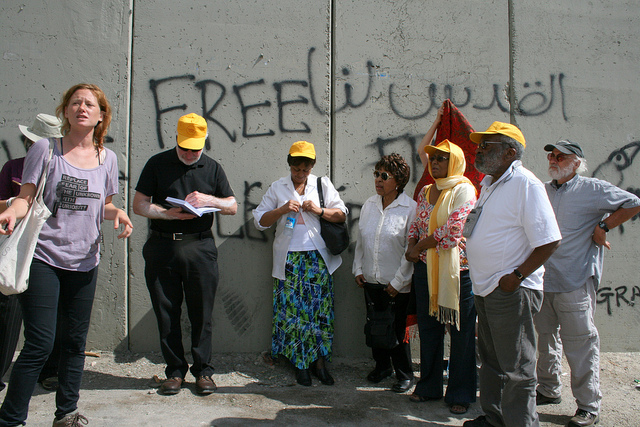
Delegates on a tour led by Ruth Edmonds of the Israeli Coalition Against Home Demolitions (photo: Allie Perry)
Received from my friend and colleague Rabbi Brian Walt:
“Our lives begin to end the day we become silent about the things that matter.”
Dr. Martin Luther King, Jr.
An immediate end to Israel’s assault on Gaza, “Operation Pillar of Defense,”matters. An immediate end to the violence—the onslaught of missiles, rockets, drones, killing, and targeted assassination—matters. An end to Israel’s ongoing blockade of Gaza matters. An end to Israeli’s 45-year occupation of Palestine matters. A resolution of the issue of Palestinian refugees expelled from their homes in 1948, many of whom live in Gaza matters. Equality, security, and human rights for everyone matters.
We write as individuals who recently traveled to the West Bank with the Dorothy Cotton Institute’s 2012 Civil and Human Rights Delegation, organized by Interfaith Peace-Builders. We cannot and will not be silent. We join our voices with people around the world who are calling for an immediate cease-fire. Specifically, we implore President Barack Obama to demand that Israel withdraw its forces from Gaza’s borders; make U.S. aid to Israel conditional upon Israel’s adherence with relevant U.S. and international law; work with Israeli and Palestinian leaders to bring an end to Israel’s occupation of the Palestinian territories and to secure a just peace that ensures everyone’s human rights.
In the words of Dr. Martin Luther King, Jr., “Returning violence for violence multiplies violence, adding deeper darkness to a night already devoid of stars.” As Prime Minister Yitzhak Rabin declared in 1993, “Enough of blood and tears.” Enough!
We deplore the firing of rockets on civilian areas in Israel. We also deplore and are outraged by the asymmetry, the disproportionality, of Israel’s bombardment of Gaza, evidenced by the growing number of Palestinian civilian deaths and casualties. This is not a conflict between equal powers, but between a prosperous occupying nation on one hand, armed and sanctioned by 3 billion dollars in annual U.S. military aid, and on the other, a population of 1.7 million besieged people, trapped within a strip of land only 6 miles by 26 miles, (147 square miles) in what amounts to an open-air prison.
United States military support to Israel is huge. From 2000 to 2009, the US appropriated to Israel $24 billion in military aid, delivering more than 670 million weapons and related military equipment with this money. During these same years, through its illegal military occupation of the Palestinian West Bank, East Jerusalem and Gaza Strip, Israel killed at least 2,969 Palestinians who took no part in hostilities.
During our trip to the West Bank, we witnessed for ourselves the injustice and violence of the Israeli occupation and the suffering inflicted on the Palestinians, in violation of international law and UN resolutions.
In the Palestinian village of Nabi Saleh, for just one example, we observed a weekly nonviolent protest. The neighboring Israeli settlement of Halamish was illegally built on Nabi Saleh’s land. This settlement has also seized control of the Nabi Saleh’s water spring, allowing villagers to access their own spring water for only 7-10 hours a week. Demonstrators of all ages participated in the protest, including several who, in recognition of the civil rights veterans in our delegation, carried posters with quotations from Dr. Martin Luther King, Jr. We watched in horror as heavily armed members of the Israel Defense Forces (IDF) responded to this peaceful assembly with violence, strafing the demonstrators with a barrage of tear gas canisters, rubber bullets, gas grenades, and even a round of live ammunition.
The IDF assault in response to these weekly nonviolent demonstrations can be deadly. Rushdi Tamimi, a young adult Nabi Saleh villager, died this past week while he was protesting Israel’s attack on Gaza. The IDF fired rubber bullets into Rushdi’s back and bullets into his gut, and slammed his head with a rifle butt.
Israel’s assault on Gaza is exponentially more violent than what we witnessed in the West Bank, but the context–the oppression of the Palestinian people—is the same. Most of the inhabitants of Gaza are refugees or descendants of refugees expelled from their homes in Israel in 1948. This dispossession of the Palestinians that they call the Nakba (The Catastrophe) continues on the West Bank where Israel has built extensive Jewish settlements on confiscated Palestinian land. We saw with our own eyes how this settlement expansion and the systemic discrimination has further dispossessed the Palestinian people and is creating a “silent transfer” of Palestinians who are either forced or decide to leave because of the oppression. This injustice—Israel’s decades-long oppression of the Palestinian people—has to be addressed by honest and good-faith negotiations and a genuine agreement to share the land. The alternative is a future of endless eruptions of aggression, senseless bloodshed, and more trauma for Palestinians and Israelis. This surely matters to all people of good will.
To President Obama, we say, use the immense power and authority United States citizens have once again entrusted to you, to exercise your courage and moral leadership to preserve lives and protect the dignity and self-determination, to which the Palestinian people and all people are entitled. Israel relies upon the economic, military, and strategic cooperation and support of the United States. You have the power to not only appeal to Israel to show restraint, but to require it.
Feeling ourselves deeply a part of “We the People,” sharing so much of your own tradition of organizing for justice and peace, we believe it is just, moral and in keeping with the best spirit of Dr. King to urge you to:
§ Call for an end to violence by all parties and an immediate cease-fire for the sake of all people in the region.
§ Use your power to demand that Israeli Prime Minister Benjamin Netanyahu and the IDF cease the bombardment of Gaza and withdraw their armed forces immediately.
§ Join with the international community in using all diplomatic, economic, and strategic means to end Israel’s illegal, brutal siege of Gaza.
§ Insist that the United States condition aid to Israel on compliance with U.S. law (specifically the U.S. Arms Export Control Act) and with international law.
§ Work with the leaders of Israel and Palestine to secure an end to Israel’s occupation and to negotiate a just peace.
As citizens of the United States, we are responsible for what our government does in our name, and so we will not be silent. Justice, peace and truth matter. The future of the children of Israel and Palestine matter. We cannot be silent and neither can you.
Members of the The Dorothy Cotton Institute 2012 Civil and Human Rights Delegation:
(List in formation)

 Shalom Rav