Category Archives: Nonviolence

My Lunch with Yonatan Shapira

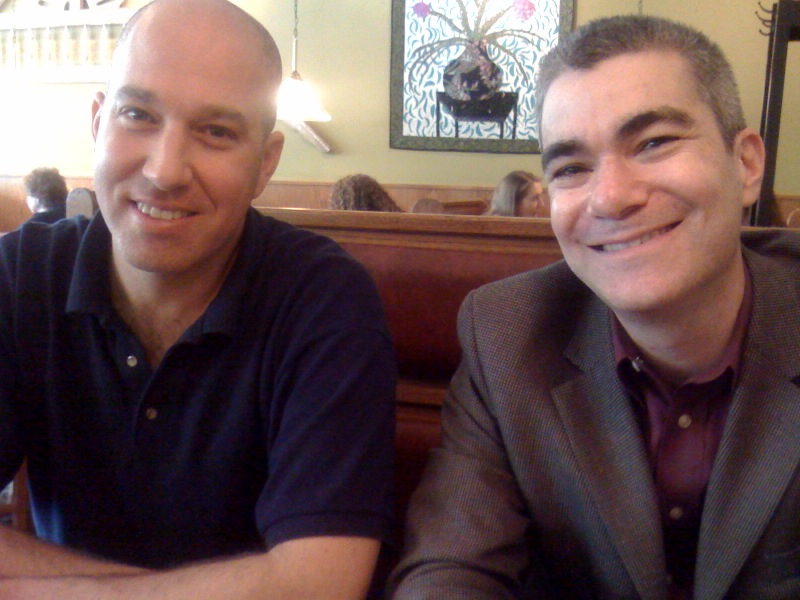
Had the pleasure of meeting Yonatan Shapira for lunch in Evanston yesterday.  If you’ve never heard of him, Yonatan was an officer in the Israeli Air Force and flew hundreds of missions over the territories in a Blackhawk helicopter squadron during the course of his eleven year career. Following a targeted bomb assassination of a Hamas leader that killed fourteen civilians in Gaza, he became a prominent Israeli “refusenik,” authoring the Pilot’s Letter – a 2003 statement signed by 27 Israeli pilots who publicly refused to fly missions over the Occupied Territories.

Since that time, Yonatan has gone on to co-found “Combatants for Peace” a prominent organization in the growing Israeli Refusenik movement. A few years ago he gained some more notoriety for writing and performing “Numu, Numu,” a powerful protest song written in the form of an ironic “Lullaby to Pilots.”   (More recently, he’s become the object of a pop love song that’s currently making the rounds on Israeli radio – Richard Silverstein has the story on that in Tikun Olam).

I had known of Yonatan’s refusenik activism, but during our lunch conversation I was surprised to learn that he is also very active in supporting non-violent Palestinian actions in Sheikh Jarrah, Bi’ilin and throughout the Occupied Territories. (He was, in fact, arrested last January at a demonstration in Sheikh Jarrah.) He told me that this work has been transformative for him, explaining that as an IDF officer and even as a leader in the Israeli peace movement he has always been socialized to step forward and lead the way. He said he’s come to realize that the most important way he can serve now is to “stand behind” Palestinians in their non-violent campaign for liberation.

He told me numerous stories about his experiences at demonstrations. He mentioned that the IDF is increasing their crackdown on protesters, that they hire infiltrators to throw stones at the army to given soldiers the a pretext to open fire. None of it succeeds, of course: quite the opposite. The Palestinian non-violence movement is growing steadily – a “White Intifada” that  Yonatan believes has already begun. As a IDF officer himself, he explained the Israeli military mentality – that army commanders truly believe they have the power to “outlaw” these protests through the sheer force of their military might.

Yonatan also mentioned that as part of his support of non-violent Palestinian activism, he has also signed on to the internal Israeli movement for Boycott, Divestment and Sanctions (BDS) known as “Boycott from Within.”   Now that is the new definition of bravery: a high ranking Israeli Air Force veteran who comes from a military family (his father was a fighter pilot during the Six Day War) has now firmly put himself on the front lines of a global non-violence campaign initiated by the very people he himself had once been trained to attack.

I assumed that Yonatan would be made a virtual pariah for his public stands. He replied that as a military man he understands how soldiers think and generally knows how to engage them in dialogue even when they strongly disagree with him.  He also mentioned that his family is supportive of his work – his father “is not quite there yet” but respects his activism and his mother is “the most active of them all.”

Click below for Yonatan’s “Lullaby for Pilots:”

Thousands Rally in Sheikh Jarrah!

By all reports, the protests against Palestinian home evictions in Sheikh Jarrah, East Jerusalem have evolved into a political phenomenon that cannot be ignored. Last Saturday night, thousands of demonstrators came out in the largest joint Israeli-Palestinian protest on record.

For more: this Ynet article posted in Coteret, blogger Jerry Haber’s report on Magnes Zionist, and a piece from the Jerusalem Post.  My friend and colleague Father Cotton Fite is currently visiting Israel/Palestine; he attended the rally and has just posted impressions on his blog.  My good pal Rabbi Brian Walt also offers a thorough report.

An excerpt from Brian’s post:

I have attended several Israeli demonstrations but this was the first demonstration where there was a large presence of Palestinians, Palestinian flags, and speakers who addressed the crowd in Arabic.  The mixed crowd – Israeli Jews, mostly secular but some wearing kippot, Palestinian women in traditional dress, Palestinian and Israeli youth – felt wonderful, a rare experience of the reality in this country, two peoples living together on the land with two languages, two cultures and three or more religions.  It is very rare for the two peoples to share anything.   I think among the young people involved in this struggle it is truly an Israeli – Palestinian effort and their vision is one of a shared future.  One of the most prominent posters at these rallies reads: Jews and Arabs together, refuse to be enemies.  In Hebrew it rhymes: Yehudim v’Aravim, mesarvim lih’yot oyvim.

This image inspired something in me something resembling hope – something I haven’t felt re the Israel/Palestine conflict in a long, long time…

Mobilization for Justice in Sheikh Jarrah

The protest in Sheikh Jarrah, East Jerusalem seems to be reaching a fever pitch. Organizers have now called for a rally this Saturday night that they hope will attract thousands.

From a Ma’ariv article by Hagai El-Ad, Executive Director of the Association for Civil Rights in Israel:

This Saturday night (March 6, 2010) will witness one of the most important demonstrations in years, in the struggle for human rights and justice here…

The asymmetric legal situation in Israel, through the Absentee Property Law, makes it possible for Jews to return to property that was owned by Jews before 1948 — while Palestinian property return is completely impossible. This is both unjust and unwise. In Sheikh Jarrah, this has resulted in Palestinian refugees, originally housed in the neighborhood by the Jordanian government after 1948, becoming refugees a second time. Of course, unlike the settlers forcing the Palestinians out of their homes, the Palestinians cannot return to the homes they owned before 1948 — not in Jaffa, nor in West Jerusalem or anywhere else…

(What) is happening in Sheikh Jarrah is part of a larger process — the Hebronization of East Jerusalem … As if watching the replay of a movie whose ending we have already seen, here in front of our eyes the Hebron processes are taking place once again, this time in Jerusalem: the entry of settlers to the heart of a Palestinian neighborhood, the provocations and violence, the one-sided actions of the security forces – always serving the interests of the Jewish settlers over the rights of the Palestinian residents. And then, what follows: restrictions of movement, segregation, life becoming a nightmare, and all this in the name of “security considerations.” Shuhada Street in Hebron is already closed for Palestinians for years — a street that was part of the bustling heart of one of the largest Palestinian cities, and has become a ghost road in the service of extremist settlers, the human rights of local Palestinians thrown to the roadside.

A similar process to what has already happened in Hebron is now happening in Jerusalem. Sheikh Jarrah now has police checkpoints at the entrance to the neighborhood. During certain hours on Friday the entrance to the neighborhood is generally blocked, but is open to Jewish worshipers. In contrast, Jews wishing to enter Sheikh Jarrah to express solidarity with the Palestinian families are prevented from entering the neighborhood. Violence against Palestinians ends with arrests — of Palestinians. The mechanism of dispossession and the construction of security excuses are already at work. And all this is happening right here, in Jerusalem.

Rabbi Brian Walt has also written a powerful post about a recent protest in Sheikh Jarrah. This is what I wrote about the situation there last December:

International protesters refer to these actions as “ethnic cleansing.” If that seems like too incendiary a term, what do we prefer to call it? And more critically, what are we going to do about it?

A BDS Wake Up Call?

A recent report from the Forward:

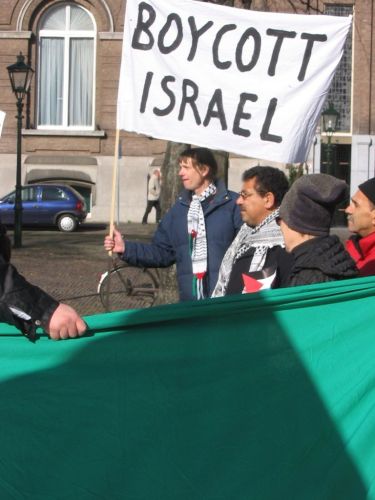
With anti-Israel boycott, divestment and sanctions efforts gaining visibility, the Jewish community’s main public-policy coordinating body is for the first time confronting the BDS movement as a specific and stated priority.

At its recent annual plenum, the Jewish Council for Public Affairs passed a resolution stating that BDS should now “be regarded with the utmost seriousness and urgency.”

“This is a very serious matter,” JCPA’s executive director, Rabbi Steve Gutow, told the Forward. “We need to wake up, whether we are on the right, left or center.”

The JCPA, an umbrella body representing Jewish community relations councils across the country and more than a dozen leading national Jewish groups, adopted the anti-BDS resolution at its plenum in Dallas on February 23. Gutow said that JCPA member groups are planning to create a permanent body that would respond to the activities of the BDS movement.

My two cents: creating a permanent body to combat the “negative branding” caused by BDS is a waste of Jewish communal resources.  I just don’t believe that the old counterattack tactics will work any more (if they ever did).  I’d suggest that if the Jewish community really wants to “wake up” to the challenge presented by BDS, then we need to honestly confront the fundamental reasons for its growth in the first place.

The BDS movement was founded in 2005 by a coalition of Palestinian groups who sought to fight for Israel’s human rights violations through nonviolent direct action. It arose out of their frustration over Israel’s continued refusal to comply with international law on any number of critical issues – and the oppressive manner in which it has occupied and ruled over Palestinians. I can’t help but think that by treating BDS simply as a PR threat to be fought, we’re utterly misunderstanding the essential of the point (and strength) of this movement.

By all accounts, this campaign is rapidly gaining support. It’s not a stretch to assume that the longer this oppressive status quo is allowed to continue, the longer Palestinians will resist – and the longer they will seek international support for their resistance.  One year ago, I predicted as much on this blog: BDS will grow as long as very real injustices remain unaddressed.

When will we wake up to this painful reality?

My Favorite Rabbis: Everett Gendler

Most people probably don’t realize this, but rabbis need rabbis too.

And there are a lot of great rabbis out there. Over the years I’ve been personally inspired by many of them: remarkable, talented leaders whose work challenges me, drives me and constantly reminds me why I do what I do. So with this post I’m debuting a new series I’m calling “My Favorite Rabbis:” ongoing profiles of the contemporary rabbis whom I consider to be my own spiritual teachers.

I’ll start by introducing you to Rabbi Everett Gendler, a Conservative rabbi whose moral courage has provided Jewish leadership for some of the most important progressive causes of our day. Today, some fifty years since he became a rabbi, I believe he remains on the cutting edge of the issues that truly matter.

This MLK weekend, it is certainly appropriate to note that Rabbi Gendler was one of the first rabbis to become actively involved in the struggle for civil rights in America and played a critical role in involving American rabbinical leadership in the movement. It’s doubtful that American rabbis would have stepped up to this struggle nearly as much had it not been for Rabbi Gendler’s prophetic influence.

During the early and mid-1960s, Rabbi Gendler led groups of American rabbis to participate in numerous prayer vigils and protests throughout the South. Of course many know that the legendary Rabbi Abraham Joshua Heschel marched with Dr. Martin Luther King in Selma in 1965. I imagine far fewer are aware that it was in fact Rabbi Gendler who persuaded Heschel to do so.

Heschel biographer Edward K. Kaplan writes:

Despite fears for his safety from his wife and the twelve year old Susannah, (Rabbi Heschel) agreed to join the march at the urging of Rabbi Everett Gendler, a pacifist and former student. Gendler had led a group of rabbis to Birmingham, Alabama to work for voting rights and remained in touch with the Reverend Andrew Young, King’s Executive Assistant at the SCLC. (From “Spiritual Radical: Abraham Joshua Heschel in America,” p. 222)

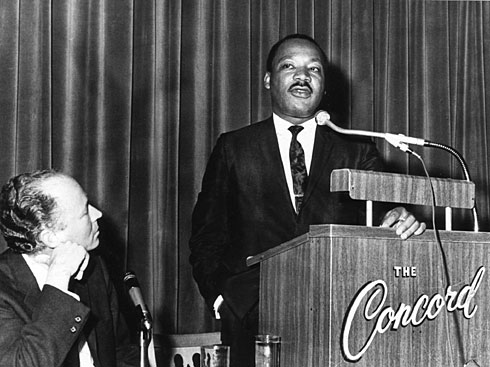
Rabbi Gendler was also instrumental in arranging Martin Luther King’s keynote address at the Rabbinical Assembly’s convention on March 25, 1968. This now-legendary speech took place at the Concord Resort hotel in New York’s Catskill Mountains just 10 days before King’s death. (That’s Rabbi Gendler to the left of Dr. King in the pic above).

Today, decades after King’s death, Rabbi Gendler remains an eloquent Jewish advocate for the path of nonviolence. His work has taken him across the world – most notably to India where he and his wife Mary teach the principles of nonviolence to Tibetan exiles.

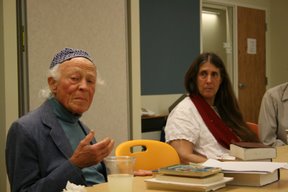
I’m personally honored to serve with Rabbi Gendler on the Elder’s Council of the Shomer Shalom Institute for Jewish Nonviolence. In this picture, he leads a workshop at JRC in 2008. Shomer Shalom founder Rabbi Lynn Gottlieb (someone whom I may well be profiling in the future) is sitting next to him.

Rabbi Gendler has also been a long time advocate for Palestinian human rights – and his courageous stands have made it possible for new generations of rabbis to find their own voices on this painful issue. When Rabbi Brian Walt and I first began Ta’anit Tzedek and were looking for rabbis to join our campaign to protest the blockade of Gaza, we immediately turned to Rabbi Gendler, who joined our effort without hesitation. It is difficult to describe how much it means to know there are rabbis out there like Everett, someone who has been putting himself on the line for so long, and upon whom we always know we can rely for guidance and support.

Rabbi Gendler was also one of the first Jewish leaders to embrace environmentalism and vegetarianism long before they became fashionable. As the rabbi of a green synagogue myself, I recognize a tremendous debt to Everett, who more than anyone helped to put environmental issues on the radar screen of the Jewish community.

From a 2008 article in the Los Angeles Jewish Journal:

On a ferociously cold evening in November 1978, Rabbi Everett Gendler climbed atop the icy roof of Temple Emanuel in Lowell, Mass., and installed solar panels to fuel the synagogue’s ner tamid (eternal light)…

Gendler’s conversion of that eternal light marks the first known action to green a synagogue, making it more spiritually and ecologically sustainable, and Gendler himself, now Temple Emanuel’s rabbi emeritus, has been hailed as the father of Jewish environmentalism.

There so much more to say about Everett and his work. I suppose the most essential thing I can say about him is that he was and remains a spiritual maverick. His work remains as relevant and courageous as ever.

As we honor Dr. King this weekend, it’s critically important to honor those who continue his to walk his path in our own day. For me and so many others, Rabbi Everett Gendler is the one who teaches us how to walk that walk.

Palestinian Christians: “The Occupation is a Sin”

Last week, a group of Palestinian Christians representing a variety of churches and church-related organizations issued a powerful, prayerful call for an end to the Israeli occupation.  My friend Rabbi Brian Walt was present at the meeting in Bethlehem in which the statement – known as  “The Kairos Palestine Document” – was released. Upon his return, he described to me his profound, often painful conversations with Palestinian Christians and he told me that as a Jew, he considered the Kairos Document to be an enormously important spiritual/political statement. Having now read the entire 12 page document, I must say that I agree wholeheartedly.

Palestinian Christian liberation theologians such as Naim Ateek of the Sabeel Institute have been doing important work for decades and I believe their ideas present important spiritual challenges to the Jewish community. Many Jews point to the more radical incarnations of these theologies – and while I share some of these concerns, I believe that we make a profound mistake by dismissing Palestinian Christian theology wholesale. (Frankly, I am much more troubled by the “End of Days” theologies of fundamentalist Zionist Christians such as Pastor John Hagee than I am by Naim Ateek and the authors of the Kairos document.)

My friend and colleague Father Cotton Fite of St. Luke’s Church in Evanston, tells me he hopes that American Christians will study the Kairos Document carefully. I mentioned to him that I hoped Jews would read it as well. In fact, I think we should create opportunities to read it together. Despite our differences, I believe it offers both of our communities an ideal place to begin meaningful dialogue over the spiritual implications of this conflict.

One of the more important and challenging passages:

Our presence in this land, as Christian and Muslim Palestinians, is not accidental but rather deeply rooted in the history and geography of this land, resonant with the connectedness of any other people to the land it lives in. It was an injustice when we were driven out. The West sought to make amends for what Jews had endured in the countries of Europe, but it made amends on our account and in our land. They tried to correct an injustice and the result was a new injustice.

I can already predict that many Jews will bristle that this passage does not specifically reference the Jewish connection to the land as well. To this I would say, how deeply do we Jews ever honor the reality that we are not the only people who are “deeply rooted in the history and geography of this land?” Moreover, how deeply do we ever face the true injustice that was committed when a people with deep roots in the land were driven out and not allowed to return?

Another sobering passage in the document describes the Occupation as no less than a “sin:”

We also declare that the Israeli occupation of Palestinian land is a sin against God and humanity because it deprives the Palestinians of their basic human rights, bestowed by God. It distorts the image of God in the Israeli who has become an occupier just as it distorts this image in the Palestinian living under occupation. We declare that any theology, seemingly based on the Bible or on faith or on history, that legitimizes the occupation, is far from Christian teachings, because it calls for violence and holy war in the name of God Almighty, subordinating God to temporary human interests, and distorting the divine image in the human beings living under both political and theological injustice.

Many of us view the Occupation as a political problem to be solved. But indeed, as Jews, we must admit basic human rights are rooted in our religious tradition. Like Christians, we also believe that all human beings are created in the image of God. We also believe that when the basic dignity of anyone’s humanity is diminished, the Divine Image is diminished as well. How then, can we fail to understand that the Occupation is not only a geo-political problem but a spiritual/moral problem as well?

This conclusion leads to a logical next step:

Love is seeing the face of God in every human being. Every person is my brother or my sister. However, seeing the face of God in everyone does not mean accepting evil or aggression on their part. Rather, this love seeks to correct the evil and stop the aggression.

The injustice against the Palestinian people which is the Israeli occupation, is an evil that must be resisted. It is an evil and a sin that must be resisted and removed. Primary responsibility for this rests with the Palestinians themselves suffering occupation. Christian love invites us to resist it. However, love puts an end to evil by walking in the ways of justice. Responsibility lies also with the international community, because international law regulates relations between peoples today. Finally responsibility lies with the perpetrators of the injustice; they must liberate themselves from the evil that is in them and the injustice they have imposed on others.

Again, the Occupation is viewed not as a diplomatic issue to be negotiated but a spiritual evil to be resisted.

I have no illusions that for many Jews, suggestions such as these present daunting and painful challenges.  So will many of the ultimate political ramifications of the Kairos Document. All I can hope for is that political disagreements will not keep us from honestly facing the profound spiritual dimensions of this conflict.  Speaking for myself, I do believe this statement was written in good faith, genuine love and true religious conviction:

Our message to the Jews tells them: Even though we have fought one another in the recent past and still struggle today, we are able to love and live together. We can organize our political life, with all its complexity, according to the logic of this love and its power, after ending the occupation and establishing justice.

What can I say to this except “Amen?”

Judaism as Nonviolence: A Sermon for Rosh Hashanah

During my Rosh Hashanah sermon, I asked the following questions:

Is there a place in Judaism for pacifism? Is it in fact possible – or desirable – as a Jew, to walk the path of nonviolence?

Click below to read my answers…

Continue reading

I Can’t Dance Any More

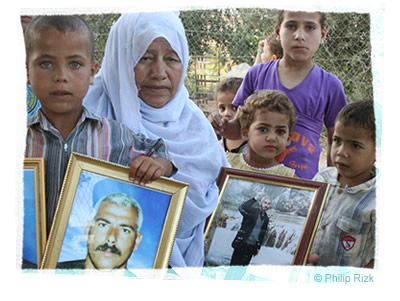
Salah_Fam

I know there are those who wonder why, with all of the various injustices going on in the world, do I seem to dwell on Israel’s treatment of Palestinians?  It’s a fair and important question.  For me it boils down to this: I’ve come to believe that too many of us in the Jewish community will unabashedly protest persecution anywhere in the world, yet remain silent when Israel acts oppressively.

I know all too well how we actively avoid this truth. We use any number of rhetorical and political arguments to deny it, to mitigate the discomfort and pain it causes us.  We engage in a kind of tortured dance of rationalization that we save for no other world issue but this one. But for me, at least, but none of it really addresses the core issue at hand: however difficult it might be for us to face, Israel is unjustly oppressing Palestinians.

So what are we going to do about it?

Many of us deal with it by putting our faith and efforts into the peace process. And well we should: though I’ve been honest in expressing my own doubts and concerns regarding the peace process, I understand that in the end the only true solution to this conflict will be a political one.  But as the peace process enters into its latest incarnation, as the various actors involved painfully wrangle over diplomatic parameters, it is safe to say this saga will continue to take its time to unfold. And in the meantime, the real lives of real Palestinians on the ground will continue to grow increasingly intolerable.

For myself, at least, I cannot use the peace process, critical as it is, as a kind cover to keep me from facing and protesting the oppression that is occuring in Israel/Palestine every day, even as I write these very words.  While I will do what I can to advocate for a just and peaceful political settlement to this crisis, this work does not give me a pass on speaking out. If we truly believe we must protest injustice anywhere, anytime, then it seems to me that this principle must apply to Israel/Palestine as well, no matter how painful or difficult the prospect of doing so.

Earlier this week, I was the moderator of a discussion following the showing of a powerful new documentary, “This Palestinian Life” – a film that was often unbearably painful to watch. TPL documents a little-seen aspect of Palestinian life: the nonviolent steadfastness (in Arabic: “sumoud“) of Palestinian villagers who live with a crushing occupation, constant settler attacks, and the deliberate, relentless annexation of their farm land.

This quote from one villager sums up the movie’s essential theme:

I don’t own a gun.

I don’t own any weapons and I’m not prepared to own any…

My only weapon of defense is that I won’t leave this place…

and my hope is that the world will respond to Israel’s treatment of us.

As difficult as it was, I was honored to have been asked to moderate the post-film discussion. I know there are many who would regard my participation in such a program as an act of disloyalty or at the very least an exercise in masochism. But in the end, it really came down to this: I just can’t do the dance any more.

People You Should Know About: Ezra Nawi

If you’re looking for the definition of an Israeli hero, here’s my nomination: human rights activist Ezra Nawi.  Well-known in the Israeli-Palestinian peace movement, Nawi is a true original. This is how he was described by journalist Neve Gordon in a recent Guardian article:

Nawi is not a typical rights activist. A member of the Ta’ayush Arab-Jewish Partnership he is a Jewish Israeli of Iraqi descent who speaks fluent Arabic. He is a gay man in his fifties and a plumber by trade. Perhaps because he himself comes from the margins, he empathises with others who have been marginalised – often violently.

Nawi has long been active on behalf of the Palestinians and Bedouins of South Hebron, a region where the occupation is particularly oppressive and harassment at the hands of Jewish settlers is virtually constant. While his non-violent activism has helped bring international attention to this troubled region, it has also made him a target in the eyes of the occupation authorities. In July 2007, he was arrested and charged with assaulting a police officer while protesting the destruction of a Palestinian house. He will be sentenced next month and will most certainly face jail time unless there is a significant public outcry.

As it turns out, the home demolition and arrest were all captured on film and broadcast on the Israeli news. (Click above – Nawi is the one in the green jacket and the grey cap.)  The footage is riveting and everything is clearly documented from beginning to end (including the non-assault of the officer.)  Nawi himself gets the last word however. Sitting handcuffed in a military vehicle before laughing, scornful soldiers he says, “Yes, I was also a soldier, but I did not demolish houses. There’s a big difference. The only thing that will be left here is hatred…”

Since Nawi’s arrest, support has been building. Jesse Hochheiser’s blog, “Across the Borderline” contains several powerful testimonials, including this from Hebrew University professor and fellow Ta’ayush activist David Shulman:

Ezra Nawi is probably the most courageous person I have ever met. I have seen him in countless moments when settlers violently attacked him and other peace activists, Palestinians and Israelis; his presence of mind, steadfastness, and clarity always got us through such times. He is that most unusual of human beings– a person of profound inner gentleness and moral principle, selfless and creative in finding ways to help the Palestinian shepherds and farmers of the South Hebron hills.

The only thing standing between Ezra Nawi and imprisonment is your voice. Click here to offer your support.

In Search of Perspective in Bil’in

Recently read a piece on Ynet describing the experience of IDF soldiers stationed in Bil’in – a Palestinian village which has been the site of a weekly demonstration for the past four years. I was particularly intruiged by the description of one soldier, who described the detail as “more terrifying for us than dealing with terrorists in Gaza inside a tank:”

In Gaza you spot a terrorist, fire a shell, and it’s over. Here you face citizens who hurl a stone or a Molotov cocktail, but your ability to respond is limited. It may appear that we are the ones using force here, but in reality that’s not the case, as we are subject to very difficult restrictions.

I completely understand the perspective of an individual soldier who is ordered to perform a incomprehensibly difficult duty such as this. But I understand that there is also more to understand – so much more.  I certainly don’t begrudge the experience of individuals caught up in this bitter struggle. But I believe we do ourselves a huge disservice when we neglect – as this article did – the larger context in which this struggle occurs.

Some context: the Bil’in demonstration was born in response to Israel’s placement of its separation barrier in such a way that it now separates 60% of the village from its farming land – land that Israel is using to expand its settlement of Modi’in Illit, which lies immediately to the west.

In 2007, the Israeli Supreme Court ordered the government to reroute the barrier, which it called “highly prejudicial” to the villagers of Bil’in. Though Israel’s Defense Ministry has said it will abide by the ruling, the fence has yet to be moved. Just last month, the state submitted a new proposal to the Court to redraw the route of the barrier. According this plan, however, only 700 of the original 1,700 dunams of farmland will be returned to the villagers of Bil’in.

The Bil’in demonstration  is a non-violent direction action that began in January 2005 and has taken place every Friday since then (see clip above). Though Bil’in is a local initiative, it is an integral part of the larger Palestinian non-violence movement- a significant socio-political phenomenon that is chronically under reported by the Western media.  Indeed, it is important to note that Palestinian non-violent action vastly predates Bil’in – this is a movement that coalesced in large part during the years of the First Intifada. (I highly recommend Mary Elizabeth King’s excellent book, “A Quiet Revolution” for more on this important history.)

It has been well reported that the Bil’in demonstrations have witnessed tragedy in recent months. Four Palestinians, including two children, have been killed in the area since last summer and dozens have been injured. Last month Bassem Abu Rahmeh, a Palestinian demonstrator, was killed by a tear gas canister that sliced through his chest. A month earlier, an American demonstrator named Tristan Anderson was critically injured in a similar demonstration in the nearby village of Ni’ilin.

As the YNet article attests, some Palestinian demonstrators have indeed become increasingly violent. In a sense, we are witnessing the classic spiral. As any student of non-violent activism knows, it is difficult to contain the frustration that invariably sets in when an action settles in for the long haul – particularly when there is so little progress along the way.  This recent article from the Guardian illuminates the challenges the Bil’in protesters face in this regard – including the generational split in the villagers’ attitudes toward non-violence:

The Bil’in demonstration was always intended to be non-violent, although on Friday, as is often the case, there were half a dozen younger, angrier men lobbing stones at the soldiers with slingshots. The Israeli military, for its part, fires teargas, stun grenades, rubber-coated bullets and sometimes live ammunition at the crowd.

There have long been Palestinian advocates of non-violence, but they were drowned out by the militancy of the second intifada, the uprising that began in late 2000 and erupted into waves of appalling suicide bombings.

Eyad Burnat, 36, has spent long hours in discussions with the young men of Bil’in, a small village of fewer than 2,000, convincing them of the merits of “civil grassroots resistance”.

“Of course it gets more difficult when someone is killed,” said Burnat, who heads the demonstration. “But we’ve faced these problems in the past. We’ve had more than 60 people arrested and still they go back to non-violence. We’ve made a strategic decision.”

Some, like the moderate Palestinian MP Mustafa Barghouti, hope this might be the start of a broader movement throughout Palestinian society. “It is a spark that is spreading,” he said in Bil’in. “It gives an alternative to the useless negotiations and to those who say only violence can help.”

But it is not so much that all the young men of the village are converted to the peaceful cause, rather that they respect and follow their elders. “I personally don’t believe in non-violent resistance,” said Nayef al-Khatib, 21, an accountancy student. “They’ve taken our land by force so we should take it back from them by force.”

As always, perspective is everything. The Ynet article did a fine job of documenting the perspective of scared, frustrated young soldiers who find themselves in an impossible position. But there there are other equally valid and compelling perspectives we cannot ignore: the perspective of the farmers whose access to their own lands and livelihood have been taken from them; the perspective of villagers seeking justice in an inherently unjust situation; the perspective of non-violent activists trying to rise about the frustration and rage that inevitably surface during the course of their struggle.

As for us Jews, I only hope we can go beyond our narrow perspective of Palestinians as nothing more than violent terrorists who want nothing more than to wipe Jews off the face of the map. Is that a step we might be willing to take?