Category Archives: Nonviolence

Reflections on the Four Cups – A Guest Post by Rabbi Lynn Gottlieb

4cupsHere is a guest post written by my friend and colleague, Rabbi Lynn Gottlieb, founder of Shomer Shalom Institute for Jewish Nonviolence. Read it around your seder table:

Talmud Yerushalmi (Pesachim 10a) associates the four verses that describe the liberation of the families of Israel from subjugation with the four cups of wine at the Passover table. As it is written, “Say, therefore to the Families of Yisrael, ‘I am Adonai and I will take you out from under the burdens of Mitzryim, and I will save you from their bondage, and I will redeem you with an outstretched arm and with great judgments and I will take you to Me as a people…and you shall know the Spirit that draws you forth from under the burdens of subjugation.”

The four words imply a process a process of transformation. This process has four parts: Mitzryim is the Hebrew word that refers to the condition of structural subjugation. Pesakh moves from limping under the burden of the oppression to leaping like a liberated lamb through the parting seas that lead to freedom. The process happens in stages.

V’hotzayti~I will take you out: Complete subjugation is resisted by resisting the occupation of the mind that oppression imposes. In this stage we must ask questions that release us from the narratives that justify subjugation. That is why the seder begins with a collective invitation to the poor and oppressed to speak their stories and share a meal. The four children are a way of exploring one’s own relationship to subjugation.

V’he’tzal’ti~I will save you: Mitzryim is not mentioned by name, implying a lessening of the power of subjugation. At this stage, the community engages in acts of resistance and noncooperation-direct action in order to embody the liberation and begin the long journey of stepping out of subjugation. The midwives boycotting Pharaoh’s order to harm children, and instead, made the healing of children their first priority. Some traditions say they were non-Jewish midwives, and other traditions equate them with Miriam and Yochevet. What is clear for all of us? Liberation depends on multicultural, intergenerational and multifaith solidarity. Freedom is a country without borders.

V’ga’al’ti~I will redeem you:  Redemption requires collective mass action and the building of pillars of support in sections of society that have not yet taken action. Systematic and structural violence can be overcome when the society as a whole no longer accepts the normative status quo. Oppression is moved out of the margins into the center as a social issue.  During this stage oppression can increase because people are moving closer to the goal of overcoming subjugation. Pharaoh sends his armies to attack those seeking liberation. At this moment we need to call upon the entire nation’s faith that the seas will part.

Lakach’ti~I will take you in beloved relationship: Liberation requires a communal effort to building alternative institutions, and to create alternatives to the violent narratives of oppression. Liberation is the creation of a new reality outside the subjugation framework where the dignity of every single human being is valued. Dignity is a country without borders, it is the promised land.

As the process of liberation proceeds, we come to V‘yadatem~and you shall know. This knowledge is the knowledge of the heart that comes from faith in nonviolence and compassion.  When liberation is internalized  it is a powerful turning point in the healing process.  It is awakening to the realization that we are all equal and precious in the eyes of the Creator.

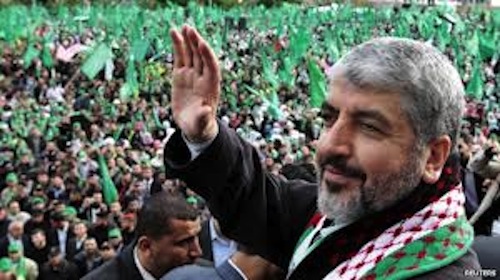
Khaled Meshaal’s Speech: Actions Speak Louder

Khaled-Meshaal

I’ve just finished reading Hussein Ibish’s excoriation of Hamas leader Khaled Meshaal’s victory speech in Gaza last week, in which he accuses Meshaal of “unhelpful escalating rhetoric” against Israel. Along the way, Ibish dishes out a fair amount of rhetorical hyperbole himself, calling Meshaal’s speech “one of the most cynical, damaging and dangerous speeches in the history of the Palestinian national movement” and “profoundly toxic from every perspective.”

It’s certainly true that Meshaal’s speech, which he delivered as he made his first-ever visit to Gaza on the occasion of the 25th anniversary of Hamas and the end of Israel’s latest military campaign, Operation Pillar of Defense, struck a note of resolute defiance.

Here’s a translated excerpt from an Al Jazeera report:

“Palestine is our land and nation from the [Mediterranean] sea to the [Jordan] river, from north to south, and we cannot cede an inch or any part of it,” he said. “We fight Zionists, not Jews. We fight whoever occupied our land, regardless of religion … Statehood will be the fruit of resistance, not negotiations,” Meshaal told cheering fans.

Hamas does not belong to the PLO, but Meshaal said a year ago that it and other factions were “on the path to joining” it.

While this is certainly strong – even incendiary – stuff, are we really to believe it was “one of the most cynical, damaging and dangerous speeches in the history of the Palestinian national movement?”

First of all, let’s take a closer look at the context in which this speech occurred. Shortly before Meshaal’s visit, Israel had leveled a devastating military assault against Hamas in Gaza. During two weeks of fighting, Hamas sent numerous missles into Israel – some of which landed close to major population centers in Tel Aviv and Jerusalem. The violence was eventually quelled through a US/Egypt brokered ceasefire. 

In other words, this is what it took to elicit the US’s active engagement with Israel and Palestine. Years of IDF crushing of Palestinian non-violent demonstrators have garnered nothing but silence. The PA’s attempt to gain recourse through the UN was met with active opposition from the Obama administration. It was only the armed resistance of Hamas in Gaza that managed to bring Hilary Clinton to the region and actively engage with the Israelis and Palestinians. In the end, what kind of message does that send to the Palestinian people?

So yes, Khaled Meshaal, told a cheering crowd that “statehood will be the fruit of resistance, not negotiations.” But should we really be so surprised? While negotiations have proved disastrous for the Palestinian people, armed resistance seems to be the only way they ever catch the attention of the international community.  Did Ibish really think Meshaal was going to get up on the podium and call for a resumption of the peace process?

Although those who consider Hamas to be an unrepentant “Islamist” terror organization would likely scoff, Meshaal and other Hamas leaders have in the past made noteworthy overtures that indicated a willingness to engage in a US-led peace process (albeit fundamentally different than the one embodied by the follies of Oslo.)  Most notably, following President Obama’s Cairo speech (which signaled at the time, a different American attitude toward the Muslim world), Meshaal responded with an important 2009 policy speech in which he welcomed a “change of tone” from Obama.  He went on to attribute this new American tone as the fruit of the “stubborn steadfastness of the people of the region, while resisting in Palestine, Lebanon, Iraq and Afghanistan” and stressed that it was not merely a change of tone but a change of policy that was needed to make progress in the region.

Meshaal added that Palestinians would judge the US not by its words but by its actions, which would have to “begin with reconstruction of Gaza and the lifting of the blockade, lifting the oppression and security pressure in the West Bank, and allowing Palestinian reconciliation to take its course without external pressures or interference.”

Whether or not one believes these overtures were genuine, we’ll never really know. Meshaal’s opening went utterly unregarded by the Obama administration, who refused to deal with Hamas and chose to maintain its support of Israel’s crippling siege of Gaza.

Given this history, are we really to believe, as Ibish would have it, that Meshaal’s recent speech is one of the most “cynical, damaging and dangerous speeches” Palestinian history?  Or is it merely a reflection of its time – a moment in which the Obama administration has thoroughly squandered its own stated desire to usher in a new era of engagement in the Middle East?

In the end, Meshaal’s speech was simply that – a political speech. And history (particularly Middle East history) has shown us time and again that parsing a politicians words are a notoriously bad way to predict what he/she will eventually agree to. In the words of the very insightful Israeli blogger Noam Sheizaf:

The bottom line is that none of this matters. It’s all a huge red herring. Nothing a leader says now determines the way he will act in the future. Public statements are important only to a limited extent and agreements depend on the continued willingness of both sides to uphold them. As long as both parties feel that they benefit from a certain status quo, or that their interests are better served than by any alternative, the deal they reach could hold. If one party is coerced into signing but doesn’t have its interests and desires addressed, all the nice declarations won’t matter. Twenty years after the historic peace deal that should have ended the Israeli-Palestinian conflict but didn’t, you’d think that people would get it.

The arguments about the meaning and importance of the Hamas charter are all but identical to the decade-long debate over the PLO charter. How much effort and time was put into forcing Arafat to change it, and how little did it matter when negotiations collapsed in Camp David and violence returned. The same goes for today: Given the right pressure, a certain Palestinian leadership could be made to promise Israel anything. Yet none of it would matter if you don’t address the fundamentals of the conflict: The occupation, the refugees, the holy sites, the settlements, the access to land and to water. The leaders would change their minds and if they don’t new leaders (“more extreme”) will come. Reality will prevail over rhetoric.

So let’s be honest. Meshaal didn’t mince his words –  but in the end it is actions that ultimately matter.  And in this regard, Meshaal’s words were considerably less damaging to the cause of the Palestinian national movement than the Netanyahu government’s announcement that it would build 3,000 more units in the E1 region, which would successfully cut the West Bank in half and cut it off completely from East Jerusalem, ending any reasonable hope for a viable two state solution. Sadly, the only response this deeply damaging action elicited from the Obama administration were words such as “counterproductive” and “we urge restraint.”

To my mind these kinds of words are considerably more dangerous to the cause of a just peace in Israel/Palestine.

American Civil Rights Leaders: End the Violence and Secure a Just Peace

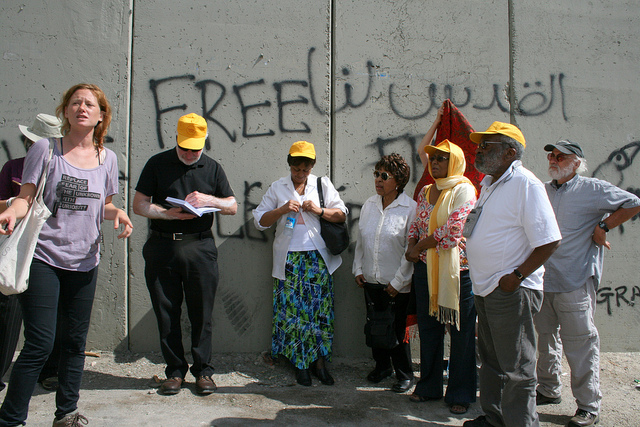
Delegates on a tour led by Ruth Edmonds of the Israeli Coalition Against Home Demolitions (photo: Allie Perry)

Received from my friend and colleague Rabbi Brian Walt:

“Our lives begin to end the day we become silent about the things that matter.”

Dr. Martin Luther King, Jr.

An immediate end to Israel’s assault on Gaza, “Operation Pillar of Defense,”matters. An immediate end to the violence—the onslaught of missiles, rockets, drones, killing, and targeted assassination—matters. An end to Israel’s ongoing blockade of Gaza matters.  An end to Israeli’s 45-year occupation of Palestine matters. A resolution of the issue of Palestinian refugees expelled from their homes in 1948, many of whom live in Gaza matters.  Equality, security, and human rights for everyone matters.

We write as individuals who recently traveled to the West Bank with the Dorothy Cotton Institute’s 2012 Civil and Human Rights Delegation, organized by Interfaith Peace-Builders.  We cannot and will not be silent.  We join our voices with people around the world who are calling for an immediate cease-fire. Specifically, we implore President Barack Obama to demand that Israel withdraw its forces from Gaza’s borders; make U.S. aid to Israel conditional upon Israel’s adherence with relevant U.S. and international law; work with Israeli and Palestinian leaders to bring an end to Israel’s occupation of the Palestinian territories and to secure a just peace that ensures everyone’s human rights.

In the words of Dr. Martin Luther King, Jr., “Returning violence for violence multiplies violence, adding deeper darkness to a night already devoid of stars.”  As Prime Minister Yitzhak Rabin declared in 1993, “Enough of blood and tears.”  Enough!

We deplore the firing of rockets on civilian areas in Israel.  We also deplore and are outraged by the asymmetry, the disproportionality, of Israel’s bombardment of Gaza, evidenced by the growing number of Palestinian civilian deaths and casualties.  This is not a conflict between equal powers, but between a prosperous occupying nation on one hand, armed and sanctioned by 3 billion dollars in annual U.S. military aid, and on the other, a population of 1.7 million besieged people, trapped within a strip of land only 6 miles by 26 miles, (147 square miles) in what amounts to an open-air prison.

United States military support to Israel is huge.  From 2000 to 2009, the US appropriated to Israel $24 billion in military aid, delivering more than 670 million weapons and related military equipment with this money.  During these same years, through its illegal military occupation of the Palestinian West Bank, East Jerusalem and Gaza Strip, Israel killed at least 2,969 Palestinians who took no part in hostilities.

During our trip to the West Bank, we witnessed for ourselves the injustice and violence of the Israeli occupation and the suffering inflicted on the Palestinians, in violation of international law and UN resolutions.

In the Palestinian village of Nabi Saleh, for just one example, we observed a weekly nonviolent protest.   The neighboring Israeli settlement of Halamish was illegally built on Nabi Saleh’s land.  This settlement has also seized control of the Nabi Saleh’s water spring, allowing villagers to access their own spring water for only 7-10 hours a week.  Demonstrators of all ages participated in the protest, including several who, in recognition of the civil rights veterans in our delegation, carried posters with quotations from Dr. Martin Luther King, Jr.  We watched in horror as heavily armed members of the Israel Defense Forces (IDF) responded to this peaceful assembly with violence, strafing the demonstrators with a barrage of tear gas canisters, rubber bullets, gas grenades, and even a round of live ammunition.

The IDF assault in response to these weekly nonviolent demonstrations can be deadly.  Rushdi Tamimi, a young adult Nabi Saleh villager, died this past week while he was protesting Israel’s attack on Gaza.  The IDF fired rubber bullets into Rushdi’s back and bullets into his gut, and slammed his head with a rifle butt.

Israel’s assault on Gaza is exponentially more violent than what we witnessed in the West Bank, but the context–the oppression of the Palestinian people—is the same.  Most of the inhabitants of Gaza are refugees or descendants of refugees expelled from their homes in Israel in 1948.   This dispossession of the Palestinians that they call the Nakba (The Catastrophe) continues on the West Bank where Israel has built extensive Jewish settlements on confiscated Palestinian land. We saw with our own eyes how this settlement expansion and the systemic discrimination has further dispossessed the Palestinian people and is creating a “silent transfer” of Palestinians who are either forced or decide to leave because of the oppression.   This injustice—Israel’s decades-long oppression of the Palestinian people—has to be addressed by honest and good-faith negotiations and a genuine agreement to share the land.  The alternative is a future of endless eruptions of aggression, senseless bloodshed, and more trauma for Palestinians and Israelis. This surely matters to all people of good will.

To President Obama, we say, use the immense power and authority United States citizens have once again entrusted to you, to exercise your courage and moral leadership to preserve lives and protect the dignity and self-determination, to which the Palestinian people and all people are entitled.   Israel relies upon the economic, military, and strategic cooperation and support of the United States.  You have the power to not only appeal to Israel to show restraint, but to require it.

Feeling ourselves deeply a part of “We the People,” sharing so much of your own tradition of organizing for justice and peace, we believe it is just, moral and in keeping with the best spirit of Dr. King to urge you to:

§  Call for an end to violence by all parties and an immediate cease-fire for the sake of all people in the region.

§  Use your power to demand that Israeli Prime Minister Benjamin Netanyahu and the IDF cease the bombardment of Gaza and withdraw their armed forces immediately.

§  Join with the international community in using all diplomatic, economic, and strategic means to end Israel’s illegal, brutal siege of Gaza.

§  Insist that the United States condition aid to Israel on compliance with U.S. law (specifically the U.S. Arms Export Control Act) and with international law.

§  Work with the leaders of Israel and Palestine to secure an end to Israel’s occupation and to negotiate a just peace.

As citizens of the United States, we are responsible for what our government does in our name, and so we will not be silent.  Justice, peace and truth matter.  The future of the children of Israel and Palestine matter.  We cannot be silent and neither can you.

Members of the The Dorothy Cotton Institute 2012 Civil and Human Rights Delegation:

(List in formation)

Continue reading

Guest Post By Rabbi Brian Walt: We are Building Up a New World

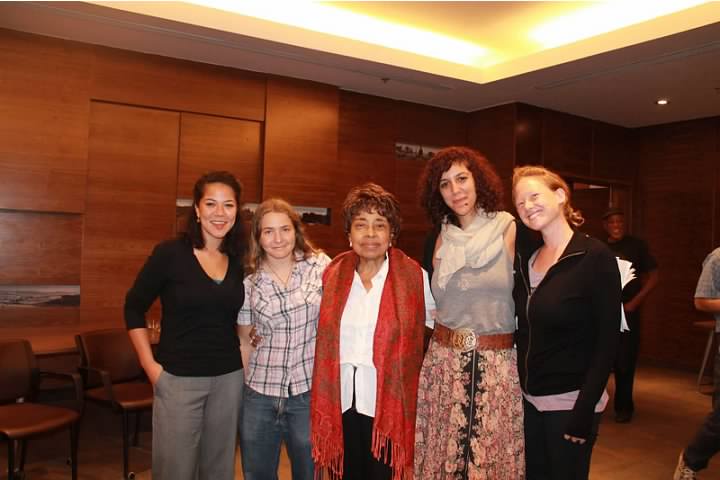
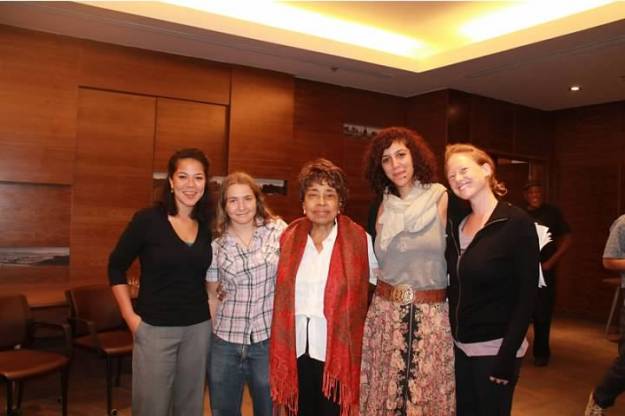
Dorothy Cotton (middle) with Israeli and Palestinian Activists (Photo: Rev. Osagyefo Sekou)

Cross-posted with Rabbi Brian’s Blog

We are building up a new world, we are building up a new world,
We are building up a new world, builders must be strong.
Courage brothers don’t be weary, courage sisters don’t be weary,
Courage people don’t be weary, though the road be long.

This is one of the many songs I sang as I led a remarkable delegation of US Civil Rights movement leaders, young human rights leaders, prominent Black academics and educators and several Jewish activists that traveled through the West Bank two weeks ago.

Our delegation was a project of the Dorothy Cotton Institute, an organization dedicated to human rights education and to building a global human rights community. Dorothy Cotton served as the Director of Education of the Southern Christian Leadership Conference (SCLC) and was the only woman on the executive staff.  She led the Citizenship Education Program that empowered the disenfranchised to exercise their rights as citizens.

The goals of this historic delegation were:

– to create and build an ongoing relationship between leaders of the US civil rights movement and the leaders of the growing Palestinian nonviolent resistance movement on the West Bank and their Israeli allies;

– to increase the visibility of this movement in the US and internationally;

– to learn from one another about nonviolence, effective solidarity and social transformation;

– and to educate Americans about the role the United States plays in supporting the status quo on the West Bank.

Our delegation spent two weeks on the West Bank.  We visited three Palestinian villages – Budrus, Bilin, Nabi Saleh – that have engaged for many years in a popular nonviolent struggle to reclaim land expropriated by the Israeli military.  We met several young Palestinians who are building the Coalition for Dignity, a grassroots, youth – led nonviolent movement.

And we met Israeli allies who stand in solidarity with the Palestinian nonviolent movement and who work in their own society to end militarism and human rights violations against Palestinians.  We learned from many Israeli and Palestinian nonviolent activists about their work, their vision and their dreams.

In short, our delegation saw and learned about realities that the overwhelming number of visitors to Israel never see or hear.

Singing was an essential part of the spiritual and political life of our trip.  Dorothy has a beautiful spirit, a powerful voice, and loves to sing.  Throughout the delegation, she always reminded us that singing was a critical tool for energizing the civil rights movement.  She told me,

We had songs for different occasions. We sang at mass meetings, and we sang at funerals … We sang, “I am going to do what the Spirit says do” and our singing inspired us to do just that.

And so our new civil rights delegation sang as we traveled through the West Bank.  Singing was just one powerful way in which our delegation made a connection between the Black-led struggle for civil rights in the US and the Palestinian struggle for justice, peace and security for all.

This, for instance, is the song we sang at the grave of a young man in Budrus who was killed in a nonviolent demonstration to protest the confiscation of his village’s land:

Come By here my Lord, come by here.
For our brother, my Lord, come by here.
For his courage my Lord, come by here.

Standing around the grave, delegates spontaneously composed the lyrics. It felt like we were praying, acknowledging the courage and the profound cost that the struggle for freedom demands.

We sang before we joined the weekly nonviolent demonstration in Nabi Saleh, another village on the West Bank fighting to reclaim their land.   The residents of the village had made special signs composed of quotations from Dr. Martin Luther King in honor of our visit.  “Injustice anywhere is a threat to justice everywhere” read one of the signs.

And we sang:

Ain’t going to let nobody turn me around, turn me around, turn me around.
Keep on walking, keep on talking, marching down to freedom land.

We sang to express our appreciation and to provide support after hearing activists tell us their stories – Palestinians and Israelis who told us of their amazing work and the toll it has taken on their lives, and sometimes even their spirits and souls.  One such occasion was after Israeli activist Gabi Laski told us of her work to defend children from villages like Nabi Saleh who are arrested at night.

We’re going to keep on marching forward, keep on marching forward, keep on marching forward, never turning back, never turning back.

We sang after standing next to the thirty foot high Separation Wall in Jerusalem dividing a Palestinian neighborhood in two.  And we sang on the bus as we went through a checkpoint on our way to the airport at the end of our trip, encouraged by our Palestinian guide to keep singing even when the soldier boarded our bus.  (Our bus was pulled aside for a security check because it was a Palestinian bus while Israeli buses and motorists were waved through the checkpoint).

We returned to the United States both inspired and disturbed by our experience.  We were inspired by the determination, vision and commitment of so many Palestinians and their Israeli allies, working tirelessly day after day, year after year, often at great personal and communal cost, for justice, freedom and equality for all.  Now that we are home, we look forward to sharing the stories and vision of these courageous civil rights activists with our friends and communities.

But our trip was not simply inspiring.  It was profoundly disturbing to witness the harsh realities of life on the West Bank that are so invisible to the discourse in America.  Every day we saw and heard about a systematic denial of human rights in countless ways: land confiscation, extensive restrictions on movement, humiliation at check points, home demolition, the arrest of children, the revocation of residency permits and many other violations.

The delegates were profoundly shocked. Several American civil rights veterans  commented that the discrimination, humiliation and injustice they witnessed was “frighteningly familiar.”

While we were on the West Bank the two presidential candidates tried to outdo one another in their public declarations of support for Israel in the final presidential debate.  They mentioned Israel 31 times with only one passing reference to Palestinians.  The contrast between American policy and what we witnessed is stark.  Now that we have returned, we are determined to share this disturbing reality with our communities; to challenge the ways in which our country funds, provides diplomatic cover, and enables these injustices.

I have visited the West Bank before but never for more than a day or two, and almost always with progressive Israeli groups.  On this visit, however, we spent virtually all out time in the West Bank – on the other side of the Separation Wall.  For me personally, it was a transformative experience.  It was a privilege to travel with such a special group of people and to see the profound impact of our delegation on the activists that we met.

Before we left on our journey, I was struck by a comment made by Dr. Vincent Harding, a close associate of Dr. Martin Luther King, a person with a long history of involvement in the struggle for freedom and a very close life-long connection to Jewish teachers, fellow travelers and co-workers.  Dr. Harding talked about “encouragement” as one of his primary goals for the trip.  I was struck by the word and the simple power of his intention.  He wanted to meet activists on the West Bank and to “encourage” them.

And that is exactly what happened. The people we met commented how encouraged they felt by meeting people who had spent their entire lives fighting for freedom in the US.  Dr. Harding and others would repeatedly ask all our presenters to tell us about themselves, their families and what motivated them to do what they were doing.

He and others always shared how much he appreciated their work and how important it was for all of us and for our collective future.  After hearing an inspiring talk by Fadi Quran, one of the young leaders of the Palestinian nonviolent movement, Dr. Harding said, “Fadi, I want to tell you how proud I am and how grateful I am for you, and want to encourage you to keep on going.”

It felt like we were building a new world.  On the very first day of our trip, Dorothy Cotton sang and danced with three women activists, Israeli and Palestinian, who had spoken to us. It was a joy to see the profound gift she was giving them and that they were giving her in return. Those who had spent their lives building a new world in America were creating a relationship with those who were building a new world in Israel/Palestine.

Towards the end of the trip we realized that we were just beginning to build a new world in another way by creating a new possibility for the relationship between Jews and Blacks in our own country.   Historically, Israeli policy has been a source of tension between the African American and Jewish communities.  While many African Americans on the delegation have deep and positive connections to Jews, it is often difficult for Blacks and Jews to have honest conversations about Israel.

There were eight Jews on this delegation.  On this trip we joined together as a group of Blacks, Jews, Christians and people with varied faith commitments, united in our commitment to nonviolence and our dedication to justice, freedom and equality in Israel/Palestine, in our own country, and around the world.  We are renewing an alliance between Blacks and Jews, an alliance rooted in our shared values.

We are building up a new world, we are building up a new world.
We are building up a new world, builders must be strong.
Courage brothers don’t be weary, courage sisters don’t be weary,
Courage people don’t be weary, though the road be long.

Rabbi Brian Walt: Christian Leaders Cannot be Cowed into Silence

Please read my friend Rabbi Brian Walt’s new piece in Ha’aretz. He has recently returned from a remarkable interfaith delegation to the West Bank; I will be posting more of his writings about his experiences in the near future.

In his recent Haaretz op-ed, “Heading toward an irreparable rift between U.S. Jews and Protestants,” my colleague, Rabbi Eric Yoffie, sharply criticized the recent letter to Congress by leaders of Protestant churches that called for U.S. military aid to Israel to be contingent on Israeli compliance with American law. Nowhere in his article, however, did Yoffie mention the central concern of the Christian leaders’ letter: the overwhelming evidence of systematic human rights violations by the Israeli military against Palestinians.

Over the past two weeks, I had the privilege of leading an interfaith delegation including several leaders of the civil rights movement, younger civil and human rights leaders, Christian clergy, academics, and several Jews, on a two-week trip to the West Bank.

We were all shocked by the widespread human rights violations that we saw with our own eyes and that we heard about from both Palestinians and Israelis. Several black members of our group, including those who participated actively in the civil rights movement, remarked that what they saw on the West Bank was “frighteningly familiar” to their own experience, a systemic pattern of discrimination that privileged one group (in this case, Jews) and denigrated another (Palestinians).

Continue reading

My “Wrestling” Interview with Truthout

Check out my wide-ranging and freewheeling conversation with Truthout’s Mark Karlin, which focuses on my book, but also touches on subjects such as Zionism, BDS, the two-state solution and Palestinian solidarity, among others.

Here’s a taste, below. Click here for the full interview.

Mark Karlin: Stereotyping any group of people is dangerous. In polls during peaceful periods, most Palestinians and Israelis appear to support peace. A lot of what Netanyahu appears to do is stir up the pot so that there will never be a long enough period to negotiate a peace. That’s not to excuse those in Hamas and Hezbollah who have their own motives in heating up the conflict now and then, along with other parties who have vested interests in stalling peace. When you talk of your Palestinian solidarity, some critics accuse you of abandoning Jewish solidarity and not sufficiently condemning those Arab extremists who are in the “destroy Israel” industry as much as Netanyahu is in the suppression-of-Palestinian-rights industry. How do you respond?

Brant Rosen: At the end of my book I addressed this issue directly:

As a Jew, I will also say without hesitation that I reject the view that I must choose between standing with Jews or standing with Palestinians. This is a zero-sum outlook that only serves to promote division, enmity and fear.

For me, the bottom line is this: the cornerstone value of my religious tradition commands me to stand in solidarity with all who are oppressed. It would thus be a profound betrayal of my own Jewish heritage if I consciously choose not to stand with the Palestinian people.

In other words, I believe my Jewish liberation to be intrinsically bound up with Palestinian liberation. It’s really that simple.

I’ve come to believe that solidarity should ultimately be driven by values, not tribal allegiances. It should be motivated by the prophetic vision that demands that we stand with the powerless and call out the powerful. Of course, in the case of Israel, this form of solidarity presents a very painful challenge to many Jews. I understand that. But at the very least, shouldn’t we be talking about this challenge and what it represents for us?

Does my solidarity mean that I agree with everything that is done by Palestinians in furtherance of their liberation? Of course not. When you stand in solidarity with a people, it is inevitable that you will find yourself standing next to some people whose actions and beliefs you will find odious. That comes with the territory when you choose to take a stand. And I might add that this is the case for liberal Zionists who stand in solidarity with Israel as well.

American Heroes: Code Pink’s Anti-Drone Delegation to Pakistan

Medea Benjamin is a true American hero.

The Code Pink founder and nonviolence activist is currently leading a delegation of 31 American peace activists through Pakistan to protest the tragic damage wrought by US drone attacks.  Traveling with popular Pakistani politican, Imran Khan, the delegation recently attempted to hold a rally in the tribal regions that have been hardest hit by the US drone campaign.  On October 9, the delegation will publicly fast from sunrise to sunset at a vigil in front of the Islamabad Press Club, where they will display pictures of the more than 160 Pakistani children who have been killed by American drones. (Jews who have only recently completed a fast of atonement should appreciate the spiritual power of such an act…)

From a recent WashPo feature:

The majority-female delegation — in their early 20s to late 70s — traveled with no security guards despite announced militant threats against them and Khan, head of the Pakistan Justice Movement political party. They fell in line behind Khan’s procession as legions joyously waved party flags atop trucks.

By late Saturday, when the Codepink delegates finally reached a large farm belonging to a regional party official, they were mobbed by an admiring Pakistani media and given a hero’s welcome by hundreds of the candidate’s fans.

Anti-American sentiment runs extremely high in Pakistan, but the delegation focused on a simple message: “We are against drones” was emblazed in Urdu in green fluorescent script, outlined with glitter, on the oversize white bibs they wore.

“You hit people with these drones and you create instant enemies,” said JoAnne Lingle, a silver-haired Mennonite from Indianapolis. “It’s supposed to be increasing our national security and it’s doing the opposite.”

The US drone wars are our national shame. If there had previously been any doubt, I’d say they’ve been put to rest by the NYU School of Law and Stanford University Law School, who released a deeply damning report entitled “Living Under Drones: Death, Injury and Trauma to Civilians From US Drone Practices in Pakistan” late last month.

From the report’s Executive Summary:

In the United States, the dominant narrative about the use of drones in Pakistan is of a surgically precise and effective tool that makes the US safer by enabling “targeted killing” of terrorists, with minimal downsides or collateral impacts.

This narrative is false.

Following nine months of intensive research—including two investigations in Pakistan, more than 130 interviews with victims, witnesses, and experts, and review of thousands of pages of documentation and media reporting—this report presents evidence of the damaging and counterproductive effects of current US drone strike policies. Based on extensive interviews with Pakistanis living in the regions directly affected, as well as humanitarian and medical workers, this report provides new and firsthand testimony about the negative impacts US policies are having on the civilians living under drones…

(While) civilian casualties are rarely acknowledged by the US government, there is significant evidence that US drone strikes have injured and killed civilians. In public statements, the US states that there have been “no” or “single digit” civilian casualties.”2 It is difficult to obtain data on strike casualties because of US efforts to shield the drone program from democratic accountability, compounded by the obstacles to independent investigation of strikes in North Waziristan. The best currently available public aggregate data on drone strikes are provided by The Bureau of Investigative Journalism (TBIJ), an independent journalist organization. TBIJ reports that from June 2004 through mid- September 2012, available data indicate that drone strikes killed 2,562-3,325 people in Pakistan, of whom 474-881 were civilians, including 176 children.

Shortly after this report was issued, Obama had the temerity to stand before the UN and decry the “killing of innocents” in the US mission in Benghazi.  This, while his administration continues to kill innocents in a secrecy-shrouded military program that blatantly undermines the US Constitution and international law – and is most surely inflaming further Mideast rage toward the US.  In the face of such hypocrisy, all I can say is thank God for truth-tellers like Medea Benjamin.

You can follow the progress of the Code Pink delegation here.  For further reading, I highly recommend reading Benjamin’s excellent new book, “Drone Warfare: Killing by Remote Control” and this recent piece by journalist Glenn Greenwald, who has been indefatigably writing shining a bright light on Obama’s drone wars since their inception.

“Jews in Solidarity with Palestinians” – My Upcoming Conversations with Miko Peled

To those who live in or around Chicago: I’ll be appearing twice with the courageous Israeli peace activist Miko Peled (author of “The General’s Son: Journey of an Israeli in Palestine.“) Both Miko and I have books published by Just World Books – both of which chart the our respective (and unlikely) journeys to Palestinian solidarity work. I’ve admired Miko’s work enormously and am delighted we have the opportunity to engage in two public conversations.

If you’re closer to the South Side, you can catch us at Saturday, October 13, 7:00 pm at Hyde Park Union Church (where our conversation will moderated by Palestinian activist/journalist Ali Abunimah.)  For all you North Siders, we’ll be appearing Sunday, October 14, 7:00 pm at Evanston Quaker Meeting.

Please join the conversation!

Parsing the (Odious) New Term, “Jew-Washing”

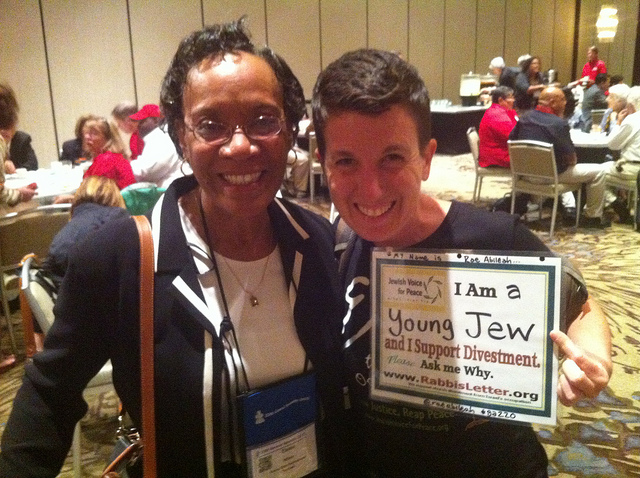
photo: Jewish Voice for Peace

Cross-posted in the “Forward Thinking” blog of the Jewish Daily Forward:

In his latest column, Philologos correctly parses the linguistic problems with Yitzhak Santis and Gerald M. Steinberg’s invented term, “Jew-washing.” His political analysis, alas, fails miserably.

Philologos has it completely wrong when he speaks of the “anti-Semitism in boycotts of Israel.” To begin with, Santis and Steinberg did not use the term “Jew-washing” in reference to a boycott of Israel as a whole, but rather to a resolution recently brought to the Pittsburgh General Assembly of the Presbyterian Church (USA) that called for divestment of their pension funds from three specific companies that profit from Israel’s brutal and illegal occupation of the West Bank.

Regardless, it is highly disingenuous for Philologos to accuse the Presbyterian Church of anti-Semitism. Our Christian friends’ response to the Palestinian civil society call for Boycott, Divestment and Sanctions (BDS), reflects their deeply held commitment to justice in a land their tradition also considers holy.

Philologos asks, “Have the Presbyterians considered boycotting China because of Tibet? India because of Kashmir? Russia because of Chechnya?” This, of course, is classic misdirection. The issue at hand is not global human rights, but a very specific call from Palestinian civil society for international support in ending their oppression.

The real question before them (and us) is not “what about Tibet, Kashmir and Chechnya?”  The question, rather, is: “will we or won’t we respond to the Palestinian call?” To this question, many members of the Presbyterian Church are courageously responding “we will.” So too are increasing numbers of Jews who believe that our legacy of anti-Jewish oppression leads us to stand with Palestinians being denied basic human rights in our name.

No, we are not being used as pawns by Christian partners to further some nefarious “anti-Semitic plot”. Rather, we are standing in solidarity with the oppressed, as the most basic of our Jewish teachings demand that we do.  What irony that other Jews should stand in the way of the Jewish imperative to end injustice. How heartbreaking that some in the Jewish community pervert this imperative by labeling the best intentions of our Christian friends as “anti-Semitism.”

We do, however, fully share Philogos’ distaste for the term “Jew-washing,” the coining of which is a sign of abject desperation that itself crosses the line of anti-Semitism, as blogger Jeremiah Haber pointed out last week. We predict that odious terms such as this will soon be relegated to the history books as part of a last, flailing effort by a fearful generation of Jewish leaders unwilling to recognize the moral urgency of the moment. It also reflects the short-sightedness of an establishment that continues to support war and occupation while deliberately alienating itself from the next generation of courageous Jewish leaders.

Why I Support Kairos USA

Last week a group of US clergy, theologians and laypersons unveiled Karios USA, a powerful and important American Christian spiritual call for justice in Israel and Palestine.  As a religious Jew, I am inspired by its prophetic courage, its unabashed call for justice and its heartfelt model of compassion. It truly deserves to be shared and studied by all who who seek a genuinely religious call for justice in this land that is so central to so many peoples and spiritual traditions.

Kairos USA is modeled on the religious testimony of Kairos Palestine, a document that was drafted by prominent Palestinian Christian leaders in 2009 (which was itself inspired by the 1985 South African Kairos statement).  Despite these important influences, however, Kairos USA stands on its own as a uniquely American Christian call for justice in Israel/Palestine.

Indeed, this unique mission is evoked in the statement’s Preamble at the very outset:

In June 2011, a group of U.S. clergy, theologians and laypersons, cognizant of our responsibility as Americans in the tragedy unfolding in Israel and Palestine, and mindful of the urgency of the situation, met to inaugurate a new movement for American Christians. We have been inspired by the prophetic church movements of southern Africa, Central and South America, Asia and Europe that have responded to the call of their Christian sisters and brothers in occupied Palestine. This is our statement of witness and confession—and our response as U.S. Christians to the Palestinian call.

And more specifically, from the Introduction:

As U.S. Christians we bear responsibility for failing to say “Enough!” when our nation’s ally, the State of Israel, violates international law. Our government has financed Israel’s unjust policies and has shielded its government from criticism by the international community. At the outset of the current U.S. administration, our government led Palestinians to believe that at last we would pursue a political solution based on justice. But the “peace process” has continued to be no more than a means for the continuing colonization of the West Bank and East Jerusalem, the imprisonment of Gaza and the intensification of the structures of oppression.

I have no doubt at all that like Kairos Palestine, Kairos USA will be excoriated by many self-appointed leaders of the American Jewish establishment.  As for myself, now that I’ve read the document carefully, I can say without hesitation that I believe this statement is a truly sacred testimony, offered in good faith and with genuine religious integrity.

I was particularly moved to read how sensitively Kairos USA treads over some of the most complex hot-button issues in the Jewish-Christian relationship. For instance, on the issue of historical church anti-Semitism, the statement includes the following confession:

As Christians addressing the Palestinian cause we must also acknowledge our shameful role in the historic persecution of the Jewish people. We recognize the dehumanizing and destructive power of doctrines and theologies that denigrated Judaism. Our predecessors perpetuated anti-Semitic stereotypes, practiced scapegoating and cloaked prejudice, hostility and murder itself in the robes of our religion. We confess that our churches failed to resist, and sometimes even aided and abetted pogroms, mass dislocations of Jews, and the calamity of the Nazi Holocaust itself. In so doing, they betrayed the teaching and example of the one we claim to follow. We speak for and with our forbears in expressing deep remorse. With a commitment to never forget those failures and to be instructed by them, we pledge ourselves to growth in faithfulness, compassion and justice.

The statement goes on, however, to state that Christians’ honest desire to repent for the church’s historic crimes against Jews must not inhibit them from speaking out against injustices perpetrated by Israel against Palestinians. To my mind, this is a call for real and honest interfaith relations – dialogue that is not defined by guilt or emotional blackmail, but rather by a willingness to venture into and openly discuss the more difficult and painful places:

We acknowledge with sadness and distress that because of the powerful impulse on the part of Christians to atone for their sins against the Jewish people, vigilance against anti-Semitism today has come to trump working for justice in Palestine and Israel. The Christian need to rectify centuries of anti-Jewish doctrine and actions and to avoid even the perception of anti-Jewish feeling has served to silence criticism of Israel’s policies and any questioning of the consequences of U.S. government support for Israel. Differences between anti-Semitism and legitimate opposition to Israeli actions are avoided or explained away. Responsible discourse about Zionism is often denounced as hostility toward Israel and its citizens or branded as anti-Semitism. We believe that in our dialogue with our Jewish friends, family members and colleagues and in our relationships with the Jewish community on institutional levels, we must confront this pattern of avoiding, denying or suppressing discussion of issues that may cause conflict or discomfort. The fact that anti-Semitism still exists makes it all the more important to differentiate between actual anti-Jewish feelings and criticism of the actions of a nation state. Uncomfortable though it may be, we cannot be afraid to address the urgent issue of justice and human rights in Israel and Palestine with our Jewish sisters and brothers here in the United States.

I also deeply admire the statement’s willingness to directly address the charged issue of so-called Christian “replacement” or “supersessionist” theology (a view that promotes Christianity – and not Judaism – as the genuine fulfillment of Biblical tradition):

We are aware that in denying a theology of entitlement that gives the Jewish people exclusive rights to the Holy Land, we risk the charge of reviving the Christian doctrine known as replacement theology (sometimes known as supersessionism). In this view, the Church takes the place of Israel in God’s purposes, denigrating Judaism itself and condemning the Jews to suffering for rejecting the Gospel. Christians have rightly wished to distance themselves from this destructive and divisive doctrine. We repudiate the anti-Semitic legacy of the church’s past and the theology that undergirds it.

As a Jew who rejects a sense of Jewish entitlement just as strongly as I reject any religious viewpoint that makes an exclusive claim to the land, I particularly appreciate Kairos USA’s religious approach on this point:

Our core Christian belief is that God’s promise in the Gospel is a promise to all nations. This means that God’s kingdom work in Christ is a promise to everyone regardless of race. We believe that the Church has found in Christ a fulfillment of all that God promised in Abraham, and that both Jews and Gentiles have been invited equally into this promise of a world renewed in love and compassion. The Church does not replace Israel. Jews continue to have a place in God’s plan for the world. In Christ, all nations can be blessed (Genesis 18:18, 22:18; Galatians 3:8). In these times of growing international conflict and cultural mistrust, this is a significant promise. Theologies that privilege one nation with political entitlements to the exclusion of others miss a central tenet of the Gospel and inspire increased conflict.

I believe the above statement provides a crucial challenge to both American Jews and Christians.  From a theological point of view, I believe it is time to reframe the issue. The real debate is not about which religious tradition or people has a more compelling religious “right” to the land of Israel, rather, it is between those who make exclusivist theological claims and those whose theology makes room for all peoples who live on or feel a connection to this land.

I also have no doubt that many in the American Jewish establishment will reject out of hand Kairos USA’s positive advocacy of BDS (“Boycott, Divestment and Sanctions”).  But here again, I find that the statement deals with a hot-button issue with sensitivity and integrity:

Participation in the BDS movement by U.S. churches, notably in the form of initiatives to divest church funds from companies profiting from the occupation of the West Bank and the blockade of Gaza, has generated critically-important discussions at local, denominational and ecumenical levels about the responsibility of the church to act. It has also generated intense controversy. Opposition, from Jewish organizations as well as from voices within the churches, has often been fierce, claiming that such actions will inflict grievous damage on hard-won positive relationships with the Jewish community. Many express fear that these actions may encourage anti-Semitism. We note with distress that many have confused these actions with anti-Jewish discrimination and persecution in the Christian past. But BDS is directed at Israeli policy, not the state itself or its citizens, and certainly not against the Jewish people. Divestment and other forms of socially responsible investing (SRI) are not directed against groups, nor are they intended to hurt individuals, corporations or states. They are, rather, directed at unjust, oppressive policies and are about promoting our own values and stated commitments by noncooperation with evil. Furthermore, methods to exert economic pressure on governments and companies, in addition to being a legal, ethical and time-tested way of influencing the political process and corporate behavior, serve to increase awareness, promote open discussion and create the grassroots support required to urge governments to take effective action and to change unjust policies. We urge congregations, clergy and church leaders to become educated about the BDS movement and to consider the many forms that it can take on personal, local and national levels.

As I American Jew who is deeply distressed by the American Jewish establishment’s abject vilification of BDS, I don’t think I could possibly put it any better.

I urge all people – whether religious and secular, Christian, Jewish or Muslim – to read, share, discuss and respectfully debate this important new American statement of faith.  My deepest gratitude to those (including my good friends Mark Braverman and Father Cotton Fite) who helped spearhead and draft Kairos USA.  May it inspire us all to reframe a new religious response to the sorrows of Israel/Palestine – and lead the way to a better future to all who call this land home.