Category Archives: Palestine

Daoud Nassar and His Message of Hope

If you’ve been reading my blog for a while, you how I feel about my friend Daoud Nassar, founder of Tent of Nations (and if you haven’t, you can read those posts here, here and here). It’s been my honor to serve on the Advisory Board of Friends of Tent of Nations – North America – and when they told me Daoud was coming to the US for speaking engagements, I jumped at the chance to add Chicago to his itinerary.

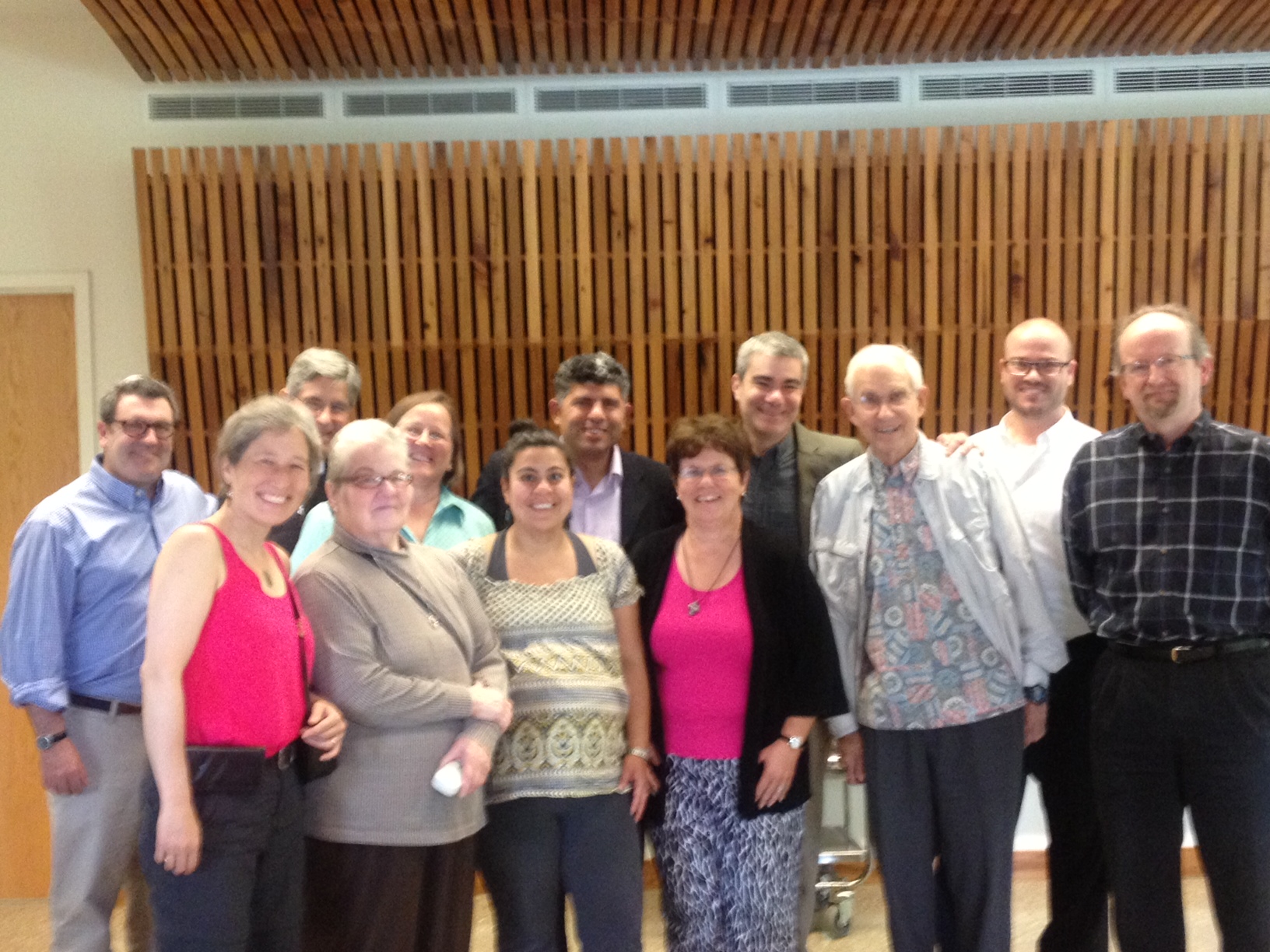
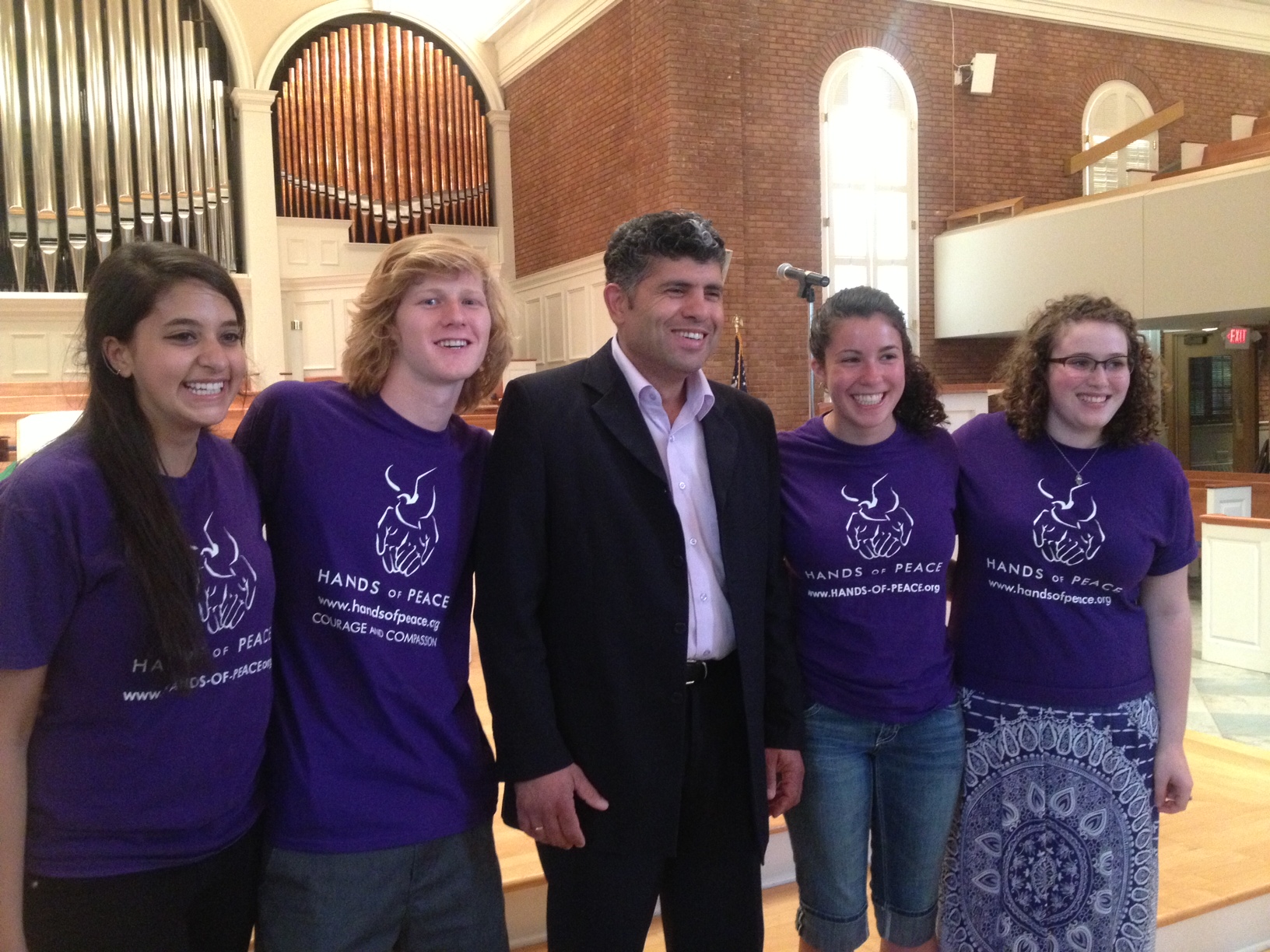
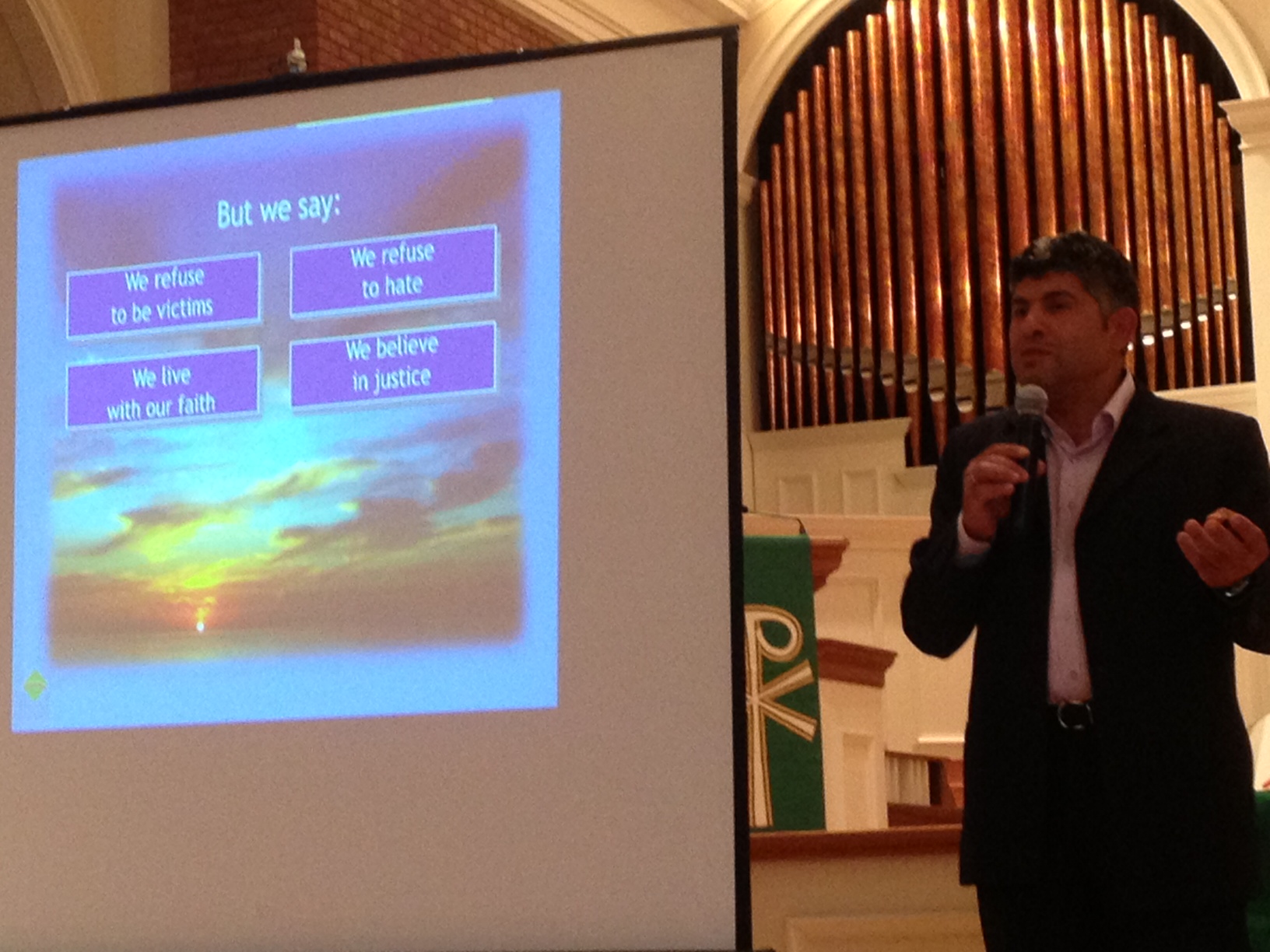
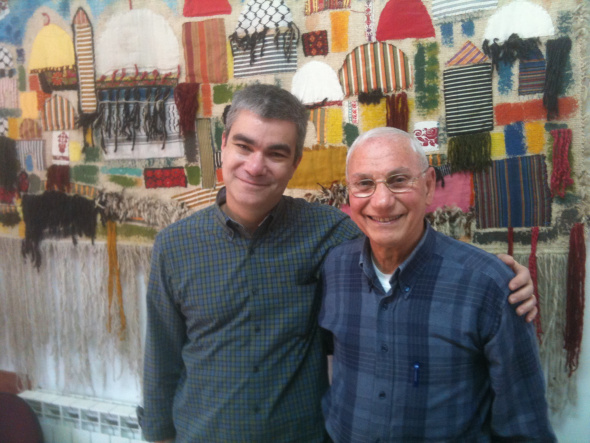
Among his stops here was a meeting with local interfaith clergy (below) and a presentation last night at Glenview Community Church for a program co-sponsored by Hands of Peace, a Chicago-area coexistence initiative on whose Advisory Board I also serve (bottom two pix).  At every stop, it was my pleasure see so many new friends and supporters inspired by Daoud’s message of steadfastness and hope.

Last Sunday, Daoud gave the sermon at the prestigious Riverside Church in New York City. I’ve just watched the video (above) and I was deeply moved by his words. I’ve listened to Daoud present many times, but I’ve never heard him speak in the unique context of his Christian faith.  As a Jew, I found his sermon to be deeply resonant, spiritually profound – grounded both in the truth of his own personal testimony as well as universal values of hope and human dignity. I encourage you to watch it in its entirety.

daoud clergy

daoud and hands

daoud.glenview

B’tselem Reports on Israel’s “De Facto Annexation” of Area C

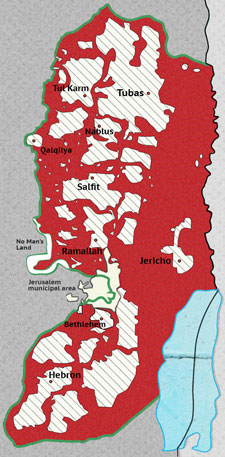
201306_area_c_map_engAs the we wait in vain for a “breakthrough” in the current incarnation of  “peace process,” I’d like to recommend some essential reading: “Acting the Landlord: Israel’s policy in Area C, the West Bank” – a report released this month by B’Tselem – The Israeli Information Center for Human Rights in the Occupied Territories. It will go a long way in explaining to you how Israel has effectively closed the door on a viable two-state solution.

Some background:

As part of the 1993 Oslo Accords, the West Bank was divided up into three administrative regions: Areas A, B and C. According to these interim accords, the Palestinian Authority was given full civil and security control over Area A, which today accounts for 18% of the West Bank. In Area B, which takes up 21% of the West Bank,  the PA was given civil control while Israeli maintains security control.

Area C, which makes up 60% of the West Bank and contains all the major Jewish “settlement blocs,” is under full Israeli civil and security control. In the map on the right, Area C is marked in red, Area B in the lined sections, and Area A in white. You can clearly how Areas A and B are scattered like an archipelago in the ocean of Area C, cut off from each other and essentially under the ultimate control of the Israel Defense Forces.

Slowly but surely, Israel has been moving Palestinians into these disconnected islands while strengthening its settlement regime over Area C. It is also rapidly blurring the distinction between Area C and Israel proper. Israeli-only highways now lead from Israel into the heart of the West Bank, connecting the Jewish settlements to each other while bypassing Palestinian communities. Jewish communities are also connected through their common use of electrical and water resources that are denied non-Jewish communities. Israel is literally investing billions of shekels in Area C while deliberately preventing the development of Palestinian infrastructure there.  The new B’tselem report now offers a detailed and devastating picture of the sophisticated bureaucratic process by which Israel has been able to create these facts on the ground.

From the report summary:

Israel prohibits Palestinian construction and development on some 70 percent of Area C territory by designated certain areas as “state lands” or “firing zones.” Meanwhile, Israel refuses to recognize most of the villages in the area or draw up plans for them, prevents the expansion and development of Palestinian communities, demolishes homes and does not allow the communities to hook up to infrastructure. Thousands of inhabitants live under the constant threat of expulsion for living in alleged firing zones or “illegal” communities.

In addition, Israel has taken over most of the water sources in Area C and has restricted Palestinian access to them. In theory, Israel retains full control in the West Bank only of Area C. In practice, Israel’s control of Area C adversely affects all Palestinian West Bank residents. Scattered throughout the vast expanses of Area C are 165 “islands” of Area A- and B-land that are home to the major concentrations of population in the West Bank. The land reserves that surround the built-up sections of West Bank towns and villages are often designated as Area C, and Israel does not allow construction or development on these reserves. Israel thereby stifles many Area A and B communities, denying them the opportunity to develop.

This is one of the contributing factors to the difficulty in obtaining lots for construction, the steep price hike in the cost of the few available plots, the dearth of open areas, and the total lack of suitable sites for infrastructure and industrial zones. If, for want of an alternative, residents of these areas build homes without permits on nearby land – owned by them but classified “Area C” – they live under the constant shadow of the threat of demolition.

This report presents Israel’s policy as implemented in Area C, primarily by the Civil Administration, and explores the policy’s implications for the population of the West Bank as a whole. The report focuses on several specific locations in Area C where the policy has considerable impact on the lives of the residents:

– There are dozens of Palestinian villages in the South Hebron Hills that the Civil Administration refuses to recognize and for which it does not prepare master plans. Over 1,000 people, residents of eight of these villages, currently live under the perpetual threat of expulsion on the grounds of residing in a designated “firing zone”.

– The Civil Administration plans to uproot at least two thousand Bedouins from land near the settlement of Ma’ale Adumim and transfer them to so-called “permanent communities” in order to expand nearby Israeli settlements and achieve a contiguous built-up bloc linking the settlements to the city of Jerusalem. Previously, hundreds of Bedouins from this area had been displaced for the establishment and then the expansion of Ma’ale Adumim.

– Palestinians in the Jordan Valley are subject to frequent house demolitions. They are occasionally evacuated for the benefit of military exercises and must deal with the confiscation of water cisterns that are the source of drinking water for them and their livestock.

– Al-Khader, Yatma and Qibyah are examples of Palestinian communities most of whose built-up area is located in Area B. Yet most of these communities’ lands available for construction of homes, infrastructure and public services are located in Area C, where the Civil Administration does not allow construction and development. Palestinians in these communities who, for the want of any other options, built homes on their community’s lands in Area C,  face the constant threat of demolition.

Some Area C residents, harmed by Israel’s planning and building policy, have applied to Israel’s High Court of Justice for redress. However, of the dozens of petitions submitted, the court deemed not a single case worthy of its intervention with Civil Administration considerations. The court thus enabled the restrictive, harmful and discriminatory policy to carry on.

At the same time, and counter to international law, Israel encourages its own nationals to settle in the West Bank. Israel allocates vast tracts of land and generous water supplies to these settlements, draws up detailed plans that take into account both current requirements and future expansion, and turns a blind eye to violations of planning and construction laws in settlements.

Israel’s policy in Area C is anchored in a perception of the area as meant above all to serve Israeli needs. Consequently, Israel consistently takes actions that strengthen its hold on Area C, displace Palestinian presence, exploit the area’s resources to benefit Israelis, and bring about a permanent situation in which Israeli settlements thrive and Palestinian presence is negligible. Israel’s actions have brought about a de facto annexation of Area C and have created circumstances that will influence the final status of the area.

Israel’s policy in Area C violates the essential obligations of international humanitarian law, namely: to safeguard occupied territory on a temporary basis; to refrain from altering the area or exploiting its resources to benefit the occupying power; and, most importantly, to undertake to fulfill the needs of the local residents and respect their rights. Instead, through the Civil Administration, Israel pursues a policy designed to achieve precisely the opposite: the Civil Administration refuses to prepare master plans for the Area C communities and draws on the absence of these plans to justify the prohibition of virtually all Area C construction and infrastructure hook-ups. In cases where, having no alternative, residents carry out construction despite the prohibition, the Civil Administration demolishes their homes. Israel utterly ignores the reality that residents cannot build their homes legally. Israel conducts itself as though this situation were not in fact a direct result of its own policy.

One of the most important sentences in the report above:

Israel’s actions have brought about a de facto annexation of Area C and have created circumstances that will influence the final status of the area.

Increasingly, we are hearing educated observers say out loud what many of us have long suspected: Israel has successfully annexed most of the territory long considered to be the heart of an eventual Palestinian state.

Please read this report and share it widely.

The Village of Iqrit and the Dream of Return

I’ve been following with great interest an ongoing campaign by Palestinian citizens of Israel to reestablish their village of Iqrit, which was depopulated of its inhabitants in 1948 and destroyed by the Israeli military a few years later. In its way, I think this story shines an important light on the reverberations caused by the founding of a Jewish state in historic Palestine – and how they continue to resonate profoundly even today.

Iqrit was a Palestinian Christian village in northern Galilee which was emptied of it inhabitants in November, 1948. Unlike residents of other Arab villages in Palestine, Iqrit’s inhabitants weren’t forcibly expelled and they did not flee. Rather, they surrendered to Israeli military forces with the promise that they would be able to return in two weeks at the end of military operations.

Most of Iqrit’s 490 inhabitants were transferred to a nearby village, taking only basic necessities – shortly thereafter, the area was declared a military zone and the villagers were forbidden from returning. The villagers took their case to Israel’s Supreme Court, which ruled in July 1951 that they must be permitted to return to their homes. On Christmas Eve of that year, however, the Israeli military demolished the village and took it over for “state use,” leaving only the church and the cemetery intact. Since that time, Iqrit’s former inhabitants have been allowed to hold services in the church and bury their dead in the cemetery, but have not been allowed to return.

Now decades later, the villagers and their descendants are seeking to return and rebuild their ancestral village. In the words of Walaa Sbait, a young music teacher who lives in Haifa: “At the moment Iqrit people have the right to return only in a coffin, but we want to live here.”

Sbait is among a group of remarkable young activists who have literally been returning to the village from which their grandparents were exiled. Last summer set up a makeshift camp in Iqrit and have been staying there in shifts, living in an improvised annex to the church that houses a sitting area and kitchen. Nearby tin shacks provide showers and toilets. (They also planted saplings and built a chicken coop, which were subsequently demolished.)

Explains Sbait:

We never lost the connection to this place. Every summer we hold a summer school here for the children to learn about the village and their past. And once a month the villagers hold a service at the church. For us, this was always our real home.

When I visited the website of the Iqrit Community Association, I was deeply moved by the palpable sense of community expressed by the ancestors of this lost village. Reading through their extensive testimonies and reports, it became powerfully clear to me that their passion for return has kept this community intact long after the bricks and mortar of their village were destroyed.

The new camp established at Iqrit is only the beginning. According to a recent article by journalist Jonathan Cook, a residents’ committee is due to publish a master plan for the village this summer, showing how it would be possible to build a modern community of 450 homes, including a school, for the villagers-in-exile, who today number 1,500.

Cook writes:

Iqrit’s refugees are also involved in a pilot project to work out the practicalities of implementing the right of return, understanding the legal, technical and psychological problems facing the refugees.

“This really is a historic moment for the Palestinian community,” said Mohammed Zeidan, head of the Nazareth-based Human Rights Association, which has been helping to organise the project. “For the first time, we are acting rather than just talking.

“The villagers are not waiting for Israel to respond to their grievance, they are actively showing Israel what the return would look like.”

For those who scoff at the Palestinians’ desire for Israel to honor their right of return, this case represents an important challenge. Indeed, it is all to easy to dismiss the claims of refugees, who have precious little political clout. It is far more difficult, however, to brush off similar claims of Palestinians who are actually citizens of the State of Israel.

According to Cook, there were some Israeli government attempts to set aside a small area for Iqrit to be rebuilt in the early 1990s. However in 2002, Prime Minister Ariel Sharon decided that the promise to the villagers of Iqrit (and another village, Biram) could not be implemented because it “would set a precedent for the return of other refugees and threaten Israel’s Jewish majority.” 

It seems clear to me that beyond this “demographic slippery slope” argument lies a more fundamental issue: by granting the Iqrit’s villagers’ request, Israel would be making a tacit admission that it committed an injustice by depopulating and destroying a Palestinian village and refusing to allow its residents to return. And if it does so in this case, it would also be forced to admit that it did so in literally hundreds of others cases throughout historic Palestine in 1947/48.

Jonathan Cook’s article thoroughly explores this critical point, noting that the Iqrit villagers’ campaign to rebuild is occurring just as Israel’s treatment of Palestinian refugees from 1948 is coming under renewed public scrutiny. In particular, recent files unearthed by Israeli researchers have confirmed suspicions that Israel’s chief historical claim for denying the refugees’ right of return – namely that Arab leaders had ordered the Palestinian villagers to leave – was essentially invented by Israeli officials:

The files, located in the state archives, reveal that David Ben Gurion, Israel’s prime minister in 1948 and for many years afterwards, set up a research unit in the early 1960s to try to prove that Arab leaders had ordered the Palestinian villagers to leave.

Israel’s move was a response to growing pressure from the United States president of the time, John F Kennedy, that it allow several hundred thousand refugees to return to their lands.

I encourage you to read Jonathan Cook’s article in full and to visit the website of the Iqrit Community Association.  I cannot help but be struck by the Palestinian dream of return – and the obvious resonances it evokes for me as a Jew. The concept of return is part of the spiritual DNA of my religious tradition – but I fervently believe we are being challenged to honestly confront what has the Zionist “return” has wrought.  How do we understand a Jewish “right of return” to Israel that grants automatic citizenship to any Jew anywhere in the world while denying that same right to the very people who actually lived on this land not long ago?

And can any “return” truly be complete as long as it denies that right to others?

Israeli Government Poised to Evict 40,000 Bedouin – Please Act Now!

The Israeli government is poised to evict 40,000 Bedouin citizens of Israel from their homes – from land upon which they’ve lived since even before the State of Israel was established.  This Knesset bill, known as the “Prawer-Begin Outline Plan” was designed without the consultation of the Bedouin communities and denies their basic rights over their land and will surely throw them into further unemployment and despair. While the government is trying to force the bill through, but a huge public outcry now can persuade coalition parties to think twice before endorsing this injustice.

The Knesset vote on the “Prawer-Begin Outline” plan was postponed this week – and they may vote next Tuesday. Please click here to to press Knesset members to either vote down the “Prawer-Begin Outline” or withdraw it entirely.

For further information:

From displacement in the Negev to ‘price tag’ attacks: A week in photos – May 23-29
This week: Palestinians and settlers stage West Bank demonstrations, Bedouins and friends protest the Prawer Plan and rebuild demolished homes in Atir, Israelis resist evictions and privatization, free T-shirts remind tourists that Bethlehem is in Palestine, the Israeli army invades refugee camps and Palestinians resist new settler outposts.  (Activestills, +972)

A primer on the proposed Bedouin resettlement in the Negev (Ha’aretz)
http://www.haaretz.com/news/features/a-primer-on-the-proposed-bedouin-resettlement-in-the-negev.premium-1.519738

Ministerial committee approves plan to displace thousands of Bedouin-Palestinians (+972 Blog)
http://972mag.com/nstt_feeditem/ministerial-committee-approves-plan-to-displace-thousands-of-bedouin-palestinians/

Israel ignores Bedouin needs with Begin plan (Association for Civil Rights in Israel paper)
http://www.acri.org.il/en/2013/05/03/information-sheet-begin-plan/

The full Begin plan “Regulating the
 Status 
of 
Bedouin 
Settlement 
in
 the 
Negev” (unofficial translation by ACRI)
http://www.acri.org.il/en/wp-content/uploads/2013/01/Begin-Report-English-January-2013.pdf

“Wrestling in the Daylight” in Seattle

Here’s a great quality video of my entire speaking appearance at University Friend’s Meeting in Seattle this past Monday night. I attended series of wonderful – and at times inspiring – events during my short stay in the Northwest and will be reporting on them in due course.  In the meantime here’s a taste:

Rebuilding Alliance Rebuilds Hope for Palestinians in Area C

2832

New Kindergarten facility in Al Aqaba, built through the support of Rebuilding Alliance

In my last post, I addressed Israel’s creeping annexation of Area C, a region that accounts for 60% of the West Bank and contains all the major Jewish “settlement blocs.” It’s a process that has systematically depopulated this area of its Palestinian residents through a militarily-managed bureaucracy of home demolitions, forced evictions, revocation of residency rights while increasing widespread Jewish settlement throughout the region. Since 1967, the Palestinian population in Area C has dropped from as many as 320,000 to 56,000. During the same time, the Jewish population there has grown from 1,200 to 310,000.

In my post I addressed the political implications of these policies – but it’s just as crucial to remember that every home demolished, every residency revoked and every family evicted represents a devastating reality for real lives on the ground.  That’s why it’s so important to support the organizations working valiantly on their behalf.

One of my favorites is Rebuilding Alliance, a coalition of groups and individuals around the world that partners with Israeli and Palestinian NGOs to help devastated Palestinian communities in Area C rebuild in the face of often overwhelming obstacles.

Rebuilding Alliance is truly a model of its kind, using a holistic approach to peace-building, combining community-directed rebuilding with grassroots and diplomatic advocacy.  One of RA’s most important projects has focused on the Area C village of Al Aqaba, located in the Jordan Valley.  Al Aqaba was used for decades as a military training zone, during which twelve villagers were killed and dozens wounded during live-fire training exercises. In 2003, the village won a landmark victory when the Israeli High Court ruled that the army camp at the entrance of the village had to relocate. By that time, however, 70% of the village’s original one thousand residents had already left, seeking safety and better living conditions.

In the hopes that these former residents could return to their homes, the Al Aqaba Village Council appealed to international organizations to help them plan for their future. Among the projects they sought to implement were a medical clinic and a new three-story building that housed a sewing cooperative and a kindergarten for the children of Al Aqaba whose families who had relocated to nearby villages. With the help of grant money, Rebuilding Alliance began construction of a new kindergarten in 2004 (see pic above). As soon as the building was erected however, the military issued demolition orders for it and most of the village.

Through RA’s advocacy, the American Embassy helped stop the bulldozers with two homes demolished. Now they are helping Al Aqaba to legally and diplomatically challenge the demolition orders as they push ahead with plans to rebuild the village. Through its “Rebuilding to Remain” project, it plans to build 30 affordable, colorful, eco-friendly homes and construction has already begun. Breaking ground for this project was a huge victory for Al Aqaba.

Still, like so many villages in Area C, the residents in Al Aqaba live under constant threat of demolition. The pretext for demolishing Palestinian buildings has been the lack of Israel-issued building permits, which are only attainable once a master-plan has been approved, and are virtually unattainable for Palestinians.

mirroringhope1

I had the pleasure of speaking at Rebuilding Alliance’s “Mirroring Hope” dinner in San Mateo, CA when I was in the Bay Area last week (see above) and can attest to the incredible creativity of this courageous organization. I have learned a great deal from the example and work of Founder/Executive Director Donna Baranski-Walker and RA staff person Morgan Bach and it’s truly been a honor for me to support their work.

I urge you to do the same – click here make a donation. Click here to see Rebuilding Alliance’s Palestine Crisis Map, which offers English language news reports of human rights violations and rebuilding efforts in Area C and throughout Israel/Palestine – and to receive alerts on the status of specific villages.

The One-State Reality in Israel/Palestine

bibi1_600_1 Every time a new new Israeli-Palestinian peace plan is unveiled, diplomats and analysts will invariably urge the various players to summon the political courage to seize this latest “window of opportunity.” And sure enough – as I was reading an article on the latest revamping of the Arab Peace Plan, one Israeli leftist pundit was quoted tweeting:””Historic opportunity for Israel. Will our government have the guts to seize it?”

As for me, I’m asking a different question: “Since Israel has all but annexed 60% of the West Bank through home demolitions, forced evictions, revocation of residency rights and unchecked construction of Jewish settlements, how could anyone think this government is even remotely interested in a viable two-state solution?”

How much longer does this have to continue until we are ready to admit the patently obvious intentions of Israel’s governments? Given the facts on the ground, the discussion of a viable, contiguous Palestinian state in the West Bank is beyond absurd.  Israel has been inexorably settling Area C and East Jerusalem while simultaneously depopulating those regions of Palestinian residents for decades. By this point, this process has become nigh well complete. Now Israel’s newest government coalition includes a major party whose official platform calls to annex Area C. One prominent Israeli settler leader calls the current government “a wet dream.”  Are we really, truly going to continue to talk about a two-state peace process with a straight face?

According to a 2011 EU research report, in 1967, between 200,000 and 320,000 Palestinians lived in what is today called Area C. But since that time, home demolitions and Israel’s prevention of new building has caused that number drop to 56,000. In a similar period, the Jewish population in Area C has grown from 1,200 to 310,000.

Israeli journalist Amira Hass has convincingly argued that the creation of “Palestinian ghettos” in Areas A and B “were always the plan” even well before the 1993 Oslo peace process that created these zones. According to Hass, when new coalition party member Naftali Bennett calls for annexing Area C, he is only “following the logic of every single Israeli government: maximize the territory, minimize the Arabs:”

According to Bennett, about 60 percent of the West Bank – a.k.a. Area C – is annexable. What’s important about Area C is not whether 50,000 Palestinians live there, as democratic, benevolent Bennett claims, while suggesting to naturalize them and grant them Israeli citizenship, or whether the number is around 150,000 (as my colleague Chaim Levinson reminded us earlier this week).

Don’t worry. Even if there are 300,000 Palestinians living in Area C and all of them agree to become citizens, the Israeli bureaucracy will find ways to embitter their lives (the way it does the lives of the Bedouin in the Negev), revoke their citizenship (the way it does the residency status of Palestinians in East Jerusalem) and leave them without the little share of their land they still have (the way it did to the Palestinian citizens of Israel within the 1948 borders).

This is why Bennett can allow himself to be munificent. The true story behind area C is that there aren’t 400,000 Palestinians living there today; the villages have not expanded in accordance with their natural population growth; the number of residents has not grown; the herders can no longer graze their flocks freely; many of the inhabitants lack access to water, electricity, school and medical clinics; Israel has not been taken to the International Criminal Court in the Hague for destroying the cisterns; there are no paved roads in and between villages…

As I have said a million times and will say another million times: Area C is a tremendous success of Israeli policy and its implementers, the army and the Civil Administration. It is part of a farsighted, well-executed, perfectly thought-out policy that has succeeded precisely in that there aren’t 400,000 Palestinians living in the area. Bennett is probably decent/honest enough to acknowledge the debt he owes to the previous generations of Israeli politicians and military officials who warmed the country up for his annexation plan, ensuring its acceptance would be as effortless as a knife cutting butter in the sun.

The long and short of it? If the international community is really interested in a just peace, it should stop trying to breathe life into a corpse of a peace process and hold Israel accountable for its ethnic cleansing/annexation of Area C.  And at the same time, it would behoove us all to start exploring creative new solutions that would extend full civil and human rights to all who live on the land.

In this regard, I highly recommend this recent piece by journalist/blogger Mitchell Plitnick. Mitchell has long represented an important progressive voice on Israel/Palestine: consistently smart, well-informed and always underscored by an abiding political realism. Like so many of us, he has long clung to the paradigm of a two-state solution – but over the past year he has been openly exploring the compelling reasons why he believes that the door to this solution has now become irrevocably closed. In this recent article, he dares to explore out loud what a new one-state solution might possibly look like:

…In the end, Israelis will realize that the status quo can’t hold and they will have to find a way to give Palestinians their freedom and their rights. That can be done without losing the most basic elements of a Jewish homeland. But it will require abandoning the ethnocratic concept of the Jewish state that has characterized Israel since before it was Israel.

The state can still be a Jewish home, with a constitution that guarantees that any Jew fleeing anti-Semitism anywhere in the world can find a haven in Israel. It can be a state where Hebrew is still a national language and one that has a culture that draws heavily from Jewish roots, European, Middle Eastern and Iberian. It just can’t do these things exclusively. They will also have to apply equally to Palestinians.

It’s not such a leap. Palestinians would also be able to come to this reformed state to flee persecution. Arabic would also be a national language, as it officially is now. The culture of the state would reflect the Palestinian heritage as well as the Jewish one. Yad Vashem, the Holocaust memorial, would still be there, but there might also be memorials to the Palestinian villages that were destroyed. Palestinian refugees who wish to would have an opportunity to return gradually, through some bureaucratic process that both peoples would agree upon. Yes, that means the Jews will not be a majority, but a constitution would protect not only Jewish and Arab rights equally, but would ensure that the character of the state reflected both cultures.

That is important, and it is also the place where the vision of a secular, democratic state falls short. The biggest problem with that vision is that it ignores the strong sense of nationalism that exists among both Israeli Jews and Palestinian Arabs. As someone who has no use or liking for nationalism, I wish that were not the case, but wishing does not make it so. The future state cannot be a melting pot, a mere civic society, in the manner the United States strives to be. It must be a national home. Whatever the political formation may be, it must be reflective of the nations that have been created by Zionism among Jews and Palestinian nationalism among the Arabs of Palestine.

Obviously, this is a future that is not on the horizon. And it is clear that many people, probably most, would not be able to conceive that such a future is even possible. But the alternative for Israeli Jews will be the eventual total loss of any homeland in Eretz Yisrael. A state with democratic structures like Israel which deprives millions of people of human and civil rights is an inherent contradiction. A state with one set of laws for some people and another set for another group of people all under one sovereign is an apartheid state, and it is a thing the world no longer tolerates. Only Israel’s unique place as the state of the Jews, in the wake of the Holocaust has allowed that state of affairs to last this long.

Mitchell is certainly correct when he says that this future is not on the horizon as of yet. Soon enough, however, the world will see the patently apartheid nature of a state the privileges its Jewish citizens while warehousing Palestinians inside a “security” regime of walls and checkpoints.  As this oppression become more undeniable, we’ll surely be hearing and reading similar visions to Mitchell’s. At present these ideas exist largely in the domain of academia, journalism and the activist community; might we dare to imagine that events on the ground will eventually cause them to be considered by the political elites?

As far as I’m concerned, that time cannot come soon enough.

JVP Rabbis Call Out: “Open Hillel!”

I’ve just returned from an inspiring sojourn at the Jewish Voice for Peace National Members’ Meeting in Berkeley, CA (you can read more about the event here.) While I was there, I took the opportunity to film a few of my colleagues on the JVP Rabbinical Council voicing their support for the Open Hillel campaign (a recent and very important student-run initiative about which I blogged not too long ago.)

Here ’em testify!  From top to bottom, Rabbis Brian Walt, Lynn Gottlieb, David Mivasair, Margaret Holub, David Bauer and Alissa Wise:

Support “A People Without a Land” – New Documentary on Israel/Palestine

In 2007, Orthodox Jewish filmmaker Eliyahu Ungar-Sargon made “Cut,” a provocative and important film about circumcision. Now he’s poised to do the same with Israel/Palestine:

“A People Without a Land,” is a feature-length documentary that challenges the conventional wisdom about the Israeli-Palestinian conflict. (It) grew out of our frustration with the narrowness and lack of depth that characterizes so many discussions about the conflict. We wanted to make a film that would both broaden the conversation and articulate a vision for a real and lasting solution. Unlike many films about Israel/Palestine, we do not limit our field of vision to Israel’s 1967 occupation of the West Bank and Gaza Strip. A People Without a Land examines the questions that lie at the heart of the conflict: Why has the peace process failed? What does it mean that Israel is a Jewish State? What should happen to the millions of Palestinian refugees? How about the Palestinian citizens of Israel, or the West Bank settlers? We believe that by directly addressing these questions, we can jump-start a conversation that will ultimately lead to a just solution.

This project promises to be pretty special: among those interviewed are Ali Abunimah, co-founder of the Electronic Intifada, Eitan Bronstein, founder of Zochrot, Middle East scholar Ghada Karmi and Neta Golan, co-founder of the International Solidarity Movement. It will also feature the music of klezmer great Daniel Kahn and the Painted Bird as well as a score by Alan Sufrin of Stereo Sinai.

Ungar-Sargon is currently raising money for “A People Without a Land” through a Kickstarter campaign. It’s entered into its final week – click here to contribute.

My “Wrestling” Interview with Just World Books

mikeClick here to listen to a podcast interview I did with Just World Books last February.

In this podcast, Rabbi Brant Rosen, author of ‘Wrestling in the Daylight: A Rabbi’s Path to Palestinian Solidarity,’ shared his reflections on his book and how it has impacted his understanding of “what to do” with his beliefs and convictions as well as provided his insights about the effects of Operation Cast Lead, the Gaza flotilla incident, and other Israeli actions on both the views of young American Jews and the Arab Spring. He also offers his opinion on what President Obama should do in his second term about the Israeli-Palestinian conflict.