Category Archives: Palestine

The Latest UN Resolution: Will Obama Do the Right Thing?

Will the Obama administration ever be ready to act as an honest broker in the Israeli-Palestinian peace process? Another test seems to be looming.

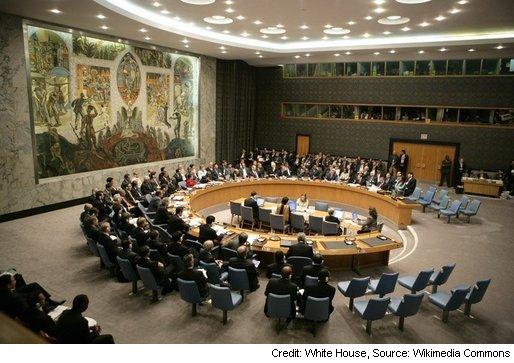
The following resolution, introduced by 120 co-sponsors, is currently pending the UN Security Council:

Israeli settlements established in the Palestinian Territory occupied since 1967, including East Jerusalem, are illegal and constitute a major obstacle to the achievement of a just, lasting and comprehensive peace.

On its face its not a particularly controversial claim. It more or less echoes long-held US policy on Israeli settlements. But of course when it comes to the UN, nothing is ever that simple.

What makes this situation a bit more interesting is that it is not only the usual suspects who are urging Obama to support the resolution. A letter signed by former US officials, prominent policy writers, academics and religious figures has just been released, calling upon the US to cast a yes vote.

An excerpt:

At this critical juncture, how the US chooses to cast its vote on a settlements resolution will have a defining effect on our standing as a broker in Middle East peace. But the impact of this vote will be felt well beyond the arena of Israeli-Palestinian deal-making – our seriousness as a guarantor of international law and international legitimacy is at stake.

America’s credibility in a crucial region of the world is on the line – a region in which hundreds of thousands of our troops are deployed and where we face the greatest threats and challenges to our security. This vote is an American national security interest vote par excellence. We urge you to do the right thing.

To be sure, the signators are not easily dismissible: they include former US Trade Representative and Council on Foreign Relations Chair Carla Hills, journalist and former New Republic editor Peter Beinart, former Under Secretary of State for Political Affairs Thomas Pickering, former Assistant Secretary of State James Dobbins, former Assistant Secretary of State Robert Pastor, former US Secretary of Defense Frank Carlucci and former US Ambassador to Israel Edward “Ned” Walker, among others.

It’s easy to be cynical about the UN, but it will still be interesting to see how this saga plays out. As Alex Spillius recently pointed out in The Telegraph, it may be Obama’s last chance to present himself as a fair dealer in this region.

If history is any indication, the final vote on this resolution will not be forthcoming any time soon. We can surely expect months of wordsmithing and back room dealing, and public posturing. Still, it certainly seems that there’s a bit more riding on this particular UN resolution than usual.

Stay tuned on this one.

JRC Israel-Palestine Trip Featured on Chicago Public Radio

Our JRC Israel/Palestine Study Tour was featured today on the Chicago Public Radio program, “Worldview.” I was interviewed along with trip participants Marge Frank and Michael Deheeger for an extensive and quite wide-ranging conversation about our experiences.

The first half of the program featured an powerful interview with Israeli Palestinian solidarity activist Joseph Dana, whose important work I’ve cited on this blog on several occasions. All told, a pretty important hour of radio.

Click here to give a listen. I strongly encourage you to tune in for the entire program; if you choose to listen to our interview alone, click here.

Lessons In Humility – A Guest Post From Palestine

Photo by Mike Okrent

Here’s a guest post by Lynn Pollack, another participant from our JRC trip to Israel/Palestine:

I was one of the people on the recent JRC trip to the West Bank and Israel, but having visited three times before in the last few years I didn’t think I had that much to learn.  After all, I had devoted much of the last decade to advocating for a just peace for Israelis and Palestinians – a peace that includes an end to occupation and a beginning of real equality.  What could possibly move me on another visit?   Arrogant, huh?  Well, yes, and on this trip I was humbled many times.

Continue reading

Initial Impressions and Later Reflections: A Guest Post From Palestine

Photo by Rich Katz

Here’s a guest post by Michael Shapiro, another participant from our JRC trip to Israel/Palestine:

Let me first thank Rabbi Brant Rosen for his vision and leadership in organizing this trip and for his astuteness in working with Aziz and Kobi.  They were articulate, deeply knowledgeable, warm and witty guides, but through their life histories and their relationship modeled the struggle for mutual understanding between their communities.  I am also grateful to Rabbi Rosen for the invitation to post on his blog.

The trip gave me a deeper understanding of the way the conflict burdens the lives of Palestinians.  It was no surprise to me that the weight of military occupation could be oppressive, but I now have a more acute sense of what it is like for those whose daily lives include humiliation and harassment at checkpoints or for those separated from farms, jobs, schools, and families by a wall built on their own land.

I will not forget hearing Marge Frank translate our Jenin host’s anguished and angry account of being made, more than once, to strip to his underwear at a checkpoint he had to pass through on his way to work in Israel. Nor will I forget the head of the Budrus Popular Committee, who led his village in a successful non-violent protest that resulted in a rerouting of the wall.  These and other equally indelible memories have deepened my understanding of the conflict and of the unconscionable injustice and suffering inflicted on the Palestinian people by the occupation and settlements.

In some instances, however, I have found that distance and reflection have placed initial impressions in a wider context and introduced  “complications,” a word that can sometimes mask moral callousness if not moral cowardice, but can sometimes challenge simplistic thinking by focusing  on  thorny realities. I would offer three examples.

Continue reading

Hear O Israel, The Land is One: A Guest Post from Palestine

Here is a guest post from Leon Fink – another a participant of our JRC trip to Israel/Palestine. (Leon and his wife Sue toured Israel for a week before our group arrived):

An intense two-week, late-December trip to Israel/Palestine (the first segment visiting classic Israeli sites, the second as part of a synagogue-sponsored “listening tour” of Palestine) has left me with myriad impressions but one overall conviction.  Like it or not—and I know many American Jews as well as Jewish Israelis do not—both the welfare and future of Israelis and Palestinians are indelibly linked.  And the sooner the Jewish community recognizes the need for a common, dual stewardship of the Biblical Land, including both its human and physical resources, the better. 

Continue reading

Aziz Blogs: “My Brother’s Kippah”

You might remember my post last week from Palestine, in which I described how Aziz Abu Sarah, our Palestinian tour guide, put on my kippah in order to enter the Jewish-only section of Hevron.

Now Aziz himself has just written a moving piece in +972 about his experience:

As we approached Shuhada Street I was thinking of a way to stay with the group. I wanted to show them Abu Seneineh neighborhood, where my ancestors came from before moving to Jerusalem 80 years ago.  I wanted them to see my aunt’s house and share with them my childhood memories about Hebron. So, I found myself devising a plan that would allow me to pass through without raising the soldiers’ suspicions.

Before arriving to the street, I asked Brant, the congregations’ rabbi, for his “kippah” (skullcap). I put it on my head and walked straight up to the Israeli soldier at the entrance of the street. I told him (in Hebrew) that I have a  Jewish group touring from Chicago that wants to walk through. He only had one question: “do you have any Arabs with you?”  I answered confidently, “No, they are all Jews,” and that was all we needed to get inside the “Jewish area.”

I was amazed by what a kippah could do. Suddenly, I was not suspicious and was transformed for the soldiers from an enemy to a friend.  The kippah became my entry visa, my access papers. I felt like it was my “shibboleth” into an elite club and the kippah was like the card I swipe to get in.

JRC in Israel/Palestine: My Final Thoughts

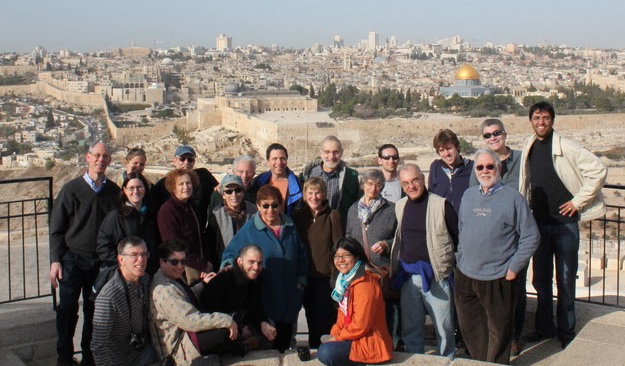
JRC Israel/Palestine Study Tour Participants 12/21/10 (Photo: Rich Katz)

My turn:

Our JRC Israel/Palestine Study Tour has been over for almost a week now, but I think I speak for everyone when I say it was a transformative experience for us all. I’ll also say that I am bursting with pride and admiration for my fellow JRC travelers.

I don’t know for sure, but I’m fairly certain this was an unprecedented Jewish congregational Israel tour. Most trips of this kind generally offer what I’d call a “hermetically-sealed” experience of Israel: an itinerary that remains largely west of the Green Line, offering participants a decidedly Jewish-centric perspective. I think most would agree it’s unusual for a rabbi to bring nineteen of his congregants on a trip that focused almost exclusively on East Jerusalem and the West Bank, spending the night in refugee camps, meeting with Palestinians, and learning from Palestinian civil society activists.

If I ever had any doubt, the reaction we encountered from those we met along the way drove this point dramatically home for us. Whenever we introduced ourselves and explained what we were doing, we’d invariably get the same open-mouthed reaction from our hosts. As the Israeli reporter Orly Halpern wrote me immediately after meeting with our group:

It was great meeting your open-minded and courageous congregation, Brant. Courageous because they were willing to hear the Other.

So yes, I’m very proud. Proud that we could take such a trip, and particularly proud of the congregational members who stepped forward to participate in it. Each and every one of them was willing to be deeply challenged – to lower their their ingrained defenses enough to face very real and painful truths – a reality that often directly contradicted the image of Israel with which they were raised.

Jewish Settlement in the heart of the Muslim Quarter (Photo: Rich Katz)

To be sure, it’s one thing to read about Israel’s oppression of Palestinians in the newspaper or hear about it second-hand; it’s quite another to witness it right in front of you where it’s impossible to rationalize or explain away. These congregants were willing to go places – literally and figuratively – where most American Jews remain resolutely unwilling to go. They were ready to let down their guard and be touched and transformed by what they saw.

And they were. Over and over and over again.

There will undoubtedly be those who will criticize us for taking a trip such as this, who will claim that our tour was “not balanced,” that is was unduly “biased,” that we didn’t take time to hear from the “other side.” I can’t help but be struck that these kinds of concerns are never raised when Jewish congregations organize Israel trips that pay scant attention to Palestinians and Palestinian life. And I don’t believe I’ve ever heard anyone in the American Jewish establishment criticize Birthright trips for being too “one-sided.”

I also believe that in our obsessive need to achieve balance, we conveniently ignore the fact that this is an inherently unbalanced conflict. As trip participant Marge Frank so eloquently put it in her previous guest post, “When one people is being oppressed and occupied by another, there is only one side to the story: that of the oppressed.” For most American Jews, it seems to me, the truth of Israel’s oppression of Palestinians is impossibly difficult to admit – and so we habitually explain it away, rationalize it, or deflect it in the name of balance.
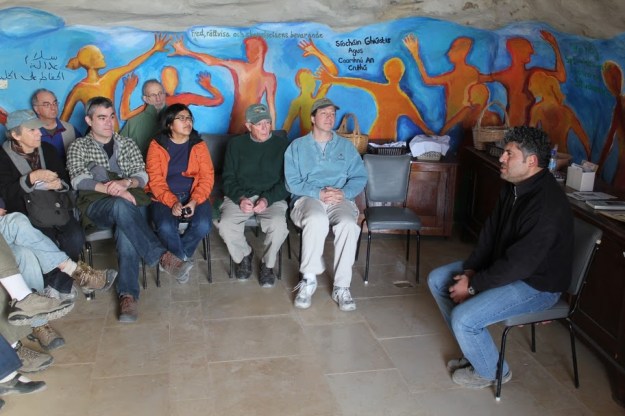
With Daoud Nasser in one of the natural caves on his family farm, Tent of Nations (Photo: Rich Katz)

At the end of the day, the experiences I wrote about on my blog this past week weren’t mere isolated examples of Israeli bad behavior. The home demolitions in Silwan, the attempted expropriation of Daoud Nasser’s family farm, the dehumanizing checkpoints, the racial separation and settlers’ harassment in Hevron – in the end I believe these are all part of a larger fabric of persecution. As painful as this might be for us to admit, these are not merely exceptional blemishes on the face of an otherwise healthy state. If any of us had any doubt about this, it became painfully difficult for us to deny once we saw it with our own eyes.

Kobi and Aziz, Hevron (photo: Rich Katz)

While our group experienced some profoundly dark truths, however, we also bore witness to very real signs of hope: the resilience and dignity of the Palestinian people and the inspiring example of those Israelis who stand in solidarity with them. In this regard we had no more powerful example of than Aziz and Kobi, our Palestinian and Israeli tour guides – two very courageous men who have transcended their own painful pasts and are now devoting their lives to reconciliation, justice and peace. As every member of our group will agree, they were truly our guides in every sense of the word.

For myself, I’m irrevocably committed to this journey now – and I am heartened beyond measure to know that there are American Jews who are willing to take it with me.

Busy Hevron street, (H1) (Photo: Rich Katz)

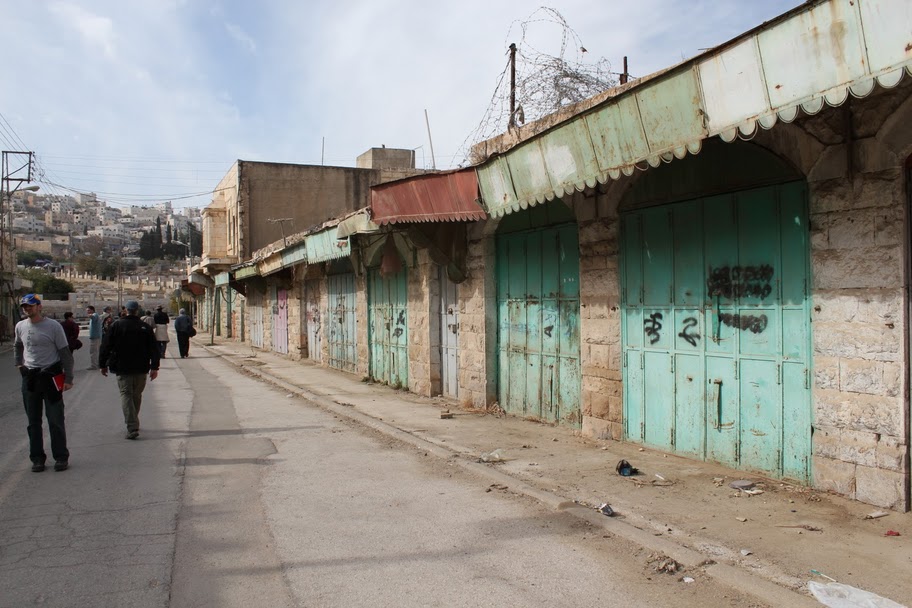
Shehadeh St. in Hevron (H2), now rendered completely off-limits to Palestinians

Demonstration at Silwan Peace Tent, E. Jerusalem 12/24/10 (Photo: Rich Katz)

Translation: "There is no holiness in an occupied city." Silwan demonstration, 12/24/10 (Photo: Rich Katz)
Jerusalem Has Other Lovers, Too: A Guest Post From Palestine

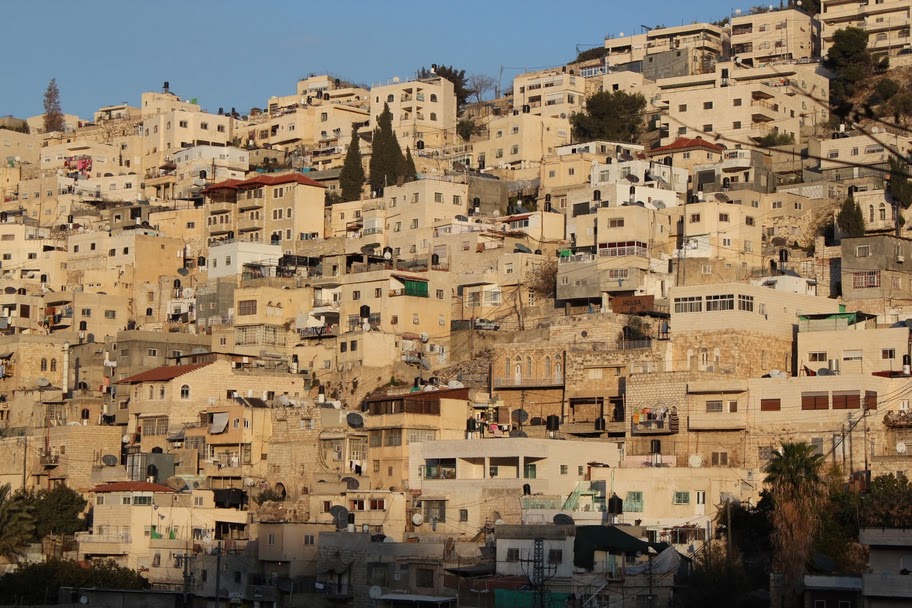
Silwan, E. Jerusalem, 12/24/10 (Photo: Rich Katz)

Here’s a guest post by Liz, another participant from our trip:

Looking back, it becomes clear to me that I fell in love with Jerusalem years before I would ever meet her.

We finally did meet for the first time in 1987, when I went to Israel on a high school summer program. Arriving instantly confirmed my feelings. I saw the forests of trees that I helped to build as a little girl all those times I answered the JNF’s call to give money to plant a tree in Israel. I saw the beautiful Jerusalem stone buildings everywhere. I saw Jews, feeling safe after the Holocaust, walking around proud to be there. I knew I was in love.

Subsequently, now that I was in love, I planned to spend my Junior year of college abroad in Jerusalem. But the Gulf War was launched the semester I was supposed to go and I was stuck in the US, separated from my lover. I missed being in Jerusalem so much that I told myself if I couldn’t go Junior year, then I would go for graduate school. I lived in Jerusalem from 1992-1996 and received my Master’s degree in English and Hebrew Literature from Hebrew University.

I was still in love. I was a young woman in my twenties living in Jerusalem walking the streets with pride — as though my whole life had led me to live, work, and study in this beautiful city. I deserve to be here, I am welcomed here, I need to be here.

Having just returned from the JRC trip to Israel/Palestine, I can’t get two things out of my mind. First, that my love for Jerusalem still runs very deep. And second, that it does for others even more so. Having stayed in the West Bank once before as a facilitator for Hands of Peace (a Chicago-based Israeli-Palestinian coexistence program), I was not blind to the Palestinians’ plight. For many of the Palestinians with whom I stayed, I was the first Jewish person they had met who wasn’t a soldier. They were hospitable, generous, and hungry to tell their stories. I listened, and when I returned to Chicago, I read everything I could.

This JRC trip, however, was very different. It was incredible to go with a group of Jews who had agreed to put themselves in emotionally vulnerable, uncomfortable situations which would require a lot of thinking, reflecting, and feeling. It was as though we all walked out onto a tightrope, knowing we could not go back.

Continue reading

From the Side of the Oppressed: A Guest Post From Palestine

Here is a guest post from Marge Frank, one of the participants from our trip:

Brant asked me to post on his blog, as the only Israeli-American on our tour, in order to add this perspective to the discussion.  I am honored to do so, albeit a bit overwhelmed as to how to choose what to share. This has been the most amazing, depressing, overwhelming, and transformative experience of my life and I’m still reeling from the multitude of emotions I’ve experienced.

Continue reading

A Day in Jenin, Return via Checkpoint

On our final full day in Palestine, we spent the morning and afternoon in the Jenin refugee camp. Our first stop was the Jenin Freedom Theatre.

The Freedom Theatre was founded by Israeli political and human rights activist Arna Mer Khamis in the wake of the First Intifada. Arna’s project used theater and arts to address Jenin’s childrens’ trauma, chronic fear and depression that resulted from the violence of the Intifada and the Occupation. Arna passed away in 1995 and her work has since been carried on by her son Juliano.

The Freedom Theatre’s theater building was destroyed during Israel’s military invasion of the Jenin refugee camp in 2002. It was rebuilt in 2007 and now flourishes with an array of amazing programs, performances and cultural events.

JRC member Joel Gratch at the entrance to the Jenin Freedom Theater

What makes the Freedom Theatre truly special is at the end of the day, it is about Palestinian solidarity – not simply another example of coexistence, dialogue or Israeli noblesse oblige. All who work at the Theatre, whether they are Palestinians, Israelis or internationals understand that above all, the Freedom Theatre is a form of Palestinian cultural resistance.

As part of our tour, we viewed these two films (at top and below) about the Theatre’s work. The films elicited a deeply emotional reaction from our group. When you will watch them you will understand why – and why we must learn about and support invaluable projects such as this.

After our visit, we toured the refugee camp, which has only partially been rebuilt since the Israeli military invasion in 2002. We then boarded the bus for our ride back to Jerusalem. When we arrived at Bethlehem (though we technically didn’t need to) we got off the bus and walked through the checkpoint in order to get a first hand look at this daily, signature Palestinian experience. We had the luck of arriving before rush hour – and of course of being American tourists who were undoubtedly being given preferential treatment by the IDF.

We waited in line and eventually arrived at a long, narrow chute that forced us into single file. One by one, we filed through a huge steel turnstile, which locked frequently with the flash of a red light and a loud buzzer. Once through the turnstile, were in a kind of an antechamber, in which soldiers spoke to us through a loudspeaker from a control room on the other side of thick glass. We were instructed to put our packs and metal objects on a conveyor belt/x-ray machine, and eventually emerged on the other side.

Those who have never seen an Israeli checkpoint cannot fathom how massive and extensive they are. This is something far beyond a mere road block or airport security line. Everything about this experience reminds you of your abject disempowerment; of the fact that you are utterly, frighteningly at the mercy of an armed power much greater than yourself.

It was impossible for us to begin to comprehend what it must do to Palestinians who has to endure such humiliation on a daily basis. And again: we weren’t even asked to disrobe, step away form the line, or wait for literally hours on end.

I didn’t take any pictures, but here are some images of the Bethlehem checkpoint from ActiveStills. They’ll give you a good solid sense of the scale of this massive checkpoint:

Stay tuned for some guest posts and final thoughts.