Category Archives: Palestine

The Sorrows of Jewish Ethnonationalism

Israel is going down a very dark road.

From a recent article in The Economist:

Not long ago, Lod, an Israeli city near the commercial hub of Tel Aviv, was a sleepy backwater. Its 20,000 Arabs among 45,000 Jews peppered their Arabic with Hebraisms, voted for Jewish parties, and described themselves as Israeli. The Arab population, drastically reduced in the 1948 war that marked Israel’s birth, has revived, exceeding its previous total.

But the calm has been disturbed. This month Israel’s leaders have taken their demand that the world—and the Palestinians—should recognise their state as specifically Jewish in exchange for a renewed freeze on building Jewish settlements in the West Bank, to Lod. Cabinet members have proposed “strengthening” the city’s population by bringing in more Jews and have approved a wider bill requiring new citizens to swear a loyalty oath accepting Israel as Jewish and democratic—in that order. Other measures are aimed at Israel’s Arabs, including a ban on teaching the Palestinian narrative that Israel expelled most of its Arabs in the war of independence.

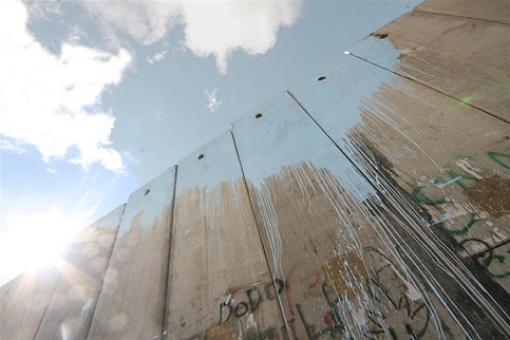
Liberal Israelis fear that these measures may import the Arab-Israeli conflict, which had been largely confined to the territories occupied by Israel beyond the 1948 partition line, into Israel proper. Adding to the psychological barriers, the Lod authorities have erected physical ones. This year they have finished building a wall three metres high to separate Lod’s Jewish districts from its Arab ones. And where the Arab suburbs are cordoned off to prevent their spread, Israel’s prime minister, Binyamin Netanyahu, encourages building for Jews to proceed with abandon.

His foreign minister, Avigdor Lieberman, on the coalition’s far right, champions building quarters for soldiers’ families in the town. The equally chauvinistic interior minister, Eli Yishai, who heads an ultra-Orthodox party, Shas, grants building permits for religious Jews. A series of gated estates are sprouting across the city reserved for religious Zionists. “These blocks will ensure Lod stays Jewish,” says Haim Haddad, the town’s chief rabbi, one of the first to move into a new estate.

By contrast, old Arab houses are under threat of demolition. Now and again, bulldozers demolish a couple, stressing Arab vulnerability. A study by a liberal Israeli group called Shatil (“Seedling”) estimates that 70% of Arab homes in Lod lack legal status. Many municipal services, such as street lighting and rubbish collection, stop at the boundaries of Arab suburbs. Sixteen kilometres (ten miles) from Tel Aviv, Israel’s richest city, sewage flows through some of Lod’s Arab streets.

And this from a recent article in Ha’aretz:

The Knesset’s Constitution, Law and Justice Committee on Wednesday unanimously approved a bill which gives the right to absorption committees of small communities in Israel to reject candidates if they do not meet specific criteria.

The bill has sparked wide condemnation and many believe it to be discriminatory and racist, since it allows communities to reject residents if they do no meet the criteria of “suitability to the community’s fundamental outlook”, which in effect enables them to reject candidates based on sex, religion, and socioeconomic status.

The bill is due to be presented before the Knesset plenum in the coming weeks.

Israeli Arab MKs were outraged by the proposal and walked out on the committee’s discussion of it.

MK Talab al-Sana (United Arab List – Ta’al) called the bill racist and said it was meant to prevent Arabs from joining Israeli towns. MK Ahmed Tibi (United Arab List – Ta’al) compared the bill to racist laws in Europe during World War Two, and the two told the committee members before leaving the hall: “We will not cooperate with this criminal law – you have crossed the line.”

The committee’s chairman, David Rotem (Yisrael Beiteinu), responded to claims the bill was meant to reject Arabs from joining Israeli towns. “In my opinion, every Jewish town needs at least one Arab. What would happen if my refrigerator stopped working on a Saturday?”

On JVP, Zionism and Jewish Community Growing Pains

As the co-chair of the newly created Jewish Voice for Peace Rabbinical Council, I’ve naturally been interested in the fallout from the Anti Defamation Leagues‘s naming of JVP as one of their “Top Ten Anti-Israel Groups in America.” According to the ADL and its supporters, JVP is guilty of any number of Jewish communal sins – the most cardinal among them, apparently, is JVP’s refusal to call itself a pro-Zionist organization, thus making it trefe in the eyes of the mainstream Jewish organizational community.

From a recent article on this issue in the New York Jewish Week:

The JVP website depicts a group that clearly puts most of the onus for the ongoing conflict on Israel and conspicuously refrains from calling itself “Zionist” even as it claims its positions are based on Jewish values.

“We do not take a position on Zionism,” said JVP’s (Executive Director Rebecca) Vilkomerson, who is married to an Israeli and has lived in the Jewish state. “That’s not a useful conversation; we have Zionists, anti-Zionists and post-Zionists.”

Zionism is, of course, the litmus test of communal loyalty in the old Jewish establishment. I’ve often been struck by the fact that although political Jewish nationalism is a relatively recent phenomenon in Jewish history, it has fast become the sacred cow of the American Jewish community.

Indeed, in the organized Jewish community today, nothing will earn you a Scarlet Letter quicker than terming oneself an “anti,” “non” or “post-Zionist.” So when the JVP politely declines to display its Zionist credentials at the door, it’s inevitable that the Jewish communal gatekeepers will be poised to pounce.

Again, from the Jewish Week article:

JVP “plays a role in inoculating anti-Zionists and often anti-Jewish organizations and activists by offering a convenient Jewish voice that agrees with what they’re saying — as if that voice is not coming from a radical fringe,” said Ethan Felson, assistant executive director of the Jewish Council for Public Affairs (JCPA)…

This is nothing new. Jews have been accusing other Jews of being part of the “radical fringe” from time immemorial. This how communal authority is typically wielded: leaders determine the reach of their power by marking the boundaries of what it considers “normative” and by attempting to marginalize what it deems “beyond the norm.”

Of course, boundaries tend to be moving targets. As it invariably turns out, yesterday’s radicals become today’s establishment. The outsiders eventually move inside. And little by little, the new authorities will be compelled to redraw the boundaries of the norm yet again.

In the case of Zionism, for instance, we have a movement that was regarded as a small and insignificant Jewish fringe when it was founded in 19th century Europe. Though it feels like ancient history today, even in the years prior to the establishment of the State of Israel in 1948 there were many respectable anti-Zionist institutions in the American Jewish community (the Reform movement being the most obvious example).

And in truth, even following the founding of the State, devotion to Israel was still not considered to be the sine qua non of American Jewish identity. It was only after the Six Day War in 1967 – a mere forty years ago – that Zionism came to be considered an incontrovertible component of the American Jewish communal consciousness.

In this regard, I found this line in the Jewish Week article to be particularly noteworthy:

In another departure from the pro-Israel canon, JVP does not specifically endorse a two-state solution.

Wow. It’s an innocuous claim, but when you stop to think about it, it’s pretty astounding to consider that the two-state solution is now considered to be a mainstream element of the “pro-Israel canon.” I well remember when the mere suggestion of a Palestinian state was tantamount to heresy in the Jewish community.

A history lesson:

In 1973 a group of young rabbis and and Jewish activists founded Breira – an “alternative” Jewish organization that sought to put progressive values on the agenda of the American Jewish community. When it was created, Breira was a national membership organization of over one hundred young Reform and Conservative rabbis (including Arnold Jacob Wolf and Everett Gendler) and many important American Jewish writers (including Arthur Waskow and Steven M. Cohen). In its first (and by far most controversial) public statement, Breira called for negotiations with the PLO and advocated for a two-state solution to the Israel-Palestinian conflict.

To make a long story short, in four short years Breira – an vital organization of 1,500 members and prominent young Jewish leaders – was dead and gone, successfully blackballed by the organized Jewish community.

Today, when I hear Jewish organizations such as the ADL and the JCPA trying to marginalize JVP, I can’t help but think about Breira. I can’t help but think about the arc of Jewish communal history, and how it inevitably bends from the outside in. And I can’t help but wonder at an old school Jewish establishment trying desperately to hold on to communal paradigms that are slowly but surely slipping from their grasp.

Bottom line? Jewish Voice for Peace is an example of a new Jewish organization that speaks to a young post-national generation of Jews that simply cannot relate to Zionism the way previous generations did. Indeed, increasing numbers of Jewish young people are interested in breaking down walls between peoples and nations – and in Israel they see a nation that often appears determined to build higher and higher walls between itself and the outside world. (It’s a poignant irony indeed: while Zionism was ostensibly founded to normalize the status of Jewish people in the world, the Jewish state it spawned seems to view itself as all alone, increasingly victimized by the international community.)

Whether the old Jewish establishment likes it or not, there is a steadily growing demographic in the American Jewish community: proud, committed Jews who just don’t adhere to the old narratives any more, who are deeply troubled when Israel acts oppressively, and who are galled at being labeled as traitors when they choose to speak out.

Here is the introduction to the JVP’s mission statement. Witness the words of an organization that the JCPA’s Ethan Felson calls “a particularly invidious group.” Is it any wonder why JVP is growing steadily – and why this growth strikes fear in the hearts of the Jewish establishment?:

Jewish Voice for Peace members are inspired by Jewish tradition to work together for peace, social justice, equality, human rights, respect for international law, and a U.S. foreign policy based on these ideals.

JVP opposes anti-Jewish, anti-Muslim, and anti-Arab bigotry and oppression. JVP seeks an end to the Israeli occupation of the West Bank, Gaza Strip, and East Jerusalem; security and self-determination for Israelis and Palestinians; a just solution for Palestinian refugees based on principles established in international law; an end to violence against civilians; and peace and justice for all peoples of the Middle East.

No, I’m not surprised when I hear the invective of the Abe Foxmans and Ethan Felsons of the Jewish world. Painful as they are, I have to remind myself that their words are ultimately a sign of our Jewish communal health and vigor.

Yes, I suppose growing pains are brutal – but in the end, we shouldn’t have it any other way.
Maguire and Shapira on Justice for Gaza

Ta’anit Tzedek hosted a powerful and inspirational conference call today with Irish Nobel Laureate Mairead Maguire and Israeli human rights activist Yonatan Shapira. Both spoke movingly about their activism and their participation on the latest Freedom Flotilla to Gaza.

Click here to listen. Please send it on.

Addendum 10/21: The Velveteen Rabbi has just posted a long piece about the call , complete with extensive background and transcriptions. Thanks, Rachel!

Mavi Marmara Post Mortems

I finally finished reading the full report commissioned by the UN Human Rights Council to investigate the IDF attacks on the Mavi Marmara last May. I can’t begin to describe how chilling these findings are.

The mission’s conclusion:

The circumstances of the killing of at least six of the passengers were in a manner consistent with an extra-legal, arbitrary and summary execution. Furkan Doğan and İbrahim Bilgen were shot at near range while the victims were lying injured on the top deck. Cevdet Kiliçlar, Cengiz Akyüz, Cengiz Songür and Çetin Topçuoğlu were shot on the bridge deck while not participating in activities that represented a threat to any Israeli soldier. In these instances and possibly other killings on the Mavi Marmara, Israeli forces carried out extralegal, arbitrary and summary executions prohibited by international human rights law, specifically article 6 of the International Covenant on Civil and Political Rights.

Although the Israeli military described the event as a “lynching” of its soldiers by brutal provocateurs, the post-mortem description of the victims makes it pretty clear who the real victims were that night. Witness, for example, this post-mortem description of the body of teenage victim Furkan Dogan:

Furkan Dogan, a nineteen-year old with dual Turkish and United States citizenship, was on the central area of the top deck filming with a small video camera when he was first hit with live fire. It appears that he was lying on the deck in a conscious, or semi-conscious, state for some time. In total Furkan received five bullet wounds, to the face, head, back thorax, left leg and foot. All of the entry wounds were on the back of his body, except for the face wound which entered to the right of his nose. According to forensic analysis, tattooing around the wound in his face indicates that the shot was delivered at point blank range. Furthermore, the trajectory of the wound, from bottom to top, together with a vital abrasion to the left shoulder that could be consistent with the bullet exit point, is compatible with the shot being received while he was lying on the ground on his back. The other wounds were not the result of firing in contact, near contact or close range, but it is not otherwise possible to determine the exact firing range. The wounds to the leg and foot were most likely received in a standing position.

The fact-finding mission conducted interviews with more than 100 witnesses in Geneva, London, Istanbul and Amman – and consulted with numerous forensic and medical experts.  It is impressively thorough, especially considering Israel refused to cooperate with the investigation and still refuses to release the extensive video and documentary evidence it seized from passengers.

Not surprisingly, Israel has denounced the report as “biased and distorted” and is conducting its own investigation, the Turkel Commission. (The news from that investigation doesn’t look too promising – already we’re receiving reports that the commission is showing outright hostility to Israeli human rights groups that were called to testify.)

For a spot-on analysis of the UNHC report, I strongly recommend this piece by Salon’s Glenn Greenwald, who rightly takes the US government to task for its “appalling silence” in the face of Israel’s outrageous violation of human rights and international law:

Perhaps most illustrative of all is how inconceivable it is to imagine the U.S. Congress doing anything at all in the face of this report . . . except passing a Resolution condemning the investigators themselves while defending Israeli actions, including the actions that resulted in the death of an American teenager.  Is there any doubt that such a Resolution would pass with overwhelming bipartisan support, approaching unanimity — as happens each and every time there is a controversy involving Israel?   Thus far, the U.S. media and Government are largely silent about this U.N. Report, but if they are prodded into responding, the response will almost certainly be to condemn the report itself while defending and justifying Israeli actions even in the face of overwhelming evidence as to what really happened here, which managed to emerge despite the Israelis’ very telling efforts to keep it suppressed.

Greenwald is correct, of course. By all rights our government should be condemning this brutal assault and insist that Israel release all evidence of what occurred that night.

In the meantime, the only footage available to us is the video taken and smuggled out by Iara Lee, Executive Director of Cultures of Resistance – and one of the few Americans on the Mavi Marmara. (Part one above, part two below). While it is certainly not easy to watch, I suspect the videos Israel has locked away are infinitely more disturbing…

PS: If ploughing through a lengthy human rights commission report isn’t your cup of tea, I highly recommend the recently published anthology “Midnight on the Mavi Marmara.” Essential, essential reading.

The ADL’s Celebration of Diversity

Imagine my surprise to read that the ADL has just released its list of “Top 10 anti-Israel groups in America,” listing such organizations as Jewish Voice for Peace (a group with which I proudly affiliate) as well as the Council on American-Islamic Relations, Friends of Sabeel, the International Solidarity Movement, If Americans Knew, and the US Campaign to Stop the Occupation.

There have already been some fine responses to the ADL’s silly blacklist – check out these articles in Salon, the Daily Beast and Mondoweiss. JVP itself has released a very eloquent response that I encourage you to read as well.

An excerpt:

We do not hold Zionism as a litmus test for membership. Some of our members are Zionists, some are anti-Zionists, and some are non-Zionists. We believe you can define yourself in any of these ways as long as you support an end to the Israeli occupation of the West Bank — including East Jerusalem — and Gaza, and you advocate for human rights, which naturally apply equally to Israelis and Palestinians.

We stand by Israelis that hold these views, such as Israeli conscientious objectors and Israeli actors refusing to play in illegal settlements in the West Bank.

We stand by Palestinians that hold these views, such as Palestinian activists protesting the Israeli confiscation of land in the West Bank town of Bil’in.

We stand by internationals that hold these views, such as students pressing for divestment from occupation and war crimes or activists trying to break the siege of Gaza.

What unites us is our belief in human rights and equality.

Right on.

I’ll cite one more response to the ADL’s intolerance: it comes, interestingly enough, from the ADL itself.

Among the many projects sponsored by the ADL is it’s “A World of Difference Institute,” an impressive provider of anti-bias education and diversity training programs and resources. According to its mission, the AWOD Institute ” seeks to help participants recognize bias and the harm it inflicts on individuals and society; explore the value of diversity; (and) improve intergroup relations.”

As it turns out, our younger son recently told us that AWOD is coming to his High School to conduct a student workshop they call “Names Can Really Hurt Us,” a program that “allows students open, honest and relevant exploration about diversity and bias in their school communities.”

I’m enormously glad to hear that the ADL cherishes diversity and encourages open, honest exploration.

I’d say it’s time it applied these values to the Jewish community as well.

“Why We Sailed to Gaza” – A Conversation with Mairead Maguire and Yonatan Shapira

Please mark your calendar for the next Ta’anit Tzedek fast day, Thursday, October 21, 12:00 pm (EST), which we will mark with a conference call, “Why We Sailed to Gaza” featuring Nobel Peace Prize laureate Mairead Corrigan Maguire and Israeli peace activist Yonatan Shapira.

Earlier this month, both Maguire and Shapira recently set sail on flotilla of boats attempting to break the siege of Gaza by bringing symbolic amounts of humanitarian aid to its citizens.

Maguire is a well-known Irish peace activist who co-founded the “Community for Peace People” during the period known as “The Troubles” in Northern Ireland. She  subsequently helped found the Nobel Womens Initiative, a group of six women Nobel Peace Laureates devoted to strengthening women’s rights and and advocating for justice and peace around the world.

More recently, Maguire has become involved in activism for peace and justice in Israel/Palestine. She has sailed on three boats to Gaza, in October 2008 (when they reached Gaza), on June 2009 and then on the MV Rachel Corrie in June 2010. In 2009 and 2010, the boats were intercepted by the Israeli Navy and she was arrested along with all the passengers. On her most recent attempt, Maguire remained in prison as she fought Israel’s efforts to deport her. The Israeli Supreme Court upheld the decision to deny her entry and she was deported from Israel earlier this month.

Shapira was an officer in the Israeli Air Force and flew hundreds of missions over the territories in a Blackhawk helicopter squadron during the course of his eleven year career. Following a targeted bomb assassination of a Hamas leader that killed fourteen civilians in Gaza, he became a prominent Israeli “refusenik,” authoring the Pilot’s Letter – a 2003 statement signed by 27 Israeli pilots who publicly refused to fly missions over the Occupied Territories. Since that time, Yonatan has gone on to co-found “Combatants for Peace” a prominent organization in the growing Israeli Refusenik movement.

Shapira has also become a public supporter of the internal Israeli movement for Boycott, Divestment and Sanctions (BDS) known as “Boycott from Within,” and regularly participates in Palestinian nonviolence campaign in East Jerusalem and the West Bank. According to witnesses aboard the “Jewish boat” to Gaza earlier this month, Shapira nonviolently resisted when the IDF boarded the ship and was tazered repeatedly in the heart by the senior commanding officer.

Here’s the call-in info:

Access Number: 1.800.920.7487

Participant Code: 92247763#

There will be a question and answer period during the call –  please join the conversation! (Big thanks to our co-sponsors, Jewish Voice for Peace, the Shalom Center, and Shomer Shalom Institute for Jewish Nonviolence.)

Another Palestinian Gandhi Sent to Prison

We’ve often heard asked “where are the Palestinian Gandhis?”  The answer?  Too many of them are sitting in Israeli prisons.

Exhibit A: Abdallah Abu Rahmah, a leader of the nonviolent campaign in the West Bank village of  Bil’in, who was arrested last year by soldiers who raided his home at the middle of the night. An Israeli military court exonerated him on charges of stone-throwing and arms possession (the “arms” turned out to be empty bullet casings and tear gas canisters that Abu Rahmah had collected to prove IDF violence against demonstrators) but he was eventually convicted of “organizing illegal demonstrations” and “incitement.”

Here’s how Israeli activist Jonathan Pollak characterized these events last year:

On a pitch black early December night, seven armored Israeli military jeeps pulled into the driveway of a home in the West Bank town of Ramallah. Dozens of soldiers, armed and possibly very scared, came to arrest someone they were probably told was a dangerous, wanted man – Abdallah Abu Rahmah, a high school teacher at the Latin Patriarchate School and a well-known grassroots organizer in the village of Bil’in.

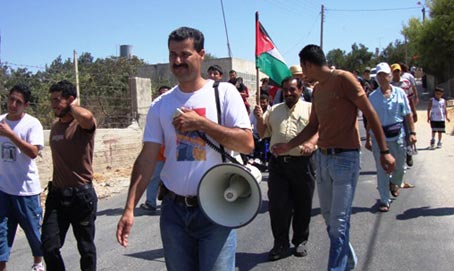
Every Friday, for the past five years, Abdallah Abu Rahmah has led men, women and children from Bil’in, carrying signs and Palestinian flags, along with their Israeli and international supporters, in civil disobedience and protest marches against the seizure of sixty percent of the village’s land for Israel’s construction of its wall and settlements. Bil’in has become a symbol of civilian resistance to Israel’s occupation for Palestinians and international grassroots.

Abu Rahmah was taken from his bed, his hands bound with tight zip tie cuffs whose marks were still visible a week later, and his eyes blindfolded. A few hours later, as President Obama spoke of “the men and women around the world who have been jailed and beaten in the pursuit of justice” upon receiving the Nobel Peace Prize, Abu Rahmah’s blindfold was removed as he found himself in a military detention center. He was being interrogated about the crime of organizing demonstrations. In occupied Palestinian territories, Abu Rahmah’s case is not unusual – about 8,000 Palestinians currently inhabit Israeli jails on political grounds.

Abu Rahmah’s sentence came down today: one year in prison, a six months suspended sentence for three years, and a fine of 5,000 shekels. The military prosecution is expected to appeal, which means he is likely to remain in jail indefinitely.  Another Bil’in activist, Adeeb Abu Rahmah, was also sentenced for twelve months on similar charges but still remains in prison after fifteen months while prosecutors continue to appeal his conviction.

How can we in the Jewish community help promote peace and justice in Israel/Palestine? By standing in solidarity with courageous Palestinian leaders such as Abdallah Abu Rahmah. Click here to learn more about his case and how you can support his cause.

The IDF Belly Dance: This Is What Occupation Does to the Occupied and the Occcupier

From Ha’aretz:

A video uploaded to YouTube shows an Israel Defense Forces soldier wriggling in a belly dance beside a bound and handcuffed Palestinian woman, to the cheers of his comrades who were documenting the incident.

The IDF’s internal investigation department ordered an immediate probe into the matter…

As the article notes, it’s only the latest incident of an IDF “Abu Ghraib-style” scandal – but don’t think for a second that all is well now that the IDF is “investigating the matter.” I’m in agreement with blogger Mitchell Plitnick, who points out that these incidents are just the outward manifestation of something much more fundamental and much more troubling:

In my work I’ve come to meet and get to know many soldiers, from several countries (most, of course, either Israeli or American), both active ones and veterans. I know that most soldiers do not behave this way. But it is clear, from every war, conflict, police action and occupation that there are always some soldiers who do.

Israelis are no different, but there is something that is different about this dynamic. It is that these soldiers are the products of a militarized society which has been holding millions of people under military occupation, with no rights of citizenship, for over 43 years. That has a long term effect on both occupier and occupied.

These soldiers are young men and women, who are the second or even third generation of occupiers. They have been raised in a culture that, as is natural for an occupying power, both dominates the Palestinians and also fears them. That fear is not limited to terrorists, but extends to the very existence of the Palestinians, and their legacy of dispossession.

The Settlement Freeze: Painted Into a Corner?

The deadline on Israel’s “settlement freeze” has come and gone. On the West Bank, construction crews are gearing back up and the settler celebrations have begun. Abbas is mulling over his options with the Arab League.  Once again, the peace process seems to be hanging by a thread.

For their part, many analysts are now using a “painted into a corner” metaphor to dissect the impact of the settlement freeze. Israeli analyst Nahum Barnea, for instance, recently opined that,

Three politicians – Barack Obama, Benjamin Netanyahu and Mahmoud Abbas – painted themselves into a corner and didn’t know how to get out of it.

And none other than King Abdullah of Jordan said this on the Daily Show last week:

We all got painted into a corner on the issue of settlements, unfortunately, and where we should have concentrated was on territories and the borders of a future Israeli-Palestinian two-state solution.

It’s bewildering to me that the issue of settlements can somehow considered to be a pesky distraction to the peace process. How can talks on “territories and borders” proceed with anything resembling good faith if one side settles these disputed areas with impunity and the “honest broker” to the proceedings refuses to rein it in?  How can we be expected to take such a process seriously?

We already know that one of the main reasons for Oslo’s failure was the inability to deal with the settlement issue directly.  As a result, Israel took that as an opportunity to significantly expand its settlement regime during the course of the “peace process.” This has brought us to where we are today: in the wake of Oslo more than 500,000 settlers now live throughout the West Bank in settlements and small cities, with special Israeli-only highways that effectively cut Palestinian territories into individual cantons separated by military checkpoints.

Have we learned nothing from past experience? Here’s lesson #1: the settlements are not a side issue. The Israel’s settlement of the West Bank and East Jerusalem are – and have always been – a central obstacle to the peace process. Until it is made to cease and desist, I can’t see how the latest round of talks can be considered anything but a charade.

Jews, Power and Privilege: A Sermon for Yom Kippur 5771

From my Yom Kippur sermon yesterday:

For matter how painful the prospect, I don’t think we can afford to dodge this question. If we agree that the inequitable distribution of power and privilege is a critical problem for us and for our world, then there will inevitably be times in which we are faced with an intensely difficult question: does tribal loyalty trump solidarity with the oppressed?

Actually, I’m coming to believe that this is not the best way to frame the question. I don’t really think it’s all that helpful to view this issue as some kind of zero-sum game; to see it as a question of tribal allegiance; to insist that I either stand with my own people or I don’t. I prefer to say it this way: that it is in my self interest as a Jew to stand in solidarity with the oppressed because I believe that Jews cannot be fully human while they benefit from a system that denies others their own humanity. For those with power and privilege, the struggle against racism and oppression is fought knowing that our own liberation is also at stake.

Click below to read the entire sermon:

Continue reading