Category Archives: Palestine

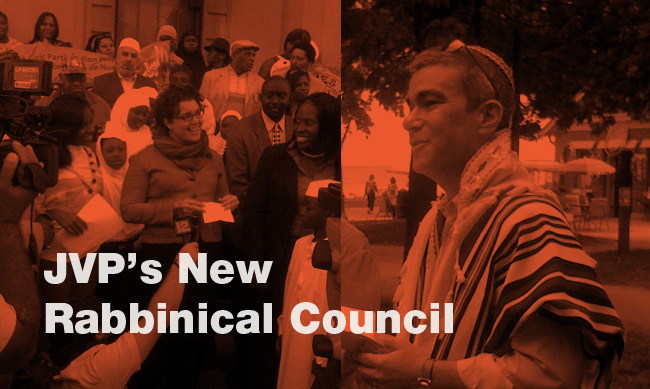
Jewish Voice for Peace Launches Rabbinical Council

I’ve just begun serving with my good friend and colleague Rabbi Alissa Wise as co-chair of Jewish Voice for Peace’s newly launched Rabbinical Council. As readers of this blog may have surmised by now, JVP has become an increasingly important and vital organizational address for me – and I’m honored to be working with Alissa to help organize Jewish spiritual leaders on its behalf.

If you’re a rabbi, rabbinical student or cantor, we invite you to sign on. You can contact us at rabbis@jvp.org.

Israeli Artists Say No to Performing in Ariel – and Support is Growing!

Very big and inspiring news:

Last week, fifty Israeli actors, directors and producers publicly released a letter saying they would not perform in a new multi-million dollar theater center in the West Bank settlement of Ariel and that they would continue to do so until there was an Israeli-Palestinian peace agreement.

Their stand drew immediate outrage from the Israeli government. PM Netanyahu, Culture and Sports Minister Limor Livnat and Finance Minister Yuval Steinitz responded by threatening to deny government funding to any  cultural institutions that refuse to hold performances in the Occupied Territories. Netayahu released a statement accusing the Israeli artists of joining an “international delegitimization campaign” adding that “the last thing the state needs to do is fund bodies that are promoting boycotts from within.”

These events had a powerful and galvanizing effect within Israeli society. Almost as immediately, over 150 leading Israeli academics and writers (including authors Amos Oz and David Grossman) came to the defense of the artists. The boycott quickly became a central issue of discussion in the Israeli press – for its part, Ha’aretz’s staff editorial stated:

Theater actors are not marionettes, and cultural coercion of artists who fear for their livelihood does not befit a freedom-loving country. Cultural and academic institutions that receive budgetary support from the state do not owe it obedience in return. On the contrary, the government should be thankful for the existence of institutions that constitute such a vital interest for Israeli society.

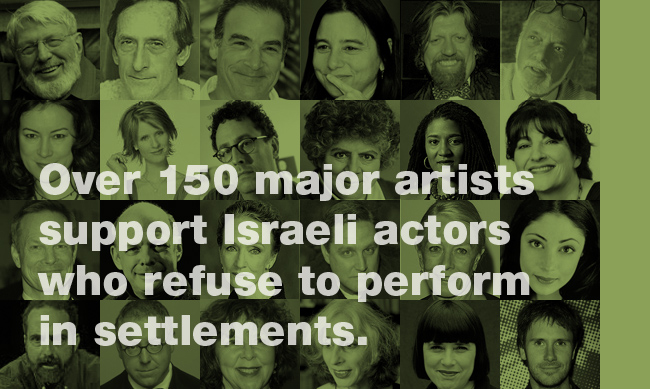
Now it appears the struggle has moved to the United States. I’m so incredibly proud to see that Jewish Voice for Peace has now organized a support statement by over 150 American and European theater and film professionals – including Mandy Patinkin, Theodore Bikel, Eve Ensler, Tony Kushner, Cynthia Nixon, Ed Asner, among others.

Here’s the text of the statement:

On August 27th, dozens of Israeli actors, directors, and playwrights made the brave decision not to perform in Ariel, one of the largest of the West Bank settlements, which by all standards of international law are clearly illegal.  As American actors, directors, critics and playwrights, we salute our Israeli counterparts for their courageous decision.

Most of us are involved in daily compromises with wrongful acts. When a group of people suddenly have the clarity of mind to see that the next compromise looming up before them is an unbearable one  — and when they somehow find the strength to refuse to cross that line  —  we can’t help but be overjoyed and inspired and grateful.

It’s thrilling to think that these Israeli theatre artists have refused to allow their work to be used to normalize a cruel occupation which they know to be wrong, which violates international law and which is impeding the hope for a just and lasting peace for Israelis an Palestinians alike.  They’ve made a wonderful decision, and they deserve the respect of people everywhere who dream of justice. We stand with them.

This is big. Indeed, as the government’s apoplectic response clearly demonstrates, it represents much more than a mere symbolic stand. To stand up against performing in Ariel, which Netanyahu has described as the “Capital of Samaria,” means to stand up against the very heart of Israel’s settlement enterprise.

It is also the most significant internal cultural boycott to ever take place in Israel – and the support of the artistic community around the world shows that there is a growing constituency of prominent figures who are willing to publicly speak out against Israel’s impunity.

In other words, the artistic community is stepping up and going to the places to which our politicians seem unwilling to go. Bravo!

South Hebron Tragedy: Blogosphere Reactions

Two posts from today’s blogosphere offer spot-on responses to yesterday’s tragic killings in Hebron:

From Mitchell Plitnick’s “The Third Way:”

I very much appreciate President Obama condemning yesterday’s murders of four settlers in the South Hebron Hills.

But that condemnation would be an awful lot more meaningful, to myself and to many others I’m sure, if we saw similar outrage in Washington when Israel killed over 700 Palestinian non-combatants in Operation Cast Lead. Or when a border policeman killed Bassem Abu Rahmeh by firing a gas cannister directly and intentionally at him. Or for any of the 100 Palestinians killed since the end of Operation Cast Lead (many of whom were killed as combatants, to be sure, but 32 of whom were not taking part in hostilities nor were counted as “targeted assassinations”).

From Paul Woodward’s “War in Context:”

Whether or not Hamas had a role in yesterday’s attack it is too soon to tell. And even if some or all of the gunmen turn out to belong to the movement does not necessarily reveal a great deal about the level of command and control or political motives for the attack.

Whatever the motives, the outcome itself has opened political opportunities to each constituency that now portrays itself as a victim.

Given that the attack took place in an area controlled by the IDF, President Abbas could have taken the opportunity to point out that the attack underlines the fact that there can ultimately be no security solution to the political conflict. Instead, Palestinian security services have been quick to launch what is being described as one of the largest arrest waves of all time in the West Bank.

At the funerals of the four Israelis killed, settler leaders took the opportunity to push for settlement expansion, call for vengeance (a call which has already been acted upon), deny the existence of the Palestinian people and made a thinly-veiled appeal for ethnic cleansing…

When President Obama tries to press Benjamin Netanyahu to extend the so-called settlement freeze, the Israeli prime minister will no doubt tell him solemnly that in light of recent events, his hands are well and truly tied.

They shoot and we build has become the settlers’ slogan — one that is almost certainly to Netanyahu’s liking.

Martin Indyk on the Peace Process: Hoping Against Hope

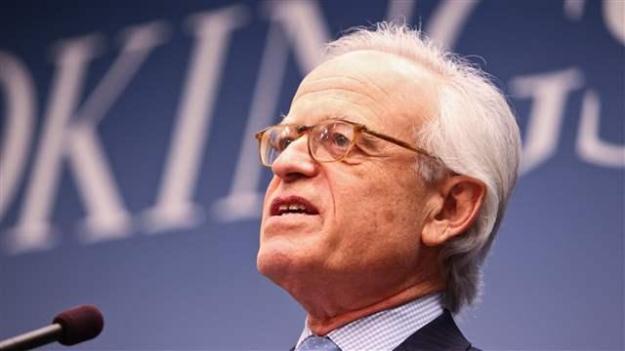
martin_indyk001_16x9

A commenter on my last post asked me what I thought of Martin Indyk’s recent NY Times op-ed, in which he expresses a powerful optimism about the upcoming I/P peace talks in Washington.

My answer?  Indyk’s article represents a picture-perfect example of the inherent inequity of the peace process as it is currently defined.

In his op-ed, Indyk lists four factors that he believes distinguish this round of direct talk from previous attempts. Number one, he claims that “violence is down considerably in the region.” Thanks to the PA’s security measures in the West Bank and Hamas’ in Gaza, Indyk explains, Palestinian violence against Israelis has decreased considerably.

His analysis, however, completely leaves out the other side of the equation: Israel’s violence against Palestinians, which remains as brutal and oppressive as ever. The examples are legion: Israel’s military assault in Gaza in 2008/09 that left 1,400 dead, the structural violence of its ongoing blockade of Gaza, which is having a devastating effect on Gaza’s economy, health care system, infrastructure and Gazans’ freedom of movement. In the West Bank, the IDF continues its armed crackdown on weekly non-violent protests and has increased its arrests and incarceration of non-violent Palestinian leaders.  Home evictions and demolitions continue throughout the territories, East Jerusalem and even in Israel proper.

Indyk’s myopia on this front is fascinating. Indeed, it offers an important window into a fundamental injustice that currently pervades the peace process – a process where only Palestinian violence against Israelis is considered germane to negotiations. It might reasonably be asked: is this process about delineating the terms of a equitable peace treaty or dictating the terms of a Palestinian surrender?

Indyk’s second factor: Israel’s “settlement activity has slowed down considerably.” To demonstrate his claim he quotes from the Israeli Central Bureau of Statistics, which reports that

(No) new housing starts in the West Bank were reported…in the first quarter of this year. What’s more, there have been hardly any new housing projects in East Jerusalem since the brouhaha in March, when Vice President Joe Biden, during a visit to Israel, condemned the announcement of 1,600 additional residential units. The demolition of Palestinian houses there is also down compared with recent years.

It is a clear sign of Indyk’s abiding prejudice that he turns to the Israeli government for an accurate report of facts on the ground. I’d suggest a more trustworthy source: namely, Peace Now, who has been indefatigably tracking Israel’s settlement activity in the West Bank.

According to its most recent report:

(On) the ground, there is almost no freeze or even a visible slowdown, despite the fact that legal construction starts have been frozen for 8 months (and) that the Government of Israel is not enforcing the moratorium.

The report’s main findings:

• At least 600 housing units have started to be built during the freeze, in over 60 different settlements.

• At least 492 of those housing units are in direct violation of the law of the freeze.

• During an average year (when there is no freeze) approximately 1,130 housing units start to be built in 8 months in the settlements. The new construction starts during the moratorium constitute approximately half of the normal construction pace in the settlements.

• Some 2,000 housing units are currently under construction in the settlements, most of them started before the freeze was announced in November 2009.

This means that on the ground, there is almost no freeze or even a visible slowdown, despite the fact that legal construction starts have been frozen for 8 months.  It also means that the Government of Israel is not enforcing the moratorium.

In short? Indyk’s claim is misleading and spurious. Palestinians have been reasonably concerned about entering into direct talks while Israel’s settlement activity is ongoing.  As things currently stand, the “freeze” is slated to be lifted next month – precisely the same time talks in Washington are scheduled to commence.

For factors three and four, Indyk points out that a majority of the public on both sides support a two-state solution – and that there really isn’t that much left to negotiate anyway.  He blames Arafat exclusively for the breakdown of Camp David in 2000, a failure that left “Palestinians and Israelis mired in conflict.” This is, of course, the conventional Israeli narrative regarding the failure of Camp David: the Israelis made a generous offer, the Palestinians spurned it, and the Second Intifada ensued.

This is a simplistic, one-sided narrative that has long been challenged by compelling accounts of the actual negotiations.  Most famously, this narrative asserts that Israel was prepared to offer 96% of the Occupied Territories to the Palestinians. It has since been pointed out that this 96% number more accurately represented the percentage of the land over which Israel was prepared to negotiate. It did not include, among other things, East Jerusalem, the huge belt of Jewish settlements around the city or a ten mile wide military buffer zone around the Palestinian territories. In fact, after factoring in an obligation to lease back settlements to Israel for twenty five years, the total Palestinian land from which Israel was prepared to withdraw actually came to approximately 46%.

Regardless of which narrative we choose to believe, it is clear that ten years after Camp David many difficult complicated issues remain unaddressed. In the meantime, Israel has continued to expand its settlement regime across Palestinian territories, which likely means the amount of land from which it is prepared to withdraw has shrunk all the more. Under these circumstances, Indyk has little cause to treat the current round of negotiations as pro-forma.

Albert Einstein has been quoted as observing that “the definition of insanity is doing the same thing over and over again and expecting different results each time.” For the past twenty years the peace process has been defined by the same basic – and one-sided – parameters. Each time the process has been rebooted, we’ve heard the same kinds of hopeful tropes that Indyk expresses here. Each time we’ve been told that we have an unprecedented opportunity for peace. Each time we’ve been told that those who criticize the process are the “enemies of hope.” But each time, this flawed political process has brought us no further along toward a viable two-state solution.

Perhaps it is time to envision a different process. One that takes values of justice and equity as seriously as it does peace. One in which the United States acts as a truly honest broker, in which Israel is held to account for its violence against Palestinians, for its oppressive policies and its ongoing settlement of the occupied territories. Then, and only then, will there truly be, as Indyk puts it, “hope in the Middle East.”

Peace with Justice in Israel/Palestine: A Dialogue

Since my recent post on the current round of the Israeli-Palestinian peace process I’ve received many responses, via comment, in person, and email. Here’s one of the most thoughtful and challenging, sent to me by a good friend. Click at the finish for my response:

As the Midrash (Leviticus Rabbah 9) teaches, “Great is Peace, since even in a time of war, one should begin with peace…”

Even now, when the prospect of achieving peace seems so remote and the hostility from some in the Netanyahu government so hostile, we as Jews are commanded to pursue peace. This doesn’t mean that we should be Pollyannaish about the possibilities of success in the upcoming talks, but neither should we give up before they’ve started. There is always the possibility, however remote, that Netanyahu will decide to take the bull by the horns and do a Nixon to China like move. Those of us who care deeply must encourage the best possible outcome. After all, if these talks fail and the Palestinian Authority disintegrates, where will this leave in terms of security in the West Bank and international credibility? Where will it leave President Obama who has hinged so much of his foreign policy on resolving the conflict? These are serious and weighty matters for Israel and the U.S.

I know that the political maneuvering around peace talks can be very discouraging for those like you who are trying to improve the situation on the ground. Politicians make all sorts of moves that are hard to swallow. Hillary Clinton, for example, started out very strongly on human rights issues leading the way for international financial assistance to Gaza following the war and strong denouncing settlement building in East Jerusalem. To get to these talks, she has become much more restrained in response to both the failure of the settlement freeze policy and to fear of attacks from the right wing (both Jewish and Christian) in characterizing Obama as anti-Israel. There is a place for politics in moving things forward, but it operates in a very different manner than truth telling. Mobilizing support from people with a broad range of perspectives involves compromises that can be very hard to swallow, but until we find a way to win over broader grassroots support, this is the price we will pay until then.

I admire your decision as a prominent rabbi to telling the truth about the on the ground situation in Israel and Palestine. This is extremely difficult to look at for many of us, and yet you have decided to unflinchingly dive in headfirst. However, I believe that your framing the political process in opposition to justice on the ground is quite problematic and ultimately more harmful to your dreams than heuylpful.

I cannot praise your glorification of hopelessness and the messianic like idea that we cannot pursue peace until there is justice. We cannot stop seeking peace and we cannot stop seeking justice, and we must use all of the tools at our disposal including politics and including truth telling.

Most importantly, if you really want to “extend civil rights, human rights, equity and equality for all inhabitants of Israel/Palestine” then you will need every possible ally. Please don’t make yourself the leader of an exclusive club that turns away your natural allies for lack of moral purity. It’s so much easier to stand on supposed high moral ground and criticize those who imperfectly seek to bring about change than to do the dirty work of making it happen. In the end, we all need each other if we’re going to move this forward.

Continue reading

The Peace Process is Dead

Israelis and Palestinians are being brought back to the table, but no one really seems to be all that happy about it. Indeed, I can’t remember a time when renewed peace talks were greeted with such widespread cynicism. And that’s when you can even read about it at all – as I scour my usual media outlets for news and commentary on the peace process, I’m getting the distinct impression that this kind of thing is simply not considered to be news any more.

The only significant piece I’ve read recently is Ethan Bronner’s front page article in Saturday’s NY Times. The first few paragraphs pretty much tell you everything you need to know:

The American invitation on Friday to the Israelis and Palestinians to start direct peace talks in two weeks in Washington was immediately accepted by both governments. But just below the surface there was an almost audible shrug. There is little confidence — close to none — on either side that the Obama administration’s goal of reaching a comprehensive deal in one year can be met…

“These direct negotiations are the option of the crippled and the helpless,” remarked Zakaria al-Qaq, vice president of Al Quds University and a Palestinian moderate, when asked his view of the development. “It is an act of self-deception that will lead nowhere.”

And Nahum Barnea, Israel’s pre-eminent political columnist, said in a phone interview: “Most Israelis have decided that nothing is going to come out of it, that it will have no bearing on their lives. So why should they care?”

I used to believe where there’s talk, there’s hope. (In fact, I think I’ve even written those very words on this blog once or twice before). I don’t think I really believe this any more – not, at least, when it comes to the Israeli-Palestinian peace process. For almost two decades, the US and the international community has been brokering talks between both sides and now this is what it has come to: beyond the pro-forma diplomatic statements, everyone seems to agree that it’s really just a road to nowhere. And a half-hearted attempt to bring the “crippled and the helpless” to the bargaining table simply doesn’t inspire hope. Quite the opposite.

I’m not even tempted any more to engage in an analytical discussion of how/why/where talks have failed. There are still more than enough pundits out there ready to parse the political maneuvering. To my mind, it’s all fairly moot at this point. For so many years, so many of us have been working overtime to advocate for the peace process. But while so many of us have held forth the two-state solution as a kind of Holy Grail, the prospect of a viable Palestinian state has grown increasingly remote.

Again, from Ethan Bronner:

Most Palestinians — and many on the Israeli left — argue that there are now too many Israeli settlements in the West Bank for a viable, contiguous Palestinian state to arise there. Settlement growth has continued despite a construction moratorium announced by Mr. Netanyahu.

Moreover, support for many of the settlements remains relatively strong in Israel. In other words, if this view holds, the Israelis have closed out any serious option of a two-state solution. So the talks are useless.

As someone who has fervently supported peace talks from the beginning, I write these words with great sorrow: it is time to face the facts and declare that the peace process is dead. I respect those who honestly disagree with such a position, but for myself at least, I cannot in good conscience advocate for a peace process that is so fatally flawed in so many ways. For me, the much more critical and pressing question at this point is not “how can we get both parties to the table?” but “how can we find a way to extend civil rights, human rights, equity and equality for all inhabitants of Israel/Palestine?”

That’s really the crux of the issue for me: peace without justice is no peace at all. Whether or not there is eventually a one-state, two-state or fifteen-state solution, it will need to be a just solution. And at the moment, justice seems to be precisely what is missing from the peace process.

At the end of the day, Israel simply cannot claim to take the concept of Palestinian statehood seriously while it establishes Jewish settlements throughout the Palestinian territories with impunity. Israel cannot say it accepts the concept of a Palestinian capital in Jerusalem yet at the same time evict Palestinians from their homes in East Jerusalem with a clear intention of Judaizing these neighborhoods. And perhaps most critically, Israel cannot claim to meet the Palestinians across the peace table in good faith while it oppresses Palestinians on a daily basis.

My friend and colleague Cantor Michael Davis once said to me that the real problem with the peace process is that “we are focusing exclusively on the future at the expense of the present.” I agree. For far too long we have been using the peace process as a shield to keep us from honestly facing the very real and troubling human rights abuse Israel is committing on the ground right now. Yes, there will need to be a political solution to this conflict. But until a present justice is consciously attached to a future peace, I believe in my heart that the peace process will remain as good as dead.

Ta’anit Tzedek Sponsors “A Conversation About Women, Health, Children and Human Rights in Gaza”

The next fast day sponsored by Ta’anit Tzedek – Jewish Fast for Gaza will take place on Thursday, August 19. To mark the occasion, we will host “A Conversation About Women, Health, Children and Human Rights in Gaza,” a conference call with Dr. Mona El-Farra, Director of Gaza Projects for the Middle East Children’s Alliance.

Dr. El-Farra is a physician by training and a human rights and women’s rights activist by practice in the Gaza Strip. She was born in Khan Younis, Gaza, and has dedicated herself to developing community-based programs that seek to improve health quality and link health services with cultural and recreational services throughout the Gaza Strip.

Our conference call will take place on Thursday, August 19, at 12:00 pm (EST).

Call info:

Access Number: 1.800.920.7487

Participant Code: 92247763#

There will be a question and answer period during the call.

Tony Judt, May His Memory Be for a Blessing

When Tony Judt passed away from ALS on August 6, the world lost a brilliant historian and a brave, unflinching observer of current political events. In the Jewish community, Judt was famous (some undoubtedly would say infamous) for his views on the Israel/Palestine conflict; particularly for a piece he wrote for the New York Review of Books in 2003:

The problem with Israel, in short, is not—as is sometimes suggested—that it is a European “enclave” in the Arab world; but rather that it arrived too late. It has imported a characteristically late-nineteenth-century separatist project into a world that has moved on, a world of individual rights, open frontiers, and international law. The very idea of a “Jewish state”—a state in which Jews and the Jewish religion have exclusive privileges from which non-Jewish citizens are forever excluded—is rooted in another time and place. Israel, in short, is an anachronism.

Judt’s historical/political analysis of Zionism, needless to say, ensured that he would become persona non grata in many Jewish circles. But whether or not you agreed with his conclusions, I believe he courageously raised crucial, if painful questions that we continue to confront today – and whose relevance, I predict, will become only more critical in the coming years.

One of his final editorials on the subject was this trenchant analysis of the recent Gaza flotilla tragedy. Click above to get a poignant glimpse of the man himself. May his memory be for a blessing.

Facing the Silence: On Reading Khirbet Khizeh

When I was twenty or so and living in Israel, I made a valiant attempt to plow my way through the classic 1949 Hebrew novella, Khirbet Khizeh by S. Yizhar. Alas, there was only so much a young American college student could really understand, but I persevered because I was just so eager to experience this seemingly radical counter-cultural work of Israeli literature.

Khirbet Khizeh, which painfully portrays an Israeli unit’s expulsion of Palestinian villagers from their homes in 1948, has long been considered a seminal work in modern Israeli literature, fusing stream of consciousness style Hebrew with poetic Biblical literary allusions.  Even more remarkable is the fact that despite its profoundly controversial subject matter, Khirbet Khizeh has generally been accepted as a classic by Israelis. Indeed, the book has long been included in Israeli high school curriculum and the the author himself went on to enjoy a long and distinguished career as a member of the Knesset.

So imagine my pleasant surprise to learn that almost thirty years later, the great Khirbet Khizeh has finally been published in English translation by a boutique press called Ibis Editions. And I must say that having just now finished it, I am all the more moved by its literary power and moral urgency.

At the same time, however, reading it today left me with a baffling set of resonances. How could a work of such abject moral outrage be widely considered as a classic in Israel? How could a society embrace a work such as this, and be so unwilling to face its essential message? (In Yizhar’s words: “We came, we shot, we burned, we blew up, expelled, drove out and sent into exile.”)

Witness the devastating conclusion of the novella, which is told from the point of view of a morally conflicted Israeli soldier who has just participated in the expulsion of Arab villagers from the fictional village of Khirbet Khizeh:

When they reached their place of exile night would already have fallen. Their clothing would be their only bedding. Fine. What could be done? The third truck began to rumble. Had some astrologer already seen in the conjuncture of the stars in the sky over the village or in some horoscope how things would turn out here? And what indifference there was in us, as if we had never been anything but peddlers of exile, and our hearts had coarsened in the process. But this was not the point either.

And how does it end?

The valley was calm. Somebody started talking about supper. Far away on this dirt track, close to what appeared to be its end, a distant, darkening swaying truck, in the manner of heavy trucks laden with fruit or produce or something, was gradually being swallowed up. Tomorrow, both painful humiliation and helpless rage would turn into a kind of casual irritation, shameful, but fading fast. Everything was suddenly so open. So big, so very big. And we had all become so small and insignificant. Soon a time would arise in the world when it would be good to come home from work, to return exhausted, to meet someone, or walk alone, to walk saying nothing. All around silence was falling, and very soon it would close upon the last circle. And when silence had closed in on everything and no man disturbed the stillness, which yearned noiselessly for what was beyond stillness – then God would come forth and descend to roam the valley, and see whether all was according to the cry that had reached him.

I am particularly taken by Yizhar’s reference to silence – and how he subverts it with a final allusion to the anguished cries of Sodom and Gomorrah. Yizhar, who himself fought in the 1948 war as an intelligence officer, was already able to articulate a deep dark silence descending upon the land in the aftermath of those deep, dark days. Now over sixty years after the terrible events recorded in this novella, it seems that this silence has only deepened all the more.

So how could such a devastating book be considered to be an Israeli classic by Israelis?  By any other yardstick, one might assume that such a work would be considered something of an underground novel. In a recent NY Times feature, Israeli author A.B. Yehoshua suggested that “there was no scandal” when it was written “because the society felt itself so just that it could absorb a critic.”

I interpret his comment to mean that as the victorious party, Israel could certainly allow itself a bit of angst over how its victory was achieved. In this regard, you could well draw a straight line from Khirbet Khizeh to the deep moral challenges represented in works of contemporary Israeli writers such as Amos Oz or David Grossman, or films such as Waltz with Bashir or the just-released Lebanon.

In fact, the Hebrew term “shoot and cry” (“yorim u’vochim“) was actually coined in the wake of the 1982 Lebanon war to describe this unique form of Israeli cultural angst, as if these powerful expressions of moral accounting could somehow erase the guilt of what Israel had perpetrated – and continues to perpetrate – against Palestinians.

And so in the end, despite all of the genuinely anguished soul-searching, we are still left with the terrifying silence. But ironically enough, whatever the statement Yizhar was intending to make with Khirbet Khizeh, whatever its literary/cultural legacy, I find that it still cries out with unbearable intensity.

(Click here to hear a very interesting and informative interview with co-translator Yaacob Dweck.)

Israel Levels a Bedouin Village – Add Your Voice of Protest

On July 27, an Israeli police force of 1,500 evicted over 300 Bedouin Israeli citizens – mostly children – from the village of Al-Arakib in the Negev, leaving them homeless, expelled from their land, and bereft of their possessions. Bulldozers from the Israel Lands Administration then proceeded to demolish their homes, sheep pens, fruit orchards and olive tree groves, so that the Jewish National Fund can plant a forest on their land.

You can read more about this shameful episode here in the LA Times and here in the BBC News. I also encourage you to read the reactions of the New Israel Fund and Adalah – The Legal Center for Arab Minority rights in Israel.

From an Adalah press release:

Residents of the Arab Bedouin unrecognized village al-Araqib in the Naqab (Negev) in the south of Israel were woken up at dawn on 27 July 2010 to find themselves surrounded by police officers, some of them on horseback. The police declared the village to be a “closed area”, and warned residents that any attempt to resist their orders would lead to their forced evacuation. The police ordered the residents to leave their homes in two minutes. The residents tried to take their belongings from their houses, but the police did not wait and began to immediately demolish their homes. No less than 1,300 police officers, accompanied by the Green Patrol, a unit within the Nature Reserves and Parks Authority that often harass the Arab Bedouin, took part in the brutal destruction of the village. Throughout the demolition operation, a helicopter flew above the village. When the demolition ended, all 45 houses of the houses were razed to the ground and its 250 residents – men, women, elderly people and children, were left without a roof over their heads and all of their belongings confiscated.

In violation of law, most police officers who took part in the raid covered their faces and did not wear identity tags. They had weapons, tear gas, truncheons and other arms. Apparently in this way, the police officers sought to prevent the residents from identifying them. T-he residents did not respond violently to the destruction.

One of the most shocking aspects of the raid was that a bus filled with dozens of radical right-wing Jewish youth accompanied the police to the village. The youth began to tease the Arab Bedouin residents, who are citizens of Israel and who just lost their homes, and applauded when the police officers demolished the homes. This conduct amounts to vigilantism, a punishment outside of the law.

During the operation of destruction, the police confiscated all personal possessions of the residents from their homes including refrigerators, ovens, closets, bedroom and dining room furniture, textiles, carpets, crafts, etc. They also took other property from the area surrounding the houses such as electricity generators, plows, flour bags and the like.

Representatives of the Tax Authority also accompanied the police and seized property of residents in debt to the tax authorities. This confiscation was undertaken without prior warning or demand from the residents to pay their debt, and therefore, it too was illegal. Residents were required to pay NIS 22,500 (almost US $6,000) to retrieve their property.

One final encouragement if you are a member of the Jewish community: while this action is clearly a violation of international human rights, it is also of critical importance to Jews, who are implicated in all actions taken by the Jewish state. Please sign and pass on this petition which is being disseminated by the Jewish Alliance for Change. The campaign hopes to add American Jewish voices to a growing Israeli petition, which will be hand delivered to the Prime Minister’s Office in Jerusalem on August 10.