According to Jewish law, it is forbidden to mourn on Shabbat: between sundown on Friday and sundown on Saturday, funerals do not take place and the public aspects of shiva observance are suspended. For many, the very notion “forbidding mourning” can feel harsh and emotionally insensitive. I’ve often heard from mourners who resist this idea of “suspending their grief.” More than one congregant has pointed this out to me over the years: “Grief isn’t something I can just turn on and off. How do I possibly stop my grieving for this one day? Should I pretend that Shabbat will just magically make everything better?”
One way to answer to this question is to understand the difference between grief and mourning. While grief is an emotional state; mourning refers to the rituals and practices we observe to help us manuever through our experience of loss. Of course, we cannot turn our grief on and off, nor should we be expected to. Grief by its very nature cannot be scheduled to our convenience. As anyone who has experienced the loss of a loved one will attest, the emotions that attend grief will invariably grip us with unsettling randomness – often when we least expect it.
When we suspend certain mourning practices on Shabbat, however, even in the midst of intense grief, we affirm a life beyond the loss, beyond the pain. Shabbat is our weekly reminder of this: our regular opportunity to experience olam haba – “the world as it should be.” When we suspend these rituals on Shabbat, we make a point of affirming healing during the most painful times in our lives. In some ways, it feels like nothing less than an act of spiritual defiance.
For over a month now, it has been a time of unimaginable, exponential, cascading grief on a scale few of us have ever seen. Israelis and scores of Jews the world over are still experiencing deep shock and trauma over Hamas’ brutal attack on October 7. Even as I write these words, we do not know the full extent of these massacres and abductions – many still do not know if their loved ones are alive or dead, whether they were killed or taken hostage. We are still learning the heinous nature of the attacks that unfolded on that terrible day. How does one even begin to mourn when faced with grief of such magnitude?
Tragically, we were never given the opportunity to learn the answer to this question. Only a few days after this attack, the Israeli government chose to respond with a vengeful military onslaught. As so many have now observed, Israel “weaponized its grief” against an imprisoned population of 2.2 million Palestinians trapped in Gaza with nowhere to run. The exponential human loss Israel has unleashed is truly beyond comprehension: to date, the current death toll: 12,000 people, including 5,000 children.
For so many of us, the only work of the past six weeks has been to voice our collective conscience as loudly, as often and as fiercely as possible. We have been bearing witness to the most sacred values of our tradition: pikuach nefesh – saving a life is sacrosanct and tzelem elohim – affirming that all humanity is created in the divine image. All of these values are embodied in the two sacred words we’ve been chanting over and over and over again: “Ceasefire Now!” To end this vengeful, genocidal violence. To negotiate a homecoming for hostages and prisoners. To begin the process of rebuilding and healing through a process of just peace for all.
No, as Shabbat falls this evening, we will not “switch off our grief.” We will not deny this all-pervading, still unfolding pain. But we will affirm a world beyond it.
We know all too well that in moments of brokenness, it is difficult to imagine a world beyond. We know from experience that brokenness, by definition, involves loss. We know that what is broken can never be put back exactly the same way it was. But beyond the loss, Shabbat comes to remind us that no matter what, we never forfeit the chance to rebuild and heal. While grief can break us open, it also has the potential to transform us: opening us up to new visions, new opportunities, new worlds that we never may have dreamed possible.
In this moment, when so much around us seems to be shattering into so many painful shards, let us hold tightly to this truth.
As Israel intensifies its horrific military assault on Gaza – at current count, over 8,000 Palestinians have been killed, including over 3,000 children – the popular call for a ceasefire in Gaza is growing powerfully around the US and throughout the world. Last weekend, hundreds of thousands of protesters took to the streets. Jewish Voice for Peace, together with other Jewish groups, have organized massive actions of civil disobedience in Washington DC, New York City and other cities throughout the North America. Last Friday, “Rabbis for Ceasefire” released a new initiative that included a video calling for a “complete ceasefire now.” To date, over 100 rabbis have signed on to our statement.
As I wrote in my previous post, there is still a discernable resistance to the call for a ceasefire from members of the Jewish community. That resistance now seems to have developed a public call of its own: “Free the Hostages Now.” Over the past week or so, this adversarial binary has been echoing throughout social media in the form of dueling memes. When I posted a “Ceasefire Now” profile picture on my Facebook page, a FB friend immediately added the comment, “Free the Hostages” as a kind of knee-jerk rejoinder to my public statement. The increasing back and forth between these two demands has all but turned into a perverse game of rhetorical ping-pong.
As I consider this phenomenon, I can’t help but think that this alternative call is presenting us with a moral litmus test – as if those who advocate for a ceasefire without also demanding a release of the hostages somehow favor Palestinian lives over Israeli lives. As if calling for a ceasefire expresses concern for Palestinians only and not all who happen to be in Gaza at this terrifying moment.
Of course, any humane person would and should desire a return of the hostages. The details of Hamas’ mass murders and their abduction of hostages have been appalling and horrific to behold. But just as we struggled to comprehend the scope the trauma that occurred on October 7, our grief was weaponized and metabolized into a war of vengeance. Before we had time to even catch our breath, Israel immediately initiated a massive scorched earth military campaign in Gaza, unleashed a scale of death and destruction that has magnified this grief to unimaginable proportions.
It has been truly unsettling to witness the apocalyptic language used by Israeli leaders to describe the military objectives of this withering assault. Despite their claim to be prioritizing the release of the hostages, Israeli leaders have made it clear that vengeance and the destruction of Hamas – along with the rest of Gaza – is its primary objective. On October 11, Israel’s President Isaac Herzog said, “It is an entire nation who are responsible. This rhetoric about civilians being uninvolved is absolutely untrue…We will fight until we break their backs.” More recently, Israeli PM Netanyahu compared their military assault to the commandment to destroy the Amalekites – the divine Biblical imperative to wipe out an entire people completely.
Amidst this unsparing bombing campaign, family members of hostages have been speaking openly about their fear that their loved ones will be killed before they can be rescued. The father of one hostage has said “We are very worried about our loved ones who are there and we don’t know if the military operation will take those hostages under consideration, (to make sure) that no one will be injured.” Others are imploring their government to engage diplomatically to ensure the return their loved ones in exchange for Palestinian prisoners.
Indeed, the issue of Palestinian prisoners raises a crucial piece of context that has been regularly been lost in discussions of the current hostage crisis. Over the past several decades, in fact, there has been precious little discussion in the mainstream media of Israel’s practice of imprisoning Palestinians in military prisons as well as in “administrative detention” – a central feature of its brutal occupation. While many Palestinian prisoners have been committed violent acts against Israelis, many more are imprisoned without anything remotely resembling due process. Israel’s Military Order 101 has essentially criminalized civic activities under the basis of “hostile propaganda and prohibition of incitement.” The order, which is still in use in the occupied West Bank, outlaws the participation and organization of protests, printing and distributing political material, waving flags and other political symbols – and any activity that demonstrates sympathy for an organization deemed illegal under military orders.
As described by the Israeli human rights organization B’Tselem:
In administrative detention, a person is held without trial without having committed an offense, on the grounds that he or she plans to break the law in the future. As this measure is supposed to be preventive, it has no time limit. The person is detained without legal proceedings, by order of the regional military commander, based on classified evidence that is not revealed to them. This leaves the detainees helpless – facing unknown allegations with no way to disprove them, not knowing when they will be released, and without being charged, tried or convicted.
Unjust illegal imprisonment has long been a way of life for the Palestinian people. It has been estimated that four in ten Palestinian men have spent time in Israeli jails. According to the Palestinian prisoner support and human rights organization Adameer, there are currently, 1264 administrative detainees – and 5,200 Palestinian political prisoners overall – currently being held in Israeli prisons.
As has been widely noted, Palestinian minors are also among the imprisoned. Defense for Children International – Palestine has reported, approximately 500 to 700 Palestinian children, some as young as 12 years old, are detained and prosecuted in the Israeli military court system every year. Israel remains the only country in the world that automatically and systematically prosecute children in military courts. According to child rights groups, these children are often interrogated without the presence of a parent or lawyer, subjecting them to physical and psychological torture.
Bottom line? Abducting and imprisoning civilians – whether by militant groups or militarized states – is an immoral act. But as we do this moral calculus, we must also make sure to include an honest power analysis. Israel’s imprisonment of Palestinians in administrative detention – not to mention their imprisonment of 2.2 million Gazans in an open-air prison – occurs in the context of a heavily militarized state who have been subjecting the Palestinian people to systemic oppression and dispossession for decades. Hamas’ abduction of hostages – brutal and heinous as it was – occurred in response to a colonial, apartheid regime that been governing their lives for the past 75 years.
This is key: while Netanyahu would like us to believe that Hamas are Amalekites who have abducted hostages out of sheer evil, these acts were ultimately carried out in order to gain some leverage in amidst a never-ending blockade that has left them completely at Israel’s mercy. Such has always been the case with these hostage crises: underlying the terrifying violence of these acts lie a desire for strategic leverage in potential negotiations.
When it comes to understanding the strategic realities involved in hostage negotiations, there are few Israelis with more experience than Gershon Baskin, Middle East director of the International Communities Organization. According to Baskin, who was instrumental in procuring the release of the abducted Israeli solider Gilad Shalit in 2011 and has had relationships with Hamas leaders over the years, the current situation is considerably more complex than the one he faced back twelve years ago. As Baskin has pointed out, Israel has never had to face such a massive number of civilians taken hostage. Things are further complicated by the fact that the hostages seem to be held by multiple groups in addition to Hamas, Moreover, he says:
We’re in the midst of a war with an enormous bombing campaign going on in Gaza, destroying much of the Gaza Strip. More than a million Gazans are homeless already. So there’s a horrific humanitarian crisis in Gaza as well, with so many innocent people being killed.
Baskin added that while the safe return of the hostages is the number one priority of their family members, “it’s not necessarily the number one priority of Israel. There are other priorities, like dismantling Hamas’s ability to ever attack Israel again and threaten Israel.” In other words, Israel is more interested in the destruction of Hamas than ensuring the welfare of anyone who happens to be in Gaza at the moment. At the end of the day, the hard fact remains: Israel cannot destroy Hamas without killing scores of Palestinians – and likely many hostages as well.
This, in short, is why it is so profoundly problematic to counter the demand for a ceasefire with a demand to release the hostages first. As long as Israel rains bombs mercilessly on Gaza, the chances of getting the hostages back alive grow that much dimmer. At the same time, it is utterly unrealistic to expect that Hamas will release the hostages without a ceasefire. The hostages are the only realistic leverage Hamas has at this moment. And Hamas most certainly knows if they hand over the hostages before a ceasefire is negotiated, Israel will almost certainly press on with its massive military assault until Hamas is completely destroyed – along with much of Gaza.
On both a moral and strategic level, if we want to save the lives of Israelis as well as Palestinians, we simply must put all our efforts into a demand for a ceasefire now. As ever, there is no military solution to this crisis. There are only two alternatives: engagement or annihilation. While the former now feels more remote than ever, the latter is simply unthinkable.
I’ll end now with the powerful, heartfelt, urgent words of Gershon Baskin:
My heart bleeds for all of the innocent people of Gaza who have been killed, many of them buried alive under the thousands of homes that have been destroyed by Israeli bombs. War crimes are being committed by Israel in Gaza. Killing innocent people is not “collateral damage.” We are talking about the lives of thousands of people who are victims of this conflict as well, regardless of their political opinions or their views on Hamas. If they are non-combatants, they are innocent victims. The indiscriminate bombings have to end. There will be a day after tomorrow when this war ends. There will still be two peoples living on this land and we will either look back at the horrors of what we have done to each other, or we will begin to look forward. These events are the biggest traumas for Israelis since the Holocaust and for the Palestinians since the Nakba. We will not forget. This will be the new chapters in our collective memories and narratives. The question is will we stand up from the ashes and from the pains and finally realize that everyone living between the River and the Sea must have the same right to the same rights or we will continue to say that only my side has the rights to express our collective identity on this Land?
As of this writing, Israel has killed over 7,000 Palestinians in Gaza – almost 3,000 of whom are children. (According to Defense for Children International – Palestine, almost 1,000 children are reported missing under the rubble of destroyed buildings.) Israel has cut off all food, water and power to the Gaza Strip. Gazans will soon run out of fuel to run their generators – their last link to medical treatment and drinkable water.
Israel clearly has no intention to end their onslaught any time soon; in fact, they are making their intentions all too clear. Prime Minister Netanyahu: “We will turn Gaza into an island of ruins.” Israeli army spokesman, Daniel Hagari: “We are dropping hundreds of tons of bombs on Gaza. The focus is on destruction, not accuracy.” President Herzog: “It is an entire nation who are responsible. This rhetoric about civilians being involved is absolutely untrue…We will fight until we break their backs.”
I don’t think it’s an overstatement to say we are currently facing the greatest moral reckoning of our time. A genocidal onslaught in unfolding before us in real time – countenanced by the international community and enabled by the US government. There can be no more pressing, urgent need at this moment than an immediate ceasefire to this unspeakable violence.
On the face of it, a ceasefire would seem to be the most morally obvious and straightforward course of action – but alas, the simple suggestion that Israel cease its carnage is tantamount to a radical – even extreme – idea at the moment. The Biden administration has made its staunch opposition to a ceasefire abundantly clear. When asked about the human toll, White House spokesperson John Kirby commented, “It is ugly and it’s going to be messy, and innocent civilians are going to be hurt.” When Biden himself was asked a similar question, he answered that he “has no confidence in the numbers that the Palestinians are using.”
Ceasefire is the last thing on Biden’s mind at the moment. Quite the contrary: he’s asking Congress for $14.3 billion in supplemental military aid to enable Israel’s war effort. The only sign of moral leadership in Washington: the “Ceasefire Now” resolution introduced last week by Rep. Cori Bush, which actually asserts currently audacious suggestion that “all human life is precious.” As Bush put it, “We can’t bomb our way to peace, equality, and freedom. With thousands of lives lost and millions more at stake, we need a ceasefire now.” (The number of endorsers currently stands at 18 members of congress. Click here to urge your representative to sign it – or to thank them for doing so.)
Yes, in the current political moment, simply calling for a ceasefire is considered to be a radically dangerous act. Democratic Rep. Josh Gottheimer lambasted the 18 signers, referring to them as “a very small group of extremists.” UN General Secretary António Guterres was subjected to similar treatment: after he recently called for a ceasefire, Israel’s envoy Gilad Erdan, demanded that he resign immediately, saying, “His comments … constitute a justification for terrorism and murder. It’s sad that a person with such views is the head of an organization that arose after the Holocaust.”
This is what it has come to.
I’m profoundly sorry to say that things are no better in the Jewish community. While it’s not a surprise that the Jewish communal establishment is offering its full-throated support to Israel’s military actions, The response from liberal Jewish organizations, sadly, has been no different. J Street, for instance, has warned Democrats who don’t sponsor a “We Stand with Israel” bill that they will lose the group’s endorsement come reelection time. The rabbinical organization T’ruah has also resisted calls for a ceasefire, issuing instead a tepid call for Israel to “follow the laws of armed conflict to avoid harm to civilians” and a “humanitarian corridor” to be opened so that “critical supplies” can enter Gaza.
For its part, the venerable Boston Workers’ Circle dared to sign on to a call for a ceasefire and promptly found itself facing expulsion from the Boston Jewish Community Relations Council. The organization choose to quit the group voluntarily, stating, “Rather than engage in the lengthy and arduous process to be formally expelled, we are turning our attention to focusing on building a future of peace and justice for all.”
According to the Torah, we must not stand idly by while the blood of our neighbor is being shed. And yet here we are. The world is allowing – if not actively enabling – the mass carnage Israel is inflicting on the people of Gaza. Please do what you can: contact President Biden, tell Congress, write to the press. Hit the streets. Shout it to the world:
When I heard the initial reports that Palestinians had breached the fences of Gaza this past Saturday, I will be completely honest – my first reaction was “good for them.” Israel had been collectively punishing Palestinians in Gaza for years with a crushing blockade with little to no care from the rest of the world. Now, amazingly, Palestinians had broken free from this seemingly impenetrable open-air prison. With power and ingenuity, they were resisting their oppression, reminding Israel – and the world at large – that they were still here. That they would not submit.
Inevitably, as the news of the attacks trickled in during the course of the day, however, my emotions turned to shock and grief. Along with the rest of the world, I learned about the sheer scale of violence committed by Hamas militants against Israeli civilians: the largest single day massacre in Israeli history. At last count, at least 1,200 Israelis have been killed and it is estimated that 150 have been abducted and taken hostage into Gaza. Everyone in Israel and many Jews throughout the world, know people – or know of people – who were killed, injured or taken hostage. Like so many in the Jewish community, my social media feed has been filled with heartbreaking pictures and stories of Israelis who have been slain or are still unaccounted for.
Amidst all the grief, however, I was also deeply troubled by the ominous, growing cries for vengeance voiced by the Israeli government and media, and felt a creeping dread over the shattering military response that would almost certainly rain down on the people of Gaza. And now that day has come. Israel has shut off all electricity and water for over two million Palestinians as the military wreaks complete and total devastation on across that tiny strip, attacking hospitals, schools, mosques, marketplaces, and apartment buildings. As of this writing, the death toll has risen to more than 1,200, with 5,600 wounded. More than 250,000 people have been rendered homeless – and these numbers will almost certainly rise significantly in the coming days and weeks.
In a letter to my congregation a few days ago, I wrote that “so many of us are feeling layers upon layers of intense emotion, in often confusing and contradictory ways. For Jews who stand in solidarity with Palestinians, I know these confusing contradictions are particularly keen.” Even so, I wrote, we simply must lift up the underlying context of this horrible violence. I continue to hold tightly to this conviction. While the sheer scope of our grief may feel incomprehensible, we simply must find the wherewithal to say out loud that the facts of these events have not only been comprehensible, but in fact inevitable.
Indeed, Palestinians and their allies have long been sounding the alarm that Israel was subjecting Palestinians to a brutally violent apartheid regime with impunity – and that there would be terrible consequences if the international community failed to intervene. Over and over, we’ve been warned about the cataclysmic violence that would inevitably ensue if Israel was not held to account. As Palestinian historian Rashid Khalidi put it recently, “an entire people (has been) living under this kind of incredible oppression, in a pressure cooker. It had to explode.”
As we attempt to understand the context of this recent violence, I believe it’s utterly critical to know where to plot the starting point – and to my mind, this is precisely where most of the media analyses of the past several days have sadly gone astray. To judge by any number of pundits, this current outbreak of violence began alternatively with the US – Saudi deal or the policies of the far-right Netanyahu administration. While it might be said that any of these causes may have provided the most recent spark, I’ve been deeply disappointed, if not surprised, that precious few of these analyses have even mentioned the Nakba in relation to this latest outbreak of violence.
To be sure, the Nakba was an act of violence and harm that has been reverberating through the land between the river and the sea from 1948 until this very day. To put it simply, for the past 75 years, Israel has been violently dispossessing Palestinians in order to make way for a majority Jewish state. And for just as long, the Palestinian people have been resisting their dispossession – yes, often violently.
It is not by chance that this most recent violence has occurred in and around Gaza. As many commentators have observed, Gaza has in many ways been the epicenter of the Nakba – and of the Palestinian people’s resistance to it. To grasp this fully, it is important to understand the history of this region. Gaza’s narrative did not begin with Israel’s blockade or the political ascension of Hamas. What we call today the “Gaza Strip” was artificially created in 1949, when it became a repository for a flood of ethnically cleansed Palestinian refugees from cities and villages in the coastal plain and lower Galilee. Before the Nakba, the population of this small region numbered 60 to 80,000 residents. By the end of the hostilities, at least 200,000 refugees were crowded into this 140 square mile strip of land.
At the time, most of the refugees fully expected to return home – some could even see their towns and villages through the fences. Those who crossed the border to gather their possessions or harvest their crops were considered “infiltrators” by Israel and shot on sight. Eventually, it became all too clear there would be no return. Over the years the tents turned into concrete buildings that grew ever higher along that narrow corridor. The numbers of that once sparse territory have grown to a population today of over 2,000,000 people – at least 70% of whom are refugees.
Following the founding of the state of Israel, many of the original settlements and kibbutzim founded on the border with Gaza were military outposts, most of which were built on top of or near demolished Palestinian villages. In fact, the sites that suffered the brunt of last Saturday’s massacres (including Kibbutz Kfar Aza, Re’im and Sderot) were settlements that were originally established in these locations for reasons of Israeli “national security.”
One such site was Kibbutz Nahal Oz, which was flooded by dozens of Hamas militants, and where, according to witnesses, at least two entire families were killed, and two more kidnapped and taken to Gaza as hostages. When I heard about the massacre at Nahal Oz, I couldn’t help but recall that this was not the first time this community had experienced Palestinian armed resistance. Back in 1956, a group of Palestinian militants entered Nahal Oz and killed a kibbutznik named Roi Rotenberg. At the time, this tragedy was keenly felt throughout the nascent state of Israel. At Roi’s funeral, the famed Israeli general Moshe Dayan offered a eulogy, expressing himself with brutal and unexpected honesty:
Do not today besmirch the murderers with accusations. Who are we that we should bewail their mighty hatred of us? For eight years they sit in refugee camps in Gaza, and opposite their gaze we appropriate for ourselves as our own portion the land and the villages in which they and their fathers dwelled…This we know: that in order that the hope to destroy us should die we have to be armed and ready, morning and night. We are a generation of settlement, and without a steel helmet and the barrel of a cannon we cannot plant a tree and build a house. Our children will not live if we do not build shelters, and without a barbed wire fence and a machine gun we cannot pave a road and channel water. The millions of Jews that were destroyed because they did not have a land look at us from the ashes of Israelite history and command us to take possession of and establish a land for our nation.
Dayan’s words resonate today with terrible prescience. Decades later, the descendants of this original Gazan generation still remain in refugee camps in Gaza, “gazing though the barrier fences as Israel appropriates as its own portion the land and the villages in which their ancestors dwelled.” Dayan’s eulogy also powerfully described a hypervigilant Israeli mindset that has only deepened throughout the decades. Since the Nakba could not and did not result in the complete ethnic cleansing of Palestinians from their homes, Israel has attempted to control them with a “steel helmet and the barrel of a cannon” for the past 75 years. During this time, Israel has widened its regime of violence in order to contain Palestinians in the occupied territories, subjecting them to a daily context of systemic, unceasing state violence every moment of their lives.
It is also telling that Dayan invoked the trauma of the Holocaust in his eulogy – and today, so many decades later, we can clearly see that this trauma was not limited to his generation alone. If anything, it has been handed down to subsequent generations in way that are all too real and all too palpable. Indeed, we can clearly see this generational trauma at work in Jewish responses to this latest violence, which is being openly characterized as “the worst mass murder of Jews since the Holocaust.” It is painfully poignant to consider that these massacres occurred in a state that was founded in the wake of the Holocaust in order to safeguard Jewish lives once and for all.
At the same time, however, this Holocaust rhetoric is deeply troubling given the vengeful fury currently being whipped up by a far-right Israeli government that is demonizing Palestinians with unabashedly genocidal language. Israel’s Defense Minister Yoav Gallant recently stated “Israel is fighting human animals” and should “act accordingly.” Netanyahu has promised that Israel’s military offensive on Gaza will “reverberate for generations.” One prominent Israeli general has promised to “open the gates of hell.” And perhaps most chillingly, a member of Israeli Parliament has called for a “second Nakba that will overshadow the Nakba of 1948.”
As I write these words, the Israeli military is mercilessly bombarding the Gaza Strip with a ferocity that is truly terrifying to behold. For the past few days, I’ve been combing social media for their postings from friends in Gaza, as I helplessly watch footage of whole neighborhoods and communities completely destroyed along with their inhabitants. One of the last messages I read came from a friend and former colleague at American Friends Service Committee: “Nothing left to say. More than 80 hours without electricity, water, or internet connection. Communication is very limited with everyone inside or outside Gaza. Carnage everywhere, hard to recognize streets, we are all waiting for the time to die.”
It is not an understatement to suggest that the Jewish community is now faced with a profound moral challenge. Even as we mourn our dead in Israel, we must acknowledge and protest the genocide Israel is currently perpetrating in their memory in no uncertain terms. I cannot say this forcefully enough: those of us who ignore this reality – who mourn the Jewish dead exclusively without even a mention of the massive crimes Israel is actively committing against the Palestinian people – will be quite frankly, complicit in this horrific bloodshed.
Over the past several days, I’ve found myself returning to a famous narrative from this week’s Torah portion: the story of Cain and Abel. In the wake of the first act of violence in human history, God says to Cain, “What have you done? The blood of your brother is crying out to me from the ground! Cursed by the ground that opened its mouth to receive the blood of your brother.” From this we learn, among other things, that bloodshed actually has the power to pollute the earth. Later on in the Torah, we will learn that nothing can ever be the same – or considered normal again – when blood is spilled. it must be expiated, or atoned for through a set of very complex and explicit sacrificial rituals. In our day, we can understand these to be acts of reparation, restoration and repatriation. We will only truly make atonement for this bloodshed with very real measures that will restore justice and balance for those who dwell in the land.
As I read this story, I can’t help but think of the blood originally shed in the terrible days of the Nakba, and how it continues to cry out to us all from the ground. I can’t help but think of the immense amount of blood that has been shed since, whose collective cry must certainly be a searing roar, if only we would allow ourselves to hear it. But we will never heed the cry as along as we remain hardened into sides, into “us and them.” In fact, in this week’s Torah portion, there are no “sides” to speak of. There are no nations, no Israelites, no Canaanites, no Amalekites, no Moabites. There is only one common humanity, struggling how to live together in a too often harsh and unyielding world.
Those it may seem more painfully difficult than ever, let us hearken to this voices that have so long been crying out from the ground. Let us respond with understanding, compassion and action. Even amidst the terrible grief, let us shine an unflinching light on the true roots of this violence – and on the vision of a future based on justice and equality for all who live in the land.
With this in mind, I will conclude now with the prayerful words of my dear friend and colleague Rabbi Alissa Wise:
May the One Who Remembers allow us to hold in one hand 75 years of occupation, dispossession and violence and in the other a future of peace, justice and freedom;
May the One Who is Slow to Anger soften our hearts and our fists helping us to put down the sword even at the height of the arc of our rage;
May the One of Possibility remind us that a future of peace with justice is possible;
May the One Who Awakens Us to Life hold us in our pain and vindictiveness until we set those down for the sake of life;
May the One Who Endures allow us to act for the sake of the coming generations;
May the One Who is Without Limit expand our senses of what is possible as we reach for justice, freedom and peace for us all.
An op-ed version of this sermon was published in Truthout
Jewish tradition teaches that words have a sacred power. In the very beginning of the Torah, God creates the world itself through the power of the word. In the book of Exodus, the Israelites speak as one people at Sinai, thereby entering into a covenant with God. It is said that on Yom Kippur, the High Priest would enter the Holy of Holies in the Jerusalem Temple and utter the otherwise unspeakable name of God – and at that moment the fate of the very world would hang in the balance. On Yom Kippur, we ourselves stand as a community and say the words of our collective confessions together. As our liturgy would have it, we may not be written into the book of Life for the new year unless we speak these words out loud.
In their way, the power of words is akin to energy. Once they are spoken, they are out in the world – and from that point on there are a myriad of ways their impact might be manifest. Sometimes their power will remain dormant. Other times, our words can be the conduit for deep and powerful transformation.
I think a great deal about the impact of our words when it comes to the issue of Israel/Palestine. We have witnessed their power for instance, over the course of this past year, as thousands of Israelis have been holding regular demonstrations against the current Israeli administration and its plans to limit the power of the Israeli judiciary. Week after week, protesters have chanted words in the streets and carried them on signs, expressing their collective outrage over the government’s “threat to Israeli democracy.” More recently, many in the American Jewish community – including many rabbis – have voiced their support for these protests and have even been staging public protests of their own.
On one level, it could be said that these massive rallies have had a powerful impact. They are the largest and most sustained protests in Israeli history and the most massive mobilization of the Israeli left in years. The rhetoric of the rally has also empowered Zionists in general. Many who advocate for Israel will often refer to it as “the only democracy in the Middle East.” I would suggest that the use of this word is powerful for all the wrong reasons. It covers up the reality that while Israel may be a democracy for Jews, it is decidedly not one for Palestinians. Indeed, for many centrist and right wing Israelis these demonstrations are important because they bolster the illusion of democracy. In so doing, they serve to entrench Zionism and strengthen the Jewish state.
It is true that at many of these demonstrations, there have been some chants and signs condemning Israel’s “occupation.” However, this is an oft-invoked word that can mean different things to different people. For some it refers only to Israel’s military occupation of the West Bank and Gaza. For others it also includes annexed territories such as East Jerusalem and the Golan Heights. For still others, the entire land between the river and the sea is considered to be occupied territory. Thus, when the word “occupation” is invoked during the demonstrations, there is little clarity on what it actually means – or what is actually being demanded.
There is yet another powerful word that has recently emerged in relation to Israel/Palestine, and that word is “apartheid.” Last year, three respected human rights organizations: Amnesty International, Human Rights Watch and the Israeli group B’Tselem, all released well-researched reports concluding that Israel is an apartheid regime. Over the past year, many surprising figures have also been increasingly using this word in relation to Israel, including a retired Israeli general.
This past year, a letter was posted online by Israeli academics that openly criticized American Jews for “(paying) insufficient attention to the elephant in the room: Israel’s long-standing occupation.” The letter pointedly stated that “there cannot be democracy for Jews in Israel as long as Palestinians live under a regime of apartheid, as Israeli legal experts have described it.” The so-called Elephant in the Room Letter was widely distributed and was eventually signed by Jewish leaders and figures – to date it has over 2,700 signatures.
With liberal Jewish leaders increasingly willing to use the “A” word in public, there is every indication that it is losing its stigmatized, transgressive status in the Jewish community. But even here, the meaning of the word “apartheid” depends on how it is used. The B’Tselem report, for instance, claims that Israeli apartheid extends “from the Jordan River to the Mediterranean Sea.” The Israeli general, on the other hand, limited it to the West Bank alone.
There are also those who would say that the term “apartheid” itself doesn’t go far enough – that it is a technical term from international humanitarian law that has limited legal applications. Many would argue that the word “settler colonialism” is much more powerful and meaningful because it is related to decolonization – a concrete process of action that includes the return of refugees and reparations to the Palestinian people.
Yes, all of these words do indeed have a complex kind of power when it comes to Israel/Palestine, and I’m often fascinated by the strategic ways we utilize this power. Years ago, I used to avoid controversial and potentially incendiary words in connection with Israel, feeling that they might well alienate and push away the very people I was trying to reach. I would typically use words I thought were less triggering: “dispossession” instead of “ethnic cleansing,” “non-Zionist” instead of “anti-Zionist,” “occupation” instead of “settler colonialism.”
I feel differently about this now. I actually think it’s important to use words such as these. I believe it’s important to name oppression explicitly and not to soften it with euphemisms. If some words make people uncomfortable, that’s OK. Once a word is said, it can’t be unsaid. It’s now part of the discourse. While some may well recoil from that word, they may well come around to accept it in time.
Words can indeed push the line of what is considered acceptable. But they can also represent one step too far, or the crossing of a line. There is still, for instance, a hard line drawn on the word Zionism. For most Jews, it is still considered beyond the pale to refer to oneself as an anti-Zionist: to break not just with the Israeli government, not just with the 1967 occupation, but with the very concept of an exclusively Jewish nation-state.
Apropos of Yom Kippur, it seems to me that when we say these words and cross this particular line openly, we’re really making a kind of confession. It’s not merely a political opinion – it’s an ethical admission that our Jewish identity has been inextricably connected to the oppression of another people.
When I was growing up, I was routinely taught that Zionism was the national liberation movement of the Jewish people. But I was never taught that this “liberation” came at the expense of another people. Like many American Jews, I was raised to view the establishment of the state of Israel as the exclusive Jewish homeland; a Jewish refuge after centuries of persecution; a redemptive homecoming following the collective trauma of the Holocaust.
Our trauma has been compounded by the sense that the world was complicit in it – that the Jewish people were abandoned by the international community. To be sure, the allied nations should rightly bear deep shame for their inaction during the Holocaust and their refusal to accept Jewish refugees following the war. But even as collective Jewish trauma is all too real, it was tragic and profoundly wrong to justify it by inflicting trauma on another people: by establishing a Jewish state on their backs and creating what has now become the largest refugee population in the world.
When Jewish Zionists publicly confess and act on the truth of this history it can often shake their Jewish identity to the core. This phenomenon often reminds me of something James Baldwin wrote in his classic 1962 essay, “A Letter to My Nephew:”
As you will discover, people find it very difficult to act on what they know. To act is to be committed and to be committed is to be in danger. In this case the danger in the minds and hearts of most white Americans is the loss of their identity. Try to imagine how you would feel if you woke up one morning to find the sun shivering and all the stars aflame. You would be frightened because it is out of the order of nature. Any upheaval in the universe is terrifying because it so profoundly attacks one’s sense of one’s own reality.
Though Baldwin was addressing white supremacy in the US, I think his words are equally applicable to Jewish supremacy in Israel. Zionism has become such an indelible part of Jewish identity that it has caused us to enable – or at the very least tolerate – the oppression of another people. The power of this mythic Zionist narrative manages to keep the truth of this ongoing oppression at bay, lest it causes everything we once held so dear to come crashing to the ground.
I experienced this upheaval personally in 2008, at my former congregation. During Israel’s military assault on Gaza, I experienced deep anguish – and I expressed those feelings in a blog post. While I had often been critical of Israel in the past, this was very different. Rather than using the usual words, calling for “balance” and a plea for “peace on both sides,” I used strong and angry language, explicitly naming Israel as the oppressor. I concluded my post with these words:
We good Jews are ready to protest oppression and human rights abuses anywhere in the world but are all too willing to give Israel a pass. It’s a fascinating double standard, and one I know all too well. I understand it, because I’ve been just as responsible as anyone else for perpetrating it.
So no more rationalizations. What Israel has been doing to the people of Gaza is an outrage. It has brought neither safety nor security to the people of Israel and it has wrought nothing but misery and tragedy upon the Palestinian people.
There I said it. Now what do I do?
Now many years after later, I realize that post was a kind of confession. Though I didn’t know it at the time, when I wrote those words I was actually crossing a line that would eventually force me to leave my congregation. To use Baldwin’s words, it was upheaval so profound that it attacked my sense of my own reality. I was fairly sure I couldn’t continue as a congregational rabbi – and I wasn’t completely sure what kind of Jew I would be either.
But as I said earlier, once our words are out in the world, there are myriad ways their power might be manifested. I was eventually able to recover my Jewish identity along with my Jewish conscience. Speaking those words was unexpectedly liberating. I discovered there were other Jews like me – lots and lots of them. And together we became part of an emergent Jewish community that had the freedom to say out loud what must be said. I have no illusions that there is a distinct minority of Jews on this side of the line, but I also know that there are many who are now crossing over, breaking their silence on Israel/Palestine in unprecedented ways.
In its way, this new Jewish community is creating a new counter-narrative to the Zionist narrative that has been dominant for so long. One critical part of this counter-narrative is the understanding that standing in solidarity with Palestinians is a mitzvah – a sacred act. When it comes to solidarity in particular, words are enormously important. Those who engage in solidarity with disenfranchised people know that while words may have great power, words can quickly lose their power if they do not lead to action.
Indeed, history is littered with the betrayal of empty words, promises unkept and treaties broken. Staying true to one’s word can often be a challenge for those who are trying to practice solidarity in good faith. The growing popularity of land acknowledgements is a good example. Land acknowledgements are significant and important, but as many Native people have pointed out, they amount to empty words unless they contain accountability – unless they exist in a larger context of decolonization and reparation. As President Robert Larsen of the Lower Sioux Indian Community has put it, “An apology or an acknowledgment is one thing, but what are you going to do next?”
The same applies to those of us who express solidarity with the Palestinian people. Yes, the words we say matter, but unless they lead to genuine transformation, they will remain little more than empty words. To return to my metaphor of energy, words represent the initial spark, but once kindled, it takes real effort to sustain and increase its power. We must take active responsibility to maintain that initial spark by acting on our words, lest it eventually sputter out.
Putting our words of solidarity with Palestinians can take many forms, but a core priority requested by Palestinian civil society groups is support for BDS – the Palestinian-led Boycott, Divestment and Sanctions movement. In this regard, I encourage those who are able to attend our Yom Kippur afternoon program today. We will be hosting a conversation with Omar Barghouti, the co-founder of the BDS national committee, whose presentation is entitled, “Repentance, Reparation and Ethical Reconciliation: A Palestinian Vision for Common Liberation.” Omar was deeply honored to be asked to be our teacher for Yom Kippur – but as I told him, I could think of no more appropriate way for a congregation such as ours to observe this day.
I also want to remind our members that Tzedek Chicago was one of the first congregations to sign a pledge from the Apartheid-Free Communities initiative, a newly created interfaith coalition convened by the American Friends Service Committee. In that statement, signatories pledge “to join others in working to end all support to Israel’s apartheid regime, settler colonialism and military occupation.” Now that we have publicly made this pledge, it will be our challenge to live out these words as a community – and in the spirit of Yom Kippur, I want to encourage us to explore what this will mean for our congregation in the years ahead. By signing this public pledge, it is also our hope that it will give other Jewish congregations and organizations the courage to speak these previously unspeakable truths as well.
In the Shacharit service – the Jewish morning prayer – we say the words, “Baruch she’amar ve’haya ha’olam” – “Blessed is the one who spoke and the world became.” While this literally refers to God but it is also a statement about the potential within each and every one of us. Our words have the power to transform our lives and our world – indeed, to create whole new worlds anew.
So let this be our collective blessing this Yom Kippur: let us find the courage to speak the words that must be spoken. Let our words kindle sparks of possibility, and may they inspire us all to create the world we know is possible: a world of Tzedek/Justice, of Tikkun/Repair and of Shalom/Wholeness for all who dwell on earth.
During the course of my rabbinical career, I’ve participated in a good number of interfaith dialogues. These were facilitated conversations, usually involving the three so-called Abrahamic traditions – Christians, Muslims and Jews – in which we would explore our respective faith traditions together. The goal of the dialogues, generally speaking, was to achieve a deeper level of interfaith appreciation and understanding – to walk away with a respect for our differences as well as the underlying values we had in common.
I haven’t participated in an interfaith dialogue in many years. If truth be told, I’m not sure I really believe in them anymore. It’s not that I don’t think it’s a good thing for people of different religions to learn from one another – I certainly do. It’s just that our dialogues never seemed to go much further than the talking. While our conversations were often substantive, we generally avoided more uncomfortable political topics. The underlying assumption seemed to be that religion and politics didn’t mix.
During Jewish – Christian conversations in particular, we rarely delved too deeply into issues such as Christian hegemony, white supremacy and antisemitism. When we did, we tended to treat such issues as part of the past. We seemed to be guided by the liberal assumption that such things belonged to a bygone, less enlightened age than our own.
I can’t help but think such assumptions feel downright quaint today, in an age in which White Christian Nationalism is openly amassing political power. In which a mob wielding crosses and Christian banners literally stormed the Capitol in a coup attempt. In which Republican politicians have openly declared themselves to be Christian nationalists and a Republican candidate for president has called on his followers to “put on the full armor of God.” In the current political age, I think it’s safe to say the interfaith need of the moment goes far beyond liberal religious dialogue. The stakes are now far too serious – and far too consequential – for that.
Over the past two years, there’s been a great deal of analysis of the political threat posed by White Christian Nationalism: an ethno-nationalist movement that espouses a toxic combination of Christian exceptionalism and white supremacist ideology. White Christian Nationalists are guided by the belief that God has destined America, like Biblical Israel, for a special role in history – and that it will receive divine blessing or judgment depending on its obedience. It also promotes Replacement theory and actively demonizes Muslims, Jews, LGBTQ+ people, immigrants, and all others who do not fit into their white Christian ideal.
In the age of Trump, this movement has become entrenched in the Republican Party – and while they’re still a minority, their power has become critical to the GOP’s political strength. According to polls, most Republicans support declaring the US to be Christian nation, even if such a move would be unconstitutional. And among White Christian nationalists as a whole, 40% believe that “true patriots might have to resort to violence to save our country.”
Though this movement has emerged in a specific political moment, it is not uniquely of the moment. It actually dates as far back as the early days of European colonialism. Experts trace its roots back to the Doctrine of Discovery: a 15th century papal decree proclaiming European civilization and western Christianity to be superior to all other religions and cultures. The Doctrine of Discovery, of course, was an important driving force behind European colonial domination of the so-called New World and the conversion of the native peoples who lived there.
This movement is also deeply rooted in white supremacist ideology. In his book, “White Too Long: The Legacy of White Supremacy in American Christianity,” Robert P. Jones wrote powerfully about this connection: how a wide spectrum of white Christians – from evangelicals in the South to mainline Protestants in the Midwest and Catholics in the Northeast – developed theologies that justified American slavery and Jim Crow.
This legacy of white supremacy in American Christianity is alive and well in 2023. In 2015, a white supremacist entered Mother Emanuel AME Church in Charleston, South Carolina and murdered nine African American members of the congregation during a Bible study. Though there was extensive press at the time about his white supremacist beliefs, there was relatively little discussion of his Christian faith. In fact, his manifesto was filled with Christian imagery, including a drawing of a resurrected white Jesus rising from the tomb. He also wrote in his journal a call to action to white people to transform American Christianity from being “this weak cowardly religion” to “a warrior’s religion.”
Of course, Jews have every reason to be alarmed by such a movement as well. It was a brutal wake-up call indeed to watch torch carrying marchers in Charlottesville calling to “reclaim” America as a Christian nation while chanting “Jews will not replace us!” That wake-up call became downright deafening on a Shabbat in 2018, when a Bible quoting white supremacist murdered 11 Jewish worshippers at the Tree of Life synagogue in Pittsburgh.
At the same time, the Jewish community has been the recipient of genuine solidarity from Christian allies and friends. I’ve experienced this first hand more than once. This past February, for instance, when it was reported that Christian nationalists were planning to mobilize a “Day of Hate” against the Jewish community, my colleague and comrade, Reverend Tom Gaulke, wrote these beautiful words in a letter to our congregation:
As we hear of Christian Nationalists and Christian Supremacists calling for a “day of hate,” I would like to renew a promise on my own behalf and on behalf of the communities I’ve served:
For over a decade, we have marched side by side. And we’re not going to stop. As your family, we’ve got your back, come what may. Together, we’ve got a love that will conquer hate and a love that can only overcome.
To my mind, this gesture sums up the critical need of our new political moment: not so much interfaith dialogue, as interfaith solidarity. We must find a way to mobilize an interfaith movement that, in Tom’s words, ‘will conquer hate and can only overcome.”
If we are truly serious about this level of solidarity, however, each of our religious communities will need to engage in a great deal of deep discernment in our own backyards. I know there are many examples of white Christian communities who are doing this work in important ways; who understand that white solidarity must go hand in hand with justice and reparation. In his book, Robert Jones wrote about one white Baptist minister whose congregation has entered into an ongoing relationship with a black Baptist church. In describing that relationship, the minister said:
I’ve stopped using the word reconciliation…for what we’re doing. I’ve started using justice work more… When we throw around the word reconciliation, especially as white Christians, white people, we’re betraying our desire to just kind of move through all of the hard stuff to get to the happy stuff. So, when we’re talking about justice work, for me we’re getting into these much stickier questions of what has been lost, what is owed.
Christian solidarity with non-Christians can also be hampered when well-meaning Christians fall back on a myth of innocence – when they distance themselves from White Christian Nationalism by saying “it’s not my religion.” I’ve witnessed this repeatedly – last year, for instance, the presiding Episcopal Bishop stated that White Christian Nationalism was “not Christianity.” Another progressive Christian activist has written it is a “political ideology rather than a religious one.”
While I understand the good intentions behind these kinds of statements, I believe it’s deeply problematic when Christians disavow the more unsavory aspects of their religious tradition. In so doing, they avoid accountability for centuries of their own history and invisiblize its victims. As I’ve often commented, no religion is pure – all religions have their good, their bad and their ugly. In the end, I would submit that the proper way to confront the toxicity in our traditions is for people of faith to own the all of our religions – and to grapple with them seriously, honestly and openly.
This will be a reckoning for the Jewish community as well. For one thing, in order to confront White Christian Nationalism, we will need to honestly interrogate persistent myths about Jews and whiteness. While white Jews understandably feel vulnerable at this particular moment, we still dwell under ashelter of white privilege. We must not assume that the threat of White Christian Nationalism poses a danger to all members of the Jewish community equally. White Jews will have to reckon with the fact that we are protected from this threat in ways that Jews of color are not. In other words, for the Jewish community, intra-communal racial solidarity will be just as critical as interfaith solidarity.
There is another issue facing the Jewish community that is perhaps even more challenging: if we are to truly stand down this movement – this toxic fusion of religion and nationalism – we’ll have to do so without exception. That means that Israel cannot get a pass.
Though it may be troubling for many to consider, there are clear parallels between white Christian Nationalism and Zionism. Consider this: the Doctrine of Discovery holds that America was “discovered,” glorifying the noble innocence of the nation’s original “pioneers.” The ideology of Manifest Destiny is deeply connected to a vision of European Christian chosenness, viewing America as a “new Zion.”
For its part, Zionism is rooted in a similar colonial view of a “land without a people for a people without a land.” It venerates the heroism of the chalutzim – the pioneers who “drained the swamps” and cultivated the land. And Zionism’s central narrative also comes from the Bible, utilizing texts that emphasize Jewish chosenness and exclusive entitlement to the land.
Even more to the point, both White Christian nationalism and Zionism are forms of ethno-nationalism: movements that seek to establish and maintain nation-states predicated on the identity of one specific group of people. In its way, these two movements are religious nationalist mirror-images of each other, both seeking to create exclusive, homogeneous nation-states at the expense of their native inhabitants.
Believe me, I know all too well that there are many in the Jewish community who will vociferously object to this kind of analysis. But painful as it may be, we can no longer cling to this myth of innocence when it comes to Israel. I think it’s absolutely critical that we find the strength to say these things out loud: to admit that after centuries of persecution at the hands of Christian empire, a modern Jewish movement is now actively following in its footsteps.
All of this means that Jews, Christians – and all people of faith will need to reckon seriously with the issue of power – and in particular, the fusing of religion and state power. After all, don’t we know all too well from history where this road leads? We know what happens when religion is used by nations as a weapon of conquest. When God is invoked by the state to demonize others and exert their power over them. And make no mistake, religions that follow Biblical tradition will find ample justification for conquest and domination in that particular text.
But there is, however, another, decidedly different religious vision: it is a sacred act to resist oppressive state power. This path comes from the Bible as well; it is embodied by the Exodus narrative, the sacred story that lifts up the God of Liberation, and stands down the god of conquest. That puts the oppressed, not the oppressor at the center. That views the Promised Land not as a territory to be conquered by a chosen few but a land of equity and justice that is open to all. We don’t have to look far to find contemporary examples of this sacred narrative in action. To name but two examples, it is exemplified by the Latin American liberation theology movement and the American black church: both of which lift up sacred visions of resistance that have leveraged genuine socio-political change.
This sacred narrative of liberation runs mightily through Jewish tradition as well. We are currently witnessing an emergent movement of radical, liberative Judaism that is truly exciting to behold. And I am so proud that Tzedek Chicago is an active and important participant in this movement. As we’ve done this work together, it’s been striking to me how integral and basic these values of solidarity and liberation are to Jewish tradition: from the weekly radical revolution that is Shabbat, to our deep-seated culture of study, questioning and Godwrestling, to our holidays, all of which contribute to a sacred drama that enact and re-enact the possibility of change and transformation in our world.
We enact these sacred values, in fact, each and every Rosh Hashanah. One of the central themes of the New Year is malchuyot – “divine sovereignty.” As I’ve come to understand it, this concept doesn’t have to refer to a literal belief in an all-powerful supernatural God sitting on his Kingly throne. Another way of understanding malchuyot, is as an affirmation of a Force Yet Greater – greater than any human or institution in our world: a power greater than Pharaoh in Mitzrayim, greater than the mightiest empire – and yes, even greater than systems of colonialism and white supremacy.
Rosh Hashanah is also the day in which we stand before the open gates of heaven and sound the shofar as a wake-up call for the new year. We declare Hayom Harat Olam – “today the world was created,”affirming the eternal potential for transformation in our world. Over the next ten days, we will dig deeply into our individual and collective souls and discern what needs changing. Then, at the close of Yom Kippur, we will sound the shofar once final time as a call to action to go forth and create the world we know is possible.
I’d like to close now with the words of a contemporary religious leader who truly embodies these ideas and values of interfaith solidarity: the great Rev. William Barber, co-chair of the Poor People’s campaign and president of Repairers of the Breach. May his words be our call to action this Rosh Hashanah:
The world doesn’t change when powerful people get new ideas. The world changes when people who’ve been rejected come together and realize that they are blessed to show their neighbors that another world is possible. Change happens when those who have been otherized decide we ain’t takin’ it no more…
There’s some stuff wrong in America and there’s no way to mend the flaws of this nation and be one nation under God with liberty and justice for all, unless the rejected people are at the center.
May this be the year we discover the true source of our collective power. May this be the year we transform the world that is into the world we know is possible.
In early August, a powerful letter with the title “The Elephant in the Room” was posted online. Signed by hundreds of academics, clergy, and other public figures from Israel/Palestine and abroad, the statement openly criticized American Jews for “(paying) insufficient attention to the elephant in the room: Israel’s long-standing occupation.” It went on to list a litany of Israeli crimes against Palestinians, including “constant violence,” “ethnic cleansing” and “Jewish supremacism. Then came the money quote:
Without equal rights for all, whether in one state, two states, or in some other political framework, there is always a danger of dictatorship. There cannot be democracy for Jews in Israel as long as Palestinians live under a regime of apartheid, as Israeli legal experts have described it.
Since its publication, the Elephant letter has garnered well over 2,000 signatures. It has also gained global media attention as something of a game changer, not least because of the large number of prominent public figures who have signed onto it. Indeed, when I scrolled through the list, I noticed the names of numerous liberal Zionists and rabbinic colleagues whom I never dreamed would ever publicly associate Israel with apartheid and Jewish supremacism.
The statement has, of course, been thoroughly excoriated by the usual suspects in the Israel advocacy world. There are also Palestinians and members of the Palestine solidarity community who believe the letter doesn’t go far enough. After all, it centers its concern on “democracy for Jews in Israel.” It emphasizes injustice in the Occupied Territories rather than Israel proper. It doesn’t mention the Nakba or the Palestinian Right of Return. And while it criticizes Israeli apartheid and Jewish Supremacy, none of its four goals explicitly call for the dismantling of these structural injustices.
While I share these criticisms, I chose to sign the letter nonetheless. In the end, beyond whatever issues I might have with the specific wording of the letter, I believed it was a watershed statement. When it comes to US support for Israel/Palestine, the voice of the American Jewish community is very important – and it was no small thing that such a large number of Jewish communal figures saw fit to sign a public statement condemning Israeli apartheid. For me, the calculus was simple: I could opt out, or I could add to their number.
I often like to say that when it comes to Jews working for justice in Israel/Palestine, there is both an “inside game” and an “outside game.” Naturally, as the rabbi of an anti-Zionist synagogue, I make no bones about the fact that I play the outside game. Among other things, that means that the concept of solidarity is central. As a Jewish ally in the struggle for Palestinian liberation, I know I must first and foremost be accountable to Palestinians.
But as someone who worked inside the organized Jewish community for many years, I respect the critical importance of the inside game as well. While I have thoroughly broken with the Zionist party line, I understand that it is extremely significant when more and more liberal Zionists take these kinds of public stands. By naming Israeli apartheid out loud, they put a deeper crack in the wall of Israeli impunity. They make the conventional Zionist narrative all the more untenable. And by so doing, I believe, it helps bring a future of real and genuine justice in Israel/Palestine that much closer to reality.
Movements are stronger and more successful when organizers and activists understand that everyone has a role to play. Even when we don’t ideologically agree on the specifics, our movements will only grow when more people see fit to participate in the struggle. We know from history that oppressive regimes cannot last long when broad based movements rise up to call out oppression for what it really and truly is.
So may the movement continue to grow this coming new year. May the cracks in the wall continue to widen. And may we witness liberation and justice for all who live in the land, speedily in our day.
On July 26, the eve of the Jewish festival of Tisha B’Av, I learned, along with the rest of the world, about the death of the great Irish singer/songwriter Sinéad O’Connor. Her death has filled me with a great sadness – like so many, I’ve been a huge fan of her amazing voice, her powerful music, her emotionally raw artistry. But more than that, Sinéad O’Connor was for me a true moral role model – an artist/activist who was true to her vision and ideals and was consistently willing to pay the price for it.
By now her brave public stands have been well covered: her protest at the 1989 Grammys over the erasure of rap music from the program, her request that the American national anthem not be played before her performance at a New Jersey arena, and of course, the incident that essentially ended her career as a musical superstar: when in 1992 she ripped up a picture of the Pope on Saturday Night Live in response to the cover-up of widespread sexual abuse by the Catholic Church.
I recall well the vitriolic rage and ridicule that was directed at her in the days and years after that incident. But for me – and for many – it was precisely her willingness to speak truths no matter the consequences that made her one of the most important artists of our day. She was true and consistent to her ideals – for her there was simply no other way. And of course, despite the vitriolic rage and ridicule, we know now that she was right all along. (And I know that history will eventually vindicate her refusal to perform in Israel in 2014, saying, ““Let’s just say that, on a human level, nobody with any sanity, including myself, would have anything but sympathy for the Palestinian plight.”)
There are special souls in the world who can’t help but be true to themselves and to publicly speak truths to abusive powers, no matter what the cost. It’s not a matter of summoning up courage – it is really that they know of no other way to be in the world. And though such people are prophetically strong in so many ways, it seems to me that their strength often abides together with a certain fragility and vulnerability. Sinéad O’Connor was open about this aspect of her life as well: her experience of childhood abuse, her struggles with mental illness. I do believe that the brilliance, courage and creativity of many of our heroes stem in no small way from deep wounds of the soul. And although they appear so brave and strong to us, I wonder if we underestimate the extent to which the public opprobrium they endure wounds them all the more.
Sinéad O’Connor was a true and unabashed spiritual seeker – and her search was deeply reflected in almost every song she wrote. Though her post-1992 work was not nearly as well-known as her early popular hits, they truly deserve to be. It’s often occurred to me that most of her songs are genuine religious hymns. To take but one example, her 1994 song “Thank You For Hearing Me” is a kind of mantra; and on the surface it seems to be a simple litany of gratitude. But then it goes in an unexpected direction. For her, gratitude is not just a feeling; the gratitude we come by honestly emerges from the experience of pain and loss. In a sense, if we are to be truly grateful, we must be grateful for the all of our experiences: the good the bad and the ugly. Hence the final three verses of the song:
Thank you for holding me And saying I could be Thank you for saying “Baby” Thank you for holding me
Thank you for helping me Thank you for helping me Thank you for helping me Thank you, thank you for helping me
Thank you for breaking my heart Thank you for tearing me apart Now I’m a strong, strong heart Thank you for breaking my heart
As I’ve listened to her music these past several days, I has occurred to me that Sinéad O’Connor’s death feels sadly, powerfully appropriate to the current Jewish season. I find it meaningful that we leaned of her death on the eve of Tisha B’Av, the festival that commemorates the trauma of the destruction of the Temple in Jerusalem. But now that Tisha B’Av is past, we are traveling through a period of consolation and hope, which will lead us into the month of Elul – and the season of forgiveness embodied by the High Holidays.
So in the spirit of this season, here are two of my favorite Sinéad O’Connor performances. The first, apropos of Tisha B’Av, her devastating song “Jerusalem” (described by one critic as “an anthem to living in a body that can feel like a war zone.”) The second, reflecting the truth of healing from trauma and loss, is her beautiful hymn of comfort, “This is to Mother You.” I can’t think of two more diametrically different performances – but taken together, I think they embody what made Sinéad O’Connor so very important to so many of us.
May her memory be for a blessing – and may her music continue to be a source of strength, healing and hope for us all.
While the US Congress is undoubtedly a horrid dysfunctional mess of an institution, there have been occasional examples of genuine hope and even inspiration. This past week provided us with one of those examples.
Many of you, I’m sure, have been following the upheaval that occurred when Washington Rep. Pramila Jaypal called Israel “a racist state” at the Netroots Nation conference. After the wrath of the Israel lobby and her Israel-supporting congressional colleagues inevitably rained down upon her, Jaypal walked back her statement. Shortly after, a Republican congressperson cynically introduced a non-binding House resolutionthatexpressed unconditional support for Israel and condemned antisemitism. Of course, it passed overwhelmingly.
While all this was boilerplate Israel politics on Capitol Hill, nine Democratic representatives had the courage tovote no on the resolution: Alexandria Ocasio-Coretz and Jamaal Bowman of New York, Cori Bush of Missouri, Andre Carson of Indiana, Summer Lee of Pennsylvania, Ilhan Omar of Minnesota, Ayanna Pressley of Massachusetts, Delia Ramirez of Illinois and Rashida Tlaib of Michigan.
And speaking of courage, Tlaib went on to say this on the House floor:
Israel is an apartheid state. To assert otherwise, Mr. Speaker, in the face of this body of evidence, is an attempt to deny the reality and an attempt to normalize violence of apartheid. Don’t forget: This body, this Congress, supported the South African apartheid regime, and it was bipartisan as well.
And if this wasn’t enough, all of this occurred before a US visit from Israeli Prime Minister Isaac Herzog. When Herzog address a joint session of Congress, his speech was openly boycotted by Ocasio-Cortez, Bowman, Omar, Bush and Tlaib.
While some will undoubtedly say that we are only talking about a small number of congresspeople here, it is still utterly unprecedented. Some might well recall that back in 2015, 58 members of Congress similarly skipped a speech by Prime Minister Netanyahu. That protest, however, was largely an issue of political protocol – it was a Democratic response to the refusal of Congressional Republicans to alert the Obama White House of their invitation to Netanyahu to address Congress. By contrast, this boycott was an unabashed protest against Israeli racism and apartheid.
Of course, Jaypal was absolutely correct in referring to Israel as a racist state – a fact that was pointed out in several mainstream media op-eds following her comment. It was also noted that many Israelis and Israeli organizations have regularly referred to Israel in this manner as well. Apropos of Tlaib’s comment, I can’t help but recall when it was considered politically beyond the pale to criticize South African apartheid on the Hill. To be sure, naming this term out loud was an important part of what eventually resulted in the passage of the Anti-Apartheid Act of 1986 (vetoed by President Reagan, but overridden largely due to the leadership of the Black Congressional Caucus).
Fast forward to 2023: did any of us ever expect we would live to see the day that a Palestinian American congressperson would call Israel an apartheid state on the House floor? Or that another congressperson (Ilhan Omar) would publicly state:
There is no way in hell I am attending the joint session address from a President…during the deadliest year for Palestinians in the West Bank in history, immediately following Israel’s largest incursion into the occupied West Bank in two decades, one that flattened city blocks, and killed at least a dozen people.
Yes, we did indeed witness genuine political courage in Washington DC this week. Please join me inthanking these congresspeople for their fearless stand against Israeli apartheid.
For many, Gillo Pontecorvo’s “The Battle of Algiers” (1966) remains one of the truly great movies of modern times – and arguably the greatest anti-colonial film ever made. So much has been written about its audacious pseudo-documentary style and its radical ideological pedagogy – and well as the ways it has provided a kind of real life template for colonial powers and liberation movements throughout history. For me, this latter point has particular resonance and relevance in the wake of Israel’s latest military “counter-terrorism” operation in Jenin.
I use the word “latest,” because this recent assault was precisely that – the latest of a continuum of Israeli military incursions into the Jenin refugee camp on the pretense of rooting out Palestinian “terrorists” and “militants.” Jenin – a camp composed of refugees who were ethnically cleansed from their homes in 1948 – has long been a center of Palestinian resistance by groups such as the PLO, the Al Aqsa Martyrs Brigades, Hamas and Palestinian Islamic Jihad (PIJ), among others. Despite a long litany of Israeli operations to crush them, however, Palestinian resistance groups have inevitably continued to regroup and thrive throughout the years.
This dynamic was incisively described in a recent New York Times op-ed by Tareq Baconi, “The Tale of Two Invasions,” in which he compared Israel’s recent assault on Jenin to its 2002 Jenin assault led by then Prime Minister Ariel Sharon. Baconi powerfully concludes:
Residents of the Jenin camp, some of whom had fled from their homes in what is now Israel in 1948, are refugees once again. And some of the toddlers who were in the camp in 2002 are now the young men of the Palestinian resistance. As the history of other struggles against apartheid and colonial violence have taught us, today’s children will no doubt take up arms to resist such domination in the future, until these structures of control are dismantled.
After reading Baconi’s article, I immediately flashed on a memory from Israel’s 2002 invasion of Jenin (in which, according to Human Rights Watch, 52 Palestinians were killed, at least 22 of whom were civilians, including children, physically disabled, and elderly people). I well recall reading at the time that Israeli commander, Col. Moshe “Chico” Tamir, believed that “The Battle of Algiers” was “a valuable source of information” for his soldiers who were fighting against PIJ in the Jenin casbah. It was also noted that PIJ leader Iyad Sawalhe was hunted down and killed much in the same manner as in the conclusion of the film, when the Algerian rebel leader Ali La Pointe is killed by the French military.
Much of the power of “The Battle of Algiers” derives from its complex portrayal of the military mentality and tactics of the French in Algeria. In one of its most famous scenes, the French commander Col. Mathieu offers a long monologue at at press conference in which he calmly and rationally presents the colonial case for what amounts to the torture and oppression of the Algerian people. When he concludes, he offers this final rhetorical argument: “Do you think France should stay in Algeria? If you do, you have to accept the necessary consequences.”
This colonial rationale, of course, is often made in a myriad of ways by the state of Israel and its defenders – and it goes a long way in explaining why Israel continues to stage brutal assaults upon Jenin, Gaza and other sites of Palestinian resistance. In essence: “Do you believe a Jewish state must continue to exist? If so, you have to accept the necessary consequences.”
Every time I watch “The Battle of Algiers,” I’m always moved by the dramatic finale, which portrays the killing of Ali La Pointe then abruptly jump cuts five years later to the liberation of the resistance and end of French colonial rule in Algeria. The message is all too clear: colonial powers may win the battles, but they will inevitably be defeated in the end.
So too in Jenin: Israel’s regular assaults may succeed in quashing the latest leaders of the Palestinian resistance, but it will never destroy the Palestinian people’s will to resist. As Baconi so aptly put it: “today’s children will no doubt take up arms to resist such domination in the future, until these structures of control are dismantled.”

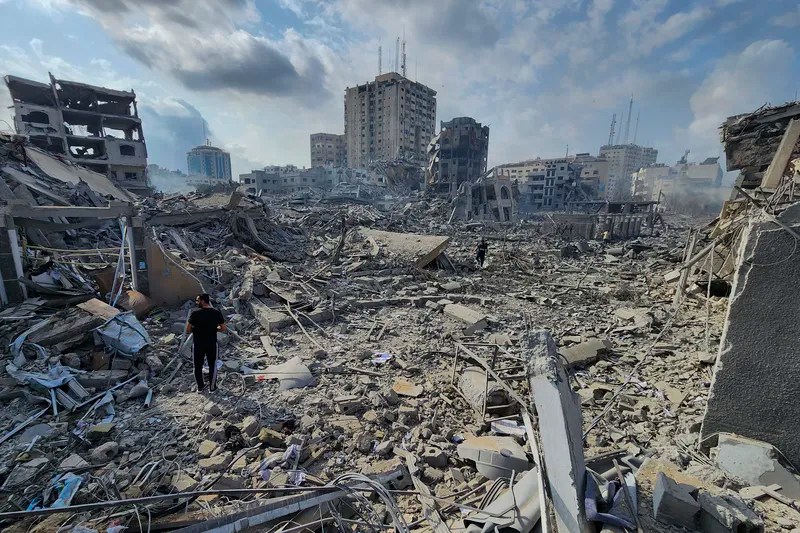
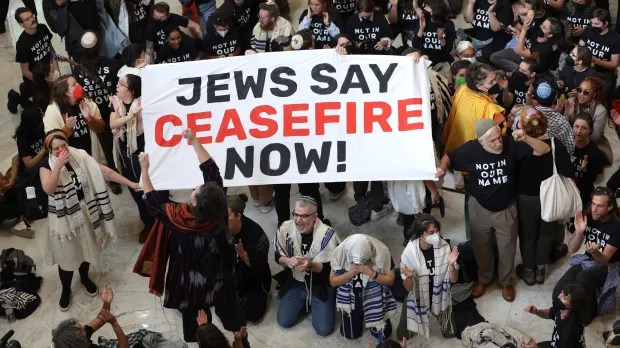
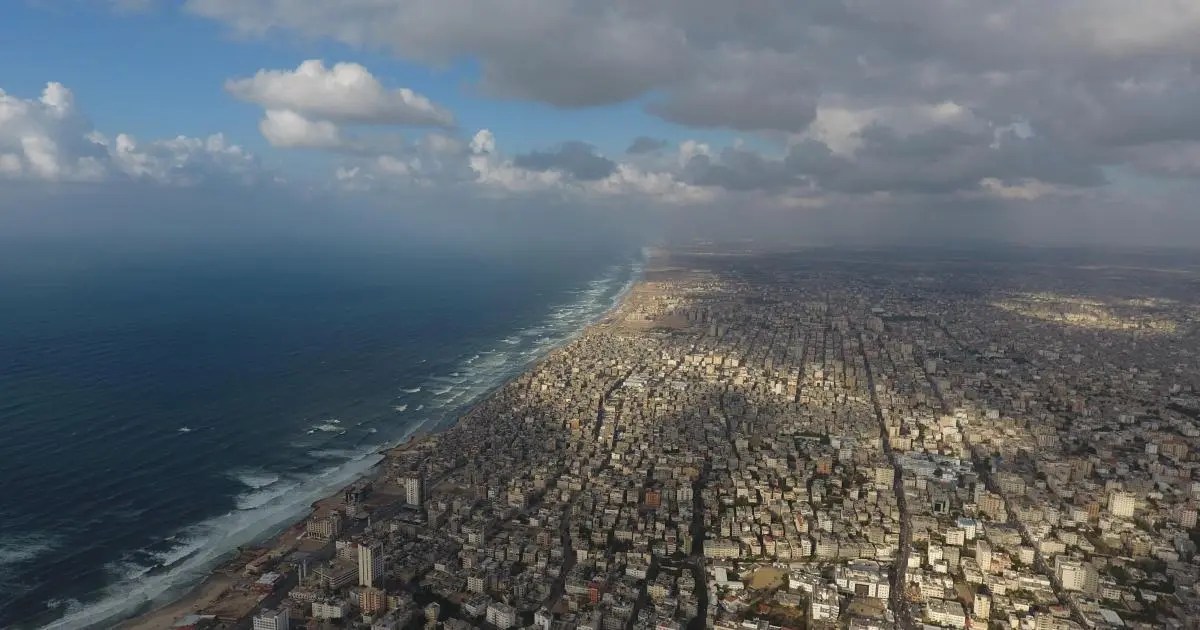
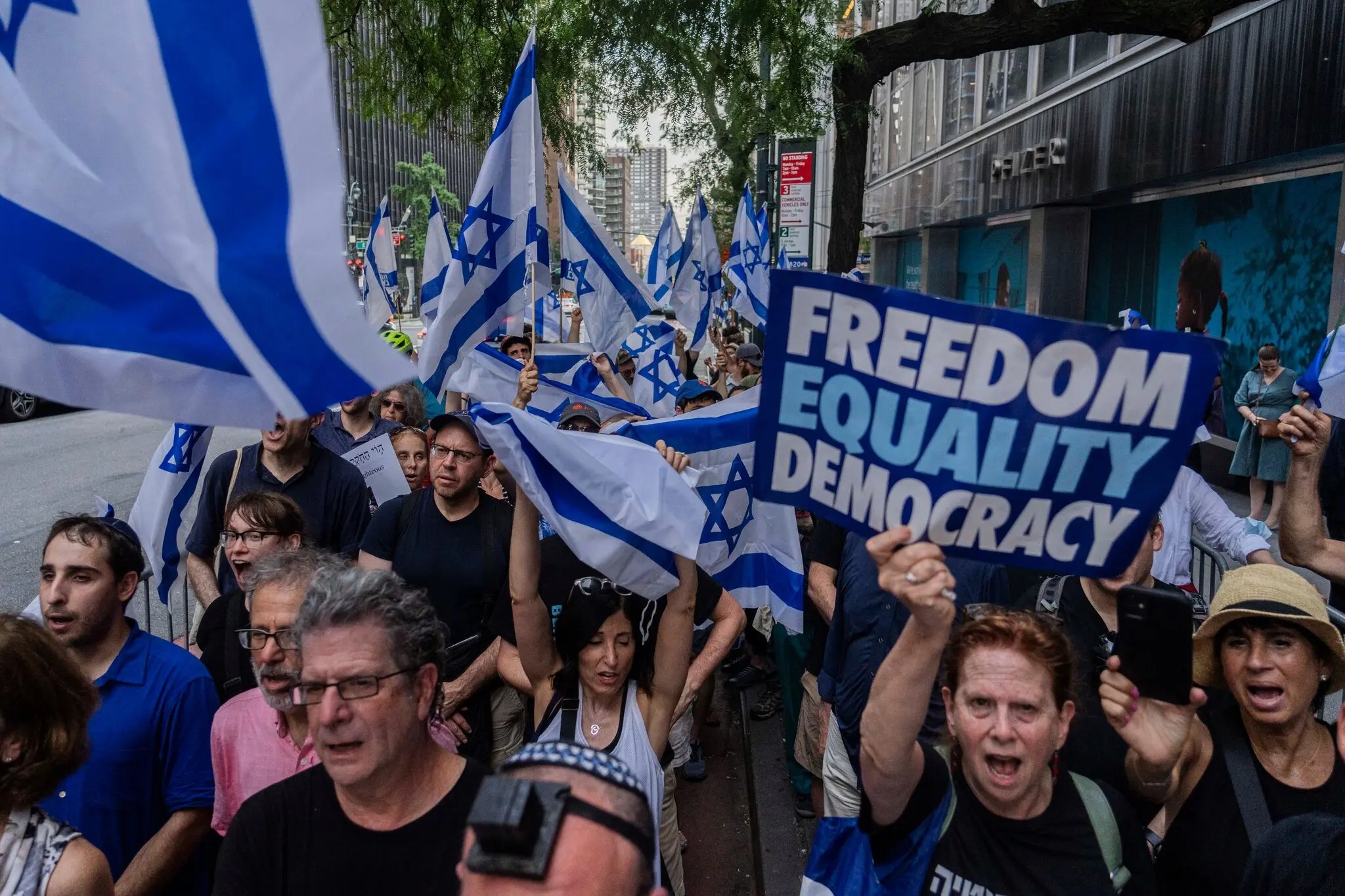


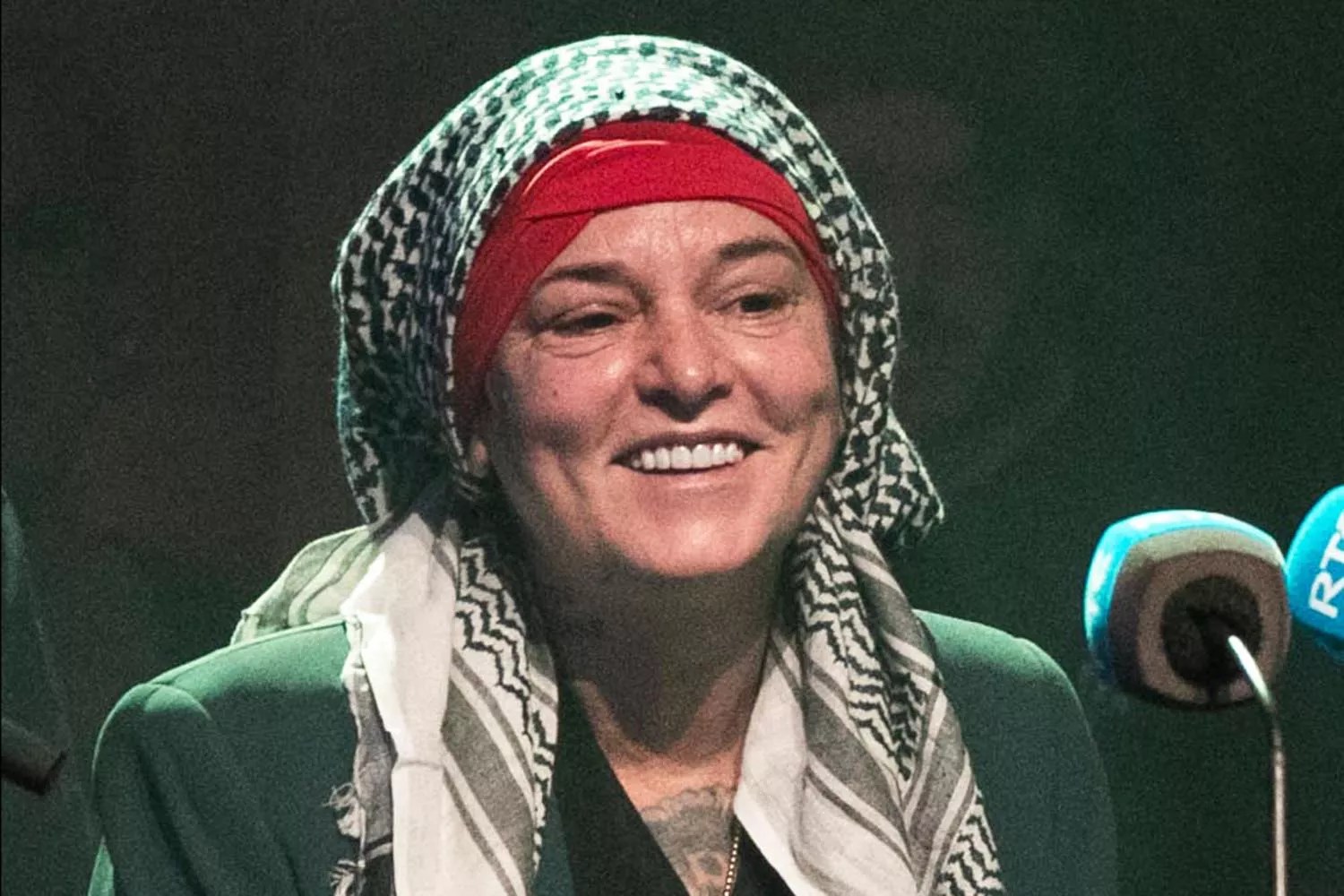
 Shalom Rav