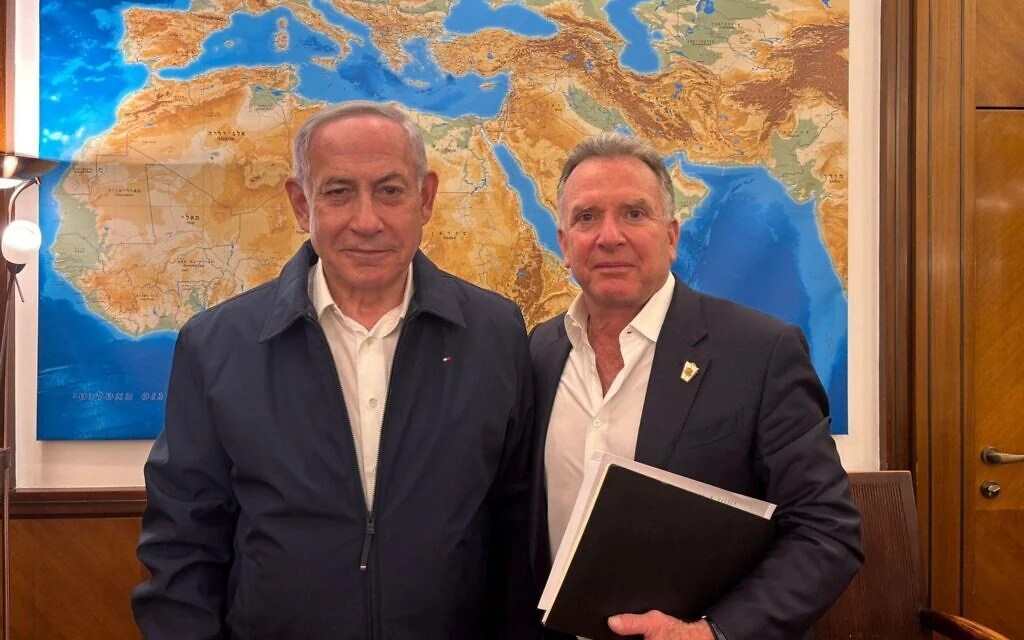
Benyamin Netanyahu and Steve Witkoff, January 11, 2025
For Palestinians and those who stand in solidarity with them, the news of a ceasefire agreement between the Netanyahu administration and Hamas was welcome news. When the reports first broke, and I saw images of Gazans singing and dancing in the streets, I couldn’t help but feel a joyful solidarity with them. But like all brokered agreements between Israelis and Palestinians, this deal is also fragile and fraught – and filled with deeply disingenuous political maneuvering.
Some history: according to reports, this ceasefire deal is identical to the one brokered by the Biden administration last May, which was accepted by Hamas leaders in early July. At the last minute, however, Netanyahu later backed out, insisting on nothing less than the total destruction of Hamas. Israel then assassinated Hamas’ political leader and chief negotiator, Ismail Haniyeh and continued its relentless bombardment of Gaza.
Though this was all a direct affront to the Biden administration, the US government responded not by pressuring Netanyahu to accept the deal but by rewarding Israel with a $20 billion arms sale. Biden and Secretary of State Blinken also actively promoted the lie that it was Hamas and not Israel that had kiboshed the deal. In the meantime, the Israeli military continued with its genocidal onslaught. From the time that the talks fell apart until now, the death toll of Palestinians rose from at least 39,000 to 46,707, including more than 18,000 children.
So why is Israel accepting the very same deal a half a year later? We now know it was due to the efforts of Donald Trump, who has made it clear he didn’t want to deal with the distraction of Israel’s war on Gaza as he began his presidency. Last week, Trump asked his friend, Steve Witkoff, a billionaire real estate developer, to call Netanyahu and tell him in no uncertain terms that Israel’s military operations in Gaza must end before the inauguration.
In other words, a President-elect was able to do with a single visit from a private citizen what the Biden administration was either unable or unwilling to do for over a year.
Though the ceasefire deal was welcome news, it was not accomplished through the “tireless efforts of the Biden administration.” Neither was it due to the altruism (needless to say) of the President elect. Trump is nothing if not transactional – and there is already speculation over what he might give Netanyahu in return, whether it’s a brokered diplomatic deal with Saudi Arabia or the annexation of the West Bank (or both).
In the meantime, within 24 hours of the announcement of the deal, Israel escalated its bombing of Gaza, killing 80 Palestinians. According to analyst Yousef Munayyer, Israel has a habit of late-hour bombing to empty its stockpiles in anticipation of larger military aid packages from the US. In this case, since Israel has not realized its military objective of obliterating Hamas, “there may be an urge to do great damage while they can before ceasefire comes in, reacting to that disappointment.” As of this morning, the Netanyahu government, is indicating his government is prepared to accept the deal, which is set to go into effect on Sunday, but it is still yet to be signed.
But even if it is finalized, we should have no illusions. Like past deals, there is so much that Israel can do to pursue its own designs going forward. Like past deals, this one is set to unfold in stages. The first phase will feature a ceasefire, a withdrawal of Israeli troops, an initial swap of hostages and prisoners and an influx of humanitarian aid into Gaza. However, the second and third phases are far less developed. There is no agreement on the rebuilding of Gaza, the future of the Israeli military presence, who will govern, or how.
When I read the details of this agreement, I couldn’t help but recall the Oslo Accords in 1993, which was also negotiated in phases. The first was an interim phase, in which Israel would gradually withdraw from Palestinian areas in the West Bank and transfer administrative power to a temporary “Palestinian Authority.” The second phase involved permanent status details such as Jerusalem, refugee rights, settlements and borders. In the end, Israel agreed to the first phase as a cover to extend its settlement regime across the West Bank – all the while enacting policies that further dispossessed Palestinians from their homes.
Oslo was a hard lesson on the ultimate designs of all Israeli administrations, from left to right. No matter who is in power, the Israel’s goals are the goals of Zionism itself: the maintenance of a Jewish majority in the land. This goal necessarily entails the ongoing ethnic cleansing – an ongoing Nakba – of the Palestinian people. After the genocide in Gaza, we can honestly add the words “by any means necessary” to this sentence. No matter the diplomatic rhetoric around this current deal, we must not lose sight of this crucial history. Put simply: Netanyahu is all too likely to assent to phase one of the deal, get back a requisite number of hostages, then continue with the genocide in Gaza in order to destroy Hamas completely, ensure a maximum number of Palestinians are either dead or unable to return to their homes, and re-entrench Israeli civilian settlement there.
In this week’s Torah portion, Parashat Shemot, there arises a new Pharoah who “did not know Joseph.” Threatened by the demographic growth of the Israelite people in the land, he institutes murderous policies to stem their birthrate and reduce their number through harsh enslavement. But there are also those who resist Pharoah’s tyranny through acts of courageous civil disobedience: Hebrew midwives who refuse to kill Israelite baby boys, a mother and sister who save an Israelite child and a daughter of Pharoah who adopts him. All of these events set in motion a chain that will inexorably, inevitably lead toward the liberation of the Israelite people.
So in this moment, let us welcome the prospect of the cessation of hostilities. But let us have no illusions about the designs of all Pharoahs past and present. Like the Israelites in our Torah portion, the Palestinian people continue to cry out for liberation.
The centerpiece of this week’s Torah portion, Parshat Vayechi, is Jacob’s final soliloquy to his individual sons: a Biblical poem that is equal part blessing and curse, history and prediction. While his words are complex and wide ranging, Jacob saves his harshest words for his sons Shimon and Levi:
Shimon and Levi are a pair/Their weapons are tools of lawlessness. Let not my person be included in their council/Let not my being be counted in their assembly. (Genesis 49:5-6)
Jacob’s curse of Shimon and Levi seems to be a reference to their role in the calculated and deadly attack on Shechem that occurred in Genesis 34. Biblical scholars surmise that these verses likely reflect the tribal biases of the original author. But whatever the reason for Jacob’s words, his characterization of Shimon and Levi have come to represent the cursed impact of calculated and unrestrained violence.
As I read these words this year, I recalled something I hadn’t thought of in a long time: a speech delivered by the late Israeli Prime Minister Yitzhak Rabin on February 28, 1994. Four days earlier, a Jewish extremist settler, Baruch Goldstein, had murdered 29 Muslim worshippers in the Cave of the Patriarchs/Ibrahimi Mosque in Hebron/Al Khalil in a calculated, vicious attack. In an address before the Knesset, Rabin actually quoted Jacob’s words to Shimon and Levi. He then continued, addressing the late Goldstein, who was already becoming viewed as a martyr in the eyes of his zealous followers:
To him and to those like him we say: You are not part of the community of Israel. You are not part of the national democratic camp to which we in this house all belong, and many of the people despise you. You are not partners in the Zionist enterprise. You are a foreign implant. You are an errant weed. Sensible Judaism spits you out. You placed yourself outside the wall of Jewish Law. You are a shame on Zionism and an embarrassment to Judaism.
A year after delivering this speech, Rabin was dead, murdered by another Jewish extremist settler.
Since his death, Yitzhak Rabin has since achieved mythic status in Liberal Zionist circles as a heroic figure who was struck down for daring to make peace with the Palestinians. And for many years, I was among those who believed he was indeed a casualty of the curse of Shimon and Levi to which he referred just one year earlier. As I read Rabin’s speech 30 years later, however, I believe the reality is not nearly that simple.
I’m particularly taken by his characterization of Goldstein as an “errant weed” and “foreign implant” to the Zionist enterprise, as if we can draw a meaningful line between “good Zionism” and “bad Zionism.” It’s worth noting that Rabin himself was the general who oversaw the most massive expulsion of Palestinians during the Nakba: the ethnic cleansing of the Palestinian villages of Lydda and Ramle in July 1948, which included the infamous Lydda massacres and the Lydda death march. Rabin personally signed the expulsion order which stated, “The inhabitants of Lydda must be expelled quickly without attention to age….”
Years later during the First Intifada in 1988/9, Rabin was Israel’s Defense Minister when he issued the well known order to “break Palestinians bones” – a directive that was intended “to permanently disable Palestinian youth by inflicting lasting injuries that incapacitate them.” As generations of disabled Palestinians will attest, the legacy of this order has had a devastating impact on their lives to this day.
Although many promote the mythology of Rabin as a former military man who later became a man of peace, the truth is much more problematic. In fact, Rabin never supported Palestinian statehood throughout the Oslo “peace process.” It is more accurate to say he used the veneer of this process to enable an Israeli settlement regime that has since become permanently entrenched in the West Bank. Rabin’s role in Oslo can be directly linked in a straight line to the systemic violence against Palestinians that is now raging with impunity throughout the Occupied Territories.
In other words, while Liberal Zionist mythology attributes the curse of Shimon and Levi to “bad apple” Zionists, this kind of systemic, unrestrained violence has been central to the Zionist project from its very beginning. Indeed, Israel’s still ongoing genocide in Gaza is not the result of “errant weeds” in the Israeli government like Netanyahu, Smotrich and Ben-Givir. It is the logical end game of Zionism itself: an ideology and movement that has from its very origins dehumanized and dispossessed Palestinians to make way for Jewish settlement.
As the book of Genesis comes to a close, Jacob’s deathbed words ring out to us with renewed clarity. Zionism’s weapons are tools of lawlessness. Let us not be included in their council. Let our being not be counted in their assembly.
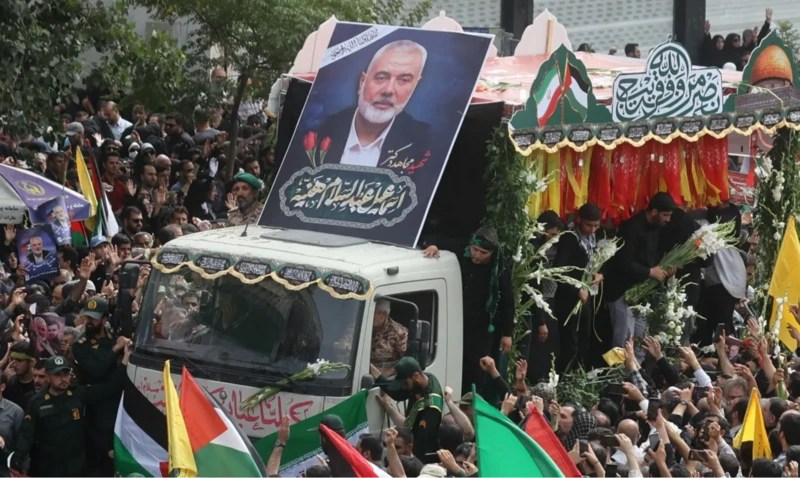
Among the myriad of news items jostling for our attention this past week was the assassination of Ismail Haniyeh, a top political leader of Hamas, who was killed by a bomb in Tehran on Wednesday. Israel is almost surely behind this act, even if it hasn’t publicly acknowledged it. While I realize that there are many in the Jewish community and around the world who are not mourning Haniyeh’s death, it’s difficult to overstate the damaging impact of Israel’s actions on the prospects for a ceasefire in Gaza.
Ismail Haniyeh may have been a leader of Israel’s sworn enemy, but he was also one of the primary figures in ongoing ceasefire negotiations. By killing its own negotiating partner, Israel has made it substantively more difficult to realistically imagine an end to its genocidal violence, a return of Israeli hostages and a Palestinian prisoner exchange any time soon. The Prime Minister of Qatar, who has been a central figure in brokering ceasefire talks put it bluntly: “How can mediation succeed when one party assassinates the negotiator on the other side?”
Why would Israel assassinate Haniyeh, knowing that it might fatally damage ceasefire talks? Many are suggesting that it is in Netanyahu’s personal/political interest to prolong this violence as long as possible – even as it endangers the lives of his own nation’s citizens. While this is no doubt true, I think there is a deeper reason: these latest targeted killings were rooted in Israel’s historic – and fatal – belief that the use of its relentless, overwhelming military force will inevitably force their enemies to submit. It’s worth noting that Haniyeh’s assassination follows the targeted killing of his three sons last April, as well as his sister and nine other members of his family in June. These actions certainly track with Netanyahu’s vow to exact a “mighty vengeance” following Hamas’ October 7 attack.
In fact, Israel has had a long history of assassinating Palestinian leaders, knowing full well that these actions ultimately serve no strategic purpose other than a satisfying show of force. The Israeli military has been assassinating Hamas’ leaders for decades – and Hamas has consistently replaced them. For all its efforts, Israel has succeeded only in increasing the number of Palestinian martyrs and strengthening Hamas’ resolve to resist all the more. In this most recent instance, many observers have pointed out that the killing of Haniyeh will now leave a vacuum to be filled by more radical leaders such as Yahya Sinwar, among others.
Meanwhile, Israel’s genocidal onslaught in Gaza continues with impunity – and nary a protest from the international community. Yesterday, Israel killed at least 15 people – including two children – and injured 40 others in an airstrike that targeted a school-turned-shelter in Gaza’s Shejaiya neighborhood. On Wednesday, the Israeli military killed two journalists from Al-Jazeera, Ismail Al-Ghoul and cameraman, Rami Al-Rifi, with an airstrike on their car. Their colleague Hind Khouri broke down as she reported on their killings, which brings the current number of journalists killed in Gaza to 113.
Israel’s most recent actions have also brought the region, terrifyingly, that much closer to all-out war. On the same day as Ismail Haniyeh’s killing, the Israeli government confirmed that it had assassinated a top Hezbollah leader, Fuad Shukr, in Beirut. The leadership of both Iran and Lebanon, and their proxies in the region are now vowing to retaliate – and the Israeli military is reportedly on “high alert.” Even more ominously, the US intelligence community reports it has received “clear indications” that Iran is planning an attack. One official said the Pentagon and US Central Command are making preparations to help defend Israel militarily, “(involving) US military assets in the Gulf, the Eastern Mediterranean and the Red Sea.”
In times such as these, we are reminded how unbearably high the stakes of a just peace in the region truly are. I understand the palpable sense of powerlessness in the current moment: it sometimes feels as if there is nothing left to do but to pray that leaders on all sides ultimately take a breath and a step back from the brink. In the end, however, we cannot be content to passively hope that the leaders who have brought us to this unthinkable moment will do the right thing.
As has often been said, hope is a discipline. We must find the wherewithal to continue the struggle: to demand a US arms embargo to Israel, an immediate ceasefire in Gaza – and a redoubling of our commitment to a just and equitable peace for all. We must advocate in no uncertain terms that the alternative is utterly unacceptable.
It’s safe to day that International Holocaust Remembrance Day will arrive tomorrow at a deeply fraught moment for the Jewish community. Just today, we’ve received the news that the International Court of Justice, ruling on a case brought by South Africa, has ordered Israel to take action to “prevent acts of genocide” in Gaza. And later today, a federal court in California will hear a case brought by the Center for Constitutional Rights on behalf of Palestinian human rights organizations, Palestinians in Gaza and Palestinian Americans accusing Biden and other senior US leaders of being complicit in genocide.
In short, International Holocaust Remembrance Day 2024 is arriving just as Israel and the US government are literally being judged on the world stage for an ongoing genocide against the Palestinian people.
As we contemplate the monumental nature of this moment, it’s instructive to consider the history of International Holocaust Remembrance Day itself. This annual commemoration was created by the UN in 2005, to take place annually on January 27: the day Auschwitz was liberated by allied forces. In its resolution establishing the day, the UN General Assembly made it clear that this observance would not merely be about commemorating the past; it pointedly urged member states “to develop educational programs that will inculcate future generations with the lessons of the Holocaust in order to help to prevent future acts of genocide.”
The GA also made it explicit that this remembrance would not be limited to the European Jewry alone, but should also extend to “countless members of other minorities” who were murdered en masse by the Nazi regime. As then Secretary General Ban-Ki Moon pointedly commented during the 2015 commemoration, “More than a million inmates, primarily Jews, were brutally and systematically killed in the place where the Nazis introduced the monstrous concept of ‘industrialized murder.’ Among the other victims were non-Jewish Poles, political prisoners, Soviet prisoners of war, Sinti and Roma, homosexuals, disabled persons and Jehovah’s witnesses.”
In other words, International Holocaust Remembrance Day was purposely established to universalize the memory and the lessons of the Holocaust.
There is of course, another Holocaust memorial day widely observed by the world Jewish community – namely, Yom Hashoah. In contrast, to International Holocaust Remembrance Day, Yom Hashoah is not universal in nature – it is a day set apart by the Jewish community to mourn their own in a Jewish context, as part of the Jewish festival calendar. While it is altogether appropriate for the Jewish people to honor the memories of our ancestors in such a way, it’s worth noting the history of this particular day as well.
Yom Hashoah was officially founded by an act of Israeli parliament in 1951, immediately following the founding of the state itself. It was purposefully established on Jewish date of the 27 Nisan (April/May) to begin a week of commemoration leading into Yom Hazikaron (Memorial Day), concluding with Yom Ha’atzmaut (Independence Day). In this way, Yom Hashoah served to promote the Zionist historical mythology that viewed the establishment of the state of Israel as a “rebirth,” arising out of the ashes of the Holocaust, through the brave sacrifice made by the soldiers who fought in the War of Independence.
Like many Jews growing up in America, I simply accepted Yom Hashoah as an organic part of the rhythm of the Jewish year, observed annually in synagogue services and communal commemorations. I was never taught that it was first and foremost an Israeli national holiday. And of course, I was never taught that the state of Israel was founded in the wake of the Holocaust through the ethnic cleansing of the Palestinian people from their homes.
While there should most certainly be a communal Jewish day of memorial for the six million, it’s worth questioning the prominent status afforded Yom Hashoah by world Jewry. This is, after all, a day that serves to reinforce the view that the Israel’s founding was a “redemptive” moment for the Jewish people following the tragic cataclysm of the Holocaust – utterly ignoring the reality that the state of Israel was established through the dispossession of another people. I strongly believe we should consider an entirely different Jewish frame for commemorating the Holocaust; in the meantime, however, we should have no illusions about the real agenda behind Yom Hashoah and the problematic narrative it seeks to support.
It might well be said that in this terrifying current moment, the very real implications of this Zionist mythology are being directly challenged by the universal message of International Holocaust Remembrance Day. It’s actually quite staggering to consider: as the world prepares to observe this day, compelling legal proceedings are formally accusing Israel of (and the US of abetting) genocide. Even more sobering: it arrives amidst an increasingly damning verdict in the court of public opinion in which, according to a recent poll, “more than one in three Americans believe Israel is committing genocide against Palestinians.”
I realize how painful – even unthinkable – it will be for many Jews to lift up the lessons of International Holocaust Remembrance Day to suggest Israel that is committing genocide against the Palestinian people. But as I suggested in my sermon this past Yom Kippur, we must find the courage to say out loud the words that must be spoken. If this particular day is truly is to be a day for us to apply the “lessons of the Holocaust in order to help to prevent future acts of genocide,” it is all the more critical for us to speak out and name a genocide that is literally unfolding before us in real time. No matter how uncomfortable or painful the prospect.
In this regard, I’m immensely proud to be part of a Jewish community that has the courage to say these words out loud. In a just released public letter to President Biden, the Jewish Voice for Peace Rabbinical Council is demanding that he “honor the word and spirit of the International Holocaust Remembrance Day by using (his) office to bring a ceasefire to this tragic violence — and to stop blocking efforts toward building a truly just peace for all who live between the river and the sea.”
An excerpt:
We hold the traumatic history of our people with care and sensitivity — and know how painful it is for Jews to grasp that a Jewish state could possibly commit a genocide. Nevertheless, we must agree with increasing numbers of scholars and international rights experts who have determined that Israel’s actions in Gaza constitute, in the words of Prof. Raz Segal, “a textbook case of genocide.”
We support and uplift South Africa’s recent application to the International Court of Justice claiming Israel is in breach of the 1948 Convention on the Prevention and Punishment of the Crime of Genocide. And now, Palestinian human rights organizations, together with Palestinians in the US and Gaza, are bringing a case against your administration for failure to prevent, and complicity in, the Israeli government’s unfolding genocide against them, their families, and the 2.2 million Palestinians in Gaza. We stand in support of their action as well.
According to a core teaching of Jewish spiritual tradition, humanity was created in the image of God. That means that each and every human being is of infinite value. The UN 1948 Convention on Genocide was created to uphold this very idea. The Torah also teaches that there will always be moments when we must make a critical moral choice. As Deuteronomy 30:19 says, “I have put before you life and death, blessing and curse. Choose life.” President Biden, you have chosen death. Instead of using your considerable power to prevent or end this genocide, you have directly abetted it with weapons, funds and diplomatic cover.
On this day of remembrance in 2021, you noted that, “The Holocaust was no accident of history.” As you stated, “It occurred because too many governments cold-bloodedly adopted and implemented hate-fueled laws, policies, and practices to vilify and dehumanize entire groups of people, and too many individuals stood by silently. Silence is complicity.”
President Biden, what is happening right now in Gaza is no accident of history — and your complicity has been anything but silent. We call upon you to be true to your word and end US complicity in Israel’s genocide against the Palestinian people.
This International Holocaust Remembrance Day, let us find the courage to speak the words that must be spoken. This International Holocaust Remembrance Day, let us find the courage to speak the words that must be spoken: Ceasefire now. Never again, for anyone. No more genocide.
Last week, the board of my congregation, Tzedek Chicago released this statement in repsonse to Israel’s ongoing military assault in Gaza. Although it is addressed to all people of conscience, it contains a specific challenge to the Jewish community at large.I’m immensely proud of the statement, which I hope will be considered seriously even (especially) by those members of the community aren’t ready to heed its words.
Our statement is not so much an academic argument as it is a call to moral action. As we say in our statement, “We are witnessing the continuation of the Nakba in real time…Now more than ever, it is time for Jews of conscience to call out the essential injustice at the heart of Zionism in no uncertain terms.“
The full statement follows below:
The unspeakable violence currently unfolding in Gaza is confronting the Jewish community with the most critical moral challenge of our lifetime.
As of this writing, over 21,000 Palestinians have been killed by the Israeli military, almost half of them children. According to the UN, nearly two million people have been internally displaced, confining them to less than one-third of the Gaza Strip’s territory. Disease and starvation are rampant, subjecting one in four households into “catastrophic conditions.” As the Secretary General of the UN recently described, “(Gaza) is at a breaking point. There is a high risk of a total collapse of the humanitarian system.”
Together with Jews and allies around the world, we grieve the massive loss of life that occurred as a result of Hamas’ heinous violence in Israel on October 7. We join with those around the world who are demanding the safe return of the remaining hostages currently being held in Gaza. We unreservedly condemn Hamas’ actions on that terrible day – there can be no justification for this brutal attack on civilian life.
We also know there was a crucial, underlying context to this horrible violence. We assert without reservation that to contextualize is not to condone. On the contrary, we must contextualize these events if we are to truly understand them – and find a better way forward.
The violence of October 7 did not occur in a vacuum. It was a brutal response to a regime of structural violence that has oppressed Palestinians for decades. At the root of this oppression is Zionism: a colonial movement that seeks to establish and maintain a Jewish majority nation-state in historic Palestine.
While Israel was founded in the traumatic wake of the Holocaust to create safety and security for the Jewish people, it was a state founded on the backs of another people, ultimately endangering the safety and security of Jews and Palestinians alike. Israel was established through what Palestinians refer to as the Nakba: the ethnic cleansing of 750,000 Palestinians from their homes in 1948. And since that time, Israel has subjected Palestinians to a regime of Jewish supremacy in order to maintain its demographic majority in the land.
This ongoing Nakba is the essential context for understanding the horrifying violence of the past three months. Indeed, since October 7, Israeli politicians have been terrifyingly open about their intentions, making it clear that the ultimate end goal of their military assault is to ethnically cleanse Gaza of its 2.2 million Palestinian residents. One prominent member of the Israeli government put it quite plainly: “We are now rolling out the Gaza Nakba. Gaza Nakba 2023. That’s how it’ll end.” More recently, Prime Minister Netanyahu was reported as saying that he is actively working to transfer Palestinians out of Gaza. The problem, he said, “is which countries will take them.”
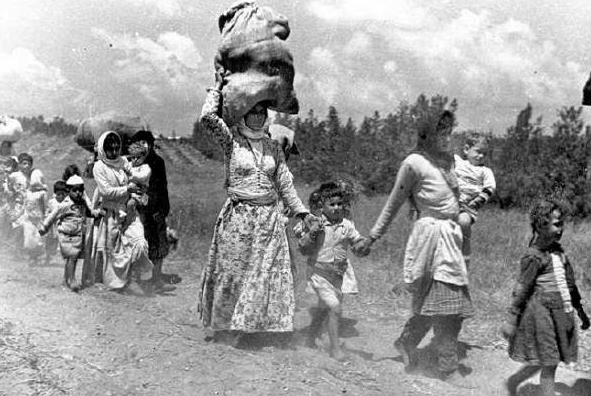
Israeli leaders are being true to their word: we are witnessing the continuation of the Nakba in real time. As in 1948, Palestinians are being driven from their homes through force of arms. As in 1948, families are being forced to march long distances with hastily-collected possessions on their backs. As in 1948, entire regions are being razed to the ground, ensuring that they will have no homes to return to. As in 1948, Israel is actively engineering the wholesale transfer of an entire population of people.
In a statement last week, the UN Special Rapporteur on the human rights of internally displaced persons warned:
As evacuation orders and military operations continue to expand and civilians are subjected to relentless attacks on a daily basis, the only logical conclusion is that Israel’s military operation in Gaza aims to deport the majority of the civilian population en masse.
In short: Israel’s military onslaught on Gaza is revealing the true face of Zionism.
From its founding, Tzedek Chicago has openly rejected the conflation of Judaism with Zionism. As expressed in our congregation’s core values statement: We are anti-Zionist, openly acknowledging that the creation of an ethnic Jewish nation state in historic Palestine resulted in an injustice against the Palestinian people – an injustice that continues to this day.
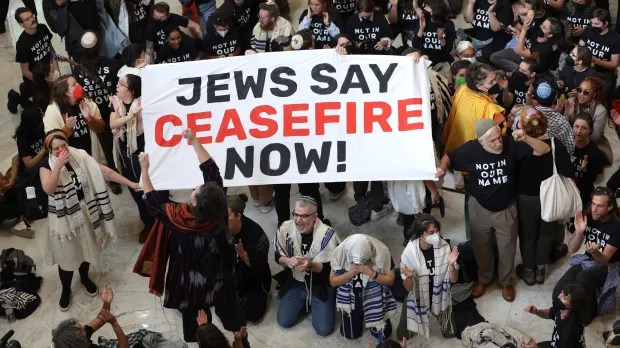
Since Israel’s most recent military assault on Gaza began, Tzedek Chicago has been a proud and active participant in the cease-fire movement, which has been steadily growing in the Jewish community. This movement is collectively motivated by the Jewish mitzvah of pikuach nefesh – the sacred imperative to save life. At the same time, however, it is critical to assert the Jewish value of “tzedek, tzedek tirdof” – “justice, justice shall you pursue.” Beyond ceasefire, we must acknowledge and call out the human dispossession that is at the root of Israel’s latest assault on Gaza.
Now more than ever, it is time for Jews of conscience to call out the essential injustice at the heart of Zionism in no uncertain terms. This is a critical moment for our Jewish communal organizations as well. We know it is not easy for Jewish institutions to reject Zionism, but we believe it’s critical that they do. In particular, we ask synagogues that are proudly “standing with Israel” to morally reckon with whom they are choosing to stand and consider the real human costs of their position.
There are some Jewish congregations that maintain an inclusive “wide tent” that makes room for both Zionists and anti-Zionists alike. While this may seem like a welcome development, we encourage these synagogues to consider how this inherently contradictory position nonetheless enables the violence Israel is perpetrating against Palestinians. We also invite congregations that publicly support “Palestinian liberation” to be clear about what this liberation will ultimately look like. Will it be a liberation in name only or will it include the dismantling and transformation of the colonial Zionist project once and for all?
The moral challenge of the moment is clear. We invite other Jews of conscience to join us in the creation of a thriving movement of Judaism beyond Zionism. A Judaism that lifts up a diasporic consciousness that doesn’t express entitlement over land. A Judaism that rejects ethno-nationalism, militarism and dispossession and celebrates our spiritual tradition of justice, liberation and solidarity with all who are oppressed.
Let our call for ceasefire be but the first step toward a greater liberation: one that extends true justice and equality for all who live between the river and the sea.
According to Jewish law, it is forbidden to mourn on Shabbat: between sundown on Friday and sundown on Saturday, funerals do not take place and the public aspects of shiva observance are suspended. For many, the very notion “forbidding mourning” can feel harsh and emotionally insensitive. I’ve often heard from mourners who resist this idea of “suspending their grief.” More than one congregant has pointed this out to me over the years: “Grief isn’t something I can just turn on and off. How do I possibly stop my grieving for this one day? Should I pretend that Shabbat will just magically make everything better?”
One way to answer to this question is to understand the difference between grief and mourning. While grief is an emotional state; mourning refers to the rituals and practices we observe to help us manuever through our experience of loss. Of course, we cannot turn our grief on and off, nor should we be expected to. Grief by its very nature cannot be scheduled to our convenience. As anyone who has experienced the loss of a loved one will attest, the emotions that attend grief will invariably grip us with unsettling randomness – often when we least expect it.
When we suspend certain mourning practices on Shabbat, however, even in the midst of intense grief, we affirm a life beyond the loss, beyond the pain. Shabbat is our weekly reminder of this: our regular opportunity to experience olam haba – “the world as it should be.” When we suspend these rituals on Shabbat, we make a point of affirming healing during the most painful times in our lives. In some ways, it feels like nothing less than an act of spiritual defiance.
For over a month now, it has been a time of unimaginable, exponential, cascading grief on a scale few of us have ever seen. Israelis and scores of Jews the world over are still experiencing deep shock and trauma over Hamas’ brutal attack on October 7. Even as I write these words, we do not know the full extent of these massacres and abductions – many still do not know if their loved ones are alive or dead, whether they were killed or taken hostage. We are still learning the heinous nature of the attacks that unfolded on that terrible day. How does one even begin to mourn when faced with grief of such magnitude?
Tragically, we were never given the opportunity to learn the answer to this question. Only a few days after this attack, the Israeli government chose to respond with a vengeful military onslaught. As so many have now observed, Israel “weaponized its grief” against an imprisoned population of 2.2 million Palestinians trapped in Gaza with nowhere to run. The exponential human loss Israel has unleashed is truly beyond comprehension: to date, the current death toll: 12,000 people, including 5,000 children.
For so many of us, the only work of the past six weeks has been to voice our collective conscience as loudly, as often and as fiercely as possible. We have been bearing witness to the most sacred values of our tradition: pikuach nefesh – saving a life is sacrosanct and tzelem elohim – affirming that all humanity is created in the divine image. All of these values are embodied in the two sacred words we’ve been chanting over and over and over again: “Ceasefire Now!” To end this vengeful, genocidal violence. To negotiate a homecoming for hostages and prisoners. To begin the process of rebuilding and healing through a process of just peace for all.
No, as Shabbat falls this evening, we will not “switch off our grief.” We will not deny this all-pervading, still unfolding pain. But we will affirm a world beyond it.
We know all too well that in moments of brokenness, it is difficult to imagine a world beyond. We know from experience that brokenness, by definition, involves loss. We know that what is broken can never be put back exactly the same way it was. But beyond the loss, Shabbat comes to remind us that no matter what, we never forfeit the chance to rebuild and heal. While grief can break us open, it also has the potential to transform us: opening us up to new visions, new opportunities, new worlds that we never may have dreamed possible.
In this moment, when so much around us seems to be shattering into so many painful shards, let us hold tightly to this truth.
As of this writing, Israel has killed over 7,000 Palestinians in Gaza – almost 3,000 of whom are children. (According to Defense for Children International – Palestine, almost 1,000 children are reported missing under the rubble of destroyed buildings.) Israel has cut off all food, water and power to the Gaza Strip. Gazans will soon run out of fuel to run their generators – their last link to medical treatment and drinkable water.
Israel clearly has no intention to end their onslaught any time soon; in fact, they are making their intentions all too clear. Prime Minister Netanyahu: “We will turn Gaza into an island of ruins.” Israeli army spokesman, Daniel Hagari: “We are dropping hundreds of tons of bombs on Gaza. The focus is on destruction, not accuracy.” President Herzog: “It is an entire nation who are responsible. This rhetoric about civilians being involved is absolutely untrue…We will fight until we break their backs.”
I don’t think it’s an overstatement to say we are currently facing the greatest moral reckoning of our time. A genocidal onslaught in unfolding before us in real time – countenanced by the international community and enabled by the US government. There can be no more pressing, urgent need at this moment than an immediate ceasefire to this unspeakable violence.
On the face of it, a ceasefire would seem to be the most morally obvious and straightforward course of action – but alas, the simple suggestion that Israel cease its carnage is tantamount to a radical – even extreme – idea at the moment. The Biden administration has made its staunch opposition to a ceasefire abundantly clear. When asked about the human toll, White House spokesperson John Kirby commented, “It is ugly and it’s going to be messy, and innocent civilians are going to be hurt.” When Biden himself was asked a similar question, he answered that he “has no confidence in the numbers that the Palestinians are using.”
Ceasefire is the last thing on Biden’s mind at the moment. Quite the contrary: he’s asking Congress for $14.3 billion in supplemental military aid to enable Israel’s war effort. The only sign of moral leadership in Washington: the “Ceasefire Now” resolution introduced last week by Rep. Cori Bush, which actually asserts currently audacious suggestion that “all human life is precious.” As Bush put it, “We can’t bomb our way to peace, equality, and freedom. With thousands of lives lost and millions more at stake, we need a ceasefire now.” (The number of endorsers currently stands at 18 members of congress. Click here to urge your representative to sign it – or to thank them for doing so.)
Yes, in the current political moment, simply calling for a ceasefire is considered to be a radically dangerous act. Democratic Rep. Josh Gottheimer lambasted the 18 signers, referring to them as “a very small group of extremists.” UN General Secretary António Guterres was subjected to similar treatment: after he recently called for a ceasefire, Israel’s envoy Gilad Erdan, demanded that he resign immediately, saying, “His comments … constitute a justification for terrorism and murder. It’s sad that a person with such views is the head of an organization that arose after the Holocaust.”
This is what it has come to.
I’m profoundly sorry to say that things are no better in the Jewish community. While it’s not a surprise that the Jewish communal establishment is offering its full-throated support to Israel’s military actions, The response from liberal Jewish organizations, sadly, has been no different. J Street, for instance, has warned Democrats who don’t sponsor a “We Stand with Israel” bill that they will lose the group’s endorsement come reelection time. The rabbinical organization T’ruah has also resisted calls for a ceasefire, issuing instead a tepid call for Israel to “follow the laws of armed conflict to avoid harm to civilians” and a “humanitarian corridor” to be opened so that “critical supplies” can enter Gaza.
For its part, the venerable Boston Workers’ Circle dared to sign on to a call for a ceasefire and promptly found itself facing expulsion from the Boston Jewish Community Relations Council. The organization choose to quit the group voluntarily, stating, “Rather than engage in the lengthy and arduous process to be formally expelled, we are turning our attention to focusing on building a future of peace and justice for all.”
According to the Torah, we must not stand idly by while the blood of our neighbor is being shed. And yet here we are. The world is allowing – if not actively enabling – the mass carnage Israel is inflicting on the people of Gaza. Please do what you can: contact President Biden, tell Congress, write to the press. Hit the streets. Shout it to the world:
When I heard the initial reports that Palestinians had breached the fences of Gaza this past Saturday, I will be completely honest – my first reaction was “good for them.” Israel had been collectively punishing Palestinians in Gaza for years with a crushing blockade with little to no care from the rest of the world. Now, amazingly, Palestinians had broken free from this seemingly impenetrable open-air prison. With power and ingenuity, they were resisting their oppression, reminding Israel – and the world at large – that they were still here. That they would not submit.
Inevitably, as the news of the attacks trickled in during the course of the day, however, my emotions turned to shock and grief. Along with the rest of the world, I learned about the sheer scale of violence committed by Hamas militants against Israeli civilians: the largest single day massacre in Israeli history. At last count, at least 1,200 Israelis have been killed and it is estimated that 150 have been abducted and taken hostage into Gaza. Everyone in Israel and many Jews throughout the world, know people – or know of people – who were killed, injured or taken hostage. Like so many in the Jewish community, my social media feed has been filled with heartbreaking pictures and stories of Israelis who have been slain or are still unaccounted for.
Amidst all the grief, however, I was also deeply troubled by the ominous, growing cries for vengeance voiced by the Israeli government and media, and felt a creeping dread over the shattering military response that would almost certainly rain down on the people of Gaza. And now that day has come. Israel has shut off all electricity and water for over two million Palestinians as the military wreaks complete and total devastation on across that tiny strip, attacking hospitals, schools, mosques, marketplaces, and apartment buildings. As of this writing, the death toll has risen to more than 1,200, with 5,600 wounded. More than 250,000 people have been rendered homeless – and these numbers will almost certainly rise significantly in the coming days and weeks.
In a letter to my congregation a few days ago, I wrote that “so many of us are feeling layers upon layers of intense emotion, in often confusing and contradictory ways. For Jews who stand in solidarity with Palestinians, I know these confusing contradictions are particularly keen.” Even so, I wrote, we simply must lift up the underlying context of this horrible violence. I continue to hold tightly to this conviction. While the sheer scope of our grief may feel incomprehensible, we simply must find the wherewithal to say out loud that the facts of these events have not only been comprehensible, but in fact inevitable.
Indeed, Palestinians and their allies have long been sounding the alarm that Israel was subjecting Palestinians to a brutally violent apartheid regime with impunity – and that there would be terrible consequences if the international community failed to intervene. Over and over, we’ve been warned about the cataclysmic violence that would inevitably ensue if Israel was not held to account. As Palestinian historian Rashid Khalidi put it recently, “an entire people (has been) living under this kind of incredible oppression, in a pressure cooker. It had to explode.”
As we attempt to understand the context of this recent violence, I believe it’s utterly critical to know where to plot the starting point – and to my mind, this is precisely where most of the media analyses of the past several days have sadly gone astray. To judge by any number of pundits, this current outbreak of violence began alternatively with the US – Saudi deal or the policies of the far-right Netanyahu administration. While it might be said that any of these causes may have provided the most recent spark, I’ve been deeply disappointed, if not surprised, that precious few of these analyses have even mentioned the Nakba in relation to this latest outbreak of violence.
To be sure, the Nakba was an act of violence and harm that has been reverberating through the land between the river and the sea from 1948 until this very day. To put it simply, for the past 75 years, Israel has been violently dispossessing Palestinians in order to make way for a majority Jewish state. And for just as long, the Palestinian people have been resisting their dispossession – yes, often violently.
It is not by chance that this most recent violence has occurred in and around Gaza. As many commentators have observed, Gaza has in many ways been the epicenter of the Nakba – and of the Palestinian people’s resistance to it. To grasp this fully, it is important to understand the history of this region. Gaza’s narrative did not begin with Israel’s blockade or the political ascension of Hamas. What we call today the “Gaza Strip” was artificially created in 1949, when it became a repository for a flood of ethnically cleansed Palestinian refugees from cities and villages in the coastal plain and lower Galilee. Before the Nakba, the population of this small region numbered 60 to 80,000 residents. By the end of the hostilities, at least 200,000 refugees were crowded into this 140 square mile strip of land.
At the time, most of the refugees fully expected to return home – some could even see their towns and villages through the fences. Those who crossed the border to gather their possessions or harvest their crops were considered “infiltrators” by Israel and shot on sight. Eventually, it became all too clear there would be no return. Over the years the tents turned into concrete buildings that grew ever higher along that narrow corridor. The numbers of that once sparse territory have grown to a population today of over 2,000,000 people – at least 70% of whom are refugees.
Following the founding of the state of Israel, many of the original settlements and kibbutzim founded on the border with Gaza were military outposts, most of which were built on top of or near demolished Palestinian villages. In fact, the sites that suffered the brunt of last Saturday’s massacres (including Kibbutz Kfar Aza, Re’im and Sderot) were settlements that were originally established in these locations for reasons of Israeli “national security.”
One such site was Kibbutz Nahal Oz, which was flooded by dozens of Hamas militants, and where, according to witnesses, at least two entire families were killed, and two more kidnapped and taken to Gaza as hostages. When I heard about the massacre at Nahal Oz, I couldn’t help but recall that this was not the first time this community had experienced Palestinian armed resistance. Back in 1956, a group of Palestinian militants entered Nahal Oz and killed a kibbutznik named Roi Rotenberg. At the time, this tragedy was keenly felt throughout the nascent state of Israel. At Roi’s funeral, the famed Israeli general Moshe Dayan offered a eulogy, expressing himself with brutal and unexpected honesty:
Do not today besmirch the murderers with accusations. Who are we that we should bewail their mighty hatred of us? For eight years they sit in refugee camps in Gaza, and opposite their gaze we appropriate for ourselves as our own portion the land and the villages in which they and their fathers dwelled…This we know: that in order that the hope to destroy us should die we have to be armed and ready, morning and night. We are a generation of settlement, and without a steel helmet and the barrel of a cannon we cannot plant a tree and build a house. Our children will not live if we do not build shelters, and without a barbed wire fence and a machine gun we cannot pave a road and channel water. The millions of Jews that were destroyed because they did not have a land look at us from the ashes of Israelite history and command us to take possession of and establish a land for our nation.
Dayan’s words resonate today with terrible prescience. Decades later, the descendants of this original Gazan generation still remain in refugee camps in Gaza, “gazing though the barrier fences as Israel appropriates as its own portion the land and the villages in which their ancestors dwelled.” Dayan’s eulogy also powerfully described a hypervigilant Israeli mindset that has only deepened throughout the decades. Since the Nakba could not and did not result in the complete ethnic cleansing of Palestinians from their homes, Israel has attempted to control them with a “steel helmet and the barrel of a cannon” for the past 75 years. During this time, Israel has widened its regime of violence in order to contain Palestinians in the occupied territories, subjecting them to a daily context of systemic, unceasing state violence every moment of their lives.
It is also telling that Dayan invoked the trauma of the Holocaust in his eulogy – and today, so many decades later, we can clearly see that this trauma was not limited to his generation alone. If anything, it has been handed down to subsequent generations in way that are all too real and all too palpable. Indeed, we can clearly see this generational trauma at work in Jewish responses to this latest violence, which is being openly characterized as “the worst mass murder of Jews since the Holocaust.” It is painfully poignant to consider that these massacres occurred in a state that was founded in the wake of the Holocaust in order to safeguard Jewish lives once and for all.
At the same time, however, this Holocaust rhetoric is deeply troubling given the vengeful fury currently being whipped up by a far-right Israeli government that is demonizing Palestinians with unabashedly genocidal language. Israel’s Defense Minister Yoav Gallant recently stated “Israel is fighting human animals” and should “act accordingly.” Netanyahu has promised that Israel’s military offensive on Gaza will “reverberate for generations.” One prominent Israeli general has promised to “open the gates of hell.” And perhaps most chillingly, a member of Israeli Parliament has called for a “second Nakba that will overshadow the Nakba of 1948.”
As I write these words, the Israeli military is mercilessly bombarding the Gaza Strip with a ferocity that is truly terrifying to behold. For the past few days, I’ve been combing social media for their postings from friends in Gaza, as I helplessly watch footage of whole neighborhoods and communities completely destroyed along with their inhabitants. One of the last messages I read came from a friend and former colleague at American Friends Service Committee: “Nothing left to say. More than 80 hours without electricity, water, or internet connection. Communication is very limited with everyone inside or outside Gaza. Carnage everywhere, hard to recognize streets, we are all waiting for the time to die.”
It is not an understatement to suggest that the Jewish community is now faced with a profound moral challenge. Even as we mourn our dead in Israel, we must acknowledge and protest the genocide Israel is currently perpetrating in their memory in no uncertain terms. I cannot say this forcefully enough: those of us who ignore this reality – who mourn the Jewish dead exclusively without even a mention of the massive crimes Israel is actively committing against the Palestinian people – will be quite frankly, complicit in this horrific bloodshed.
Over the past several days, I’ve found myself returning to a famous narrative from this week’s Torah portion: the story of Cain and Abel. In the wake of the first act of violence in human history, God says to Cain, “What have you done? The blood of your brother is crying out to me from the ground! Cursed by the ground that opened its mouth to receive the blood of your brother.” From this we learn, among other things, that bloodshed actually has the power to pollute the earth. Later on in the Torah, we will learn that nothing can ever be the same – or considered normal again – when blood is spilled. it must be expiated, or atoned for through a set of very complex and explicit sacrificial rituals. In our day, we can understand these to be acts of reparation, restoration and repatriation. We will only truly make atonement for this bloodshed with very real measures that will restore justice and balance for those who dwell in the land.
As I read this story, I can’t help but think of the blood originally shed in the terrible days of the Nakba, and how it continues to cry out to us all from the ground. I can’t help but think of the immense amount of blood that has been shed since, whose collective cry must certainly be a searing roar, if only we would allow ourselves to hear it. But we will never heed the cry as along as we remain hardened into sides, into “us and them.” In fact, in this week’s Torah portion, there are no “sides” to speak of. There are no nations, no Israelites, no Canaanites, no Amalekites, no Moabites. There is only one common humanity, struggling how to live together in a too often harsh and unyielding world.
Those it may seem more painfully difficult than ever, let us hearken to this voices that have so long been crying out from the ground. Let us respond with understanding, compassion and action. Even amidst the terrible grief, let us shine an unflinching light on the true roots of this violence – and on the vision of a future based on justice and equality for all who live in the land.
With this in mind, I will conclude now with the prayerful words of my dear friend and colleague Rabbi Alissa Wise:
May the One Who Remembers allow us to hold in one hand 75 years of occupation, dispossession and violence and in the other a future of peace, justice and freedom;
May the One Who is Slow to Anger soften our hearts and our fists helping us to put down the sword even at the height of the arc of our rage;
May the One of Possibility remind us that a future of peace with justice is possible;
May the One Who Awakens Us to Life hold us in our pain and vindictiveness until we set those down for the sake of life;
May the One Who Endures allow us to act for the sake of the coming generations;
May the One Who is Without Limit expand our senses of what is possible as we reach for justice, freedom and peace for us all.
On the surface, the Book of Ruth, the Biblical story traditionally read on the Jewish festival of Shavuot (which began last evening), appears to be a simple parable about two women struggling to survive in the wake of a devastating famine. If we dig deeper, however, we’ll find that Ruth is actually a profound and radical story that explores themes of isolation and connection, dispossession and return, emptiness and plenitude, exile and redemption.
As a Jew who views solidarity with the Palestinian struggle for liberation to be a sacred obligation, I find that these themes to be particularly resonant. As we celebrate Shavuot this year, for instance, we are receiving tragic reportsthat the Israeli military has forcibly transferred the Palestinian residents of the Ein Samiya village, including 78 children (whose school was targeted for demolition). This latest act of political dispossession is only the latest in alarger Israeli program of ethnic cleansingthat dates back to the establishment of the state in 1948.
Amidst this ongoing reality of Palestinian exile, I’d like to suggest four themes from the Book of Ruth that call out to me with special urgency this Shavuot:
One: the story of Ruth tells the story of Naomi, a childless Israelite widow and her Moabite daughter in law Ruth, who return to Naomi’s home in Bethlehem, in the hopes of finding safety and security. As unmarried women, they are radically marginalized, forced to use the power they have at their disposal to survive in a world that has symstemically disempowered them. Those of us who stand in solidarity with Palestinians – indeed, all who are oppressed – would do well to heed the moral imperative at the heart of this story.
Two: as the story opens, Naomi migrates with her husband and two sons to the land of Moab. She later crosses back with her daughter-in-law when she receives word that the famine has lifted in her home country. In its way, the Book of Ruth portrays a world in which migration was a natural social phenomenon; when border-crossing was an accepted and necessary part of life. Today, this very land is strewn with militarized borders, checkpoints and refugee camps – and Palestinians are routinely denied the most basic right of human mobility. The Book of Ruth thus calls to us with a striking vision: a land and a world in which borders pose no barrier to those seeking a better future for themselves and their families.
Third: the driving center of the Book of Ruth is the deep and loyal relationship between an Israelite woman and her Moabite daughter-in-law. Those who are familiar with the Hebrew Bible will not help but note that the Moabite nation is typically portrayed as the arch enemy of the Israelite people. In this story, however, these national allegiances and historical enmities are nowhere to be found. Instead we are left with this simple, sacred message: the ultimate path to redemption is not to be found through power and violence – but rather through mutual love and solidarity.
And finally, the Book of Ruth opens in amidst a devastating famine in Bethlehem and ends with the reaping of a new harvest and the promise of an abundant future for Ruth, Naomi, their family and descendents. This vision of abundance: in which there is more than enough for all who dwell on the land, is indeed at the heart of the Palestinian struggle for liberation: one that envisions a future of equity, justice and peace for all who live between the river and the sea.
Israelis protest against the new government’s proposed changes to the legal system, at Habima Square, Tel Aviv, January 28, 2023. (Avshalom Sassoni/Flash90)
For the past two months or so, thousands of Israelis have been holding weekly protests against the extremism of the newly elected Israeli administration, focusing in particular on the new government’s proposals to gut the power of the Israeli judiciary. While many American Jewish institutions have been predictably loath to publicly criticize the new Israeli government, liberal Zionist organizations in the US such as J St., the New Israel Fund (NIF) and T’ruah have been openly supportive of the protests. But as heartening as these statements may seem on the surface, there is a deeply problematic contradiction at the heart of this new movement to “save Israeli democracy.”
This contradiction was in full force during a widely shared sermon recently delivered by Rabbi Sharon Brous, spiritual leader of the Los Angeles synagogue, Ikar. In her stirring and passionately delivered remarks, Brous rightly criticized the American Jewish community for its silence over the policies proposed by the new Israeli administration. Calling for a “reckoning,” she went on to identify several “myths” about Israel/Palestine that the Jewish community “needs to smash.” With respect, however, I believe that Brous herself perpetuated numerous problematic myths herself during the course of her sermon.
These most prominent: the oft-invoked myth of the “endangered Israeli democracy.” This is, of course, a well-known Liberal Zionist trope and Brous drove it home early in her remarks when she stated “we believe not only in the legitimacy, but the necessity of a Jewish state….We believe in the vision of a state that is both Jewish and democratic, as envisioned by (Israel’s Declaration of Independence.)” She continued, warning that this “precious, beautiful dream” is currently under threat from extreme, undemocratic political forces in the current Israeli government.
Brous reinforced the “threat to Israeli democracy” myth when she curiously referred to the Israeli Supreme Court as the “great defender of the abuse of human rights” while there is ample evidence that demonstrates it is precisely the opposite. The Israeli human rights group B’Tselem has in fact, referred to the Israeli Supreme Court as “the Supreme Court of the Occupation” and has documented it’s systemic enabling of Israel’s ongoing human rights abuses in numerous reports:
When it comes to violation of Palestinians’ rights, Israel’s Supreme Court neither holds effective judicial review nor keeps the security forces in check. It is willing to sanction almost any injustice based on unreasonable legal interpretation, and systemically ignores the context: that the appellants come from an unrepresented population governed by a strict military regime for more than 50 years, denied political rights and excluded from basic decision-making. The court thereby sanctions not only violations – but the occupation itself.
Brous rightly went on to state that Israel’s “march toward illiberalism, ultra-nationalism and extremism has been building for decades.” However she undermined that very argument by claiming this march began when we “got comfortable with the language of ‘us and them.'” In truth, however, the rhetoric of “us and them” has been deeply rooted in the culture of the Zionist project since before the founding of the state. That is because the very idea of a Jewish state predicated on a demographic Jewish majority is itself inherently illiberal.
Similarly, Brous did well to raise the odious ideology of “Jewish Supremacy” inbred in Israeli culture. But this this ideology is not, as she put it, the product of a “marginal, fringe group” whose ideas have moved “into the mainstream.” Yes, Itamar Ben Gvir and Bezalel Smotrich are most certainly extremists who espouse patently undemocratic ideas. But they are also expressing an inconvenient truth: that the notion of a majority Jewish nation state is itself intrinsically undemocratic – and that to maintain a Jewish majority, Israel has been ethnically cleansing and expelling Palestinians from their homes since its origin.
I was heartened when Brous later addressed the “myth of moral equivalency,” correctly stating that we cannot condemn the recent killing of Jewish worshippers in Jerusalem without also condemning the Israeli military’s killing of 35 Palestinians during the month of January (including a 6 year old boy and a 61 year old woman). I likewise appreciated the way she connected the dots between the young Palestinian gunman’s personal story to his grandfather who was murdered by a Jewish settler who has never held accountable (by yes, an Israeli court).
But while Brous invited us to “interrogate why there is so much violence,” she herself sadly failed in this regard when she neglected to interrogate the crucial role played by Israeli state violence and militarism in the structural oppression of the Palestinian people. On the contrary, she notably romanticized Israeli militarism earlier in her sermon when she spoke about the father of an Israeli friend who was “born with the state” and had served as “an IDF commander in two wars.” As she put it, “these are the ones who dedicated themselves to building the state so precious, so beautiful, so fragile. And they see it being transformed before their very eyes into something utterly recognizable.”
But perhaps the most problematic myth perpetuated by Brous was the Liberal Zionist trope of a “shared future.” She raised this issue at the end of her remarks when she concluded, “If you’re feeling helpless about what’s unfolding over there, the way forward is to follow the lead of Israelis and Palestinians in the streets who are speaking a language of shared destiny.”
This is, in fact, a complete misrepresentation of the current demonstrations. As Israeli journalist Haggai Matar has pointed out:
Palestinians, for their part, have so far mostly been sitting this one out. While many Jewish Israelis are mourning, terrified, or enraged over the barrage of illiberal legislation that they see as signifying the “end of Israeli democracy,” most Palestinians on both sides of the Green Line never saw the regime as a democracy to begin with. In the words of MK Ahmad Tibi, “this is a Jewish Democracy: democratic for Jews, and Jewish for Arabs.”
The current protests are thus intended to defend only the rights of Israel’s already privileged Jewish citizens, while ignoring the rights of the oppressed who lack citizenship and civil rights. The thousands of Israeli flags waved by protesters symbolize what is bad about these demonstrations: They are intended for Jews only.
It is indeed difficult to ignore the overwhelming preponderance of Israeli flags of these demonstrations, underscoring the reality that these protests are less about justice for Palestinians than they are about saving the Zionist enterprise. As Brous quoted her friend’s parents at the beginning of her sermon, “we have no other home, no other loyalty but to Zion.”
Moreover, Brous is crucially silent over the precise nature of this “shared future.” Is she advocating a two-state solution that even J St. admits is now all but impossible? Or is she promoting equal rights for all who live in the land – a move that would inevitably spell the end of her “precious, beautiful, miraculous dream?” As long as she refuses to address this critical question, I can’t help but view her call for a “shared future” as an empty and disingenuous gesture.
Brous ended her sermon by invoking the Torah portion Beshallach, which recounts the Israelites crossing over the Sea following their Exodus from Egypt. She powerfully and poetically compared the Exodus story to a birth moment, calling upon us all to “amplify the voices” of our “Palestinian and Israeli friends and their calls for a just and equal society, to remind them to breathe and push, to breathe and push and then to be with them on the other side, to join hands and sing together a song of freedom, of liberation, of justice and a song of love.”
Like Rabbi Brous, I also find a profound resonance to the Exodus story in this current moment – but it isn’t in the myth of Palestinians and Israelis joining hands and singing a song of liberation. Rather, it is through the painful admission, at long last, that Zionism represents a present day Pharaoh – and that we will only make it to the other side when we dismantle and transform Israel’s systemic oppression of the Palestinians into a truly Promised Land for all who live between the river and the sea.



 Shalom Rav