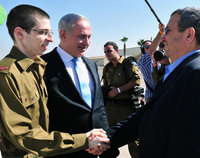
On the subject of the Gilad Shalit prisoner exchange, I can’t put it any better than blogger Emily Hauser, who has written a number of eloquent posts on this subject over the years. Click here and here to read her latest reactions.
Also highly recommended: this recent op-ed by journalist Rachel Shabi:
But meanwhile, the terms of the Israel-Hamas brokered prisoner swap – one Israeli, whose name the world knows, for 1027 faceless Palestinians – has generated some absurd comments on the value each side places on human life. In reports of how much Israelis care about the soldier Shalit – all true – there is somehow the inference that Palestinians don’t cherish their loved ones in the same way. But it is clearly more approachable a task to keep one soldier’s name in people’s hearts and in the headlines, than it is with countless thousands of Palestinian men. And the undertaking is smoothed by a media skew on the subject: taking part in a panel discussion on reporting the conflict last year, I heard a European journalist explain that Shalit was an easier pitch because he seemed innocent and blameless, while Palestinian prisoners didn’t generate the same assumptions. Meanwhile, the cold exchange rate of a thousand prisoners to one Israeli obviously doesn’t mean that Palestinians morally agree with this equation; it just points to the brutal asymmetry of forces and capacity in this struggle.
There is, however, one setting in which the two sides stand on level ground. When the prisoner deal was announced this week, there were jarringly rare images of both Israelis and Gaza strip Palestinians joyously celebrating the same news story. There it was, in that moment: an equality borne of shared humanity.
I was prepared to write extensively about Obama’s shameful speech at the UN General Assembly yesterday, but this post by Palestinian analyst/activist Abir Kopty (above) says everything I wanted to say and more.
I’ll just add that I genuinely believe that after last night, the US has utterly abdicated any meaningful role as a peace arbiter between Israel and Palestine. Where this political leadership will come from remains to be seen.
And meanwhile, the oppression continues…
We listened to you when you talked about Israel’s citizens who have been killed by rockets fired at their houses, and that other children are taught to hate Israeli children. Do you not think that Israeli children hear what is said by rabbis who preach hate about Arabs? And we listened about Jewish suffering. No doubt Jewish people have suffered Mr. Obama, but let us put things in order: Jewish people are not the victims here. The Israeli state is not the victim; it is the occupier and the oppressor which continues to deny Palestinians living in their homeland and in exile ‘their universal right to live in freedom and dignity’.
When you fail to mention Palestinian suffer under occupation, when you fail to consider Palestinian children as equal human beings who deserve a better future, who are also entitled to human rights, you might win elections, but you lose your integrity, and you make it clear to everyone why the ‘so called peace process’ should be out of your hands…
We listened to you when you talked about the Arab Spring with such a passion. We listened with much suspicion, as America was very happy with the leaders of those countries who ruled for decades, and did not care then for Egyptian, Tunisian, Libyan, Syrian, Yemeni and Bahraini aspirations for freedom and dignity. And we know that you won’t leave those nations alone.
We listened to you and we did not understand why Palestinian freedom and dignity can wait? The only thing your speech made clear is that you do not dare to speak honestly.
I strongly encourage you to read her full post – please click here.
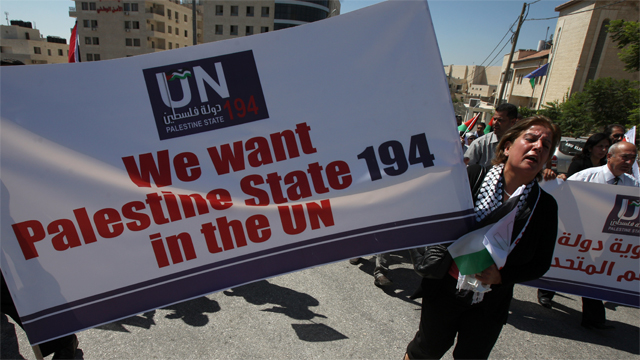
How can we understand the PA’s initiative to declare statehood at the UN? How should US and the international community respond? Will it advance the prospects for justice and peace in Israel/Palestine?
Ruebner is a former Analyst in Middle East Affairs at Congressional Research Service, a federal government agency providing Members of Congress with policy analysis. His analysis and commentary on US policy toward the Middle East appear frequently in media such as NBC, ABC Nightline, CSPAN, Al Jazeera, USA Today, Los Angeles Times, Huffington Post, Middle East Report, and more.
The US Campaign to End the Israeli Occupation is a national coalition of nearly 350 organizations working to end US support for Israel’s illegal 43-year military occupation of the Palestinian West Bank, East Jerusalem, and Gaza Strip, and to change U.S. policy toward Israel/ Palestine to support human rights, international law, and equality.
Call-in info:
Call in number: 1-800-920-7487
Code: 92247763#
Participants in the call are encouraged to read one or more of the following articles:
I don’t have a position on whether or not it is a good thing for the PA to seek membership status for Palestine at the UN. That is for the Palestinians to determine – and I know there are a variety of Palestinian opinions both pro and con on this issue.
On this one I’m in full agreement with former AJC Executive Director Henry Siegman, who offered this analysis yesterday:
(Is) there anyone who witnessed the frenzied applause that greeted Prime Minister Benjamin Netanyahu’s most recent speech before the U.S. Congress in which he left no doubt about his government’s intentions for East Jerusalem and for the West Bank, or heard President Obama’s assurances to AIPAC’s conventioneers that the ties that bind the U.S. to Israel are forever “unbreakable,” who still believes that the U.S. will ever exert the kind of pressure on Israel that will finally change its cost/benefit calculations with regard to its colonial project?
America will not turn our backs on the legitimate Palestinian aspiration for dignity, opportunity, and a state of their own…
The only resolution is for the aspirations of both sides to be met through two states, where Israelis and Palestinians each live in peace and security…
The United States does not accept the legitimacy of continued Israeli settlements. This construction violates previous agreements and undermines efforts to achieve peace. It is time for these settlements to stop…
And now here we are. The Obama administration has done everything it can to undermine its own publicly articulated goals. It continues to support Israel unconditionally as it settles the West Bank with impunity. Last February it cast the sole veto vote on a UN Security Council resolution that condemned the settlements. Now it is poised to publicly oppose Palestinians formal membership at the UN – the very body by which Israel itself became a state.
No, I’m not personally taking a stand on this because I don’t presume to preach to Palestinians what I think is in their best interest. But as an American citizen, I can’t accept my government’s claim that it is in any way committed to this so-called “peace process.” Until the Obama administration is truly ready to be an honest and effective broker, it could at the very least refrain from smacking Palestinians down when they seek recourse through other means.
And when it comes to the larger implications of a US veto, I’ll say this: whatever good will Obama might have engendered after Cairo is now on the verge of being completely and utterly squandered. You know things are looking dire when a former Saudi Ambassador to the US writes in the NY Times:
The United States must support the Palestinian bid for statehood at the United Nations this month or risk losing the little credibility it has in the Arab world. If it does not, American influence will decline further, Israeli security will be undermined and Iran will be empowered, increasing the chances of another war in the region.
When one of your only allies left in the Arab world makes a public statement such as this, I’d say its time to pay heed.
We’ve just uploaded the transcript of our conference call with Nadia Hijab last month – the Ta’anit Tzedek website now contains a recording as well as a full text of the call. I encourage you to read and/or listen to this amazing conversation. (Click here for the audio/transcript.)
Nadia covered a wide range of issues during the call, from the one state vs. two state, to human rights, to the Arab Spring, to the evolving Palestinian grassroots leadership. Listening to the conversation again, I was reminded of her impressively clear-headed, rights-based approach to the conflict – often challenging the conventional liberal American Jewish mindset in important ways.
When we ourselves challenged Nadia to state where she was on the one state vs. two state question, this was her eloquent response:
I believe the Palestinian people have the right to self-determination. I don’t care if that is exercised in one state or two states. I believe that whether it’s one state or two states, they should both be states that guarantee equality for all their citizens.
Now, separately from that, I do believe the Palestinians – and this is an individual right – have a right of return. (They) have a right to say if they would like to go back to what is now Israel and live as equal citizens in that state or if they would like to – we have the individual right to say if we’d like to stay in the countries where we’ve landed up and have rights there as citizens or if we’d like to go back to the new state of Palestine and be a citizen there, etc. Each Palestinian needs to be asked how each one wants to fulfill his or her right of return.
Another highlight from the call:
Rabbi Brian Walt: How do you, as a Palestinian, relate to Jews who feel quite attached to Israel or very attached to Israel and what it offers for Jews? And how do you feel about that sort of liberal Zionist argument that is perhaps portrayed best by J Street and other organizations like Americans for Peace now, that strongly support a two-state solution but don’t want to deal with the questions of 1947-48?
Nadia Hijab: Let me answer that in two parts. First, let me assume, just for the sake of argument that not a single Palestinian refugee returns to Israel. Let’s just assume that. There are 1.2 million Palestinian citizens of Israel and that is a challenge to Israel’s current attempt to present itself as a democratic state. It’s not. It is by law discriminatory to the Palestinians who are not even recognized as citizens. They have passports, they’re called Israelis, but they don’t actually have citizenship. And there are about twenty or thirty laws on the books, and more being added every day, to make sure that they are kept down and, hopefully some day, also out.
There’s a very racist discourse in Israel, a very openly racist discourse, that says: to the extent that we can maybe reshape the borders and get rid of some of these Palestinian Israelis, then we can keep Israel “pure,” ethnically “pure.” Well, in the 21st century that’s nonsense. And in fact, it’s been nonsense since 1948, because 1948 was not only the year that Israel was created but 1948 was the adoption of the Universal Declaration of Human Rights. Humanity had been moving towards that after one horror after another during the World Wars and other wars. So humanity has been trying to define how people deal with each other and how they relate to each other, whether as individuals or as communities or as states.
And in this day and age, it’s no longer acceptable – it’s universally seen as immoral and illegal – to discriminate against people on the basis of their religion or their race or their color, and now growing (on the basis of) their sexuality. You know, discrimination is abhorrent.
And what Israel is doing, even if you don’t take into account any of what’s going on with the occupation…what Israel is doing within its country is abhorrent. So therefore, Israel as it’s currently defined: as a state for Jews, by Jews, of Jews – that’s not a modern state, nor is it, by the way, as many states define themselves in the Arab world, (i.e.) by Muslims, for Muslims.
People have to have equal rights, whether Muslim or Christian or Jewish or men or women. A state is simply a construct in this day and age. It’s a construct for how to manage resources in a way that is fair and equitable and guaranteeing the rights of its citizens. That is what a state is. So Israel faces that challenge irrespective of whether there’s a two-state solution or a one-state solution.
Then I wanted to touch on the other part of your question, which is very important, how Jews feel about Israel or how I feel about Jews and what they feel about Israel. I work a lot with Jews who uphold a human rights approach, no matter what. And these are people who are my friends and I work extremely closely with them. And they struggle for justice for Palestinians as well as human rights for everybody, whether they’re Israelis or Palestinians, in the same way that I do.
I respect the work of many, let’s say, American Jews or liberal Zionists or whatever who stand up for some freedoms and some rights. But then when it comes to a question of Israel’s security they are less clear about where their loyalties lie. That’s problematic for me.
But I recognize that there is now a Jewish attachment to Israel and I think that over time it will be okay, because Israel exists – it was created. It was created in a way that was immoral and unjust to the Palestinians, but it was created. And eventually the attachment and the sense of belonging will be a cultural one, a social one, and maybe of family ties.
And then those attachments can be built across the Arab world as well. They don’t have to be restricted to Israel. And Israel will become a state of all its citizens, in which Palestinians and Jews and Arabs and Muslims and Christians are all equal and just one of the many states of the region.
Netanyahu’s peace plan, if that is the right phrase for the collection of unrealistic terms he presented to Congress yesterday, leads straight to the burial of the Israeli-Palestinian peace process, an international crisis and a UN declaration of a Palestinian state.
Netanyahu today essentially returned to the policies that Israel pursued before Yitzhak Rabin and Yasir Arafat agreed on mutual recognition and the joint pursuit of peace.
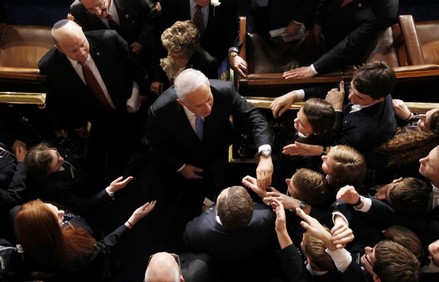
And the worst part is not the appalling things Netanyahu said, but how Congress received them. Even Netanyahu’s declaration that there is no Israeli occupation was met with thunderous applause with the Democrats joining the Republicans in ecstatic support. Every Netanyahu statement, no matter how extreme, was met with cheers.
How can an Israeli prime minister dare to say his country “fully supports the desire of Arab peoples in our region to live freely” without spitting out the entire bitter truth – as long as they aren’t Palestinian. Suddenly Netanyahu marvels at the Arab Spring, but where was he when it began? He was on his standard scare campaign, warning of the dangers of an extremist Islamic regime and rushing to build a fence along our border with Egypt. And yesterday, suddenly, it’s “the promise of a new dawn.” Apparently there is no end to hypocrisy.
And finally, please read Justin Elliot’s invaluable piece in Salon, where he counts 29 standing ovations for Bibi (more than Obama got in his State of the Union Address) providing important commentary for each and every one.
At this point, I’d usually urge you to call your senators and congresspeople, but I really don’t see the point any more. Today the overwhelming majority of Congress – Republicans and Democrats alike – have made it embarrassingly clear that they are utterly irrelevant to the search for a just peace in Israel/Palestine.
If there were any redemptive words uttered in that chamber at all today, they came from my friend Rae Abileah – a courageous young Jewish activist – who interrupted Bibi’s speech from the gallery with “No more occupation, stop Israeli war crimes, equal rights for Palestinians, occupation is indefensible.” Rae was immediately assaulted by spectators who caused serious injuries to her neck and shoulders. She was then taken to George Washington Hospital where she was promptly arrested.
Said Rae from her hospital bed:
I have been to Gaza and the West Bank, I have seen Palestinians homes bombed and bulldozed, I have talked to mothers whose children have been killed during the invasion of Gaza, I have seen the Jewish-only roads leading to ever-expanding settlements in the West Bank…
As a Jew and a U.S. citizen, I feel obligated to rise up and speak out against stop these crimes being committed in my name and with my tax dollars.
Amidst the abject hypocrisy demonstrated in Congress today, Rae’s courage should be an example for us all.
For me the most significant part of Bibi’s AIPAC speech last night came at the very end, when he invoked the famous Leviticus verse on the Liberty Bell:
Now, as Prime Minister of Israel, I can walk down the street and see an exact replica of that bell in Jerusalem’s Liberty Park. On both bells is the same inscription. It comes from the Bible, from the book of Leviticus “Proclaim liberty throughout the land.”
Actually, what’s most significant is what he left out. Bibi only quoted the first half of Leviticus 25:10 – the entire verse reads:
Proclaim liberty throughout all the landunto all the inhabitants thereof.
For me, Obama’s speech at AIPAC yesterday was on the same level of rhetorical and political brilliance as his much-vaunted 2008 “race speech.” I’m really not sure quite how he did it, but he managed to strike an impossibly perfect balance between statements of political necessity:
The bonds between the United States and Israel are unbreakable and the commitment of the United States to the security of Israel is ironclad.
hard-nosed reality:
There’s a reason why the Palestinians are pursuing their interests at the United Nations. They recognize that there is an impatience with the peace process, or the absence of one, not just in the Arab World — in Latin America, in Asia, and in Europe. And that impatience is growing, and it’s already manifesting itself in capitals around the world.
political courage:
I know very well that the easy thing to do, particularly for a President preparing for reelection, is to avoid any controversy. I don’t need Rahm to tell me that. Don’t need Axelrod to tell me that. But I said to Prime Minister Netanyahu, I believe that the current situation in the Middle East does not allow for procrastination.
and moral conviction:
The Talmud teaches us that, “So long as a person still has life, they should never abandon faith.” And that lesson seems especially fitting today.
For so long as there are those across the Middle East and beyond who are standing up for the legitimate rights and freedoms which have been denied by their governments, the United States will never abandon our support for those rights that are universal.
And all this while repeatedly bringing the AIPAC audience to their feet in applause.
Wow.
If I had any doubts about the power of this one speech, the reaction of the leftist blogosphere – where the criticism of Obama’s efforts in Israel/Palestine has been witheringly critical of late – was the ultimate indicator.
Today’s speech by Barack Obama to AIPAC was a historic speech, maybe the most remarkable speech he has ever given. For a masked and calculating man, it was incredibly sincere. For just below the politically-hogtied phrases and praises for the Israel lobby that controls his future, it was filled with rage. When he spoke over and over of a Jewish democratic state and then said that the world was changing, and spoke about that Jewish state upholding universal values that Americans also share, I heard vicious irony: You want a religious state, you have the power to demand it of me, because you are the Israel lobby, well time is running out on you.
Yes, he gave AIPAC the usual Israel boilerplate. He’ll veto a unilaterally declared Palestinian state, etc. But all that stuff is standard and subject to change as situations change. However, the overarching message was the necessity for two states and the unsustainability of the occupation.
And AIPAC applauded. Strongly.
The President did a masterful job. The neocons are outraged. And I expect that Netanyahu, seeing AIPAC’s reaction to their President, will cut his losses and back down.
Bravo, Mr. President. You even brought out the best in AIPAC.
Even Ali Abunimah, in a post that otherwise excoriated US policy in Israel/Palestine, grudgingly admitted that Obama’s speech contained “a number of interesting elements” and “a hard-headed realism about the deep trouble Israel is in.”
Now, however, the real test begins. I’ve made no secret that I believe we’ve passed the point of no return on a two state solution – and I continue to fear that for all of his political courage, Obama’s efforts are arriving too late. As I write, Israel’s settlement juggernaut continues apace, making a mockery of Obama’s stated hope for a “sovereign and contiguous Palestinian state.” Meanwhile, Netanyahu’s political strategy is patently obvious: keep building settlements, stall Obama as long as possible, cozy up to his personal congressional friends, and do what he can to stoke the fires for a Republican victory in 2012 that will make all this unpleasantness just go away.
No matter how impossible the odds, however, I remain in awe of Obama’s speech, if only that he proved a sitting President does not need to roll over for the Israel Lobby. Could we venture to hope that AIPAC’S financially-driven stranglehold on American foreign policy, its craven bullying of politicians, and its “Israel right or wrong” myopia is now being exposed for what it really and truly is?
Click on the clip above for the entire speech. The good stuff begins at about 14:00 or so.
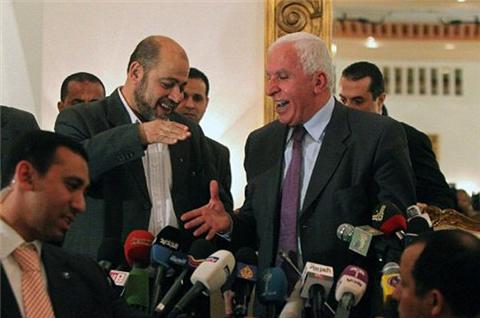
When I read of the reported “PA-Hamas reconciliation” deal, my initial response was generally positive. It seemed to me that Palestinian leaders on both sides were finally taking their constituents’ desire for unified leadership seriously. It also appeared that – together with the PA’s campaign to find international support for a declaration of statehood – Palestinian leadership had decided to proactively shake up the paralyzed status quo.
The United States supports Palestinian reconciliation on terms which promote the cause of peace. Hamas, however, is a terrorist organization which targets civilians.
At any rate, it’s fairly clear that the unity effort is likely to be more symbolic than an actual game changer. As Ali Abunimah recently pointed out, it’s difficult to imagine how a unified Palestinian leadership could ever operate effectively under current circumstances:
If there is an agreement on a joint “government” how can it possibly function without Israeli approval? Will Israel allow Hamas ministers be able to operate freely in the occupied West Bank? Will PA officials be able to move freely between the West Bank and Gaza? Israel is effectively at peace with the current Abbas wing of the Palestinian Authority and at war with Hamas. Impossible to see how such a government can operate under Israeli occupation. If anything this proves the impossibility of democracy and normal governance under Israeli military occupation.
In the end, writes Joseph Dana, the issue is not whether or not the Palestinian leadership could function with Hamas involved. The actual motive behind unity talks is not the Palestinian leadership’s desire to serve as a real functioning government – but rather its desire to co-opt the Palestinian masses who are inspired by the revolutionary spirit currently coursing though the Arab world:
The agreement signed last night between Fatah and Hamas does not represent unity. The reconciliation agreement represents a move to appease growing popular movements on the streets of Gaza and the West Bank which are demanding real unity, one that might not even involve the PA and Hamas, in order to combat Israeli occupation.
I completely agree with Dana that the Palestinian popular nonviolent resistance movement has the power to challenge Israel in ways that the PLO and Hamas never could. Indeed, this is the kind of Palestinian unity Israel should really be taking seriously:
A unified Palestinian population in the West Bank and Gaza which adopts nonviolent resistance tactics has the potential to inflict incredible damage on the Israeli occupation. Actually, Israel does not have an effective strategy to combat Palestinian nonviolence and unity. Look at the amount of military resources Israel have used to crush small West Bank villages like Nabi Saleh, which embrace unity and nonviolence against occupation.
Unless American, Israeli and Palestinian leaders show real leadership, there is every reason to believe Palestinian people may well seize that mantle themselves. Now that would be a real game changer…
Netanyahu plans to unveil a new peace plan early next month, just before he is scheduled to address both Houses of Congress in Washington. According to reports, the plan will suggest a transfer of additional territory in the West Bank to “full Palestinian control.”
Meanwhile back in the real world, Israel’s Ministry of Housing has just announced plans to build a new neighborhood of 800 housing units south of West Bank settlement Givat Ze’ev. Peace Now correctly points out that these plans represent the true intentions of the Israeli government:
It is a strategic plan, that is meant, from the one hand, to create a territorial continuity between Jerusalem and Givat Zeev, and from the other hand to create a barrier between the Palestinian communities south-west of Ramallah, and the heart of the potential Palestinian State in East Jerusalem and Ramallah.
The construction in the “Settlement Blocs” is more of a threat to the two states solution than in the other settlements, because it creates facts on the ground that will be much harder for Israel to remove, and it limits the ability of the negotiators to find potential land-swaps that would be necessary for an agreement.
Just bear this in mind when Netanyahu unveils his latest “peace plan:” actions on the ground speak much louder than his words.
 On the subject of the Gilad Shalit prisoner exchange, I can’t put it any better than blogger Emily Hauser, who has written a number of eloquent posts on this subject over the years. Click here and here to read her latest reactions.



 Shalom Rav