Category Archives: Peace

Thank You, Rep. Baird

Yet another American political voice calls to lift the Gaza blockade. From yesterday’s NY Times:

The United States should break Israel’s blockade of Gaza and deliver badly needed supplies by sea, a U.S. congressman told Gaza students.

Rep. Brian Baird, a Democrat from Washington state, also urged President Barack Obama’s Mideast envoy to visit the Hamas-ruled territory to get a firsthand look at the destruction caused by Israeli’s military offensive last year.

Rep. Baird’s statement on Gaza, from his website:

(Rocketing) from Gaza doesn’t necessarily mean that any response, regardless of scope, target or impact on civilians, is necessarily justified, moral or strategically prudent.  This kind of misleading duality itself reflects the thinking, on both sides, that can make peace so hard to achieve and violence so easy to justify.  The fact is, there were and are many alternative responses possible and it is a false dichotomy to suggest, as some have, that if one criticizes the actions taken by Israel in Gaza and the West Bank then one is necessarily ignoring the rocket attacks from Gaza or somehow siding with or enabling terrorists.

In my judgment what has happened in Gaza and what goes on in the West Bank every day endangers U.S. integrity and security and ultimately strengthens hard line extremists at the expense of moderates and to the detriment of long term Israeli security.   I also believe, having traveled and met with people throughout the region, that this adverse effect is not confined to Palestine but extends to varying degrees throughout the Islamic world and beyond.

I understand that people may disagree strongly with this perspective, but I am certainly not alone in expressing it.  Many people have contacted my office to convey support for what we have said about our visit and this includes many friends of Israel within our own country.

Click here to thank Rep. Baird for his courage.

Rosenberg: BDS May Be Inevitable

MJ Rosenberg, a Mideast analyst I’ve respected for years, has just written a powerful blog post entitled, “Are Israeli-Palestinian Negotiations Finished?”  His words are particularly meaningful, I believe, coming from someone who is firmly ensconced in the mainstream liberal Zionist camp.

He opens with an all-too familiar concern: that Israel’s suicidal path of settlement expansion will soon make the possibility of a viable Palestinian state impossible (if it hasn’t already).

Then he takes this concern to its next logical conclusion, articulating what most two-staters are generally too frightened to say out loud:

What would happen is that the Palestinians would go to the United Nations, to the European Union, and even to the United States to seek ..consequences. And these would most likely come in the demand for sanctions. There is already a burgeoning BDS (Boycott, Divestment, Sanctions) movement that is seeking to bring down the occupation the way a similar movement brought down apartheid.

Is this what Israelis want? Do they really want those concerned about the occupation to be forced to turn to an option this extreme?

I know that the last thing I want is a successful international movement that would boycott and sanction Israel as if it was apartheid South Africa. But it’s probably inevitable unless Israelis come to their senses and begin the process of ending the occupation while the decision is still theirs to make.

In other words, sooner than later we’ll have to choose between a Jewish state and basic, fundamental human rights.  It’s not the first time we’ve heard sentiments such as this, but when they come from people like Rosenberg, it’s a sign that the lines on this issue are inexorably shifting.

J Street’s Bumpy Philadelphia Road

Now that Brit Tzedek has merged with J Street, we’re witnessing the rapid growth of  “J Street Locals” proliferating throughout more than 20 regions across the country.  (I’m happy to be attending the launch of J Street Chicago at Emanuel Congregation this Thursday night and even happier to hear that a healthy turnout is expected).

I’m dismayed, tho, to learn that J Street Philadelphia‘s debut is receiving more than its share of ridiculous attacks from certain corners of the Philly Jewish community.  I’ve just read that even Penn Hillel has come under fire for renting out its facility to this “anti-Israel” group.

According to the Philadelphia Jewish Exponent:

A flap over Hillel of Greater Philadelphia’s decision to lease its space to J Street — for the official launch of its Philadelphia branch — is just one local manifestation of a debate that has roiled much of the national Jewish establishment since the advocacy organization was founded nearly two years ago…

Gary Erlbaum, who sits on the Jewish Community Relations Council’s Israel advocacy committee and is also a board member of the Jewish Publishing Group, has been outspoken in his opposition to J Street, and is upset about Hillel’s decision to host the group’s Feb. 4 event.

“What makes them pro-Israel? If the Palestinians had a lobby, it would be called J Street,” said Erlbaum. “The Hillel building is an inappropriate spot for a group that’s anti-Israel.”

Oh, for God’s sake. A group committed to supporting the two-state solution through a diplomatic means while safeguarding Israel security and its future as a Jewish and democratic state is somehow “anti-Israel?”

You know, sometimes when I’m feeling really, really optimistic, I dream about what it might feel like if the American Jewish community actually could tolerate the kind of vigorous and freewheeling debate that they enjoy in the actual Jewish state itself.  (Now wouldn’t that be “pro-Israel?”)

In Memory of Howard Zinn, z”l

I’ve been reading and listening to Howard Zinn’s work since learning of his death last week – and I’m become increasingly saddened at just what we’ve lost in his passing.  Here are just a few pieces that have moved me tremendously:

– Click above to see a clip in which Zinn  shares his thoughts on human nature and aggression.

– My friend Mark Braverman has posted a powerful and important piece by Zinn on the legacy of the Holocaust. An exerpt:

I would never have become a historian if I thought that it would become my professional duty to go into the past and never emerge, to study long-gone events and remember them only for their uniqueness, not connecting them to events going on in my time. If the Holocaust was to have any meaning, I thought, we must transfer our anger to the brutalities of our time. We must atone for our allowing the Jewish Holocaust to happen by refusing to allow similar atrocities to take place now—yes, to use the Day of Atonement not to pray for the dead but to act for the living, to rescue those about to die.

– One of his many columns for The Progressive, this one published four days after 9/11:

We need to imagine that the awful scenes of death and suffering we are now witnessing on our television screens have been going on in other parts of the world for a long time, and only now can we begin to know what people have gone through, often as a result of our policies. We need to understand how some of those people will go beyond quiet anger to acts of terrorism.

We need new ways of thinking. A $300 billion dollar military budget has not given us security. Military bases all over the world, our warships on every ocean, have not given us security. Land mines and a “missile defense shield” will not give us security. We need to rethink our position in the world. We need to stop sending weapons to countries that oppress other people or their own people. We need to decide that we will not go to war, whatever reason is conjured up by the politicians of the media, because war in our time is always indiscriminate, a war against innocents, a war against children. War is terrorism, magnified a hundred times.

Our security can only come by using our national wealth, not for guns, planes, bombs, but for the health and welfare of our people – for free medical care for everyone, education and housing guaranteed decent wages and a clean environment for all. We can not be secure by limiting our liberties, as some of our political leaders are demanding, but only by expanding them.

We should take our example not from our military and political leaders shouting “retaliate” and “war” but from the doctors and nurses and medical students and firemen and policemen who have been saving lives in the midst of mayhem, whose first thoughts are not violence, but healing, not vengeance but compassion.

Zichrono Livracha – may the memory of this righteous man be for a blessing.  And may we continue his work of bearing witness through our words and deeds…

Replanting the Uprooted on Tu B’shevat

Last week, Israeli Prime Minister Netanyahu celebrated the festival of Tu B’shevat (“The New Year of the Trees”) by leaving a meeting with American peace envoy George Mitchell and promptly embarking upon a tree-planting tour at Jewish settlements in the West Bank.

Here is what he had to say:

The message is clear – we are here and will remain here. We are planting and building; this is an inseparable part of the State of Israel.

For those looking for a different way to connect the festival of Tu B’shevat to the current political reality in the State of Israel, I recommend reading this at your seder, written by Rabbi Arik Ascherman of Israel’s Rabbis for Human Rights:

Lift the olive branch and say:

The olive branch, what is the reason for this?

We raise the olive branch as a symbol of responsibility, identification and hope.

We raise this branch in sorrow because each and every year, olive trees, the source of livelihood for Palestinian families, are intentionally chopped down, burned and uprooted.  In attempting to exercise their right to work their lands, farmers repeatedly put themselves in danger. Both the human being and the trees of the field are desecrated, and there is no earthly law or judge (ein din v’ein dayan). Only a few are guilty, but all are responsible (Rabbi Abraham Joshua Heschel).

On Tu B’shevat, we are taught that the trees cease to drink from the rains of the past year and begin to be nourished from the rains of the current year (Jerusalem Talmud, Rosh Hashanah 56a). However, into the old and the new waters have fallen the tears of the dove of peace whose feet cannot find a resting place (Genesis 8:9) because the earth has become filled with violence (Genesis 6:11). The olive branch has become bitter in her mouth – a symbol of strife.

We raise this branch as a symbol of identification with those Israelis and Palestinians who are doing everything in their power to change this reality and make enemies into friends (Pirke Avot De’Rabbi Natan) by planting, pruning, plowing and harvesting together, despite the voices of hate and incitement from both sides.

May it be Your will that the fruit of the olive, symbol of the World of Yetzirah/Creativity (Pri Eytz Hadar) inspire us to create justice and peace out of the basic materials of the soil, the fruit of the soil, and the human spirit (adamah, pri adamah, ve’ruakh ha’adam) so that by the time evening falls (Genesis 8:11) we will reconnect the olive branch to the root of the soul (Shoresh Nishmato).

May we thus beat our swords into plowshares and  our spears into pruning hooks…so that every person may sit under their vine or fig tree and none shall make them afraid (Micah 4:3-4) and the land shall know tranquility (Judges 3:11, etc.) and all of its inhabitants will rejoice.

Rabbi Brian Reports From Israel/Palestine

My friend Rabbi Brian Walt is currently living in Jerusalem with his family and will be there for next five months. I strongly encourage you to read his blog posts, in which he powerfully reflects on his experiences and describes the struggle for justice in Israel/Palestine. He just posted a piece on a recent demonstration in Sheikh Jarah; his post on a visit to Hebron last week is breathtaking.

My Favorite Rabbis: Everett Gendler

Most people probably don’t realize this, but rabbis need rabbis too.

And there are a lot of great rabbis out there. Over the years I’ve been personally inspired by many of them: remarkable, talented leaders whose work challenges me, drives me and constantly reminds me why I do what I do. So with this post I’m debuting a new series I’m calling “My Favorite Rabbis:” ongoing profiles of the contemporary rabbis whom I consider to be my own spiritual teachers.

I’ll start by introducing you to Rabbi Everett Gendler, a Conservative rabbi whose moral courage has provided Jewish leadership for some of the most important progressive causes of our day. Today, some fifty years since he became a rabbi, I believe he remains on the cutting edge of the issues that truly matter.

This MLK weekend, it is certainly appropriate to note that Rabbi Gendler was one of the first rabbis to become actively involved in the struggle for civil rights in America and played a critical role in involving American rabbinical leadership in the movement. It’s doubtful that American rabbis would have stepped up to this struggle nearly as much had it not been for Rabbi Gendler’s prophetic influence.

During the early and mid-1960s, Rabbi Gendler led groups of American rabbis to participate in numerous prayer vigils and protests throughout the South. Of course many know that the legendary Rabbi Abraham Joshua Heschel marched with Dr. Martin Luther King in Selma in 1965. I imagine far fewer are aware that it was in fact Rabbi Gendler who persuaded Heschel to do so.

Heschel biographer Edward K. Kaplan writes:

Despite fears for his safety from his wife and the twelve year old Susannah, (Rabbi Heschel) agreed to join the march at the urging of Rabbi Everett Gendler, a pacifist and former student. Gendler had led a group of rabbis to Birmingham, Alabama to work for voting rights and remained in touch with the Reverend Andrew Young, King’s Executive Assistant at the SCLC. (From “Spiritual Radical: Abraham Joshua Heschel in America,” p. 222)

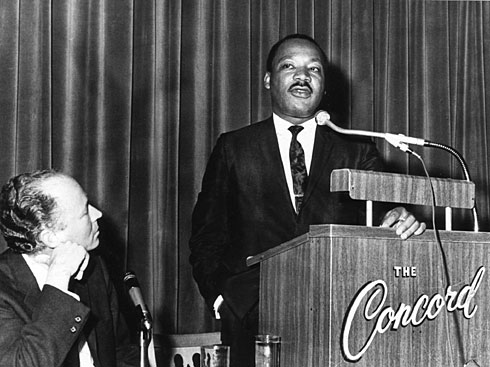
Rabbi Gendler was also instrumental in arranging Martin Luther King’s keynote address at the Rabbinical Assembly’s convention on March 25, 1968. This now-legendary speech took place at the Concord Resort hotel in New York’s Catskill Mountains just 10 days before King’s death. (That’s Rabbi Gendler to the left of Dr. King in the pic above).

Today, decades after King’s death, Rabbi Gendler remains an eloquent Jewish advocate for the path of nonviolence. His work has taken him across the world – most notably to India where he and his wife Mary teach the principles of nonviolence to Tibetan exiles.

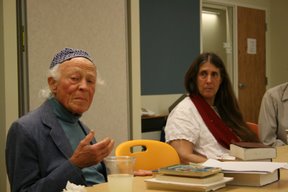
I’m personally honored to serve with Rabbi Gendler on the Elder’s Council of the Shomer Shalom Institute for Jewish Nonviolence. In this picture, he leads a workshop at JRC in 2008. Shomer Shalom founder Rabbi Lynn Gottlieb (someone whom I may well be profiling in the future) is sitting next to him.

Rabbi Gendler has also been a long time advocate for Palestinian human rights – and his courageous stands have made it possible for new generations of rabbis to find their own voices on this painful issue. When Rabbi Brian Walt and I first began Ta’anit Tzedek and were looking for rabbis to join our campaign to protest the blockade of Gaza, we immediately turned to Rabbi Gendler, who joined our effort without hesitation. It is difficult to describe how much it means to know there are rabbis out there like Everett, someone who has been putting himself on the line for so long, and upon whom we always know we can rely for guidance and support.

Rabbi Gendler was also one of the first Jewish leaders to embrace environmentalism and vegetarianism long before they became fashionable. As the rabbi of a green synagogue myself, I recognize a tremendous debt to Everett, who more than anyone helped to put environmental issues on the radar screen of the Jewish community.

From a 2008 article in the Los Angeles Jewish Journal:

On a ferociously cold evening in November 1978, Rabbi Everett Gendler climbed atop the icy roof of Temple Emanuel in Lowell, Mass., and installed solar panels to fuel the synagogue’s ner tamid (eternal light)…

Gendler’s conversion of that eternal light marks the first known action to green a synagogue, making it more spiritually and ecologically sustainable, and Gendler himself, now Temple Emanuel’s rabbi emeritus, has been hailed as the father of Jewish environmentalism.

There so much more to say about Everett and his work. I suppose the most essential thing I can say about him is that he was and remains a spiritual maverick. His work remains as relevant and courageous as ever.

As we honor Dr. King this weekend, it’s critically important to honor those who continue his to walk his path in our own day. For me and so many others, Rabbi Everett Gendler is the one who teaches us how to walk that walk.

Nurit Peled Elhanan’s Cry from the Heart

Dr. Nurit Peled Elhanan is an Israeli woman whose 13 year old daughter was killed by a Palestinian suicide bomber in 1997. Shortly after, she helped found the Bereaved Parent’s Circle, a courageous Israeli-Palestinian coexistence group about which I’ve frequently written. It’s not an exaggeration to say that over the past two decades she has become one of the most important and eloquent members of the Israeli peace activist community.

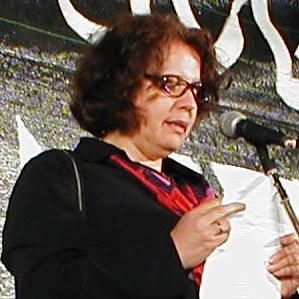
On January 2, Peled Elhanan gave an emotional speech in Tel Aviv at a rally commemorating the one-year anniversary of Israel’s military assault on Gaza. I don’t know how else to describe it but as a primal scream – a cry from deep within the reaches of her heart.  It is a gut-wrenching read, but also, in its way, enormously edifying.  More than anything else I’ve read lately, it addresses head-on the poison that has been spreading through Israel’s soul – a phenomenon many fear to be true, but few are willing to identify out loud.

Please make sure to read all the way to the end, including the footnotes, which will help you to better understand her references, as well as the Jewish soul that throughly permeates her words.

Continue reading

Toward a New Gaza Strategy

There is new tension along the Israel-Gaza border. Israel is bombing targets in Gaza; mortar shells and Qassams are flying into southern Israel once again. If  Israel’s massive military assault last year was designed to deter Hamas and/or provide security for the citizens of southern Israel – then it now appears that effort has been for naught.

When will we learn that bombs won’t work?  As so many of us have been shouting for so long, the only true solution to the Gaza conflict is a political solution: to open the border, to provide relief and development assistance, to engage with Hamas directly.

I’m gratified, at least, that the editorial board of Ha’aretz seems to be moving in this direction:

A renewal of rocket fire shows that even a major military operation that brought death and destruction cannot ensure long-term deterrence and calm. Israel has an interest in stopping escalation at the border so as not to find itself caught up in another belligerent confrontation with Hamas …

Instead of erring by invoking the default solution of more force, which does not create long-term security or ease the distress of the Palestinians in Gaza, the crossings between Israel and the Gaza Strip should be opened and indirect assistance rendered to rebuild its ruins.

Amen. Massive military bombardment and a crushing blockade is not making either side more secure – it is only exacerbating the conflict and ensuring the likelihood we will be reading more tragic news from a small patch of land that has known nothing but tragedy for the past six decades.

PS: Since I wrote this post this morning, I’ve been thinking all day about how I addressed the Gaza conflict as largely a strategic policy issue. If I’m going to be totally honest, however, I’d have to admit that my feelings about this issue go deeper than simply “war doesn’t work.”

I’ve come to accept that at its heart, this conflict is not simply strategy but about justice. To anyone who believes that this latest border issue is about Hamas and its missiles, I’d respond that it is only the latest incarnation of an injustice that was committed against the Palestinian people, long, long before the Qassams started flying.

I’m currently reading Joe Sacco’s devastating graphic-novel style reportage, “Footnotes in Gaza.” I highly recommend it to anyone interested in the tragic history of the Palestinian experience in Gaza.

Gaza One Year Later: Beyond the Complications

It was exactly one year ago that I read the first news accounts of Israel’s military assault in Gaza:

Waves of Israeli airstrikes destroyed Hamas security facilities in Gaza on Saturday in a crushing response to the group’s rocket fire, killing more than 225 — the highest one-day toll in the Israeli-Palestinian conflict in decades…

(There) was a shocking quality to Saturday’s attacks, which began in broad daylight as police cadets were graduating, women were shopping at the outdoor market, and children were emerging from school. The center of Gaza City was a scene of chaotic horror, with rubble everywhere, sirens wailing, and women shrieking as dozens of mutilated bodies were laid out on the pavement and in the lobby of Shifa Hospital so that family members could identify them. The dead included civilians, including several construction workers and at least two children in school uniforms.

By afternoon, shops were shuttered, funerals began and mourning tents were visible on nearly every major street of this densely populated city.

Previously, whenever I’d hear this kind of news out of Israel/Palestine, my shock and anguish would quickly be tempered by a familiar voice telling me to calm down, don’t overreact, don’t forget how terribly “complicated” the situation is. (Indeed, I recall hearing that voice distinctly three years earlier when the IDF responded to Hezbollah rocket attacks with a similarly massive military onslaught.)

This time, though, it was different. This time I didn’t hear the voice. Somehow, it just didn’t seem all that complicated to me any more.

This is what I wrote on my blog that day:

The news today out of Israel and Gaza makes me just sick to my stomach.

I know, I can already hear the responses: every nation has a responsibility to ensure the safety of its citizens. If the Qassams stopped, Israel wouldn’t be forced to take military action. Hamas also bears responsibility for this tragic situation…

I could answer each and every one of these claims in turn, but I’m ready to stop this perverse game of rhetorical ping-pong. I don’t buy the rationalizations any more. I’m so tired of the apologetics. How on earth will squeezing the life out of Gaza, not to mention bombing the living hell out of it, ensure the safety of Israeli citizens?

We good liberal Jews are ready to protest oppression and human-rights abuse anywhere in the world, but are all too willing to give Israel a pass. It’s a fascinating double-standard, and one I understand all too well. I understand it because I’ve been just as responsible as anyone else for perpetrating it.

So no more rationalizations. What Israel has been doing to the people of Gaza is an outrage. It has brought neither safety nor security to the people of Israel and it has wrought nothing but misery and tragedy upon the people of Gaza.

There, I’ve said it. Now what do I do?

As I read this post one year later, I remember well the emotions I felt as I wrote it. I also realize what a critical turning point that moment represented for me.

As a Jew, I’ve identified deeply with Israel for my entire life. I first visited the country as a young child and since then I’ve been there more times that I can count. Family members and some of my dearest friends in the world live in Israel.

Ideologically speaking, I’ve regarded Zionism with great pride as the “national liberation movement of the Jewish people.” Of course I didn’t deny that this rebirth had come at the expense of another. Of course I recognized that Israel’s creation was bound up with the suffering of the Palestinian people. The situation was, well, it was “complicated.”

Last year, however, I reacted differently. I read of Apache helicopters dropping hundreds of tons of bombs on 1.5 million people crowded into a 140 square mile patch of land with nowhere to run. In the coming days, I would read about the bombing of schools, whole families being blown to bits, children literally burned to the bone with white phosphorous. Somehow, it didn’t seem so complicated at all any more. At long last, it felt as if I was viewing the conflict with something approaching clarity.

Of course I think we’d all agree that the Israeli-Palestinian conflict is technically complicated. But at the same time I think we all know that at the end of the day, there is nothing complicated about persecution. The political situation in Darfur, for instance, is enormously complicated – but these complications certainly haven’t stopped scores of Jews across North America from protesting the human rights injustices being committed there. We do so because we know that underneath all of the geopolitical complexities, oppression is oppression. And as Jews, we know instinctively that our sacred tradition and own tragic history require us to speak out against all oppression committed in our midst.

I’d suggest that if there is anything complicated for us here, it is in possibility that we might in fact have become oppressors ourselves. That is painfully complicated. After all, our Jewish identity has been bound up with the memory of our own persecution for centuries. How on earth can we respond – let alone comprehend – the suggestion that we’ve become our own worst nightmare?

More than anything else, this is was what I was trying to say in that anguished, emotional blog post one year ago: is this what it has come to? Have we come to the point in which Israel can wipe out hundreds of people, whole families, whole neighborhoods and our response as Jews will be to simply rationalize it away? At the very least will we able to stop and question what has brought us to this terrifying point? Have we become unable to recognize persecution for what it really and truly is?

Those who know me (or read my blog) surely know that it has been a painfully challenging year for me. My own relationship to Israel is changing in ways I never could have predicted. Since I started raising questions like those above, I’ve lost some friends and, yes, my congregation has lost some members. If Zionism is the unofficial religion of the contemporary Jewish community then I’m sure there are many who consider me something of an apostate.

But at the same time, I’ve been surprised and encouraged by the large number of people I’ve met who’ve been able to engage with these questions openly and honestly, even if they don’t always agree with me. I suppose this is what I decided to do one year ago: to put my faith in our ability to stand down the paralyzing “complexities,” no  matter how painful the prospect.

One year later, I still hold tight to this faith.