Category Archives: Peace

American Heroes: Code Pink’s Anti-Drone Delegation to Pakistan

Medea Benjamin is a true American hero.

The Code Pink founder and nonviolence activist is currently leading a delegation of 31 American peace activists through Pakistan to protest the tragic damage wrought by US drone attacks.  Traveling with popular Pakistani politican, Imran Khan, the delegation recently attempted to hold a rally in the tribal regions that have been hardest hit by the US drone campaign.  On October 9, the delegation will publicly fast from sunrise to sunset at a vigil in front of the Islamabad Press Club, where they will display pictures of the more than 160 Pakistani children who have been killed by American drones. (Jews who have only recently completed a fast of atonement should appreciate the spiritual power of such an act…)

From a recent WashPo feature:

The majority-female delegation — in their early 20s to late 70s — traveled with no security guards despite announced militant threats against them and Khan, head of the Pakistan Justice Movement political party. They fell in line behind Khan’s procession as legions joyously waved party flags atop trucks.

By late Saturday, when the Codepink delegates finally reached a large farm belonging to a regional party official, they were mobbed by an admiring Pakistani media and given a hero’s welcome by hundreds of the candidate’s fans.

Anti-American sentiment runs extremely high in Pakistan, but the delegation focused on a simple message: “We are against drones” was emblazed in Urdu in green fluorescent script, outlined with glitter, on the oversize white bibs they wore.

“You hit people with these drones and you create instant enemies,” said JoAnne Lingle, a silver-haired Mennonite from Indianapolis. “It’s supposed to be increasing our national security and it’s doing the opposite.”

The US drone wars are our national shame. If there had previously been any doubt, I’d say they’ve been put to rest by the NYU School of Law and Stanford University Law School, who released a deeply damning report entitled “Living Under Drones: Death, Injury and Trauma to Civilians From US Drone Practices in Pakistan” late last month.

From the report’s Executive Summary:

In the United States, the dominant narrative about the use of drones in Pakistan is of a surgically precise and effective tool that makes the US safer by enabling “targeted killing” of terrorists, with minimal downsides or collateral impacts.

This narrative is false.

Following nine months of intensive research—including two investigations in Pakistan, more than 130 interviews with victims, witnesses, and experts, and review of thousands of pages of documentation and media reporting—this report presents evidence of the damaging and counterproductive effects of current US drone strike policies. Based on extensive interviews with Pakistanis living in the regions directly affected, as well as humanitarian and medical workers, this report provides new and firsthand testimony about the negative impacts US policies are having on the civilians living under drones…

(While) civilian casualties are rarely acknowledged by the US government, there is significant evidence that US drone strikes have injured and killed civilians. In public statements, the US states that there have been “no” or “single digit” civilian casualties.”2 It is difficult to obtain data on strike casualties because of US efforts to shield the drone program from democratic accountability, compounded by the obstacles to independent investigation of strikes in North Waziristan. The best currently available public aggregate data on drone strikes are provided by The Bureau of Investigative Journalism (TBIJ), an independent journalist organization. TBIJ reports that from June 2004 through mid- September 2012, available data indicate that drone strikes killed 2,562-3,325 people in Pakistan, of whom 474-881 were civilians, including 176 children.

Shortly after this report was issued, Obama had the temerity to stand before the UN and decry the “killing of innocents” in the US mission in Benghazi.  This, while his administration continues to kill innocents in a secrecy-shrouded military program that blatantly undermines the US Constitution and international law – and is most surely inflaming further Mideast rage toward the US.  In the face of such hypocrisy, all I can say is thank God for truth-tellers like Medea Benjamin.

You can follow the progress of the Code Pink delegation here.  For further reading, I highly recommend reading Benjamin’s excellent new book, “Drone Warfare: Killing by Remote Control” and this recent piece by journalist Glenn Greenwald, who has been indefatigably writing shining a bright light on Obama’s drone wars since their inception.

“Wrestling in the Daylight” Launch Party!

Please join me in celebrating the publication of my new book, “Wrestling in the Daylight: A Rabbi’s Path to Palestinian Solidarity” on Thursday, September 6, 7:00 pm at The Book Cellar, 4736-38 N. Lincoln Ave, Chicago.

From a recent review by Rabbi Rachel “Velveteen Rabbi” Barenblat:

Gwen Macsai

“Wrestling in the Daylight”… is Rabbi Brant’s self-curated compilation of his blog posts from Shalom Rav, so if you’ve been reading Shalom Rav, this material won’t be new to you. But I’m finding, as I read, that reading the posts in this new setting and context — curated by their author into a narrative which clearly shows the progression of his thinking over time — is a different experience from reading the blog. And Rabbi Brant has chosen to reprint some of the comments from readers as well as responses he’s offered to those comments, which gives the book a bit of the internet’s Talmudic multivocality (and offers an example of how one can host difficult conversations in a thoughtful and generous way — which can be hard to come by on the internet, especially on questions of Israel/Palestine.)

Andrew White

The choice to include commentary makes the book particularly interesting, I think. Some of Rabbi Brant’s most frequent commentors disagree with him deeply. Over the course of the book, one can see conversations unfolding. Sometimes they are quite heated. And his responses are always thoughtful and respectful, even as he resists attempts at derailing the conversation. Having hosted some conversations about Israel at this blog over the years, I have a sense for how difficult that can be.

Kevin Coval

… Rabbi Brant Rosen is one of my role models in the difficult but important work of coming to terms with the clash between the classic Zionist narrative (a story which many of us want to continue believing — I know I still yearn for it to be true) and some of the realities on the ground in Israel and the Palestinian territories. He models for me not how one would do this internal work despite his ardent Jewishness, but precisely of it; not despite being a rabbi, but precisely because his rabbinate calls him to take seriously the Jewish call to stand with those who are oppressed. And he has also taught me a great deal about how to disagree without falling into the trap of looking down on (or dehumanizing) those with whom one disagrees.

If you’re interested in progressive Jewish takes on Israel and Palestine, this book is worth reading, and worth having on your bookshelf to return to again.

I’m thrilled to be joined at our September launch party by local Chicago celebs Kevin Coval, (Poet, Co-Founder, “Louder Than a Bomb“), Gwen Macsai, (Host, WBEZ’s Re:Sound) and Andrew White (Artistic Director, Lookingglass Theatre Company), who will join me in reading excerpts from the book. We’ll also make plenty of time for Q&A, book signing and quality bookstore shmoozing.

It promises to be a wonderful evening – RSVP at our Facebook event page here.

Rabbi Brian Walt Imagines a Judaism Without Zionism

My dear friend and colleague Rabbi Brian Walt just posted a transcript of his talk, “Affirming a Judaism and Jewish Identity Without Zionism” – a breathtaking piece that deserves the widest possible audience. I don’t know exactly how describe it except to say it’s at once an intensely personal confession, spiritual autobiography, political treatise and most of all, an anguished cri de coeur.

I finally had to admit to myself what I had known for a long time but was too scared to acknowledge: political Zionism, at its core, is a discriminatory ethno-nationalism that privileges the rights of Jews over non-Jews. As such political Zionism violates everything I believe about Judaism. While there was desperate need in the 1940s to provide a safe haven for Jews, and this need won over most of the Jewish world and the Western world to support the Zionist movement, the Holocaust can in in no way justify or excuse the systemic racism that was and remains an integral part of Zionism.

In the past I believed that the discrimination I saw – the demolished homes, the uprooted trees, the stolen land – were an aberration of the Zionist vision. I came to understand that all of these were not mistakes nor a blemishes on a dream – they were all the logical outcome of Zionism.

As a Jew, I believe in the inherent dignity of every human being. As a Jew, I believe that justice is the core commandment of our tradition. As a Jew, I believe that we are commanded to be advocates for the poor, the oppressed, the marginalized. Zionism and the daily reality in Israel violated each of these core values. And I could no longer be a Zionist. I will always be a person with deep and profound connection to Israel and my friends and family there, but I was no longer a Zionist.

I’m sure many readers will not agree with Brian’s conclusions. I’m even surer he will be attacked viciously by many for such “apostasy.”  As for me, I salute the courage it took for him to venture out onto such a precarious limb by sharing his thoughts.

Whatever your reactions, I hope you will be open to the challenge he lays before us.

My Congregation Presents “Untold Stories” of Life Under Occupation

My hometown paper, the Evanston Roundtable, has just published a thorough feature on “Untold Stories,” a program initiated by my congregation’s Peace Dialogue Task Force that features Palestinians sharing their personal stories of their lives under occupation.

“Untold Stories” was initiated after we invited two Chicago-area Palestinians  – a man from Gaza and a woman from the West Bank – two speak about their lives during our Rosh Hashanah discussion groups. The presentation was so successful and well-received, the Peace Dialogue decided to make it an ongoing program – and eventually invite other faith communities in Evanston to participate as well.

From the article:

This fall, St. Nicholas Church will host another chapter of “Untold Stories,” knowing the narratives lend themselves to surprise endings. They allow (Palestinian presenter) Daniel Bannoura to learn that in Chicago, some of his best friends can be Jewish. And (JRC’s Peace Dialogue chairperson) Sallie Gratch can discover that her involvement with Palestinians and their stories “sticks closer to my Jewish values than anything I’ve ever done.”

Some Final Thoughts on the United Methodist Divestment Vote

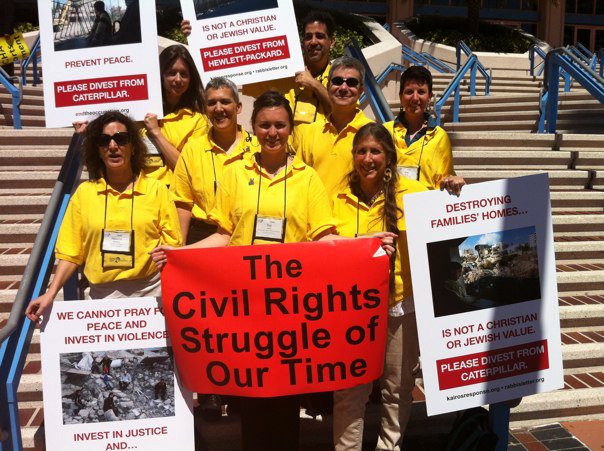
Jewish activists at the 2012 UMGC in Tampa, from left to right: Rebecca Vilkomerson (Executive Director of Jewish Voice for Peace), Anna Baltzer, (National Organizer, US Campaign to End the Israeli Occupation), Dalit Baum (Founder, “Who Profits?”), Rae Abileah (Co-director, CODEPINK Women for Peace), Sydney Levy, (Director of Advocacy, JVP), Rabbi Brant Rosen, Rabbi Lynn Gottlieb (Founder, Shomer Shalom Center for Jewish Nonviolence), Ariel Vegosen (Fair Trade and Media Social Justice Activist)

After the United Methodist divestment resolution was voted down at the UM General Conference last week, I’ve received my fair share of gloating responses from divestment opponents.  (Award for the most colorful goes to “Tzahal,” who sent in this attention-grabber: “BDS Fail, you f***ing KAPO”).

Actually, while many of us were disappointed by the final vote, I don’t view this as a fail. Not by a long shot.

First of all, as I reported from Tampa, I was deeply inspired to meet so many remarkable activists – Christians, Muslims, Palestinians, Israelis and American Jews – who constitute a new community of conscience working for justice in Israel/Palestine. This new interfaith/inter-ethnic coalition is growing rapidly and we are most certainly succeeding in raising conscience and awareness each time these kinds of resolutions are brought forth.

Beyond the final vote on this one specific resolution, we should consider it a success that these issues are increasingly being publicly discussed by our religious communities. My fellow activists and I had numerous conversations with delegates in the convention hall and we were heartened to engage so many people so honestly on this difficult issue. I was particularly gratified to speak with the numerous African delegates (who constituted 40% of the convention) who immediately understood the very real parallels to the legacy of colonialism in their own countries.

In addition, as my fellow activist Anna Baltzer recently pointed out, while the divestment resolution did not ultimately pass, the UM General Conference did adopt a resolution that among other things urged the US government to “end all military aid to the region,” called on all nations “to prohibit… any financial support by individuals or organizations for the construction and maintenance of settlements,” and “to prohibit… the import of products made by companies in Israeli settlements on Palestinian land.”

In BDS terms, this means that while the United Methodists did not affirm D (“Divestment”), they did support B and the S (“Boycott” and “Sanctions”).  No small statement, this.

I am coming away from this experience more convinced than ever that divestment is a critical tool in our quest for a just peace in I/P.  Over and over I’ve heard that divestment is an unduly harsh and polarizing tactic – and that the emphasis should be on positive engagement and investment. This, despite the fact that decades of political engagement by our government have failed miserably. This despite almost a decades worth of failed attempts by church groups to engage companies such as Caterpillar, Motorola Solutions and Hewlett/Packard – companies that literally profit from an oppressive, illegal occupation.

Add to this the testimonials of numerous Palestinian leaders who addressed “positive investment” by telling us it wasn’t charity they needed, but real, actual justice. In the words of Zahi Khouri, a prominent Palestinian Christian businessman and CEO of Coca-Cola Palestine:

It may shock you, but whenever there is a viable project identified in Palestine, we can raise the funds. We don’t need your financial help, your charity. What we need is to be able to operate freely. Divestment is the best, most immediate way that you can help us achieve that. We have been waiting for more than 40 years; we need action now.

Archbishop Desmond Tutu was so correct when he urged support of the divestment resolution by invoking MLK’s “Letter from a Birmingham Jail.” Then, as now, those who sought justice were counseled by religious leaders to “be patient” and to address the issue of oppression through engagement and non-confrontational tactics. Then, as now, there was an assumption that those who wielded corrupt power could somehow be “convinced” to give up their power voluntarily. Then, as now, this kind of patronizing counsel rings hollow and false in the ears of those who continue to suffer daily from ongoing injustice and persecution.

No, this was not a fail. There is a movement is building and this was only the beginning. Stay tuned. Similar resolutions will soon be considered in Pittsburgh at the General Assembly of the Presbyterian Church (USA) and the General Convention of the Episcopal Church in Indianapolis.

My new colleagues and I look forward to continuing this sacred work together.

United Methodist Divestment: Standing in Solidarity in Tampa

It was my honor to attend the opening of the 2012 General Conference of the United Methodist Church in Tampa, where they will be considering a resolution to divest church funds from three companies – Motorola Solutions, Hewlett-Packard and Caterpillar – that profit from Israel’s oppressive occupation.

I’ve been so inspired by the amazing people I’ve met in Tampa – Methodists from around the country, Palestinians, and many Jews – who constitute a new community of conscience on this profoundly important issue. This coming-together has been particularly important for me, because many quarters of the United Methodist Church have been unfairly demonized by the Jewish establishment over the issue of church divestment.

The resolution will be considered in committee some time over the next few days – and may possibly be voted on in plenary next week. If you, like me, stand with our Methodist brothers and sisters in our desire for justice in Israel/Palestine, please sign our Rabbi’s Letter that supports “conscientious nonviolent strategies, such as phased selective divestment, to end the occupation.”

You can read a thorough report about our efforts here on Tampa Community Radio. The clip above: my statements at a press conference yesterday which was convened by my friends at United Methodist Kairos Response – the primary sponsors of the UM divestment resolution.

What Must Be Said: We All Profit from Occupations

There’s been a great deal of analysis written about German writer Gunther Grass’ now-infamous new poem, “What Must Be Said” (in which Grass criticized Israel’s nuclear program as endangering an “already fragile world peace.”)  For me, the most astute response by far comes from Mideast historian Mark LeVine, writing in Al-Jazeera.

LeVine skillfully parses the psychology and the politics behind the uproar – but it is his identification of the larger context of the issue that resonates most powerfully for me. Here’s a long excerpt from a much longer article. The entire piece is well worth reading:

Israel has always sought to portray itself as a “normal” country, yet goes out of its way to ensure no one “names it” – to use Grass’ words – as what it is, a colonial state that every day intensifies its occupation of another people’s land. And so Grass has taken it upon himself to “say what must be said”, to name Israel as what it is, a “nuclear power” that “endangers the already fragile world peace”. It’s worth noting he doesn’t even mention the occupation, which is the far greater threat to world peace.

I have no idea if Grass really believed himself to be “bound” to Israel; if he did, we can imagine the bond is broken today, at least by Israel, now that he’s banned from returning. But Grass’ feelings are not what’s interesting or important. What’s important is the larger context, all the other “facts” which refuse to be accepted as “pronounced truths”.

These facts are that Israel, however egregious its crimes – and anyone who denies them is either completely ignorant or a moral idiot – is but one cog in a much larger global machine, one that includes too many other cases of occupation, exploitation, and wanton violence to list comprehensively here (we can name a few – Syria, China, Russia, India, Sudan, Saudi Arabia, Iran, Bahrain, Uzbekistan, Sri Lanka, the Congo, and of course, NATO and the United States – whose oppression, exploitation, and murder of their own or other peoples is a far more concrete “fact” than the potential for mass destruction caused by Israel’s nuclear programme)…

The larger fact is that the global economy is addicted to war, to militarism, oil and the rape of the planet for the minerals and resources that fuel the now globalised culture of hyperconsumption that will doom our descendants to a fate we dare not contemplate. Israel’s gluttony for Palestinian territory, and its willingness to encourage a regional nuclear arms race to keep it, is ultimately no different than the the gluttony for the 60-inch TV, the iPhone/Pad, the cavernous homes and cars, the ability to live at levels of consumption that are only sustainable if most of the world lives in poverty that increasingly defines all our cultures.

Israel has gotten Palestine on the cheap, and it costs relatively little to continue the occupation. Far less than it would cost to end it. So why bother? Especially when everyone else is doing, more or less, the same thing and, it’s clear, no one really cares anymore. Germany, whose remarkable economic stability in the recent global financial crisis is in good measure due to its central role in this global economy of hyper-consumption (think of all the energy and resources that go into making and driving all those fancy German cars), is certainly playing its role all too well.

If Grass is right that we must talk about the threat to world peace posed by Israel’s nuclear programme – and far more by its ongoing occupation – then we must also talk about the threat to global peace posed by the sick global system of which Israel is merely one of the more easily identifiable symptoms. Unlike my parents, I’m happy that Germans finally feel secure enough publicly to speak critically about Israel. But if they want their words to have a chance of bringing about a change in its behaviour, they, and everyone else, needs to broaden the discourse to include their own role in enabling and profiting from the system that Israel’s actions so benefits, and the global scope of the victims it daily produces.

Of course, this discourse would require a much longer and more complex poem, written by an even better poet than Grass. If someone manages to write it, I hope it will get the same publicity as “What Must Be Said”.

Moral Courage from the General’s Son

Please, please take 30 minutes of your time to watch this presentation by Israeli peace activist, Miko Peled, author of the recently published book, “The General’s Son.”

Among other things, Peled’s ideas and convictions carry a profound sense of moral authority because he comes with impeccable Zionist credentials. His grandfather, Avraham Katznelson, was a prominent Zionist leader and signer of the Israeli Declaration of Independence. His father Matti Peled was a major Israeli military leader who fought in the 1948 War of Independence and was an Aluf (“Major-General”) during the 1967 Six-Day War. He later became a scholar of Arabic literature, a leftist politician, and a prominent Israeli advocate of peace talks with the PLO.

Miko is following in his father’s footsteps in more ways than one. In reading his book, it is so clear to me that he is an Israeli through and through and very much a product of his family’s remarkable history. At the same time, he has carried his father’s work of moral witness firmly into the 21st century.

In the video above, he addresses what he considers the fundamental myths of Israeli society: the “Land Without a People for a People Without a Land” myth of 1948, the “War of Survival” myth of 1967, and the myth of “Israeli democracy.” He also speaks eloquently about the moral outrage of the war in Gaza and the issue of Palestinian terror.  (Tragically, Peled’s family has first-hand experience with the latter subject: his niece Smadar was killed by a Palestinian suicide bomber in Jerusalem in 1997).

Please watch the clip and send the link on. Moral heroes such as Miko Peled deserve the widest possible audience.

PS: I’m thrilled to be able to say that the publisher of “The General’s Son,” Just World Books, will be soon publishing my book – a curated anthology of “Shalom Rav” posts and comments from 2008-2010.  Much more on this soon – stay tuned!

Jewish Voices of Support for Church Divestment Resolutions!

I’m already on record as fully supporting the Presbyterian Church (USA) divestment resolution that is being brought to the PC (USA) General Assembly this summer. Now I’m thrilled to report that my colleagues on the Jewish Voice for Peace Rabbinical Council have released a letter in support of both the Presbyterian and the Methodist Church’s efforts to divest from three companies (Caterpillar, Motorola Solutions, and Hewlett-Packard) that profit from the Israeli occupation.

Here’s an excerpt of our letter:

Every day Jewish leaders are building alliances with our interfaith partners to oppose all forms of oppression and to express our outrage over the confiscation of Palestinian land, the destruction of Palestinian farms, groves and homes, and to work to end the daily harassment and violence against Palestinian people.

Several Christian denominations are making brave, constructive decisions to investigate whether their churches’ investments contribute to this violence and oppression in Israel and Palestine.

We believe that to invest your own resources in corporations which pursue your vision of a just and peaceful world, and to withdraw your resources from those which contradict this vision, is the best way to support Muslims, Christians, Jews, Israelis, Palestinians –truly all people.

We can think of no greater act of friendship than to work with us, side by side to bring justice, equality and self-determination to all people. This selective divestment process is one of the strongest tools we have.

In making this decision, we are together, Jews and Christians, living up to the biblical promise to pursue justice.

I encourage you to visit rabbisletter.org for a plethora of resources, including FAQs, additional Jewish expressions of support – and the opportunity to sign on to our letter.

You can also click here to directly support the Methodist resolution (which will be considered at the United Methodist Church General Conference in Tampa on April 24-May 4)  and here to support the Presbyterian initiative (which will brought before the PC USA General Assembly in Pittsburgh, June 30-July 7).

I Support the Presbyterian Church (USA) Divestment Resolution

As a Jew, a rabbi and a person of conscience, I am voicing my support of the divestment resolution being brought to the General Assembly of the Presbyterian Church (USA) this June.

This resolution, which has been a point of divisive contention between the PC (USA) and some American Jewish organizations for many years,  recommends that the Church divest its funds from Caterpillar, Motorola and Hewlett-Packard. It was put forth by the church’s committee on Mission Responsibility Through Investment – an appointed body that recommended church divestment of companies engaged in “non-peaceful pursuits in Israel/Palestine.”

There is a long and tumultuous history to this resolution – here’s a basic outline:

– In 1971 and 1976 the Presbyterian Church stated that it had a responsibility to ensure that its funds be invested responsibly and consistent with the church’s mission.

– In 1986, the PC (USA) formed the Committee for Mission Responsibility Through Investing (MRTI) in 1986. The MRTI Committee carried out the General Assembly’s wish to engage in shareholder activism and as a last resort, divest itself of companies which contravened the GA’s position. Divestment would follow a phased process starting with attempted dialogue and shareholder resolutions and ultimately the total sale of and future ban on the church’s holdings in a company.

– In June 2004, the PC (USA) General Assembly adopted by a vote of 431-62 a resolution that called on the MRTI Committee “to initiate a process of phased, selective divestment in multinational corporations operating in Israel.” The resolution expressed the church’s support of the Geneva Accord, said that “the occupation . . . has proven to be at the root of evil acts committed against innocent people on both sides of the conflict,” that “the security of Israel and the Israeli people is inexorably dependent on making peace with their Palestinian neighbors”, that “horrific acts of violence and deadly attacks on innocent people, whether carried out by Palestinian suicide bombers or by the Israeli military, are abhorrent and inexcusable by all measures, and are a dead-end alternative to a negotiated settlement,” and that the United States government needed to be “honest, even-handed broker for peace.”

– In 2005, MRTI Committee named five US-based companies – Caterpillar Inc., Citigroup, ITT Industries, Motorola and United Technologies – for initial focus and that it would engage in “progressive engagement” with the companies’ management.

– In 2006, following an uproar of criticism from American Jewish organizations, the PC (USA) General Assembly overwhelmingly (483-28) replaced language adopted in 2004 that focused the “phased, selective divestment” specifically on companies working in Israel.  It now called for investment in Israel, the Gaza Strip, eastern Jerusalem and the West Bank “in only peaceful pursuits.” The new resolution also required the consideration of “practical realities,” a “commitment to positive outcomes” and an awareness of the potential impact of strategies on “both the Israeli and Palestinian economies.”  The 2006 resolution also recognized Israel’s right to build a security barrier along its pre-1967 boundaries. The GA acknowledged the “hurt and misunderstanding among many members of the Jewish community and within our Presbyterian communion” that resulted from the 2004 resolution and stated that the Assembly was “grieved by the pain that this has caused, accept responsibility for the flaws in our process, and ask for a new season of mutual understanding and dialogue.”

The most recent resolution is the result of this new process and now focuses on three of the original six companies under consideration.  From the PC (USA) website:

The General Assembly Mission Council (GAMC) is recommending that the upcoming 220th General Assembly of the Presbyterian Church (USA) divest the church of its stock in three companies “until they have ceased profiting from non-peaceful activities in Israel-Palestine.”

The three companies are Caterpillar, Motorola Solutions and Hewlett-Packard.

At issue are their participation in the Israeli occupation of the West Bank, the construction of the “security barrier” between Israel and Palestinian territory, and the destruction of Palestinian homes, roads and fields to make way for the construction of Israeli settlements in the West Bank, which have been declared illegal under international law.

“We have run out of hope that these companies are willing to change their corporate practices [in Israel-Palestine],” said the Rev. Brian Ellison, a Kansas City pastor and chair of the denomination’s Mission Responsibility Through Investment Committee (MRTI). “We have made diligent effort to engage in conversation. We’d like to do more, to make progress, but substantial change does not seem possible.”

As stated above, I support this resolution without reservation and urge other Jewish leaders and community members to do so as well. I am deeply dismayed that along every step of this process, Jewish community organizations (among them, the Anti-Defamation League, the Simon Wiesenthal Center and the Jewish Council on Public Affairs) that purport to speak for the consensus of a diverse constituency have been intimidating and emotionally blackmailing the Presbyterian Church as they attempt to forge their ethical investment strategy in good faith.

It is extremely important to be clear about what is at stake here. First of all, this is not a resolution that seeks to boycott or single out Israel. Divestment does not target countries – it targets companies.  In this regard speaking, the PC (USA)’s ethical investment process seeks to divest from specific “military-related companies” it deems are engaged in “non-peaceful” pursuits.

We’d be hard-pressed indeed to make the case that the Israeli government is engaged in “non-peaceful pursuits” in the Occupied Territories and East Jerusalem.  I won’t go into detail here because I’ve been writing about this tragic issue for many years: the increasing of illegal Jewish settlements with impunity, the forced evictions and home demolitions, the uprooting of Palestinian orchards, the separation wall that chokes off Palestinians from their lands, the arbitrary administrative detentions, the brutal crushing of non-violent protest, etc, etc.

All Americans – Jews and non-Jews alike – have cause for deep moral concern over these issues.  Moreover, we have cause for dismay that own government tacitly supports these actions. At the very least, we certainly have the right to make sure that our own investments do not support companies that profit from what we believe to be immoral acts committed in furtherance of Israel’s occupation.

As the co-chair of the Jewish Voice for Peace Rabbinical Council, I am proud that JVP has initiated its own divestment campaign which targets the TIAA-CREF pension fund, urging it to divest from companies that profit from Israel’s occupation. Among these are two of the three companies currently under consideration by PC (USA): Motorola and Caterpillar.

Why the concern over these specific companies? Because they are indisputably and directing aiding and profiting the oppression of Palestinians on the ground. Caterpillar profits from the destruction of Palestinian homes and the uprooting of Palestinian orchards by supplying the armor-plated and weaponized bulldozers that are used for such demolition work.  Motorola profits from Israel’s control of the Palestinian population by providing surveillance systems around Israeli settlements, checkpoints, and military camps in the West Bank, as well as communication systems to the Israeli army and West Bank settlers.

And why is Hewlett-Packard under consideration for divestment by the PC (USA)? HP owns Electronic Data Systems, which heads a consortium providing monitoring of checkpoints, including several built inside the West Bank in violation of international law.  The Israeli Navy, which regularly attacks Gaza’s fishermen within Gaza’s own territorial waters and has often shelled civilian areas in the Gaza Strip, has chosen HP Israel to implement the outsourcing of its IT infrastructure.  In addition, Hewlett Packard subsidiary HP Invent outsources IT services to a company called Matrix, which employs settlers in the illegal settlement of Modi’in Illit to do much of its IT work at low wages.

I repeat: by seeking to divest from these companies the PC (USA) is not singling out Israel as a nation.  The Presbyterian Church has every right to – and in fact does – divest its funds from any number of companies that enable non-peaceful pursuits around the world.  In this case specifically, the PC (USA) has reasonably determined that these particular “pursuits” aid a highly militarized, brutal and oppressive occupation – and it simply does not want to be complicit in supporting companies that enable it.

I am fully aware that there are several organizations in the Jewish community that are already gearing up a full court press to intimidate the PC (USA) from passing this resolution in June.  JCPA President Rabbi Steve Gutow recently accused national Presbyterian leaders of “making the delegitimization of Israel a public witness of their church.” The Simon Wiesenthal Center has called the resolution “poisonous,” and that by considering it the PC (USA) is “showing its moral bankruptcy.”

These sorts of statements do not speak for me nor, I am sure, do they speak for the wide, diverse spectrum of opinion on the issue in the American Jewish community.  There is no place for public bullying in interfaith relations – it is, needless to say, decidedly counter to principles of honest, good faith dialogue.  To our Presbyterian friends: please know there are many Jewish leaders who stand with you as you support the cause of peace and justice in Israel/Palestine.

In a recent open letter to the PC (USA), Rabbi Margaret Holub, my colleague on the JVP Rabbinical Council expressed this sentiment eloquently with the following words:

Your Church has long been active in pursuing justice and peace by nonviolent means, including divestment, in many places around the world.  As Christians, you have your own particular stake in the land to which both our traditions have long attachments of faith and history.  We particularly acknowledge the oppression of Palestinian Christians under Israeli occupation and the justice of your efforts to relieve the oppression directed against your fellows.

To advocate for an end to an unjust policy is not anti-Semitic.  To criticize Israel is not anti-Semitic.  To invest your own resources in corporations which pursue your vision of a just and peaceful world, and to withdraw your resources from those which contradict this vision, is not anti-Semitic.  There is a terrible history of actual anti-Semitism perpetrated by Christians at different times throughout the millennia and conscientious Christians today do bear a burden of conscience on that account.  We can understand that, with your commitment to paths of peace and justice, it must be terribly painful and inhibiting to be accused of anti-Semitism.

In fact, many of us in the Jewish community recognize that the continuing occupation of Palestine itself presents a great danger to the safety of the Jewish people, not to mention oppressing our spirits and diminishing our honor in the world community.  We appreciate the solidarity of people of conscience in pursuing conscientious nonviolent strategies, such as phased selective divestment, to end the occupation.

I am proud my name is under this letter, alongside many other members of our Rabbinical Council. If you stand with us, please join us in supporting the PC (USA) divestment resolution at their GA in Pittsburgh this summer.