Category Archives: Police Violence

God is in the Resistance: Sermon for Rosh Hashanah 5786

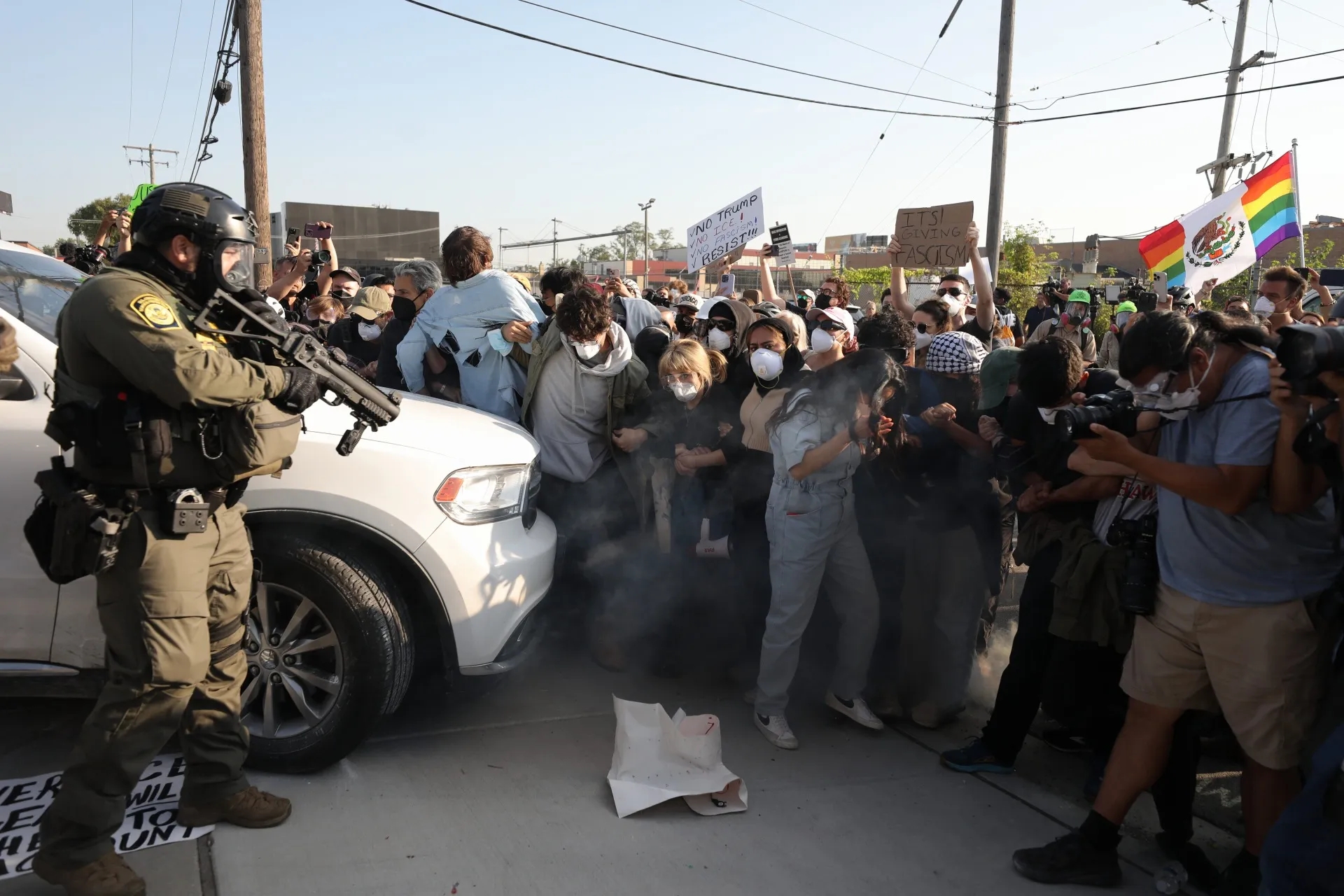
Protesters outside an ICE processing facility, Broadview Chicago. (Credit: Vincent D. Johnson/Block Club Chicago)

I’ll be honest with you: I never liked High Holiday services when I was a kid. 

There were so many things that just rubbed me the wrong way: they felt interminably long, the old school Reform choir music wasn’t my thing, and my parents would constantly shush me and my brothers when we got squirrelly (which was often). But most of all, I resented the seeming irrelevance of it all. I just couldn’t relate to the content of the services – and there was never any effort to explain why it should be relevant to me. 

On Rosh Hashanah in particular, I just couldn’t relate to the constant stream of prayers singing God’s praises, extolling God’s greatness and invoking God’s power. It all seemed designed to make us feel small and insignificant: this repeated glorification of an all-powerful God to whom we must beg and plead for another year of life. 

I realize now that I was a pretty astute kid. “Malchuyot,” which literally means “sovereignty,” is one of the central themes of Rosh Hashanah. Every new year we declare over and over that God is our supreme ruler. This theme is repeated throughout the liturgy, particularly during the Musaf service, when it is traditional to physically prostrate oneself on the floor before the divine throne during the Aleinu prayer. 

Over the years, however, as I began to attend services on my own terms rather than under duress, I came to appreciate Rosh Hashanah, yes, even the idea of Malchuyot. In fact, the older I get, the more relevant and important this concept feels to me. On a personal level, I understand to be a Malchuyot is a reminder that we often labor under illusions of our own power and control. We face these illusions head on during Rosh Hashanah when we do the work of teshuvah: the sacred process of return and repentance.

Of course, we are not all powerful. But ironically, acknowledging the limits of our power can actually be liberating. By affirming a transcendent source of power greater than our own, we can better focus and identify the things we can control in our lives. When we invoke God’s Malchuyot on Rosh Hashanah, we do so in the spirit of this liberation, to break free of our illusions of power and put ourselves on a more productive, healing path during the Days of Awe. 

Beyond the personal, I’d suggest Malchuyot has a collective and political dimension as well. It’s deeply rooted in Judaism’s central sacred narrative, the Exodus story. I actually made this very point during my very first sermon for Tzedek Chicago on Rosh Hashanah ten years ago:

At its core, I would suggest affirming Malchuyot means affirming that there is a Force Yet Greater: greater than Pharoah in Egypt, greater than the mighty Roman empire, greater than the myriad of powerful empires that have oppressed so many peoples throughout the world.

I would argue that this sacred conviction has been one of the central driving forces of Jewish tradition throughout the centuries: that it is not by might and not by power – but by God’s spirit that our world will ultimately be redeemed. I would further argue that this belief in a Power Yet Greater has sustained Jewish life in a very real way. After all, the Jewish people are still here, even after far mightier empires have come and gone. It might well be said that this allegiance to a Power Yet Greater is the force that keeps alive the hopes of all peoples who have lived with the reality of dislocation and state oppression.

I went on to suggest that through Zionism, the Jewish people have tragically betrayed this sacred Jewish narrative of liberation. When you think about it, the raison d’etre of Zionism literally is human sovereignty. It is an ideology that unabashedly deifies state power as a redemptive force in Jewish life and overturns centuries of Jewish tradition. It has subverted the sacred ideal of Malchuyot by centering and sacralizing human power above all else.

When I delivered that first Rosh Hashanah sermon, however, I never could have predicted where Zionism’s bargain with state power would lead us. In the misguided name of Jewish safety and supremacy, Israel has doubled down on its assumption of human Malchuyot to an unbearable degree. As we gather for Rosh Hashanah this year, Israel has been perpetrating an almost two-year genocide against the Palestinian people. Nearly 70,000 Palestinians have been killed, with real numbers likely to reach the hundreds of thousands. Whole families have been killed and entire bloodlines erased. Untold numbers of people have been buried under rubble, burned alive, dismembered and starved to death. At this very moment, Israel is literally bombing the entire north of Gaza off the map, trapping scores of residents who cannot leave their homes and sending scores of others to the south into active war zones.

And yet of course. Of course it has come to this. From the very beginning, the goal of establishing a Jewish-majority nation state could only be realized by dispossessing another people – what the Palestinian people refer to as the Nakba. Israel’s genocide against the Palestinians did not begin on October 7; it has been ongoing for over 70 years. There is a direct line leading from Zionism’s idolatrous attachment to Malchuyot to the crimes we are witnessing daily in Gaza.

This idolatrous attachment, of course, is not unique to Zionism. Looking back, I realize that Tzedek Chicago’s first Rosh Hashanah service took place shortly after Trump announced his first Presidential campaign. It’s also fair to say when I gave that first sermon, I never would have dreamed that just ten years later, the US would be rapidly descending into authoritarian fascist rule. That ICE would serve as our President’s secret police force, prowling the streets in plain clothes and face masks, abducting immigrants and student activists in unmarked vans. That thousands of National Guard troops would be mobilized to occupy American cities. That so many of our nation’s institutions would be defunded, plundered and centralized by unelected oligarchs. That our government would openly declare whole groups of people, including immigrants, trans people, people of color and unhoused people to be literal “enemies of the state.”

In the wake of Charlie Kirk’s murder, the incitement against these imagined enemies has reached a terrifying fever pitch. Trump and the movement he spawned are now seizing this moment to foment fury against a broad array of individuals and institutions they call the “radical left.” Trump’s aide Stephen Miller has chillingly characterized the current moment in America as a battle between “family and nature” and those who celebrate “everything that is warped, twisted and depraved.” 

Words such as these should not sound new to us; the Trump regime is using a time-honored tactic from the fascist playbook. We know that totalitarian regimes have historically consolidated their power during times of instability by fomenting a toxic “us vs. them” narrative. Hannah Arendt identified this mentality very clearly seventy-five years ago in her book The Origins of Totalitarianism: “Tribal nationalism always insists that its own people are surrounded by a ‘world of enemies’ – one against all – and that a fundamental difference exists between this people and all others.” 

Although the context of 21st century fascism is different in many ways from fascisms of the past, the fundamental building blocks of this phenomenon remain the same. In the parlance of Rosh Hashanah, the fascists of today are claiming Malchuyot – ultimate power – for themselves. And they are consolidating their power by demonizing those who do not fit into their idealized, privileged group as enemies who must be fought and eradicated at all costs. 

However, as overwhelming as the current political moment might feel, there is a textbook for resisting fascism as well. The essential rules for fighting fascism remain the same as they ever were. And the first order of business is: do not collaborate. 

This may seem obvious, but given the hard truth of the moment, I don’t think it can be repeated enough. It has been truly breathtaking to witness how quickly ostensibly independent non-governmental institutions have capitulated to Trump’s bullying and blackmail: from universities firing professors and defunding whole programs to businesses eradicating their DEI programs; from corporate media outlets becoming state mouthpieces, to law firms allocating hundreds of millions of dollars in legal services to defend the federal government. 

Has the liberal establishment been up to the challenge of this moment? Just consider its response to the murder of Charlie Kirk. Let’s be clear: Kirk was an unabashed white Christian Nationalist who incited young people on college campuses to hatred under the cynical pretense of “open dialogue.” Even so – and even as the MAGA movement is dangerously exploiting this moment – liberal leaders and institutions have been normalizing Kirk by openly praising him as a paragon of free speech and good faith debate. 

After he was killed, CA Governor Gavin Newsom eulogized Kirk by saying: “The best way to honor Charlie’s memory is to continue his work: engage with each other, across ideology, through spirited discourse. In a democracy, ideas are tested through words and good-faith debate.” Similarly, following Kirk’s murder, the Dean of Harvard College, David J. Deming publicly vowed to protect conservative students on campus, adding that Kirk’s enthusiasm for publicly debating his opponents could be a model for Harvard’s own civil discourse initiatives. And for his part, liberal New York Times columnist Ezra Klein wrote an op-ed entitled “Charlie Kirk Practiced Politics the Right Way.” 

It’s not clear if these apologists honestly believe what they are saying or if they’re just trying to avoid the government’s takedown of anyone who has anything remotely critical to say about Charlie Kirk. But in the end, it really doesn’t matter. The bottom line: liberal normalization will not appease fascists. 

To put it frankly, the government has declared war on us – and we must respond accordingly. The days of partisan cooperation and dialogue are over. The days of good faith debate and civic compromise are over. Capitulating to demagoguery and hatred will not convert the MAGA movement to the values of democracy and civil discourse. Yes, in a healthy democratic society, the concept of “collaboration” is something to be valued. But in a fascist regime, the term “collaborator” has a different meaning entirely. 

The first step in resisting collaboration is to accept that none of this is normal. We must let go of old assumptions, many of which, frankly, have led us to this moment. If we are to be totally honest, it must be said that the Democrats and the liberal establishment have been collaborating with corporate interests along with Republicans for years. As we interrogate the abnormality of this moment, we must admit that the entire system has been disenfranchising whole groups of people in this country for far too long. 

Resisting fascism also means letting go of our ultimate faith in the “rule of law.” Indeed, both the left and the right tend to fetishize the rule of law as an absolute good. And while it’s true that the law can be a tool to ensure a more just society, it can just as often be used as a blunt instrument to dismantle democracy. 

We know from history that governments routinely create laws that are inherently unjust. Slavery was legal in the US for almost 250 years. Apartheid in South Africa was legal. Apartheid continues to be legal in Palestine/Israel. In the face of such legal injustice, the obvious moral and strategic response is not to follow but to break the rule of law. As Dr. Martin Luther King famously wrote in his “Letter from a Birmingham Jail:” 

We should never forget that everything Adolf Hitler did in Germany was “legal” and everything the Hungarian freedom fighters did in Hungary was “illegal.” It was “illegal” to aid and comfort a Jew in Hitler’s Germany. Even so, I am sure that, had I lived in Germany at the time, I would have aided and comforted my Jewish brothers.

This is, in fact, the radical truth we affirm every Rosh Hashanah. When we affirm Malchuyot, we affirm that there is a moral law yet greater than any law levied by a government or regime. On this Rosh Hashanah in particular, the sound of the shofar calls on us to resist conformity; to vow to become criminals when confronted with laws that are inherently unjust. More than any Rosh Hashanah in our lifetimes, we must be ready to defy the illegitimate laws wielded by the illegitimate rulers who would govern us. 

Even if we do accept this challenge, however, the question remains: where does Malchuyot, ultimate Power, reside, if not with governments, politicians or the rule of law? Here, I’d like to quote yet another one of my heroes, the Puerto-Rican Jewish liturgist Aurora Levins Morales:

They told me we cannot wait for governments.
There are no peacekeepers boarding planes.
There are no leaders who dare to say
every life is precious, so it will have to be us.

Yes. God’s power is revealed in our readiness to show up for one another.  When we acknowledge Malchuyot on Rosh Hashanah, we affirm that the Divine Presence is manifest whenever we struggle and resist and fight for our communities, for a world where all are liberated and cherished and protected. When there are no leaders who dare to ensure that every life is precious, it will have to be us. 

Here are two concrete examples of Malchuyot in action: this last January, shortly after the inauguration, the Trump administration launched a series of raids in Chicago they called “Operation Safeguard” where, over the course of a few days, ICE, the FBI, the ATF and other federal forces coordinated massive raids in neighborhoods throughout the city and suburbs. We don’t know how many were arrested or detained, but we do know that this federal blitzkrieg was deeply frustrated by local organizing. Trump’s so-called “border czar” Tom Homan later complained that immigration organizers in Chicago were “making it very difficult” to arrest and detain people. He said, “They call it Know Your Rights. I call it how to escape from ICE.”  

Of course, even as we win these battles, this fierce war continues to escalate. ICE violence continues to rage in the neighborhoods of our cities. In Chicago, ICE has now launched another sweep, this one called “Operation Midway Blitz.” Just last Friday, at an immigrant processing center in the Broadview section of Chicago, federal agents shot tear gas, pepper spray and flash bang grenades into hundreds of demonstrators. Ten protesters were taken into custody by federal agents over the course of the day. Even amidst this escalating violence, however, local organizers here in Chicago continue to hold the line. 

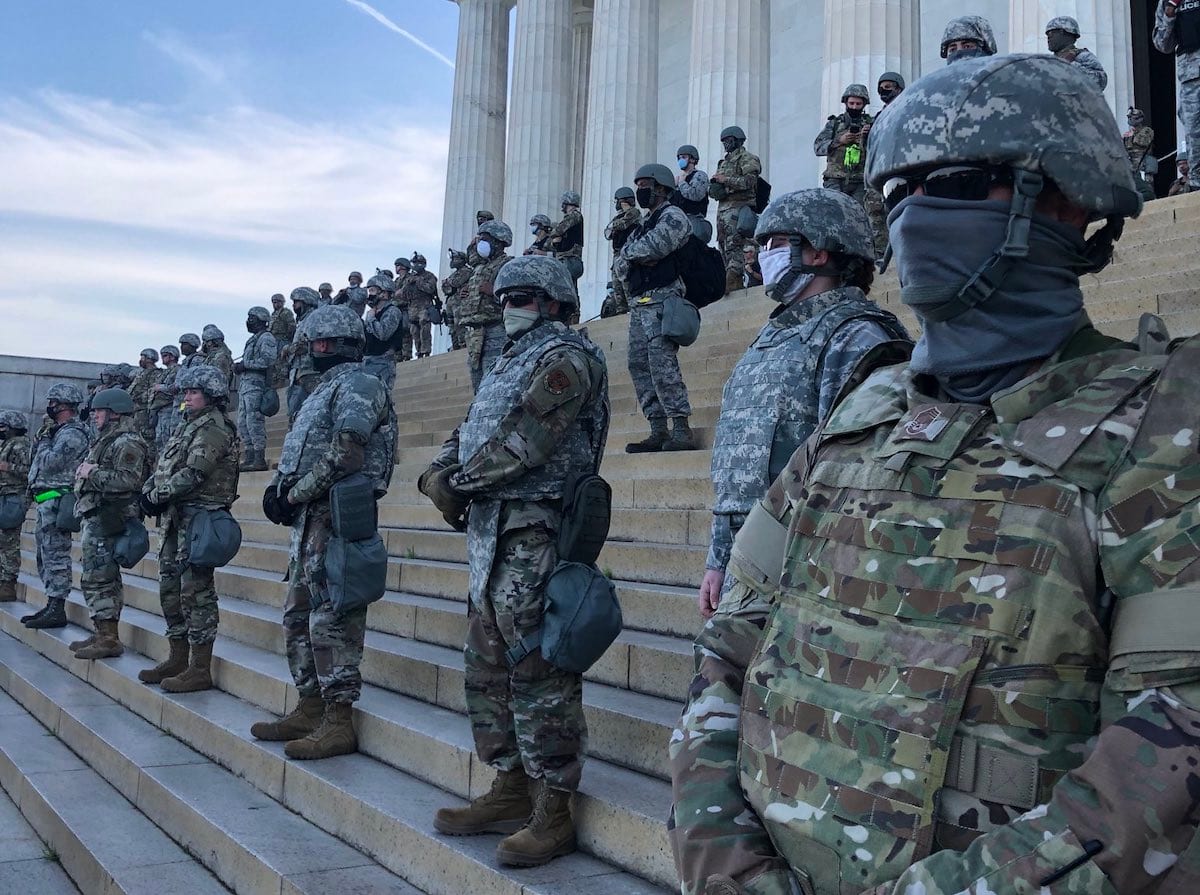
Another example: in Washington DC which is still under occupation by National Guard troops, groups of local residents called “night patrols” have been regularly patrolling the streets. According to journalist Dave Zirin, whose reports from the ground have become invaluable:

These night patrols watch over the city to ensure that people are protected from state violence, false arrest, abduction, and harassment. Failing that, their goal is to document the constitutional violations or brutality they witness, so people can see the truths about the occupation that a compliant, largely incurious media are not showing. 

Critically, these neighborhood patrols are being led and stewarded by members of impacted groups: As one night patroller put it: “a lot of young people, a lot of people of color, queer and trans folks, people who have been directly impacted by policing, and folks with street medic backgrounds. It skews toward people who already know what it’s like to be criminalized.” 

Though it isn’t being highlighted by the corporate mainstream media, this local organizing is happening in communities all over the country: in Los Angeles, where there are also still hundreds of National Guard troops, as well as New Orleans, Memphis, Baltimore and other cities that the Trump administration is directly threatening with military invasion. I know that many Tzedek Chicago members have long been active in these organizing efforts, here in Chicago, around the US and even around the world. But again, we can have no illusions over what we are up against. 

I know that the magnitude of these events often leads us to a state of overwhelm and despair. We doom-scroll through the news every day, we read about Trump’s newest executive order, the latest regressive Supreme Court ruling or some other heinous event and the ferocity of this onslaught can literally leave us breathless. This is, of course, yet another page from the authoritarian textbook: to neutralize the population through a calculated strategy of shock and awe. They want us to feel that all is lost, to give in to our despair that their power over us is all but inevitable. 

Our experience of shock and overwhelm is compounded all the more by an all-pervasive sense of grief. So much of what we have fought for has been lost. So many of the institutions we assumed would be eternally with us are being plundered and dismantled. Some of these losses may be permanent, some may not, but the harms they are causing are very, very real. 

I feel this grief myself, believe me, I do. But I also know that if we surrender to it, then their victory over us will become self-fulfilling. The way through the fear and the grief, I truly believe, is to never forget that we have power, that our words and actions matter and that nothing is ever inevitable unless we let it be so. 

Whenever we feel overwhelmed, I think the critical first step is to reclaim our equilibrium by asking ourselves, what matters most to me? What are the issues that are nearest to my heart? Most of us have the capacity to devote our time and energy to one or two causes at most. What are the most effective organizations fighting for this cause? Who are the people in my life that can connect me with the people doing this work? If I don’t have the capacity or physical ability to engage actively in these kinds of responses, what are other meaningful ways I can show up?  

Amidst all this loss, we must never forget: even if our victory is not guaranteed, there are still things in this world worth fighting for. Generations of resisters have understood this axiom well: “If I’m going to go down, I’m sure as hell going to go down swinging.” In the words of my friend and comrade, Chicago organizer Kelly Hayes, who I’ve quoted in more than one High Holiday sermon over the years:

I would prefer to win, but struggle is about much more than winning. It always has been. And there is nothing revolutionary about fatalism. I suppose the question is, are you antifascist? Are you a revolutionary? Are you a defender of decency and life on Earth? Because no one who is any of those things has ever had the odds on their side. But you know what we do have? A meaningful existence on the edge of oblivion. And if the end really is only a few decades away, and no human intervention can stop it, then who do you want to be at the end of the world? And what will you say to the people you love, when time runs out? If it comes to that, I plan on being able to tell them I did everything I could, but I’m not resigning myself to anything and neither should you. Adapt, prepare, and take the damage done seriously, but never stop fighting. Václav Havel once said that “Hope is not the conviction that something will turn out well, but the certainty that something is worth doing no matter how it turns out.” I live in that certainty every day. Because while these death-making systems exist both outside and inside of us, so do our dreams, so long as we are fighting for them. And my dreams are worth fighting for. I bet yours are too.

This New Year, I realize I’ve come a long way from that beleaguered kid who felt disempowered on the High Holidays to a rabbi telling you Rosh Hashanah is our clarion call to fight facism. But here I am. And here we are. May this new year inspire us all with the knowledge that true sovereignty, true Malchuyot, lives at the heart of the struggle. 

On this, my final Rosh Hashanah with this amazing community, this is what I am feeling to my very bones at this moment: that while Pharaohs may rise, they will inevitably fall, that beyond the horizon of Olam Hazeh, this terribly broken world, there lies Olam Haba: the world we know is possible. And no matter what may happen this new year – and every new year to come – that world is always worth fighting for.

Shanah Tovah.
Murder in DC: Toward a World Where All Lives are Grievable

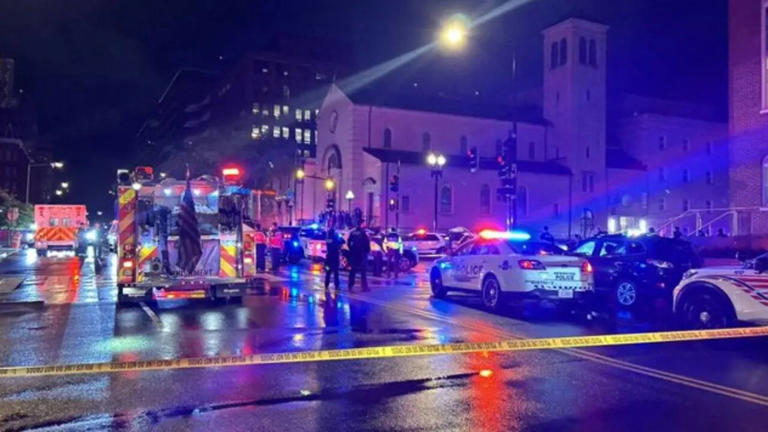
The shooting death of the two Israeli embassy workers in Washington DC this past Wednesday evening was tragic and horrific. All human life is precious – there can be no conceivable justification for this immoral act. Moreover, the man who perpetrated these murders is no hero; in addition to the lives he took and the grief he caused their families, his action has only served to harm – not help the Palestinian people. This is not what solidarity looks like.

As of this writing, there is much we don’t know about the shooting – and it would be irresponsible of me to speculate on whether the shooter was motivated by antisemitism. We do know that it was an act of political violence – and that the victims were embassy representatives of a nation that itself is engaged in an act of political violence that has killed tens of thousands of Palestinians – and is currently taking the lives of hundreds of people in Gaza every day.

Of course, there is no shortage of disingenuous politicians and media figures who are all too eager to use this act of violence for their own political advantage. But we cannot and should not equate the actions of one isolated incident with the entire movement for Palestinian liberation. Indeed, over the past nineteen months, millions of people across the US and around the world have protested peacefully for a ceasefire and an end to Israel’s genocide in Gaza. It is inaccurate – and in fact racist – to use this tragic event to make assumptions about Palestinians or collectively punish people of conscience who have been advocating for Palestinian safety and freedom. Our movement has always been about freedom, dignity and safety for all. The murderous action of one vigilante does not define us – nor should it lessen our resolve to continue advocating for an end to Israel’s genocide in Gaza.

According to one of the most sacrosanct teachings in Jewish tradition, all human beings are created in the divine image – and that all lives are equally, infinitely precious. I can’t help but think of this sacred value as I read the many poignant news stories about the young embassy workers Yaron Lischinsky and Sarah Milgrim: stories that honor the people they were as well as their hopes and dreams for the future.

At the same time, I couldn’t help but think: where are these stories in the mainstream media about the tens of thousands of Palestinians killed through political violence in Gaza over the past nineteen months? Where are the tributes to their lives, their hopes, their dreams? If they were afforded the same kinds of tributes, the media would be overwhelmed an endless cascade of stories about precious lives lost forever.

In her book, “Frames of War,” the scholar Judith Butler examines why some lives are “grievable” while others are not. Butler suggests that this selective mourning is due to a process of dehumanization, in which state powers determine which lives have the status of personhood – and thus more worthy of our grief. In short, if a person is deemed less human, they become less grievable.

When we engage in this kind of selective mourning, we become complicit in this process of anti-Palestinian dehumanization and racism. Here in the US, of course, people of color are all too familiar with this process. As Bernice Johnson Reagon powerfully wrote in her classic, “Ella’s Song:” Until the killing of black men, black mothers’ sons/Is as important as the killing of white men, white mothers’ sons/…We who believe in freedom will not rest.

How do we respond to the killings of Yaron Lischinsky and Sarah Milgrim? The same way we must respond to the tens of thousands of Palestinians who have been killed – and continue to be killed – by the Israeli military in Gaza: by continuing to protest openly and as openly as possible for an end to Israel’s genocide against the Palestinian people. By advocating for a free Palestine for all who live between the river and the sea.

And further: to insist on a world in which all may live in safety and dignity – and all people are mourned equally when they die.

Learning How to Breathe in the Era of Trump

(photo: Carl Juste/AP)

In this week’s Torah portion, Parashat Va’era, God’s tells Moses to return to Mitzrayim and say to the Israelites:

“I am יהוה. I will free you from the labors of the Egyptians and deliver you from their bondage. I will redeem you with an outstretched arm and through extraordinary chastisements.” (Exodus 6:6)

But when Moses attempts to impart this message of liberation to the people, they weren’t able to hear it as “their spirits were crushed (kotzer ruach) by cruel bondage.” (6:9)

This one verse says so much about the trauma of personal and systemic abuse. The Hebrew word ruach means both “spirit” and “breath/wind.” On one level this could mean that their oppression was so severe that individual Israelites could barely breathe. On a deeper level, it might indicate that their collective spirit was so damaged they couldn’t even begin to comprehend the possibility of liberation.  

The dual meaning of the word ruach in Jewish tradition suggests that the divine spirit is embodied by our very breath: the life force that we share with God and all that lives. In the first chapter of Genesis, we read that the process of creation began when the ruach elohim (“God’s breath”) rippled across the primordial waters. Humanity itself came to life when God breathed into the first human. In Jewish liturgy, we awaken every morning expressing gratitude for “the breath of every living thing and the spirit of all flesh.”

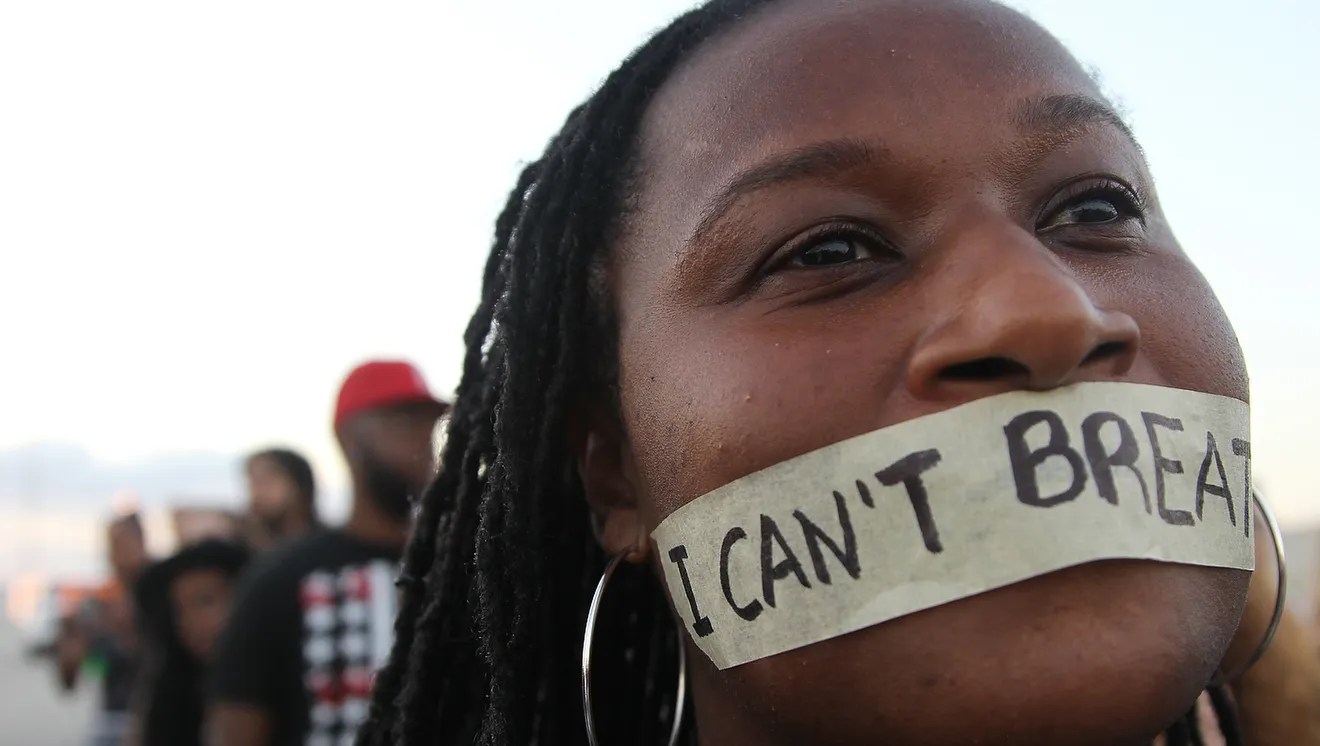
I believe there are powerful spiritual/political implications embedded in this theological concept. It suggests that when human beings – or humanly-created systems of oppression – deprive people of their ability to breathe freely, the flow of divine life force in the world is disrupted. Moreover, the demand to be able to breathe is itself a clarion call to action. We need look no farther than the phrase “I can’t breathe,” the final words of George Floyd and Eric Garner, whose deaths at the hands of systemic racism provided a powerful spark for the Black Lives Matter movement. Nigerian writer/poet Ben Okri has suggested that these three words “should become the mantra of oppression,” from the racist systems in our communities to the life-choking forces of global climate change.

In this regard, we might view the Jewish practice of giving thanks for our breath every morning as much more than a simple prayer discipline: it is nothing less than a statement of connection and solidarity with all that lives. Those who can breathe easily tend to regard the act of breathing as a natural, involuntary reflex. But as those with chronic respiratory illnesses will surely attest, it is no small thing to be able to take a breath. And in the age of COVID and climate change, millions throughout the world are increasingly becoming chronically kotzer ruach as a result of systemic oppression and corporate profit.

In other words, a commitment to a world in which everyone can breathe freely is a spiritual/political act of resistance. As disability justice activist Rabbi Julia Watts Belser has written:

Let’s learn to work more slowly, move more deliberately. Let’s learn to listen, when our bones say no. Let’s mandate breaks for anyone who works outside. Let’s require air purifiers, ventilation systems and safe work environments. Let’s make sure that all of us can breathe.

It is not too hyperbolic to suggest that the current political moment has left many of us breathless. As we death-scroll through the news of Trump’s executive orders and authoritarian policies, the ferocity of this onslaught can leave us literally or figuratively gasping for air. But this is, of course, just what Trump and his movement wants: to leave us reeling through a calculated strategy of shock and awe. They want us to feel breathless, paralyzed, despairing. We must not succumb. We must not accept that breathlessness is the new existential normal of our political age. We cannot become, like the Israelites of our Torah portion, so kotzer ruach that we cannot even imagine the possibility of something better beyond this authoritarian tyranny.

In the work of resistance, the first order of business is, quite simply, remembering to take a breath. Because in the end, if we are paralyzed with breathlessness for the next four years, we will be of no use to ourselves or anyone else. Moreover, once we regain our breath and our equilibrium, we will be in a better place to discern what we can do to meet this moment. In the wise words of Chicago organizer Kelly Hayes:

When your enemy wants you disoriented, your ability to focus is an important means of self-defense. What matters to you in this moment? Most of us can meaningfully dedicate ourselves to one or two causes, at the most. What can you commit to doing something about? Where do you get trustworthy information about those subjects? Who do you connect with when deciding what to do about what you’ve learned? Is there an organization whose resources you will employ or whose calls to action you will answer? Do you have a friend group or solidarity network that will formulate a response together? Answering these questions is key to steadying yourself in these times. Remember: Vulnerable people don’t need a sea of reactivity right now. They need caring groups of people who are working together to create as much safety as they can. We need to create a rebellious culture of care. That will take focus and intention. It will take relationships and a whole lot of energy. 

This Shabbat, let’s all commit to breathing more freely. Then let’s fight for a world in which that freedom is extended to all.

The World as it Should Be: Reflections on the DePaul Student Encampment

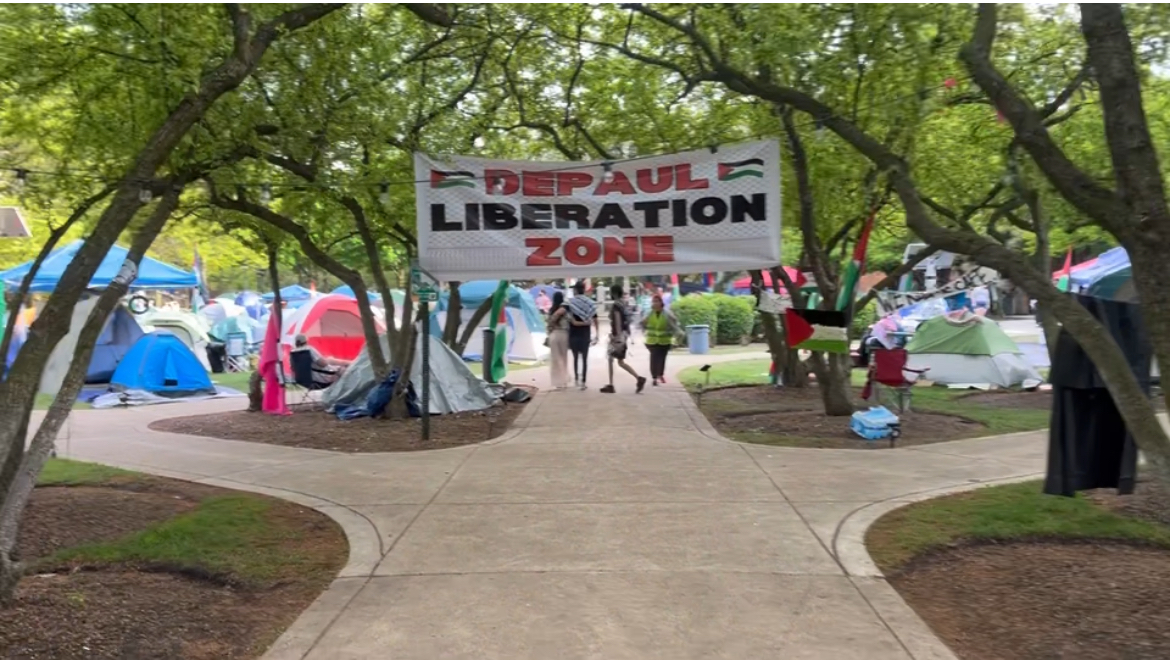
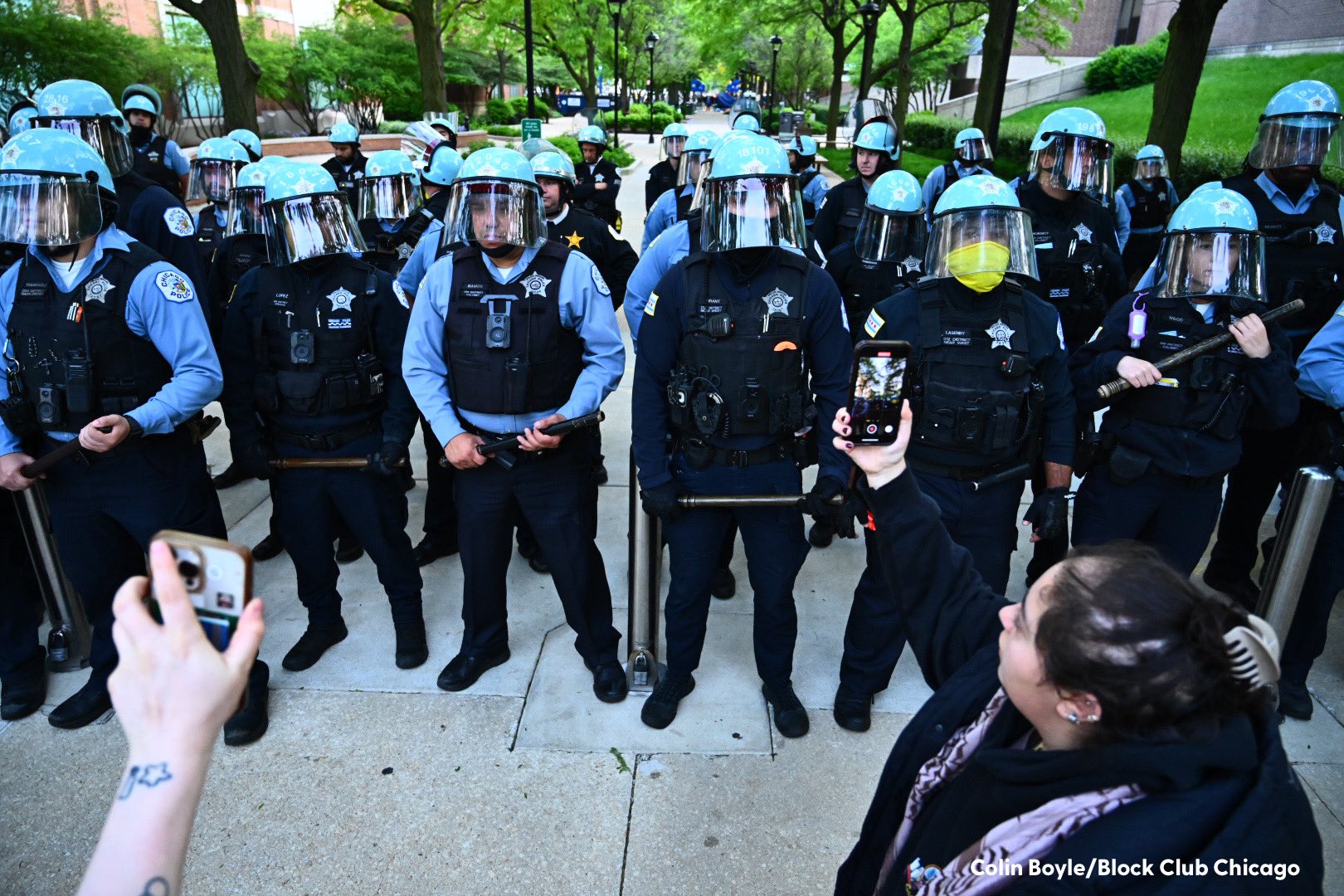
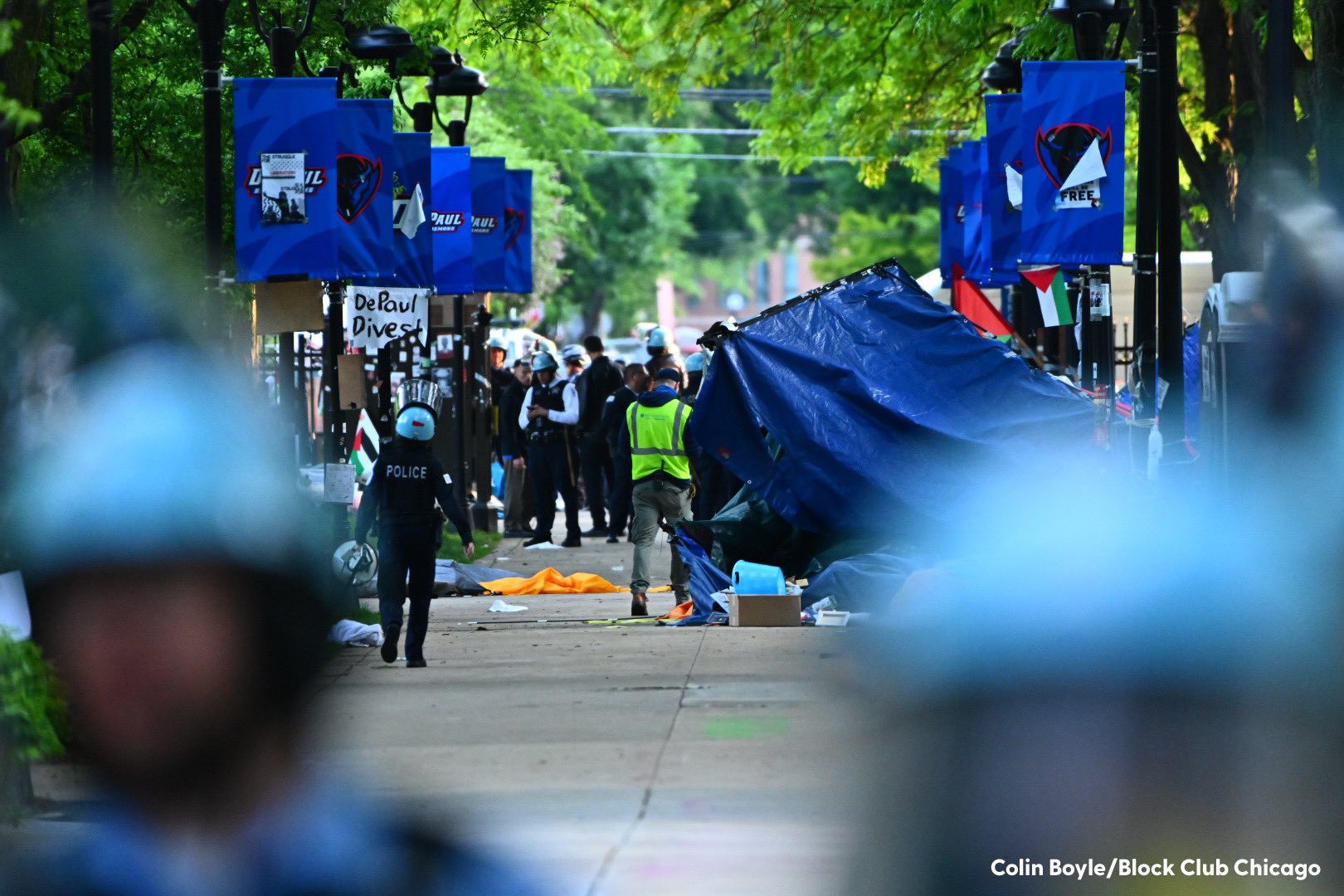
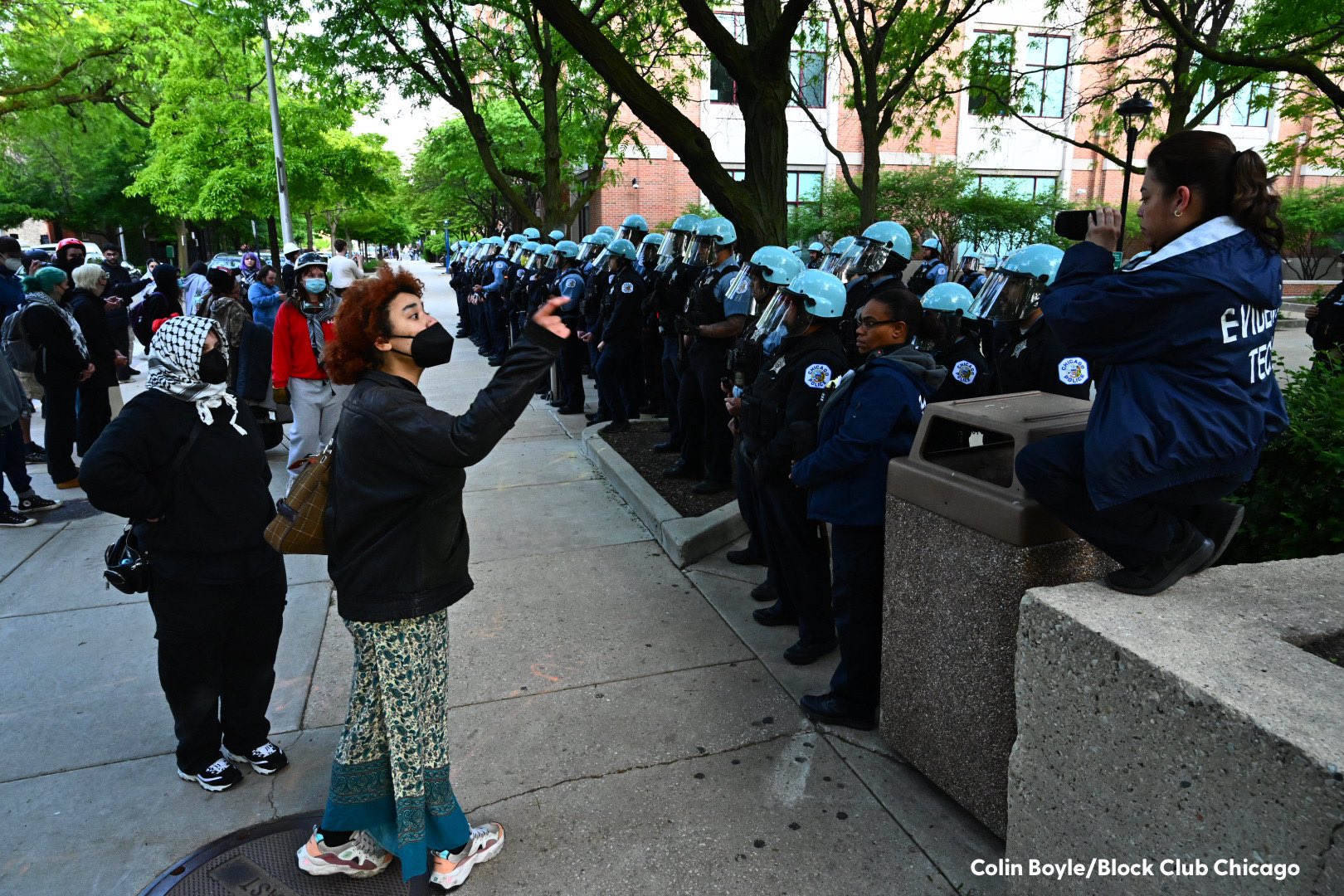
Early yesterday morning, the Chicago Police Department raided and destroyed the student encampment at DePaul University. The DePaul Liberation Zone was the last remaining student encampment in the Chicago area and had been ongoing for seventeen days. Here are my remarks from the student-called press conference at the DePaul student center that took place last night:

My name is Brant Rosen – I’m the rabbi of the congregation Tzedek Chicago and the co-founder of the Jewish Voice for Peace Rabbinical Council, and I’m here today representing the rapidly growing section of the Jewish community that is actively protesting Israel’s genocidal violence against the Palestinian people. As part of this protest, we stand with the student movement across the country – and around the world – that demand their schools divest from Israel’s war crimes in Gaza and throughout Palestine.

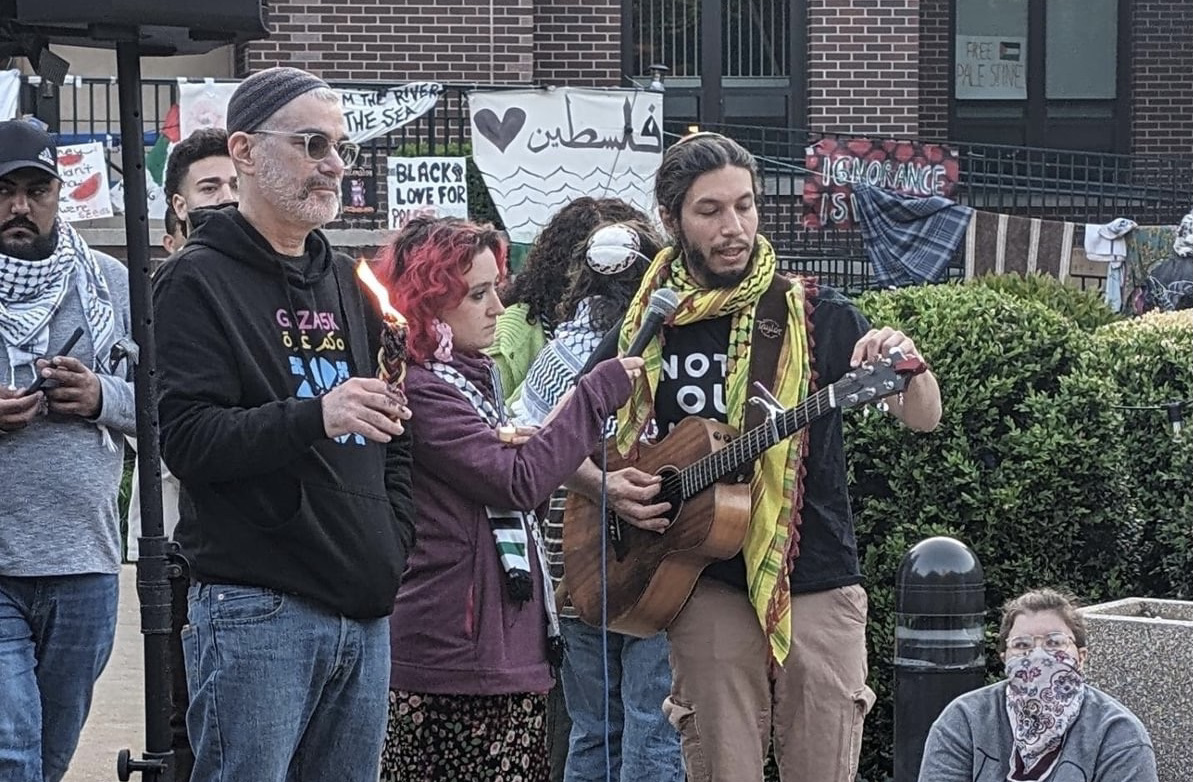
It has been my personal honor to visit the DePaul Liberation Zone numerous times over the past two weeks. Together with members of my congregation, we led two Havdalah services – the ceremonies that mark the end of the Jewish Sabbath. We were invited and scheduled to lead Shabbat services at the student encampment tomorrow evening – and are deeply saddened that this will now not be possible.

When I led Havdalah, I made the observation that Jewish tradition views Shabbat as a foretaste of Olam Haba – the World to Come. I added that this is exactly what the students were creating in their encampment. The students of DePaul created for themselves the World-As-It-Should-Be in real time. 

In truth, it was less a political protest encampment than a mindfully organized, genuine grassroots community. There was a planning committee to schedule ongoing events. There was a food tent and a first aid center. There were tutoring sites. There was training in nonviolent resistance and de-escalation. The students supported one another. They took care of one another. And they celebrated together as a truly multi-faith, multi-ethnic community. Last Saturday, our Jewish service was preceded by a Muslim call to prayer. Afterwards, a dance and music ceremony was performed by a local Aztec indigenous troupe.

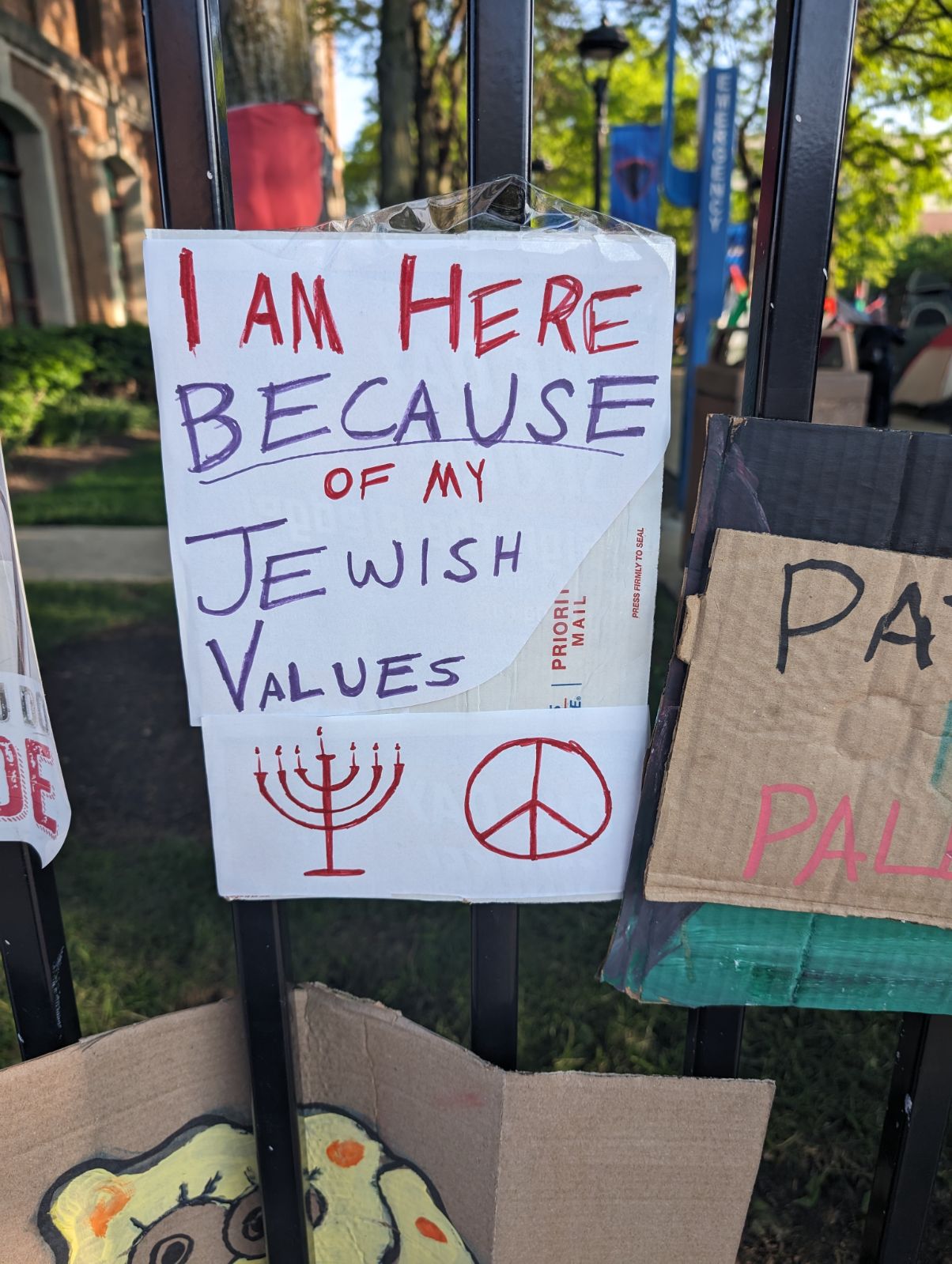
I want it to be known, for the record, that Jewish students – many of them members of Jews 4 Justice at DePaul, were an integral part of the DePaul Liberation Zone community. And I want to say as clear as I possibly can that the cynical characterization of this encampment – and others like it across the country – as bastions of Jew hatred could not be farther from the truth. As a Jewish person, I was welcomed into this community as an honored guest.

Last week, after leading Havdalah, I was approached by scores of students – many of them Palestinian – who expressed their appreciation for our presence there. There were also many Jewish students who thanked us for giving them a spiritual Jewish context for their solidarity. To my mind, this was the safest possible place I could be as a Jew: at a place where security was a shared and mutual concern. If there was any threat to safety, it came from the state violence that was unleashed on this community by DePaul and the Chicago Police Department.

As a faith-based university, DePaul should have respected the deep moral conviction at the heart of the student community. They could have followed the example of Rev. Serene Jones, the President of Union Theological Seminary, who had this to say about the students at the Columbia University encampment:

I’ve had the chance to see the protests up close, where the simple message of the demonstrators can still be heard: Stop the war, now. And I’ve learned a lot about who these protesters really are…

First and foremost, these encampments are filled with students from different religious traditions — Jews, Muslims, Christians, Buddhists, unaffiliated as well as spiritual but not religious students. They are finding solace and courage among themselves.

These spontaneous, interreligious communities happened organically, with the strikingly easy flow of connection different from self-consciously manufactured “interfaith moments.” It is simply who these protesters are: a community bound by a greater common cause to stop the mass killing of besieged Palestinians.”

But shamefully, tragically, the DePaul administration chose a different course. It chose to negotiate in bad faith. They never seriously engaged with students’ deeply held, conscience-based convictions. They egregiously demanded that student leaders attend meetings during the Muslim and Jewish Sabbaths. Rather than responding honestly to the students’ counter proposals, they abruptly declared that the negotiations were at a stalemate, unlilaterally bringing the process to a halt. And then, early this morning, they brought in the CPD, clad in full riot gear, to violently overturn and destroy a peaceful student community.

Let me be clear – what DePaul did to its students this morning was a shandeh: for shame. It represents a moral stain on a university that purports to uphold Vincentian religious values of peace and justice. It represents a failure of leadership and imagination by responding violently to a good faith, conscience-driven action of students who were challenging their school to behave morally and to divest from genocidal violence. 

That their demand has occasioned such vicious state violence clearly demonstrates the truth of the students’ essential point for all the world to see. Their acts of solidarity and mutual support are a clear and direct threat to state power. There can be no better example of this truth than the travesty we witnessed at DePaul this morning.

But make no mistake, this violence will not break the will of these students, nor will it slow the progress of a solidarity movement that is breaking wide open across the country and around the world. We are all – as I speak to you now – living in a very real moment of truth. We are all being challenged to answer the question: where do I stand? Will I remain silent or will I speak out? Will I be complicit, or will I demand accountability? Will I enable the oppressive status quo, or will I call I find the courage to say out loud, “From the river to the sea, Palestine will be free!”

These students know the answers to these questions. We would do well to listen and learn from them. We would do well to follow their example. No matter how cynically they are characterized, no matter how violent the response to their moral challenge, they will not be deterred until liberation. And until that moment comes, it will be my honor – and the honor of so many others – to stand right alongside them.

#DayofHate: How Should we Respond?

Photo by Jeenah Moon/Getty Images

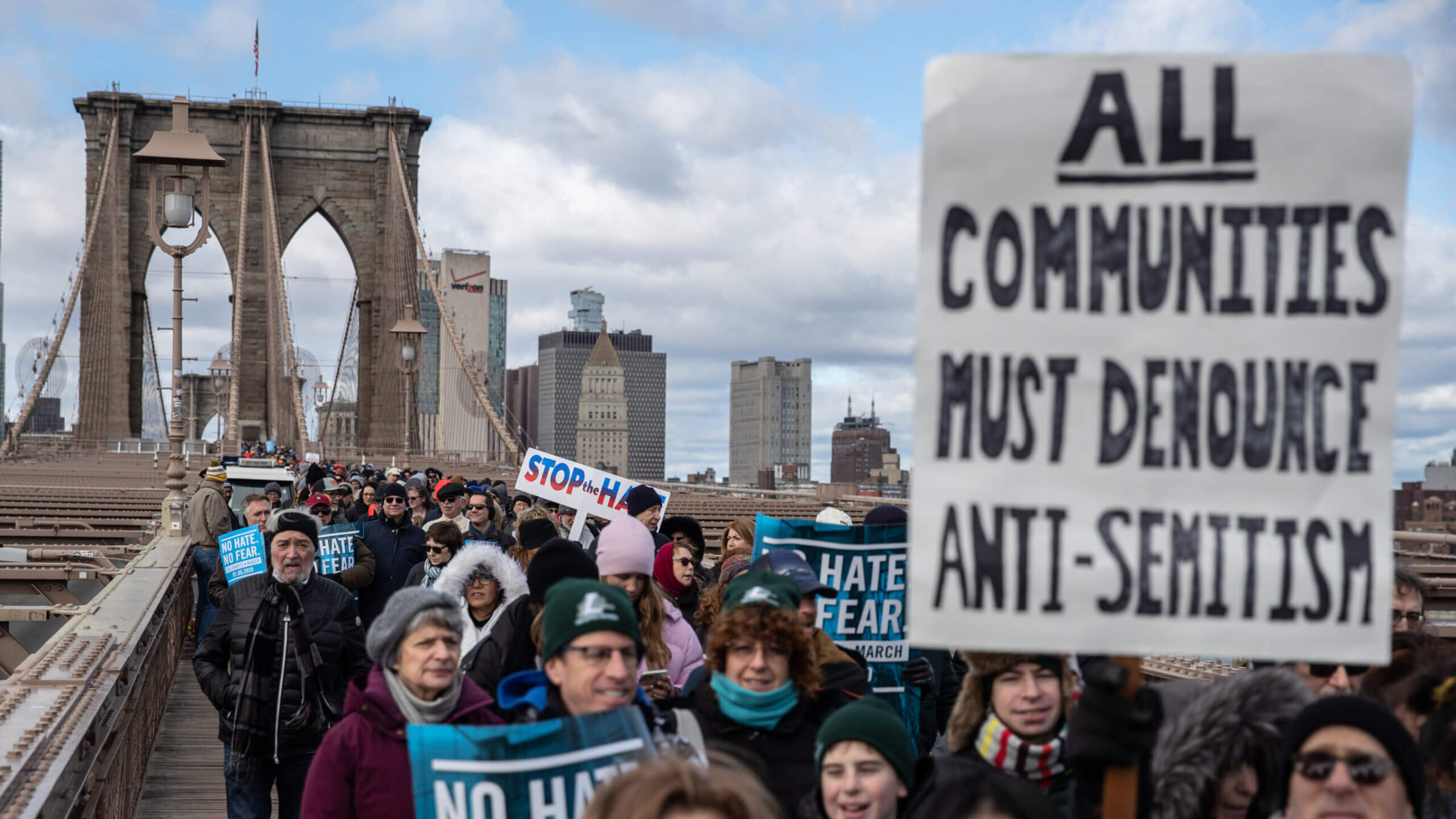
Over the past week or so, there was rising alarm over reports that some neo-Nazi groups had called for a “Day of Hate” against the American Jewish community. While the day thankfully came and went with no reports of any incidents, it seems to me that there are several important takeaways from this frightening “non-event.”

The first, of course, is that we should never take the threat of anti-Jewish violence for granted. In the wake of the “Day of Hate” warning, there was increased security at synagogues and Jewish institutions in major cities throughout the US. This response was certainly understandable, particularly following the news of a recent shooting of two Jewish worshippers outside an LA synagogue.

At the same time, as I wrote last Friday to my congregation, I was particularly heartbroken to know that extra police presence at synagogues would surely cause many in our community – particularly Jews of color – to feel less safe in their own houses of worship. As Erika Gatson, a black-Jewish activist and writer recently wrote:

I very deeply understand the need for some sort of security at synagogue, but it does not make for a comforting expereince. As a Black Jew, if feels like I have to continue to worry about not being protected by those brought in to protect the community.

It should also be noted that authorities made a point of saying there was no evidence of any imminent threat to the Jewish community. The initial report of the threat came from a leaked internal memo by the New York Police Department’s Intelligence and Counterterrorism Bureau, originally stemming from a January 4 message left on the encrypted messaging app Telegram, by members of Crew 319, an Iowa-based white supremacist group whose most visible action to date had been a relatively minor flier campaign. Indeed, one ADL leader noted that “the activism of the day will most likely be limited to small demonstrations with banner drops or graffiti, rather than violent acts.”

It might well be said that under the circumstances, the strong Jewish community response was justified, However it can also be argued that it was overblown – that in the end, the attention given to this news was disproportionate to that threat and ultimately counterproductive. A report released yesterday by the Network Contagion Research Institute, in fact, came to this very conclusion:

The recent “National Day of Hate” event planned by an obscure Iowa-based white
nationalist group received little attention (roughly 20 likes) within its own subcultural
ecosystem on Telegram, yet received widespread amplification from mainstream media and organizations such as the ADL. There is little publicly available evidence to suggest larger white nationalist groups engaged with posts associated with the planned event or were planning to participate…

Sounding an undue alarm about low-signal extremist content can potentially elevate
security risks and embolden bad actors, as they see the attention generated by their
actions as a sign of success and validation, and may be motivated to carry out further
extremist activities.

It is sobering to consider that the ADL and other similar organizations helped to drive up #DayofHate to over 100,000 tweets while a post on an underground site from a small and little-known hate group received 20 likes. It’s worth asking whether this kind of “undue alarm” may have boosted the profile of Crew 319 while simultaneously emboldening their followers. As Ben Lorber, an analyst at Public Research Associates tweeted in response, “Is this what keeping Jews safe looks like?”

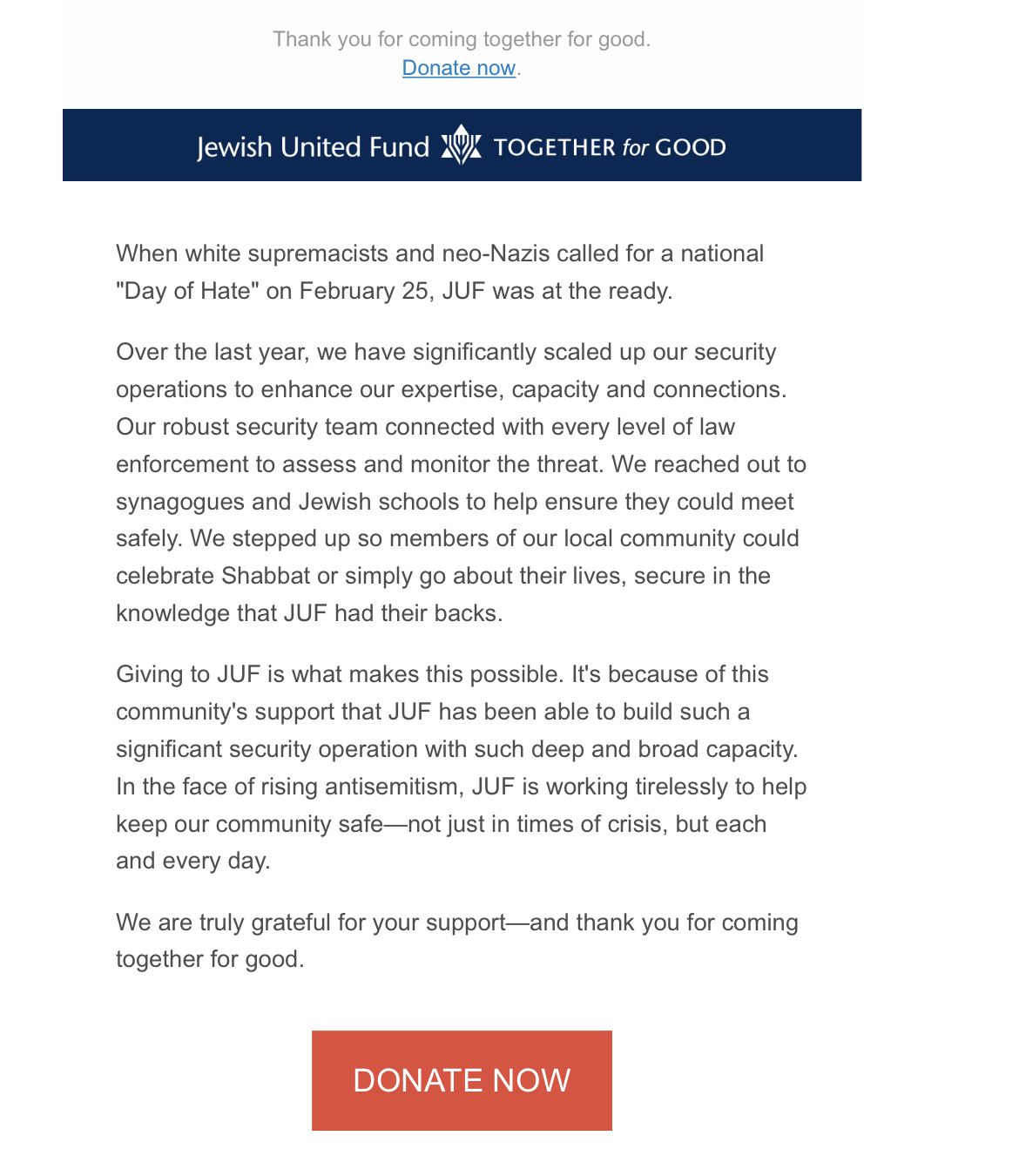
And while we’re on the subject of Jewish communal response to the threat of antisemitism, this disconcerting mass email from the Jewish United Fund of Greater Chicago landed in my inbox just this morning:

Whatever we might think about the wisdom and effectiveness of the Jewish communal reaction to the “Day of Hate,” I would say it’s generally a good rule of thumb to avoid cynically capitalizing on a non-existent antisemitic event in order to raise money for your organization.

In the end, if there were any positive takeaways from this horrid affair at all, I found it in the numerous messages of heartening solidarity from our friends and allies in the greater community, including several that I received personally. I was particularly heartened by a message to my congregation from my friend and colleague Rev. Tom Gaulke of Gethsemane Lutheran Church in Cicero, Illinois, who ended his remarks with these beautiful words: “As your family, we’ve got your back, come what may. Together, we’ve got a love that will conquer hate and a love that can only overcome.”

What else can I say to that but Amen?

Which Side are You On? A Moment of Reckoning for American Jews

ezi-jxxwoaelrn--1

photo: Martha Raddatz

Cross-posted with Jewish Voice for Peace

As is the case for many I’m sure, the refrain, “which side are you on?” has been echoing through my heart and soul this past week as the American legacy of structural racism and state violence has been so brutally laid bare in our country. In fact, I can’t recall a time in my own lifetime in which this question has ever been more critically relevant. 

As I write these words, hundreds of cities around the US are being rocked by street protests in response to the murder of George Floyd by the Minneapolis police. Police departments are responding to protesters in turn by deploying tear gas and rubber bullets. In Louisville, police shot live ammunition into a crowd and killed a local businessman. In New York, a police van was driven straight into a crowd of protesters. Philadelphia police fired tear gas directly into a crowd of protesters trapped with nowhere to run. And on Monday, after Trump vowed to deploy “thousands and thousands of heavily armed soldiers, military personnel, and law enforcement officers,” federal police were directed to use tear gas and flash grenades to disperse peaceful protesters so that he could visit a nearby church for a photo op.

Yes, if ever there was a “which side are you on?” moment, this is it. Thus, when I saw a recent article in the Jewish Forward written by three liberal Jewish leaders bearing the headline, “Every Jew must decide which side they’re on,” I read it with great interest. In the end, however, I was profoundly let down by their message, which I found to be disappointingly equivocal – and at times even harmful. 

Authors Rabbi Sharon Kleinbaum, Matt Nosanchuk, and Rabbi Rachel Timoner begin their article on a promising note, noting that “the promise of ‘equal justice under the law’ remains out of reach in a system infected with structural racism.” They go on to say that this work “begins at home,” adding that for the Jewish community, this work “has only just begun.” 

Sadly, however, they betray their own internal call to action with their statement, “we must show our black and brown siblings that we see the racism coursing through our society,” a statement grounded in the assumption that white = Jewish, summarily ignoring the significant percentage of Jews of color in the American Jewish community. 

The authors’ error is particularly egregious as it comes in the wake of an infamous article recently published by the two editors of the American Jewish Yearbook that made deeply problematic claims about the number of Jews of color in the US. With their painfully ill-considered comment, Kleinbaum, Nosanchuk and Timoner reinforce long-held assumptions of whiteness in regard to the American Jewish community. They do indeed prove their point that “our work has only begun” when it comes to anti-racist work in the Jewish community – though clearly not in the way they originally intended. 

Later in their article, the authors further betray their own call with this statement:

If we want to stand on the side of civil rights, we must respond to attacks on people of color as we would a white student facing anti-semitism on campus, or a Hasidic man beaten on the streets of Brooklyn: We must see their pain and commit to disrupting the forces that cause it.

Though it’s not completely clear, I can only surmise they are referring here to the Boycott, Divestment and Sanctions (BDS) campaigns led by Palestine solidarity activists on college campuses. If this is indeed the case, their casual conflation of racist state violence with tensions over campus activism is a muddled and harmful equation. 

The canard of antisemitism has long been cynically wielded toward pro-Palestinian student activism by Israel advocacy organizations. To assert that BDS is inherently antisemitic is problematic for a host of reasons – but it is perhaps even more harmful to casually conflate so-called “campus antisemitism” with the structural racism faced by people of color in the US. Such a claim ignores the legacy of white supremacy that has long been woven into the very fabric of our country. And if there is anything we’ve learned from the current political moment, it is that we ignore the dangers of white supremacy at our peril. 

The authors also engage in false equivalence when they invoke the recent violence against Hasidic Jews in New York. While these attacks, perpetrated largely by African Americans most certainly deserve our condemnation, it is not at all helpful to compare them to the racist violence perpetrated against people of color by state institutions. While insidious, this violence perpetrated against Jews is not part of an organized ideology or single movement. And, unlike structural racism against people of color,  it certainly does not have the power of state institutions behind it. 

Moreover, as in the case of the backlash to BDS, these events are being politically weaponized by many in the Jewish community as an example of “antisemitism on the left.” This is, to be sure, a fraught and dangerous claim. As journalist Rebecca Pierce has observed, “(using) Black antisemitism as a cudgel against the left further divides the Jewish and Black communities at the expense of actually understanding and fighting antisemitism.” We must remember that the anti-Jewish conspiracy theories embraced by some African Americans are ultimately part of the same white supremacist power structure that has long oppressed their communities. In the face of this common enemy, we would do well to cultivate solidarity rather than sow further division with facile comparisons such as these.

Finally, Kleinbaum, Nosanchuk and Timoner state, “we must be prepared to take responsibility not only for our transgressions, but also for our silence.” This is an interesting choice of words, considering that they remain completely silent on the issue of Israel’s racist state violence against the Palestinian people. Since the authors frame their call to action in terms of Jewish collective responsibility, it is remarkable that they have absolutely nothing to say about Israel’s violations of Palestinian rights, inarguably the most important moral challenge facing the contemporary Jewish community today.

No doubt there are many in the Jewish community who will reject such a comparison, claiming that one has nothing to do with the other. But in fact, they have everything to do with each other. We simply cannot call out structural violence against communities of color in the US while failing to note its intrinsic relationship to structural violence against Palestinians in Israel. 

It’s been fascinating to witness so many Jewish communal institutions – who routinely defend or rationalize away Israel’s human rights abuses of Palestinians – now passionately taking a stand against systemic racism. But in truth, it is not a tremendously heavy lift for a Jewish institution to condemn the sickening events of the past few days. Even the Anti-Defamation League – the epitome of a Jewish establishment organization – took it upon itself to issue a statement in “solidarity” with the Black community.

But of course, this is the same ADL that coordinates exchange programs that bring police departments from around the US to Israel to coordinate with the Israeli military the very tactics they use to oppress communities of color – and currently, against unarmed protestors across this country. If the ADL was truly serious about systemic change of a racist and unjust system, it certainly wouldn’t actively empower the militarization of police, harming the community with whom it hypocritically purports to stand in solidarity. 

In the end, if  “every Jew needs to decide which side we are on,” then we cannot simply issue no-brainer statements that condemn the most open and obvious examples of state violence in our midst. Kleinbaum, Nosanchuk and Timoner are absolutely right: “it starts at home.” But the white Jewish community cannot claim to take a stand against racist structural violence at home while remaining silent on Israel’s racist structural violence against Palestinians. As long as support for the Jewish state remains at the core of the official Jewish communal agenda, we must see fit to name this connection at every turn. 

As the authors themselves so eloquently put it, “we must be prepared to take responsibility not only for our transgressions, but also for our silence.”

Root Causes of Forced Migration from Honduras: Some Background

0275124-honduras-120917

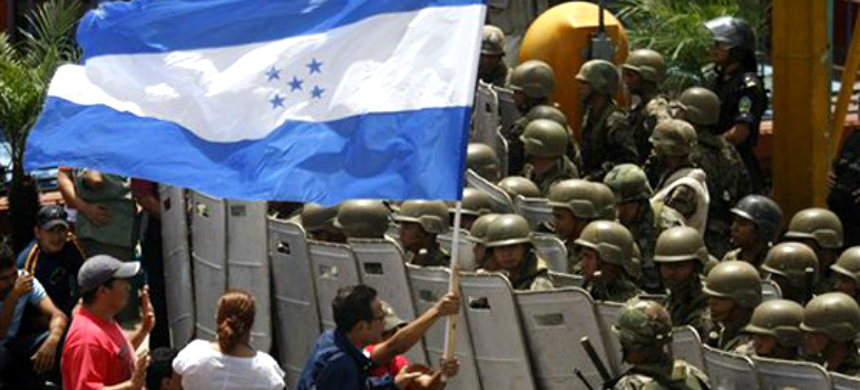
Honduran street protest against 2009 coup  (photo: DH Noticias)

It was my honor last week to travel with 75 delegates representing diverse religious traditions and advocacy organizations on a “Root Causes Pilgrimage” to Honduras. Sponsored by the the Bay Area-based SHARE – El Salvador and  Interfaith Movement for Human Integrity, we spent seven days traveling throughout the country, meeting with local grass roots groups, indigenous activists and faith leaders to learn about the root causes of forced migration – particularly those driven by US policies and multinational corporate profit.

While there has been a great deal of justified attention paid to the cruel and unjust immigration system in the US, there has been far less public discussion of how our country contributes to the poverty, violence and displacement that causes forced migration from Central America – and other countries across the global south.

Of course empires, nations and corporations have been colonizing and exploiting the natural resources of Central American countries for centuries. Shortly after Honduras gained its independence from Spain in 1821, US corporate influence in the country began with the development of the banana industry. Over the next century, the intervention of the United and Standard Fruit companies in the politics of Honduras would usurp indigenous communal lands to trade for capital investment contracts as the fair rights of Honduran laborers were ignored and exploited. This corporate/political exploitation brought instability, misery and poverty to the people of that country.

However, corporate exploitation is only one side of the story – the other is the courageous resistance of the Honduran people. The general strike of 1954 for instance, was a watershed moment, marking the first time in the history of that a country that a private corporation was pressured to negotiate with protesters to reach a collective agreement. In the 1970s, agrarian land reform reached a peak, in which the campesinos (small farmers) were able to create farm cooperatives. This came to a halt in the 1980s when neoliberal reforms opened the way for the widespread mono-cropping of the African palm tree, which overwhelmed local farms and has created environmental havoc for the region ever since.

By the time of the coup d’etat in 2009, the fortunes of Hondurans were actually starting to improve. President Jose Manuel Zelaya Rosales, who came from the Honduran elite and belonged to one of the two traditional conservative parties, had begun to take more progressive positions, influenced by democratically-elected governments that had come to power in Central America throughout the 1990s and early 2000s. In 2009, Zelaya introduced a non-binding referendum that included the creation of a new constitutional convention that would expand the rights and power of Indigenous people, women, campesinos and other disenfranchised populations in Honduras. The promise of Zelaya’s reforms however, were dashed by a military coup in June 2009, encouraged by the Obama administration.

As a result of the coup, a massive popular protest movement arose throughout the nation of Honduras. Despite widespread grassroots resistance however, the new regime was strengthened by the tacit acquiescence of the US government (Obama and Clinton famously refused to use the phrase “military coup,” which would have legally obligated the US to stop almost all foreign aid to Honduras immediately.) A sham election in late November was likewise supported by the US State Department.

Since the coup, privatization of public lands, the construction of mega-projects on indigenous and campesino land, targeted political repression, and violence has increased throughout the country. Human rights defenders, environmental activists, and others have been targeted by state repression and violence, including the March 2016 assassination of indigenous rights activist Berta Cáceres.

In November of 2017, Honduran president Juan Orlando Hernández was reelected with overwhelming evidence of electoral fraud, and in contradiction to the Honduran constitution’s prohibition against multiple terms for presidents. In response, hundreds of thousands of Hondurans again took to the streets to defend their vote and their democracy. In turn, they were met with widespread and systematic human rights abuses, including extrajudicial killings, torture, forced disappearance, kidnapping, and arbitrary detention. The abuses committed by Honduran security forces that receive U.S. training and funding, amount to crimes against humanity.

I’m sure at this point some readers might be glazing over this all-too-familiar litany of Central American military/corporate interventions. But this history is crucial for so many reasons, not least of which is the US government’s culpability in the forced migration of Hondurans. Indeed, it is impossible to underestimate how our encouragement/acquiescence to the Honduran coup its subsequent regime has normalized the rapid immiseration of the Honduran people and has caused so many of them to migrate northward.

As Professor Joseph Nevins of Vassar College has observed:

Organized crime, drug traffickers and the country’s police heavily overlap. The frequent politically motivated killings are rarely punished. In 2017, Global Witness, an international nongovernmental organization, found that Honduras was the world’s deadliest country for environmental activists.

Although its once sky-high murder rate has declined over the last few years, the continuing exodus of many youth demonstrates that violent gangs still plague urban neighborhoods.

Meanwhile, post-coup governments have intensified an increasingly unregulated, free market form of capitalism that makes life unworkable for many by undermining the country’s limited social safety net and greatly increasing socioeconomic inequality. Government spending on health and education, for example, has declined in Honduras. Meanwhile, the country’s poverty rate has risen markedly. These contribute to the growing pressures that push many people to migrate.

Enough for now. Please consider this your background reading for my next few posts. I encourage you to read the links as well, which contain critical context for the experiences I’ll be sharing over the next few days.

More soon.


On Alice Walker and Antisemitism

American Masters - Alice Walker: Beauty in Truth

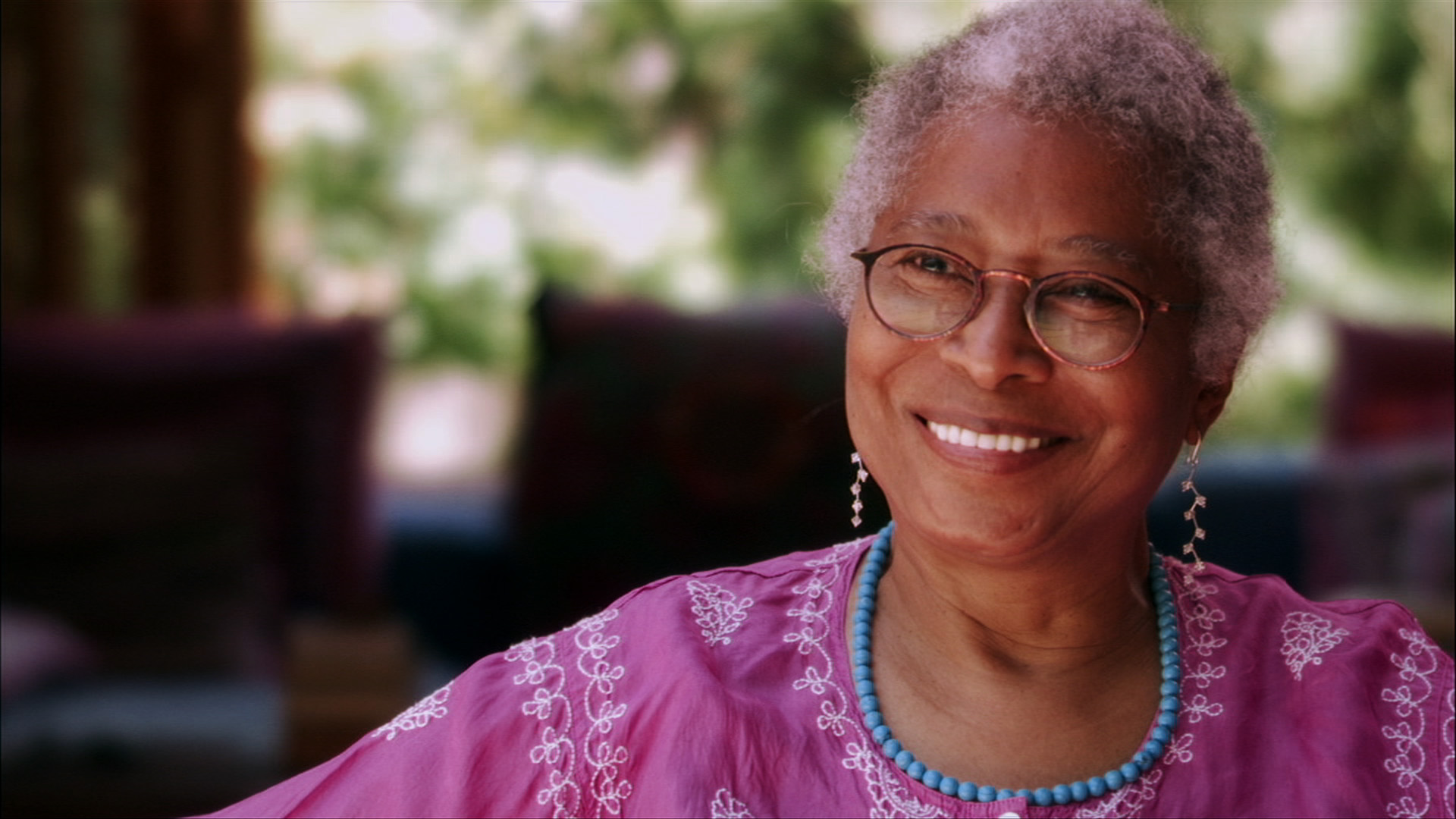
The Jewish interwebs have been abuzz regarding Yair Rosenberg’s December 17 Tablet article in which he criticized the New York Times Book Review for its interview with Alice Walker. In last Sunday’s “By the Book” column, the Times asked Walker what books she had on her nightstand; among those she cited was a book by British antisemitic conspiracy theorist David Icke entitled, “And the Truth Shall Set You Free.” Walker commented, “In (his) books there is the whole of existence, on this planet and several others, to think about. A curious person’s dream come true.”

In his article, Rosenberg listed a litany of odious excerpts from Icke’s book, including his praise of “The Protocols of the Elders of Zion,” his claims that the B’nai B’rith was behind the slave trade and his belief that the Rothschilds bankrolled Adolf Hitler. He also offered a long list of the numerous times Walker has endorsed Ickes’ ideas, including her posting of his video interview (now blocked by YouTube) with Infowars’ Alex Jones, of which she wrote:

I like these two because they’re real, and sometimes Alex Jones is a bit crazy; many Aquarians are. Icke only appears crazy to people who don’t appreciate the stubbornness required when one is called to a duty it is impossible to evade.

Rosenberg also posted in full, a deeply disturbing poem written by Walker in 2017 entitled “It is Our (Frightful) Duty to Study the Talmud.” This excerpt should give you a good idea about the tone and substance of Walker’s piece:

For a more in depth study
I recommend starting with YouTube. Simply follow the trail of “The
Talmud” as its poison belatedly winds its way
Into our collective consciousness.

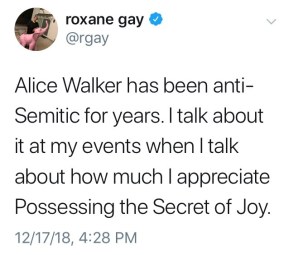
I will sadly confess that I was unaware of Alice Walker’s history of antisemitic attitudes, even though this was apparently common knowledge among many on the left. During the Twitter eruption that followed Rosenberg’s piece for instance, Roxane Gay commented:

IMG_5155

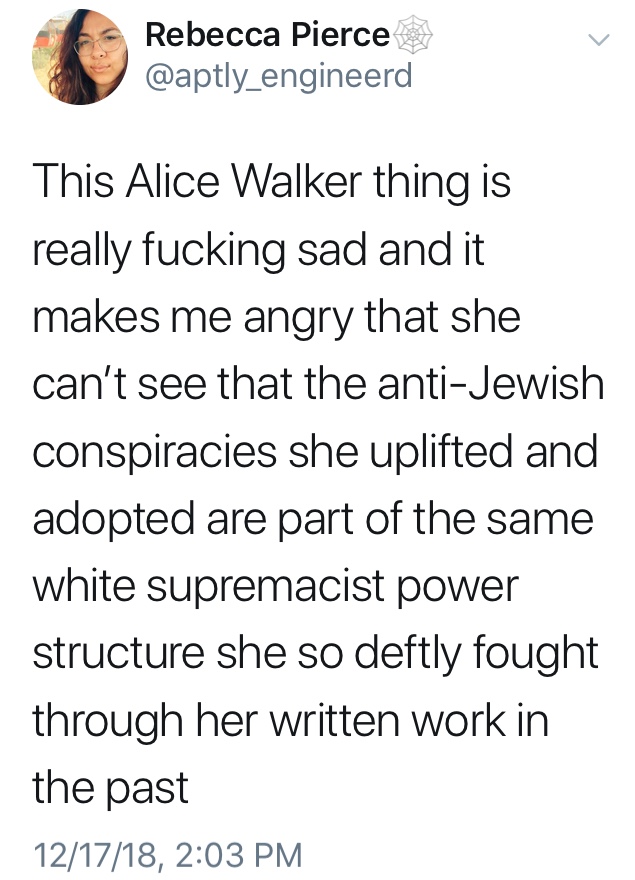
Those of us who were hearing of Walker’s antisemitic proclivities for the first time were particularly saddened to learn that this eloquent champion of anti-racism had been expressing such poisonous ideas toward Jews and Judaism. Journalist/filmmaker Rebecca Pierce spoke for many of us when she tweeted this response:

IMG_5152

In his article, Rosenberg made mention of Walker’s anti-Israel politics, challenging “the progressive left” to call out antisemitism that is “presented in the righteous guise of ‘anti-Zionism.’” Although I don’t share Rosenberg’s conservative Israel politics, I accept his challenge. And yes, it’s painfully true that Walker’s Talmud poem egregiously cites Jewish religious tradition as the root cause of Israel’s oppression of Palestinians (as well as American police brutality, mass incarceration and “war in general”):

For the study of Israel, of Gaza, of Palestine,
Of the bombed out cities of the Middle East,
Of the creeping Palestination
Of our police, streets, and prisons
In America,
Of war in general,
It is our duty, I believe, to study The Talmud.
It is within this book that,
I believe, we will find answers
To some of the questions
That most perplex us.

Walker’s claim that the Talmud is “evil” and “poisonous” – a common antisemitic trope – is worth unpacking here. First of all, what is referred to as “The Talmud” is actually a vast corpus of Jewish civil and ritual law mixed with freewheeling legend and Biblical commentary composed between 200 and 500 CE. Though it is one of Jewish tradition’s foundational texts, Talmudic literature is not, to put it mildly, immediately accessible to the untrained reader. It’s typically studied by traditional Jews in the rarified world of schools known as yeshivot, where students’ primary focus is on the unique pedagogy of Talmudic argumentation.

Like all forms of religious literature, Talmudic tradition expresses a wide spectrum of ideas and attitudes. The contemporary reader would likely find its content to be alternately inscrutable, inspiring, challenging, archaic – and yes, at times even repugnant. It contains passages for example, that are profoundly misogynistic. And as Walker pointed out in her poem, it also contains occasional material that is decidedly anti-Gentile, including a notorious passage that depicts Jesus condemned to suffer in hell in a vat of burning excrement. (Yep, it’s true.) There are also texts that unabashedly claim Jewish lives must take precedence over non-Jewish lives – an idea that was also advocated centuries later by Moses Maimonides.

These texts are undeniably, inexcusably offensive and they must be called out, full stop. At the same time however, it is exceedingly disingenuous to judge a religion on the basis of its most problematic pronouncements. This attitude simplistically accepts these texts at face value, devoid of any context or historical background. It also ignores the fact that almost all faith traditions address the offensive, archaic or inconsistent elements in their sacred literature through the use of hermeneutics – that is, principles and methods that help readers understand their meaning in ever-changing societal contexts.

How for instance, might a contemporary religious feminist read and understand a blatantly misogynist Talmudic text? In an article entitled “When Sages are Wrong: Misogyny in Talmud,” Dr, Ruhama Weiss, of Hebrew Union College offers one hermeneutical approach:

(These Talmudic traditions) caused me a powerful disturbance. They forced me to think and react; to think about mechanisms of power and control and about the ability to be free from them. To make an effort to find and highlight additional voices, earlier voices, buried and hidden in misogynist rabbinic discussions.

Most importantly, these difficult sources teach me a lesson in modesty; from them I learn that unequally talented and wise people with good intentions can bequeath to subsequent generations difficult and bad traditions. I see the moral blind spots of my ancestors, and I am obligated to examine my own moral blind spots. Bad and disturbing sources make me think.

Indeed, this same hermeneutic method can be applied to Talmud’s xenophobic, anti-Gentile content as well. That is to say, these texts can challenge us to see “the moral blind spots of our ancestors and thus to examine our own moral blind spots.” They can help us confront “mechanisms of power and control” and contemplate the ways we might be able to “free ourselves of them.” These bad and disturbing sources can “make us think.”

Of course there are those who will read the texts of their faith through a more literal, fundamentalist hermeneutic. In such cases, it is up to those who cherish their religious tradition and the value of human rights for all to challenge such interpretations, particularly when the lines between church and state power become increasingly blurred.

On the subject of state power, I must add that I find it exceedingly problematic when folks criticize Talmudic tradition for its xenophobic attitudes without acknowledging the fundamentally anti-Jewish attitudes that are embedded deep within Christian religious tradition. It’s also important to note that antisemitic church teachings were historically used to inspire centuries of anti-Jewish persecution throughout Christian Europe, while the Talmud was written and compiled in a context of Jewish political powerlessness.

Today, in this relatively new era of Jewish power, it is certainly important to remain vigilant over the ways Jewish tradition is used to justify the oppression of Palestinians. Indeed, since the establishment of the State of Israel, this subject has been intensely debated throughout Israel and the Jewish Diaspora. As I write these words in fact, I’m recalling a blog post I wrote back in 2009 about then Chief Rabbi of the Israeli Defense Forces Avichai Rontzki, who made a comment, based on Jewish religious texts, that soldiers who “show mercy” toward the enemy in wartime will be “damned”:

How will we, as Jews, respond to the potential growth of Jewish Holy War ideology within the ranks of the Israeli military?  How do we  feel about Israeli military generals holding forth on the religious laws of warfare? Most Americans would likely agree that in general, mixing religion and war is a profoundly perilous endeavor.  Should we really be so surprised that things are now coming to this?

I do not ask these questions out of a desire to be inflammatory. I ask them only because I believe we need to discuss them honestly and openly – and because these kinds of painful questions have for too long been dismissed and marginalized by the “mainstream” Jewish establishment.

In the end, every faith tradition has its good, bad and ugly. And in the end, I would submit that the proper way to confront these toxic texts is for people of faith to own the all of their religious heritage – and to grapple with it seriously, honestly and openly. And while we’re at it, it’s generally a good rule of thumb to avoid using the bad, ugly stuff in any religion’s textual tradition to make sweeping historical or political claims about that religion and/or the folks who adhere to it.

What is not at all helpful is for people such as Alice Walker to cherry-pick and decontextualize quotes from one particular religious tradition and warn that its “poison” is “winding its way into our collective consciousness.”

Like many of my friends who are just now learning about her adherence to antisemitic tropes, I fervently hope she will come to understand, as Rebecca Pierce put it, that the attitudes she endorses “are part of the same white supremacist power structure she so deftly fought through her written work in the past.”


Our Wayward and Defiant Children

HT_georgia_mom_02_jef_150501_4x3_992In this week’s Torah portion, Ki Tetzei, we read:
If a man has a wayward and defiant son, who does not heed his father or mother and does not obey them even after they discipline him, his father and mother shall take hold of him and bring him out to the elders of his town at the public place of his community. They shall say to the elders of his town: “This son of ours is disloyal and defiant; he does not heed us. He is a glutton and a drunkard.” Thereupon, the men of his town shall stone him to death. Thus you will sweep out evil from your midst: all Israel will hear and be afraid. (Deuteronomy 21:18-21)

So what is this, some kind of sick joke?

In fairness, it should be noted that many classical Jewish commentators have properly recoiled from these infamous verses. In a well-known Talmudic passage, R. Judah and R. Simeon went as far as to claim that this law was never actually enacted, stating, “There never was and never will be a wayward and defiant son. (BT Sanhedrin 71a)

Why then, you might ask, was this law included in the Torah? Rabbis Judah and Simeon cryptically respond: “Seek and you shall find reward” – a comment commonly understood to mean parents should study this passage and be appropriately scared enough to set their children on the right path.

In this Talmudic understanding, then, the commandment of the wayward and defiant son thus seems to serve as a kind of parental shock therapy. Whether or not we find this advice “rewarding,” I do think that these Torah verses reflect every parent’s deepest insecurities – and society’s latent fear that it might somehow lose control of its children.

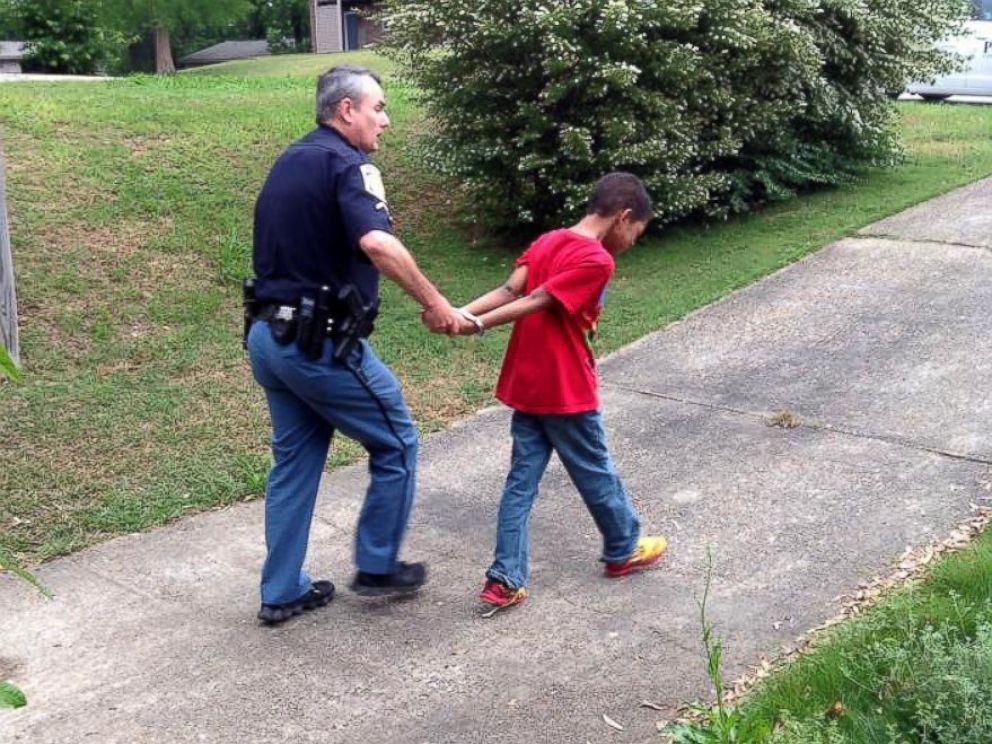
When I think of this week’s Torah portion, I can’t help but think of our own city of Chicago, where the police’s customary response to youth violence too often, is more violence. As Tamar Manasseh, founder of the local South Side organization Mother’s Against Senseless Killings recently wrote:

Putting more police on the streets or sending in the National Guard will not solve the scourge of gun violence in our communities. There will be no reduction in crime; in reality, nothing will be reduced except the number of people who are left in these neighborhoods. That’s what happens when you eliminate schools and allow food deserts to exist: People who can afford to move will do so, and the people left behind will be over-policed.

“Seek and you shall find reward.” Or, as Tamar so wisely noted,

It’s time to invest in our public schools, in job creation and in training programs to give back hope to people who have so little of it left. Chicago’s ghettos are in dire need of repair; they can be healed only when our politicians pursue policies that will raise our communities up instead of keeping us under the heel of the police.

Amen and Shabbat Shalom.

Bearing Witness as Faith Floods the Desert

011718_nmd_report-2342

(photo: Tucson Sentinel)

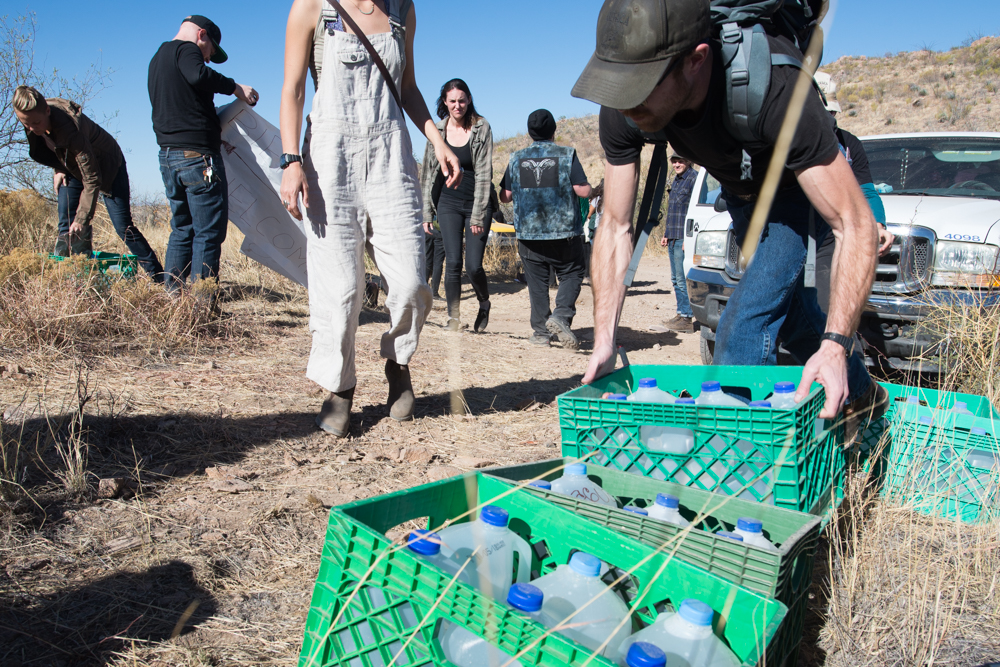
This weekend, I’ll be joining 60 faith leaders from around the country in southern Arizona to witness and respond to the suffering on our border though “Faith Floods the Desert” – a collaboration between No More Deaths/No Mas Muertes, the Unitarian Universalist Service Committee, and the Unitarian Universalist Association. Representing communities of many faiths and denominations, we’re going to stand in solidarity with humanitarian aid workers and local residents by walking into the desert and leaving gallons of water along heavily-frequented migrant trails.

No More Deaths/No Mas Muertes – a humanitarian organization based in southern Arizona – has documented how border enforcement pushes migration routes into some of the most remote, dangerous areas in Arizona’s deserts. As violence and hardship grow in parts of Latin America – in direct response to US foreign policy – and as pathways to asylum and other relief are cut off, growing numbers of people are crossing the border to reunite with their families and seek safety.

In 2017, 57 sets of human remains were found in Arizona’s West Desert, including 32 on the Cabeza Prieta Wildlife Refuge – a vast and remote stretch of land that shares 56 miles with the US-Mexico border. Yet this number represents only a fraction of the people who have disappeared and died in the region; some estimate that 10 times as many people died trying to cross these deserts.

For the past three years, No More Deaths/No Mas Muertes has left water, food, socks and blankets for migrants crossing the Cabeza, but outrageously enough, these humanitarian relief efforts have now been criminalized by the Trump administration. Earlier this year Scott Warren, a humanitarian aid provider with No More Deaths, and two people receiving humanitarian aid were arrested by US Border Patrol. Now Warren and eight other No More Deaths volunteers are facing federal misdemeanor charges relating to their humanitarian aid work on the Cabeza. (Warren’s arrest is particularly suspicious as it occurred eight hours after NMD released a video of border police dumping water and destroying supplies left by relief workers.

Faith Floods the Desert asserts “the right of all people to receive the basics of humanitarian aid, including rights to food, water, and medical assistance.” Tragically, I find that these words resonate in all-to-familiar ways. I can’t help but think of Palestinians in Gaza, deprived of these basic needs as a result of Israel’s crushing and brutal blockade. I cannot help but connect the state violence at our militarized southern border and the state violence directed toward Palestinians in the West Bank, forced to live behind militarized walls and travel daily through armed checkpoints.

I understand that my participation in the “Faith Floods the Desert” campaign is but a part of a larger struggle of solidarity with all who are oppressed by these interconnected systems of state violence. As American Jews, we can’t protest the injustices our nation commits against undocumented immigrants while remaining silent about the very same oppression directed toward Palestinians by a state that purports to act in our name.

According to the Torah, God provided for the needs of those who journeyed through the wilderness. The lesson this teaches us in our current political moment is all too obvious: the provision of humanitarian aid is divine work. Those who stand up to systems of state violence are not criminals – they are following a sacred imperative at the very heart of the Exodus story.

I look forward to sharing my experiences when I return.