Category Archives: Religion

Interfaith Prayers for Immigrant Justice

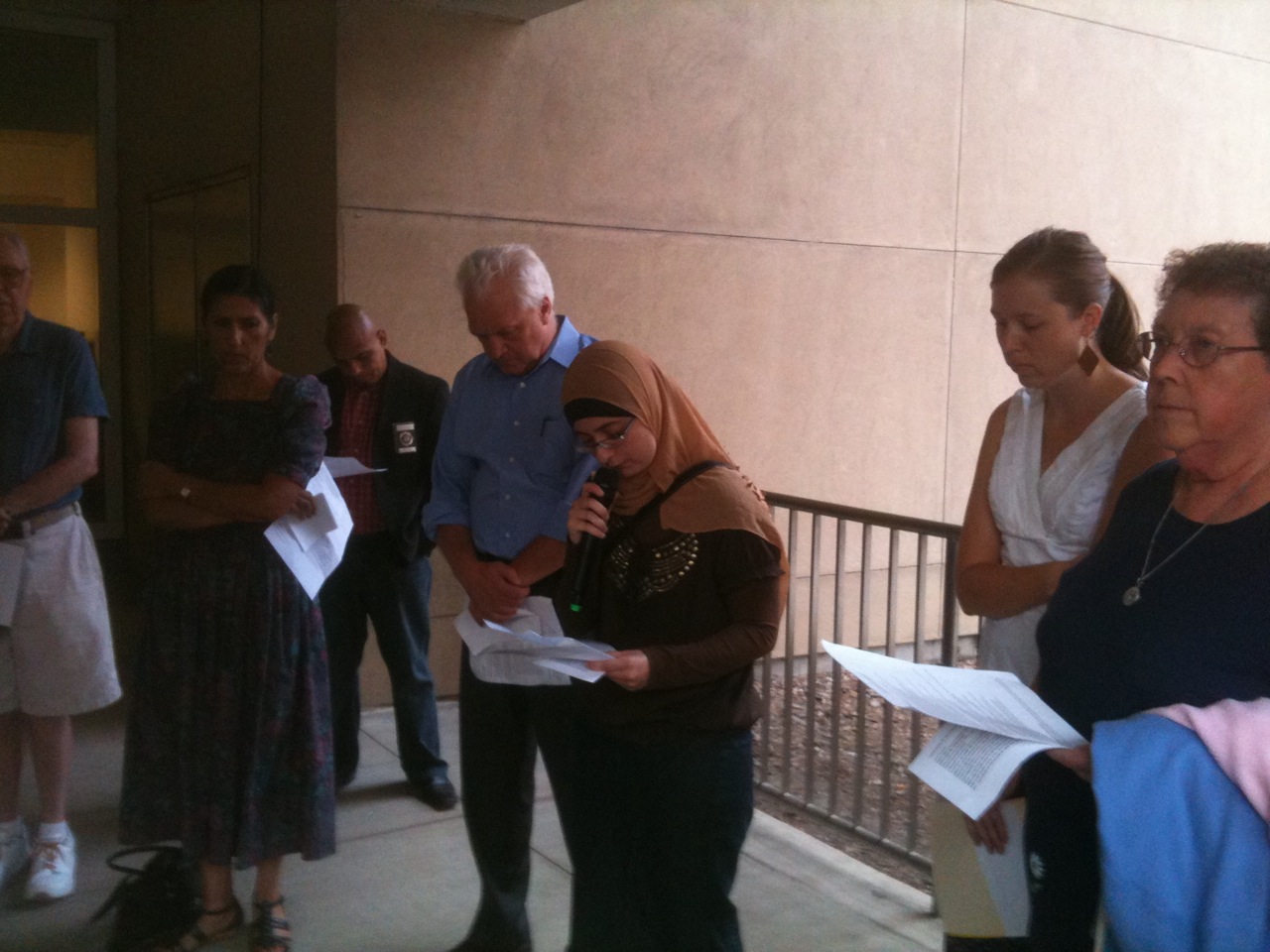
This morning I attended the Immigrant Justice prayer vigil of which I’ve written several times before. It’s been taking place every Friday morning at 7:00 am at a local immigrant detention center to show solidarity with undocumented immigrants as they are in the process of being deported – and to protest the national shame that is our nation’s current immigration policy.

This vigil previously took place at the Broadview detention facility just west of Chicago, but for the past several months undocumented immigrants have been held and processed at the Federal Building on 101 W. Congress Parkway. If you live in or around Chicago, I encourage you to join us.

Though the vigil was originally established by Catholic activists and featured the recitation of the rosary, it has long included attendees of many faiths. Just recently the first Friday of every month has been formally designated to be an interfaith ceremony. Today’s service included Christian, Muslim and Jewish participants – truly an inspiring show of prayerful solidarity.

Some years ago, I wrote and delivered a prayer specifically for this vigil.  JRC member Gonzalo Escobar recently translated it into Spanish and this morning we read a bilingual version of it together. I’ve included it below, along with other powerful prayers that were recited during our ceremony.

Again, if you live in the area, please join us on Friday mornings at 101 W. Congress and help us raise a prayerful voice all the way to Washington…
Continue reading

New Clergy Report: Workers Speak out on Hyatt Injustice

Please, please read the recently released “Open the Gates of Justice: A Clergy Report on Working Conditions at Hyatt Hotels.”

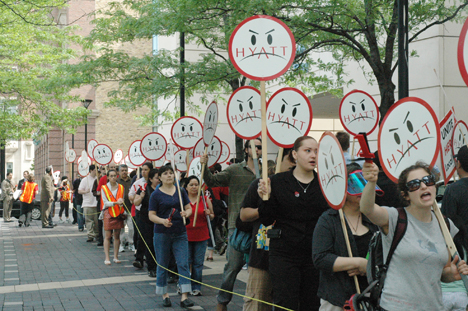
Readers of this blog know I’ve long been standing in solidarity with Hyatt workers who have called for boycotts at eighteen hotels across the US. We’ve watched with deep dismay as Hyatt, a multi-billion dollar corporation, has eliminated jobs, replaced career housekeepers with minimum wage temporary workers, and imposed dangerous workloads on those who remain.

The centerpiece of this new report is the direct testimony of hotel workers themselves, who speak eloquently to the injustices they endure – as well as their desire only to be valued as workers for the important work they do for Hyatt hotels. Their testimonies came from numerous interviews conducted by clergy from across the country who fervently believe that the struggle for worker justice is a central tenet of all of our faith traditions.

From the introduction to the report:

It is part of the purpose of this report to challenge the complacency that we and the mainstream religious community have previously exhibited to these business practices, to identify these practice as oshek/oppression, and to propose steps that we, as people of faith, can do to stand in solidarity with workers as they challenge their employers to live up to the ideals set by our religious traditions for more equitable workplaces and a more equitable society.

I was also thrilled to read enthusiastic support for the report in a recent Forward editorial:

(This) much is clear: The extensive documentation and textual support in the rabbinical report is a welcome addition to a growing number of efforts to link Jewish law and scholarship to timely social concerns. Advocates for the environment, labor, sustainable agriculture and development policy increasingly use Jewish language and teachings to frame their arguments. The rabbinic report on Hyatt calls social teachings on labor “the best kept secrets of our religious tradition.” Not anymore.

And click here to read a substantive feature on the report from the Boston Jewish Advocate that just came out today.

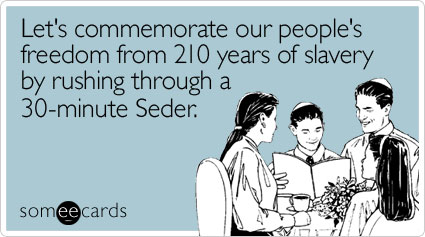
Liberate Yourself With New Passover Resources!


With the first night of Passover fast approaching, check out these great new seder resources you can bring to the table:

– Hot off the presses: the Jewish Voice for Peace 2011 Haggadah. One powerful excerpt – a new Passover poem written by Rabbi Rachel Barenblat for her “Velveteen Rabbi’s Haggadah for Pesach“:

Freedom
In remembrance of the 2011 protests in Tunisia, Egypt, Gabon, Bahrain, Libya, and elsewhere.

Liberation comes when people gather
by the tens and by the thousands
demanding that the despot who’s held the reins
step down, and in between the slogans
they dish out lentils cooked over open flame,
and homes open up so the protestors can shower
and members of one faith link hands
to protect members of another faith at prayer.
Liberation comes at a cost: not only
the horses and chariots swept away, but
innocents gunned down by their own army,
panicked children lost in the roiling crowds
activists imprisoned for speaking freely,
and when the world stops watching
they may be beaten—or worse.
It’s upon us to at least pay attention
on mobile phones and computer screens
as real people rise up to say
we have the right to congregate and to speak
we will not be silenced, we are not afraid.

A “Food and Justice” seder from Uri L’Tzedek;

– “The Labor Seder” by Jews United for Justice;

– American Jewish World Service’s “Slavery, Freedom and Migration;”

A Haggadah Insert by Jewish Solidarity with Native American People;

The 2011 Tikkun Magazine Haggadah supplement which, as always, has enough material for 10 seders.

May it be a liberating Pesach for us all!

This is Why Unions Matter

Many are saying that the battle in Wisconsin is, at long last, shedding some much needed light on the critical role unions play in our economy and in the lives of real working people. If that’s actually so, I’d say it’s high time.

A few recent insights on the subject that are well worth taking to heart. First, from Kevin Drum, writing in Mother Jones:

Of course unions have pathologies. Every big human institution does. And anyone who thinks they’re on the wrong side of an issue should fight it out with them. But unions are also the only large-scale movement left in America that persistently acts as a countervailing power against corporate power. They’re the only large-scale movement left that persistently acts in the economic interests of the middle class.

Robert Reich, who blogged two years ago on the reasons unions are so central to the health of our economy:

The American middle class isn’t looking for a bailout or a handout. Most people just want a chance to share in the success of the companies they help to prosper. Making it easier for all Americans to form unions would give the middle class the bargaining power it needs for better wages and benefits. And a strong and prosperous middle class is necessary if our economy is to succeed.

Mik Moore, on unions and the 21st century Jewish community:

Warren Jacobson is the president of the Madison chapter of the Zionist Organization of America. He is middle class. Conservative. Mid-Western. And for 18 years, a union member and government worker.

In 2010, he voted for Scott Walker. But when asked by a JTA reporter if he supported the Governor’s effort to effectively neuter the state government employees’ union, he said no. He had experienced anti-Semitism and discrimination. Unions might not be perfect, he acknowledged, but:

“I want someone supporting me.”

His statement is a powerful distillation of why unions remain vital. Without a union, each worker is on his or her own. They must fend for themselves. And more often than not, they will lose…

We are fooling ourselves if we think unions are no longer important to maintaining and growing the large Jewish middle class. They are. Jacobson is more typical than we realize.

And finally, Rabbi Jill Jacobs offers a trenchant historical reminder in Religion Dispatches:

Almost exactly a century ago, on March 25, 1911, the Triangle Shirtwaist Factory went up in flames, killing 146 people, mostly immigrant women workers. The management had locked exit doors and stairwells to prevent workers from leaving early. As a result, workers trying to escape the fire were forced to jump from as high as the tenth floor, or simply to wait and smolder to death.

At a gathering in the Metropolitan Opera House a few days after the fire, labor organizer Rose Schneiderman rallied the crowd with the following words:

“Every time the workers come out in the only way they know to protest against conditions which are unbearable the strong hand of the law is allowed to press down heavily upon us… I know from my experience it is up to the working people to save themselves.”

Schneiderman understood that more was at stake in the days following the catastrophe than fire safety regulations. Instead, she argued that only a strong union movement would guarantee workers a safe and dignified workplace in the long run…

Governor Walker and his billionaire supporters are on the verge of destroying the labor movement in America. If that happens, workers will lose most negotiating power, wages will fall, and many more of us will lose our health insurance and other benefits. If Rose Schneiderman were here today, she would tell us, “It’s up to us to save ourselves.”

A Blessing From Wisconsin

The following blessing was just sent to me by my friend and colleague Rabbi Laurie Zimmerman, of Reconstructionist congregation Sha’arei Shamayim in Madison, WI. It was said during the Shabbat morning Torah service for all those who participated in the many protests, vigils, or hearings at the Wisconsin State Capitol last week.  Laurie reports that 90% of the congregation and guests came up for the blessing.

Mi sheberach Avoteynu Avraham, Yitzhak, v’Ya’akov
May the One who blessed our forefathers Abraham, Isaac, and Jacob,

V’Imoteynu Sarah, Rivka, Rachel, v’Leah
And our foremothers Sarah, Rebecca, Rachel, and Leah,

Bless all of you who have come up to the Torah this morning.

No matter what happens in the next week may you be reminded that even tiny actions can affect others, create ripple effects, and make a difference in our world.

May you take responsibility for what you say, for how you behave, for what you do and for what you do not do.

May you pursue justice, act with integrity, and work hard to create a society where all are cared for, where every person has the resources that he or she needs.

May you remember to take care of yourselves and your families so that your work is sustainable.

And may you heed the words of Pirke Avot: “If I am not for myself, who will be for me?  If I am only for myself, what am I?  And if not now, when?”

And let us say, Amen.

On Rabbis and Racism

According to signator Rabbi Yosef Scheinen (left), head of the Ashdod Yeshiva: "Racism originated in the Torah"

From Ha’aretz:

A number of leading rabbis who signed on to a religious ruling to forbid renting homes to gentiles – a move particularly aimed against Arabs – defended their decision on Tuesday with the declaration that the land of Israel belongs to the Jews.

Dozens of Israel’s municipal chief rabbis signed on to the ruling, which comes just months after the chief rabbi of Safed initiated a call urging Jews to refrain from renting or selling apartments to non-Jews.

Needless to say, the reaction to this noxious ruling has been nothing short of thunderous throughout Israel and the Jewish world. Israeli politicians from Netanyahu on down have publicly called out the rabbis on their racism. The New Israel Fund is disseminating “Rabbis Against Religious Discrimination” a statement that calls upon Israeli rabbis to “take a strong public stand” against “this painful distortion of our tradition.”  At last count, 880 rabbis from around the world have signed on. Even the ADL has joined the fray in denouncing the ruling.

It’s been heartening to hear such an immediate and powerful Jewish communal response. Still, for all of the brouhaha, I’m struck – and fairly troubled – that there has been very little discussion of the fact that these rabbis are on the government payroll at all.

Indeed, it’s very easy to criticize rabbis such as this, but in truth, the mere existence of racist rabbis in Israel shouldn’t come as much of a shock to us. Truth be told, prominent Israeli rabbis have been disseminating xenophobia for some time now. Every religion has its religious extremist “spokespeople” – and Judaism is certainly no different on this score.

No, the real problem here is not the horrid personal beliefs of a handful of individual rabbis – the core issue is a political system that sees no problem in granting state authority to them – or to any clergy, for that matter. For me, this is the most disturbing aspect of this whole sorry episode: at the end of the day, these rabbis are ultimately part of a larger infrastructure of intolerance that inevitably results from wedding religion to nation-statism.

I was very happy to read that some left-wing Israeli politicians have gone as far as to call for the firing of the rabbis in question, but in the end, I’m just not convinced that this problem ultimately stems a few “rogue employees.” The real problem, I fear, has to do with a nation that claims to be both Jewish and democratic – but is finding it increasingly difficult to square that circle.

A Jew In Solidarity With the Palestinian People

As today marks the UN’s International Day of Solidarity with the Palestinian People, I’d like to take occasion of this day to publicly state, without hesitation, that I stand in solidarity with the Palestinian people.

As a Jew, I will also say without hesitation that I reject the view that I must choose between standing with Jews or standing with Palestinians. This is a zero-sum outlook that only serves to promote division, enmity and fear.

For me, the bottom line is this: the cornerstone value of my religious tradition commands me to stand in solidarity with all who are oppressed. It would thus be a profound betrayal of my own Jewish heritage if I consciously choose not to stand with the Palestinian people.

In other words, I believe my Jewish liberation to be intrinsically bound up with Palestinian liberation. It’s really that simple.

But of course, there is nothing simple or uncomplicated about it. To take such a step it is deeply painful in many ways. It means, among other things, facing down my peoples’ own potential for oppression; to admit that the state of Israel, born in the wake of persecution, has itself become a persecutor.

However, I must also admit that this pain, uncomfortable though it is, is nothing compared to the pain felt that is being experienced by the Palestinian people on a daily basis. Anyone person of privilege who stands in solidarity with the oppressed would do well to bear this in mind: while must we explore our own guilt and culpability, we must also bear in mind that it is not ultimately about us.

From a wonderful essay on white privilege, but very applicable in this case:

Solidarity…is a long-term participation in the struggle, understanding the part you play and how the issues affect you personally. As well, solidarity may very well mean not being the center of the solution, but just a small part. It may mean deferring your sense of authority and leadership. It can also mean dropping your own agenda for how change should be achieved. It can be very problematic when the leadership in an organization is people from the dominant culture. When people from the dominant culture define the issues or strategies for oppressed people it can be condescending and ineffective. So, an example of solidarity is being part of community organizing efforts led by people of color, womyn, etc in an active, but non-leadership role. Being in solidarity means seeing how you will benefit from the liberation of others.

And so today I’ll take this opportunity to say I stand in solidarity with the Palestinian people. But I’m not taking it to assuage my Jewish pain and guilt, nor to claim I personally know how this liberation must eventually be achieved.

In the end, I stand here because I know in my heart it is where I must be.

The New Jersey Standard’s Editorial Bigotry

Last week, the New Jersey Jewish Standard ran an announcement of a same-sex union – this week, after receiving pressure from local traditional/orthodox rabbis, they have announced that they will no longer “run such announcements in the future.” They defended their action by stating that their paper “has always striven to draw the community together, rather than drive its many segments apart.”

Well, I’d say the Standard is about to learn the true meaning of “communal division.” Their editorial decision is particularly appalling as it comes on the heels of the suicide of a gay New Jersey university student who was the tragic victim of cyber-bullying. We’d do well to ask which is more important: the views of a religious minority or sensitivity to prejudice that literally has life or death implications?

Please, please write to the Standard and let them know how outraged you are. If you are Jewish, I encourage you to add that this kind of bigotry has no place in our community.  Click here for the contact info.

Jews, Power and Privilege: A Sermon for Yom Kippur 5771

From my Yom Kippur sermon yesterday:

For matter how painful the prospect, I don’t think we can afford to dodge this question. If we agree that the inequitable distribution of power and privilege is a critical problem for us and for our world, then there will inevitably be times in which we are faced with an intensely difficult question: does tribal loyalty trump solidarity with the oppressed?

Actually, I’m coming to believe that this is not the best way to frame the question. I don’t really think it’s all that helpful to view this issue as some kind of zero-sum game; to see it as a question of tribal allegiance; to insist that I either stand with my own people or I don’t. I prefer to say it this way: that it is in my self interest as a Jew to stand in solidarity with the oppressed because I believe that Jews cannot be fully human while they benefit from a system that denies others their own humanity. For those with power and privilege, the struggle against racism and oppression is fought knowing that our own liberation is also at stake.

Click below to read the entire sermon:

Continue reading

The Supreme Sacrifice: A Sermon for Erev Yom Kippur 5771

From my Erev Yom Kippur sermon last Friday:

And as I think about it, perhaps this is why we read a Martyrology on Yom Kippur. As we remember our martyrs, we search our own souls and ask ourselves honestly: what have we done in the past year to prove ourselves worthy of these profound sacrifices? What have we done to affirm that these people did not die in vain? Did we indeed honor their memories by transforming loss into justice and hope for our world?

Click below to read the entire sermon:

A JRC member recently asked why we never do the Martyrology service on Yom Kippur. I wrote back to the congregant – and I’ll confess to you now: I’ve never been a huge fan of this particular liturgy.

Continue reading