Category Archives: Religion

“All Who are Hungry Come and Eat:” A Report from a Passover Action at the Gaza Border

Cross-posted with The Nation

In 2017, I spent several days in Gaza as a staff person for the American Friends Service Committee. Although I took away many powerful and vivid memories from that trip, some of the most indelible involved the delicious food that was continuously served to us by our Gazan hosts. Gazans are famously proud of their cuisine, and rightfully so, as it provides them with a palpable connection to Palestinian history and life outside that small 140 square mile strip – to communities in Palestine that their ancestors used to live. As journalist Laila El-Haddad has observed, Gazan food is “a sort of treasure map to a largely invisible, or invisibilized, world of Palestinian history going back well before the 1948 Nakba.”

During the course of our visit, Ali, a member of the AFSC Gaza staff, mentioned more than once that Gazan knafeh (a traditional Arabic dessert) was by far the best in Palestine. When our staff group gathered at a restaurant in Gaza City for our final meal, Ali was chagrined to learn that there was no more knafeh left in the kitchen. Determined, Ali got up, ran down the street to another restaurant, and returned with a huge round plate of the sticky, golden pastry for our table. It was indeed more delicious than any knafeh I have eaten before or since.

I’ve recalled that sweet memory often over the past seven years. When I think of it now, however, I find its sweetness has curdled into horror. As far back as December, human rights agencies determined that Israel “was using starvation as a weapon of war.” According to the World Food Program, Gaza’s food system was on the brink of collapse and the population was facing a “high risk of famine.”

This past March, the mainstream media published shocking, heartbreaking pictures of Yazan Kafarneh, a 10 year old Gazan boy reduced to skin and bones from starvation. To date, it has been estimated that 28 children have died of malnutrition and starvation in northern Gaza. By all accounts, starvation in Gaza has now reached “catastrophic” proportions. Knowing about the Gazan people’s deep pride in their food culture, I’m experiencing deep heartbreak as I read reports that Palestinians in Gaza are now forced to eat grass just to survive.

As a congregational rabbi, I’ve spoken with many people have told me that they are not sure how – or even if – they will celebrate Passover this year. With the genocide and forced starvation of the people of Gaza deepening with no end in sight, they say, it just feels beyond challenging to celebrate a festival of Jewish liberation. To make the moral dissonance even more dissonant, many in the Jewish communal establishment are framing Passover by focusing exclusively on the Israeli hostages in Gaza and call for their liberation from Hamas, with nary a mention of the 35,000 Gazans who have been destroyed in the process through Israel’s genocidal war of vengeance.

More than once I’ve been asked, “How can I partake of this festive meal while Israel has been starving Palestinians in the name of the Jewish people?” How can I read about Pharaoh’s oppression of Israelite children when I’ve just read the latest death count of Palestinian children dying increasingly things from forced starvation?

As a political-spiritual response to this unprecedented Passover moment, Rabbis for Ceasefire mobilized and began to organize as action at the Gaza border, to literally bring food supplies with us and demand to that Israel allow us to pass through the Erez Crossing, motivated by Passover’s central imperative, “All who are hungry come and eat!” Our action would include 10 American rabbis, writer/essayist Ayelet Waldman and 30 other Israeli activists – including Israeli rabbis – who have been tirelessly protesting both at the Gaza border and organizing protective presence for West Bank communities targeted by settler violence.

Our action was originally planned for the week leading up to Passover; but when Iran’s missile attack caused the country to go on alert and airlines cancelled their flights to Israel, we almost had to cancel our action. As we read the news, Israel’s escalating hostilities with Iran took front and center The US and the West were rearming Israel and focusing on the threat from Iran – even as Israel continuingly maintained its policy of starvation and bombardment of Gaza. Most alarming were the reports that an Israeli agreement to retaliate lightly against Iran would give them leeway to move ahead with a potentially disastrous ground invasion of Rafah.  We bought plane tickets for the next week, determined to make a collective Passover statement that felt more critical than ever.
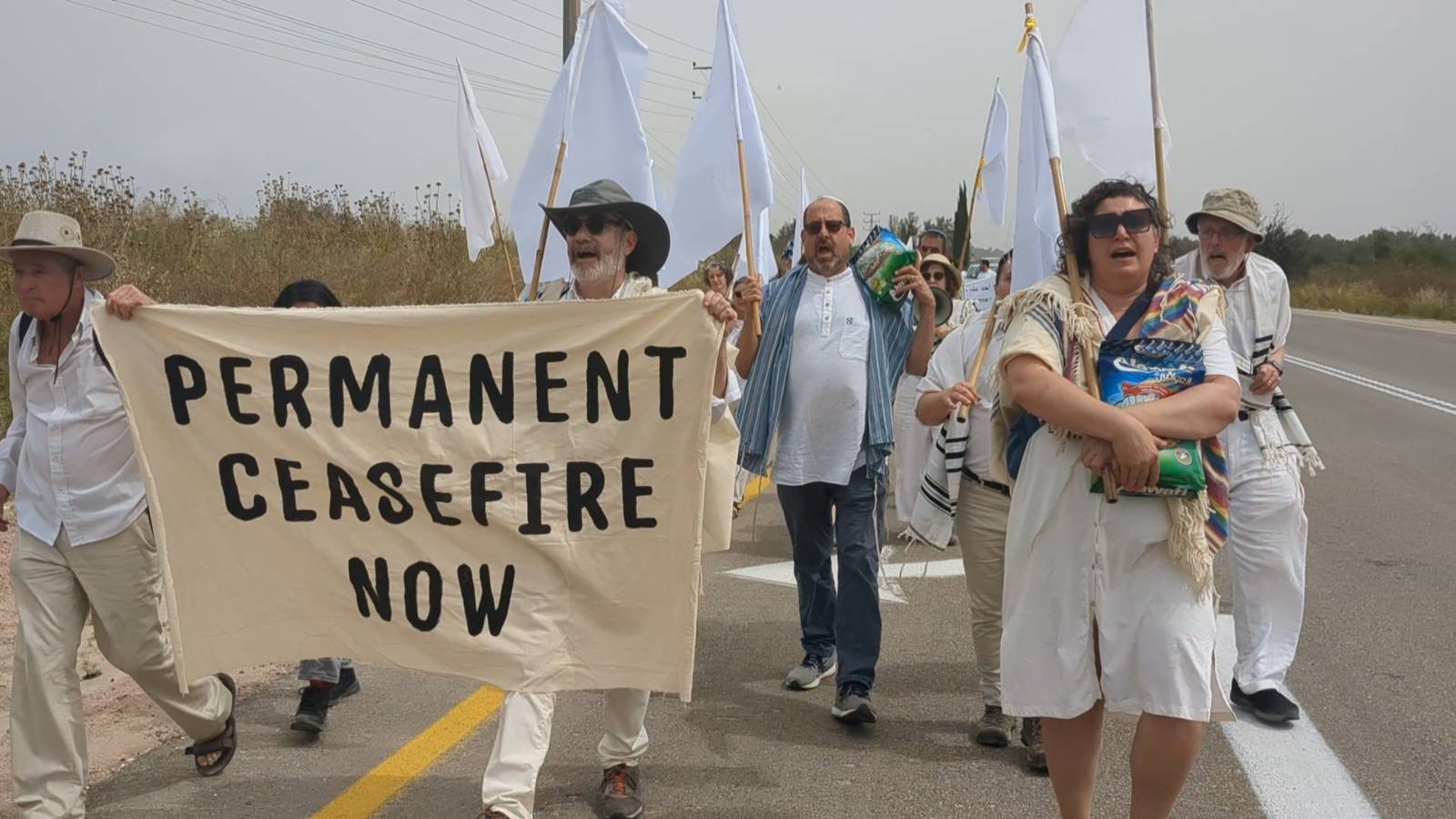
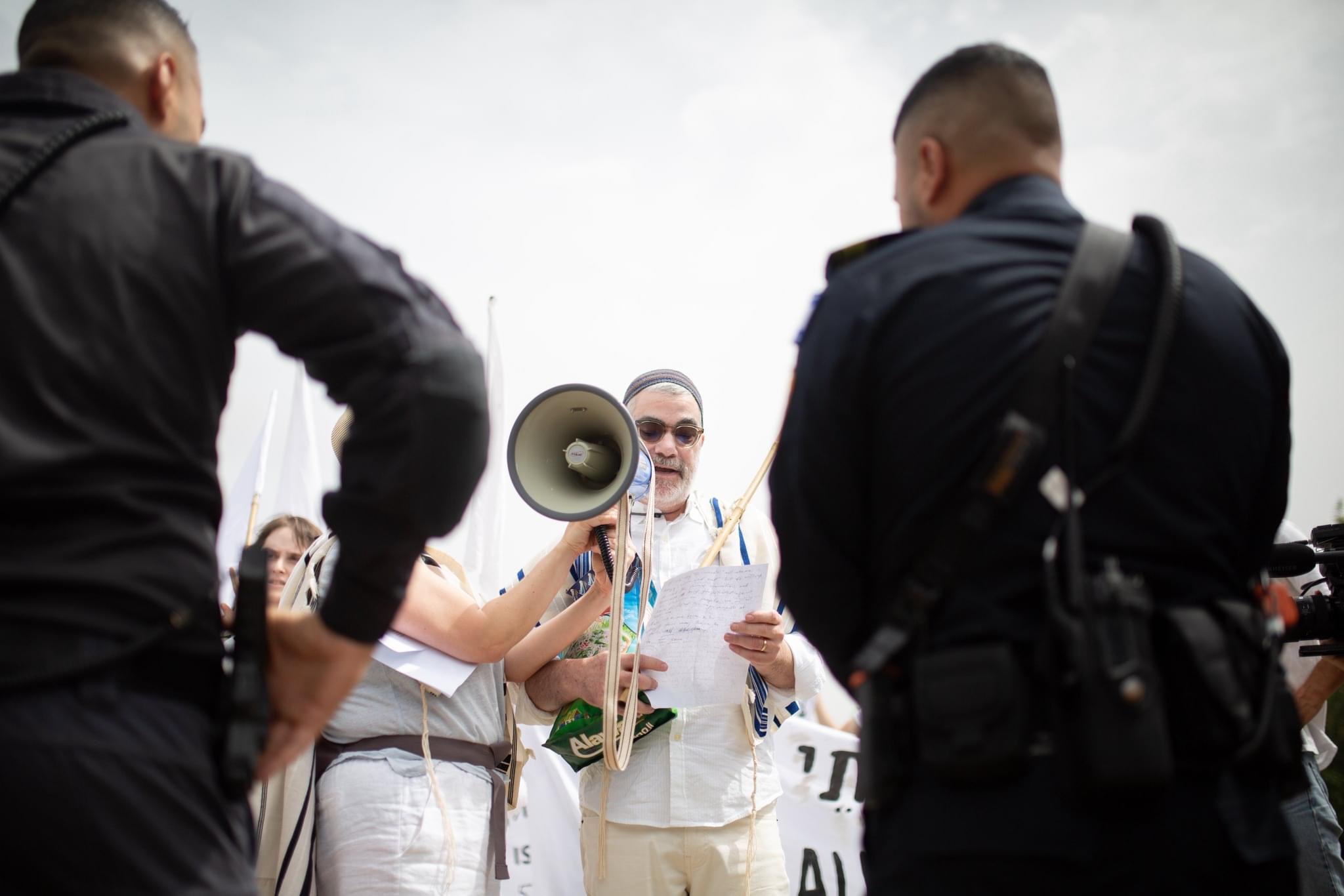
During our action, we gathered at a preplanned meet-up location, with a truck filled with half a ton of flour. We each shouldered backs of rice and, carrying banners and flags, march in the direction of the Erez Crossing. The Israeli police quickly drove up to intercept us. During that initial stand-off, several of us offered statements. I began with an opening prayer, an adaptation of the “Magid” section of the Passover Haggadah:

“This is the bread of affliction, the bread and food systemically, cruelly denied the people of Gaza. Let all who are hungry come and eat. Let all who are oppressed be liberated this Pesach. Now we are here – tomorrow let there be bread for Gaza. Now we are here – next year may there be liberation from the river to the sea!”

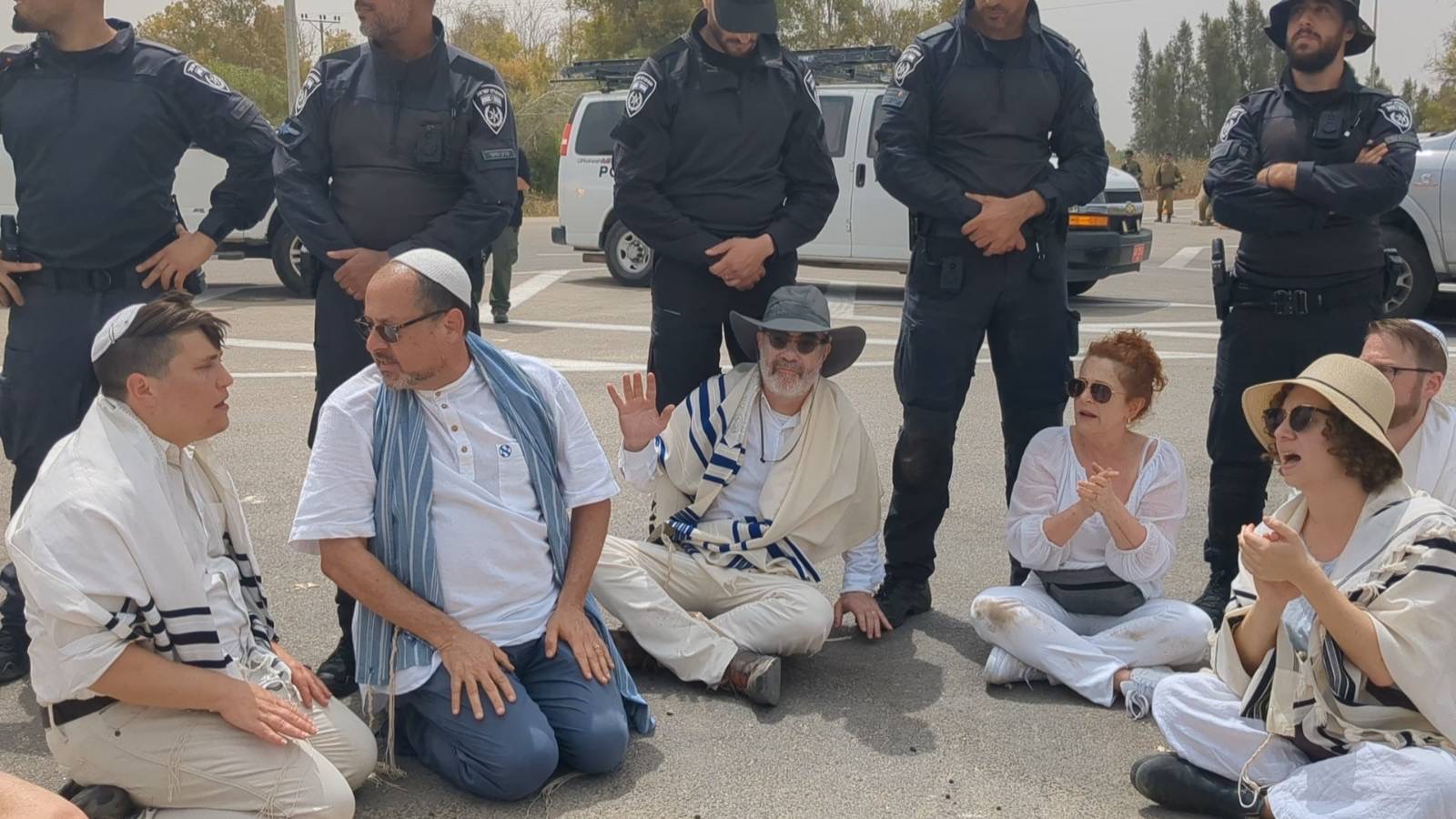
Other speakers included Israeli Rabbi Avi Dabush of Rabbis for Human Rights, a resident and survivor of a kibbutz that was attacked on October 7 and Noam Shuster-Eliassi, a well-known Israeli activist, writer and comedian. When our program was over, we pushed forward toward the border. When the soldiers violently attempted to break us up, several of us sat down in the road. During the course of the protest seven of our group: four Americans and three Israelis were arrested.

All of the arrested were fully prepared for this eventuality – the Israelis were in fact veterans at protest-arrests and had previously briefed us on protocol. They were taken to two dentention centers and interrogated for eight to nine hours. The American were told, perversely, that they were being held for “attempting to bring food into Gaza.” All the arrested were released that evening; thankfully the food we attempted to bring into Gaza was not confiscated; as we have previously planned, it was donated to the community of Masafer Yatta – an area in the South Hebron Hills were almost 3,000 residents are resisting the daily threat of demolitions, evictions and dispossession.
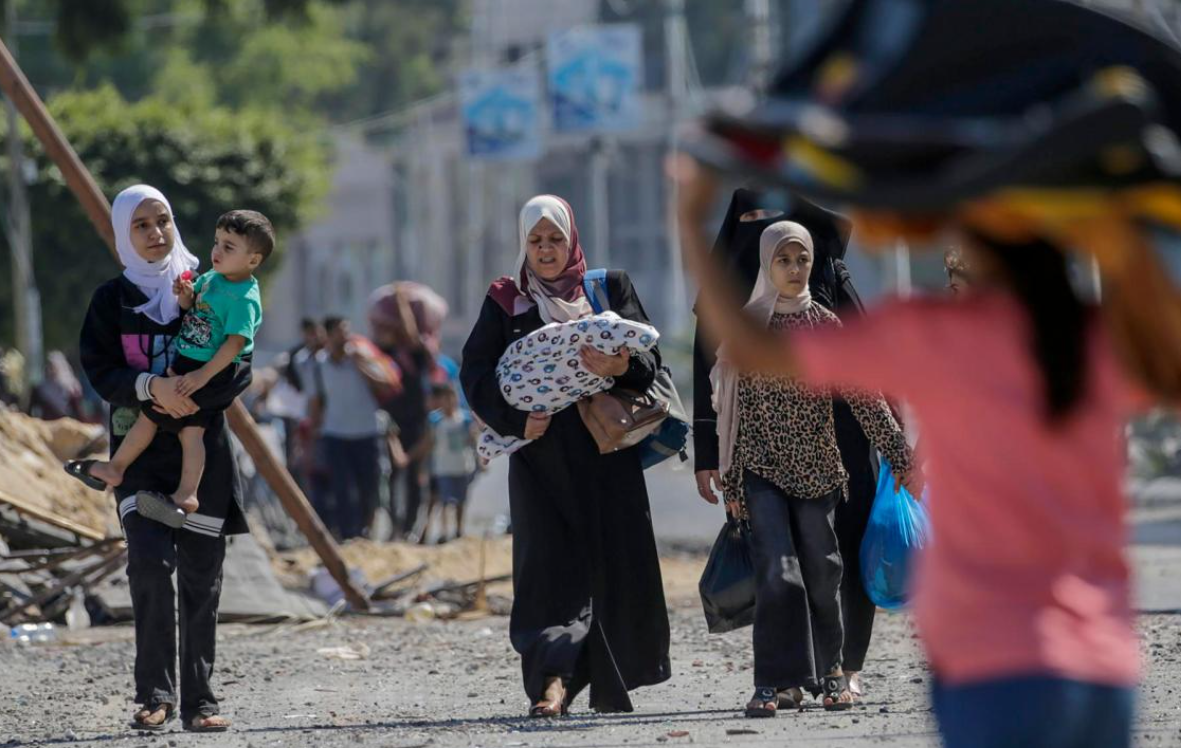
While we are satisfied with the attention our action has received, we have no illusions about the current moment in Gaza. Nearly 2.2 million Palestinians in Gaza currently face mass starvation and encroaching famine, these words have resonated with unbearably profound force during Passover this year. Hundreds of trucks filled with humanitarian goods have been sitting idle on roads leading into the Rafah crossing on the border with Egypt, blocked from entering Gaza by a draconian inspection process that severely limits the number of trucks that can pass through. Inside Gaza, the Israeli has been attacking efforts aid efforts with tragic results. According to the UN, the Israeli military has killed 196 relief workers; soldiers have also shot and killed hundreds of Gazans who venture out to seek food.

Amidst it all, the one agency that has the capacity and infrastructure to effectively distribute relief to the people of Gaza, the United Nations Relief and Works Agency (UNRWA), has been defunded by the Biden administration. This past January, the Israeli government leveled the still-unsubstantiated claim that 12 UNRWA employees were involved in Hamas’ October 7 attacks in Israel. Though UNRWA immediately fired the employees in question and launched an investigation, the US immediately withdrew their financial support of the agency, which was founded in 1949 to provide support to the hundreds of thousands of refugees created by the establishment of the state of Israel.

In its spending bill this past March, the US government extended its defunding of UNRWA for a year. Though the agency reports it has sufficient funds to operate until the end of May, its ability to operate in Gaza has already been gutted. Last month, Israel announced it would no longer approve UNRWA food convoys to the north of Gaza, where famine is the most. According to its report this month, the agency noted that “a total of 420 trucks food trucks were denied or impeded by Israeli authorities (during the month of March) …Gaza is on the brink of famine, with 1.1 million people—half of its population—experiencing catastrophic food insecurity due to the intense conflict and severe restrictions on humanitarian access.”

Most ominously, Israel continues to amplify its threats to invade Rafah, which would almost certainly result in massive human tragedy and the complete ethnic cleansing of Palestinians from Gaza. And yet, in the wake our action on the border, I continue to hold out hope. It is clear to me that our border-protest was part of something much larger: the dramatic rise in student resistance on college campuses throughout the US and unprecedented popular Palestine solidarity increasing around the world. For me, this moment expresses the core meaning of Passover powerfully than I have every experienced in my lifetime: in every generation, the cry of the oppressed demands to be heard.

This Passover, I also hold out hope from my own memory of meals in Gaza back in 2017. To be sure, AFSC’s Gaza staff has suffered terribly during this genocidal onslaught – and I’m sure the restaurants and neighborhoods where we enjoyed such delicious meals with our Gazan friends are no more. But I will never forget the tastes of the food that were so graciously served, as well as the communities in Palestine that they represent. And I am more convinced than ever that Israel cannot, try as it may, starve, bomb, or shoot away the Palestinian people’s love for their culture that is so deeply, fragrantly rooted in their homeland: In the words of El-Haddad:

Lately, I’ve been thinking about what I would go back to, and what I would find, if I returned to Gaza. Most of the landmarks have been destroyed. Gone too are many of the people I cherished. But … it feels like I am the torchbearer now, the family’s keeper of treasured recipes. Like Um Hani (Leila’s aunt, who was killed in an Israeli airstrike), I will cook and I will teach, connecting the next generation of Palestinians to our homeland.
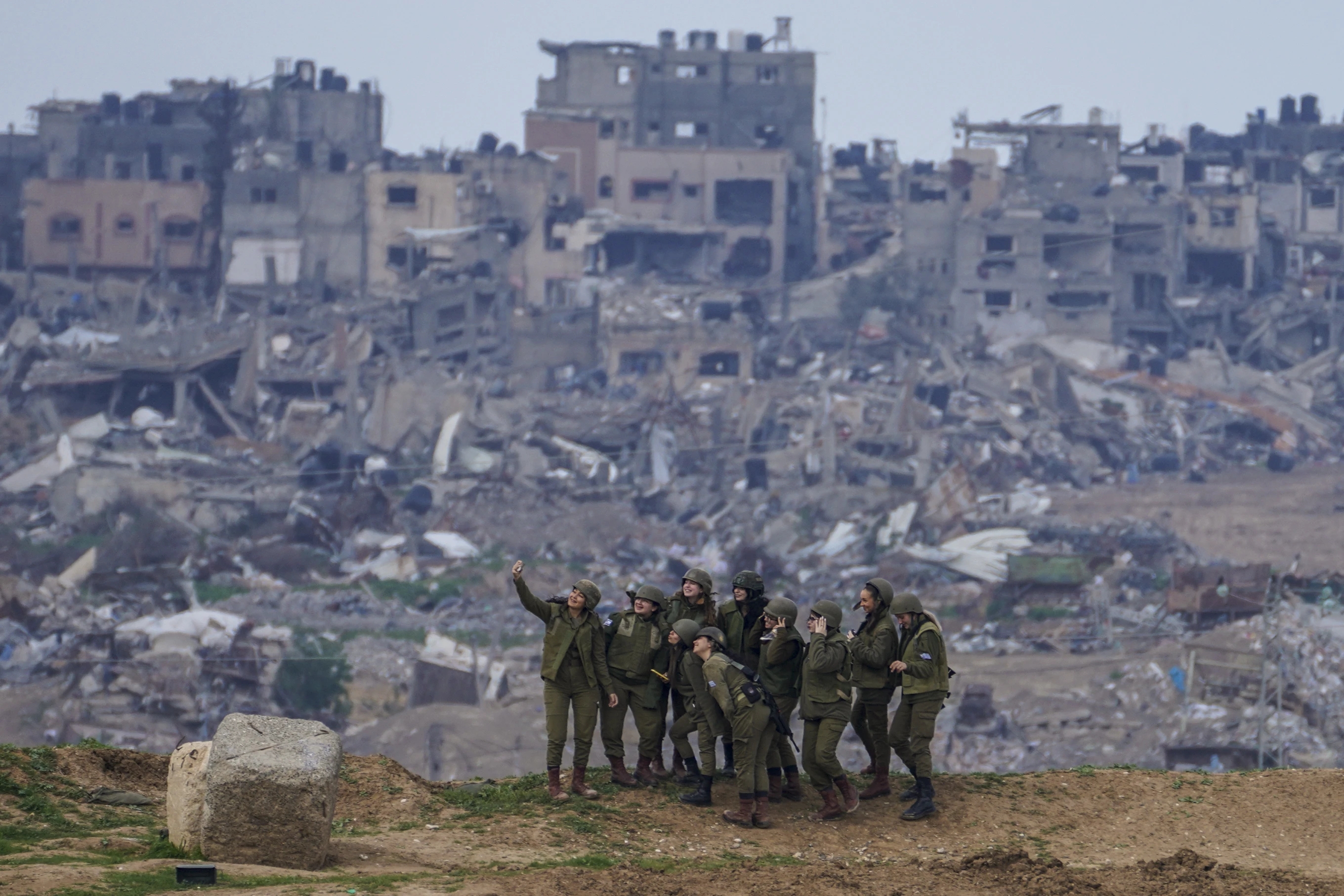
How Do We Celebrate Passover this Year?

(AP Photo/Tsafrir Abayov)

So many people have told me that they are not sure how – or even if – they will celebrate Passover this year. With the genocide and forced starvation of the people of Gaza deepening with no end in sight, they say, it just feels beyond challenging to celebrate a festival of Jewish liberation. To make the moral dissonance even more dissonant, many in the Jewish communal establishment are framing Passover by focusing exclusively on the Israeli hostages in Gaza and call for their liberation from Hamas, with nary a mention of the 34,000 Gazans who have been destroyed in the process through a terrifying war of vengeance.

I personally understand this dissonance – and I certainly don’t begrudge those who choose to scale back or forgo Passover this year. Personally speaking, I’ve chosen to lean in to the festival nonetheless. Despite all the challenge and pain this Passover, I believe the festival can offer us a deeper understanding of what is really transpiring in Gaza at the moment, and how we might respond to it.

In some ways, it seems to me that Passover is a kind of lens that reveals the inner nature of Jewish identity itself, through the deep dialectic between the particular and the universal. For many Jews, Passover is first and foremost about us. This approach identifies deeply with the servitude and liberation of the Jewish people throughout our history, refracting the Exodus story against centuries of anti-Jewish oppression and Jewish survival.

However, this is certainly not the only way to read the Exodus narrative. This is, after all, a mythic story, and one that has been universally embraced by a myriad of spiritual, political and social liberation movements throughout history. Oppressed people and peoples other than Jews have long identified with the experience of the Israelites: MLK, for instance, would routinely frame the civil rights movement in the context of the Israelites’ struggle against the tyranny of Pharaoh in more than a few of his sermons and speeches.

As a Jew who cherishes the value of universalism, this is how I’ve come to understand the Exodus story and the festival of Passover: as a commemoration of Jewish struggle and liberation alongside so many others past and present. On every Passover in every generation, we must ask the question out loud: who is Pharoah and who are the Israelites? Indeed, in the age of Zionism, I believe this question resonates with deep moral reckoning. As I wrote in an article during Passover 2016 (with words I could have easily written in this very moment):

As I watch this tragic process unfold this Passover, I find myself returning to the universal lesson this festival imparts on the corrupt abuse of state power. Although the Exodus story is considered sacred in Jewish tradition, it would be a mistake to assume that the contemporary state of Israel must be seen as equivalent to the biblical Israelites.

On the contrary, any people who suffer under oppressive government policies are, in a sense, Israelites. And any state — even a Jewish state — that views a people in its midst as a demographic threat can become a Pharaoh.

In Tzedek’s seder supplement for this year, we make this universal moral assertion clear in our opening reading when we proclaim, If we read the Passover story as a story of Jewish liberation alone or – God forbid – Jewish liberation at the expense of others, we will not have fulfilled the requirements of the Passover seder. Through this approach to Passover, we reject the view that casts the Jewish people as eternal victims. We affirm that Jews are among a myriad of peoples who have struggled for liberation throughout history. And we reject the zero-sum mindset that other peoples’ freedoms must be swept aside in order to make way for ours.

I realize that this approach to Passover may feel a bridge too far for many Jews: either those who vehemently reject viewing Palestinians as Israelites, or those for whom it is just too painful to gather around the seder table at such a particularly tragic time. But I can’t help but believe that Passover – and Jewish spiritual tradition itself – is creative and resilient enough to give our community a way forward with moral courage, commitment and grace.

Sending blessings for a liberating Passover.

On Tu B’Shevat, Our Call for Ceasefire Affirms the Sacredness of All Life

Guest Post by Maya Schenwar

Remarks by Maya Schenwar, from last night’s Tu B’shvat gathering sponsored by Tzedek Chicago and the Jewish Fast for Gaza. (Maya is director of the Truthout Center for Grassroots Journalism. She is also a coordinator of the Jewish Fast for Gaza and a member of Tzedek Chicago.)

Many of those of us involved in Jewish Fast for Gaza are breaking our fast tonight. We’ve been fasting weekly on Sundays since mid-October, and we will keep fasting weekly until a ceasefire. We donate the money we would’ve spent on food to organizations supporting people in Gaza in this time of starvation and mass death. And each week, we are also reflecting on and renewing our commitment to solidarity with our Palestinian co-strugglers and people around the world who are calling for an end to this genocide, an end to US funding for Israel’s weapons, an end to colonization and apartheid.

When we call for a ceasefire, when we fast for a ceasefire, we are uplifting a call for life. In the months since October 7, I’ve heard many people quote Ruth Wilson’s Gilmore’s sacred words, “Where life is precious, life is precious.” And one of the things Ruthie is saying, with that message, is that in societies where life is actually treated as precious—where they don’t have the death penalty and life sentences and large-scale state violence and state-sanctioned environmental devastation—in those places, violence is less likely overall, the culture is less violent, because life is affirmed.

We should bear in mind that as the US fuels Israel’s genocide in Gaza, here in the US, Alabama is preparing to carry out the US’s first execution via nitrogen gas—which is torture—on the day of Tu B’Shvat.

People are more likely to treat life as precious when their own lives are treated as precious. So we have to create the conditions in which everyone’s life is treated as inherently sacred and irreplaceable. That work is on all of us.

Our Fast for Gaza draws inspiration from the Jewish tradition of fasting as an act of mourning, and it also draws inspiration from Palestinians incarcerated inside Israeli jails, who have launched many hunger strikes to protest their incarceration, and the incarceration of all Palestinians under occupation, to INSIST that their lives are precious.

When Ruth Wilson Gilmore first introduced this idea—where life is precious, life is
precious—she was at an environmental justice conference for youth, where, among other things, the youth denounced the effects of pesticides, including on humans– and of course, pesticides also have impacts on native plants and animals. I think this is significant, for Tu B’Shvat. Recognizing that all life is precious means recognizing our interconnection with all life around us. It means we need to, in the words of Thich Nhat Hahn, “awaken from the illusion of our separateness.” It means recognizing the ways that trees have been weaponized to push Palestinians off their land. It means recognizing Israel’s mass destruction of olive trees.

Trees themselves recognize that where life is precious, life is precious. Forests are social
systems in which trees support each other through their root systems, through chemical signals in their leaves, through the social climate they create. As we celebrate the trees’ birthday today, we can also celebrate their preciousness, the preciousness of all the life they nurture and that nurtures them. And we can express that through our urgent calls for a ceasefire, for Palestinian liberation, and for collective liberation.

When we say ceasefire now, we are also saying environmental justice now. When we say ceasefire now, it is a call for Indigenous liberation now, from Palestine to Turtle Island and beyond.

Ceasefire now can be a call to stop death penalties of all kinds, including this execution that is set to happen in our own country on the day of Tu B’Shvat. Let’s insist on the preciousness of people, and of trees, and of the interconnectedness of all beings.

Chag Sameach and peace to you all.

Reenacting Pharoah’s Genocidal Decree in Gaza

(Photo: EFE)

The introduction to the book of Exodus, which we begin reading this Shabbat, has never resonated so deeply or so powerfully for me as it does this very moment.

We’re all familiar with the events that spark the Exodus narrative: a new Pharoah arises over Mitzrayim who does not know or remember Joseph. Alarmed that the Israelite minority is growing, he oppresses them with forced labor – but the more he oppresses them, the more the Israelites increase in number.

Pharoah then attempts to stem the Israelite birth rate directly by ordering the Hebrew midwives Shifra and Puah to kill every newborn boy. When they defy his order, Pharoah orders that every newborn boy be cast into the Nile. Commentators differ on why Pharoah made this very specific decree. Some say that in his paranoia, he believed the boys would eventually grow up to be soldiers and take up arms against his people. Other say his soothsayers predicted the birth of Moses. Still others say Pharoah believed that the Israelite women would intermarry and assimilate into the majority culture.

Whatever the reason, it is striking to note that Exodus’ liberation narrative begins with Pharoah’s efforts to head off the Israelite birth rate. As I’ve noted before, there are powerful parallels between this narrative and the state of Israel’s regard of the Palestinian people as a “demographic threat” to their Jewish majority. But in the midst of Israel’s genocidal assault on the people of Gaza, I’m finding that these verses now resonate with a brutal – and almost unbearable – urgency.

On November 3, less than a month into Israel’s military bombardment of Gaza, UNICEF, the World Health Organization and other NGOs reported that “Women, children and newborns in Gaza are disproportionately bearing the burden of the escalation of hostilities in the occupied Palestinian territory, both as casualties and in reduced access to health services.” More recently, the UN estimated that “around 50,000 pregnant women are currently living in Gaza, with more than 180 births taking place every day amid the ‘decimation’ of its healthcare system.”

The most devastating details on the impact of this onslaught on Gazan mothers can be read in the South African government’s application to the International Court of Justice, formally accusing Israel of committing genocide in Gaza. I strongly recommend reading this document in its entirety. Though South Africa’s claim was cynically dismissed by the White House as “meritless, counterproductive and completely without any basis in fact whatsoever,” its 84 page report is painstakingly researched, citing 574 independent sources. Though it is often near-unbearable to read, I believe it is an immensely important document and deserves the widest possible readership.

Here is a sample of the report’s findings on impact of Israel’s genocidal violence on pregnant women and newborn babies. Please be warned: the following quote it includes very graphic descriptions of traumatic violence inflicted on women and children.

Pregnant women and children –– including newborn babies –– are also particularly impacted by displacement, lack of access to food and water, shelter, clothes, hygiene and sanitation, and lack of access to health services. These effects are severe and significant. An estimated 5,500 of approximately 52,000 pregnant Palestinian women in Gaza giving birth each month are doing so in unsafe conditions, often with no clean water, much less medical assistance, “in shelters, in their homes, in the streets amid rubble, or in overwhelmed healthcare facilities, where sanitation is worsening, and the risk of infection and medical complications is on the rise”. Where they are able to get to a functioning hospital, pregnant women are having to undergo caesarean sections without anaesthetic.

Given the lack of access to critical medical supplies, including blood, doctors are being compelled to perform ordinarily unnecessary hysterectomies on young women in an attempt to save their lives, leaving them unable to have more children. Indeed, the Minister of Health for the State of Palestine, Dr May al-Kaileh, confirms that the only option facing Palestinian women in Gaza who ‘bleed out’ after giving birth is to undergo a hysterectomy in order for their lives to be saved. The lack of available drugs, such as the anti-D injection –– given to Rhesus negative women on the birth of a Rhesus positive baby –– also seriously impacts the possibility of future healthy pregnancies for affected women.

Premature births have reportedly increased by between 25-30 per cent, as stressed and traumatised pregnant women face a myriad of challenges, including being compelled to walk long distances in search of safety, attempting to escape from bombs and being crowded into shelters in often squalid conditions. Particularly in northern Gaza, cases of placenta abruption –– a serious condition that occurs to pregnant women during childbirth which is potentially life-threatening to both mother and baby –– have more than doubled.

An ever-increasing number of Palestinian babies in Gaza are reportedly dying from entirely preventable causes, brought about by Israel’s actions: newborns up to three months old are dying of diarrhea, hypothermia, and other preventable causes. Without essential equipment and medical support, premature and underweight babies have little to no chance of survival. Palestinian newborn babies have died due to the lack of fuel to supply hospital generators; others have been found decomposing in their hospital cots, medical staff taking care of them having been forced by Israel to evacuate.

On 3 November 2023, the World Health Organisation warned that “[m]aternal deaths are expected to increase given the lack of access to adequate care”, with deadly consequences on reproductive health, including a rise in stress-induced miscarriages, stillbirths and premature births. The impact will necessarily be long lasting and severe for Palestinians in Gaza as a group. By 22 November 2023 the United Nations Special Rapporteur on violence against women and girls, its causes and consequences, has expressly warned that:

“[T]he reproductive violence inflicted by Israel on Palestinian women, newborn babies, infants, and children could be qualified as… acts of genocide under Article 2 of the Convention on the Prevention of Genocide … including “imposing measures intended to prevent births within a group”. She stressed that “States must prevent and punish such acts in accordance with their responsibilities under the Genocide Convention.”

(Sections 96-100)

If there could be any doubt as to the question of intentionality behind these barbaric measures, the section immediately following these findings includes exhaustive quotes by Israeli politicians and military leaders that make their genocidal intentions all too clear. Most chillingly, it offers this quote from 95-year old Israeli army reservist Ezra Yachin — a veteran of the Deir Yassin massacre during the 1948 Nakba — who was called up for reserve duty to “boost morale” amongst Israeli troops ahead of the ground invasion: Be triumphant and finish them off and don’t leave anyone behind. Erase the memory of them. Erase them, their families, mothers and children. These animals can no longer live. . . Every Jew with a weapon should go out and kill them. (Section 102)

In this week’s Torah portion, the cry of the oppressed Israelites rises up to God, who hears and hearkens to their pain. This year, there can be no more critical question posed by our Torah portion: will God hearken to the collective cry of the people of Gaza?

The answer, as ever, is up to us all.

Lifting Up the Torah of Ceasefire in Chicago City Hall

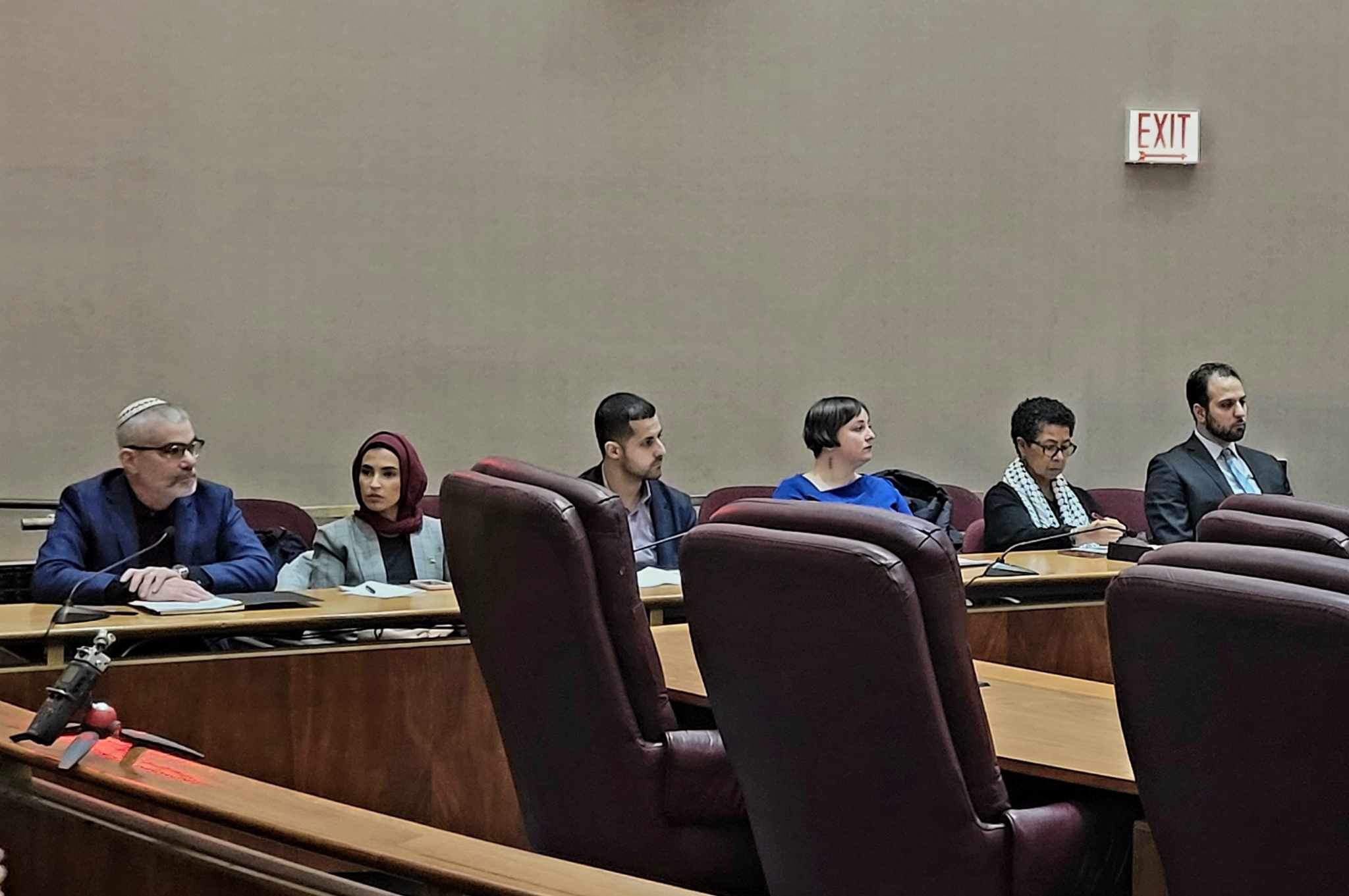
Here are the remarks, below, that I delivered at Chicago City Hall yesterday at a meeting of the Committee on Health and Human Relations as it considered an endorsement of UN Resolution 377, which calls for an immediate ceasefire in Gaza. I was among a panel of community members – which included historian Dr. Barbara Ransby and State Rep. Abdulnasser Rashid – who offered statements at the meeting. In the end, the committee voted unanimously to approve the resolution, which will now go before the entire city council in January.

As has been the case with many local legislative bodies around the county, the politics around the issue of ceasefire has been marked by deep cowardice and toxicity. In October, the city council passed a strongly worded resolution in support for Israel that only glancingly referred to Palestinians – or to Israel’s rapidly escalating military onslaught on Gaza. As it became clear that the very word “ceasefire” was a political non-starter, Alder Rossana Rodriguez-Sanchez of the 33rd Ward decided to build support for the UN resolution as chair of the Committee on Health and Human Services. Such is the politics of ceasefire in this horrid moment: it takes these kinds of torturous procedural efforts just to get a city council to call for an end to genocidal violence that has killed 20,000 people, almost half of whom are children.

Due to time constraints, I didn’t read my entire statement. Here are my remarks, in full:

I’m honored to be able to offer these remarks here today in support of this resolution. I agree with so much of the powerful testimony that was given during public comment and I want to thank the speakers for those remarks. I don’t want to go over much of what has been said other than to say I lift up the sentiment of outrage over the genocidal violence that Israel is committing in Gaza even as we speak.

But I would like to speak in particular, as a leader in the Jewish community, to many of the disingenuous and frankly false claims about Jews, about Judaism, about Zionism, about antisemitism that are being lifted up over the past two plus months during this terrible, tragic time. I hope it will at least provide a little bit of context as we start to consider the importance of calling for a ceasefire and our support of this resolution here in the city of Chicago.

We are living, at this very moment, through an extraordinary moment of reckoning. It’s not an understatement to say that the ongoing, unspeakable violence in Israel-Palestine is confronting us with the most critical moral challenge of our lifetimes. I can personally attest that this is most certainly the case in the Jewish community. Hamas’ violent attack on October 7 has deeply traumatized Israelis and many Jews throughout the world. This trauma, however, is not being manifest in one particular way. There are many Jews, myself included, who are deeply grieving these losses, who pray for the safe return of Israeli hostages – but who are also anguished and appalled at the massive violence and trauma Israel has been unleashing on the people of Gaza.

The Jewish community has never been monolithic – and it certainly has never been lockstep on the issue of Israel. And right now, the divisions within our community are becoming manifest in unprecedented ways. For the past two months, day after day, thousands of Jews have been organizing and taking to the streets throughout the country, engaging in relentless acts of civil disobedience to demand an immediate ceasefire in Gaza.

In October, there were massive protests in Washington DC, at the White House and on Capitol Hill. In New York City, Jewish protestors shut down Grand Central Station and the Statue of Liberty. Here in Chicago hundreds of Jews and allies took arrest at Ogilvie Transportation Center; last Thursday, on the final night of Hanukkah, hundreds of us marched from Daley Plaza to Boeing headquarters. This was one of eight coordinated Jewish actions that took place across the country that evening.

The events of the past two months reflect an important trend that has long been growing in the American Jewish community. The traditional legacy Jewish organizations, who have typically purported to speak for the Jewish community have become increasingly out of touch on the issue of Israel-Palestine. Over the past two decades, every Jewish communal survey has shown support for the state of Israel steadily eroding in the American Jewish community. 

Moreover, the percentage of Jews – particularly young Jews – who identify as anti-Zionist is growing. We are pushing back strongly on the fallacy that Judaism = Zionism – and the deeply disingenuous accusation that anti-Zionism is antisemitism. We hear this claim being made repeatedly by the state of Israel and its advocates in the American Jewish establishment. Here’s but one example: Jonathan Greenblatt, the CEO of the Anti-Defamation League, who has been repeating this accusation over and over again in recently said this in an interview with the New Yorker:

Zionism, a desire to go back to Jerusalem, the longing for Zion, isn’t something that David Ben-Gurion came up with. It isn’t something that Theodor Herzl came up with. It has been embedded in the faith and the traditions of Judaism for thousands of years. You can’t open a Torah on a Saturday morning for your daily prayer, you can’t go through a holiday, without seeing these references.

I’d like to address this claim head on because it a deeply inaccurate statement – and in its way, even dangerous. Greenblatt is of course correct that there is an important connection in Judaism to the Land of Israel. And yes, this connection is quite clear throughout the Torah, liturgy and Jewish tradition in general. However – and this is a big however – the notion of creating a political Jewish nation state was never part of Jewish tradition until the rise of the Zionist movement in the 19th century.

Judaism is a centuries-old Jewish peoplehood. Zionism is a political movement of modernity that arose in Europe that sought to radically change Jewish identity and Jewish life. For most of Jewish history, the yearning to return to Zion was expressed as an idealized messianic vision. Some Jews made pilgrimage to the land. And a small minority of indigenous Jews consistently lived in historic Palestine throughout the centuries. But the rabbis fervently opposed the establishment of a 3rd Jewish commonwealth in historic Palestine. They actually considered it to be blasphemous – a “forcing of God’s hand” to create something that could and should only occur in the messianic age.

From the very beginning, there has always been principled Jewish opposition to Zionism. Many Jews have embraced anti-Zionism not as a matter of traditional messianic belief, but as a matter of Jewish moral and political conscience. We recognize that there is a fundamental injustice at the core of Zionism, namely, the creation of a Jewish majority state through the dispossession and oppression of another people.

It is important to note that political Zionism is a form of ethno-nationalism. In other words, the Jewish identity of the state of Israel is predicted on the maintenance of a majority of one particular group of people in the land. Up until 1948, Jews were a minority in Palestine – and this necessarily posed a problem for the Zionist movement. In the end, the state of Israel could only be created one way: through what Palestinians refer to as the Nakba. Today, even many Israeli historians agree: the state of Israel was founded through the ethnic cleansing of Palestinian Arabs from their homes and Israel’s refusal to let them return. This is what happened in 1948 – and this dispossession of Palestinians to make way for a Jewish state has been happening every day for the past 75 years.

In 2021, B’Tselem, a respected Israeli human rights organization released a 300-page report in which it concluded, “The Israeli regime, which controls all the territory between the Jordan River and the Mediterranean Sea, seeks to advance and cement Jewish supremacy throughout the entire are.” I want to make this clear: a prominent Israeli human rights organization has said that Israel has created a regime of Jewish supremacy between the river and the sea. This is not an antisemitic claim – it is a claim rooted international law and human rights. This is what it means when Palestinians and solidarity activists call for Palestine to be free “from the river to the sea” – they are expressing basic human rights that we all take for granted – or should. And it is not antisemitic to say so.

Are there some individual anti-Zionists who antisemitic? Undoubtedly. But it is disingenuous and wrong to claim that anti-Zionism is fundamentally antisemitic. As I said earlier, there are increasing numbers of Jews, myself included, whose are anti-Zionist as a deep expression of our Jewish values. Torah teaches that all human beings are created in the divine image, that we must seek justice and liberation for all. It teaches that love for Zion is not divine entitlement to a piece of land, but an expression of a Zion consciousness. That the land – like the entire earth itself – does not belong to us but to God, and we are but strangers upon it.

Another central precept of Judaism is the prophetic injunction, “Not by might and not by power, but by my spirit, says the Lord of Hosts.” This sacred imperative is what compels us to reject Israel’s militarism or to affirm in any way that Jewish state power will keep Jews safe. If there was ever any doubt, the events of the last two months should make this abundantly clear. It makes us all less safe – Jewish and Palestinians alike. And make no mistake: if this nightmarish war should spread through the region, it will endanger the safety and security of us all.

This why so many of us in the Jewish community are literally taking to the streets, calling for an immediate ceasefire and return of all hostages. This is why we welcome and support resolutions like UN Resolution 377. And this is why we are urging our political leaders, on every level, to join the call for ceasefire. This is moment of deep moral reckoning for us – and for the world. History will judge us by our action or our inaction in this critical moment. And that is why I urge us all to support the cause of justice and peace for all who live between the river and the sea – and for all who dwell and earth.

Again, I thank you for giving me the opportunity to speak to you today.

How Do We Suspend Our Mourning for Israel/Palestine on Shabbat ?

photo: Washington 7 News

According to Jewish law, it is forbidden to mourn on Shabbat: between sundown on Friday and sundown on Saturday, funerals do not take place and the public aspects of shiva observance are suspended. For many, the very notion “forbidding mourning” can feel harsh and emotionally insensitive. I’ve often heard from mourners who resist this idea of “suspending their grief.” More than one congregant has pointed this out to me over the years: “Grief isn’t something I can just turn on and off. How do I possibly stop my grieving for this one day? Should I pretend that Shabbat will just magically make everything better?”

One way to answer to this question is to understand the difference between grief and mourning. While grief is an emotional state; mourning refers to the rituals and practices we observe to help us manuever through our experience of loss. Of course, we cannot turn our grief on and off, nor should we be expected to. Grief by its very nature cannot be scheduled to our convenience. As anyone who has experienced the loss of a loved one will attest, the emotions that attend grief will invariably grip us with unsettling randomness – often when we least expect it.

When we suspend certain mourning practices on Shabbat, however, even in the midst of intense grief, we affirm a life beyond the loss, beyond the pain. Shabbat is our weekly reminder of this: our regular opportunity to experience olam haba – “the world as it should be.” When we suspend these rituals on Shabbat, we make a point of affirming healing during the most painful times in our lives. In some ways, it feels like nothing less than an act of spiritual defiance. 

For over a month now, it has been a time of unimaginable, exponential, cascading grief on a scale few of us have ever seen. Israelis and scores of Jews the world over are still experiencing deep shock and trauma over Hamas’ brutal attack on October 7. Even as I write these words, we do not know the full extent of these massacres and abductions – many still do not know if their loved ones are alive or dead, whether they were killed or taken hostage. We are still learning the heinous nature of the attacks that unfolded on that terrible day. How does one even begin to mourn when faced with grief of such magnitude?

Tragically, we were never given the opportunity to learn the answer to this question. Only a few days after this attack, the Israeli government chose to respond with a vengeful military onslaught. As so many have now observed, Israel “weaponized its grief” against an imprisoned population of 2.2 million Palestinians trapped in Gaza with nowhere to run. The exponential human loss Israel has unleashed is truly beyond comprehension: to date, the current death toll: 12,000 people, including 5,000 children. 

For so many of us, the only work of the past six weeks has been to voice our collective conscience as loudly, as often and as fiercely as possible. We have been bearing witness to the most sacred values of our tradition: pikuach nefesh – saving a life is sacrosanct and tzelem elohim – affirming that all humanity is created in the divine image. All of these values are embodied in the two sacred words we’ve been chanting over and over and over again: “Ceasefire Now!” To end this vengeful, genocidal violence. To negotiate a homecoming for hostages and prisoners. To begin the process of rebuilding and healing through a process of just peace for all.

No, as Shabbat falls this evening, we will not “switch off our grief.” We will not deny this all-pervading, still unfolding pain. But we will affirm a world beyond it.

We know all too well that in moments of brokenness, it is difficult to imagine a world beyond. We know from experience that brokenness, by definition, involves loss. We know that what is broken can never be put back exactly the same way it was. But beyond the loss, Shabbat comes to remind us that no matter what, we never forfeit the chance to rebuild and heal. While grief can break us open, it also has the potential to transform us: opening us up to new visions, new opportunities, new worlds that we never may have dreamed possible.

In this moment, when so much around us seems to be shattering into so many painful shards, let us hold tightly to this truth.

Speaking the Unspeakable on Israel/Palestine: Sermon for Yom Kippur 5784

phot: Hiroko Masuike/The New York Times

An op-ed version of this sermon was published in Truthout

Jewish tradition teaches that words have a sacred power. In the very beginning of the Torah, God creates the world itself through the power of the word. In the book of Exodus, the Israelites speak as one people at Sinai, thereby entering into a covenant with God. It is said that on Yom Kippur, the High Priest would enter the Holy of Holies in the Jerusalem Temple and utter the otherwise unspeakable name of God – and at that moment the fate of the very world would hang in the balance. On Yom Kippur, we ourselves stand as a community and say the words of our collective confessions together. As our liturgy would have it, we may not be written into the book of Life for the new year unless we speak these words out loud.

In their way, the power of words is akin to energy. Once they are spoken, they are out in the world – and from that point on there are a myriad of ways their impact might be manifest. Sometimes their power will remain dormant. Other times, our words can be the conduit for deep and powerful transformation.

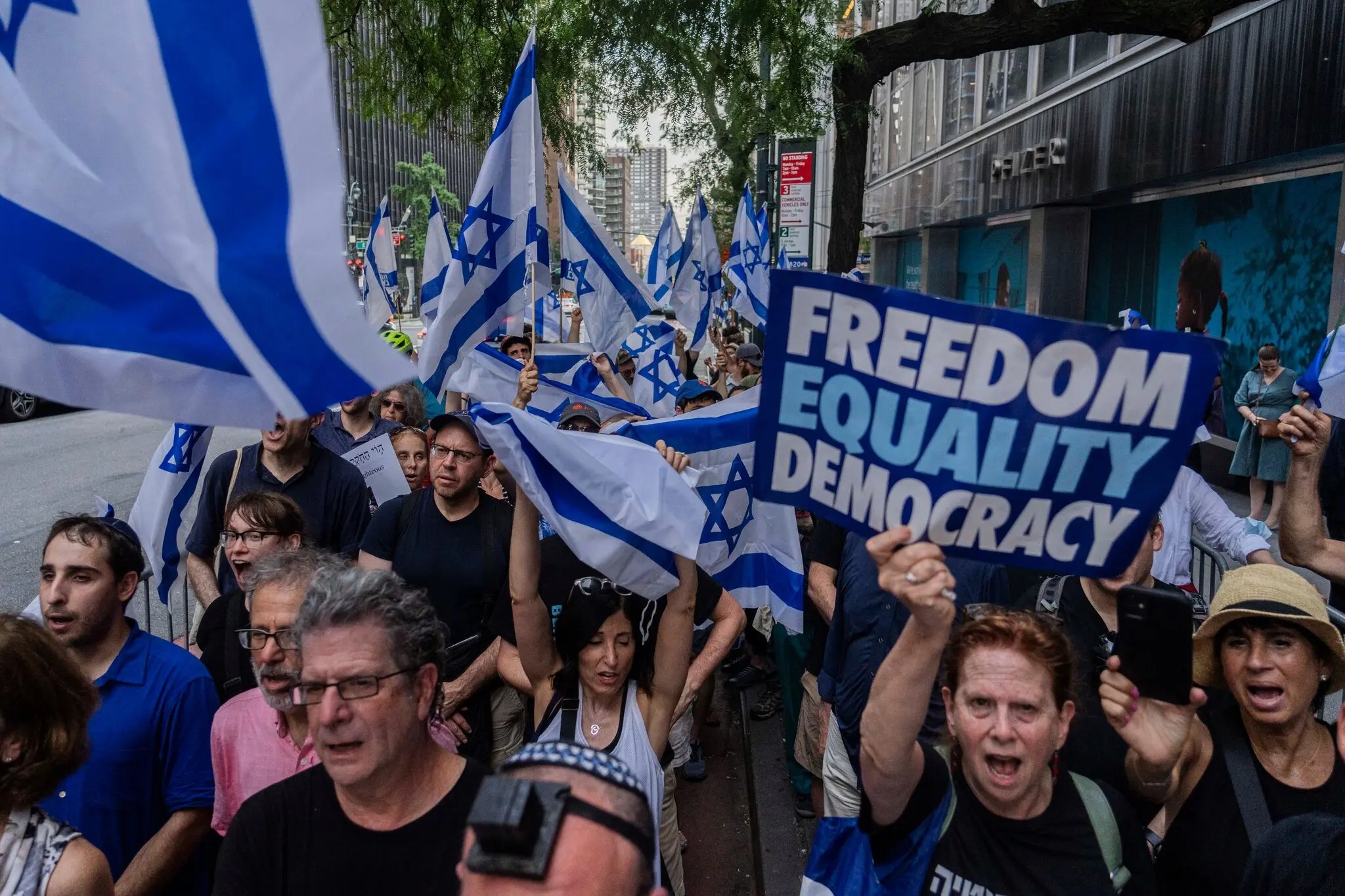
I think a great deal about the impact of our words when it comes to the issue of Israel/Palestine. We have witnessed their power for instance, over the course of this past year, as thousands of Israelis have been holding regular demonstrations against the current Israeli administration and its plans to limit the power of the Israeli judiciary. Week after week, protesters have chanted words in the streets and carried them on signs, expressing their collective outrage over the government’s “threat to Israeli democracy.” More recently, many in the American Jewish community – including many rabbis – have voiced their support for these protests and have even been staging public protests of their own.

On one level, it could be said that these massive rallies have had a powerful impact. They are the largest and most sustained protests in Israeli history and the most massive mobilization of the Israeli left in years. The rhetoric of the rally has also empowered Zionists in general. Many who advocate for Israel will often refer to it as “the only democracy in the Middle East.” I would suggest that the use of this word is powerful for all the wrong reasons. It covers up the reality that while Israel may be a democracy for Jews, it is decidedly not one for Palestinians. Indeed, for many centrist and right wing Israelis these demonstrations are important because they bolster the illusion of democracy. In so doing, they serve to entrench Zionism and strengthen the Jewish state.

It is true that at many of these demonstrations, there have been some chants and signs condemning Israel’s “occupation. However, this is an oft-invoked word that can mean different things to different people. For some it refers only to Israel’s military occupation of the West Bank and Gaza. For others it also includes annexed territories such as East Jerusalem and the Golan Heights. For still others, the entire land between the river and the sea is considered to be occupied territory. Thus, when the word “occupation” is invoked during the demonstrations, there is little clarity on what it actually means – or what is actually being demanded.

There is yet another powerful word that has recently emerged in relation to Israel/Palestine, and that word is “apartheid.” Last year, three respected human rights organizations: Amnesty International, Human Rights Watch and the Israeli group B’Tselem, all released well-researched reports concluding that Israel is an apartheid regime. Over the past year, many surprising figures have also been increasingly using this word in relation to Israel, including a retired Israeli general.

This past year, a letter was posted online by Israeli academics that openly criticized American Jews for “(paying) insufficient attention to the elephant in the room: Israel’s long-standing occupation.” The letter pointedly stated that “there cannot be democracy for Jews in Israel as long as Palestinians live under a regime of apartheid, as Israeli legal experts have described it.”  The so-called Elephant in the Room Letter was widely distributed and was eventually signed by Jewish leaders and figures – to date it has over 2,700 signatures.

With liberal Jewish leaders increasingly willing to use the “A” word in public, there is every indication that it is losing its stigmatized, transgressive status in the Jewish community. But even here, the meaning of the word “apartheid” depends on how it is used. The B’Tselem report, for instance, claims that Israeli apartheid extends “from the Jordan River to the Mediterranean Sea.” The Israeli general, on the other hand, limited it to the West Bank alone.

There are also those who would say that the term “apartheid” itself doesn’t go far enough – that it is a technical term from international humanitarian law that has limited legal applications. Many would argue that the word “settler colonialism” is much more powerful and meaningful because it is related to decolonization – a concrete process of action that includes the return of refugees and reparations to the Palestinian people.

Yes, all of these words do indeed have a complex kind of power when it comes to Israel/Palestine, and I’m often fascinated by the strategic ways we utilize this power. Years ago, I used to avoid controversial and potentially incendiary words in connection with Israel, feeling that they might well alienate and push away the very people I was trying to reach. I would typically use words I thought were less triggering: “dispossession” instead of “ethnic cleansing,” “non-Zionist” instead of “anti-Zionist,” “occupation” instead of “settler colonialism.”

I feel differently about this now. I actually think it’s important to use words such as these. I believe it’s important to name oppression explicitly and not to soften it with euphemisms. If some words make people uncomfortable, that’s OK. Once a word is said, it can’t be unsaid. It’s now part of the discourse. While some may well recoil from that word, they may well come around to accept it in time.

Words can indeed push the line of what is considered acceptable. But they can also represent one step too far, or the crossing of a line. There is still, for instance, a hard line drawn on the word Zionism. For most Jews, it is still considered beyond the pale to refer to oneself as an anti-Zionist: to break not just with the Israeli government, not just with the 1967 occupation, but with the very concept of an exclusively Jewish nation-state.

Apropos of Yom Kippur, it seems to me that when we say these words and cross this particular line openly, we’re really making a kind of confession. It’s not merely a political opinion – it’s an ethical admission that our Jewish identity has been inextricably connected to the oppression of another people.

When I was growing up, I was routinely taught that Zionism was the national liberation movement of the Jewish people. But I was never taught that this “liberation” came at the expense of another people. Like many American Jews, I was raised to view the establishment of the state of Israel as the exclusive Jewish homeland; a Jewish refuge after centuries of persecution; a redemptive homecoming following the collective trauma of the Holocaust.

Our trauma has been compounded by the sense that the world was complicit in it – that the Jewish people were abandoned by the international community. To be sure, the allied nations should rightly bear deep shame for their inaction during the Holocaust and their refusal to accept Jewish refugees following the war. But even as collective Jewish trauma is all too real, it was tragic and profoundly wrong to justify it by inflicting trauma on another people: by establishing a Jewish state on their backs and creating what has now become the largest refugee population in the world.

When Jewish Zionists publicly confess and act on the truth of this history it can often shake their Jewish identity to the core. This phenomenon often reminds me of something James Baldwin wrote in his classic 1962 essay, “A Letter to My Nephew:”

As you will discover, people find it very difficult to act on what they know. To act is to be committed and to be committed is to be in danger. In this case the danger in the minds and hearts of most white Americans is the loss of their identity. Try to imagine how you would feel if you woke up one morning to find the sun shivering and all the stars aflame. You would be frightened because it is out of the order of nature. Any upheaval in the universe is terrifying because it so profoundly attacks one’s sense of one’s own reality.

Though Baldwin was addressing white supremacy in the US, I think his words are equally applicable to Jewish supremacy in Israel. Zionism has become such an indelible part of Jewish identity that it has caused us to enable – or at the very least tolerate – the oppression of another people. The power of this mythic Zionist narrative manages to keep the truth of this ongoing oppression at bay, lest it causes everything we once held so dear to come crashing to the ground.

I experienced this upheaval personally in 2008, at my former congregation. During Israel’s military assault on Gaza, I experienced deep anguish – and I expressed those feelings in a blog post. While I had often been critical of Israel in the past, this was very different. Rather than using the usual words, calling for “balance” and a plea for “peace on both sides,” I used strong and angry language, explicitly naming Israel as the oppressor. I concluded my post with these words:

We good Jews are ready to protest oppression and human rights abuses anywhere in the world but are all too willing to give Israel a pass. It’s a fascinating double standard, and one I know all too well. I understand it, because I’ve been just as responsible as anyone else for perpetrating it.  

So no more rationalizations. What Israel has been doing to the people of Gaza is an outrage. It has brought neither safety nor security to the people of Israel and it has wrought nothing but misery and tragedy upon the Palestinian people.

There I said it. Now what do I do?

Now many years after later, I realize that post was a kind of confession. Though I didn’t know it at the time, when I wrote those words I was actually crossing a line that would eventually force me to leave my congregation. To use Baldwin’s words, it was upheaval so profound that it attacked my sense of my own reality. I was fairly sure I couldn’t continue as a congregational rabbi – and I wasn’t completely sure what kind of Jew I would be either.

But as I said earlier, once our words are out in the world, there are myriad ways their power might be manifested. I was eventually able to recover my Jewish identity along with my Jewish conscience. Speaking those words was unexpectedly liberating. I discovered there were other Jews like me – lots and lots of them. And together we became part of an emergent Jewish community that had the freedom to say out loud what must be said. I have no illusions that there is a distinct minority of Jews on this side of the line, but I also know that there are many who are now crossing over, breaking their silence on Israel/Palestine in unprecedented ways.

In its way, this new Jewish community is creating a new counter-narrative to the Zionist narrative that has been dominant for so long. One critical part of this counter-narrative is the understanding that standing in solidarity with Palestinians is a mitzvah – a sacred act. When it comes to solidarity in particular, words are enormously important. Those who engage in solidarity with disenfranchised people know that while words may have great power, words can quickly lose their power if they do not lead to action.

Indeed, history is littered with the betrayal of empty words, promises unkept and treaties broken. Staying true to one’s word can often be a challenge for those who are trying to practice solidarity in good faith. The growing popularity of land acknowledgements is a good example. Land acknowledgements are significant and important, but as many Native people have pointed out, they amount to empty words unless they contain accountability – unless they exist in a larger context of decolonization and reparation. As President Robert Larsen of the Lower Sioux Indian Community has put it, “An apology or an acknowledgment is one thing, but what are you going to do next?”

The same applies to those of us who express solidarity with the Palestinian people. Yes, the words we say matter, but unless they lead to genuine transformation, they will remain little more than empty words. To return to my metaphor of energy, words represent the initial spark, but once kindled, it takes real effort to sustain and increase its power. We must take active responsibility to maintain that initial spark by acting on our words, lest it eventually sputter out.

Putting our words of solidarity with Palestinians can take many forms, but a core priority requested by Palestinian civil society groups is support for BDS – the Palestinian-led Boycott, Divestment and Sanctions movement. In this regard, I encourage those who are able to attend our Yom Kippur afternoon program today. We will be hosting a conversation with Omar Barghouti, the co-founder of the BDS national committee, whose presentation is entitled, “Repentance, Reparation and Ethical Reconciliation: A Palestinian Vision for Common Liberation.” Omar was deeply honored to be asked to be our teacher for Yom Kippur – but as I told him, I could think of no more appropriate way for a congregation such as ours to observe this day.

I also want to remind our members that Tzedek Chicago was one of the first congregations to sign a pledge from the Apartheid-Free Communities initiative, a newly created interfaith coalition convened by the American Friends Service Committee. In that statement, signatories pledge “to join others in working to end all support to Israel’s apartheid regime, settler colonialism and military occupation.” Now that we have publicly made this pledge, it will be our challenge to live out these words as a community – and in the spirit of Yom Kippur, I want to encourage us to explore what this will mean for our congregation in the years ahead. By signing this public pledge, it is also our hope that it will give other Jewish congregations and organizations the courage to speak these previously unspeakable truths as well.

In the Shacharit service – the Jewish morning prayer – we say the words, “Baruch she’amar ve’haya ha’olam” – “Blessed is the one who spoke and the world became.” While this literally refers to God but it is also a statement about the potential within each and every one of us. Our words have the power to transform our lives and our world – indeed, to create whole new worlds anew.

So let this be our collective blessing this Yom Kippur: let us find the courage to speak the words that must be spoken. Let our words kindle sparks of possibility, and may they inspire us all to create the world we know is possible: a world of Tzedek/Justice, of Tikkun/Repair and of Shalom/Wholeness for all who dwell on earth. 

Confronting the New COVID Normal: Sermon for Erev Yom Kippur 5784

(photo: Jose Carlos Fajardo/Bay Area News Group)

The High Holidays we observed in 2020 were like none we’d ever experienced before. We were in the midst of the COVID lockdown – and like every other synagogue, we held our services entirely on Zoom. It all felt utterly unprecedented and surreal – apropos of a year in which pretty much everything felt unprecedented and surreal.

On Rosh Hashanah, I addressed the pandemic directly, suggesting that we were all in a collective state of grief – both for those had died and for the world we had lost:

Amidst all of this massive change, even as we adjust to this new world, there’s that nagging question lurking in the background: how long will we actually have to do this? When will we get our lives and our world back? When will things get back to “normal?”

I think it’s safe to say we’ve come a long way in the three years since then. Just a few months after I spoke those words, the first COVID vaccine was administered – and since that time, COVID related deaths and hospitalizations have decreased dramatically. Lockdown orders have been lifted, mask mandates have disappeared and social distancing requirements are now a thing of the past. While a large percentage of the workforce are still working from home, increasing numbers are returning to their workplaces. 

We’re also receiving a confident political message that things are getting “back to normal.” A year ago, President Biden publicly declared that the pandemic was over during an appearance in 60 Minutes. This past May, his administration ended the Public Health Emergency Declaration, dramatically reducing funding for COVID vaccines and treatments. In its announcement, the White House claimed that “(COVID-19) no longer meaningfully disrupts the way we live our lives.”

Is this actually true? Are things really getting back to normal? Technically speaking, the pandemic is not over, though we fervently wish it were. Thousands continue to die every week – in the US, nearly one hundred are dying every day. In recent weeks, a spike has caused a sharp increase in hospitalizations, a dramatic reminder that COVID is still very much a part of our lives and our world. 

What’s the reason for this normalization? On a purely human level, I think it’s pretty easy to understand. We want our lives back. We don’t want to live with uncertainty and upheaval any more. We crave the connection and community that we once knew. We want things to feel normal again. 

But no matter how fervently we might back our days of old, things are still not normal. On so many levels. 

In the first place, things are not certainly normal for the loved ones of the millions who have died of COVID. Almost 7,000,000 people have died from COVID globally since the pandemic began – including over 1,000,000 in the US. The mass grief caused by this pandemic is still very palpable and very real. For those who are just beginning to struggle with the loss of a parent, a partner, a child, the suggestion that it is time for things to “get back to normal” is quite simply, profane. 

This insistence on normalcy dismisses the massive, life-altering consequences of these losses. Many who died of COVID were the primary or sole wage earner in their household. Moreover, hundreds of thousands of children in the US – and over 10 million children worldwide – have lost a parent or caregiver to COVID. According to a report last December by the Covid Collaborative, more than 13,000 children have lost their sole caregiver; children who were already more socially and economically at risk. 

COVID normalization also amounts to an abject abandonment of elderly people in our communities. Hospital admissions, while dropping, are more than five times higher among people over 70 than those in their 50s. COVID also disproportionately affects immunocompromised, disabled and chronically ill people, whose humanity is routinely dismissed by US government and health officials that treat their conditions as expected, and thus somehow more acceptable. 

In a recent New York Times article about the latest COVID spike, I read one subtle paragraph that sums up the prevailing attitude toward those who are at higher risk of illness and death:

At the moment, the numbers suggest that Americans should tailor their behavior to their own risks, some experts said. Those who are the most vulnerable to COVID — older adults, pregnant women and those with weakened immune systems — might well choose to take the utmost precautions, such as masking most or all of the time and avoiding crowded indoor spaces.

In other words, those who are the most vulnerable people are essentially on their own. Their welfare is their individual responsibility – it is not the problem of the communities in which they live. 

The changes to our world wrought by the virus remain so profound. The increasing numbers of people who have developed the post-virus condition known as long COVID will attest to its debilitating and life-altering symptoms. Scores of children have lost years of their education. Teachers, health care workers and essential service workers continue to live with acute trauma and anxiety. We’ve witnessed the massive loss of small businesses and the devastation of whole economies. The list goes on and on. Truly, it would take a great deal of willful denial to regard any of this as normal. 

The political motives behind COVID normalization, of course, are clear – and it is causing very real harm. When the Biden administration terminated the Public Emergency Declaration in May, it was essentially capitulating to congressional Republicans, who months earlier had passed a bill they called “The Pandemic is Over Act.” In so doing, it ended a vital series of protections for millions of Americans, causing what the Nation Magazine referred to as “a public health disaster.”

In the meantime, the Biden administration is also preparing to transfer COVID vaccines to the private market. For their part, Pfizer and Moderna have announced that they plan to increase the price of their vaccines by 400%, which will cost uninsured Americans anywhere from $110 to $130 per dose. Such is the human price of the new normalcy. It is, in the end, really just the entrenchment of the old normalcy. 

This human price, of course, is symptomatic of a deeper dysfunction: a system that has always divided humanity into those who count and those who do not. In their important and powerful new book “Let This Radicalize You,” Mariame Kaba and Kelly Hayes put it perfectly:

(Capitalism) requires an ever-broadening disposable class of people in order to maintain itself, which in turn requires us to believe that there are people whose fates are not linked to our own: people who must be abandoned or eliminated. 

When the COVID pandemic first broke out, it occurred to me that this virus was presenting us with a fundamentally different way to live. It was challenging us to live according to an ethic of collectivity rather than radical individualism. COVID was a dramatic reminder that our neighbors’ fates were linked to our own. And that if we were to literally survive, we had to accept that our personal well-being was inextricably tied to the well-being of all.  

People in disenfranchised communities have long understood this truth. When you live in a system that doesn’t care about you, that regards you as disposable, you learn how to care for one another. Indeed, long before the pandemic descended, poor people, people of color, disabled people, LGBTQ+ people and Native people have been creating their own communities of care through powerful mutual aid projects

The term mutual aid refers to grassroots groups that organize collectively outside the mainstream and are not dependent on the largess of external charity. While mutual aid projects have long existed in various forms, they mobilized and proliferated during the pandemic in ways that were truly inspiring to behold. As Kaba and Hayes have described it:

In spring 2020, unprecedented numbers of people organized mutual aid efforts to help their neighbors survive. Using technology to overcome the physical barriers imposed by the pandemic, tens of thousands of people started new groups and built new mechanisms within existing organizations to meet the needs of people who were struggling. From delivering groceries and medicine to helping people access remote therapy after the loss of loved ones, people across the country devised ways to care for one another. Contrary to fictitious, popular depictions of people in dire straits, many people coping with the grief, uncertainty, and isolation of the pandemic longed to connect through acts of aid and care and they did. Grassroots groups redistributed millions of dollars to people who were struggling. Empty refrigerators were stocked. Countless people in crisis were met with compassion and assistance. In a society where we are taught to fear each other, many were moved by the realization that we were and are each other’s best hope amid catastrophe. 

To my mind, these words are a powerful description of what the new normal should be. Though we must always fight to hold them accountable, governments are not going to save us. Nor will philanthropic charities, crisis response or nonprofit organizations. Collective care will ultimately be created by communities of people honoring their interconnectedness. By those who understand that they are each other’s best hope. 

As the world increasingly looks to mutual aid groups as a model for living, it will be important for privileged folks not to tokenize disenfranchised people or co-opt their efforts. But having said this, I do believe that the idea of mutual aid models a way of living for all people. One that values a culture of care: interdependence over individualism. Thriving and not merely surviving. A way of creating community that centers innate altruism and a long-term commitment to one another.

In her book, “A Paradise Built in Hell,” Rebecca Solnit pointed out that contrary to the dominant narrative, the natural human response to disaster is not an apocalyptic, individualistic “everyone for themselves” mentality. Through examining the human response to several different catastrophes, Solnit concluded, “The image of the selfish, panicky or regressively savage human being in times of disaster has little truth to it.” Rather, “most people are altruistic, urgently engaged in caring for themselves and those around them, strangers and neighbors as well as friends and loved ones.” This, I would suggest, is the true normal: a more natural culture of mutuality, not self-interest and abandonment. 

As you know, last month, the Tzedek Chicago board passed a COVID safety policy for our High Holiday services requiring all in-person attendees to wear N95 masks and have up to date vaccinations. Our board’s decision was prompted by a request from chronically ill and disabled members of our congregation, which inspired our leadership to engage in honest process of discernment. It occurred to me that these conversations were utterly appropriate to our season – a time for interrogating how we can do better in our lives and in our communities.

Though mask mandates have become politicized to an absurd degree, two-way masking is still the most effective way to mitigate the spread of the COVID virus. When healthy, younger, abled people put the burden of masking on those at greater risk, whether they realize it or not they are sending the message that they health is not their problem. As one public health expert has written:

I get it—wearing a mask can suck. I don’t exactly enjoy it, and like most people, I’d rather be living life like it is 2019. That’s the final problem with one-way masking: If we can all relate to masking being uncomfortable, why would we suggest that the immunocompromised and disabled be relegated to wearing a mask in perpetuity? 

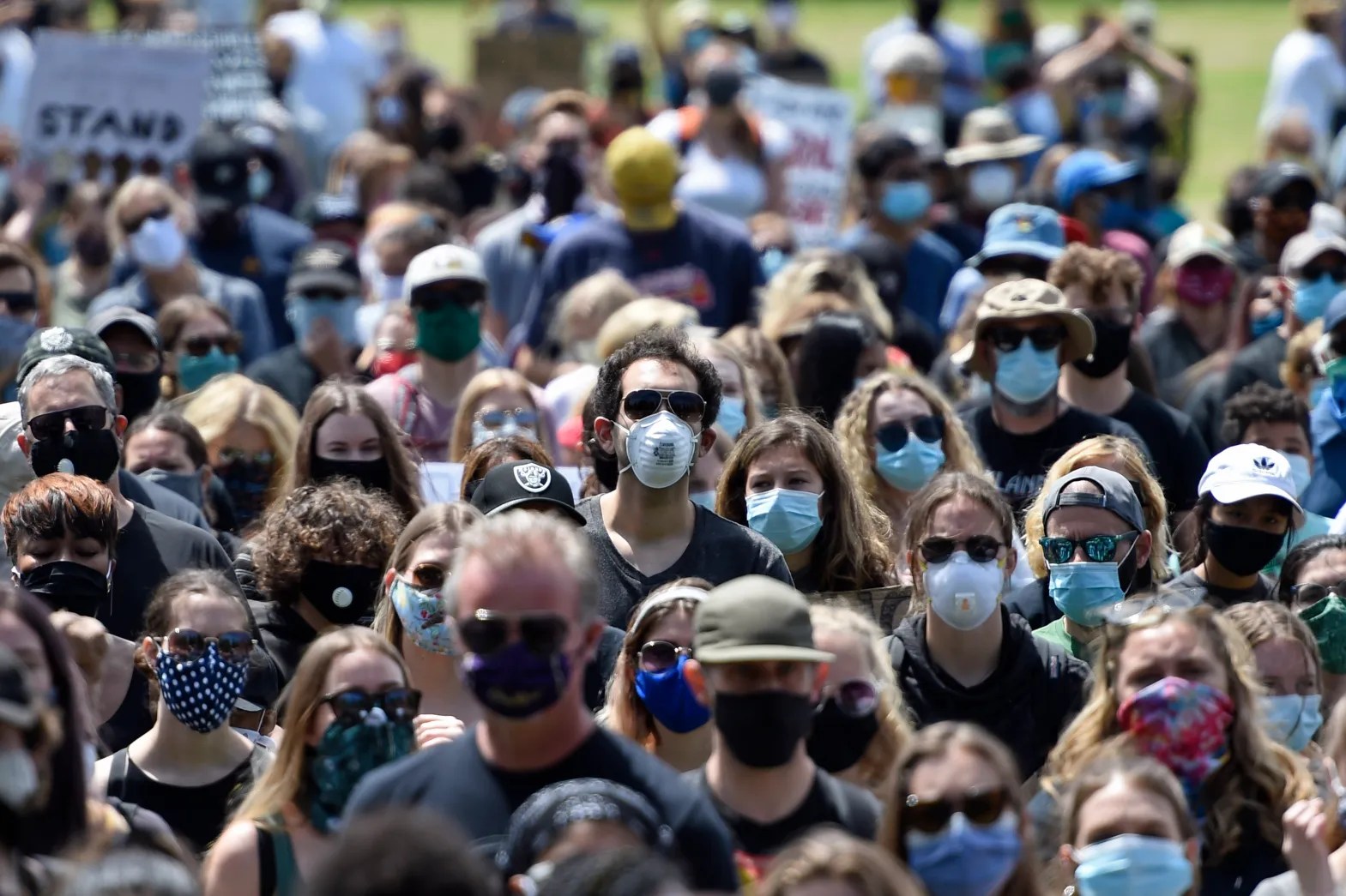
As I look out into our sanctuary now, to a room full of masked people gathering for Yom Kippur, I see a powerful visual of one community’s commitment to the health of all its members. This what the new normal should look like.

In my High Holiday sermon three years ago, I quoted the great activist poet Sonya Renee Taylor who wrote these words at the outset of the pandemic:

We will not go back to normal. Normal never was. Our pre-corona existence was not normal other than we normalized greed, inequity, exhaustion, depletion, extraction, disconnection, confusion, rage, hoarding, hate and lack. We should not long to return my friends. We are being given the opportunity to stitch a new garment. One that fits all of humanity and nature. 

Today, three years after those words were written, powerful interests are trying to convince us that it is time to “go back to normal.” We must not let them. We must continue to hold on to Taylor’s beautiful vision of a new garment, even in the face of such daunting odds. We must cherish this vision and resist the cynical voices telling us that what they are giving us is the best we can hope for. 

Because we should hope for more. We should aspire to more. After all, isn’t this what Yom Kippur is ultimately all about? Every year, at this season, we’re commanded to take a hard, unflinching look at the status quo, openly admit what needs changing, and commit to the hard work it will take to transform it. It’s an inherently radical idea: to proclaim every year that the status quo is unacceptable and that nothing short of genuine intervention will do. If our Yom Kippur prayers are to mean anything at all, we must be prepared to act upon this radical idea. 

This is also the season in which we stand before the open gates of heaven, before the open books of life and death, and pray that we may be written in the book of life for the coming year. But we also affirm that repentance, prayer and acts of justice can “avert the decree.” To me that means that we cannot wait passively for that choice to be made for us. In the end, we’ll need to take responsibility for writing our own names and the names of our neighbors in the Book of Life. If we’re going to be sealed for life, it is we who must affix that seal.

So this new year, let us affix that seal by recommitting ourselves to the value of pikuach nefesh – the moral imperative that views the saving of life as sacrosanct. Let us resist a “return to a normalcy” that values some lives over others. Let’s enter this new year affirming not only in word, but in deed, that it must be all of us or none.

From Interfaith Dialogue to Interfaith Solidarity: Sermon for Rosh Hashanah 5784

(AP photo by Adam J. Dewey/NurPhoto)

During the course of my rabbinical career, I’ve participated in a good number of interfaith dialogues. These were facilitated conversations, usually involving the three so-called Abrahamic traditions – Christians, Muslims and Jews – in which we would explore our respective faith traditions together. The goal of the dialogues, generally speaking, was to achieve a deeper level of interfaith appreciation and understanding – to walk away with a respect for our differences as well as the underlying values we had in common. 

I haven’t participated in an interfaith dialogue in many years. If truth be told, I’m not sure I really believe in them anymore. It’s not that I don’t think it’s a good thing for people of different religions to learn from one another – I certainly do. It’s just that our dialogues never seemed to go much further than the talking. While our conversations were often substantive, we generally avoided more uncomfortable political topics. The underlying assumption seemed to be that religion and politics didn’t mix.

During Jewish – Christian conversations in particular, we rarely delved too deeply into issues such as Christian hegemony, white supremacy and antisemitism. When we did, we tended to treat such issues as part of the past. We seemed to be guided by the liberal assumption that such things belonged to a bygone, less enlightened age than our own. 

I can’t help but think such assumptions feel downright quaint today, in an age in which White Christian Nationalism is openly amassing political power. In which a mob wielding crosses and Christian banners literally stormed the Capitol in a coup attempt. In which Republican politicians have openly declared themselves to be Christian nationalists and a Republican candidate for president has called on his followers to “put on the full armor of God.” In the current political age, I think it’s safe to say the interfaith need of the moment goes far beyond liberal religious dialogue. The stakes are now far too serious – and far too consequential – for that.

Over the past two years, there’s been a great deal of analysis of the political threat posed by White Christian Nationalism: an ethno-nationalist movement that espouses a toxic combination of Christian exceptionalism and white supremacist ideology. White Christian Nationalists are guided by the belief that God has destined America, like Biblical Israel, for a special role in history – and that it will receive divine blessing or judgment depending on its obedience. It also promotes Replacement theory and actively demonizes Muslims, Jews, LGBTQ+ people, immigrants, and all others who do not fit into their white Christian ideal.

In the age of Trump, this movement has become entrenched in the Republican Party – and while they’re still a minority, their power has become critical to the GOP’s political strength. According to polls, most Republicans support declaring the US to be Christian nation, even if such a move would be unconstitutional. And among White Christian nationalists as a whole, 40% believe ​that “true patriots might have to resort to violence to save our country.”

Though this movement has emerged in a specific political moment, it is not uniquely of the moment. It actually dates as far back as the early days of European colonialism. Experts trace its roots back to the Doctrine of Discovery: a 15th century papal decree proclaiming European civilization and western Christianity to be superior to all other religions and cultures. The Doctrine of Discovery, of course, was an important driving force behind European colonial domination of the so-called New World and the conversion of the native peoples who lived there. 

This movement is also deeply rooted in white supremacist ideology. In his book, “White Too Long: The Legacy of White Supremacy in American Christianity,” Robert P. Jones wrote powerfully about this connection: how a wide spectrum of white Christians – from evangelicals in the South to mainline Protestants in the Midwest and Catholics in the Northeast – developed theologies that justified American slavery and Jim Crow. 

This legacy of white supremacy in American Christianity is alive and well in 2023. In 2015, a white supremacist entered Mother Emanuel AME Church in Charleston, South Carolina and murdered nine African American members of the congregation during a Bible study. Though there was extensive press at the time about his white supremacist beliefs, there was relatively little discussion of his Christian faith. In fact, his manifesto was filled with Christian imagery, including a drawing of a resurrected white Jesus rising from the tomb. He also wrote in his journal a call to action to white people to transform American Christianity from being “this weak cowardly religion” to “a warrior’s religion.”

Of course, Jews have every reason to be alarmed by such a movement as well. It was a brutal wake-up call indeed to watch torch carrying marchers in Charlottesville calling to “reclaim” America as a Christian nation while chanting “Jews will not replace us!” That wake-up call became downright deafening on a Shabbat in 2018, when a Bible quoting white supremacist murdered 11 Jewish worshippers at the Tree of Life synagogue in Pittsburgh.

At the same time, the Jewish community has been the recipient of genuine solidarity from Christian allies and friends. I’ve experienced this first hand more than once. This past February, for instance, when it was reported that Christian nationalists were planning to mobilize a “Day of Hate” against the Jewish community, my colleague and comrade, Reverend Tom Gaulke, wrote these beautiful words in a letter to our congregation:

As we hear of Christian Nationalists and Christian Supremacists calling for a “day of hate,” I would like to renew a promise on my own behalf and on behalf of the communities I’ve served:

For over a decade, we have marched side by side. And we’re not going to stop. As your family, we’ve got your back, come what may. Together, we’ve got a love that will conquer hate and a love that can only overcome.

To my mind, this gesture sums up the critical need of our new political moment: not so much interfaith dialogue, as interfaith solidarity. We must find a way to mobilize an interfaith movement that, in Tom’s words, ‘will conquer hate and can only overcome.”

If we are truly serious about this level of solidarity, however, each of our religious communities will need to engage in a great deal of deep discernment in our own backyards. I know there are many examples of white Christian communities who are doing this work in important ways; who understand that white solidarity must go hand in hand with justice and reparation. In his book, Robert Jones wrote about one white Baptist minister whose congregation has entered into an ongoing relationship with a black Baptist church. In describing that relationship, the minister said:

I’ve stopped using the word reconciliation…for what we’re doing. I’ve started using justice work more… When we throw around the word reconciliation, especially as white Christians, white people, we’re betraying our desire to just kind of move through all of the hard stuff to get to the happy stuff. So, when we’re talking about justice work, for me we’re getting into these much stickier questions of what has been lost, what is owed. 

Christian solidarity with non-Christians can also be hampered when well-meaning Christians fall back on a myth of innocence – when they distance themselves from White Christian Nationalism by saying “it’s not my religion.” I’ve witnessed this repeatedly – last year, for instance, the presiding Episcopal Bishop stated that White Christian Nationalism was “not Christianity.” Another progressive Christian activist has written it is a “political ideology rather than a religious one.” 

While I understand the good intentions behind these kinds of statements, I believe it’s deeply problematic when Christians disavow the more unsavory aspects of their religious tradition. In so doing, they avoid accountability for centuries of their own history and invisiblize its victims. As I’ve often commented, no religion is pure – all religions have their good, their bad and their ugly. In the end, I would submit that the proper way to confront the toxicity in our traditions is for people of faith to own the all of our religions – and to grapple with them seriously, honestly and openly. 

This will be a reckoning for the Jewish community as well. For one thing, in order to confront White Christian Nationalism, we will need to honestly interrogate persistent myths about Jews and whiteness. While white Jews understandably feel vulnerable at this particular moment, we still dwell under a shelter of white privilege. We must not assume that the threat of White Christian Nationalism poses a danger to all members of the Jewish community equally. White Jews will have to reckon with the fact that we are protected from this threat in ways that Jews of color are not. In other words, for the Jewish community, intra-communal racial solidarity will be just as critical as interfaith solidarity.

There is another issue facing the Jewish community that is perhaps even more challenging: if we are to truly stand down this movement – this toxic fusion of religion and nationalism – we’ll have to do so without exception. That means that Israel cannot get a pass. 

Though it may be troubling for many to consider, there are clear parallels between white Christian Nationalism and Zionism. Consider this: the Doctrine of Discovery holds that America was “discovered,” glorifying the noble innocence of the nation’s original “pioneers.” The ideology of Manifest Destiny is deeply connected to a vision of European Christian chosenness, viewing America as a “new Zion.” 

For its part, Zionism is rooted in a similar colonial view of a “land without a people for a people without a land.” It venerates the heroism of the chalutzim – the pioneers who “drained the swamps” and cultivated the land. And Zionism’s central narrative also comes from the Bible, utilizing texts that emphasize Jewish chosenness and exclusive entitlement to the land. 

Even more to the point, both White Christian nationalism and Zionism are forms of ethno-nationalism: movements that seek to establish and maintain nation-states predicated on the identity of one specific group of people. In its way, these two movements are religious nationalist mirror-images of each other, both seeking to create exclusive, homogeneous nation-states at the expense of their native inhabitants. 

Believe me, I know all too well that there are many in the Jewish community who will vociferously object to this kind of analysis. But painful as it may be, we can no longer cling to this myth of innocence when it comes to Israel. I think it’s absolutely critical that we find the strength to say these things out loud: to admit that after centuries of persecution at the hands of Christian empire, a modern Jewish movement is now actively following in its footsteps. 

All of this means that Jews, Christians – and all people of faith will need to reckon seriously with the issue of power – and in particular, the fusing of religion and state power. After all, don’t we know all too well from history where this road leads? We know what happens when religion is used by nations as a weapon of conquest. When God is invoked by the state to demonize others and exert their power over them. And make no mistake, religions that follow Biblical tradition will find ample justification for conquest and domination in that particular text.

But there is, however, another, decidedly different religious vision: it is a sacred act to resist oppressive state power. This path comes from the Bible as well; it is embodied by the Exodus narrative, the sacred story that lifts up the God of Liberation, and stands down the god of conquest. That puts the oppressed, not the oppressor at the center. That views the Promised Land not as a territory to be conquered by a chosen few but a land of equity and justice that is open to all.  We don’t have to look far to find contemporary examples of this sacred narrative in action. To name but two examples, it is exemplified by the Latin American liberation theology movement and the American black church: both of which lift up sacred visions of resistance that have leveraged genuine socio-political change.

This sacred narrative of liberation runs mightily through Jewish tradition as well. We are currently witnessing an emergent movement of radical, liberative Judaism that is truly exciting to behold. And I am so proud that Tzedek Chicago is an active and important participant in this movement. As we’ve done this work together, it’s been striking to me how integral and basic these values of solidarity and liberation are to Jewish tradition: from the weekly radical revolution that is Shabbat, to our deep-seated culture of study, questioning and Godwrestling, to our holidays, all of which contribute to a sacred drama that enact and re-enact the possibility of change and transformation in our world.

We enact these sacred values, in fact, each and every Rosh Hashanah. One of the central themes of the New Year is malchuyot – “divine sovereignty.” As I’ve come to understand it, this concept doesn’t have to refer to a literal belief in an all-powerful supernatural God sitting on his Kingly throne. Another way of understanding malchuyot, is as an affirmation of a Force Yet Greater – greater than any human or institution in our world: a power greater than Pharaoh in Mitzrayim, greater than the mightiest empire – and yes, even greater than systems of colonialism and white supremacy. 

Rosh Hashanah is also the day in which we stand before the open gates of heaven and sound the shofar as a wake-up call for the new year. We declare Hayom Harat Olam – “today the world was created,”affirming the eternal potential for transformation in our world. Over the next ten days, we will dig deeply into our individual and collective souls and discern what needs changing. Then, at the close of Yom Kippur, we will sound the shofar once final time as a call to action to go forth and create the world we know is possible. 

I’d like to close now with the words of a contemporary religious leader who truly embodies these ideas and values of interfaith solidarity: the great Rev. William Barber, co-chair of the Poor People’s campaign and president of Repairers of the Breach. May his words be our call to action this Rosh Hashanah:

The world doesn’t change when powerful people get new ideas. The world changes when people who’ve been rejected come together and realize that they are blessed to show their neighbors that another world is possible. Change happens when those who have been otherized decide we ain’t takin’ it no more…

There’s some stuff wrong in America and there’s no way to mend the flaws of this nation and be one nation under God with liberty and justice for all, unless the rejected people are at the center.

May this be the year we discover the true source of our collective power. May this be the year we transform the world that is into the world we know is possible. 

Listening to Sinéad O’Connor During the Season of Comfort

photo: REDFERNS/GETTY IMAGES

On July 26, the eve of the Jewish festival of Tisha B’Av, I learned, along with the rest of the world, about the death of the great Irish singer/songwriter Sinéad O’Connor. Her death has filled me with a great sadness – like so many, I’ve been a huge fan of her amazing voice, her powerful music, her emotionally raw artistry. But more than that, Sinéad O’Connor was for me a true moral role model – an artist/activist who was true to her vision and ideals and was consistently willing to pay the price for it.

By now her brave public stands have been well covered: her protest at the 1989 Grammys over the erasure of rap music from the program, her request that the American national anthem not be played before her performance at a New Jersey arena, and of course, the incident that essentially ended her career as a musical superstar: when in 1992 she ripped up a picture of the Pope on Saturday Night Live in response to the cover-up of widespread sexual abuse by the Catholic Church.

I recall well the vitriolic rage and ridicule that was directed at her in the days and years after that incident. But for me – and for many – it was precisely her willingness to speak truths no matter the consequences that made her one of the most important artists of our day. She was true and consistent to her ideals – for her there was simply no other way. And of course, despite the vitriolic rage and ridicule, we know now that she was right all along. (And I know that history will eventually vindicate her refusal to perform in Israel in 2014, saying, ““Let’s just say that, on a human level, nobody with any sanity, including myself, would have anything but sympathy for the Palestinian plight.”)

There are special souls in the world who can’t help but be true to themselves and to publicly speak truths to abusive powers, no matter what the cost. It’s not a matter of summoning up courage – it is really that they know of no other way to be in the world. And though such people are prophetically strong in so many ways, it seems to me that their strength often abides together with a certain fragility and vulnerability. Sinéad O’Connor was open about this aspect of her life as well: her experience of childhood abuse, her struggles with mental illness. I do believe that the brilliance, courage and creativity of many of our heroes stem in no small way from deep wounds of the soul. And although they appear so brave and strong to us, I wonder if we underestimate the extent to which the public opprobrium they endure wounds them all the more.

Sinéad O’Connor was a true and unabashed spiritual seeker – and her search was deeply reflected in almost every song she wrote. Though her post-1992 work was not nearly as well-known as her early popular hits, they truly deserve to be. It’s often occurred to me that most of her songs are genuine religious hymns. To take but one example, her 1994 song “Thank You For Hearing Me” is a kind of mantra; and on the surface it seems to be a simple litany of gratitude. But then it goes in an unexpected direction. For her, gratitude is not just a feeling; the gratitude we come by honestly emerges from the experience of pain and loss. In a sense, if we are to be truly grateful, we must be grateful for the all of our experiences: the good the bad and the ugly. Hence the final three verses of the song:

Thank you for holding me
And saying I could be
Thank you for saying “Baby”
Thank you for holding me

Thank you for helping me
Thank you, thank you for helping me

Thank you for breaking my heart
Thank you for tearing me apart
Now I’m a strong, strong heart
Thank you for breaking my heart


As I’ve listened to her music these past several days, I has occurred to me that Sinéad O’Connor’s death feels sadly, powerfully appropriate to the current Jewish season. I find it meaningful that we leaned of her death on the eve of Tisha B’Av, the festival that commemorates the trauma of the destruction of the Temple in Jerusalem. But now that Tisha B’Av is past, we are traveling through a period of consolation and hope, which will lead us into the month of Elul – and the season of forgiveness embodied by the High Holidays. 

So in the spirit of this season, here are two of my favorite Sinéad O’Connor performances. The first, apropos of Tisha B’Av, her devastating song “Jerusalem” (described by one critic as “an anthem to living in a body that can feel like a war zone.”) The second, reflecting the truth of healing from trauma and loss, is her beautiful hymn of comfort, “This is to Mother You.” I can’t think of two more diametrically different performances – but taken together, I think they embody what made Sinéad O’Connor so very important to so many of us.

May her memory be for a blessing – and may her music continue to be a source of strength, healing and hope for us all.