Category Archives: Rosh Hashanah

God is in the Resistance: Sermon for Rosh Hashanah 5786

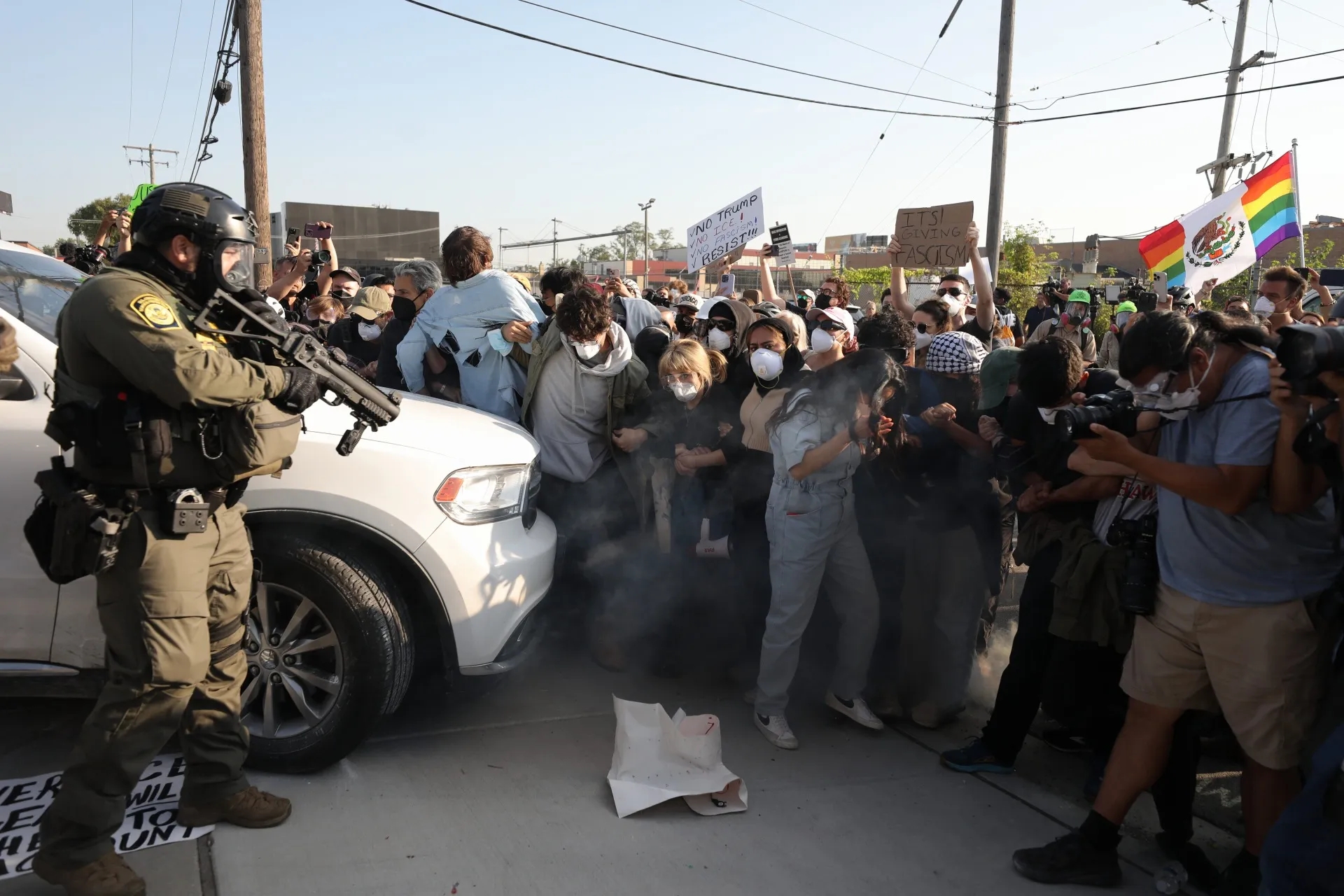
Protesters outside an ICE processing facility, Broadview Chicago. (Credit: Vincent D. Johnson/Block Club Chicago)

I’ll be honest with you: I never liked High Holiday services when I was a kid. 

There were so many things that just rubbed me the wrong way: they felt interminably long, the old school Reform choir music wasn’t my thing, and my parents would constantly shush me and my brothers when we got squirrelly (which was often). But most of all, I resented the seeming irrelevance of it all. I just couldn’t relate to the content of the services – and there was never any effort to explain why it should be relevant to me. 

On Rosh Hashanah in particular, I just couldn’t relate to the constant stream of prayers singing God’s praises, extolling God’s greatness and invoking God’s power. It all seemed designed to make us feel small and insignificant: this repeated glorification of an all-powerful God to whom we must beg and plead for another year of life. 

I realize now that I was a pretty astute kid. “Malchuyot,” which literally means “sovereignty,” is one of the central themes of Rosh Hashanah. Every new year we declare over and over that God is our supreme ruler. This theme is repeated throughout the liturgy, particularly during the Musaf service, when it is traditional to physically prostrate oneself on the floor before the divine throne during the Aleinu prayer. 

Over the years, however, as I began to attend services on my own terms rather than under duress, I came to appreciate Rosh Hashanah, yes, even the idea of Malchuyot. In fact, the older I get, the more relevant and important this concept feels to me. On a personal level, I understand to be a Malchuyot is a reminder that we often labor under illusions of our own power and control. We face these illusions head on during Rosh Hashanah when we do the work of teshuvah: the sacred process of return and repentance.

Of course, we are not all powerful. But ironically, acknowledging the limits of our power can actually be liberating. By affirming a transcendent source of power greater than our own, we can better focus and identify the things we can control in our lives. When we invoke God’s Malchuyot on Rosh Hashanah, we do so in the spirit of this liberation, to break free of our illusions of power and put ourselves on a more productive, healing path during the Days of Awe. 

Beyond the personal, I’d suggest Malchuyot has a collective and political dimension as well. It’s deeply rooted in Judaism’s central sacred narrative, the Exodus story. I actually made this very point during my very first sermon for Tzedek Chicago on Rosh Hashanah ten years ago:

At its core, I would suggest affirming Malchuyot means affirming that there is a Force Yet Greater: greater than Pharoah in Egypt, greater than the mighty Roman empire, greater than the myriad of powerful empires that have oppressed so many peoples throughout the world.

I would argue that this sacred conviction has been one of the central driving forces of Jewish tradition throughout the centuries: that it is not by might and not by power – but by God’s spirit that our world will ultimately be redeemed. I would further argue that this belief in a Power Yet Greater has sustained Jewish life in a very real way. After all, the Jewish people are still here, even after far mightier empires have come and gone. It might well be said that this allegiance to a Power Yet Greater is the force that keeps alive the hopes of all peoples who have lived with the reality of dislocation and state oppression.

I went on to suggest that through Zionism, the Jewish people have tragically betrayed this sacred Jewish narrative of liberation. When you think about it, the raison d’etre of Zionism literally is human sovereignty. It is an ideology that unabashedly deifies state power as a redemptive force in Jewish life and overturns centuries of Jewish tradition. It has subverted the sacred ideal of Malchuyot by centering and sacralizing human power above all else.

When I delivered that first Rosh Hashanah sermon, however, I never could have predicted where Zionism’s bargain with state power would lead us. In the misguided name of Jewish safety and supremacy, Israel has doubled down on its assumption of human Malchuyot to an unbearable degree. As we gather for Rosh Hashanah this year, Israel has been perpetrating an almost two-year genocide against the Palestinian people. Nearly 70,000 Palestinians have been killed, with real numbers likely to reach the hundreds of thousands. Whole families have been killed and entire bloodlines erased. Untold numbers of people have been buried under rubble, burned alive, dismembered and starved to death. At this very moment, Israel is literally bombing the entire north of Gaza off the map, trapping scores of residents who cannot leave their homes and sending scores of others to the south into active war zones.

And yet of course. Of course it has come to this. From the very beginning, the goal of establishing a Jewish-majority nation state could only be realized by dispossessing another people – what the Palestinian people refer to as the Nakba. Israel’s genocide against the Palestinians did not begin on October 7; it has been ongoing for over 70 years. There is a direct line leading from Zionism’s idolatrous attachment to Malchuyot to the crimes we are witnessing daily in Gaza.

This idolatrous attachment, of course, is not unique to Zionism. Looking back, I realize that Tzedek Chicago’s first Rosh Hashanah service took place shortly after Trump announced his first Presidential campaign. It’s also fair to say when I gave that first sermon, I never would have dreamed that just ten years later, the US would be rapidly descending into authoritarian fascist rule. That ICE would serve as our President’s secret police force, prowling the streets in plain clothes and face masks, abducting immigrants and student activists in unmarked vans. That thousands of National Guard troops would be mobilized to occupy American cities. That so many of our nation’s institutions would be defunded, plundered and centralized by unelected oligarchs. That our government would openly declare whole groups of people, including immigrants, trans people, people of color and unhoused people to be literal “enemies of the state.”

In the wake of Charlie Kirk’s murder, the incitement against these imagined enemies has reached a terrifying fever pitch. Trump and the movement he spawned are now seizing this moment to foment fury against a broad array of individuals and institutions they call the “radical left.” Trump’s aide Stephen Miller has chillingly characterized the current moment in America as a battle between “family and nature” and those who celebrate “everything that is warped, twisted and depraved.” 

Words such as these should not sound new to us; the Trump regime is using a time-honored tactic from the fascist playbook. We know that totalitarian regimes have historically consolidated their power during times of instability by fomenting a toxic “us vs. them” narrative. Hannah Arendt identified this mentality very clearly seventy-five years ago in her book The Origins of Totalitarianism: “Tribal nationalism always insists that its own people are surrounded by a ‘world of enemies’ – one against all – and that a fundamental difference exists between this people and all others.” 

Although the context of 21st century fascism is different in many ways from fascisms of the past, the fundamental building blocks of this phenomenon remain the same. In the parlance of Rosh Hashanah, the fascists of today are claiming Malchuyot – ultimate power – for themselves. And they are consolidating their power by demonizing those who do not fit into their idealized, privileged group as enemies who must be fought and eradicated at all costs. 

However, as overwhelming as the current political moment might feel, there is a textbook for resisting fascism as well. The essential rules for fighting fascism remain the same as they ever were. And the first order of business is: do not collaborate. 

This may seem obvious, but given the hard truth of the moment, I don’t think it can be repeated enough. It has been truly breathtaking to witness how quickly ostensibly independent non-governmental institutions have capitulated to Trump’s bullying and blackmail: from universities firing professors and defunding whole programs to businesses eradicating their DEI programs; from corporate media outlets becoming state mouthpieces, to law firms allocating hundreds of millions of dollars in legal services to defend the federal government. 

Has the liberal establishment been up to the challenge of this moment? Just consider its response to the murder of Charlie Kirk. Let’s be clear: Kirk was an unabashed white Christian Nationalist who incited young people on college campuses to hatred under the cynical pretense of “open dialogue.” Even so – and even as the MAGA movement is dangerously exploiting this moment – liberal leaders and institutions have been normalizing Kirk by openly praising him as a paragon of free speech and good faith debate. 

After he was killed, CA Governor Gavin Newsom eulogized Kirk by saying: “The best way to honor Charlie’s memory is to continue his work: engage with each other, across ideology, through spirited discourse. In a democracy, ideas are tested through words and good-faith debate.” Similarly, following Kirk’s murder, the Dean of Harvard College, David J. Deming publicly vowed to protect conservative students on campus, adding that Kirk’s enthusiasm for publicly debating his opponents could be a model for Harvard’s own civil discourse initiatives. And for his part, liberal New York Times columnist Ezra Klein wrote an op-ed entitled “Charlie Kirk Practiced Politics the Right Way.” 

It’s not clear if these apologists honestly believe what they are saying or if they’re just trying to avoid the government’s takedown of anyone who has anything remotely critical to say about Charlie Kirk. But in the end, it really doesn’t matter. The bottom line: liberal normalization will not appease fascists. 

To put it frankly, the government has declared war on us – and we must respond accordingly. The days of partisan cooperation and dialogue are over. The days of good faith debate and civic compromise are over. Capitulating to demagoguery and hatred will not convert the MAGA movement to the values of democracy and civil discourse. Yes, in a healthy democratic society, the concept of “collaboration” is something to be valued. But in a fascist regime, the term “collaborator” has a different meaning entirely. 

The first step in resisting collaboration is to accept that none of this is normal. We must let go of old assumptions, many of which, frankly, have led us to this moment. If we are to be totally honest, it must be said that the Democrats and the liberal establishment have been collaborating with corporate interests along with Republicans for years. As we interrogate the abnormality of this moment, we must admit that the entire system has been disenfranchising whole groups of people in this country for far too long. 

Resisting fascism also means letting go of our ultimate faith in the “rule of law.” Indeed, both the left and the right tend to fetishize the rule of law as an absolute good. And while it’s true that the law can be a tool to ensure a more just society, it can just as often be used as a blunt instrument to dismantle democracy. 

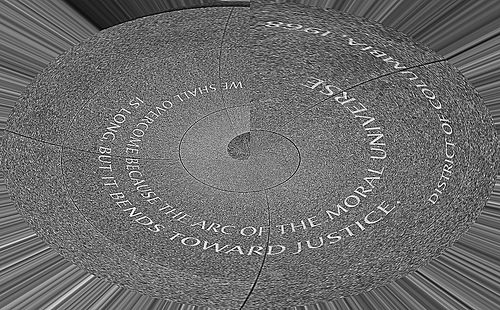
We know from history that governments routinely create laws that are inherently unjust. Slavery was legal in the US for almost 250 years. Apartheid in South Africa was legal. Apartheid continues to be legal in Palestine/Israel. In the face of such legal injustice, the obvious moral and strategic response is not to follow but to break the rule of law. As Dr. Martin Luther King famously wrote in his “Letter from a Birmingham Jail:” 

We should never forget that everything Adolf Hitler did in Germany was “legal” and everything the Hungarian freedom fighters did in Hungary was “illegal.” It was “illegal” to aid and comfort a Jew in Hitler’s Germany. Even so, I am sure that, had I lived in Germany at the time, I would have aided and comforted my Jewish brothers.

This is, in fact, the radical truth we affirm every Rosh Hashanah. When we affirm Malchuyot, we affirm that there is a moral law yet greater than any law levied by a government or regime. On this Rosh Hashanah in particular, the sound of the shofar calls on us to resist conformity; to vow to become criminals when confronted with laws that are inherently unjust. More than any Rosh Hashanah in our lifetimes, we must be ready to defy the illegitimate laws wielded by the illegitimate rulers who would govern us. 

Even if we do accept this challenge, however, the question remains: where does Malchuyot, ultimate Power, reside, if not with governments, politicians or the rule of law? Here, I’d like to quote yet another one of my heroes, the Puerto-Rican Jewish liturgist Aurora Levins Morales:

They told me we cannot wait for governments.
There are no peacekeepers boarding planes.
There are no leaders who dare to say
every life is precious, so it will have to be us.

Yes. God’s power is revealed in our readiness to show up for one another.  When we acknowledge Malchuyot on Rosh Hashanah, we affirm that the Divine Presence is manifest whenever we struggle and resist and fight for our communities, for a world where all are liberated and cherished and protected. When there are no leaders who dare to ensure that every life is precious, it will have to be us. 

Here are two concrete examples of Malchuyot in action: this last January, shortly after the inauguration, the Trump administration launched a series of raids in Chicago they called “Operation Safeguard” where, over the course of a few days, ICE, the FBI, the ATF and other federal forces coordinated massive raids in neighborhoods throughout the city and suburbs. We don’t know how many were arrested or detained, but we do know that this federal blitzkrieg was deeply frustrated by local organizing. Trump’s so-called “border czar” Tom Homan later complained that immigration organizers in Chicago were “making it very difficult” to arrest and detain people. He said, “They call it Know Your Rights. I call it how to escape from ICE.”  

Of course, even as we win these battles, this fierce war continues to escalate. ICE violence continues to rage in the neighborhoods of our cities. In Chicago, ICE has now launched another sweep, this one called “Operation Midway Blitz.” Just last Friday, at an immigrant processing center in the Broadview section of Chicago, federal agents shot tear gas, pepper spray and flash bang grenades into hundreds of demonstrators. Ten protesters were taken into custody by federal agents over the course of the day. Even amidst this escalating violence, however, local organizers here in Chicago continue to hold the line. 

Another example: in Washington DC which is still under occupation by National Guard troops, groups of local residents called “night patrols” have been regularly patrolling the streets. According to journalist Dave Zirin, whose reports from the ground have become invaluable:

These night patrols watch over the city to ensure that people are protected from state violence, false arrest, abduction, and harassment. Failing that, their goal is to document the constitutional violations or brutality they witness, so people can see the truths about the occupation that a compliant, largely incurious media are not showing. 

Critically, these neighborhood patrols are being led and stewarded by members of impacted groups: As one night patroller put it: “a lot of young people, a lot of people of color, queer and trans folks, people who have been directly impacted by policing, and folks with street medic backgrounds. It skews toward people who already know what it’s like to be criminalized.” 

Though it isn’t being highlighted by the corporate mainstream media, this local organizing is happening in communities all over the country: in Los Angeles, where there are also still hundreds of National Guard troops, as well as New Orleans, Memphis, Baltimore and other cities that the Trump administration is directly threatening with military invasion. I know that many Tzedek Chicago members have long been active in these organizing efforts, here in Chicago, around the US and even around the world. But again, we can have no illusions over what we are up against. 

I know that the magnitude of these events often leads us to a state of overwhelm and despair. We doom-scroll through the news every day, we read about Trump’s newest executive order, the latest regressive Supreme Court ruling or some other heinous event and the ferocity of this onslaught can literally leave us breathless. This is, of course, yet another page from the authoritarian textbook: to neutralize the population through a calculated strategy of shock and awe. They want us to feel that all is lost, to give in to our despair that their power over us is all but inevitable. 

Our experience of shock and overwhelm is compounded all the more by an all-pervasive sense of grief. So much of what we have fought for has been lost. So many of the institutions we assumed would be eternally with us are being plundered and dismantled. Some of these losses may be permanent, some may not, but the harms they are causing are very, very real. 

I feel this grief myself, believe me, I do. But I also know that if we surrender to it, then their victory over us will become self-fulfilling. The way through the fear and the grief, I truly believe, is to never forget that we have power, that our words and actions matter and that nothing is ever inevitable unless we let it be so. 

Whenever we feel overwhelmed, I think the critical first step is to reclaim our equilibrium by asking ourselves, what matters most to me? What are the issues that are nearest to my heart? Most of us have the capacity to devote our time and energy to one or two causes at most. What are the most effective organizations fighting for this cause? Who are the people in my life that can connect me with the people doing this work? If I don’t have the capacity or physical ability to engage actively in these kinds of responses, what are other meaningful ways I can show up?  

Amidst all this loss, we must never forget: even if our victory is not guaranteed, there are still things in this world worth fighting for. Generations of resisters have understood this axiom well: “If I’m going to go down, I’m sure as hell going to go down swinging.” In the words of my friend and comrade, Chicago organizer Kelly Hayes, who I’ve quoted in more than one High Holiday sermon over the years:

I would prefer to win, but struggle is about much more than winning. It always has been. And there is nothing revolutionary about fatalism. I suppose the question is, are you antifascist? Are you a revolutionary? Are you a defender of decency and life on Earth? Because no one who is any of those things has ever had the odds on their side. But you know what we do have? A meaningful existence on the edge of oblivion. And if the end really is only a few decades away, and no human intervention can stop it, then who do you want to be at the end of the world? And what will you say to the people you love, when time runs out? If it comes to that, I plan on being able to tell them I did everything I could, but I’m not resigning myself to anything and neither should you. Adapt, prepare, and take the damage done seriously, but never stop fighting. Václav Havel once said that “Hope is not the conviction that something will turn out well, but the certainty that something is worth doing no matter how it turns out.” I live in that certainty every day. Because while these death-making systems exist both outside and inside of us, so do our dreams, so long as we are fighting for them. And my dreams are worth fighting for. I bet yours are too.

This New Year, I realize I’ve come a long way from that beleaguered kid who felt disempowered on the High Holidays to a rabbi telling you Rosh Hashanah is our clarion call to fight facism. But here I am. And here we are. May this new year inspire us all with the knowledge that true sovereignty, true Malchuyot, lives at the heart of the struggle. 

On this, my final Rosh Hashanah with this amazing community, this is what I am feeling to my very bones at this moment: that while Pharaohs may rise, they will inevitably fall, that beyond the horizon of Olam Hazeh, this terribly broken world, there lies Olam Haba: the world we know is possible. And no matter what may happen this new year – and every new year to come – that world is always worth fighting for.

Shanah Tovah.
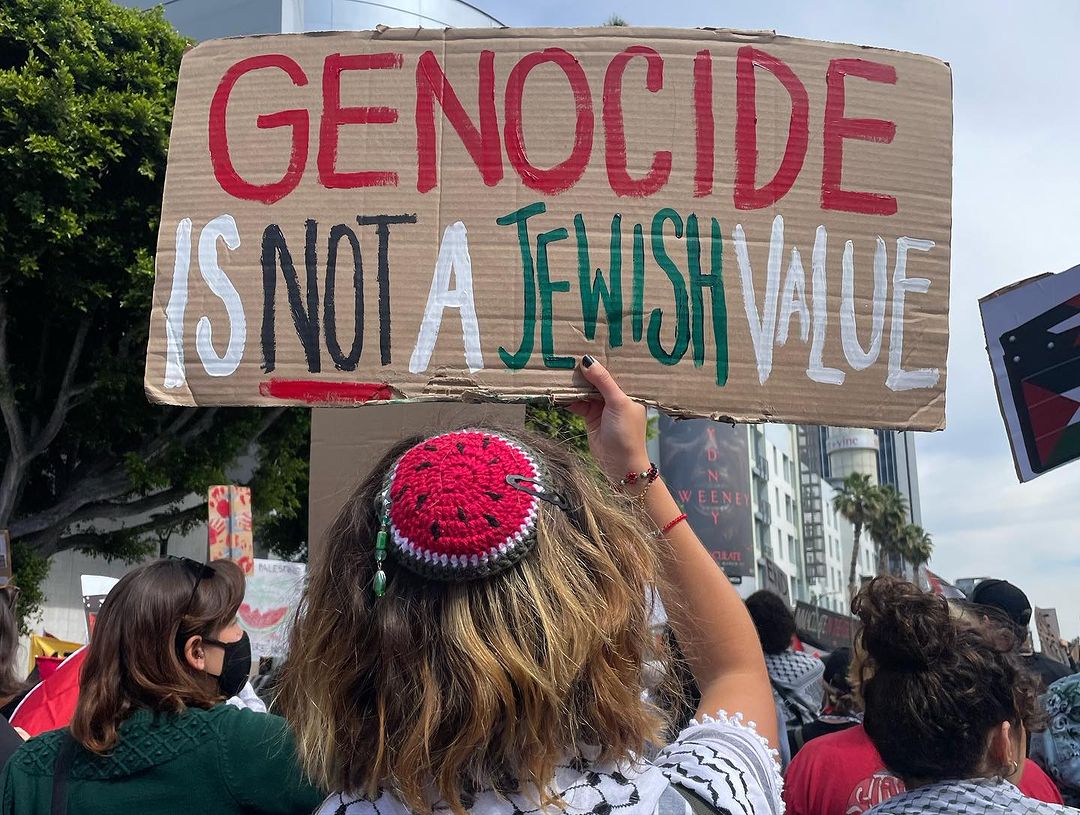
We Charge Genocide: A Sermon for Rosh Hashanah 5785

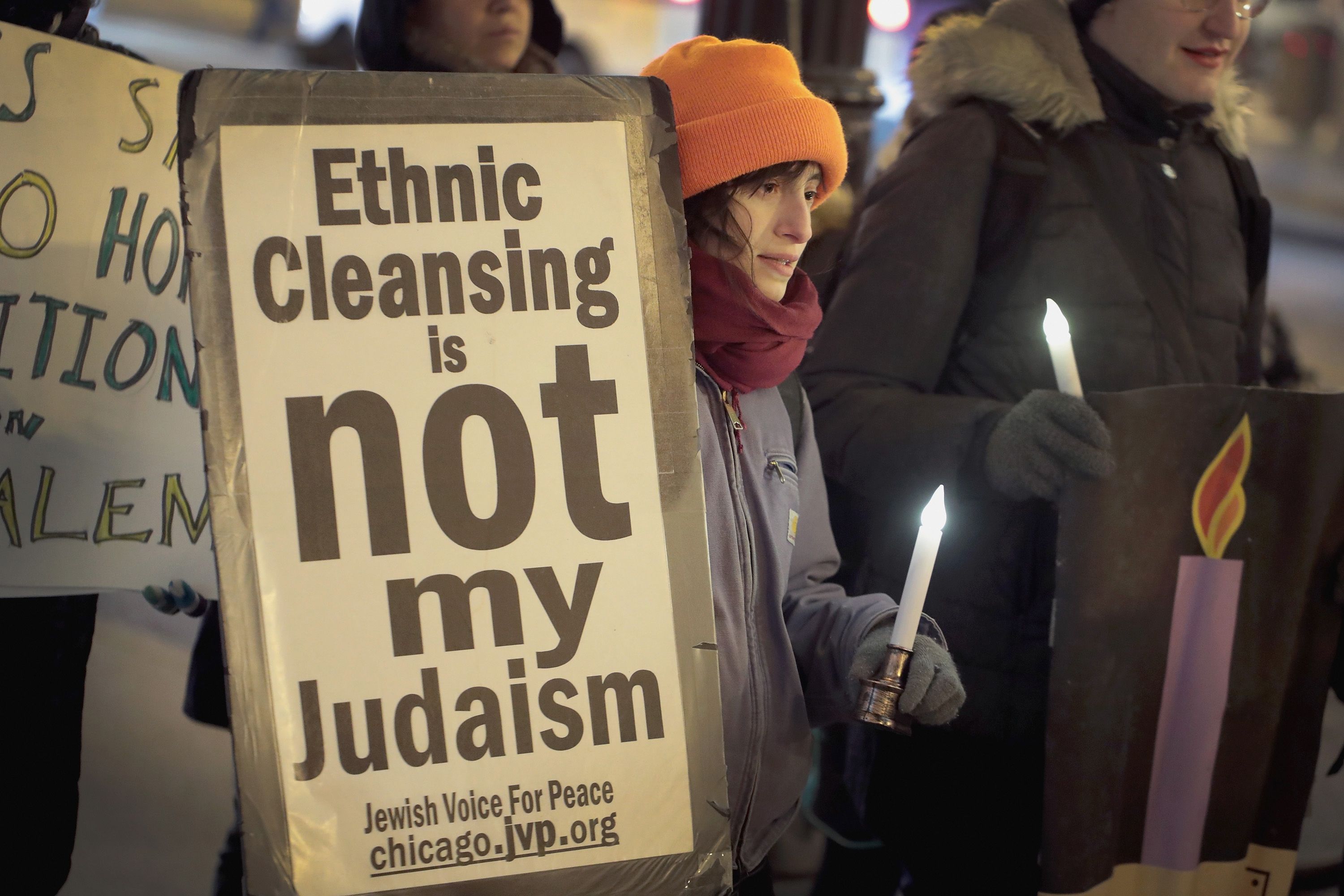
(photo credit: Jewish Voice for Peace)

Cross-posted, in article format, in Truthout

Why do we sound the shofar on Rosh Hashanah? Over the centuries, commentators have offered us a variety of reasons. Moses Maimonides famously called it a wake-up call to personal atonement; others view it a call to action or a tribute to God’s power. This new year, however, I believe one reason stands out among all others. Today, this Rosh Hashanah, we sound the shofar as a call to moral accountability.

Today, we begin the holiest season of the year. Over the next ten days, we’ll be challenged to break open the shells of inertia and complacency that have built up over the past year. We’ll sound the shofar to herald the inauguration of a deep, collective soul searching: to look deep within, to face honestly what must be faced, if we are to truly begin our new year anew. 

To put it frankly, I honestly cannot remember a Rosh Hashanah when the collective moral stakes were any higher for the Jewish community than this year. I would even go as far to say that this may be the most morally consequential High Holiday season of our lifetimes. As we begin this new year, the shofar calls us to account for a genocide, ongoing even as we speak, perpetrated by a nation acting in the name of the Jewish people. 

How can we begin to fathom a moral accounting of such a magnitude? Over 41,000 Palestinians killed in Gaza to date and over 95,000 injured, the majority of whom are women and children. According to one estimate, the ultimate death toll may eventually be nearly 200,000. Whole extended families, entire Palestinian bloodlines have been wiped out completely. Much of Gaza has been literally reduced to a human graveyard, with scores of bodies buried beneath the rubble of destroyed and bulldozed homes. Neighborhoods and regions have been literally wiped off the map. 

Gaza’s infrastructure and health care system has been decimated. According to the UN an “intentional and targeted starvation campaign” has led to widespread famine and disease throughout the Gaza strip. Polio has now broken out – relief workers are literally working to deliver vaccines to children as bombs and missiles fall around them. 

Health care workers, humanitarian workers and journalists are being killed, injured and imprisoned in massive numbers. Human rights agencies have documented widespread torture and abuse of prisoners, including sexual abuse, throughout a network of torture camps. 

Please note that this unspeakable litany is not a review of the past year. It is a description of a nightmare that continues as I speak, with no end in sight. 

As we contemplate this inhuman status quo, it occurs to me that this Rosh Hashanah, the broken sound of the shofar is more than a mere all to accounting. It is a broken wail of grief – and a desperate moral challenge. This year the shofar calls out to us in no uncertain terms: We Charge Genocide

This is not a point upon which we can equivocate. Not today. On this day, we face what must be faced and say out loud what must be said. To argue this point now would frankly be a sacrilege. 

From a purely legal point of view, a myriad of academic and legal experts have long since confirmed the charge of genocide. As far back as October, Holocaust and Genocide scholar Raz Segal has called Israel’s actions in Gaza “a textbook case of genocide.” On October 18, almost 800 scholars, lawyers and practitioners called on “all relevant UN bodies…as well as the Office of the Prosecutor of the International Criminal Court to immediately intervene…to protect the Palestinian population from genocide.” More recently, Omer Bartov, a respected historian of the Holocaust and Genocide Studies at Brown University accused Israel of “systematic war crimes, crimes against humanity and genocidal actions.” 

But beyond the legal arguments, there is a critical, moral imperative behind this claim. For many Jews, it’s impossible to imagine – let alone say out loud – that a Jewish state, founded in the wake of the Holocaust, could possibly be perpetrating a genocide. 

I understand the pain behind this refusal. I know it confronts many Jews with an unimaginable prospect: to accept that we have become our own worst nightmare. But if we cannot admit the truth on this of all days, then why bother gathering for Rosh Hashanah in the first place? To dither on this point would make a sham of a festival we dare to call the holiest season of the year. 

Not long ago I had a long conversation with my dear friend and colleague Rachel Beitarie, director of the Israeli organization Zochrot. Rachel is among the precious few Israeli activists who are in unabashed solidarity with Palestinians. You may remember her presentation to our Tzedek community several months ago. Among other things, she spoke about what it was like to be an Israeli activist for Palestinian liberation who grew up on a kibbutz near the Gaza border, who personally knew Israelis who were killed and taken hostage on October 7. 

During our recent conversation, Rachel and I talked in particular about the way Israel metabolizes the traumatic memory of the Holocaust as a way to rationalize away its genocidal violence in Gaza. In a follow up letter to our conversation, Rachel wrote the following words to me:

As years go by and most Holocaust survivors are no longer with us, the identification and reliving of the trauma of former genocide seems to only grow, in direct relation to the crimes committed under the excuse of the right to defend ourselves and “prevent a second Holocaust.” 

Because of this unrelenting propaganda, the linkage of the Hamas attack of October 7 to the Holocaust was made immediately, even though it was logically bogus. ​​It was understandable at first, especially from people – many of my friends and acquaintances among them – who personally experienced the horrors of that day, waiting for help that took many hours to come. 

Having grown up in Israel, exposed as we are to re-traumatizing Holocaust education, the associative connection was almost inevitable. Soon however, it became clear that this linkage was being overblown and manipulated to justify the annihilation of Gaza; to justify, dare I say it, another Holocaust.

Many outside of Israel have made the linkage between October 7 and the Holocaust as well. Almost immediately in fact, the terrible massacres of that day were openly characterized as “the worst mass murder of Jews since the Holocaust.” As Rachel pointed out, the two events have nothing to do with each other whatsoever. Still, it is indeed painfully poignant to consider that this mass killing occurred in a state founded in the wake of the Holocaust in order to safeguard Jewish lives once and for all.

We can only imagine what on earth will be said about October 7 on its one year anniversary, which will arrive exactly between Rosh Hashanah and Yom Kippur. From what I’ve read about officially sponsored Jewish community commemorations, the dominant message will be thoroughly suffused with a Holocaust-informed victim mentality: “Bring them home,” “We stand with Israel,” “It’s us against the world,” with nary a mention of the vengeful carnage Israel has been unleashing on Gaza for the better part of a year.

In contrast to this particular messaging, however, I would suggest that sacred Jewish tradition presents us with an important opportunity on this anniversary. Yes, the Days of Awe are an occasion to mourn the losses of the past year – but this season is also a time to seek out a deeper understanding. To do a genuine accounting and to take real accountability. 

As we start to reckon with the events of October 7, I would suggest that the first step would be to admit that this date was not a starting point. If we are to truly and honestly commemorate this tragic anniversary, we must understand it in the context of the ongoing violence and injustice known as the Nakba – a nightmare that began decades ago and is still ongoing. 

As Israel’s violence in Gaza escalated during the final months of 2023, Tzedek Chicago’s board had numerous conversations about whether or not to issue a congregational statement. I’ll make a confession: I wasn’t originally in favor of it. To be honest, I was starting to become dubious about the value of these kinds of gestures. At a moment when so many of us were working overtime organizing on behalf of the Palestine solidarity movement, it seemed like a waste of time to spend our time on a congregational statement. It felt as if the only statement that needed to be made, over and over again in the streets, was “Ceasefire Now!” 

Eventually, however, I came to agree with our board that Tzedek Chicago – as an avowedly anti-Zionist congregation – had a unique voice to offer on this issue. And so, during the month of December, we worked together to craft a statement titled, “In Gaza, Israel is Revealing the True Face of Zionism.” 

Here’s an excerpt:

We … know there was a crucial, underlying context to (the) horrible violence (of October 7). We assert without reservation that to contextualize is not to condone. On the contrary, we must contextualize these events if we are to truly understand them – and find a better way forward.

The violence of October 7 did not occur in a vacuum. It was a brutal response to a regime of structural violence that has oppressed Palestinians for decades. At the root of this oppression is Zionism: a colonial movement that seeks to establish and maintain a Jewish majority nation-state in historic Palestine.

While Israel was founded in the traumatic wake of the Holocaust to create safety and security for the Jewish people, it was a state founded on the backs of another people, ultimately endangering the safety and security of Jews and Palestinians alike. Israel was established through what Palestinians refer to as the Nakba: the ethnic cleansing of 750,000 Palestinians from their homes in 1948. And since that time, Israel has subjected Palestinians to a regime of Jewish supremacy in order to maintain its demographic majority in the land.

This ongoing Nakba is the essential context for understanding the horrifying violence of the past three months. Indeed, since October 7, Israeli politicians have been terrifyingly open about their intentions, making it clear that the ultimate end goal of their military assault is to ethnically cleanse Gaza of its 2.2 million Palestinian residents. One prominent member of the Israeli government put it quite plainly: “We are now rolling out the Gaza Nakba. Gaza Nakba 2023. That’s how it’ll end.” More recently, Prime Minister Netanyahu was reported as saying that he is actively working to transfer Palestinians out of Gaza. The problem, he said, “is which countries will take them.”

Israeli leaders are being true to their word: we are witnessing the continuation of the Nakba in real time. As in 1948, Palestinians are being driven from their homes through force of arms. As in 1948, families are being forced to march long distances with hastily-collected possessions on their backs. As in 1948, entire regions are being razed to the ground, ensuring that they will have no homes to return to. As in 1948, Israel is actively engineering the wholesale transfer of an entire population of people.

It is now eight months since we released that statement and I believe it is more accurate than ever. In her letter to me, Rachel observed the irony that more and more Israelis are now threatening a “second Nakba” when “until recently Israelis denied that the Nakba ever happened.” Now however, many Israelis are using the term with unabashed vengeance. Through word and deed, Israel’s ultimate end game is becoming all too clear: it is the ethnic cleansing of Gaza. 

This past August, in fact, the Israeli press revealed the presence of a government plan for Israel’s long term occupation of Gaza on “the day after.” According to the plan: 

Israel will control the northern Gaza Strip and drive out the 300,000 Palestinians still there. Major Gen.Giora Eiland, the war’s ideologue, proposes starving them to death, or exiling them, as a lever with which to defeat Hamas. The Israeli right envisions a Jewish settlement of the area, with vast real estate potential of convenient topography, a sea view, and proximity to central Israel… The southern Gaza Strip will be left for Hamas, which will have to care for the destitute residents under Israeli siege, even after the international community loses interest in the story and moves on to other crises.

In other words, a “real time Nakba” is being discussed openly in Israeli political and academic circles. More recently, on September 15, Professor Uri Rabi, a prominent researcher at Tel Aviv University, actually said these words in a radio interview: “Remove the entire civilian population from the north, and whoever remains there will be lawfully sentenced as a terrorist and subjected to a process of starvation or extermination.” 

As we engage in moral accounting over the next ten days, we must reckon seriously with words such as these. Indeed, from the very beginning of this genocide, Israeli leaders and politicians have been all too transparent about their intentions. Just as the founders of the Zionist movement themselves, from Theodor Herzl to David Ben-Gurion promoted the “transfer” of the native Palestinian population to make way for a majority Jewish state. Then, as now, we must take these leaders at their word. We must take them very seriously. We can never say we didn’t know. 

More than ever before, this High Holiday season calls to us to reckon seriously with what Zionism has wrought. Not only in Gaza, but throughout the West Bank, where violence and ethnic cleansing is running rampant and in Lebanon, which is now experiencing its own carnage and displacement, bringing the entire region ever closer to all-out war. 

How could it be otherwise? This is what comes of an ideology and movement that from the beginning viewed Jewish safety as zero sum; in which our security can only be achieved at the expense of others, empowerment gained through the sheer power of superior military technology, stronger weapons and higher walls. 

And finally, this High Holiday season, we must take this opportunity to ask ourselves collectively: where have we fallen short? This is a critical question in particular for those of us who have been active in the Palestine solidarity movement. 

If this is indeed the season for hard truths, we must face the fact that despite all our efforts this past year, we failed to stop a genocide. For all our calls for ceasefire, on street corners and in the halls of city governments, for all of the mass protests and acts of civil disobedience, for all of the courageous student activism on college campuses, a ceasefire seems farther away than ever at the moment. 

This is not to say that there has not been genuine progress this past year. But how do we measure these successes against the mass killing that has occurred and continues to occur every single day? On this point, I’d like to share with you the words of Sumaya Awad, of the Adalah Justice Project, who offered us this powerful challenge at the plenary for the Socialism 2024 conference here in Chicago last month:

We know that there has been a massive shift in the United States around Palestine. We have seen poll after poll show that the majority of Americans support an arms embargo, the majority of Americans don’t want to support Israel, are critical of Israel and yet we haven’t seen that translate into the mass action we need. 

Despite this massive shift, we grapple with the fact that this shift came at the expense of how many lives lost? How many people murdered? Who paid the price for these people to shift? And it’s not to say that this shift is not tremendous and incredible and good – it is all of those things, but we must also grapple with the fact that lives are being lost on the daily. And that it is all by design and that it all can be stopped in basically a moment.

And I say all of this not to pity Palestinians, quite the opposite, nor that we must grieve more. Grief is necessary, but that’s not the answer. I say it all because … we have to keep asking ourselves – you have to ask yourselves – what am I doing with this knowledge?  What am I doing with this education? How is it translating into action? How does it translate into action that does not preach to the choir, but preaches to those who are not yet where we need them to be? 

And you have to have an answer to that question. Because a year from now, when you are back here, you have to have an answer. Don’t find yourself just asking the same question. Be ready to answer, what have I done in the last year? 

Though Sumaya spoke these words in a very different context, I find them nonetheless appropriate to the sacred imperative of this new year. A year from now, when we are back here, we will have to have an answer. We can’t find ourselves just asking the same question. We must be ready to answer: what did we do in the last year to bring this genocide to an end? 

I know this in my heart and soul as well: years from now, we will likewise have to stand in judgment. When the story of this genocide is written, we will be asked: did we speak out? And if so, what did we say? What did we risk?  

For now, that book is still open, even if every new page is becoming increasingly unbearable to read. Even if the world would rather move on to another story. How will we write ourselves into this book when it is finally recorded? 

May we all play our part in bringing this book of the genocide to a finish. May it come to an end soon, in our own day. And when it does, may we come to understand it was only part of a larger story – an even greater book that will conclude with these glorious words: “then Palestine was finally free, from the river to the sea.”

From Interfaith Dialogue to Interfaith Solidarity: Sermon for Rosh Hashanah 5784

(AP photo by Adam J. Dewey/NurPhoto)

During the course of my rabbinical career, I’ve participated in a good number of interfaith dialogues. These were facilitated conversations, usually involving the three so-called Abrahamic traditions – Christians, Muslims and Jews – in which we would explore our respective faith traditions together. The goal of the dialogues, generally speaking, was to achieve a deeper level of interfaith appreciation and understanding – to walk away with a respect for our differences as well as the underlying values we had in common. 

I haven’t participated in an interfaith dialogue in many years. If truth be told, I’m not sure I really believe in them anymore. It’s not that I don’t think it’s a good thing for people of different religions to learn from one another – I certainly do. It’s just that our dialogues never seemed to go much further than the talking. While our conversations were often substantive, we generally avoided more uncomfortable political topics. The underlying assumption seemed to be that religion and politics didn’t mix.

During Jewish – Christian conversations in particular, we rarely delved too deeply into issues such as Christian hegemony, white supremacy and antisemitism. When we did, we tended to treat such issues as part of the past. We seemed to be guided by the liberal assumption that such things belonged to a bygone, less enlightened age than our own. 

I can’t help but think such assumptions feel downright quaint today, in an age in which White Christian Nationalism is openly amassing political power. In which a mob wielding crosses and Christian banners literally stormed the Capitol in a coup attempt. In which Republican politicians have openly declared themselves to be Christian nationalists and a Republican candidate for president has called on his followers to “put on the full armor of God.” In the current political age, I think it’s safe to say the interfaith need of the moment goes far beyond liberal religious dialogue. The stakes are now far too serious – and far too consequential – for that.

Over the past two years, there’s been a great deal of analysis of the political threat posed by White Christian Nationalism: an ethno-nationalist movement that espouses a toxic combination of Christian exceptionalism and white supremacist ideology. White Christian Nationalists are guided by the belief that God has destined America, like Biblical Israel, for a special role in history – and that it will receive divine blessing or judgment depending on its obedience. It also promotes Replacement theory and actively demonizes Muslims, Jews, LGBTQ+ people, immigrants, and all others who do not fit into their white Christian ideal.

In the age of Trump, this movement has become entrenched in the Republican Party – and while they’re still a minority, their power has become critical to the GOP’s political strength. According to polls, most Republicans support declaring the US to be Christian nation, even if such a move would be unconstitutional. And among White Christian nationalists as a whole, 40% believe ​that “true patriots might have to resort to violence to save our country.”

Though this movement has emerged in a specific political moment, it is not uniquely of the moment. It actually dates as far back as the early days of European colonialism. Experts trace its roots back to the Doctrine of Discovery: a 15th century papal decree proclaiming European civilization and western Christianity to be superior to all other religions and cultures. The Doctrine of Discovery, of course, was an important driving force behind European colonial domination of the so-called New World and the conversion of the native peoples who lived there. 

This movement is also deeply rooted in white supremacist ideology. In his book, “White Too Long: The Legacy of White Supremacy in American Christianity,” Robert P. Jones wrote powerfully about this connection: how a wide spectrum of white Christians – from evangelicals in the South to mainline Protestants in the Midwest and Catholics in the Northeast – developed theologies that justified American slavery and Jim Crow. 

This legacy of white supremacy in American Christianity is alive and well in 2023. In 2015, a white supremacist entered Mother Emanuel AME Church in Charleston, South Carolina and murdered nine African American members of the congregation during a Bible study. Though there was extensive press at the time about his white supremacist beliefs, there was relatively little discussion of his Christian faith. In fact, his manifesto was filled with Christian imagery, including a drawing of a resurrected white Jesus rising from the tomb. He also wrote in his journal a call to action to white people to transform American Christianity from being “this weak cowardly religion” to “a warrior’s religion.”

Of course, Jews have every reason to be alarmed by such a movement as well. It was a brutal wake-up call indeed to watch torch carrying marchers in Charlottesville calling to “reclaim” America as a Christian nation while chanting “Jews will not replace us!” That wake-up call became downright deafening on a Shabbat in 2018, when a Bible quoting white supremacist murdered 11 Jewish worshippers at the Tree of Life synagogue in Pittsburgh.

At the same time, the Jewish community has been the recipient of genuine solidarity from Christian allies and friends. I’ve experienced this first hand more than once. This past February, for instance, when it was reported that Christian nationalists were planning to mobilize a “Day of Hate” against the Jewish community, my colleague and comrade, Reverend Tom Gaulke, wrote these beautiful words in a letter to our congregation:

As we hear of Christian Nationalists and Christian Supremacists calling for a “day of hate,” I would like to renew a promise on my own behalf and on behalf of the communities I’ve served:

For over a decade, we have marched side by side. And we’re not going to stop. As your family, we’ve got your back, come what may. Together, we’ve got a love that will conquer hate and a love that can only overcome.

To my mind, this gesture sums up the critical need of our new political moment: not so much interfaith dialogue, as interfaith solidarity. We must find a way to mobilize an interfaith movement that, in Tom’s words, ‘will conquer hate and can only overcome.”

If we are truly serious about this level of solidarity, however, each of our religious communities will need to engage in a great deal of deep discernment in our own backyards. I know there are many examples of white Christian communities who are doing this work in important ways; who understand that white solidarity must go hand in hand with justice and reparation. In his book, Robert Jones wrote about one white Baptist minister whose congregation has entered into an ongoing relationship with a black Baptist church. In describing that relationship, the minister said:

I’ve stopped using the word reconciliation…for what we’re doing. I’ve started using justice work more… When we throw around the word reconciliation, especially as white Christians, white people, we’re betraying our desire to just kind of move through all of the hard stuff to get to the happy stuff. So, when we’re talking about justice work, for me we’re getting into these much stickier questions of what has been lost, what is owed. 

Christian solidarity with non-Christians can also be hampered when well-meaning Christians fall back on a myth of innocence – when they distance themselves from White Christian Nationalism by saying “it’s not my religion.” I’ve witnessed this repeatedly – last year, for instance, the presiding Episcopal Bishop stated that White Christian Nationalism was “not Christianity.” Another progressive Christian activist has written it is a “political ideology rather than a religious one.” 

While I understand the good intentions behind these kinds of statements, I believe it’s deeply problematic when Christians disavow the more unsavory aspects of their religious tradition. In so doing, they avoid accountability for centuries of their own history and invisiblize its victims. As I’ve often commented, no religion is pure – all religions have their good, their bad and their ugly. In the end, I would submit that the proper way to confront the toxicity in our traditions is for people of faith to own the all of our religions – and to grapple with them seriously, honestly and openly. 

This will be a reckoning for the Jewish community as well. For one thing, in order to confront White Christian Nationalism, we will need to honestly interrogate persistent myths about Jews and whiteness. While white Jews understandably feel vulnerable at this particular moment, we still dwell under a shelter of white privilege. We must not assume that the threat of White Christian Nationalism poses a danger to all members of the Jewish community equally. White Jews will have to reckon with the fact that we are protected from this threat in ways that Jews of color are not. In other words, for the Jewish community, intra-communal racial solidarity will be just as critical as interfaith solidarity.

There is another issue facing the Jewish community that is perhaps even more challenging: if we are to truly stand down this movement – this toxic fusion of religion and nationalism – we’ll have to do so without exception. That means that Israel cannot get a pass. 

Though it may be troubling for many to consider, there are clear parallels between white Christian Nationalism and Zionism. Consider this: the Doctrine of Discovery holds that America was “discovered,” glorifying the noble innocence of the nation’s original “pioneers.” The ideology of Manifest Destiny is deeply connected to a vision of European Christian chosenness, viewing America as a “new Zion.” 

For its part, Zionism is rooted in a similar colonial view of a “land without a people for a people without a land.” It venerates the heroism of the chalutzim – the pioneers who “drained the swamps” and cultivated the land. And Zionism’s central narrative also comes from the Bible, utilizing texts that emphasize Jewish chosenness and exclusive entitlement to the land. 

Even more to the point, both White Christian nationalism and Zionism are forms of ethno-nationalism: movements that seek to establish and maintain nation-states predicated on the identity of one specific group of people. In its way, these two movements are religious nationalist mirror-images of each other, both seeking to create exclusive, homogeneous nation-states at the expense of their native inhabitants. 

Believe me, I know all too well that there are many in the Jewish community who will vociferously object to this kind of analysis. But painful as it may be, we can no longer cling to this myth of innocence when it comes to Israel. I think it’s absolutely critical that we find the strength to say these things out loud: to admit that after centuries of persecution at the hands of Christian empire, a modern Jewish movement is now actively following in its footsteps. 

All of this means that Jews, Christians – and all people of faith will need to reckon seriously with the issue of power – and in particular, the fusing of religion and state power. After all, don’t we know all too well from history where this road leads? We know what happens when religion is used by nations as a weapon of conquest. When God is invoked by the state to demonize others and exert their power over them. And make no mistake, religions that follow Biblical tradition will find ample justification for conquest and domination in that particular text.

But there is, however, another, decidedly different religious vision: it is a sacred act to resist oppressive state power. This path comes from the Bible as well; it is embodied by the Exodus narrative, the sacred story that lifts up the God of Liberation, and stands down the god of conquest. That puts the oppressed, not the oppressor at the center. That views the Promised Land not as a territory to be conquered by a chosen few but a land of equity and justice that is open to all.  We don’t have to look far to find contemporary examples of this sacred narrative in action. To name but two examples, it is exemplified by the Latin American liberation theology movement and the American black church: both of which lift up sacred visions of resistance that have leveraged genuine socio-political change.

This sacred narrative of liberation runs mightily through Jewish tradition as well. We are currently witnessing an emergent movement of radical, liberative Judaism that is truly exciting to behold. And I am so proud that Tzedek Chicago is an active and important participant in this movement. As we’ve done this work together, it’s been striking to me how integral and basic these values of solidarity and liberation are to Jewish tradition: from the weekly radical revolution that is Shabbat, to our deep-seated culture of study, questioning and Godwrestling, to our holidays, all of which contribute to a sacred drama that enact and re-enact the possibility of change and transformation in our world.

We enact these sacred values, in fact, each and every Rosh Hashanah. One of the central themes of the New Year is malchuyot – “divine sovereignty.” As I’ve come to understand it, this concept doesn’t have to refer to a literal belief in an all-powerful supernatural God sitting on his Kingly throne. Another way of understanding malchuyot, is as an affirmation of a Force Yet Greater – greater than any human or institution in our world: a power greater than Pharaoh in Mitzrayim, greater than the mightiest empire – and yes, even greater than systems of colonialism and white supremacy. 

Rosh Hashanah is also the day in which we stand before the open gates of heaven and sound the shofar as a wake-up call for the new year. We declare Hayom Harat Olam – “today the world was created,”affirming the eternal potential for transformation in our world. Over the next ten days, we will dig deeply into our individual and collective souls and discern what needs changing. Then, at the close of Yom Kippur, we will sound the shofar once final time as a call to action to go forth and create the world we know is possible. 

I’d like to close now with the words of a contemporary religious leader who truly embodies these ideas and values of interfaith solidarity: the great Rev. William Barber, co-chair of the Poor People’s campaign and president of Repairers of the Breach. May his words be our call to action this Rosh Hashanah:

The world doesn’t change when powerful people get new ideas. The world changes when people who’ve been rejected come together and realize that they are blessed to show their neighbors that another world is possible. Change happens when those who have been otherized decide we ain’t takin’ it no more…

There’s some stuff wrong in America and there’s no way to mend the flaws of this nation and be one nation under God with liberty and justice for all, unless the rejected people are at the center.

May this be the year we discover the true source of our collective power. May this be the year we transform the world that is into the world we know is possible. 

Surviving the Apocalypse: Sermon for Rosh Hashanah 5783

Hayom Harat Olam – “Today is the birthday of the world.” It’s one of the signature lines of Rosh Hashanah, and it might be the best, most basic definition of the holiday. Every new year, we celebrate the renewal of yet another cycle. Every Rosh Hashanah we anticipate a new round of possibilities for our lives and our world.

Judaism is deeply rooted in multiple cycles, actually: daily, weekly and yearly rhythms that revolve around each other simultaneously. We observe them as a way of maintaining our own personal balance and equilibrium – but also as an expression of our empowered faith. As Jewish tradition would have it, when we live according to these sacred cycles, it is said, we help maintain the equilibrium of the world itself.

Rabbi Arthur Waskow described this phenomenon beautifully in his classic book “Seasons of our Joy:” 

Long ago our people believed that if we celebrated the cycle, the cycle was more likely to continue. The rains would come when they were due, the sun would shine more warmly in its season, the crops would grow – and die, and grow again. 

And if we celebrated the cycle, we believed, our deliverance from slavery would come again. The spiral of history would keep on circling upward if we lived through the spirals of our past… And the cycle would also help us as individuals. It is intended to help us feel more deeply, more intensely, the cycle of feelings that make us fully human. 

While I’ve always connected with this spiritual approach, I’ll confess it hasn’t come so easily to me in recent years. Over the past few Rosh Hashanahs, I’ve wondered: what does it mean to affirm a cyclical worldview in the era of global climate change? With each passing year, we render our planet that much less livable. Every Rosh Hashanah, we seem to inch ever closer to a deadline that represents the earth’s point of no return. How do we celebrate the birthday of the world when the world itself is literally unraveling before us?

It isn’t just an academic question. There’s a strong case to be made that the disruption of our planet’s rhythm is affecting the natural rhythm of our lives as well. In a sense, it’s flattening out our cyclical view of the world and making it more linear. We’re experiencing the world less in terms of cycles and more as “beginning, middle and end.” 

There’s a time-honored word for this ominous concept, and I’ll put it plainly: it’s called apocalyptic thinking.

Now I know this is a religious term, but when I use it, I’m not just talking about theology. I’m interested in something deeper. I’m interested in the ways we ourselves engage in apocalyptic thinking – those of us who aren’t religious extremists, or even religious for that matter. I want to explore how end-of-days thinking has become culturally normalized in this 21st century moment to become part of the very oxygen we breathe. 

Statistics seem to bear this claim out. It’s been reported that over the past two decades, there’s been a marked increase in the stockpiling of food, provisions and weapons in preparation for an upcoming cataclysm. According to one study, nearly three in 10 adults in the US think it’s likely that there will be an apocalyptic disaster in their lifetime.  There’s also been increasing enrollment in survivalist courses; schools that train people in the practical skills they need to live in the wake of catastrophe. The owner of one such course recently commented on this phenomenon in the press: “I feel like people sense an impending doom … they feel like something’s about to happen, a shift in our society, a shift in our way of life – and they want to be prepared for whatever, be able to forage off the land, be able to do whatever it takes to get by.”

On a less quantifiable level, I believe that apocalyptic thinking is harbored even by those of us who aren’t hoarding food and drafting survival plans. I’m willing to wager that a growing number of folks are fantasizing about leaving it all behind to live off the grid – if not in anticipation of an upcoming disaster, then at least to move to higher ground. To escape to a place where they can keep the perils of 21st century life at bay.

It’s been observed that this attitude has become an indelible part of our cultural zeitgeist, reflected, among other things, in the explosion of post-apocalyptic movies, TV shows and video games. It’s certainly not difficult to understand the appeal of these dystopian fantasies. They function as a kind of cathartic outlet of our innermost fears, yet at the same time, they reassure us. They simplify the complex, overwhelming truth of our world. They give us the chance to start over again. After the apocalypse, life might be hard, but it would be simpler and more understandable. The good guys and bad guys would be clear and obvious. We’d have a straightforward sense of what we needed to do to survive. 

While I enjoy a good zombie movie as much as anyone, I do think these entertainments are a reflection of something very deep in our collective subconscious. And that’s what scares me – even more than the zombies. Indeed, there’s something deeply conservative and reactionary at the core of these dystopian fantasies. They almost always look to a strong hero or a messiah to save the day. By definition, there is always an in-group and an out-group: those who will be included in the future world and those who must be annihilated. They always focus on the journey to a better, safer future for the survivors. At their core, these stories reflect a deeper desire to wipe the slate clean and recreate a kind of mythic idyllic past that never actually was. 

More than anything, I think, these dystopian narratives reflect the fears of a privileged group that feels its power slipping away. Bear this in mind the next time you watch the armies of the undead coming to eat the flesh of the brave survivors. Just remember the rhetoric of many white Evangelicals and QAnon followers: how they utterly dehumanize and demonize those who don’t fit into their view of the world. As we indulge in our post-apocalyptic fantasies, we shouldn’t forget that there are increasing numbers of religious extremists in the US who are actively laying the political groundwork for the apocalypse in order to remake the world in their image.

On another level, when we engage in apocalyptic thinking, whether we realize it or not, we’re engaging in a form of surrender. We’re essentially admitting that it’s over – that we’ve lost. Apart from the abject defeatism of this attitude, I can’t help but think that it’s a profoundly privileged way of thinking. Because, quite frankly, there are millions of disenfranchised people in our own communities and around the world who are already living through the apocalypse and have been for some time. Perhaps we need to stop fearing the future and pay closer attention to the cataclysm that’s going on right now.

This is, for me, the most insidious thing about apocalyptic thinking: it focuses on the future at the expense of the present. Even as there’s every indication that the climate-related apocalypse that so many fear has actually been well underway. As I speak these words to you, Puerto Rico is reeling from the devastation of yet another hurricane – one that left the entire island without power and most of its residents without running water. In Pakistan, heavy monsoons have washed away whole villages, displacing more than 33 million people. Last year, over 59 million people became involuntary migrants – most of them displaced by climate related disasters. Yes, there are millions in our own backyard and around the world who are already experiencing the apocalypse in a real way right now, in real time.

One of the most impactful books I read this past year was “The Next Apocalypse: The Art and Science of Survival.” It was written by Chris Begley, an anthropologist, archaeologist and wilderness survival instructor who has studied the collapse of ancient civilizations throughout history. Begley convincingly argues that everything we assume about the coming apocalypse is wrong. He points out that most civilizational collapses were not the product of abrupt cataclysms. Rather, they were the result of extensive, multiple crises that had various causes that took place over a long period of time. In general, collapses of societies tend to be characterized less by sudden catastrophe than by change and transformation

Begley also makes it clear that when it comes to global climate-change we need to accept that this process of change is, in fact, already underway. He writes,

From our data about the past, I imagine that the process of collapse has already started, with environmental problems as one cause and political and social issues – particularly inequities in wealth and power exacerbated by neoliberal policies over the last half century – as the other. How quickly the unraveling will proceed, and how long until we realize that the process is going on, are harder to devine. Some processes, like climate change, are understood sufficiently well that, while unknowns exist, evidence suggests it will create profound and negative changes on a global scale. 

As a survival course teacher himself, Begley definitely advocates being prepared for emergencies – and he writes extensively about the skills that will likely be needed to survive the cataclysms that are most likely to occur in our lifetimes. But he also points out that survival skills are short term solutions, designed for the self-preservation of individuals. In the long term, he writes,

Adaptability and flexibility will be key to survival. Surviving and thriving after the next apocalypse will be all about community. None of us will be able to go it alone…If we are tempted to exclude people, we must find another route through the disaster. We must include everybody, or we are not in a sustainable pattern.

“Surviving and thriving after the next apocalypse will be all about community.” I can’t think of a better antidote to apocalyptic thinking. So often this mindset starts and ends with “how will I make it through?” “How will I protect myself and my loved ones?” But if or when a cataclysm occurs, our sustainability will ultimately depend upon our ability to cooperate for the long haul. We will have to accept that in the end, it must be all of us or none. 

What does this mean in practical terms? One example comes immediately to mind: in the face of unprecedented climate migration, I strongly believe we must become unabashed advocates for a world beyond borders. On this particular subject, I’d like to quote to from another must-read book for Rosh Hashanah: “Nomad Century: How to Survive the Climate Upheaval,” by Gaia Vince:

Migration, whether from disaster to safety, or for a new land of opportunity, is deeply interwoven with cooperation – it is only through our extensive collaborations that we are able to migrate, and it’s our migrations that forged today’s global society. Migration made us. It is our national identities and borders that are the anomaly…

I’ve visited people in refugee camps in different countries across four continents, where millions of people live in limbo, sometimes for generations…As our environment changes, millions more risk ending up in these nowhere places. Globally, this system of sealed borders and hostile migration policy is dysfunctional. It doesn’t work for anyone’s benefit.

Here’s another practical example: those of us who live in the Global North, who are responsible for around half of all emissions since the Industrial Revolution, who produce a carbon footprint 100 times greater than that of the world’s poor nations combined, must continue the fight to reduce the carbon emissions that are endangering life on our planet. And locally, we must keep fighting for emergency funding, for stronger infrastructure, for rapid response capacities, most particularly for our most vulnerable communities. According to Jewish tradition, pikuach nefesh – saving a life is sacrosanct. And even as we pass various doomsday deadlines, yes, even in the midst of an apocalypse, these kinds of policies and measures still have the very real power to save lives. 

Finally, we would do well to remind ourselves that the most committed and inspired climate activists are those who are most directly affected by climate change. Indigenous peoples in particular have long been on the front lines of this struggle. We would do well to learn about their efforts, support them, and most important, to follow their lead. Because if they have not succumbed to despair, then neither can we. In the words of the great Cherokee leader and activist, Wilma Mankiller, z”l: “The secret of our success is that we never, never, give up.”

When we engage in apocalyptic thinking, we reduce the climate crisis to a singular future cataclysm, while holding tight to the illusion that everything is still somehow “normal.” But if we resist the impulse to project our dread into the future, we can better recognize and respond to the transformative changes that are occurring even as we speak. Particularly those of us who have the luxury to live in parts of the world that are relatively safe from the disastrous impact already being experienced by so many. 

Accepting that it is already happening frees us up to discern more clearly what we can do right now. It allows us to live in the world and to respond to its changes with knowledge, creativity and compassion. When we admit that this transformation is already underway, we can stand down the fear and dread that is so prevalent in our culture. It gives us permission to move with these changes. It reminds us there is still a great deal we can – and must – do.

After all, as our liturgy will remind us, even in the midst of the most devastating of changes, our actions “ma’avirin et ro’ah ha’gezeirah” – “avert the severity of the decree.” Or as Chris Begley puts it, “there are no natural disasters, only natural phenomena that we convert into disasters via our responses.” When you think about it, the essential message of the High Holidays is the polar opposite of apocalyptic thinking. On Rosh Hashanah, we are asked to look deep into the latest turn of the cycle and face the all of our world. Then, and only then, can we go forth and greet the new year. 

So, this Rosh Hashanah, let us continue to dance to the rhythms of the cycle even when it becomes increasingly painful to do so. After all, it has ever been thus. Every new year, we pray these prayers that are filled with trepidation. We will say out loud that in the coming year there will be no guarantees – that some of us will live and some of us will die. But at the same time, we will affirm that this world is worth fighting for, no matter what may happen in the coming year and beyond. And most important we will affirm this all together. Because we know that however much time we have left, it must be all of us or none.

Shanah Tovah – may it be a healthy and liberating New Year for all. And may we commit together to making it so.

Building a Global Congregation of Conscience: Sermon for Erev Yom Kippur 5782

As many of you know, in January of 2020 it was my great honor to become Tzedek Chicago’s full-time rabbi. Among my first orders of business at the time was to find an office and a more suitable facility for our congregation. As it turned out, my search didn’t last too long. Soon enough, along with the rest of the world Tzedek had to hunker down and make our home in the land of Zoom. 

We weren’t at all sure what to expect in this strange new virtual world, but we certainly weren’t prepared for what happened next. In a word, we grew. We grew from two Shabbat services a month to weekly services, Torah studies, festival services and family programs. We instituted a weekly Wednesday afternoon gathering as a check-in for our members. We also held increasing numbers of adult educational opportunities and concerts. The pandemic truly transformed the life of our congregation in astonishing and unexpected ways.

It didn’t take us long to figure out why. It was a time of profound social isolation. We all felt it palpably, some of us more than others. The world craved connection – and in this strange new world, religious congregations had a particularly crucial role to play. Like so many other houses of worship, Tzedek served as a sacred virtual space where we could regularly gather and overcome our increasing separateness from one another. 

But there was another way Tzedek grew as well: we grew geographically. Almost overnight, we gained regular members and attendees from around the country and around the world: from Canada, the UK, Germany and New Zealand, among many other places. Again, it didn’t take long to understand why. We’d always drawn our members from a wide swath of the Chicagoland area and even some surrounding states. We were never strictly a local congregation; from the very beginning we’ve been a community bound together by our convictions. 

Those of us who founded Tzedek Chicago were very clear on this point: we really weren’t interested in creating another liberal Jewish congregation. We wanted to build a congregation on a foundation of core values. We emphasized “standing with the oppressed and calling out the oppressor.” We took “a stand against colonialism and militarism, especially when it is waged in our name as Jews and Americans.” We made a particular point of disavowing Zionism, stating that “the creation of an ethnic Jewish nation state in historic Palestine resulted in an injustice against the Palestinian people – an injustice that continues to this day.”

When we founded Tzedek, we drafted our core values even before we recruited a single member of our congregation. We wanted to make sure that those who joined us would join because they sought a Jewish community that shared their values. We just knew that there was a significant and growing constituency for the vision of Judaism we sought to promote. 

It’s been so gratifying to see how our faith has been validated these past six years. Speaking personally, it’s been a blessing for me. When I left my former congregation, I really never thought I’d work as a congregational rabbi again. I’m so grateful that Tzedek has given me this opportunity – and I’ve never, ever taken it for granted. 

Over the years, I’ve received regular emails from folks from across the country and around the world asking if there was a congregation like Tzedek in their home communities. I’d almost always have to say no, I didn’t think there was. But starting in 2020, of course, that question became moot. We became a global congregation in ways we never could have dreamed. As the world opens up (may it happen soon in our day!) we’ll certainly reinstitute more in-person services and programs. But our congregational leadership has made it clear that going forward, we’ll continue to be a primarily virtual congregation. The pandemic has changed us indelibly – and we welcome this change. We’re excited by the prospect of broadening our membership even further around the world to include anyone and everyone who shares our particular vision of Jewish community. 

While I’m on the subject of vision, I’d like to return for a moment to our core values, and why they continue to be so critical – perhaps now more than ever. I mentioned that when we drafted our values, we wanted to be explicit about the fact that we weren’t Zionist. Unlike other congregations, we weren’t praying for a “just peace” or “coexistence” between both sides. We didn’t claim that our members held “a variety of views” on the Israel-Palestine conflict. We stated quite explicitly that we opposed the very concept of Jewish nation-statism. On that point we were, and continue to be, unequivocal. 

We weren’t the first progressive congregation to take this stance, but we were certainly among the very few. Over the past few years, the numbers of non and anti-Zionist communities has grown to a certain extent. Not long after our founding, Jewish Voice for Peace created a Havurah Network for spiritual communities such as ours, and we’ve been a proud, participating member of the network from the very beginning. Still, I confess to some disappointment that there still aren’t more congregations willing to take this kind of a public stand.

There’s no question that the narrative on Israel/Palestine is changing. Last May, the Jewish Electorate Institute, a group led by prominent Jewish Democrats, released the results of a poll in which 34% of US Jewish voters agreed that “Israel’s treatment of Palestinians is similar to racism in the United States,” 25% agreed that “Israel is an apartheid state” and 20% said they preferred “establishing one state that is neither Jewish nor Palestinian.” As you might expect, when these findings are narrowed down to Jews under 40, they skew significantly higher. 

It’s clearly getting harder and harder to ignore what Zionism has wrought. This past year was also the occasion of a report from the Israeli human rights organization B’Tselem entitled, “This is Apartheid: A Regime of Jewish Supremacy from the Jordan River to the Mediterranean Sea.” The report ended with these astonishing, unprecedented words:

As painful as it may be to look reality in the eye, it is more painful to live under a boot…Nevertheless, people created this regime and people can make it worse – or work to replace it. That hope is the driving force behind this position paper. How can people fight injustice if it is unnamed? Apartheid is the organizing principle, yet recognizing this does not mean giving up. On the contrary: it is a call for change.

Tragically, last year was also the occasion of yet another devastating military assault on Gaza, killing 260 Palestinians, including at least 129 civilians, of whom 66 were children. As with past Israeli attacks on Gaza, I found those weeks in May to be utterly unbearable. The massive loss of life. Entire families wiped out. Scores of Palestinians left grievously wounded and homeless. On top of that, of course, there was the appalling response of the Jewish community. Not just the organized Jewish community, whose craven support of Israel we’ve come to expect, but the so-called liberal, progressive Jewish community, who reacted to this moral outrage with equivocation – responding to war crimes committed in their name with rationalizations and hand wringing; with “yes, buts” or “both sides-isms.” 

When we openly state that our congregation is not Zionist, that’s more than mere semantics. It is a statement that the Judaism we lift up will not and cannot include apartheid, settler colonialism and militarism. This is not merely a political position – it’s a spiritual statement of conscience about what it means to be Jewish and what kinds of Jewish communities we seek to create. I’ve personally come to the conclusion that among all the issues that divide the Jewish community today, the role of Zionism is far and away the most critical. Can we truly imagine any other ideological divide that is more important – more morally consequential – than this? 

Lately, we’ve been hearing news of fairly prominent congregations that promote an “open tent” approach when it comes to Zionism – i.e., congregations that openly make room for the views of non and anti-Zionists along with liberal Zionists in their communities. As welcome as such a development is, however, I have to ask myself, is this so-called open-tent ultimately tenable? Is it sustainable? Is it even desirable: to build congregational communities in which members have such fundamentally different moral approaches to being Jewish? In which some congregational members cherish and celebrate Israel, while others view it as an apartheid, settler colonial state? However well meaning, I cannot view this as anything other than an untenable, unbridgeable divide. 

In my very first sermon for Tzedek Chicago, I said the following:

I daresay if you go to the websites of most liberal American congregations and read their core values, you’ll read words like “welcoming,” “inclusive,” “warm” and “open.” When you stop to think of it, most of these terms are actually pretty value-free. They aren’t really values per se so much as virtues. They don’t really represent anything anyone would object to and they don’t tell you anything about what the community ultimately stands for.

Six years later, I feel this even more strongly: too often, liberal Jewish congregations wield the word “inclusion” to provide them with convenient cover for taking a stand. But sooner or later, there’s a point in which the value of inclusion must give way to moral conviction. Sooner or later, we’re going to have to come clean about what kind of Judaism we seek to affirm, what kind of Jewish spiritual communities we seek to build. I can’t begin to tell you how grateful I am for Tzedek, a Jewish home in which I can speak my truth as a rabbi unabashedly and without compromise. I hope and trust it’s a community where you can openly express your most consequential Jewish truths as well. 

On Kol Nidre, we affirm the vows we make that we know we will not or cannot fulfill in the coming year. This Kol Nidre – and every Kol Nidre – let us also affirm the vows on which we will not and cannot compromise. Let us affirm that our Judaism does not depend upon the dispossession of others, but on the liberation of all. Let us continue building our congregation into a global community that is the living breathing embodiment of this vow. 

Chazak, chazak v’nitchazek – may we all go from strength to strength in the coming year and beyond.

Mir Zaynen Do – Sermon for Rosh Hashanah 5782

When I tried to think of the most appropriate saying I could offer you this Rosh Hashanah, I kept coming back to those famous Yiddish words from The Partisans Songmir zaynen do – “we are here.” It somehow feels right to invoke words of resistance at this particular moment, doesn’t it? It’s been a hard and painful battle for us all this past year, but we are here. Tragically, too many of our comrades are no longer with us, but, nevertheless, mir zaynen do. We are here. 

In an age of pandemic, just surviving itself can feel like a victory. So here we are: to date, COVID has claimed 640,000 lives in the US and over 4.5 million worldwide. And though it felt as if we’d finally turned a corner last spring, the arrival of the Delta variant was a brutal reminder that the pandemic is not at all behind us. The number of deaths is climbing again. Hospitals around the country are filling up, in some states to over-capacity. And though Trump is no longer our President, the Republican party continues to politicize the pandemic with ever-astonishing cynicism.

Despite a slight rebound last spring, things are still economically dire in our country. The percentages of those who are unemployed and uninsured are still shamefully high. Just this last August, the Supreme Court struck down eviction protections for most of the US, putting as many as 3.5 million households at risk of losing their homes, including hundreds of thousands of tenants this year alone. 

Last Rosh Hashanah, I suggested that, in a very real way, we’re all in a state of grief over the world we’ve lost. If we were to continue with this metaphor – and I still believe it’s an apt one – we’ve now gone through one full year of mourning. In Jewish tradition, the year following a loss is a spiritually intense time for mourners, traditionally marked by the regular recitation of Kaddish. When the first year is up, the intensive part of our observance is lifted and we begin our reemergence back into the world. We know, however, that we won’t be reentering the world as it was. That world has been forever changed. 

And so, even though the year of formal mourning is over, we’ll continue to say Kaddish regularly for the rest of our lives. We will never stop grieving what we’ve lost. The pain may come and go, but it never goes away entirely. Indeed, sometimes it will grip us when we least expect it. At the same time, however, we know that things can get better. If we work at it. If we affirm the truth of our healing and actively participate in the healing process. 

So all of this to say yes, it is one year later and yes, we are still experiencing the pain of the loss of the world we once knew. But while the reality of what was lost is still brutally painful for us, it is also true that there has been healing. We are not, in fact, in the same place that we were last year. 

Most obviously – and most importantly – last Rosh Hashanah, I don’t think any of us would dare to imagine that we would see a COVID vaccine any time soon. Then just a few months later, the first fully-tested immunization was approved. Let’s pause now and just try to grasp the enormity of this. It is actually unprecedented in scientific history to go from the onset of a deadly new virus to the creation of a tested vaccine in less than a year. There is really no other word for it: the vaccine is a blessing. It is saving scores of lives as we speak and it remains our greatest hope to finally reach the end of this pandemic. 

It has often occurred to me, when we gather for the High Holidays and pray to be written in the Book of Life for the coming year, we’re essentially coming to grips with the terrifying truth of our mortality. Every Rosh Hashanah we say the unsayable out loud: this time next year, some of us will still be alive and some of us will not. The Book of Life is a stark liturgical metaphor of this immensely painful truth. 

But it also occurs to me that maybe it’s not quite that simple. Maybe the book is a work in progress. Maybe, just maybe, there are a myriad of ways that we take the radical, audacious step to write ourselves into the Book of Life. If we ever needed a reminder of this, just think: last year, after the holidays were over and the gates were supposedly closed, so many people from around the world: doctors and scientists and researchers and immunologists and donors and vaccine developers and caregivers heroically took it upon themselves to write scores of human souls into the Book of Life.

So before I continue any further, I’d like us to pause and honor the blessing of this moment – to offer a blessing of gratitude for having been kept alive long enough to reach this New Year. Please join together with me: 

Blessed are you, spirit of the universe, you have given us life, you kept us alive and you have brought us all to arrive at this season together.

Now of course, while the arrival of a vaccine has been a game changer, it has decidedly not brought about the end of the pandemic. And in some ways I think this kind of magical thinking has contributed to the pain and confusion of our current moment. Last spring, when the shelter orders ended and the re-openings began, we all experienced a collective euphoria and elation that the world was finally getting back to normal. That’s why the mutations of the virus and the arrival of variants has been so brutal. That’s why we’re asking the questions now: will this ever end? Will it ever get any better? 

Again, these are the very same questions we ask when we go through the experience of grief: will things ever get back to normal? Will it ever get any better? Yes, the questions are the same – and the answers are the same as well. No, things will not get back to “normal.” But yes, it can get better. If we work at it. 

We know that this coronavirus will never be eradicated completely. The key is to suppress it to the point that it no longer poses a significant threat to us. When enough people have gained some immunity through either vaccination or infection – preferably vaccination – the coronavirus will transition from pandemic to “endemic.” It won’t be eliminated, but it won’t upend our lives anymore. It won’t cause our ICUs to overflow, force us to shelter at home and wreak havoc with our economy. We can learn to live with it

So therein lies both the blessing and the challenge for us this Rosh Hashanah. The arrival of the vaccine last year was an undeniable blessing. And this year, it seems to me, our challenge is to not squander that blessing. Our challenge is to advocate in no uncertain terms for the blessing of this vaccine to be spread as widely as is humanly possible in this country and throughout the world. 

I would go as far as to say that vaccine advocacy is, in fact, nothing short of a sacred obligation. In Jewish tradition, the mitzvah of pikuach nefesh – saving a life – is our most sacred religious value, the one that supersedes all others. That means fighting misinformation is pikuach nefesh. Advocating for vaccine mandates is pikuach nefesh. Making vaccines available to underserved populations that lack access to health care is pikuach nefesh

And there is every reason to believe we can succeed in these efforts. Strategically speaking, I don’t think it makes much sense to try to convince people who utterly refuse to get vaccinated to change their minds. I think the more effective strategy is to make the vaccine as widely available as possible to anyone and everyone. According to a recent poll, nearly four out of five adults in this country say they are ready and willing to get vaccinated. As well, the number of parents who report they are planning to vaccinate their children are increasing – more than at any other time during the pandemic. This is particularly critical, given that vaccines for children five years old and up will likely be authorized soon – and clinical trials are currently underway for children as young as six months old. 

I also want to stress that this sacred obligation is not merely local but global. Truly, one of the most shameful aspects of 2020 – and this was a year that had no shortage of shameful moments – is the phenomenon known as “vaccine apartheid.” The development of vaccines was indeed the result of the unprecedented cooperation between researchers, governments, and businesses throughout the world. But when it came time to roll them out, wealthy countries hoarded enough to vaccinate their citizens several times over. Now these countries are already administering booster shots – while fewer than 1% of people in low-income countries have received any vaccinations at all. 

But ironically enough, it is actually in our self-interest to ensure global vaccine distribution. Because the longer the world goes unvaccinated, the greater the risk for new variants to emerge that are even more dangerous than Delta – and the longer it will take for those of us in wealthy countries to achieve endemic status. This is one of the many tragic realities of the current moment: in this age of rising nativism and hyper-nationalism, we’re discovering that viruses don’t respect national borders. Economically powerful countries might find safety for their citizens in the short term, but as ever, our well-being is ultimately tied to the well-being of all who dwell on earth. 

Here are some links that will give you more information about how you can participate in advocacy for global vaccine distribution. I encourage you to get involved in this sacred effort, whether in your own home country or abroad, to ensure that this life-saving blessing is made as widely available as possible. 

On Rosh Hashanah, we undertake a cheshbon nefesh – a soul accounting – of ourselves and of the greater community. We examine deeply and unsparingly the ways we as individuals are accountable to the collective. In our 21st century world, I believe it’s imperative that we define the collective as nothing less than the global community. I can’t think of a better kavanah – spiritual intention – for the New Year than that: to affirm that our well-being is irrevocably tied to the well-being of all who dwell on earth. 

So this Rosh Hashanah, let us joyously say to one another, Mir Zaynen Do – We are here. Let us grieve those we’ve lost and celebrate the lives we’ve saved. Let’s continue to show up for one another.  Let us fight every moment of this New Year to write ourselves and our neighbors into the Book of Life. 

May it be a Shanah Tovah – a good year, a Shanah Bri’ah – a year of health, a Shanah Shel Hayyim – a year of life – for us all.

The World to Come: Sermon for Rosh Hashanah 5781

photo: Thahitun Mariam/Bronx Mutual Aid Network

On Rosh Hashanah, Jewish tradition comes to tell us every new year that everything we’ve ever known is on the line. The zodiac sign for Tishrei, the first Jewish month of the year, is the scale, and for good reason. Over and over again our liturgy tells us that the world is hanging in the balance. The Books of Life and Death have yet to be sealed and we pray the rawest of prayers, literally pleading for another year of life. In ancient times, so we’re told, the Jewish people would gather outside the Temple in Jerusalem, hoping against hope that the High Priest would emerge from the Holy of Holies to let them know the world would indeed be sustained for one more year.

I don’t think we’ve ever experienced a Rosh Hashanah in which it felt more viscerally that the world was indeed actually hanging in the balance. In our communities, throughout our country, around the world, the new year is arriving in time that feels completely and utterly uncertain. For me – and I suspect for you as well – our Rosh Hashanah prayers this year have a powerful, even unnerving resonance.

It’s difficult to know where to even start, and it’s almost unbearable to contemplate all at once: a global pandemic has taken over 200,000 lives in the US and almost one million worldwide. It has permanently changed our world in ways we’ve barely begun to understand. Our health system is overwhelmed and overtaxed. The leaders of our country have been criminally negligent in their response to the pandemic. As a result, in a moment when we desperately need to come together, they are politicizing community health measures like mask-wearing and social distancing, further tearing our national community apart. 

And of course, none of this is occurring in a vacuum. It’s astonishing to witness how quickly COVID has unleashed this terrifying domino effect of economic chaos in our country and around the world, leaving increasing numbers of people unemployed, homeless and uninsured. And contrary to the cliche, the pandemic is not a great equalizer: its impact has been particularly devastating for communities of color, the poor and too many other disenfranchised communities in our midst. 

There is no getting around it: this Rosh Hashanah, we’re greeting this new year in a state of genuine grief over the sheer enormity over what we have already lost and fear over what is yet to come. That’s why, I believe, the first order of business this new year is to give ourselves the space and permission to grieve our collective loss and name these fears out loud. To acknowledge what is no more and affirm openly and honestly that the world has been forever changed in ways we cannot yet fully grasp. Frankly, I don’t know how we can pray these prayers unless we find a way to acknowledge this together.  

I think grief is an apt metaphor for this moment. As anyone who has experienced grief knows all too well, there is a period of deep shock and disbelief that occurs immediately after the loss of someone we love. In many ways, this feels like what we’re going through now: the disbelief, the magical thinking, the inability to fully grasp our new reality, the uncertainty of everything except the hard truth that nothing in our lives will ever be the same. 

When we grieve, however, we do know some things for sure. We know that isolation is our enemy. We know that we have to depend upon each other to move forward. We know that we need community more than ever before. Though this new world is a painful and uncertain place, we must resist the temptation to withdraw from it. This will be a particular challenge in this new age of social distancing: when our survival literally depends upon our being physically apart, we know instinctively that we must find new ways to connect with one another if we are to survive. 

Over the last few months, people have found ways to connect with each other with resilient creativity. Yes, life in the COVID era is surreal, frustrating, and often downright bizarre. Yes, I never, ever dreamed I would one day find myself leading a High Holiday Zoom service, and yes, I’m very sure you never expected you would ever attend one. But over the last few months, as we’ve negotiated this brave new world in our congregation, we’ve discovered that these challenges have come hand in hand with new opportunities we never could have anticipated. 

Here at Tzedek Chicago, since the pandemic began, we’re busier than ever before. We now have four weekly programs and our attendance has grown exponentially. We’ve inaugurated a communal care Hesed Committee to check in on the immediate needs of our members. We now have new members participating regularly in our services and programs from across the country and around the world, from as far away as New Zealand and the UK. In the end, however, this isn’t just a matter of greater access. On a deeper level, I think, this new growth is a testament to the deep desire folks have to connect with others, to overcome their isolation, to find new ways to create community in this moment of profound loss. 

At the same time, amidst all of this massive change, even as we adjust to this new world, there’s that nagging question lurking in the background: how long will we actually have to do this? When will we get our lives and our world back? When will things get back to “normal?” Again, as with the experience of grief, I personally think it’s important to challenge this kind of magical thinking; to resist the temptation to assume that this is only a temporary moment; a period we just have to muscle through before things get back to the way they were. As with the experience of grief, I think it’s important for us to accept that the world we once knew is gone. Something will indeed come in its place, but whatever it is, we need to accept that things will never be the same.  

It occurs to me that Rosh Hashanah might actually be coming at just the right time to help us with this acceptance. After all, when we pray the words “t’chadeish aleynu shanah tovah u’metukah” – “renew us for a good and sweet new year” – we’re not asking for the world the way it used to be. On Rosh Hashanah, we center renewal. Over and over again we proclaim throughout our liturgy that every new year, the world can be recreated and reborn.

This idea is actually the exact opposite of that famous line from the book of Lamentations,“chadeish yameninu ke’kedem;– “renew our days as days of old.” Whatever else it may be, Rosh Hashanah was never meant to be an exercise in nostalgia, a yearning for an idealized, mythic time that never really was. On the contrary, it is an occasion for dreaming of the world that might yet be.

No, we will not go back to “normal.” But amidst the grief, it’s worth asking, do we really want to?  Should we want to?  The great activist poet Sonya Renee Taylor has written powerfully to this point:

We will not go back to normal. Normal never was. Our pre-corona existence was not normal other than we normalized greed, inequity, exhaustion, depletion, extraction, disconnection, confusion, rage, hoarding, hate and lack. We should not long to return my friends. We are being given the opportunity to stitch a new garment. One that fits all of humanity and nature. 

That’s right. For far too long, too many in this country have assumed it’s somehow normal to live in a world with a deep and deepening economic divide separating rich from poor, to tolerate a toxic environmental crisis, to treat endemic state violence and systemic racism as just a given.  But none of this has been in any way “normal.” 

In truth, we’ve been living unsustainably for far too long. Deep down, we must have known that one day this bubble would burst. And now it has. The world as we knew it has broken wide open. So yes, if there is a spiritual imperative to this particular moment, it’s not “renew our days as in days of old” – it must be “recreate this word anew.” 

Judaism actually gives us a powerful paradigm for this – a framework for living when the only world we’ve ever known has fallen away from beneath us. It is, in fact, one of the central mythic moments at the heart of Jewish tradition itself: namely the destruction of the Temple in Jerusalem in 70 ACE. Jewish spiritual memory views this as the formative moment in our history: the cataclysmic moment when Jewish life was cracked wide open. As we have come to understand it, this was the moment when everything in our world changed forever. 

Yes, the destruction of the Temple constituted a massive collective crisis for the Jewish people – but it’s also important to note that it represented an opportunity to stitch a new garment as well. After all, this was the moment that Judaism as we know it came into being. The diaspora might have been a place of exile, but it was also the fertile ground upon which the Jewish people staged their spiritual rebirth. In short, when the only world we ever knew was shattered, we responded in the spirit of hope, resilience and creativity. 

A line from a famous midrash teaches, “when the people of Israel were exiled, God went into exile with them.” Among other things, this means that God wasn’t destroyed along with the Temple. God accompanied us into this new and unknown world. And while this spiritual truth may speak directly to the Jewish experience, it’s certainly not unique to it. It’s a universal truth: at the moments of our deepest loss, we become more spiritually attuned. We can see God more clearly: in the hearts that have been broken and in the wells of strength we never knew we had. In the memory of those we’ve lost, the faces of those we love and who have suffered loss as well. And I would suggest it is this very Presence that is accompanying us right now as we face this uncertain new world. 

So, if we are ready to fully enter this changed and changing new kingdom, what do we do now? I think it goes without saying that the order of the moment is care for each other. Too many lives have been devastated already and we know that this devastation will continue in the coming year. For now – and forever more – we must view mutual aid as a mitzvah – a sacred imperative. I know many of you are involved in these kinds of projects, which are founded on the ethics of solidarity and not mere charity. At Tzedek Chicago, we’ve been compiling an ongoing list of efforts in which we can participate locally – mutual aid that supports those who were already economically vulnerable before the onset of the pandemic, in particular low-income workers, day laborers, domestic workers, those who work in the gig economy. If you know of initiatives that are not on our list, please let us know about them so we can make them available to our membership.

It’s also important for us to bear in mind that radical empathy is not only a means to an end. Yes, we empathize with each other because we are social animals that depend on each other for our survival – and this must certainly never be underestimated. But at the same time, it’s worth considering that our empathic support for another actually creates the world we want to see in real time. When we support and find comfort in one another, we need not yearn for the world to come because in a sense, it’s here right now. Beyond the pain, beyond the loss, we would do well to realize that the world we’ve been struggling for all along is being built by our love and support for one another. 

And how do we find hope when that pain and loss feels like it is too much to bear? For me, I’ve always been taken with the definition of hope offered by folks like Vaclav Havel and Cornell West. Optimism, they say, is the shallow expectation that things will naturally get better. Hope, however, is the conviction that some things are worth fighting for no matter what may happen. Hope is the courage to act, even in – especially in – those times when doubt might be warranted.

So let this be my blessing for us all this Rosh Hashanah-like-no other, when so much in our world is hanging in the balance as never before: let us grieve for the world that we’ve lost, show up for those who need it most, and fight like hell for the world we know is possible.

Shanah Tovah to you all. 

“Birthday of a World on Fire” – A Sermon for Rosh Hashanah 5780

photo credit: Reuters

One of the signature moments on Rosh Hashanah is the sentence traditionally proclaimed after the shofar is sounded: “Hayom Harat Olam” (“Today is the birthday of the world.”) On Rosh Hashanah, tradition tells us, we celebrate a world reborn, joyfully acknowledging the order and balance of God’s creation and the awesome power embedded deep within it. What better way to celebrate the potential for our own renewal in the year ahead than by looking to a world that renews itself every year according to the sacred rhythms of birth and rebirth?

While I personally find this idea to be among the most profound of this season, I’ll confess, I’ve been struggling with it in recent years. With the hard reality of the global climate crisis hitting home deeper and deeper every year, I find myself asking, what does it mean to gather every Rosh Hashanah to reaffirm creation even as we are literally undoing it?  How can we honestly celebrate the power embedded in God’s world, even as human power is steadily destroying it? Even as the world is literally on fire? To be completely honest, in this era of global climate crisis, I’m not sure the traditional understanding of Rosh Hashanah really makes much sense any more.

And it is indeed a crisis. Many are suggesting, in fact, that we’ve moved beyond crisis and have entered the category of emergency. And we can’t say we haven’t been warned. As far back as 1992, 1700 scientists around the world issued a famous statement called a “warning to humanity,” declaring that we were on a “collision course” with the natural world if we did not “fundamentally change” the way we lived upon it. 

More than 25 year later, almost all of their chilling predictions are now in full swing. Last year, the UN Intergovernmental Panel on Climate Change (IPCC) issued the first in a series of three reports that describe in vivid detail the effects of greenhouse gas emissions throughout the world. The first of three reports, which came out last October, warned that we have only a dozen years to keep global warming to a maximum of 1.5 degrees Celsius beyond pre-industrial levels. If we go up even half a degree beyond this, we will significantly worsen the risks of drought, floods, extreme heat and poverty for hundreds of millions of people. 

However, this was not merely a prediction: the report made it clear that this crisis was already well underway. The world is currently 1.1 degrees warmer than pre-industrial levels. The average global temperature for 2015–2019 is already the hottest of any five-year period on record. The Amazon rainforest, even as I speak now, is still burning. It’s been estimated that we’ve already lost 50% of the planet’s biodiversity in the past four decades. 20% of the earth’s coral reefs have died. The Antarctic ice sheet has lost three trillion tons of ice in the last 25 years. In roughly that same amount of time, the rate of global ocean warming has doubled. Many, if not most, of these losses are irreversible. 

And these losses are increasing exponentially. Every new half degree will cause rapidly increasing and irreversible chain reactions: growing species extinction, greater food insecurity, the disappearance of coastal cities and island nations, increased migration and social conflict, more wildfires and hurricanes, the destruction of polar ice, the loss of entire ecosystems. 

It’s important to note however, that the IPCC report did not conclude that all is lost. The scientists repeatedly stressed that it was still possible to limit warming to 1.5 degrees. But they also made it clear it will take a radical global effort to achieve this goal. Jim Skea, Co-Chair of IPCC Working Group put it this way: “Limiting warming to 1.5°C is possible within the laws of chemistry and physics, but doing so would require unprecedented changes.”

Unprecedented indeed. Given our voracious dependance upon fossil fuels – and the economic interests in the companies that produce them – the hard truth is that we have only twelve years to reverse the growth of global capitalism itself. This is not a radical statement – I’d argue it’s actually quite reasonable under the circumstances. Those who dismiss advocate structural proposals such as the Green New Deal as naive, “pie in the sky” ideas routinely miss this one essential point: we need radical solutions if we are to take on the unfettered economic greed that has brought us to this terrifying moment in human history.

Now I know that many, if not most of you have heard these facts and figures before. But even so, as I pondered what to talk about this Rosh Hashanah, it felt enormously important to me that the findings of the IPCC report be spoken out loud. We need to say them out loud. Otherwise, I’m really not sure if the rest of our prayers really make much sense.

I realize how depressing, how enormous – how terrifying – it is to contemplate all of this. But as we gather for Rosh Hashanah, I really can’t think of a more important issue for us to talk about. And so this morning, I’d like to push a brief pause on our celebration of creation’s power and face the ways we are willfully degrading that power. I’d like to offer a few thoughts on how we might reframe our understanding of this crisis so that we might avoid the inevitable overwhelm, paralysis and despair that comes with it. Ultimately, I suppose, what I’d really like to do is offer a measure of hope in the face of an increasingly hopeless reality. To take our cue from the new year and imagine a world reborn – so that we might feel that much more ready to go forth and actually make it so. 

When most of us confront the overwhelming reality of the global climate crisis, I think we tend to do what comes naturally: we compartmentalize it. We silo it into its own separate category the way we do with so many other complex social issues. We view it as one issue among many in the desperate hope that if we isolate it, we might be able to find a way to somehow address it. 

But in truth, the climate crisis isn’t one issue. In fact, I would say it is in many ways the issue. It’s the one universal issue that connects all others. The changes we are causing to the earth’s temperatures have direct causal relationships to immigration, to human rights, to poverty, to housing, to war, to so many examples of social and political upheaval worldwide. 

So yes, addressing this crisis means we must advocate for policies that will keep global temperatures from reaching the 1.5 mark. But it cannot only mean that. It must also mean that we must stand with the scores of people around the world who are already suffering from the effects of the climate crisis. In the end, there is really no contradiction between working for justice and climate activism. They are, in fact, intimately intertwined. 

We know full well that the primary brunt of the global climate crisis is being borne by the poor and communities of color. It has been estimated that the global climate crisis could push more than 120 million more people into poverty by 2030. Even if we do manage to increase to only 1.5 degrees by 2100, extreme temperatures in the global south will leave disadvantaged populations increasingly food insecure, with less incomes and worsening health. Increasing numbers of people will have to make the agonizing choice between starvation or migration. 

Here in the US, we can see the connection between the climate crisis and structural racism all too well. Polluting facilities are routinely built in low-income neighborhoods and communities of color, which means that people with marginalized identities experience more asthma, a greater likelihood of heart attacks and premature death. The disadvantages that come with those health issues create a cycle of poverty and lack of access to opportunity for people of color and the poor in the United States.

It’s a sad irony that the ones least responsible for the climate crisis are bearing the brunt of it – and have the least capacity to protect themselves. This phenomenon has been referred to as “environmental racism” or “climate apartheid” – in which the wealthy have the means to escape overheating, hunger and conflict while the rest of the world is left to fend for itself. 

We witnessed climate apartheid in full swing when the devastating Hurricane Dorian slammed into the Bahamas earlier this month. In advance of the hurricane, the ultra-wealthy homeowners on Abaco Island hired local workers to board up their vacation houses, while they escaped to their primary homes in the US or Europe. The Baker’s Bay Golf & Ocean Club hired a private security team, equipped with helicopters and assault rifles, to protect their property. The rest of the island’s residents, made up mostly of undocumented Haitians, had nowhere to go and had to ride out the storm in shanty towns and church shelters. Within hours, the community was almost completely flattened. Dozens of poor residents were killed and thousands more are still missing. 

As Jews, we need to acknowledge that climate apartheid is deeply enmeshed throughout Israel/Palestine as well. Since the Middle East is among the hardest hit by global warming, the issue of justice in Israel/Palestine is directly related to the control of water resources – and Israel has almost complete control over water sources in the region. The so-called Mountain Aquifer, the most critical water source in Israel/Palestine, is situated almost completely east of the Green Line. This goes a long way to explain why Israel has not and likely will never give up the West Bank – as doing so would mean surrendering its most valuable water source. 

The environmental situation in Gaza is even more dire, due largely to Israel’s crushing blockade. At present, 97% of Gaza’s freshwater is unsuitable for human consumption, and only 10% of Gaza’s two million people have access to safe drinking water. As a result of Israel’s regular military assaults, 110 million liters of raw and untreated sewage are pouring directly into the Mediterranean every day, creating a massive sanitation crisis. 

But, as is invariably the case in all forms of climate apartheid, what goes around comes around. This past June, Ha’aretz reported on the effects of Gaza’s toxic pollution on Israel. The headline read: “Collapsing Environmental State of Gaza Poses Threat to Israel’s National Security, Report Warns.” Tellingly, even as it maintains total control over natural resources, Israel cannot escape the devastating impact of the growing climate crisis.

My friend and colleague, Robert Cohen, a writer and blogger from the UK, recently wrote a post in which he argued that “the climate emergency makes Zionism obsolete.” In it, he made this very compelling argument:

How can Israel present itself as a Jewish safe haven from a hostile world when its water security is at high risk, crop yields will soon be falling and fires will be raging all year round. In a region already fraught with conflict, climate analysts expect temperature rise to have a multiplier effect that exacerbates and accelerates wars and mass migrations. Promoting Zionism starts to look like an invitation to Jews to jump from the metaphorical frying pan into the literal fire.

When it comes to climate change, national borders will offer no protection from antisemitism. Climate has no interest in faith or ethnicity or in historical or religious claims to a particular piece of land. Climate change is staunchly apolitical, ahistorical and agnostic.

Of course, climate change won’t make antisemitism go away. But like much else that’s wrong and unfair about the world, the Climate Emergency compels us to look at things differently, consider the root causes, and understand the interconnectedness of injustice. As well as terrible threats, climate change forces upon us the possibility of a profound ethical revolution.

I believe Robert hits the nail on the head with this analysis. In a way, the Israel/Palestine issue is a microcosm of a much larger, universal issue. In the face of global climate crisis, nationalism will not save us. Stronger borders will not save us. Sooner or later this crisis will come for us all. In the meantime, however, we can be sure that those who have more power will do everything they can to protect themselves from its effects until the very bitter end – at the expense of everyone else. 

This is where, as Robert Cohen puts it, the “profound ethical revolution” comes in. Yes, to address the climate crisis, we must be advocating for policies and practices that decrease our global carbon output – but it must mean standing in solidarity with those most affected by the crisis as well. There can be no separation between the two. And in this regard, we all have a part to play. 

The first step, I believe, is to resist the temptation toward overwhelm and despair. This is, quite frankly, a luxury we cannot afford. While it can be tempting to adopt a fatalistic, “all is lost” attitude, we would do well to remind ourselves that some of the most committed, inspired climate activists are those who are most directly affected by it. If they have not succumbed to despair, than neither can we.

In fact, the movement for climate justice is being led by members of indigenous nations worldwide. This past April in Brazil, an estimated 4,000 indigenous peoples from various tribes gathered for three days in that nation’s capital to protest for their rights, demonstrate their traditions and confront congressional leaders. This nonviolent mobilization, called Free Land Camp, has taken place every year since 2004 and is organized by the Articulation of Indigenous Peoples of Brazil — an alliance of indigenous communities and organizations from several regions of the country. 

Closer to home, the resistance by at Standing Rock has been at the vanguard of the fight for climate justice in this country. And as this movement is increasingly youth led, we need to be lifting up the work of indigenous youth activists – young people such as 15 year old Autumn Peltier, of the Wiik-wem-koong First Nation in Northern Ontario who recently spoke at the UN and 19 year old Naelyn Pike, of the San Carlos Apache tribe in Arizona, who had this to say in her speech at a youth leadership gathering in 2017:

I’m saying no! And many people, millions of people in this world, are saying no! We have so many sacred lands that are going to be desecrated, so many fights to protect Chaco Canyon, to protect Bears Ears, to protect Indigenous land, food, water, the right to live, our identity. We’re fighting against so many pipelines. And the thing is that these generations behind us had told us this prophecy.

But there’s another prophecy: That the youth is going to stand. And that’s us today. That’s us here and now.

In addition to Indigenous-led movements, there are any number of growing climate justice movements that deserve our attention and support – and I know many in this room have long been active in these efforts: the Sunrise Movement, the Climate Strike, +350 and Extinction Rebellion, to name a few. And as I mentioned earlier, given everything that is at stake, we need to wage an all-out political fight against the economic interests that make greater profit through increased greenhouse gas emissions. In this country, this fight is primarily being waged nationally via the Green New Deal, but it is also being fought on state and local levels as well. As I said before, there is a part we can all play. The main thing is to connect the dots, to understand that the climate crisis is at heart a justice issue – and that all struggles for justice are ultimately bound up with the movement to roll back the climate crisis. 

So what can Rosh Hashanah mean at this moment in human history, in this unprecedented time when the very future of our world is literally hanging in the balance? I want to suggest that we can no longer celebrate the new year – the birthday of the world – without explicitly spelling out what is at stake. Yes, it is a day of hope, but this hope must be celebrated together with a hard and sober realism. 

We know that the task ahead of us will be daunting. We know that some of the effects of climate change can yet be turned back. But we also know that some of the damage we’ve inflicted upon the earth is permanent. We do have a window of time in which we can stop or decrease global temperatures, but it will take a Herculean world-wide effort to achieve this. We’ve been told by scientists that we have 12 years before the social and economic fabric we take for granted starts to unravel beyond the point of no return. We need to admit this and say it out loud if these New Year’s rituals are to retain any meaning for us whatsoever any more. 

In the end, it may well be that the High Holidays will hold more meaning than ever before. After all, when the new year is through, when we move toward Yom Kippur, our prayers will literally evoke a world that hangs in the balance. We will ask “who shall live and who shall die?” We will plead to be written into the Book of Life. We will ask ourselves honestly, how can we change our ways to ensure it shall be so? It seems to me that these prayers have never had more universal, global meaning than right now.

One of the things I love most about Judaism and Jewish culture in general, is that it invites us to work toward the world to come, the world as it should be. Yes, this work can be a struggle, but it can also be filled with joy and celebration. And there are yet times during the struggle when we create a microcosm – when we get a glimpse of the world to come. These moments remind us we must continue to live with a spirit of joyous resistance, even if we know full well that world we seek may never be at hand.

How do we possibly do this? How do we find the strength to fight a fight we know we may not win? And to so joyfully? Let me share with you the words of indigenous activist and organizer, Kelly Hayes, who offers us as eloquent a manifesto for the new year as I can imagine:

I would prefer to win, but struggle is about much more than winning. It always has been. And there is nothing revolutionary about fatalism. I suppose the question is, are you antifascist? Are you a revolutionary? Are you a defender of decency and life on Earth? Because no one who is any of those things has ever had the odds on their side. But you know what we do have? A meaningful existence on the edge of oblivion. And if the end really is only a few decades away, and no human intervention can stop it, then who do you want to be at the end of the world? And what will you say to the people you love, when time runs out? If it comes to that, I plan on being able to tell them I did everything I could, but I’m not resigning myself to anything and neither should you. Adapt, prepare, and take the damage done seriously, but never stop fighting. Václav Havel once said that “Hope is not the conviction that something will turn out well, but the certainty that something is worth doing no matter how it turns out.” I live in that certainty every day. Because while these death-making systems exist both outside and inside of us, so do our dreams, so long as we are fighting for them. And my dreams are worth fighting for. I bet yours are too.

This new year, let us commit to fight like hell for the world of our dreams, for a world reborn anew. Let us fight with joy, commitment and solidarity, knowing full well that this is a fight for the survival of the world as we know it. And let us fight not with the certainty that we will ultimately be victorious, but with the faith that it is worth waging no matter what.             

Ken Yehi Ratzon – May it be our will this new year – and every new year from this time forward.

Shanah Tovah.

Reckoning with the Arc of the Moral Universe in the Age of Trump: A Sermon for Rosh Hashanah 5779

Arc of the Moral Universe

Writing topical High Holiday sermons is a process fraught with peril. It’s common knowledge among rabbis that if you sit down to write at the beginning of the summer, chances are pretty good that your chosen issue will be obsolete by the time the holidays roll around. In the current political moment however, where current events have accelerated to warp speed, it feels as if issues become obsolete every hour on the hour. Thus my challenge this year: how do I respond without contributing to the ever-increasing barrage that has become our current reality?

More to the point: how do I avoid contributing to the widespread despair that so many of us are feeling? I’m sure most of us are experiencing current events as an onslaught. They come at us faster and faster: every new policy strike-down, every new act of deregulation, every new appointment feels like yet another kick to the stomach.

To put it simply, the world that so many of us fought for seems to be unraveling before our eyes. So many of the socio-political gains we’ve struggled so hard for for so long are being rolled back on an almost daily basis.

So this Rosh Hashanah, I want to forgo the topical sermon in favor of some deeper questions. Namely, how can we maintain our equilibrium during the current political moment? How do we respond to the onslaught? How do we resist the despair that for so many of us, characterizes the nightmare age of Trump?

Since the election, we’ve been hearing from mental health experts that there’s been a dramatic spike in anxiety and depression since the election – a kind of “political stress disorder” – but that’s not what I’m talking about. Rather, I’d like to explore why so many of our previously held beliefs about our world seem to have come crashing down on top of us. In particular, I want to look closely at the assumptions that Americans – particularly liberal Americans – use to understand the history of progress in our country.

I’d like to ask, have they been harmful in ways we don’t often stop to realize? And if they are, might there be different frames we can use to understand the world around us? Ones that will help us stand down the despair and give us the strength to fight for the world we want to see? And finally, on this new year, I’d like to explore how Torah and Jewish tradition address this question in ways that might help us find a way forward together.

Let’s start with one very common assumption: the view that history is a march toward progress. This view is considered a central tenet of liberalism and it dates all the way back to the Enlightenment. In fact, this idea is so deeply embedded in the mindset of so many Americans that it is almost taken for granted.

Now certainly, when we look at the unfolding of American history, we could make a very strong case for this view. It certainly seems that the arc of history bends toward justice. Our march toward progress is well known: the abolition of slavery, the creation of labor laws, the right of women to vote, civil rights legislation, environmental regulation.

The idea in a nutshell: “We struggled, we won, progress was achieved.” This linear view of socio-political progress is deeply ingrained in the mythos of liberal America. When these historical moments occur, they enter into our national consciousness and become part of a collective narrative of progress. We venerate them, we celebrate them – often on an annual basis – and then either consciously or unconsciously, we assume that history will continue to progress in a linear fashion from that point onward.

The only problem with this assumption is that it doesn’t. And it never has.

Let’s use the first example on the list I just mentioned: abolition. Most of us date the abolition of slavery back to 1865 with the adoption of the 13th amendment – but in truth, abolition resulted from over century of struggle on many different fronts. But it wasn’t a linear struggle. And the struggle is far from over.

During Reconstruction, former slaves did make meaningful political, social and economic gains. Black men voted and even held public office across the South. Biracial experiments in governance flowered. Black literacy surged, surpassing those of whites in some cities. Black schools, churches and social institutions thrived.

But as W.E.B. Du Bois famously wrote “the slave went free; stood a brief moment in the sun; then moved back again toward slavery.” After the formal fall of slavery in the South, there was sharecropping, in which black farmers became debt slaves to their white landlords; there was the convict lease system, in which black men were leased out to wealthy plantation owners and corporations; there were widespread lynchings in the South and yes, often in the North as well. There was Jim Crow – a legal caste system that literally divided black and white Americans.

And after the civil rights movement helped bring down segregation, we’ve seen the emergence of the “New Jim Crow” as a result of mass incarceration. As scholar Michelle Alexander and others have pointed out, more black men are currently behind bars or under the thumb of the criminal justice system than there were enslaved at the height of slavery.

Yes, the abolition of slavery was a significant victory and yes, we should celebrate our victories. But we cannot assume that injustice will simply end or evaporate with these victories. More often than not, it morphs into different forms in insidious ways.

It seems to me that liberal Americans – particularly white liberal Americans – chronically underestimate the tenacity and staying power of injustice. Why? Well for one thing, although we don’t often acknowledge it, this country was founded on injustice – on the original sins of indigenous genocide, slavery and the economic supremacy of white property-holding men. Injustice is part of our national DNA. As long as we fail admit this, it’s too easy to ignore the ways injustice is chronically manifest in the life of our country.

Our American political culture reinforces the notion that struggles for liberation invariably lead to the eradication of injustice. The way we memorialize the civil rights movement provides a good example. In her recent book, “A More Beautiful and Terrible History,” Professor Jeanne Theoharis writes powerfully about the ways political elites – who historically fought the passage of civil rights – regularly use this history as proof of how great our country is. President Ronald Reagan for instance, repeatedly resisted efforts to turn Dr. Martin Luther King’s birthday into a national holiday. He finally relented however, when he realized he could co-opt MLK and the civil rights movement.

When Reagan signed the bill into law, he said,

We’ve made historic strides since Rosa Parks refused to go to the back of the bus. As a democratic people, we can take pride in the knowledge that that we Americans recognized a grave injustice and took action to correct it. And we should remember that in many countries, people like Dr. King never have the opportunity to speak out at all.

But it’s not only conservative politicians who promote this new mythic history. Theoharis also quotes Barack Obama from a 2007 speech in Selma, Alabama. Referring to the civil rights generation, he said, “They took us 90 percent of the way there, but we still got that 10 percent in order to cross over to the other side.” The implication that we have eradicated 90% of the racial problems in our country is of course, serious political hyperbole. And it speaks to a very common trope in our national culture: that our great nation was founded on a struggle for freedom, that these struggles are what make this country great, and that these struggles somehow eradicate injustice from our midst.

In reality, however, these struggles don’t succeed because of our country – they succeed in spite of our country. And they certainly do not end racism and injustice once and for all. Whether they stem from hyperbole, ideology or unconscious assumptions, I believe that these false tropes breed complacency. After all, why worry too much if we believe history proves our struggle will eradicate injustice in end? And when injustice metastasizes into new and different forms, it upsets our neat, linear assumptions about American progress. As a result, we’re ill-equipped – emotionally and strategically – to respond properly to this new reality.

I’d like to turn now to Jewish tradition and explore whether or not the Torah has anything to offer us on this particular question. It’s often been observed by liberal scholars in fact, that this linear view of historical progress can be traced back to Biblical tradition. According to this school of thought, the polytheistic traditions of the Ancient Near East viewed history as circular, embodied in the never ending, constantly repeating cycles of nature. Israelite monotheism however, upended these traditions, sublimating the gods of nature to the one God of history, who alone could control nature and events according to his will.

Here’s a good representation of this view – I’m quoting from an essay by Rabbi Ismar Schorsch, the former Chancellor of the Jewish Theological Seminary:

The consequences of this shift from nature to history reinforce the idea of ethical monotheism. Judaism develops a linear concept of time as opposed to a cyclical one and sanctifies events rather than places. The mountain of Sinai is not holy, or even known, but the moment of revelation is. The Torah intentionally conceals from us the place where Moses is buried. Time is a medium less susceptible to idolatry or polytheism, in which God’s presence is made manifest audibly rather than visually. Time becomes for Judaism the realm in which humanity and God join to complete together the work of creation…The triumph of morality will eventually render nature perfect, bringing history to its messianic conclusion.

While this is a popular view of many Jewish scholars, I find it to be problematic on so many levels. Particularly this notion that “the triumph of morality will eventually render nature perfect, bringing history to its messianic conclusion.” This kind of linear messianic thinking leads to a concrete end game, a victory that will solve all our problems. Messianic movements of course, have historically arisen during periods of acute crisis – times in which the vision of the ideal world becomes profoundly exciting and intoxicating to the growing numbers of people. But as we know all too well, messianic movements almost always end in upheaval, disillusionment and too often, tragedy.

You don’t have to be fundamentalist or even particularly religious to engage in linear messianic thinking. We all have a tendency, particularly during difficult times, to focus our expectations on an idealized conclusion. While this is undeniably inspiring and motivating, we too often end up mistaking the victories we experience along the way as the end game itself. We fall into the trap of viewing progress as an entitlement rather than something that must be constantly, constantly struggled for in every generation. It sometimes feels to me that this fixation on the end game is itself a kind of idolatry. We might say that we create a false god whenever we objectify one idea or concept or movement as the ultimate panacea for the problems of the world.

This is not however, the only Jewish frame for understanding history. I’d like to suggest another – one that I personally find to be much more helpful and inspiring. It is embodied by the word,“Yisrael” which literally means “one who struggles with God.” In the book of Genesis, Jacob’s name is changed to Yisrael after he wrestles with a mysterious night visitor that turns out later to be God. Jacob is victorious – and this moment marks a critical turning point in his life. But at the same time, he is wounded by the encounter – he limps as he crosses the river the next morning.

It’s also notable that Jacob’s struggle does not end with this one episode. His life certainly does not follow a straight line from this point on. Nor does the journey of the people of Israel who bear his name. In fact, the Torah narrative always ends before the Israelites enter the Promised Land. Just when they arrive at the threshold, we literally rewind the Torah back to the beginning and we start the journey anew. The cycle begins once again.

In other words, redemption is not located in any particular place or point in time – it is experienced in the act of struggle itself. God cannot be found in a land or place, nor at some literal end time. God is in the struggle. We might even say, God is the struggle.

Now I know for some this might seem on the surface to be a bit on the bleak side. Some might of you might be thinking, “Is this all we have to look forward to? Life is just one long endless struggle? And we never even get to the Promised Land? How is this inspiring?

Please understand: I’m not saying we can ever give up on our vision of our the world we want to see. I am suggesting that at some point it is important to let go of the expectation that we must inevitably get there – because I really do believe that holding on too tightly to that expectation is a set up for despair and disillusionment.

Yes, this spiritual frame does involve an acknowledgement that we will not literally arrive in the Promised Land; that the Messiah will not actually come. But at the same time, its worth considering that we do indeed enter into messianic time in ways we never stop to consider: when we show up for our fellow strugglers, when we celebrate our victories along the way, when our efforts are infused with our highest values of justice and equity and sacrifice, at those moments we find ourselves dwelling in the world we’ve been fighting for all along. We experience the world we want to see because we create it for one another.

Struggle is hard work, but if we view it exclusively as a means to an end, it will be only that: hard work. However, if we view struggle as an inherently sacred act, we may yet see the face of God in our comrades and those who have gone before us. We may come to understand that the messianic age is not simply a far off dream. We may yet find we are dwelling in the Promised Land in ways we have never been able to realize before.

According to Jewish tradition, Rosh Hashanah is a kind of “spiritual reboot” for ourselves and our community. In the traditional liturgy we say “Hayom Harat Olam” – it is the birthday of the world! On one level I think this means we never forfeit the ability to view the world with different eyes, through new and different frames. And if we can do this, we may well be able to transform the world itself. Yes, we live in painful, difficult times, but this is nothing new. Yes, there have been significant setbacks to many hard won battles in our country, but the struggle is far from over. In fact, as our liturgy would have it, it may be just beginning.

To all of you in Am Yisrael – and by this I mean all who struggle side by side for the cause of justice in the world – I wish you a heartfelt chazak ve’ematz – strength and courage. May it be a sweet and victorious year for us all.


Gaza and the High Holidays

great-return-march

Yesterday I read a devastating blog post by Abdalrahim Alfarra, a Palestinian Gazan activist who wrote about his cousin Ali Firwana, who was recently was shot and paralyzed at the Great March of Return.

One passage in particular continues to haunt me:

At the protest, we found the usual: tear gas canisters falling thickly, leaving us barely able to breathe or talk; ambulances and paramedics fanning out everywhere; and the sound of live bullets whizzing past.

The sound of a bullet elicits contradictory feelings. All of us know that it will hit someone. But if we hear it, we are safe, just like when we hear shelling it means it has exploded but not on us.

It’s a powerful a description as we might find of what it must be like for unarmed demonstrators to experience an overwhelming military assault such as this. But it also made me think of something else.

We’ve just begun Elul – the month that precedes the Jewish New Year. Among other things, this the season in which we begin to contemplate the randomness and fragility of our world. We look ahead to a year to come and ask with uncertainty: “Who shall live and who shall die?” I can’t think of a more gut-wrenching expression of this question than the testimony of this young Palestinian man. And I can’t think of a more critical collective moral imperative for the Jewish people than the crimes Israel is committing against Palestinians in Gaza.

Alfarra concludes his post with these words:

Ali requires further surgery. He is still hoping to move his legs again. He is still hoping to defy the treacherous bullet fired by a heartless sniper, and a world that answers Israel’s crimes with shocking silence.

When Jewish congregation gather next month for the High Holidays, it is safe to say many will “answer Israel’s crimes with shocking silence.” Others will actually attempt to justify Israel’s criminal assaults on Palestinians in Gaza. I’m proud to be part of a congregation that will choose a different way:

For blockading 1.8 millon Gazans inside an open air prison; and for unleashing devastating firepower on a population trapped in a tiny strip of land.

For wedding sacred Jewish tradition to political nationalism and militarism; and for rationalizing away Israel’s oppression of the Palestinian people.

For all these, source of forgiveness, forgive us, pardon us, receive our atonement.

May our prayers inspire us to hasten the day in which all Gazans and Palestinians are free.