Category Archives: War

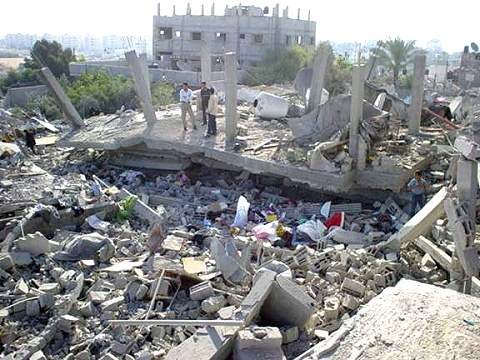
One Gaza Testimonial

gazaruin

I’m posting below a testimony by “Nancy,”  a Palestinian living in the Chicago area who is a friend of a member of my congregation. This oral testimony was given during the height of Israel’s military bombardment of Gaza, where most of Nancy’s family lives.

As you read, all I ask is that you resist the temptation to become defensive. Please don’t discount her testimony as mere propaganda (I personally do not doubt the veracity of her account). Please don’t dismiss her pain with “It’s very sad, but Hamas started it.” As difficult as it might be, I believe it is critically important for us to look into our own hearts and consider our responsibility for the staggering human cost borne by Gazan civilians over the past several weeks.

Click below for Nancy’s story – but one of thousands…

Continue reading

Rabbis on the Third Rail

usisraeliflag

Having nothing better to do, I spent a fair amount of time last week trying to spearhead a Rabbinical Statement on Gaza. Sorry to report that after several days of back and forth we had to fold the entire project when it became clear that we wouldn’t find a wording that would satisfy a critical mass of rabbis. (To make matters even worse, an early version of the statement was precipitously posted on the net before we had consensus. I’m fairly sure it’s still floating around out there in cyberland in all its unauthorized glory…)

There were several motivations for the statement. First and foremost, it came from a desire to express a Rabbinical voice of opposition to Israel’s military action in Gaza, which we felt was strategically disastrous and morally outrageous. It was also important to us that Jewish community leaders publicly expressed sorrow not just for the loss of Israeli life but also for the massive devastation experienced by Gazans during the past three weeks:

We condemn the firing of missiles from Gaza that forced so many Israelis to live in fear and we mourn the loss of life that resulted from these attacks. However, we are devastated by Israel’s disproportionate use of force, killing more a myriad of people, including over 450 children. In the wake of such overwhelming civilian bloodshed, we can only ask, in the words of the Talmud, “How do we know that our blood is redder than the blood of our fellow?”

Additionally, since we felt we could not address the tragedy of the war while ignoring the larger political context of the conflict, our statement contained a strong message for the new American administration:

We urge our new President to turn back the policies of previous administrations – policies which have given Israel permission to take numerous measures that we believe are counter to the cause of peace, including the expropriation of Palestinian lands, destruction of Palestinians homes and businesses and the widespread building of settlements in occupied Palestinian territory.

The most controversial aspect of our statement was our call for the new administration to take an assertive diplomatic approach with Israel, and not to rule out the withholding of military aid “as necessary.” As anyone familiar with American Jewish community politics must surely know, withholding aid  is the “third rail” for organized Jewry –  i.e., the line that can never be crossed.

And it was this was the sentence more than any other that confounded of our core group of signers. We tried various different wordings: “if the administration deems it necessary,”  “withholding of aid as a last resort,”  “withholding aid for noncompliance” – but in the end, no wording seemed to suffice. Some felt that this was going to far and others refused to sign unless a strong statement about withholding aid was included.

I can certainly understand why this issue pushes such profound buttons for American Jews. It plays on our deepest fears and as well as our abiding sense of Jewish vulnerability. For many American Jews, the withdrawal of aid would be tantamount to abandonment by Israel’s most significant ally. But there are other Jews – and I believe their ranks are growing – who simply do not want to be party to Israel’s growing militarism and are not afraid to admit it.

For my part, I was less concerned about this particular issue, and perhaps that just reflects my own naivete. While I understand our community’s fears, I also believe that withholding aid is probably the strongest diplomatic “stick” America can wield with Israel – and in the end it may be the only one that will ever really get Israel’s attention. But whatever we might think about this issue, I just don’t agree that it must be ipso facto off the table for mere discussion in our community – and I deeply resent those in our community who reserve the right to excommunicate others who hold this opinion in good faith.

It’s all moot anyhow. No matter how we worded the statement, we couldn’t retain our core of signers. Some asked to have their names removed for various reasons. Many told me they would have loved to have signed, but couldn’t for organizational or professional reasons. After several days we called it quits.

I know there are some decent lessons in all of this, but mostly I’m just frustrated  and very, very sad. I know for a fact that there are many Jews out there who were waiting for rabbis to make a statement of this kind, regardless of the final wording. I still believe  that whatever the political realities, those of us who care about the shared fate of Israelis and Palestinians will have to find the courage of our convictions.

For me it really comes down to this: two of our most sacred Jewish values are Ahavat Yisrael (“Love of the People Israel”) and Ahavat Habriot (“Love for All People”). Should it really be that hard for us to promote both with equal passion?

Gaza: The Arrow Cannot Be Taken Back

gaza6

“When an arrow leaves the hand of a warrior he cannot take it back.” (Mechilta of Rabbi Ishmael, Beshallach, Shirah)

From this classic Jewish teaching we learn that violence unleashes a myriad of consequences that we can neither control nor reverse. Apropos of recent events, I take this to mean many things:

…when you loose tons and tons of bombs on a small patch of land inhabited by 1.5 million people, you will invariably kill a myriad civilians.

…we cannot begin to fathom the depths of grief and loss that Israel’s actions have brought upon scores of Gazans, their families and loved ones. Indeed, even in the wake of a fragile ceasefire the death toll continues to rise. (Read this article from today’s NY Times, which documents heartbreaking scenes of victims continuing to be pulled from the rubble weeks after they were killed).

…we cannot comprehend the anger and fury Israel’s actions have inspired in Gazans, Palestinians, and the Arab world at large. Yesterday I spoke with a Palestinian American friend who told me he had never seen the Arab streets so inflamed against Israel – and in many cases, against their own governments. (The anger of Egyptian citizens toward their goverment is frightening to behold).

…it is impossible to underestimate the damage this war has done to the already tenous prospects for peace between Israel and Palestine. Most analysts seem to agree that no matter whoever might be considered the military “victor” in this war, the moderate Fatah (at present Israel’s only Palestinian peace partner) is the heaviest political casualty. Moderate Arab countries are all the queasier about supporting the peace process and the Saudis are now under fire to pull their plan from the table.

This quote from the NY Times article above sums up the tragic new reality on the ground:

In the upper middle-class neighborhood of Tal al-Hawa, Ziad Dardasawi, 40, a wood importer, was trying to process what had happened. As a supporter of Fatah, a political rival of Hamas, Mr. Dardasawi said that he despised Hamas, but that its rocket fire was no justification for Israel’s military response.

“Let’s say someone from Hamas fired a rocket — is it necessary to punish the whole neighborhood for that?” he said, standing in a stairway of his uncle’s house, where furniture had been smashed, and all the windows broken.

He drew on an analogy he thought would strike a chord: “In the U.S., when someone shoots someone, is his entire family punished?”

The Israeli actions made the situation more intractable, he said. “How can I convince my neighbors now for the option of peace? I can’t.”

He added: “Israel is breeding extremists. The feeling you get is that they just want you to leave Gaza.”

(Photo: Tyler Hicks/NY Times)

Israel and Gaza: Speaking About the Unspeakable

gaza

Stayed up until the wee hours last night surfing the web reading report after report about Gaza.  Despite my better judgement, I couldn’t take my eyes off the horrific reports that Israel was using white phosphorous in densely populated civilian areas.  After seeing a picture in the NY Times of a 10 year old boy who had lost his eyesight and most of the skin from his face from phosphorous burns, I turned to reports on B’Tselem and Human Rights Watch. I’m ashamed to report I was reading this stuff well past the time it would have made sense to go to bed…

Needless to say as I read, my mind and emotions reacted a mile a minute, ranging back and forth from defensiveness to righteous anger and everything in between. Is it really true?  Perhaps the reports are mistaken?  Burning children alive in the streets?  Couldn’t there possibly be another explanation?

It’s been all the more upsetting since there has been a near total absence of any honest communal discussion about these kinds of reports. On one end of the spectrum, some can discount upsetting news like this by placing exclusive responsibility upon Hamas for cynically using civilians as human shields. On the other end, others will excoriate Israel for the barbaric genocide it is perpetrating against the Palestinian people. The rest, I imagine, simply bury the news deep down and move on.

This morning upon arriving at work, I read one of the weekly e-briefings that I regularly receive from a well-known American Jewish organization. It purported to give an up-to-date status report/analysis on the situation in Gaza, but it was essentially yet another excuse to dispassionately analyze Israel’s successful military “operation” in Gaza:

Israel acted decisively, despite (ongoing) internal divisions, the approaching elections, and the false image of a hedonistic society. A strong, determined, and high-spirited military, both regulars and reserves, showed up ready to do battle to rid the South of the missile threat.

Hamas’s own tactical designs collapsed, as the IDF put into practice the bitter lessons of 2006: Units were thoroughly equipped, well-trained, informed by intelligence, and ready for battle, anticipating the various tactics (such as booby-trapped houses and the rush of suicide bombers in civilian clothing or even IDF uniforms.

You get the idea. And in the meantime there was nary a hint of the untold civilian suffering and loss that this horrid war has wrought. I don’t know what I expected, really. I shouldn’t underestimate how hard it is for a community to find the werewithal to speak about the unspeakable. Is it too much to hope that we find a way to start?

Who Am I to Criticize?

sderot

You have no idea what it is like to live here. You don’t understand what we live with every day. We are the ones who have to live with the consequences of this war. Who are you to criticize us?

In a very real way, of course, they’re are absolutely right. Though I visit Israel frequently and have spent a significant amount of time there, I have no idea what it is like to live and work and raise a family and makes one’s home in a country that is in a constant state of war against enemies within and without.

And I certainly cannot even begin to imagine what it must be like to live  in Southern Israel during this most current crisis: to try and live a life with some sense of normalcy knowing that at any moment an air-raid siren could go off and afford you and your family mere moments to await the possibility of an incoming missile.

It is true and I must acknowledge it. American Jews do not live with the traumatic reality of this conflict. It is very different to relate to the war in Gaza from the comfort of our homes a world away rather than mere kilometers from the border. At the end of the day, I do admit to my Israeli friends that I cannot and will never understand what it must be like to live there.

But as someone who has identified deeply with Israel for his entire life, someone who has dear friends and family there, I write this with utmost honesty and respect: I reject the suggestion that I have no place speaking out against Israel’s actions simply because I don’t actually live there.

Who am I to criticize? I am a Jew – one of the many millions of diaspora Jews for whom the Jewish state was created. According to the official Zionist narrative, Israel is my Jewish inheritance, my Jewish national home. As a Jew living outside of Israel, I have been given the right to receive instant citizenship if I ever decide to actually move there (something, by the way, that scores of Palestinians whose families have lived in that land for generations cannot do). If Israel purports to relate to me thus, do I not have a voice in the discussion over the actions the Jewish state takes in the name of my people?

Who am I to criticize? I am American. I am a citizen whose country, the world’s largest superpower, supports Israel with significant economic and military aid. My tax dollars thus implicate me in a very real way with Israel’s national decisions – not least of which are its military actions.  I am also the citizen of a nation whose government has essentially given Israel a blank check to take numerous measures that I believe are counter to the cause of peace, including the expropriation of Palestinian lands, destruction of homes, injustice in military courts and widespread building of settlements in occupied Palestinian territory, to name but a few.

As I have written in earlier posts, I believe Israel’s response to Hamas’ missile attacks have been disproportionate and outrageous. I believe their actions only further endanger the security of  Israelis while inflicting collective punishment and a severe humanitarian crisis upon Gazans. Indeed, just as I cannot understand what it must be like to be a citizen of Sderot, I cannot even begin to imagine what it must be like to be a Gazan citizen at the moment, living under constant air attack, with no running water or electricity and dwindling food, as hospitals fill up with wounded and corpses lie rotting in the streets because relief workers are unable to reach them.

Do I believe that Palestinians bear their share of the blame in this crisis? Absolutely. As the cliche goes, there is certainly enough blame to go around. But as a Jew and an American, I am uniquely implicated in the actions Israel takes.  We Jews and Americans must bear our share of responsibility for this crisis. How far are we willing to go to contribute to a solution?

Israel and Gaza: One Geographer’s Prediction

5

I am enormously grateful to those who’ve commented on my last two posts, which inspired the longest and liveliest conversation I’ve ever seen on this blog.  I know my that my words struck a nerve but I’m grateful to have facilitated a least a small measure of open discussion.

Speaking personally, my own anguish over this tragedy has only deepened during the past week – particularly as Israel’s ground invasion begins, the civilian death/casualty toll increases and headlines scream things at us like “Ceasefire Rejected” and “No End in Sight.”  Still and all, I seem to have retained a uniquely masochistic impulse to devour every news report and analysis that comes my way.

Amidst the myriad of articles, news reports and blog posts I have read this past week, the one that has stuck with me the longest is a five year old Jerusalem Post interview with Israeli geographer Arnon Soffer.  Soffer is widely regarded as the architect of Sharon’s disengagement plan and his insights (as morally repugnant as they are) are critical for our understanding of the actual intentions behind Israel’s pullout from Gaza.  In their tragically ironic way, I believe Soffer’s words are are profoundly important in helping us understand why it shouldn’t be such a surprise that things have now come to this.

A brief excerpt:

How will the region look the day after unilateral separation?

The Palestinians will bombard us with artillery fire – and we will have to retaliate. But at least the war will be at the fence – not in kindergartens in Tel Aviv and Haifa.

Will Israel be prepared to fight this war?

First of all, the fence is not built like the Berlin Wall. It’s a fence that we will be guarding on either side. Instead of entering Gaza, the way we did last week, we will tell the Palestinians that if a single missile is fired over the fence, we will fire 10 in response. And women and children will be killed, and houses will be destroyed. After the fifth such incident, Palestinian mothers won’t allow their husbands to shoot Kassams, because they will know what’s waiting for them.

Second of all, when 2.5 million people live in a closed-off Gaza, it’s going to be a human catastrophe. Those people will become even bigger animals than they are today, with the aid of an insane fundamentalist Islam. The pressure at the border will be awful. It’s going to be a terrible war. So, if we want to remain alive, we will have to kill and kill and kill. All day, every day.

While CNN has its cameras at the wall?

If we don’t kill, we will cease to exist. The only thing that concerns me is how to ensure that the boys and men who are going to have to do the killing will be able to return home to their families and be normal human beings.

Click below to read the entire article.

Continue reading

Israel and Gaza: In Search of a New Moral Calculus

59ae8b54-d4eb-11dd-b967-000077b07658

I knew my last post would generate passionate comments – and I confess that I did hesitate before posting something so patently emotional. I went ahead though, because as I read the increasingly tragic news about the Israel-Gaza conflict, I’m consciously resisting the knee-jerk impulse to paper over my emotions with dispassionate analysis. It’s becoming clear to me that our attempts to be “rational” keep us from facing the inherent irrationality of this conflict.

Of course the Qassam attacks against Southern Israel have been intolerable. Of course Hamas bears its share of responsibility for this conflict. But beyond the rhetorical “well, he started it” arguments (which could stretch well back to 1948 and beyond) there remains the central question: what will bring safety, security and ultimately peace to this tortured region? I realize there are no easy answers, but I believe to my marrow that it will not come by sending in the war planes and reducing what’s left of Gaza to rubble.

Does anyone in their right mind truly think this abject destruction will ultimately bring safety and security to Southern Israel?  In the end, Every Gazan killed equals that many more family members and friends who will now be forever enraged and inflamed against the Jewish state. If peace depends largely on cultivating moderates on the other side, what does blowing them to smithereens accomplish? Believe me, if Israel ultimately thinks their attacks will turn Gazans against Hamas, they will be sorely disappointed. If forced to choose between Israel and Hamas, who do we really think they will choose now?

But even more than the strategic considerations, I am infinitely more troubled by the deeper moral implications of Israel’s military actions. Yes, it is true that Hamas chose to end the ceasefire and yes, Israel has few good options. But it was ultimately Israel who made the decision to bombard Gaza with a massive air attack, loosing many several hundreds of bombs into densely populated city center, virtually guaranteeing widespread civilian carnage and death.

As I write these words, I can already predict the standard moral calculus: “Yes, but Hamas purposely launches Qassams into civilian areas while Israel tries to minimize civilian casualties whenever possible.”  I’m coming to realize that pat rhetorical equations like these might serve to help us sleep better at night, but they don’t change some basic unavoidable truths: that in the Israeli-Palestinian conflict, the military power dynamic is heavily weighted in Israel’s favor, that Hamas’ Qassams are but peashooters against Israel’s armed might and ultimately, as traumatic as it undoubtedly is to live in Sderot, Palestinian civilian casualties vastly outnumber Israel’s. And in the end, it matters little to the loved one of a dead civilian whether or not his/her death was caused intentionally or by “collateral damage.”

From what I can tell, Israel’s response to this latest bloody go-round amounts to: “We regret if civilians are killed, but they started it and anyhow that’s what happens in war.”  I certainly understand how Israel, a nation that has been in a constant state of war and conflict since its inception might develop such a moral trope. But whatever comfort it might afford us in the short term, it will not ultimately provide us with a path to peace – only a rationalization for prolonging the bloody status quo.

That’s all for now. Thank you for your comments and please keep them coming. And let’s pray for better news tomorrow.

Outrage in Gaza: No More Apologies

gaza
(picture by Hatem Omar/Maan Images)

The news today out of Israel and Gaza makes me just sick to my stomach.

I know, I can already hear the responses: every nation has a responsibility to ensure the safety of its citizens. If the Qassams stopped, Israel wouldn’t be forced to take military action. Hamas also bears responsibility for this tragic situation…

I could answer each and every one of these claims in turn, but I’m ready to stop this perverse game of rhetorical ping-pong. I don’t buy the rationalizations any more. I’m so tired of the apologetics. How on earth will squeezing the life out of Gaza, not to mention bombing the living hell out of it, ensure the safety of Israeli citizens?

We good liberal Jews are ready to protest oppression and human-rights abuse anywhere in the world, but are all too willing to give Israel a pass. It’s a fascinating double-standard, and one I understand all too well. I understand it  because I’ve been just as responsible as anyone else for perpetrating it.

So no more rationalizations. What Israel has been doing to the people of Gaza is an outrage. It has brought neither safety nor security to the people of Israel and it has wrought nothing but misery and tragedy upon the people of Gaza.

There, I’ve said it. Now what do I do?

Rainy Day in Tehran

iran4-002

Our last day in Tehran was a rainy one, beginning with a visit to the headquarters of the Tehran Jewish Committee (roughly the equivalent of the Iranian Jewish Federation). We spoke at length with Committee President Rahmat ollah Raffi, who gave us a thorough tutorial on the Iranian Jewish community. In short: there are roughly 20 – 22,000 Jews in Iran. The majority live in Tehran, followed by Shiraz and Esfahan. Jews have had a long and noble presence in Persia – they have lived there for almost 3000 years, making them the oldest Diaspora Jewish community in the world.

Before 1979, there were over 100,000 Jews in Iran. As many were royalist supporters of the Shah, tens of thousands of Jews emigrated following the Islamic revolution. Most now live in the United States – there are approximately 40,000 Iranian Jews living in Los Angeles alone. The Jews who chose to remain in Iran, however, are fiercely proud of their Persian Jewish heritage and those with whom we spoke told us they feel very comfortable living as Jews in an Islamic nation. Judaism, along with Christianity and Zoastrianism, are officially recognized religions, which allows them to get significant subsidies from the government as well as Parliamentary representation. (It was pointed out to us that while the Iranian Constitution stipulates one member for every community of 500,000, the Jewish community has been granted a representative even though they only number 20,000).

The Tehran Jewish Committee (and other Jewish centers in smaller Jewish communities) supports a variety of community institutions, including synagogues, religious schools, kosher butchers and restaurants, and Jewish cemeteries. They also support major Jewish medical center in Tehran about which they spoke with particular pride. The Dr. Sapir Hospital was founded 60 years ago and was originally the only hospital serving the Jewish community in Iran. It now has 120 beds and only 5% or so of their patients are Jewish. Most of the physicians, however, are Jewish and many of them have received awards from the government. Remarkably, Sapir Hospital receives no money from outside Iran. (Pic below: Alan Gratch and FOR Executive Director Mark Johnson at the entrance to the Center office).iran4-001

The Center is also extremely active in Jewish cultural projects: they publish a Jewish magazine called “Bima,” and have begun publishing cultural/religious books in Farsi. All told, the activities of the Iranian Jewish Committee point to a strong Jewish community. One leader told us that they considered themselves to be Iranian Jews rather than Jewish Iranians – their strong connection to Persian heritage is in many ways the primary and driving aspect of their Jewish identities.

The Jewish leaders with whom we met stressed repeatedly that they have good relations with the Islamic government and said that they strive to remain apolitical in all their dealings. In certain ways, however, it seemed to me that for them, “apolitical” meant toeing the Iranian political party line. Their attitude toward Israel is the most primary example – whenever they spoke of Israel, it was invariably in a disparaging manner characteristic of official Iranian government pronouncements. Although they insist they live well as Jews in Iran, it seemed clear to me that they’re extremely careful not to make waves.

Though it’s hard to imagine that Iranian Jews don’t feel their existence in the Islamic Republic isn’t precarious to some extent, we still came away from our meeting with the impression that this was a vital community with a strong sense of itself and its heritage. One man we spoke to said that religious Jews generally welcome the opportunity to live in a religious nation. He added with sadness that Iranian Jews who emigrate to America tend to assimilate into secular American culture. Here in Iran, he said, Muslim religiosity tends to dovetail with Jewish religiosity, especially with those customs that are similar to Islamic customs like head covering or regular daily prayer. (Check out the interesting pic at the top: our meeting room at the Jewish Committee’s office: note the wall with the Jewish Ten Commandments next to the pictures of Ayatollahs Khomeini and Khameini…)

Even with all the complexities involved, I can’t help but feel that we American Jews are missing out on a huge opportunity by failing to learn about and forge greater ties with Iranian Jewry. This is truly an exciting and vibrant community and we clearly have a lot to learn from each other. I’m excited with the prospect of building upon the relationships that we’re creating here.

The other highlight of our day was a visit with Habib Ahmadzadeh, an Iranian writer, filmmaker and peace activist. Habib, who we met through Leila, is a veteran of the Iran-Iraq war. He was sixteen years old and living in a West Iranian border town when the Iraqi army invaded and he spent the next eight years defending his home town. Most of Habib’s creative work deals with war – and with the Iran-Iraq war in particular. One of his novels was recently translated into English and he wrote the screenplay for the acclaimed Iranian feature film, “Night Bus,” based on one of his short stories. (That’s me and Habib in the pic below):iran4-003

We met Habib in his Tehran office, where he screened the film for us. It’s a powerful war drama about a teenage Iranian soldier who is given the job of escorting 38 Iraqi POWs on a bus to prison camp. In our conversation afterwards, we learned that the majority of the events in the movie were based on his own war experiences.

We in the West know very little about this eight year war, but it for Iranians it continues to be a traumatic and transformative event. Almost an entire generation of young Iraqis were decimated by the Iran-Iraq war, in which hundreds of thousands of young, ill-equipped Iranian men were sent in human wave attacks to almost certain death. Many, including Habib, are living with the terrible after affects of chemical weapons poisoning.

In addition to his creative work, Habib is a committed anti-war activist. His production company recently took “Night Bus” to the western border towns to screen for young people in the small western communities where the war was fought. He hopes to show the film to greater numbers of Iraqis as well, to help raise consciousness about war and its tragic after affects.

Habib has also worked considerably to raise awareness about the downing of an Iranian passenger plane by an American warship, the USS Vincennes, in 1988. 290 Iranian civilians died in this tragedy, which the US government originally covered up and for which it has never apologized. (Adding insult to tragedy, some officers of the Vincennes were actually awarded medals in the wake of the disaster). Again, most Americans barely remember this event, if they remember it at all. But as Habib and others have told us, Flight 655 is Iran’s 9/11 – and it remains as yet one more painful obstacle to Iranian-American reconciliation.

Habib has gained some fame for a public letter he wrote to the Captain of the Vincennes, Will Rogers III, who remains implacably unrepentant to this day. It’s a remarkable document, filled with pain, but also a powerful palpable desire for reconciliation. In its way, I think, it seems to speak for many in this country.

Tommorow we’re off to Qom to dialogue with Muslim scholars at Mofid University.