Category Archives: Zionism

Palestinian Christians: “The Occupation is a Sin”

Last week, a group of Palestinian Christians representing a variety of churches and church-related organizations issued a powerful, prayerful call for an end to the Israeli occupation.  My friend Rabbi Brian Walt was present at the meeting in Bethlehem in which the statement – known as  “The Kairos Palestine Document” – was released. Upon his return, he described to me his profound, often painful conversations with Palestinian Christians and he told me that as a Jew, he considered the Kairos Document to be an enormously important spiritual/political statement. Having now read the entire 12 page document, I must say that I agree wholeheartedly.

Palestinian Christian liberation theologians such as Naim Ateek of the Sabeel Institute have been doing important work for decades and I believe their ideas present important spiritual challenges to the Jewish community. Many Jews point to the more radical incarnations of these theologies – and while I share some of these concerns, I believe that we make a profound mistake by dismissing Palestinian Christian theology wholesale. (Frankly, I am much more troubled by the “End of Days” theologies of fundamentalist Zionist Christians such as Pastor John Hagee than I am by Naim Ateek and the authors of the Kairos document.)

My friend and colleague Father Cotton Fite of St. Luke’s Church in Evanston, tells me he hopes that American Christians will study the Kairos Document carefully. I mentioned to him that I hoped Jews would read it as well. In fact, I think we should create opportunities to read it together. Despite our differences, I believe it offers both of our communities an ideal place to begin meaningful dialogue over the spiritual implications of this conflict.

One of the more important and challenging passages:

Our presence in this land, as Christian and Muslim Palestinians, is not accidental but rather deeply rooted in the history and geography of this land, resonant with the connectedness of any other people to the land it lives in. It was an injustice when we were driven out. The West sought to make amends for what Jews had endured in the countries of Europe, but it made amends on our account and in our land. They tried to correct an injustice and the result was a new injustice.

I can already predict that many Jews will bristle that this passage does not specifically reference the Jewish connection to the land as well. To this I would say, how deeply do we Jews ever honor the reality that we are not the only people who are “deeply rooted in the history and geography of this land?” Moreover, how deeply do we ever face the true injustice that was committed when a people with deep roots in the land were driven out and not allowed to return?

Another sobering passage in the document describes the Occupation as no less than a “sin:”

We also declare that the Israeli occupation of Palestinian land is a sin against God and humanity because it deprives the Palestinians of their basic human rights, bestowed by God. It distorts the image of God in the Israeli who has become an occupier just as it distorts this image in the Palestinian living under occupation. We declare that any theology, seemingly based on the Bible or on faith or on history, that legitimizes the occupation, is far from Christian teachings, because it calls for violence and holy war in the name of God Almighty, subordinating God to temporary human interests, and distorting the divine image in the human beings living under both political and theological injustice.

Many of us view the Occupation as a political problem to be solved. But indeed, as Jews, we must admit basic human rights are rooted in our religious tradition. Like Christians, we also believe that all human beings are created in the image of God. We also believe that when the basic dignity of anyone’s humanity is diminished, the Divine Image is diminished as well. How then, can we fail to understand that the Occupation is not only a geo-political problem but a spiritual/moral problem as well?

This conclusion leads to a logical next step:

Love is seeing the face of God in every human being. Every person is my brother or my sister. However, seeing the face of God in everyone does not mean accepting evil or aggression on their part. Rather, this love seeks to correct the evil and stop the aggression.

The injustice against the Palestinian people which is the Israeli occupation, is an evil that must be resisted. It is an evil and a sin that must be resisted and removed. Primary responsibility for this rests with the Palestinians themselves suffering occupation. Christian love invites us to resist it. However, love puts an end to evil by walking in the ways of justice. Responsibility lies also with the international community, because international law regulates relations between peoples today. Finally responsibility lies with the perpetrators of the injustice; they must liberate themselves from the evil that is in them and the injustice they have imposed on others.

Again, the Occupation is viewed not as a diplomatic issue to be negotiated but a spiritual evil to be resisted.

I have no illusions that for many Jews, suggestions such as these present daunting and painful challenges.  So will many of the ultimate political ramifications of the Kairos Document. All I can hope for is that political disagreements will not keep us from honestly facing the profound spiritual dimensions of this conflict.  Speaking for myself, I do believe this statement was written in good faith, genuine love and true religious conviction:

Our message to the Jews tells them: Even though we have fought one another in the recent past and still struggle today, we are able to love and live together. We can organize our political life, with all its complexity, according to the logic of this love and its power, after ending the occupation and establishing justice.

What can I say to this except “Amen?”
You Are But Strangers: Jewish Theology and the Land of Israel

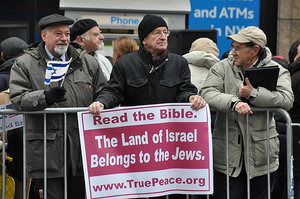
The land of Israel is ours because God gave it to us.

This particular Jewish claim is bandied about so much that I imagine it would some as a surprise to many that it is, in fact, a misrepresentation of the Torah and its teachings.

I would go farther and say this: this view is actually a betrayal of Jewish tradition – and has only become widely popular since the rise of political Zionism.

Let’s take a closer look at the texts in question:

Jewish fundamentalists and ultra-nationalists are fond of pointing out that God promised the land of Israel to Abraham in the book of Genesis:

On that day, the Lord made a covenant with Abram, saying, “To your offspring I assign this land, from the river of Egypt to the great river, the river Euphrates…” (Genesis 15:18)

Biblical scholars and commentators note that the covenant God makes with Abram (soon to be renamed Abraham) appears as a promisory covenant. In this early point in the narrative, the land indeed seems to be assigned to the people Israel with “no strings attached.”

Later in Exodus, however, once Israel has left Egypt and has become a nation at Sinai, God clarifies the terms of this covenant. It is spelled out in decidedly conditional language: if Israel follows God’s commandments, then they will indeed be able to live on the land that has been assigned to them by God. In other words, Israel now learns that their future on the land will be radically dependent on how they behave on the land.

As I see it, this is the fatal mistake made by those who claim that the land must ipso facto “belong” to the Jewish people. They focus exclusively on the Abrahamic promise, but neglect the critical next step: God’s conditional covenant with the Israelite nation.

In so doing, they pervert the Torah’s meaning – and do great damage to the central Jewish understanding of our relationship to the land. The land is not given to us unconditionally – we will only be able to live on the land if we prove ourselves worthy of it.

Interestingly, the Torah actually points out that previous inhabitants of the land had failed in this regard. Following a long litany of laws in Leviticus, we read:

Do not defile yourselves in any of those ways, for it is by such that the nations that I am casting out before you defiled themselves. Thus the land became defiled; and I called it to account for its iniquity and the land vomited out its inhabitants. (Leviticus 18:24-25)

In similarly colorful language, Israel is told that they might well meet the same fate if they do not keep God’s laws when they live on the land:

So let not the land vomit you out for defiling it, as it spewed out the nation that came before you. (18:28)

In another important verse from Leviticus, God makes it clear to whom the land ultimately belongs. In the discussion of the Jubilee year (in which landholdings revert back to their original owners) we read:

…the land must not be sold beyond reclaim, for the land is Mine; you are but strangers resident with Me. (Leviticus 25:23)

Notably, the Hebrew word for “stranger,” (“ger”) literally means “resident alien.” This word appears over and over throughout the Torah – particularly in admonitions to Israel not to mistreat the stranger, “for you were once strangers in the land of Egypt.” It is sobering indeed to learn that even after the Israelites enter Israel, they will still be, in effect, resident aliens on the land.

In the end, although many Jewish fundamentalists often treat the Torah as the Jews “deed of sale” to the land of Israel, it might be more accurate to describe it as a “lease” with very explicit conditions. In Deuteronomy, this conditional language reaches its apex. As the Israelites prepare to enter the land of Israel, Moses reminds them that they could be exiled from the land in an instant if they do not remain faithful to God’s covenant:

If you fail to observe faithfully all the terms of this Teaching…the Lord will scatter you among all the people from one end of the earth to the other, and there you shall serve other gods, wood and stone, whom neither you nor your ancestors have experienced. Yet even among those nations you shall find no peace, nor shall your foot find a place to rest… (Deuteronomy 28:58-65)

For the prophets and later the rabbis, the conditional covenant was central in understanding Israel’s collective tragedy: “mipnei chataeinu” – “because of our sins” we were exiled from the land. This in fact remained the normative Jewish understanding of our centuries-long sojourn in the diaspora until the advent of Zionism and the establishment of the state of Israel.

Though today we live in a radically different context than Ancient Israel, this question remains powerfully relevant: now that we have returned again to this land, how will we prove ourselves worthy of it?

Whatever our answer, this much seems clear: we will not be worthy of the land if we betray our own religious teachings and cling to misguided, exclusivist claims. The Torah teaches us still: if we insist that the land “belongs” to us and us alone, we will only endanger our collective future upon it.

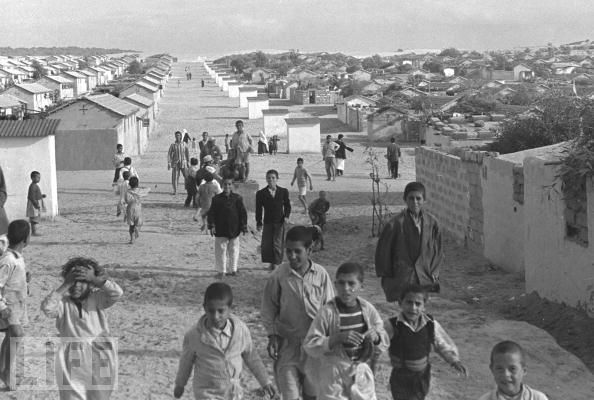
Gaza 1956

gaza1956

Earlier this year I shared a 2004 Jerusalem Post interview with Arnon Soffer, the architect of Israel’s disengagement from the Gaza Strip. It was a painfully sobering read, not least for his chilling predictions of Israel’s post-disengagement reality:

(When) 2.5 million people live in a closed-off Gaza, it’s going to be a human catastrophe. Those people will become even bigger animals than they are today, with the aid of an insane fundamentalist Islam. The pressure at the border will be awful. It’s going to be a terrible war. So, if we want to remain alive, we will have to kill and kill and kill. All day, every day…

If we don’t kill, we will cease to exist. The only thing that concerns me is how to ensure that the boys and men who are going to have to do the killing will be able to return home to their families and be normal human beings.

I thought of this article today as I read another piece about Gaza: a famous 1956 eulogy given by Moshe Dayan for a young kibbutznik named Ro’i Rotenberg, who was killed by Gazan Arabs who had crossed over the border into Israel.

At the start of his eulogy, Dayan offered these astonishingly candid remarks:

Do not today besmirch the murderers with accusations. Who are we that we should bewail their mighty hatred of us?  For eight years they sit in refugee camps in Gaza, and opposite their gaze we appropriate for ourselves as our own portion the land and the villages in which they and their fathers dwelled.

Not from the Arabs in Gaza, but from ourselves shall we require the blood of Ro’i. How did we close our eyes so as not to see the goal of our generation in its full measure of cruelty?  Did we forget that this group of young men and women, which dwells in Nahal Oz, bear on their shoulders the heavy gates of Gaza, gates on the other side of which are crowded together with hundreds of thousands of eyes and hands that pray for our weakness, that it may come, so that they may rip us to shreds – have we forgotten this?

This we know: that in order that the hope to destroy us should die we have to be armed and ready, morning and night. We are a generation of settlement, and without a steel helmet and the barrel of a cannon we cannot plant a tree and build a house. Our children will not live if we do not build shelters, and without a barbed wire fence and a machine gun we cannot pave a road and channel water. The millions of Jews that were destroyed because they did not have a land look at us from the ashes of Israelite history and command us to take possession of and establish a land for our nation.

(Translation, Michael Shalom Kochin, 2009)

J Street Reflections

jst.I’m back from the national J Street Conference in DC and its been a whirlwind. There’s so much to tell, but I’m not sure I can do it any better than the myriad of bloggers who have already weighed in. For your reading pleasure, I recommend the missives from the good folks at Jewschool and the Velveteen Rabbi’s thorough session transcriptions. Also worthwhile: Adam Horowitz’s insightful piece in Mondoweiss and Richard Silverstein at Tikun Olam. Wade through all of those and you can consider yourself an honorary conference participant.

My proverbial two cents:

There is no denying that this was a milestone event for the American Jewish left. In a breathtakingly short amount of time, Jeremy Ben-Ami and his cohorts have rallied the “Pro- Israel, Pro-Peace” troops in an undeniably impressive show of force. For years, this message has been languishing in the hands of too many small groups that did little but wring their hands at the institutional strength of AIPAC. The American Jewish left is clearly ready to play with the big boys now.

Even before the conference began, however, it became obvious that it would not be a simple matter to gather the various progressive Jewish factions under a single tent. I was personally disappointed when J Street ominously bowed to pressure from the right wing press and rescinded its invitation to poets Kevin Coval and Josh Healy, who were scheduled to perform at the conference.

Now that the conference is over, it’s even clearer to me that this will be J Street’s greatest challenge: can it be a “big Israel tent” for the progressive Jewish community as well as a political lobbying force that must necessarily hew closely to its two-state solution talking points?

The JTA viewed this challenge in largely generational terms:

Older conference goers appeared to be virtually unanimous in expressing support for a  two-state solution, calling themselves Zionists and saying that while they back more U.S. pressure on the parties, they reject cutting aid to Israel if it does not accede to U.S. demands.

But a number of delegates under 40, especially college students and recent graduates, appeared to be much more equivocal on the idea of two states for two peoples. Some were hesitant about identifying as Zionists, and some were open to the idea of making U.S. aid to Israel conditional on progress in the peace process.

Whether this divide is strictly generational or not, I can attest that it was clearly apparent throughout the conference.  While virtually everyone I spoke to agreed that the conference was remarkable and often inspiring, I also heard widespread frustration that the content of most of the sessions revealed nothing particularly new.

Over the course of the three days, we repeatedly heard professions of love for Israel, concern over the endangered “Jewishness” of the Jewish state, and expert analysis of the peace process. But for many in the crowd, it seemed that the conference was most galvanizing during the relatively rare and unscripted moments when presenters and participants delved more deeply into the inherent injustice of the situation on the ground.

Indeed, this dynamic was apparent from the very beginning of the conference. During Jeremy B-A’s opening words, for instance, it was lost on no one that the only applause he received was when he acknowledged the suffering of Palestinian children. This kind of energy played out in notable ways over and over again. I can’t help but wonder if by pitching a wide tent, J Street has unwittingly opened a Pandora’s Box that will not easily be closed back up.

For me, the most unabashedly diverse and honest sharing of ideas occurred during the “bloggers lunch.” Interestingly enough the session was not officially sponsored by J Street – and given the free-wheeling nature of the opinions expressed it was to their credit that they allowed it to take place at all. (In a much-discussed Atlantic interview with Jeffrey Goldberg, Jeremy B-A defended his decision thus: “Come on Jeffrey, I’m letting them have a room for lunch.”)

Therein lies J Street’s genius – and its challenge.

On Jewish Hearts and Minds: A Response to Daniel Gordis

Just read Rabbi Daniel Gordis’ recent op-ed in the Jerusalem Post, one of several articles that have given some free publicity to Ta’anit Tzedek.  But it wasn’t Gordis’ offhand slam on TT that really bothered me – it was the decidedly patronizing way he analyzed the gulf between the American Jewish community and Israel – or as he termed it, American Jewry’s “growing abandonment of Israel.”

Gordis’ main premise: American Jewry’s newest generation is essentially self-centered (tainted “with the ‘I’ at the core of American sensibilities”) and simply cannot relate to the national sense of duty embodied by Israel:

In America, the narratives of immigrant groups are eroded, year by year, generation after generation.  In America, we are oriented to the future, not to the past, and if we cling to some larger grouping, it is to a human collective whole rather than to some “narrow” ethnic clan…

Similarly, the recreation of the State of Israel is truly powerful only against a backdrop of centuries of Jewish experience, and is spine-tingling only if my sense of self is inseparable from my belonging to a nation with a past and a people with a purpose.

In today’s individualistic America, the drama of the rebirth of the Jewish people creates no goose bumps and evokes no sense of duty or obligation. Add the issue of Palestinian suffering, and Israel seems worse than irrelevant – it’s actually a source of shame.

It’s not clear to me if Gordis is interested in winning over the hearts and minds of young American Jews, but if he is, I’d suggest that talking down to them from an Israeli ivory tower is not the way to do it.  I’m afraid that record just doesn’t play any more.

Gordis is correct when he posits that the old narratives simply aren’t working on American Jews the way they used to.  But that’s only because a new, more complex narrative is now being written by the current generation. It’s compelling in its own right, though this may be difficult to understand when viewed from the conventional Israeli vantage point.

I work with a great number of American Jews – particularly the 35 and younger demographic that Gordis cites – and from where I sit they look nothing like narcissistic, self-obsessed Americans he describes. On the contrary, most are engaged, seriously seeking Jews.  Yes, it’s true, unlike previous generations they don’t necessarily understand their Judaism in traditionally tribal terms anymore. But that doesn’t make them self-centered. Rather, they are increasingly viewing their Jewishness against a larger, more universal global reality.  In short, to be a Jew and a global citizen is what gives them “goose bumps.”

If, as Gordis suggests, American Jews are abandoning Israel, I’d suggest it’s not due to the lack of a sense of Jewish “duty or obligation” – I believe it’s because they are left cold by an Israeli national culture that appears to them to be overly tribal and collectively self-centered.

Indeed, while most young people today seem to be interested in breaking down walls between peoples and nations, Israel often appears determined to build higher and higher walls between itself and the outside world. It’s a poignant irony of Jewish history: while Zionism was ostensibly founded to normalize the status of Jewish people in the world, the Jewish state it spawned seems to view itself as all alone, increasingly victimized by the international community.

Gordis himself exemplifies this “it’s us Jews against the rest of the world” ethos in the opening paragraphs of his article:

About one thing, at least, the world seems to be in agreement: Israel is the primary culprit in the Middle East conflict, the cause of relentless Palestinian suffering and the primary obstacle blocking the way to regional peace.

The international chorus of opprobrium is growing by the day…It’s relentless, this ganging up, but it’s also not terribly new. The momentum has been building for years, and though we may not like it, we cannot honestly claim to be surprised.

While I understand the psychology of this world view, I don’t think it helps make Israel’s case for young Jews today – nor do I think it promotes a particularly healthy Jewish identity. It seems to me to be the product of self-pity, more than pride – a victim mentality that’s not likely to get us anywhere with newer generations of Jews who are feeling increasingly comfortable with the “outside world” and who don’t particularly identify with the claim that when push comes to shove, all the world really does just hate the Jews.

I will also predict that Gordis’ two cynical references to “Palestinian suffering”  will not resonate for growing numbers of Jews who are legitimately troubled by Israel’s treatment of Palestinians.  I understand full well that our criticism sounds galling to most Israeli ears. And no, I don’t believe that we American Jews can even begin to understand how Israelis feel – on so many levels.

But whether Israelis like it or not, there is a steadily growing demographic in the American Jewish community: proud, committed Jews who are deeply troubled when Israel acts oppressively, who feel implicated as Americans and as Jews in these actions, and who are galled at being labeled as traitors when they choose to speak out.

At the very least, I hope that Gordis will understand that if American Jews are identifying with organizations that protest Israel’s oppressive policies (organizations, yes, such as Ta’anit Tzedek) their affiliation does not come from a shame-filled desire to “bash” Israel. It comes from a deeper and much more Jewishly authentic place than that.

I realize that all of this may be too much to ask for. It’s long been clear that the American Jewish and Israeli Jewish communities are two very different animals with two decidedly different ways of understanding what it means to be a Jew in a rapidly changing world.  (Sociologists Steven Cohen and Charles Liebman pointed this out with great insight in their book “Two Worlds of Judaism” twenty years ago).

But it seems to me if we truly want to facilitate the Jewish future, we’re going to have to do it together. And to do that, we’ll  need to meet one another with openness and understanding, not dismissal and judgment.

Judaism as Nonviolence: A Sermon for Rosh Hashanah

During my Rosh Hashanah sermon, I asked the following questions:

Is there a place in Judaism for pacifism? Is it in fact possible – or desirable – as a Jew, to walk the path of nonviolence?

Click below to read my answers…

Continue reading

Bibi’s History Tutorial

netanyahu

I’m in agreement with the pundits who conclude that there was absolutely nothing new for consideration offered in Netanyahu’s speech. Perhaps he achieved a personal milestone by finally uttering the words “Palestinian state” but beyond this it was a tune we’ve all heard before. He offered “peace negotiations immediately without prior conditions” then proceeded to spell out the all too familiar prior conditions that everyone knows are non-starters for the Palestinians (i.e. Jerusalem remains the “united capital of Israel,” “natural growth” of the settlements will continue, there will be no right of return for the Palestinians.)

Same old, same old.   For me at least, the most interesting parts of his speech were not his tired policy pronouncements, but his extended forays into historical analysis – and in particular, his repeated justifications of the Jewish people’s right to the land:

The connection of the Jewish People to the Land has been in existence for more than 3,500 years. Judea and Samaria, the places where our forefathers Abraham, Isaac and Jacob walked, our forefathers David, Solomon, Isaiah and Jeremiah this is not a foreign land, this is the Land of our Forefathers.

It seemed clear that Netanyahu’s history lesson was a pointed rejoinder to Obama’s Cairo speech, in which Obama stated that the “Jewish homeland is rooted in a tragic history that cannot be denied.” You may have heard that following his speech, many in the Jewish community criticized Obama for connecting Israel’s right to exist to the Holocaust and failing to cite the Jewish people’s historical connection to the land.  Witness this livid Jerusalem Post editorial:

Mr. President, long before Christianity and Islam appeared on the world stage, the covenant between the people of Israel and the Land of Israel was entrenched and unwavering. Every day we prayed in our ancient tongue for our return to Zion. Every day, Mr. President. For 2,000 years.

Perhaps it’s because Palestine was never sovereign under the Arabs that even moderate Palestinians cannot find it in their hearts to acknowledge the depth of the Jews’ connection to Zion. Instead, they insist we are interlopers.

When Obama implies that Jewish rights are essentially predicated on the Holocaust—not once asserting they are far, far deeper and more ancient—he is dooming the prospects for peace.

For why should the Arabs reconcile themselves to the presence of a Jewish state, organic to the region, when the US president keeps insinuating that Israel was established to atone for Europe’s crimes?

Thus Netanyahu’s pointed words yesterday:

The right of the Jewish People to a state in the Land of Israel does not arise from the series of disasters that befell the Jewish People over 2,000 years – persecutions, expulsions, pogroms, blood libels, murders, which reached its climax in the Holocaust, an unprecedented tragedy in the history of nations…The right to establish our sovereign state here, in the Land of Israel, arises from one simple fact: Eretz Israel is the birthplace of the Jewish People.

It’s facinating to me that Netanyahu et al are so threatened by the suggestion that Israel’s establishment is ultimately bound to the Holocaust.   After all, didn’t Theodor Herzl himself found political Zionism as a reponse to world anti-Semitism?  And whatever historical claim the Jewish people might have to the land of Israel, it’s safe to say there would never have been international support for a Jewish state had it not been for the Holocaust.

Beyond this, I’m troubled by the need to continuously and defensively remind the world of the historical Jewish connection to this particular piece of land. I’m not at all sure that this is really a road we really need or want to go down.

What does it really mean for any people to have a “right” to a land?  I understand that the Jewish nation, like every nation, has its historic narrative, but let’s face it: nations don’t exist by right, they exist by fiat. Nations exist by virtue of military power and by their ability to maintain a system of governance  that will ensure their survival as a polity. Beyond this, it’s pointless to argue one’s historical or moral right to a land. It seems to me that if history has proven anything, it’s that might makes right – and all the rest is commentary.

The real question here is not who has a right to this land. The central issue is how its inhabitants will see fit to exist on the land. And on this point, I don’t see that Netanyahu gave us anything fresh to consider.

Rabbis Remembering the Nakba

IMG_0324

“These I remember and I pour out my soul…”

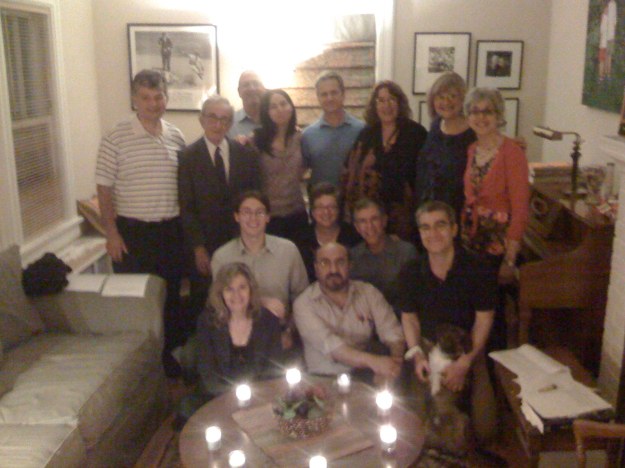
Last Thursday night I welcomed 14 people  – 9 Jews and 5 Palestinians – into my home for what turned out to be a powerful and sacred experience. The timing of our gathering was significant. May 14, 1948, the date of the State of Israel was declared, is a joyful milestone for Israel and Jews around the world. For the collective memory of the Palestinian people, however, this date represents their displacement and dispossession – an event they refer to collectively as the Nakba (“catastrophe.”)

The gathering in my home was one of four events that took place throughout the country on Thursday evening sponsored by “Rabbis Remembering the Nakba” – a new ad hoc group of rabbis and rabbinical students who seek to create a Jewish context for remembering this tragic event. Even more crucially, we believe it is critical that the Jewish community find a way to honestly face the painful truth of this event – and in particular, of Israel’s role in it.

In the words of a statement that was read at each gathering:

Our gathering tonight, “Rabbis Remembering the Nakba” is part of a series of programs occurring simultaneously around the country. It was originated by an ad-hoc group of American rabbis who desire to seriously reflect upon the meaning of Israel’s Independence Day. We are united in our common conviction that we cannot view Yom Ha’atzmaut – or what is for Palestinians the Nakba – as an occasion for celebration. Guided by the values of Jewish tradition, we believe that this day is more appropriately an occasion for zikaron (memory), cheshbon nefesh (“soul searching”) and teshuvah (“repentance.”)

These spiritual values compel us to acknowledge the following: that Israel’s founding is inextricably bound up with the dispossession of hundreds of thousands indigenous inhabitants of the land, that a moment so many Jews consider to be the occasion of national liberation is the occasion of tragedy and exile for another people, and that the violence begun in 1948 continues to this day. This is the truth of our common history – it cannot be denied, ignored or wished away.

Jewish tradition teaches that peace and reconciliation can only be achieved after a process of repentance. And we can only repent after an honest accounting of our responsibility in the wronging of others. While it is true that none of the Jews present tonight were actively involved in the dispossession of Palestinians from their homes in 1948, it is also true that if we deny or remain silent about the truth of these events, past and present, we remain complicit in this crime. In the words of Rabbi Abraham Joshua Heschel, “In a free society some are guilty, but all are responsible.”

Our gatherings this evening bring together Jews and Palestinians in this act of remembrance. This coming together is an essential, courageous choice. To choose to face this painful past together is to begin to give shape to a vision of the future where refugees go home, when the occupation is ended, when walls are torn down and where reconciliation is underway.

In addition to the event I hosted in Chicago, “Rabbis Remember the Nakba” gatherings were held simultaneously in Berkeley (led by Rabbi Lynn Gottlieb), New York (Rabbinical Student Alissa Wise), and Philadelphia (Rabbi Linda Holtzman). Though each event was organized separately and involved the additional participation of various local peace and justice groups, each gathering was linked by a few important common factors: each was led by a rabbi or rabbinical student, each involved the participation of both Jews and Palestinians, and each incorporated aspects of Jewish ritual in their ceremonies.

At the Chicago gathering, the guiding value of our ritual was zikaron – remembrance. As part of our ceremony, we bore witness by reading the history of the eight Palestinian villages that were destroyed on May 14, 1948. (In all, over 400 villages were depopulated of their inhabitants over the course of that year.)  In addition to learning about the events that transpired on the Nakba, we also learned about the history, culture, and communal life of each village. (Palestinian historian Walid Khalidi’s exhaustive and highly recommended work, “All That Remains” was an essential resource for our ceremony.) After hearing the history and fate of each village, a memorial candle was lit and we recited the following line from the Yom Kippur liturgy together: “These I remember and I pour out my soul.”

IMG_0328

On the whole I would describe our evening as a modest first effort that nonetheless contained some profound and indelible moments. By incredible coincidence, one of the Palestinian participants, Shafic Budron, mentioned that his wife’s family was from al-Bassa – one of the eight villages we commemorated in our ceremony. (Al-Bassa was a large village in Acre District, near the northwest coast of Palestine.)

As we read about al-Bassa’s fate during the Nakba, we learned this tragic account relayed by Palestinian eyewitnesses: after occupying the village, Haganah forces lined up some of the townspeople outside a church, shot them, and ordered others to bury the bodies. Shafic said he has heard numerous stories about al-Bassa from his mother-in-law over the year, including her traumatic recounting of the massacre on May 14. He added that his mother-in-law now has Alzheimer’s and has lost most of her adult memory – her only remaining memories are of her childhood village.

After our ritual, other Palestinian participants spoke at length about the stories of their own families. One man told us about the experiences of his mother, who was a survivor of an infamous massacre in the village of Deir Yassin, outside Jerusalem. Our gathering also included a Christian Palestinian from the north of the country, who experienced the Nakba personally.  Another Palestinian participant told us about his father who was saved by a Jewish friend during the Irgun’s attack on Jaffa.

In the end, the Palestinian participants were quite obviously moved that they were given this opportunity to have this conversation with Jews, as part of a ceremony convened by a rabbi. To put it mildly, it was obviously something quite unprecedented in their experience.  For the Jewish participants, there were a myriad of complex and powerful emotions. I’m personally still trying to sort through them all.

Whatever cognitive dissonance I might feel over this issue, I truly believe that this kind of reckoning is utterly essential for us as Jews. When it comes to the Nakba, most of us tend to respond through denial, avoidance, or dismissive rationalization (“that’s just how nations are made – what can you do?”)  The reason seems fairly clear: to face the painful truths of this history means to admit that our people  – a people who has been the victim of dispossession and dehumanization for centuries – has now become the perpetrator. And if we do indeed manage to face these truths, where does that leave the Zionist narrative that has been so deeply cherished by so many of us for so long?

I don’t know where we will go from here, but everyone present agreed that this was the tentative beginning of something enormously important. Our humble gathering resonated with a myriad of implications that ranged from the personal to the political. But by the end of the evening, it was clear that whatever happens next, Jews and Palestinians must do it together.

PS: Just learned that Yisrael Beiteinu, the party of Avigdor Lieberman, seeks to make it illegal for Arabs in Israel to commemorate the Nakba. This is what it has now come to: memory is not only denied, it is now deemed against the law…

Is BDS anti-Semitism?

boycott1For many Jews, no three letters seem to conjure up rage and fury as effectively as “BDS.” Still, I have a strong suspicion that we’ll be hearing them bandied about increasingly in the coming months.

Since the Gaza war, the movement for global Boycott/ Divestment/ Sanctions against Israel seems to have gained new momentum. Among its prominent new supporters is economic journalist/activist Naomi Klein, who made a passionate call for BDS at the peak of the crisis:

Every day that Israel pounds Gaza brings more converts to the BDS cause, and talk of cease-fires is doing little to slow the momentum. Support is even emerging among Israeli Jews. In the midst of the assault roughly 500 Israelis, dozens of them well-known artists and scholars, sent a letter to foreign ambassadors stationed in Israel. It calls for “the adoption of immediate restrictive measures and sanctions” and draws a clear parallel with the anti-apartheid struggle. “The boycott on South Africa was effective, but Israel is handled with kid gloves.… This international backing must stop.”

Yet even in the face of these clear calls, many of us still can’t go there. The reasons are complex, emotional and understandable. And they simply aren’t good enough. Economic sanctions are the most effective tools in the nonviolent arsenal. Surrendering them verges on active complicity.

Count longtime peace activist Rabbi Arthur Waskow is one of those who “still can’t go there.” The current issue of “In These Times” contains a fascinating debate between Klein and Waskow on the merits of BDS. For his part, Waskow opposes it primarily for tactical reasons:

(The) BDS approach is not the way to bring about the change that is absolutely necessary.  The most important, and probably the only effective, change that can be brought about is a serious change in the behavior of the U.S. government. That means we need to engage in serious organizing within the United States…Boycotts and divestment are not going to do it. I understand that they express a kind of personal purity—”not with my money you don’t”— but they won’t change U.S. policy, which is exactly what needs to be changed.

Klein and Waskow’s conversation is edifying as far as it goes, but to my mind it doesn’t address the main concern over BDS articulated by so many American Jews: namely that given all of the odious regimes throughout the world, the unique singling out of Israel for sanction is an expression of flat-out anti-Semitism. This point of view was well summed up by Thomas Friedman in the NY Times back in 2002, at a time when student movements were increasingly pressuring universities to divest from Israel:

How is it that Egypt imprisons the leading democracy advocate in the Arab world, after a phony trial, and not a single student group in America calls for divestiture from Egypt? (I’m not calling for it, but the silence is telling.) How is it that Syria occupies Lebanon for 25 years, chokes the life out of its democracy, and not a single student group calls for divestiture from Syria? How is it that Saudi Arabia denies its women the most basic human rights, and bans any other religion from being practiced publicly on its soil, and not a single student group calls for divestiture from Saudi Arabia?

Criticizing Israel is not anti-Semitic, and saying so is vile. But singling out Israel for opprobrium and international sanction — out of all proportion to any other party in the Middle East — is anti-Semitic, and not saying so is dishonest.

For his part, Alan Dershowitz expressed a similar critique in response to recent reports (later retracted) that Hampshire College was divesting from six companies that profit from Israel’s occupation:

The divestment campaign applies to Israel and Israel alone. Hampshire will continue to deal with companies that supply Iran, Saudi Arabia, China, Cuba, North Korea, Zimbabwe, Libya, Syria, Sudan, Belarus and other brutal dictatorships around the world that routinely murder civilians, torture and imprison dissenters, deny educational opportunities to women, imprison gays and repress speech. Indeed many of those who support divestiture against Israel actively support these repressive regimes. This divestment campaign has absolutely nothing to do with human rights. It is motivated purely by hatred for the Jewish state.

Klein is absolutely right when she writes of BDS that “many of us can’t go there.” The reasons for this are complex and painful – and Friedman and Dershowitz do a compelling job of spelling out just how deeply painful and divisive they are. I must admit I have serious hesitation in taking on an issue that pushes so many of my own Jewish fear-buttons. (I’m not unmindful of the tragic historic spectres that boycotts against Jews and Jewish institutions conjure up for us.)  Still and all, I can’t help but wonder that by dismissing BDS as simple, abject hatred of Jews and Israel, we are misunderstanding the essential of the point of this movement. Even more fundamentally, I wonder if our rejection of BDS simply papers over our inability to face the more troubling aspects of the Jewish state.

I’ll start here: in a way, Dershowitz is correct when he writes that BDS has “nothing to do with human rights.” This particular movement did not in fact arise out of the international community’s concern over human rights in Israel/Palestine: it was founded in 2005 by a coalition of Palestinian groups who sought to fight for self-determination through nonviolent direct action. It arose out of their frustration over Israel’s continued refusal to comply with international law on any number of critical issues – and the oppressive manner in which Israel has occupied and ruled over Palestinians.  In other words, it is absolutely true that BDS is not an international human rights campaign. It is, rather, a liberation campaign waged by the Palestinian people – one for which they are seeking international support.

Yes, there are many oppressive nations around the world – and if a call came from indigenous, grassroots movements in these nations calling for international support of BDS, I’d say we most of us would seriously consider lending them our support. To use a partial list of nations mentioned by Friedman-Dershowitz, if any constituencies of the oppressed in Egypt, Syria, Saudia Arabia, Libya, Zimbabwe or Belarus called for nonviolent global boycott/divestment/sanction campaigns to force change in their countries’ policies, yes, I think we might well agree that they would be worthy of our backing. However, the absence of such movements does not necessarily negate the justice of the Palestinians’ current campaign. And it doesn’t seem to me that support of their call automatically constitutes hatred of Israel or Jews.

What I think Friedman-Dershowitz – and so many of us – fail to grasp is this: even as we recoil from nations that “choke the life out of their democracies” and “routinely murder civilians, torture and imprison dissenters, deny educational opportunities to women, imprison gays and repress speech,” the only way we can help truly address this kind of oppression is to support the ones who struggle for rights within these countries themselves – it is not for us Westerners to determine what is best for them. (And I particularly fear that when we frame this as a fight for “democracy,” as Friedman does,  this is really just a code for “imposing Western influence” – but perhaps that is a discussion for another day.)

The bottom line? While I believe there are undoubtedly those out there who will support BDS out of hatred pure and simple, I think it is just too easy to dismiss this movement as ipso facto anti-Semitism. Beyond the fears articulated by Friedman, Dershowitz and so many others like them, I think there’s an even deeper fear for many of us in the Jewish community: the prospect of facing the honest truth of Israel’s oppression of Palestinians.

For so many painful reasons, it is just so hard for us to see Israel as an oppressor – to admit that despite all of the vulnerability we feel as Jews, the power dynamic is dramatically, overwhelmingly weighted in Israel’s favor.  Though a movement like BDS might feel on a visceral level like just one more example of the world piling on the Jews and Israel, we need to be open to the possibility that it might more accurately be described as the product of a weaker, dispossessed, disempowered people doing what it must to resist oppression.

I have to say it feels like I’m going out on a serious limb by writing these words. I’m only raising these issues, as always, in the hope of starting a wider discussion in the Jewish community. Somehow, I feel that it is only by facing the stuff we prefer not to have to face that we might begin to find a way out of the this painful reality.

As always, I welcome your thoughts and reactions…