Why is the RAC Holding Social Justice Conventions at Boycotted Hotels?

When it was announced that the Religious Action Center of Reform Judaism (RAC) had signed contracts with Hyatt Hotels for upcoming conventions – including their signature Consultation on Conscience and L’Taken Social Justice Seminars – many who stood in solidarity with Hyatt workers believed it was moment of truth for the Jewish community. Would the RAC, one of the most prominent and venerable social justice organizations in the American Jewish community, go ahead with their plans to hold high profile conventions in boycotted hotels?  Or would they grasp the critical importance of this moment and opt to hold their events elsewhere?

Some background:

When they learned of the contracts, concerned Jewish clergy as well as the Hyatt workers’ union, UNITE HERE, formally asked the RAC and the Union for Reform Judaism (URJ) to honor the recently announced global boycott of Hyatt. Last month, the URJ and RAC met with union leaders and Hyatt employees. They learned that Hyatt summarily fired nearly 100 housekeepers from three Boston-area hotels in August 2009, replacing longtime housekeepers with temps at far lower rates of pay.  They learned that Hyatt has been undermining the stability of jobs by increasingly subcontracting their workers. They learned Hyatt has been undermining the safety of jobs by increasing housekeeping workloads to dangerous levels. And they learned that Hyatt has been actively thwarting efforts by non-union hotel workers to exercise their fundamental right as workers to collectively bargain.

The RAC and the URJ also heard from high ranking officials at Hyatt. Not surprisingly, Hyatt challenged the union’s claims of unjust treatment of workers. While they admitted there may have been problems at some of their hotels in the past, they insisted that they had now been addressed.

After deliberating, the organizations publicized their final decision. In a released statement, the URJ/RAC opened with an affirmation of the Reform movement’s long-time support for unions and the labor movement, dating back to the days of “the historic Jewish garment trade unions.” (It was right about here that I started to get that familiar sinking feeling…)  After laying out an extended description of their deliberation process, they announced their decision: they had “decided not to seek to move the events in question from Hyatt hotels.”

In a subsequent article in the Jewish Daily Forward, (“When Principles and Interests Collide,” November 3, 2012) columnist (and senior adviser to the RAC) Leonard Fein offered what was essentially a condensed version of the original statement. While he recognized “the challenges faced by many hotel workers” and believed the Reform movement was “at the forefront of efforts to provide greater rights and protections for hotel workers,” Fein wrote that the request by UNITE HERE was still “hardly a no-brainer.”

The RAC/URJ statement gave three essential reasons for their decision:

1. They had done due diligence.  Prior to entering into the contracts, the URJ/RAC checked each specific hotel on INMEX (Information Meeting Exchange), a system established by UNITE HERE to help non-profits avoid entering into contracts with hotels involved in labor disputes. Because the contracts were signed long before the Hyatt global boycott was announced, none of the Hyatt hotels in question were listed as having any labor disputes at the time.

2. The situation was “complex.” Because boycotts affect “many stakeholders who have no involvement in the disputes,” the URJ/RAC only honors boycotts “in certain exceptional circumstances.”  In determining whether to honor a boycott, their process requires “detailed investigation, meetings with as many stakeholders as possible, hearing and considering arguments on all sides, and going through the often arduous process of trying to validate the claims made by the various parties.”  In the end, their support for boycotts is “the exception and not the rule.”

3. It would cost the Reform movement a great deal of money. The URJ/RAC has a fiduciary responsibility to the congregations and donors who have entrusted their funds to them. The cancellation of the contracts would cost $450,000 in penalties – funds that are critically needed given the enormous fiscal constraints on Reform congregations and the movement at large.  The loss of the money would also impede the RAC’s ongoing efforts to promote social justice, including decent working conditions in hotels. And even if they did break the contracts it would ultimately profit Hyatt hotels, as none of the $450,000 would go to the labor union or the workers.

The statement concluded:

We respect those who disagree with us. For those who do disagree, let us point out that no one has to stay at a Hyatt to participate in our conferences. We hope they will join us in education programs on the situation of workers to be held at the conferences, showing our support for hotel workers, including those at Hyatt.

For those of us who have long been fighting in the trenches with Hyatt workers for fair treatment and dignity it is particularly galling that the URJ/RAC claim to support “hotel workers, including those at Hyatt” even as they refuse to honor the workers’ boycott. For embattled workers, a boycott is the most important and effective tool for shifting the balance of power. It is plainly disingenuous for the URJ/RAC to refuse the Hyatt workers’ boycott call while claiming to support their cause.

Such a stance also misses the essential point of solidarity.  In the labor movement, as with all movements of liberation, solidarity means truly listening to the voices of those who are oppressed. It means allowing them – and not us – to be the architects of their liberation. It is patronizing in the extreme for the URJ/RAC to purport to support Hyatt hotel workers by saying, in essence, “we support your cause, but we’re going to support it our way – not your way.”

Let’s take a closer look at the rationales the URJ/RAC offered for refusing to rescind the Hyatt contracts:

1. The URJ/RAC claimed that it checked with the INMEX list and saw “there were no disputes with the Hyatt hotels in question.” In fact, INMEX does not include the union hotel guide and boycott list on its website because these lists are not useful for situations such as this – i.e., when organizations plan events far in the future. The UNITE HERE boycott list explicitly warns Group Customers that they should not solely rely on the list of currently boycotted hotels when planning events many months or years in advance.  In such cases, groups should “insist on protective contractual language”  that would address the eventuality of a future labor dispute or boycott.  For whatever reason, the URJ/RAC failed to do this. In any event, their claim that they checked the boycott list does not suffice as an valid excuse.

2.  While it is true that there are many “stakeholders” in a boycott, it is it is difficult to deny that vulnerable non-union workers who work for a barely livable wage, who are given increased and often dangerous workloads and who work with the constant risk of replacement by temps have the most at stake in this situation.  The “stakeholder playing field” cannot reasonably be considered level when you consider that workers are going up against an aggressively expanding multi-million dollar corporation. (Hyatt recently reported that its third quarter net profit earnings jumped 64% to $23 million compared to this time last year.)

On the subject of stakeholders, it bears noting that JB Pritzker, a principal owner of Hyatt Hotels Corporation, has long been a significant donor to the URJ and the RAC. Moreover, as late as 2010 he was listed as a member of the Commission on Social Action of Reform Judaism, serving at the Chair’s discretion. While there is no proof that Pritzker had any undue influence on the movement’s decision, this point is certainly germane to any discussion of significant “stakeholders.”

3. The URJ/RAC cites its fiduciary responsibility to its Reform movement constituents when considering the potential $450,000 in penalty fees for breaking its contracts with Hyatt. This overtly corporate rhetoric belies Reform Judaism’s status as a religious movement that considers social justice to be a central element of its mission. While it is certainly true that the Reform movement has a fiduciary responsibility to its members, it could also argued that the URJ/RAC has a stronger spiritual/ethical responsibility to its constituents to serve as a role model for its deeply cherished religious values of worker justice.

As the clergy report on the Hyatt, “Open the Gates of Justice,” states:

As religious leaders with a commitment to the moral bottom line, we consider it unacceptable when in good times employers keep their profits for themselves and in bad times they pass on their losses to their workers. We insist that the best business practice is the one that benefits workers, many of whom have served their hotels for over two decades. The best business practice benefits the guests, who want their rooms cleaned by trained and dedicated staff and who have sufficient time to do a thorough job cleaning each room. The best business practice benefits the community, which thrives on good jobs at good wages but which loses economic strength when the workforce is paid below a living wage.

In truth, many organizations that have honored the boycott have renegotiated their contracts with Hyatt to reduce or waive penalty fees. But even if they go forward with the contracts as they are, it is spurious to argue that the $450,000 in penalties would only benefit Hyatt and not the workers. After all, by contracting with the hotels, the URJ/RAC will ultimately pay Hyatt a significantly higher sum.  On the other hand, Hyatt workers would almost certainly exchange a $450,000 penalty put into the pockets of Hyatt for the invaluable and uplifting moral support they would gain from the public solidarity of the Reform movement.

I personally know many courageous Reform rabbis who have long stood in solidarity with Hyatt workers – and who are deeply offended that the Religious Action Center will be hosting social justice conventions at boycotted hotels. The URJ/RAC statement certainly does not stand for them and, I wager, for many lay members of the Reform movement who still cherish their denomination’s historic commitment to social justice.

My Reform colleagues understand that a real commitment to workers cannot end with the honoring of past struggles. It is simply not enough to invoke the International Ladies Garment Workers Union and offer bland statements about the historic role Jews played in building the American labor movement.

True solidarity means understanding that the struggle ever continues – and that there are flesh and blood “stakeholders” in our own day who call on us to support the sacred cause of worker justice.

Click here to re/affirm a pledge to support the Hyatt boycott.
Chicago Clergy to Dick Durbin: Don’t Deal Away Our Most Vulnerable!

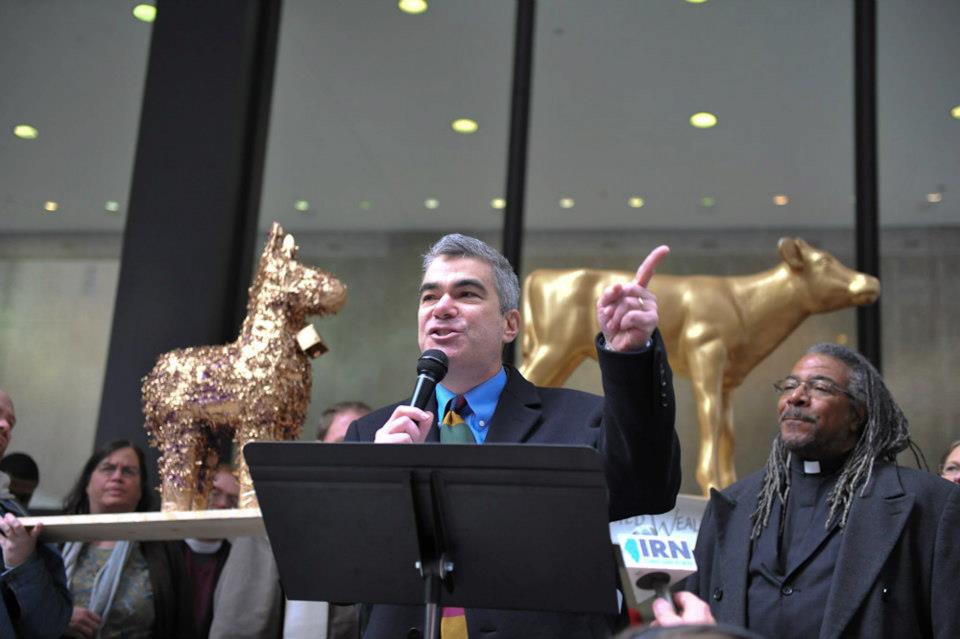
Had the honor this morning to participate in an interfaith ceremony at Chicago’s Daley Plaza that called on Illinois Senator Dick Durbin to resist devastating cuts to Federal programs in the upcoming “fiscal cliff” budget talks.  It was quite a dramatic and inspiring gathering, organized by IIRON, Make Wall Street Street Pay – Illinois and other local organizing initiatives. Over 40 members of the Chicago clergy community marched to Daley Plaza, where we encountered two Golden Calves symbolizing the idolatrous motivations behind Wall St. greed and wealth disparity. After hearing from several speakers, one of the calves (a piñata, as it turned out) was smashed open, gold coins scattering in every direction.

We didn’t focus on Dick Durbin simply because he happens to our senator.  As the Majority Whip for the Democratic Party, Durbin is one of the most important players in Washington, officially charged with leading the Democrats who control the Senate. And thus far, there is ample reason for concern that his leadership bodes ill for the more vulnerable members of our society.

Since Congress has kicked the budgetary can down the road, critical social programs in this country stand to lose $600 billion dollars on January 1 unless they choose to act. Durbin has already indicated that he favors a “grand bargain” with Republicans that may entail cuts to Social Security, Medicare and/or Medicaid. Just as ominously, Durbin has still not signed an open letter written by Congressmen Harry Reid and Bernie Sanders (and signed by 29 senators) calling on the members of Congress not to cut Social Security.

For our part, the interfaith community of Chicago has written a letter – to Senator Durbin:

Dear Senator Durbin:

Our message to you comes from Deuteronomy 30:15-19 & Joshua 24:15 as we ask you “to choose this day whom you will serve…!” We urge you to choose life and to reject “Simpson-Bowles” or any other “grand bargain” that cuts vital services to vulnerable Americans. We urge you to make absolutely to make absolutely no cuts to Social Security, Medicare or Medicaid.

Working Americans did not create this economic crisis or this false and manufactured “fiscal crisis”. Wall Street’s speculative bubble, made possible by Congressional deregulation crashed the global economy. As a result, the American people have suffered unemployment, underemployment, foreclosure, homelessness, and have lost their savings, retirements and wealth. Congress used working people’s taxes to bail out Wall Street banks instead of assisting underwater homeowners, creating jobs or rescuing state and local governments. The people have suffered enough. Doing further harm to working people is morally unconscionable.

It is immoral to make any further cuts to vital federal programs and services when wealthy individuals and big corporations are not paying their fair share to care for the broader community of whom they are part and on whom they rely. In this time of unparalleled income inequality and concentrated wealth, we will not accept any solution to the federal budget deficit other than raising revenue from those who have not done their share and can easily afford to do much more.

The kinds of cuts being discussed under Simpson-Bowles and other “deals” will literally result in sickness and death for many and will fall upon the poor and vulnerable in order to provide for the excess for the wealthy.  Senator Durbin, you now face a choice between serving the false gods of greed and excessive wealth or implementing policies that promote life and shared prosperity. It is important that as a key leader in the Senate you stand firmly on the side of those who stand to lose so much.  Therefore we bring to you four demands:

– Block any reductions in benefits for Social Security, Medicare, or Medicaid

– Block any extension of the Bush Tax Cuts for people with taxable income above $250,000 per year

– Block the “sequestration” cuts to domestic programs set to occur in January 2013

– Support progressive sources of taxes including a robust estate tax, taxing capital gains at a rate equal or higher to wages and pass a strong Financial Transaction Tax (aka the Robin Hood Tax)


To Chicago residents: A myriad of local organizing initiatives is holding a rally on Friday, November 9 in Pritzker Park (State and Van Buren) at 3:00 pm. Together we will tell our elected officials: “We Won’t Pay for Your Crisis!” and demand that the wealthy and big corporations must “Pay Their Fair Share”.

Calling Israel’s Discrimination What it Is

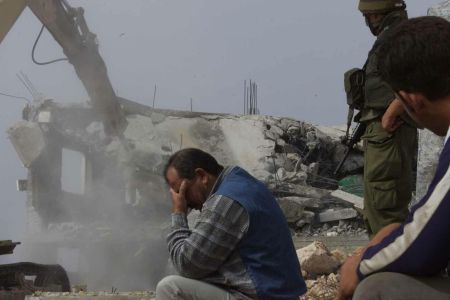
The H-2 section of Hevron, where Palestinians must walk on separate sidewalks from Jews.

Cross-posted with the Jewish Daily Forward “Forward Thinking” Blog:

Forward columnist Philologos recently took the Israeli daily Ha’aretz to task for using the term “apartheid” in its reporting on a poll that showed most Israelis support discrimination against Arab citizens. “Apartheid” and mere discrimination are two very different things, Philologos claimed. He suggested that Ha’aretz should be censured for using such a damning epithet.

Philologos went on to define what he sees the critical difference between “apartheid” and “discrimination.” The former refers to “the systematic segregation of one people, race or group from another,” while the latter means “the systematic favoring of one people, race or group over another, such as exists in numerous countries around the world today.” And while Israel may practice regrettable discrimination against its Arab citizens, he claimed it was a “lie” to suggest that it is in any way an apartheid state.

While Philologos may be a fine linguist, his knowledge of international human rights law is sorely lacking.

Contrary to Philologos’ characterization, the term “apartheid” does not refer simply to segregation, although the term comes from a word in the South African Afrikaans language that means separate-ness or segregation. In legal terms, apartheid applies to a wide range of acts in which a dominant racial regime commits institutionalized oppression against another ethnic group.

According to the 1998 Rome Statute of the International Criminal Court, for instance, the “crime of apartheid” was included in a list of “crimes against humanity,” and defined as:

(Inhuman) acts…committed in the content of an institutionalized regime of systematic oppression and domination by one racial group over any other racial group and committed with the intention of maintaining that regime.

Earlier, in 1973, the UN’s General Assembly adopted the International Convention on the Suppression and Punishment of the Crime of Apartheid. Among the “inhuman acts” listed were:

(Any) legislative measures and other measures calculated to prevent a racial group or groups from participation in the political, social, economic and cultural life of a country.

There is certainly a compelling claim to be made that the term “apartheid” may appropriately be applied to Israel’s treatment of its Palestinian citizens. In a recent report, Adalah, an Israeli legal NGO, described no fewer than 30 laws, either enacted or proposed, that create different sets of legal rights for Jewish and non-Jewish (i.e. Palestinian) citizens of Israel.

While many Jews prefer to view Israel as an essentially healthy, if flawed, democracy, those willing to face the painful truth have long known that the so-called “democratic Jewish state” would more accurately be described as a democracy for Jews but not for non-Jews. Consider the following facts:

– Israel has no constitution that guarantees individual liberties for all. Palestinian citizens’ homes and land are regularly seized or demolished to give housing to Jews. B’tselem, an Israeli human rights organization, recently reported that the citizenship of increasing numbers of East Jerusalem residents are being revoked to make way for more land appropriation.

– There are separate schools for Palestinians and Jews. In Israeli universities, no courses are offered in Arabic, even Arabic literature. Use of Arabic in road signs is banned except in towns that the government deems Arab.

– While Jewish citizens of Israel can confer citizenship on new spouses who are not already Israeli citizens, Palestinian citizens cannot. According to the law, a Palestinian citizen of Israel who marries a Palestinian resident of the West Bank or Gaza may not reside inside Israel. The ruling literally affects the lives of thousands of couples and their precious right to marry if they so choose. In upholding this law, one Israeli Supreme Court judge conceded that Palestinian rights take a back seat to maintaining a Jewish majority in Israel. “Human rights are not a prescription for national suicide,” he wrote.

– Palestinian citizens of Israel have distinguishing characteristics on their ID cards, presumably so they can be easily identified for additional scrutiny by law enforcement agencies. Palestinians are regularly harassed, searched and asked to produce identification, based entirely on their race. While Jewish citizens are legally entitled to a speedy trial, fair legal representation and clear charges, these laws do not apply to Palestinian citizens.

There are many more examples of ways that Israel systematically privileges Jewish citizens over non-Jewish citizens. Organizations such as Adalah, B’tselem and the Association for Civil Rights in Israel have extensively documented these methods.

It is important to note that these are not simply a collection of random discriminatory laws, as Philologos would have it. Taken together, they constitute a systematic, institutional “legal” system that maintains Jews’ privileged status in the Jewish state and, most critically, seeks to ensure a Jewish demographic majority within Israel’s borders at all costs.

One telling case in point: back in 2005, Shimon Peres told U.S. officials (in a statement recently revealed by Wikileaks) that Israel had “lost” land in the Negev “to the Bedouin” and would need to take steps to “relieve” the “demographic threat”.

Flash forward to January 2012: the Israeli government approves the Prawer Plan for mass expulsion of the Arab Bedouin community in the Negev desert. When fully implemented, this plan will result in the forced displacement of up to seventy thousand Arab Bedouin citizens of Israel and the destruction of thirty-five “unrecognized” villages.

At the end of the day, it really is academic whether we choose to label this kind of policy — and many others like it — to be “discrimination,” “institutional racism” or “apartheid.”

The real question before us not what to call it. For Jews who purport to cherish human rights, the right question is: what are we willing to do about it?

Guest Post By Rabbi Brian Walt: We are Building Up a New World

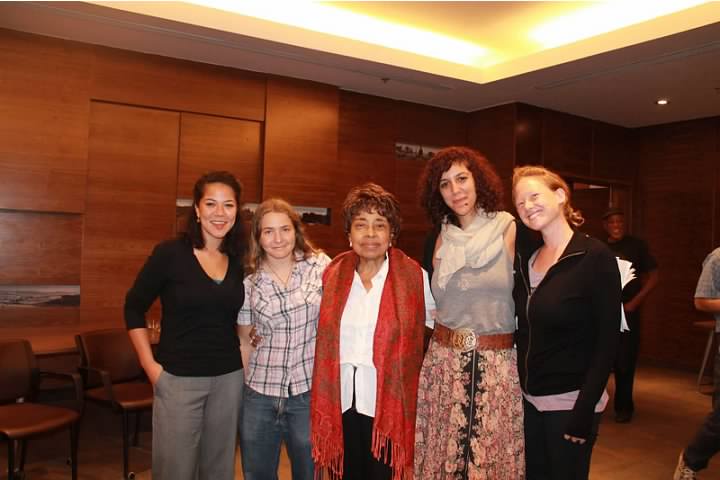
Dorothy Cotton (middle) with Israeli and Palestinian Activists (Photo: Rev. Osagyefo Sekou)

Cross-posted with Rabbi Brian’s Blog

We are building up a new world, we are building up a new world,
We are building up a new world, builders must be strong.
Courage brothers don’t be weary, courage sisters don’t be weary,
Courage people don’t be weary, though the road be long.

This is one of the many songs I sang as I led a remarkable delegation of US Civil Rights movement leaders, young human rights leaders, prominent Black academics and educators and several Jewish activists that traveled through the West Bank two weeks ago.

Our delegation was a project of the Dorothy Cotton Institute, an organization dedicated to human rights education and to building a global human rights community. Dorothy Cotton served as the Director of Education of the Southern Christian Leadership Conference (SCLC) and was the only woman on the executive staff.  She led the Citizenship Education Program that empowered the disenfranchised to exercise their rights as citizens.

The goals of this historic delegation were:

– to create and build an ongoing relationship between leaders of the US civil rights movement and the leaders of the growing Palestinian nonviolent resistance movement on the West Bank and their Israeli allies;

– to increase the visibility of this movement in the US and internationally;

– to learn from one another about nonviolence, effective solidarity and social transformation;

– and to educate Americans about the role the United States plays in supporting the status quo on the West Bank.

Our delegation spent two weeks on the West Bank.  We visited three Palestinian villages – Budrus, Bilin, Nabi Saleh – that have engaged for many years in a popular nonviolent struggle to reclaim land expropriated by the Israeli military.  We met several young Palestinians who are building the Coalition for Dignity, a grassroots, youth – led nonviolent movement.

And we met Israeli allies who stand in solidarity with the Palestinian nonviolent movement and who work in their own society to end militarism and human rights violations against Palestinians.  We learned from many Israeli and Palestinian nonviolent activists about their work, their vision and their dreams.

In short, our delegation saw and learned about realities that the overwhelming number of visitors to Israel never see or hear.

Singing was an essential part of the spiritual and political life of our trip.  Dorothy has a beautiful spirit, a powerful voice, and loves to sing.  Throughout the delegation, she always reminded us that singing was a critical tool for energizing the civil rights movement.  She told me,

We had songs for different occasions. We sang at mass meetings, and we sang at funerals … We sang, “I am going to do what the Spirit says do” and our singing inspired us to do just that.

And so our new civil rights delegation sang as we traveled through the West Bank.  Singing was just one powerful way in which our delegation made a connection between the Black-led struggle for civil rights in the US and the Palestinian struggle for justice, peace and security for all.

This, for instance, is the song we sang at the grave of a young man in Budrus who was killed in a nonviolent demonstration to protest the confiscation of his village’s land:

Come By here my Lord, come by here.
For our brother, my Lord, come by here.
For his courage my Lord, come by here.

Standing around the grave, delegates spontaneously composed the lyrics. It felt like we were praying, acknowledging the courage and the profound cost that the struggle for freedom demands.

We sang before we joined the weekly nonviolent demonstration in Nabi Saleh, another village on the West Bank fighting to reclaim their land.   The residents of the village had made special signs composed of quotations from Dr. Martin Luther King in honor of our visit.  “Injustice anywhere is a threat to justice everywhere” read one of the signs.

And we sang:

Ain’t going to let nobody turn me around, turn me around, turn me around.
Keep on walking, keep on talking, marching down to freedom land.

We sang to express our appreciation and to provide support after hearing activists tell us their stories – Palestinians and Israelis who told us of their amazing work and the toll it has taken on their lives, and sometimes even their spirits and souls.  One such occasion was after Israeli activist Gabi Laski told us of her work to defend children from villages like Nabi Saleh who are arrested at night.

We’re going to keep on marching forward, keep on marching forward, keep on marching forward, never turning back, never turning back.

We sang after standing next to the thirty foot high Separation Wall in Jerusalem dividing a Palestinian neighborhood in two.  And we sang on the bus as we went through a checkpoint on our way to the airport at the end of our trip, encouraged by our Palestinian guide to keep singing even when the soldier boarded our bus.  (Our bus was pulled aside for a security check because it was a Palestinian bus while Israeli buses and motorists were waved through the checkpoint).

We returned to the United States both inspired and disturbed by our experience.  We were inspired by the determination, vision and commitment of so many Palestinians and their Israeli allies, working tirelessly day after day, year after year, often at great personal and communal cost, for justice, freedom and equality for all.  Now that we are home, we look forward to sharing the stories and vision of these courageous civil rights activists with our friends and communities.

But our trip was not simply inspiring.  It was profoundly disturbing to witness the harsh realities of life on the West Bank that are so invisible to the discourse in America.  Every day we saw and heard about a systematic denial of human rights in countless ways: land confiscation, extensive restrictions on movement, humiliation at check points, home demolition, the arrest of children, the revocation of residency permits and many other violations.

The delegates were profoundly shocked. Several American civil rights veterans  commented that the discrimination, humiliation and injustice they witnessed was “frighteningly familiar.”

While we were on the West Bank the two presidential candidates tried to outdo one another in their public declarations of support for Israel in the final presidential debate.  They mentioned Israel 31 times with only one passing reference to Palestinians.  The contrast between American policy and what we witnessed is stark.  Now that we have returned, we are determined to share this disturbing reality with our communities; to challenge the ways in which our country funds, provides diplomatic cover, and enables these injustices.

I have visited the West Bank before but never for more than a day or two, and almost always with progressive Israeli groups.  On this visit, however, we spent virtually all out time in the West Bank – on the other side of the Separation Wall.  For me personally, it was a transformative experience.  It was a privilege to travel with such a special group of people and to see the profound impact of our delegation on the activists that we met.

Before we left on our journey, I was struck by a comment made by Dr. Vincent Harding, a close associate of Dr. Martin Luther King, a person with a long history of involvement in the struggle for freedom and a very close life-long connection to Jewish teachers, fellow travelers and co-workers.  Dr. Harding talked about “encouragement” as one of his primary goals for the trip.  I was struck by the word and the simple power of his intention.  He wanted to meet activists on the West Bank and to “encourage” them.

And that is exactly what happened. The people we met commented how encouraged they felt by meeting people who had spent their entire lives fighting for freedom in the US.  Dr. Harding and others would repeatedly ask all our presenters to tell us about themselves, their families and what motivated them to do what they were doing.

He and others always shared how much he appreciated their work and how important it was for all of us and for our collective future.  After hearing an inspiring talk by Fadi Quran, one of the young leaders of the Palestinian nonviolent movement, Dr. Harding said, “Fadi, I want to tell you how proud I am and how grateful I am for you, and want to encourage you to keep on going.”

It felt like we were building a new world.  On the very first day of our trip, Dorothy Cotton sang and danced with three women activists, Israeli and Palestinian, who had spoken to us. It was a joy to see the profound gift she was giving them and that they were giving her in return. Those who had spent their lives building a new world in America were creating a relationship with those who were building a new world in Israel/Palestine.

Towards the end of the trip we realized that we were just beginning to build a new world in another way by creating a new possibility for the relationship between Jews and Blacks in our own country.   Historically, Israeli policy has been a source of tension between the African American and Jewish communities.  While many African Americans on the delegation have deep and positive connections to Jews, it is often difficult for Blacks and Jews to have honest conversations about Israel.

There were eight Jews on this delegation.  On this trip we joined together as a group of Blacks, Jews, Christians and people with varied faith commitments, united in our commitment to nonviolence and our dedication to justice, freedom and equality in Israel/Palestine, in our own country, and around the world.  We are renewing an alliance between Blacks and Jews, an alliance rooted in our shared values.

We are building up a new world, we are building up a new world.
We are building up a new world, builders must be strong.
Courage brothers don’t be weary, courage sisters don’t be weary,
Courage people don’t be weary, though the road be long.

Getting Political with Sandy

Lots of pundits are cautioning Obama and Romney against “playing politics” with the tragic aftermath of Hurricane Sandy. I disagree. I’d say if there was ever a time to play politics, now is it.

As far as I can tell, neither candidate has broken their “climate silence” in relation to Hurricane Sandy – that is, explicitly connect the dots and say in no uncertain terms that Hurricane Sandy was, as George Lakoff so accurately described it, systemically caused by global warming:

Global warming systemically caused the huge and ferocious Hurricane Sandy. And consequently, it systemically caused all the loss of life, material damage, and economic loss of Hurricane Sandy. Global warming heated the water of the Gulf and Mexico and the Atlantic Ocean, resulting in greatly increased energy and water vapor in the air above the water.  When that happens, extremely energetic and wet storms occur more frequently and ferociously. These systemic effects of global warming came together to produce the ferocity and magnitude of Hurricane Sandy.

The precise details of Hurricane Sandy cannot be predicted in advance, any more than when, or whether, a smoker develops lung cancer, or sex without contraception yields an unwanted pregnancy, or a drunk driver has an accident.  But systemic causation is nonetheless causal.

If we do believe that, in the wake of this devastation we must redouble our efforts to prevent future tragedies such as this from occurring, then the most important thing we can do is to play politics. And the first step is to break climate silence. Even if our leaders are unwilling, it is time for us to speak up and face down the deniers.

Please watch and share the clip above to everyone you know. Then help those who are advocating in no uncertain terms for public policies that will curb carbon emissions and promote alternative energies worldwide.

Rabbi Brian Walt: Christian Leaders Cannot be Cowed into Silence

Please read my friend Rabbi Brian Walt’s new piece in Ha’aretz. He has recently returned from a remarkable interfaith delegation to the West Bank; I will be posting more of his writings about his experiences in the near future.

In his recent Haaretz op-ed, “Heading toward an irreparable rift between U.S. Jews and Protestants,” my colleague, Rabbi Eric Yoffie, sharply criticized the recent letter to Congress by leaders of Protestant churches that called for U.S. military aid to Israel to be contingent on Israeli compliance with American law. Nowhere in his article, however, did Yoffie mention the central concern of the Christian leaders’ letter: the overwhelming evidence of systematic human rights violations by the Israeli military against Palestinians.

Over the past two weeks, I had the privilege of leading an interfaith delegation including several leaders of the civil rights movement, younger civil and human rights leaders, Christian clergy, academics, and several Jews, on a two-week trip to the West Bank.

We were all shocked by the widespread human rights violations that we saw with our own eyes and that we heard about from both Palestinians and Israelis. Several black members of our group, including those who participated actively in the civil rights movement, remarked that what they saw on the West Bank was “frighteningly familiar” to their own experience, a systemic pattern of discrimination that privileged one group (in this case, Jews) and denigrated another (Palestinians).

Continue reading

American Christians Dare to Speak Their Conscience on Israel/Palestine

My recent op-ed for the Jewish Telegraphic Agency:

CHICAGO (JTA) — There has long been an unwritten covenant between the Jewish establishment and Christian leaders when it comes to interfaith dialogue: “We can talk about any religious issues we like, but criticism of Israel’s human rights violations is off limits.”

Over the past few weeks, we’ve painfully witnessed what can happen when Christians break this covenant by speaking their religious conscience.

Continue reading

More Fallout from the Protestant Leaders’ Letter on Aid to Israel

Two spot on responses to the recent NY Times article, “Church Appeal on Israel Angers Jewish Groups:”

The first comes from the Daily Beast’s Andrew Sullivan:

It seems to me that aid of all kinds should have basic human rights strings attached to it. I would have suspended all aid to Israel when it refused to stop its settlement policy on the West Bank, but that’s a little like being in favor of an immediate space station on Mars, given the Greater Israel lobby’s grip on Congress.

So let me just reiterate something that has no chance of ever happening, but I might as well put on the record: we should treat Israel as any other recipient of US aid. If a country is occupying and settling land conquered through war, if it’s treating a minority population with inhumanity, the US should stand up for Western values. It should not single Israel out; but we have to stop treating Israel as the exception to every other US foreign policy rule.

Rev. Jim C. Wall (Contributing Editor of the “Christian Century”) in an unflinchingly honest blog post:

To begin with, the 15 church leaders are heavyweights, top officials for their denominations. They include the leaders of the Presbyterian Church (U.S.A.), Evangelical Lutheran Church in America, the United Methodist Church, the National Council of Churches, the United Church of Christ, the Christian Church (Disciples of Christ), the American Friends Service Committee (a Quaker agency) and the Mennonite Central Committee. Two Catholic leaders also signed, not including the Catholic Council of Bishops.

These are not just leaders of a few religious groups, which a Protestant version of the Jewish Council of Public Affairs could corral into an interfaith dialogue meeting. These are the major-domos of American Protestantism, which raises the question of what exactly gives the JCPA and its scattered letter signers, these “outraged Jewish groups” as the Times calls them,  the right to claim religious standing in this conversation. Many of these Jewish groups are secular and function as part of the Israel Lobby, a collection of lobbying organizations that have Israel, not Judaism as their primary client…

The JCPA and its letter signers have no dogs in this hunt. They can be as outraged as they want.  This is still a free country. But the 15 church leaders have made the right religious, not political, move. They are speaking the language of “moral responsibility” in a letter directed to the U.S. Congress on the matter of U.S. funds used by Israel to violate the human rights of the Palestinian people.

Interfaith dialogue has always been nothing more than a device used by American Jewish groups to intimidate the American churches into keeping the ecumenical deal. By this intimidation, these groups have followed the example set by the government of Israel which has long used the so-called “peace process” to sustain its occupation and expand its borders, always to the detriment of the Palestinian people.

It is the right time for the leaders of the American churches to make their moral demand to the Congress. With their letter, they have done so, courageously, considering the political climate of our time. Interfaith dialogue can wait.

As things stand now, the Jewish groups have called for a “summit” for the top leaders of Christian churches to “discuss” the situation with them – and they are reportedly considering it. I hope the Christian leaders will stand firm.  It is not the role of these Jewish organizations to dictate how Christian religious leaders can live out their conscience or their values. These Jewish leaders have chosen to walk away from the table – they are in no position to demand the terms by which “dialogue” may resume.

We can only hope this sad turn of events will lead to a more honest interfaith conversation about Israel-Palestine – one based on honesty, respect and justice rather than emotional blackmail.

Rabbis Endorsing Candidiates: Advocacy for the Sake of Heaven?

Recently read an interesting blog post by Rabbi Rachel Gurevitz of Congregation B’nai Shalom (Reform), in Westborough, MA, in which she expresses her disapproval of clergy who endorse candidates for public office.

Exhibit A: “Rabbis for Obama:”

Over 600 rabbis, from across the Jewish denominations, have signed their names – as individuals – to ‘Rabbis for Obama’ … I will tell you now, my name is not on that list.  And, while I see that many of my colleagues who I deeply respect as rabbis, have chosen to add themselves to the list, I am not at all comfortable with it.  I see little difference between adding one’s name to a publicly available list of this kind, and endorsing a candidate from the pulpit.  And, while I am no constitutional scholar, and am willing to accept the possibility that individual religious leaders may have a constitutional right to something, that doesn’t mean that, as responsible religious leaders and teachers, we should necessarily exercise that right.

I’m not a constitutional scholar either, but I’m fairly certain clergy don’t endanger their 501 c3 status as long as they make it clear in their endorsements that they are speaking as individuals and not on behalf of their congregations. But be that as it may, Gurevitz’s real issue with such endorsements is less legal than philosophical:

 Each individual candidate and the parties they represent, hold diverse views on a very wide array of subjects.  It is simply not true – it cannot be – that one side is ‘right’ and the other side is ‘wrong’.  This is the case whether we are speaking in terms of ethics and morals, or whether we are speaking about issues of social equity and justice.  Our political arena has become polarized enough already.  We do absolutely no service to this country, to the well-being of our society, or to the legitimacy and value of the religious traditions we serve and represent when we add to that polarization by picking sides.

Rather exacerbate our national polarization, Gurevitz suggests, rabbis should take their cue from Jewish/Talmudic tradition, which values diversity of opinion and debates “for the sake of heaven” – and not, as she puts it, “debates for the sake of winning.”

While I appreciate Rabbi Gurevitz’s desire to mitigate the polarizing discourse in American political culture, I don’t think it’s quite fair of her to assert that rabbinical endorsements automatically translate into (as she puts it), “I’m right and you are wrong, therefore we are good and you are evil, therefore we speak in God’s name and you don’t.”

This is certainly not the message – in content or tone – set by the Rabbis for Obama website, which merely contains a list of rabbis, various links, along with this fairly mild statement:

This group of over 613 rabbis … from across the country and across all Jewish denominations recognize that the President has been and will continue to be an advocate and ally on issues important to the American Jewish community. That is why they are committed to re-electing President Obama and actively doing their part to move our country forward.

That’s a pretty far cry from “We speak in God’s name and you don’t.”

In truth, when I think of rabbis who have publicly endorsed candidates over the years, I’m hard pressed to find many who have done so in an overly polarizing or patronizing manner.  In this regard, I still remember well the words of the venerable Reform Rabbi Arnold Jacob Wolf, whose last major public statement was an article for the Jewish Week entitled “My Neighbor Barack”  – in which he voiced his support for Obama during the 2008 campaign. (His article was particularly meaningful because it was published during a period in which Obama was under withering attack from certain neo-conservative quarters of the Jewish community.)

On a deeper level, however, I think Gurevitz fundamentally misreads the legacy of rabbinic debate “for the sake of heaven.”  While the rabbinic discussions of Talmud do indeed provide a graphic representation of this legacy, I would suggest that our job as rabbis is not to emulate a page of Talmud, but to engage in the debate itself.

There is no question that the issues discussed during election cycles are of profound significance for our national community.  None of us can afford to stand aloof from these issues – least of all rabbis. Indeed, by advocating for candidates who support the policies we believe will best serve the common good, we advocate for the sacred values we purport to cherish as religious leaders.  If we preach about social issues from the pulpit, why should it be inappropriate for us to endorse the candidates who are directly responsible for enacting the policies related to these issues?

I certainly agree with Gurevitz when she exhorts clergy to must speak out against “the polarizing and vindictive narrative of political debate when we see and hear it.” But I’m not at all convinced we must stand on the sidelines during election season in order to do so.

Rabbinical Support for the End of Unconditional Military Aid to Israel

Cross-posted with The Palestinian Talmud:

The undersigned members of the Jewish Voice for Peace Rabbinical Council stand with our American Christian colleagues in their recent call to “make U.S. military aid to Israel contingent upon its government’s compliance with applicable US laws and policies.”

We are as troubled as our Christian colleagues by the human rights violations Israel commits against Palestinian civilians, many of which involve the misuse of US – supplied weapons. It is altogether appropriate – and in fact essential – for Congress to ensure that Israel is not in violation of any US laws or policies that regulate the use of US supplied weapons.

The US Foreign Assistance Act and the US Arms Export Control Act specifically prohibit assistance to any country which engages in a consistent pattern of human rights violations and limit the use of US weapons to “internal security” or “legitimate self-defense.”  The Christian leaders’ letter points out, in fact, that the most recent 2011 State Department Country Report on Human Rights Practices covering Israel and the Occupied Territories detailed widespread Israeli human rights violations committed against Palestinian civilians, many of which involve the misuse of US – supplied weapons such as tear gas.

It is certainly not unreasonable to insist that foreign assistance be contingent on compliance with US laws and policies. Mideast analyst MJ Rosenberg has rightly pointed out that during this current economic downturn, Congress has been scrutinizing all domestic assistance programs -– including Social Security and food stamps –- to ensure that they are being carried out legally in compliance with stated US policy.  Why should US military aid to Israel be exempt from the same kind of scrutiny?

While some might feel that requiring assistance to be contingent with compliance would compromise Israel’s security, we believe the exactly the opposite is true. As Israel’s primary ally, the US alone is in a place to create the kind of leverage that might challenge Israel to turn away from policies that impede the cause of a just peace for Israelis and Palestinians –- and true security for all who live in the region.

As Jews we acknowledge that the signers of the letter, and the churches they represent, have ancient and continuing ties to the land of Israel just as we do, and that their concerns for the safety and dignity of Christians in Israel and in the occupied Palestinian territories is as compelling as our concern for the safety and dignity of Jews there.

We are troubled that several Jewish organizations have cynically attacked this faithful and sensitive call – and we are deeply dismayed that the Anti-Defamation League has gone so far as to pull out of a scheduled Jewish-Christian dialogue in protest.  We believe that actions such as these run directly counter to the spirit and mission of interfaith dialogue. True dialogue occurs not simply on the areas where both parties find agreement, but in precisely those places where there is disagreement and divergence of opinion. We call on all of our Jewish colleagues to remain at the table and engage our Christian colleagues on this painful issue that is of such deep concern to both our communities.

We express our full support for the spirit and content of this statement and likewise call upon US citizens to urge their representatives to end unconditional military aid to Israel.

Signed (list in formation):

Rabbi Brant Rosen
Rabbi Margaret Holub
Rabbi Alissa Wise
Rabbi Elizabeth Bolton
Rabbi Lynn Gottleib
Rabbi Brian Walt
Rabbi Julie Greenberg
Rabbi David Mivasair
Rabbi Joseph Berman
Cantor Michael Davis
Rabbi Shai Gluskin
Rabbi Tirzah Firestone
Jessica Rosenberg, Rabbinical Student
Ari Lev Fornari, Rabbinical Student